

Mailchimp Plus Purple: Marketing por E-mail Automatizado a partir de Cadastros WiFi
Este guia detalhado explica como integrar a plataforma de Guest WiFi da Purple com o Mailchimp para automatizar o marketing por e-mail a partir de cadastros WiFi. Ele aborda a configuração arquitetônica, estratégias de marcação de segmentação e a implementação de jornadas de boas-vindas automatizadas para converter o fluxo de pessoas no local em públicos digitais engajados.
🎧 Ouça este Guia
Ver Transcrição

Resumo Executivo
Para operadores empresariais que gerenciam locais com grande fluxo de pessoas, o Guest WiFi é fundamentalmente um canal de aquisição de dados. Toda vez que um usuário se conecta à rede de um local por meio de um Captive Portal, ele fornece consentimento explícito e dados de contato. A integração entre Purple e Mailchimp transforma essa coleta passiva de dados em um motor de receita ativo. Ao estabelecer uma conexão direta de API, os operadores de locais podem automaticamente direcionar cadastros compatíveis com GDPR para públicos segmentados do Mailchimp, aplicar tags de segmentação comportamental e acionar automações de boas-vindas em tempo real. Este guia fornece a arquitetura técnica e as estruturas de implantação estratégica necessárias para construir um pipeline de marketing por e-mail automatizado a partir da sua infraestrutura de Guest WiFi .
Análise Técnica Aprofundada
A Arquitetura da Sincronização
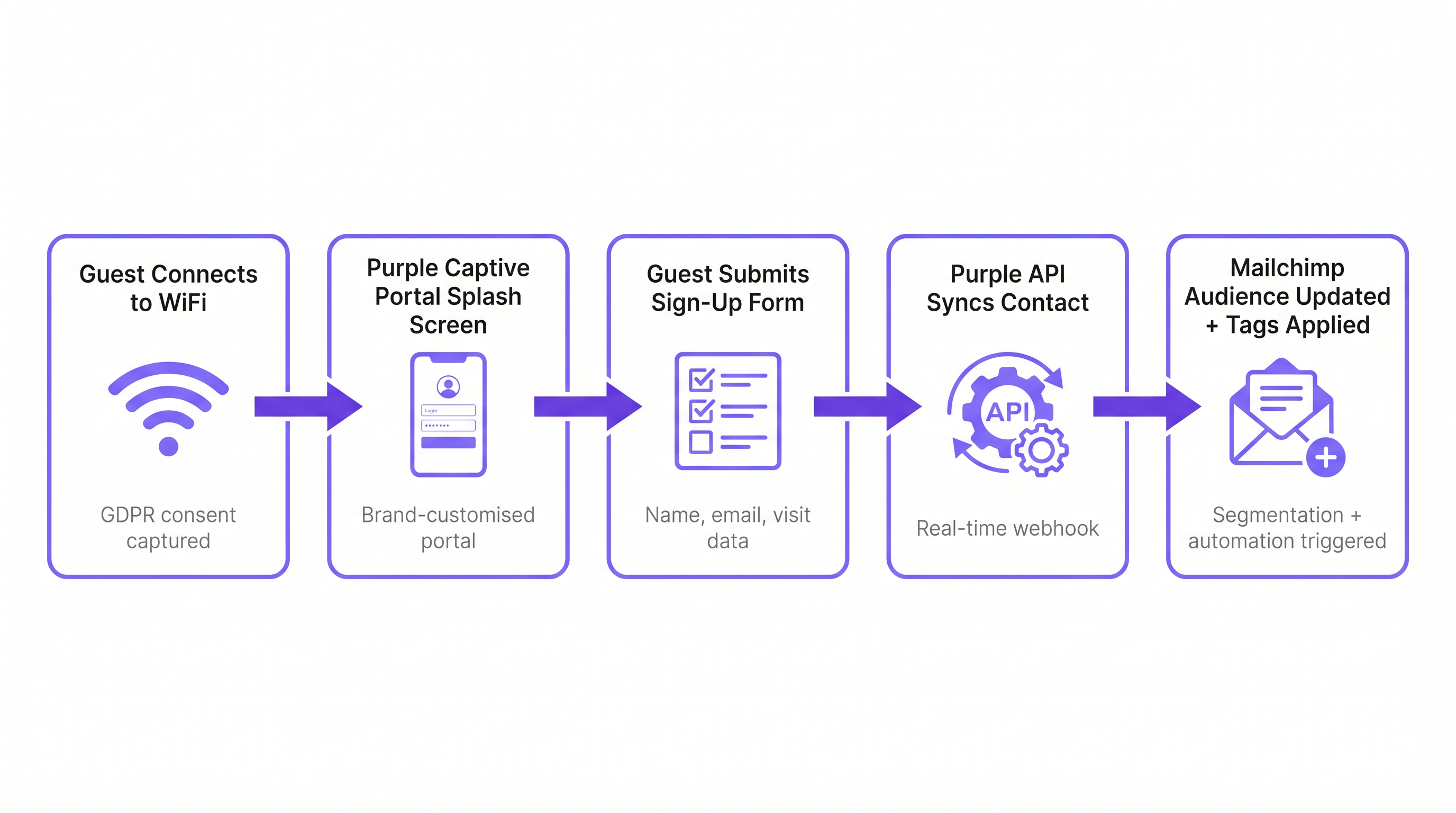
A integração depende de uma arquitetura de webhook em tempo real entre o ambiente de nuvem da Purple e a API do Mailchimp. Quando um convidado se autentica com sucesso através do Captive Portal da Purple, a plataforma captura os dados do formulário enviado juntamente com metadados sobre o evento de conexão (ID do local, endereço MAC, carimbo de data/hora).
Se o convidado fornecer consentimento explícito para marketing, a Purple aciona imediatamente uma chamada de API autenticada por OAuth para o Mailchimp. Esta chamada executa uma operação de 'upsert': se o endereço de e-mail não existir no Público designado do Mailchimp, um novo contato é criado. Se o contato já existir, seu perfil é atualizado e novas tags são anexadas sem sobrescrever os dados existentes. Isso garante que um convidado que visita várias propriedades dentro de um empreendimento mantenha um perfil único e unificado, refletindo seu histórico completo de visitas.
Conformidade e o Portal de Consentimento
A base de qualquer estratégia de marketing por e-mail é a conformidade. De acordo com o Artigo 6 do GDPR, as organizações devem estabelecer uma base legal para o processamento de dados pessoais. O Captive Portal da Purple atua como o portal de consentimento. É fundamental que a opção de marketing seja desvinculada dos termos gerais de serviço. Um usuário deve ser capaz de acessar o WiFi sem se inscrever em comunicações de marketing. A integração respeita esse limite; apenas os contatos que marcam explicitamente a caixa de opt-in de marketing são sincronizados com o Mailchimp. Essa estrita adesão aos protocolos de conformidade mitiga riscos e garante que o público resultante seja altamente engajado.
Guia de Implementação
Passo 1: Estabelecer a Taxonomia de Marcação
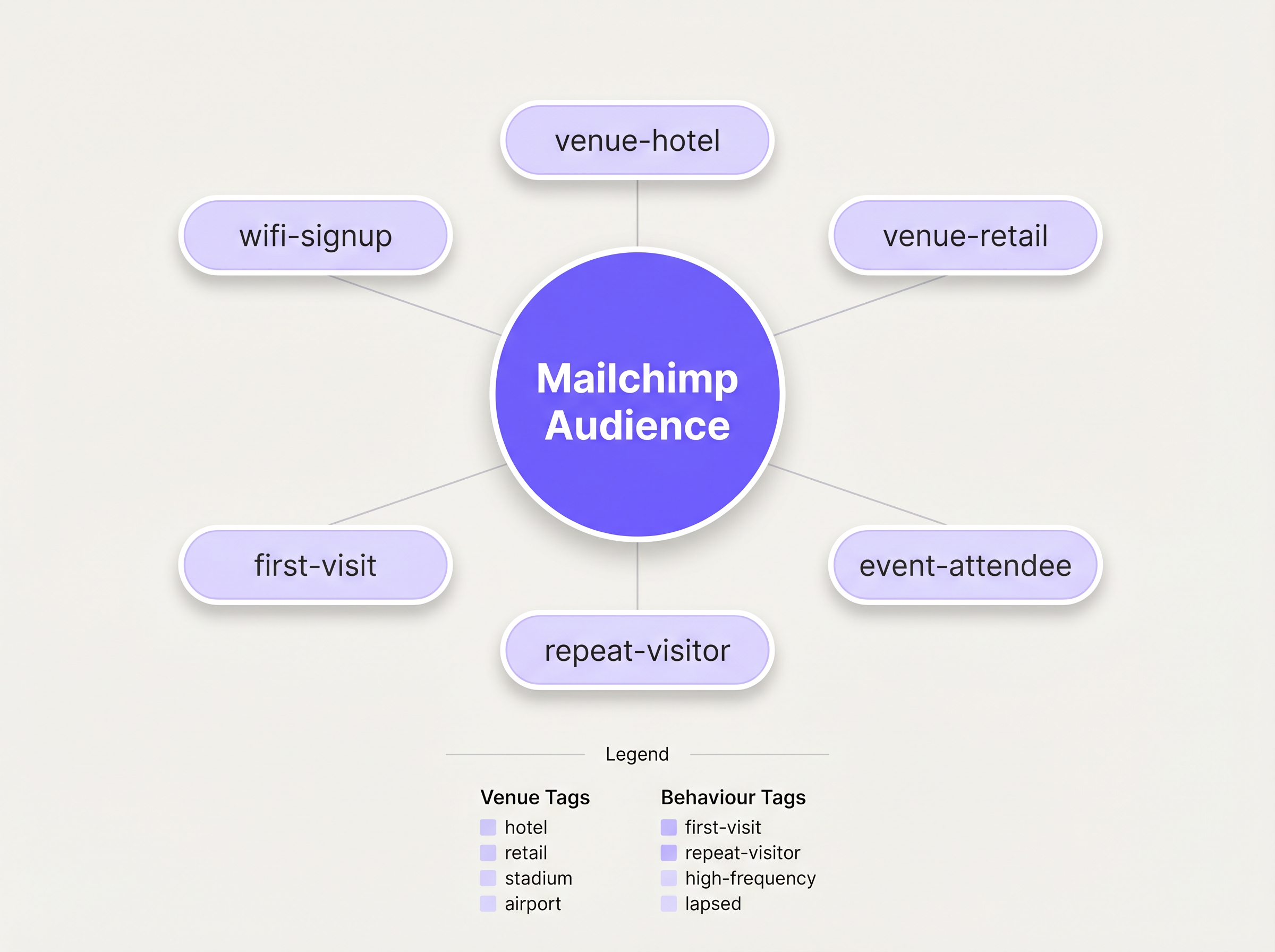
Antes de habilitar a sincronização, você deve definir uma taxonomia de marcação estruturada. Uma lista plana de contatos é praticamente inútil para marketing direcionado. A melhor prática dita uma abordagem de marcação multidimensional:
- Marcação de Origem: Identifique o canal de aquisição (por exemplo,
wifi-signup). - Marcação de Local: Identifique o local específico ou tipo de propriedade (por exemplo,
venue-hotel,location-london). - Marcação Comportamental: Identifique a natureza da visita, frequentemente aproveitando as capacidades de WiFi Analytics da Purple (por exemplo,
first-visit,repeat-visitor).
Passo 2: Configurar a Integração
A configuração é gerenciada dentro do painel da Purple. Navegue até as configurações do local e selecione a integração com o Mailchimp. Você será solicitado a autenticar via OAuth. Uma vez conectado, mapeie o local específico da Purple para o Público-alvo do Mailchimp. Aplique as tags pré-definidas nas configurações. Para implantações complexas que exigem roteamento para múltiplas plataformas, considere aproveitar o conector Zapier, conforme detalhado em nosso guia sobre Conectando Eventos WiFi a Mais de 1.500 Aplicativos com Zapier e Purple .
Passo 3: Construir a Automação de Boas-Vindas
A atividade de maior ROI neste fluxo de trabalho é o e-mail de boas-vindas imediato. No Mailchimp, construa uma Jornada do Cliente acionada pela adição da tag wifi-signup. O e-mail inicial deve ser enviado imediatamente, aproveitando a presença física do convidado no local. Para locais de Hospitalidade , isso pode incluir um desconto em refeições; para ambientes de Varejo , um código promocional por tempo limitado.
Melhores Práticas
A Regra dos 15 Minutos
A relevância contextual de um e-mail de boas-vindas decai rapidamente. Garanta que a automação inicial esteja configurada para ser acionada sem demora. Uma mensagem recebida enquanto o convidado ainda está no local alcança taxas de engajamento significativamente maiores do que uma recebida 24 horas depois.
Criação de Perfil Progressiva
Evite sobrecarregar o formulário inicial do Captive Portal. Solicite apenas os dados essenciais: Nome e E-mail. Uma vez que o contato esteja no Mailchimp, use campanhas de e-mail subsequentes para criar um perfil progressivo do usuário, solicitando preferências adicionais ou informações demográficas para enriquecer o perfil ao longo do tempo.
Aproveitar a Análise para Reengajamento
Integre insights do WiFi Analytics da Purple para identificar visitantes inativos. Se um visitante anteriormente frequente não se autenticou na rede por 90 dias, acione uma campanha de reengajamento específica no Mailchimp oferecendo um incentivo para retornar.
Solução de Problemas e Mitigação de Riscos
O Problema do Público Único
Risco: Despejar todos os contatos de múltiplos locais em um único Público do Mailchimp sem marcação adequada, destruindo a capacidade de segmentar por localização. Mitigação: Imponha uma política rigorosa de marcação em nível de local antes que a integração seja ativada. Cada sincronização deve conter um identificador de localização.
O Conflito de Cancelamento de Inscrição
Risk: Um usuário cancela a inscrição via Mailchimp, mas se reconecta ao WiFi em uma visita subsequente. Purple tenta ressincronizar o contato. Mitigação: A API do Mailchimp lida com isso de forma elegante, rejeitando a sincronização para contatos que cancelaram a inscrição. Garanta que sua equipe de operações de TI compreenda este comportamento esperado e não sinalize essas rejeições como erros de sistema.
ROI e Impacto nos Negócios
A métrica principal para avaliar esta integração é o Custo de Aquisição de Assinantes (SAC) em comparação com os canais digitais tradicionais. As inscrições via WiFi geralmente representam um custo marginal de aquisição próximo de zero. As métricas secundárias incluem as taxas de abertura e cliques da série de boas-vindas automatizada, que consistentemente superam as campanhas de transmissão padrão devido à sua alta relevância contextual. Em última análise, o sucesso da integração é medido pela taxa de conversão dessas campanhas automatizadas que impulsionam visitas repetidas ou gastos no local.
Ouça o Briefing
Para um aprofundamento na arquitetura e nos erros comuns de implementação, ouça nosso briefing técnico de 10 minutos:
Termos-Chave e Definições
Captive Portal
A web page that a user is forced to view and interact with before access is granted to a public WiFi network.
This is the primary interface for capturing user data and marketing consent in the Purple ecosystem.
Webhook
An automated message sent from one application to another when a specific event occurs.
Purple uses webhooks to instantly transmit the guest's contact data to Mailchimp the moment they submit the sign-up form.
OAuth
An open standard for access delegation, commonly used as a way for Internet users to grant websites or applications access to their information on other websites but without giving them the passwords.
This is the secure authentication method used to connect the Purple platform to a Mailchimp account.
Upsert
A database operation that updates an existing record if a specified value already exists, or inserts a new record if the specified value doesn't exist.
When Purple syncs data, it performs an upsert on the email address, ensuring existing Mailchimp profiles are updated with new tags rather than duplicated.
Segmentation
The practice of dividing an email subscriber list into smaller groups based on specific criteria, such as location or behaviour.
Effective segmentation, driven by Purple's tagging, is essential for delivering relevant campaigns rather than generic broadcasts.
Customer Journey
Mailchimp's visual automation builder that allows marketers to create automated workflows based on specific triggers and conditions.
This tool is used to build the automated welcome emails triggered by the `wifi-signup` tag.
GDPR Article 6
The section of the General Data Protection Regulation that outlines the lawful bases for processing personal data.
Venue operators must ensure their captive portal splash screens explicitly capture consent for email marketing to comply with this regulation.
Subscriber Acquisition Cost (SAC)
The total cost associated with acquiring a new email subscriber.
Guest WiFi represents a highly efficient acquisition channel, significantly lowering the overall SAC compared to paid digital advertising.
Estudos de Caso
A 200-room hotel needs to differentiate between overnight guests and attendees of a day conference in their Mailchimp marketing.
The hotel configures two separate SSIDs or captive portal splash pages within Purple. The overnight guest portal applies the tags wifi-signup, venue-hotel, and guest-overnight. The conference portal applies the tags wifi-signup, venue-hotel, and guest-conference. In Mailchimp, two distinct Customer Journeys are created. The overnight journey triggers a welcome email highlighting room service and spa facilities. The conference journey triggers an email with the day's agenda and directions to the breakout rooms.
Análise de Cenário
Q1. A retail chain with 50 locations has successfully integrated Purple and Mailchimp. They want to send a targeted campaign only to customers who visited their flagship London store in the last 30 days. How should they structure this segment in Mailchimp?
💡 Dica:Consider both the location tag applied at sign-up and the dynamic data regarding recent activity.
Mostrar Abordagem Recomendada
They should create a segment in Mailchimp with two conditions: 1) Tag includes location-london-flagship AND 2) Campaign activity or date added is within the last 30 days. This relies on Purple having correctly applied the location-specific tag during the initial sync.
Q2. During user acceptance testing, an IT manager notices that a test user who previously unsubscribed from the Mailchimp list is not being re-added when they log back into the guest WiFi. Is this a bug in the integration?
💡 Dica:Review how Mailchimp handles unsubscribed contacts via API.
Mostrar Abordagem Recomendada
No, this is the expected and correct behaviour. Mailchimp's API actively prevents the re-subscription of contacts who have previously opted out, ensuring compliance. The Purple webhook fires, but Mailchimp rejects the upsert for that specific record.
Q3. A venue operator wants to use the Purple captive portal to collect a guest's date of birth for age-gated marketing. How is this data passed to Mailchimp?
💡 Dica:Look beyond standard tags to the advanced integration settings.
Mostrar Abordagem Recomendada
The operator must configure a custom field on the Purple splash screen for 'Date of Birth'. In the Purple integration settings, this custom field must be mapped to a corresponding 'Merge Field' (e.g., DOB) within the target Mailchimp Audience. This allows Mailchimp to store the data as a specific attribute rather than a generic tag.




