
Automatizar a Revogação de Certificados com OCSP e CRL num Ambiente NAC
Este guia de referência técnica fornece aos gestores de TI e arquitetos de rede uma análise detalhada da automatização da revogação de certificados num ambiente de Network Access Control (NAC). Explora as compensações arquiteturais entre OCSP e CRL, oferece orientação de implementação neutra em termos de fornecedor e descreve o impacto empresarial da aplicação de políticas em tempo real.
Ouça este guia
Ver transcrição do podcast
Parte da nossa série principal: Enterprise WiFi Security Guide →

Resumo Executivo
Para diretores de TI de grandes empresas e arquitetos de rede que gerem ambientes de alta densidade - como espaços de hospitality, redes de retail e implementações do setor público - a gestão do ciclo de vida dos certificados é uma fronteira de segurança crítica. Embora o IEEE 802.1X ofereça uma autenticação robusta para dispositivos corporativos e BYOD, o mecanismo para revogar a confiança é frequentemente negligenciado até que ocorra uma falha de segurança.
A automatização da revogação de certificados num ambiente de Network Access Control (NAC) através do Online Certificate Status Protocol (OCSP) e de Certificate Revocation Lists (CRL) preenche a lacuna entre a desativação de dispositivos finais e a aplicação de políticas de rede. Este guia explora os mecanismos arquitetónicos da revogação automatizada, comparando as capacidades em tempo real do OCSP com a resiliência offline das CRLs.
Ao integrar plataformas de Mobile Device Management (MDM), autoridades de certificação (CAs) e motores de políticas de NAC, as organizações podem alcançar um Zero-Trust Network Access onde os dispositivos comprometidos ou desativados são imediatamente bloqueados. Esta referência técnica fornece orientação prática de implementação, estratégias de mitigação de riscos e explora como esta postura de segurança direcionada para as equipas complementa as infraestruturas públicas, como as plataformas de Guest WiFi e WiFi Analytics da Purple.
Detalhe Técnico
Em qualquer rede empresarial que utilize IEEE 802.1X com EAP-TLS, os dispositivos autenticam-se utilizando certificados digitais em vez de credenciais partilhadas. Esta abordagem é fundamental para as arquiteturas de segurança modernas, fornecendo identidades vinculadas ao dispositivo e integrando-se perfeitamente com plataformas de MDM através de protocolos como o SCEP (para mais informações, consulte The Role of SCEP and NAC in Modern MDM Infrastructure). No entanto, os certificados têm um ciclo de vida definido. Quando um dispositivo é perdido, um colaborador sai da empresa ou uma chave privada é comprometida, a infraestrutura de rede deve ser explicitamente instruída a deixar de confiar nesse certificado.
Esta instrução de revogação é transmitida através de dois mecanismos principais: CRLs e OCSP.
Arquitetura de Certificate Revocation List (CRL)
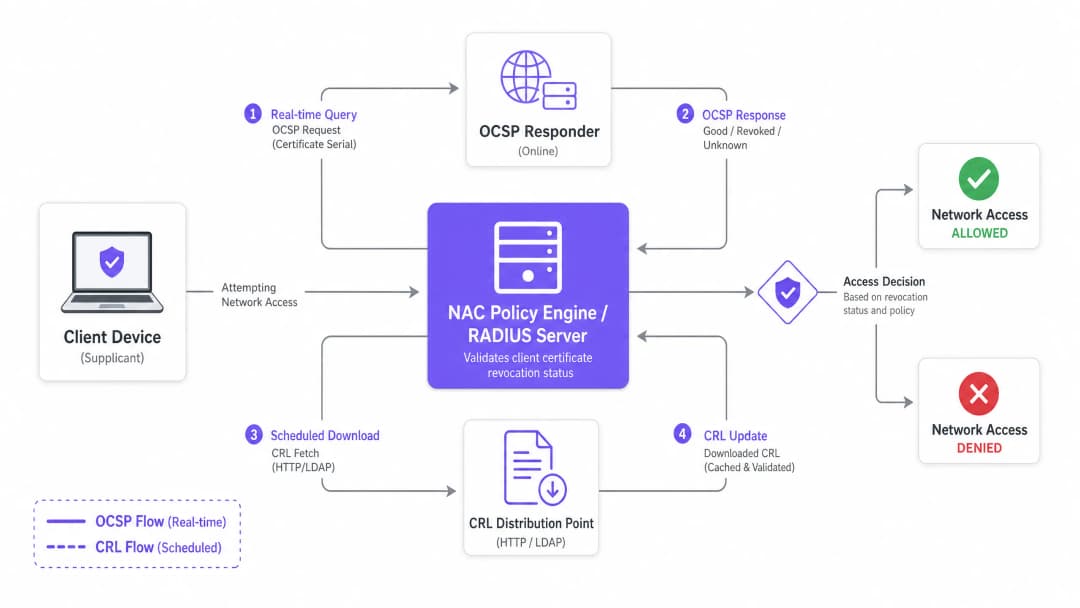
Uma CRL é um ficheiro assinado digitalmente e publicado pela Autoridade de Certificação que contém os números de série de todos os certificados que foram revogados, mas que ainda não expiraram. O motor de políticas de NAC (atuando como o servidor RADIUS) descarrega periodicamente esta lista a partir de um CRL Distribution Point (CDP) via HTTP ou LDAP.
Durante o handshake EAP-TLS, o servidor RADIUS verifica o número de série do certificado do cliente que se está a tentar ligar em relação à sua CRL armazenada localmente em cache. Se o número de série estiver presente, a autenticação é rejeitada.
Características Arquitetónicas:
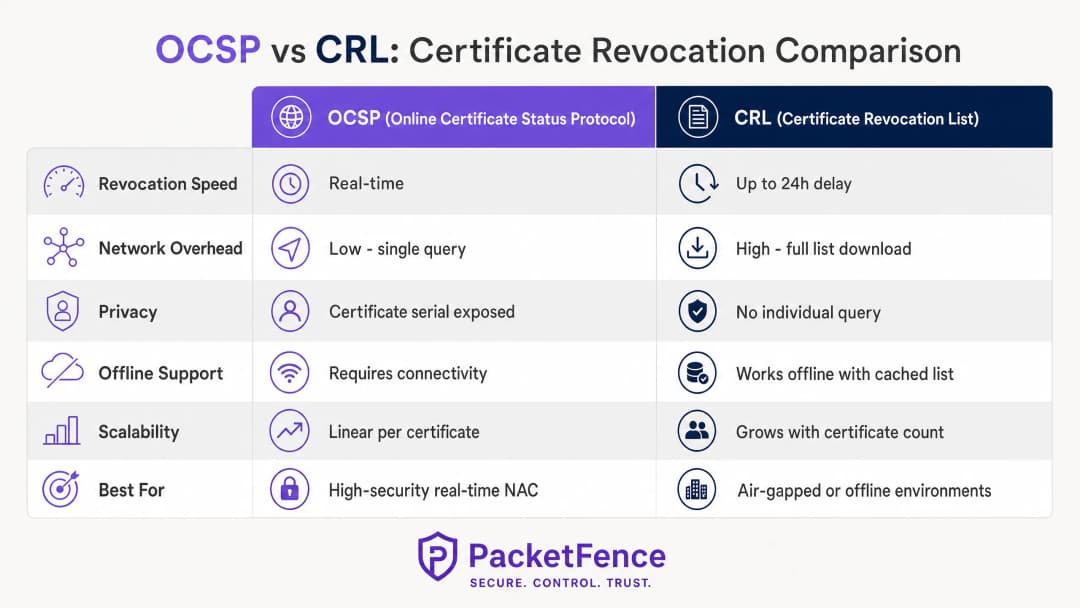
- Resiliência Offline: Como o servidor RADIUS armazena a CRL em cache, a verificação de revogação continua mesmo que a CA ou o CDP estejam inacessíveis.
- Latência: A principal desvantagem é a latência entre a revogação e a aplicação. Se um certificado for revogado às 09:00 e o intervalo de atualização da CRL for de 24 horas, o dispositivo comprometido mantém o acesso à rede até à transferência seguinte.
- Sobrecarga de Débito: Em ambientes com milhares de certificados, os ficheiros CRL podem atingir vários megabytes, exercendo pressão sobre a largura de banda durante os ciclos de atualização.
Arquitetura do Protocolo de Estado de Certificados Online (OCSP)
O OCSP aborda as limitações de latência da CRL ao permitir a verificação de revogação em tempo real. Em vez de descarregar a lista completa, o servidor RADIUS envia uma consulta direcionada que contém o número de série do certificado para um respondedor OCSP. O respondedor devolve um estado assinado: Good, Revoked ou Unknown.
Características da Arquitetura:
- Aplicação em Tempo Real: As decisões de revogação entram em vigor instantaneamente. Assim que a CA atualiza o respondedor OCSP, a tentativa de autenticação seguinte do dispositivo comprometido falhará.
- Dependência de Disponibilidade: O motor de políticas de NAC depende da elevada disponibilidade do respondedor OCSP. Se o respondedor estiver inacessível, o administrador de rede deve definir uma política de falha: "falha aberta" (autorizar o acesso, comprometendo a segurança) ou "falha fechada" (negar o acesso, comprometendo a disponibilidade).
- Grampeamento OCSP (OCSP Stapling): Para mitigar preocupações de carga e privacidade, o grampeamento OCSP permite que o dispositivo cliente obtenha a resposta OCSP assinada e a anexe ao handshake TLS, embora o suporte do requerente possa variar.
Integração com Plataformas de Convidados e Analítica
Enquanto o OCSP e a CRL gerem os requisitos de segurança rigorosos dos colaboradores e dispositivos corporativos, as redes públicas requerem uma arquitetura diferente. Para recintos públicos, a integração de um NAC de colaboradores robusto com uma plataforma pública dedicada como a Purple garante uma cobertura abrangente. A plataforma da Purple lida com a autenticação de Captive Portal, a aceitação dos termos de serviço e a captura de dados para o segmento público, enquanto a infraestrutura de rede subjacente (frequentemente os mesmos pontos de acesso físicos e switches) aplica o 802.1X e o OCSP para SSIDs corporativos. Compreender o ambiente de rádio é crucial para ambos os segmentos; consulte o guia Frequências de WiFi: Um Guia para as Frequências de WiFi em 2026 para o planeamento do espetro.
Tem dúvidas sobre a sua configuração específica?
A nossa equipa trabalha com operadores de espaços, gestores de TI e engenheiros de rede em 80.000 espaços. Agende uma chamada de 20 minutos e mostraremos como outros profissionais na sua área o resolveram.
Guia de Implementação
A implementação da revogação automatizada de certificados requer coordenação entre os domínios de PKI, MDM e NAC. Siga estes passos de implementação independentes do fabricante para estabelecer um fluxo de revogação resiliente.
Passo 1: Definir os Gatilhos de Revogação
A automatização começa na camada de gestão de endpoints. Configure a sua plataforma de MDM (por exemplo, Microsoft Intune, Jamf Pro) para acionar uma chamada de API de revogação para a sua autoridade de certificação quando forem cumpridas condições específicas:
- Quando um dispositivo deixa de estar registado no MDM
- Quando um dispositivo é marcado como não conforme
- Quando uma conta de utilizador é desativada no serviço de diretório
Passo 2: Configurar a Infraestrutura de Revogação
Para Implantação de CRL:
- Configure a CA para publicar a CRL num CDP de elevada disponibilidade (por exemplo, um servidor web interno com balanceamento de carga).
- Defina o intervalo de publicação da CRL com base na sua tolerância ao risco (por exemplo, a cada 4 horas).
- Configure o servidor RADIUS para obter a CRL em intervalos ligeiramente inferiores ao intervalo de publicação para garantir que a cache está sempre atualizada.
Para Implantação de OCSP:
- Implemente pelo menos dois respondentes OCSP atrás de um balanceador de carga para garantir uma elevada disponibilidade.
- Configure a CA para enviar atualizações de revogação para os respondentes OCSP imediatamente.
- Configure o servidor RADIUS para consultar o IP virtual do OCSP com balanceamento de carga durante a autenticação EAP-TLS.
Passo 3: Estabelecer Políticas de Recursos de Emergência
Não dependa de um único mecanismo. Configure o seu servidor RADIUS para utilizar o OCSP como a verificação de revogação principal e recorrer a uma CRL armazenada localmente em cache caso o respondente OCSP esteja inacessível. Isto proporciona uma aplicação em tempo real sob condições normais e resiliência offline durante falhas de infraestrutura.
Passo 4: Definir o Comportamento em Caso de Falha
Se o OCSP e a CRL em cache estiverem indisponíveis, o servidor RADIUS deve decidir como processar o pedido de autenticação.
- Ambientes de Alta Segurança (por exemplo, Saúde): Configure "fail closed" (falha fechada). Recuse o acesso para impedir a ligação de dispositivos potencialmente comprometidos.
- Ambientes Standard (por exemplo, interfaces de transportes): Configure "fail open" (falha aberta) com alertas. Permita o acesso para manter a continuidade operacional, mas gere um alerta de alta prioridade para o SOC.
Melhores Práticas
- Implementar Delta CRLs: Se depender de CRLs num ambiente de grande dimensão, implemente Delta CRLs. Estes ficheiros contêm apenas as alterações de revogação desde a publicação da última CRL base completa, o que reduz significativamente o tamanho do download e o consumo de largura de banda.
- Monitorizar a Latência do OCSP: As consultas de OCSP ocorrem em linha durante o handshake EAP-TLS. Se o respondente OCSP demorar 500ms a responder, a autenticação será atrasada em 500ms. Monitorize a latência do respondente e dimensione horizontalmente se os tempos de resposta degradarem.
- Certificados de Curta Duração: Considere reduzir os períodos de validade dos certificados (por exemplo, de 1 ano para 7 dias) através de renovação automatizada SCEP/EST. Os certificados de curta duração expiram naturalmente de forma rápida, reduzindo a dependência de uma infraestrutura de revogação robusta.4. Alinhar com a Estratégia de Rede Mais Ampla: Garanta que a sua implementação de NAC está alinhada com a arquitetura da sua rede de área alargada. Para obter informações sobre o design de redes WAN modernas, consulte SD WAN vs MPLS: O Guia de Rede Empresarial de 2026.
Resolução de Problemas e Mitigação de Riscos
O modo de falha mais comum da revogação automatizada é uma quebra na ligação entre a CA e o NAC, resultando num evento de "falha segura fechada" que bloqueia utilizadores legítimos.
Risco: Falha do Respondedor OCSP Mitigação: Implemente respondedores num cluster ativo-ativo em múltiplos domínios de falha. Implemente verificações de integridade abrangentes no balanceador de carga que verifiquem não apenas a disponibilidade da porta TCP 80, mas também a capacidade do respondedor de consultar a base de dados da CA.
Risco: Cache CRL Desatualizada Mitigação: Os servidores RADIUS podem falhar ao descarregar a CRL mais recente devido a partições de rede ou interrupções no CDP. Implemente uma monitorização que envie alertas quando a CRL em cache local for anterior ao intervalo de publicação definido.
Risco: Revogação MDM Incompleta Mitigação: Se o MDM falhar ao acionar uma chamada de revogação para a CA, o certificado permanece válido. Implemente um script de reconciliação que compare periodicamente a lista de dispositivos ativos do MDM com a lista de certificados válidos da CA e revogue automaticamente quaisquer discrepâncias.
Retorno do Investimento (ROI) e Impacto Comercial
A automatização da revogação de certificados transforma a segurança de um processo reativo e manual num mecanismo de defesa proativo e automatizado.
- Mitigação de Riscos: Ao eliminar a janela de exposição entre o comprometimento do dispositivo e o isolamento da rede, as organizações reduzem significativamente o risco de movimento lateral e exfiltração de dados. Isto é crucial para manter a conformidade com normas como PCI-DSS e GDPR.
- Eficiência Operacional: A automatização do fluxo de revogação elimina a necessidade de a equipa de suporte atualizar manualmente as configurações do RADIUS ou as bases de dados das CA quando os colaboradores saem da empresa, poupando centenas de horas anualmente em grandes empresas.
- Estratégia de Acesso Unificado: Um ambiente NAC robusto para dispositivos corporativos permite que as equipas de TI implementem com confiança serviços paralelos, como o WiFi de convidados baseado em análise de dados da Purple ou serviços baseados em localização (consulte Explicação sobre BLE Low Energy para Empresas), sabendo que a infraestrutura central permanece segura.
Oiça o nosso resumo técnico sobre este tema abaixo:
Definições Principais
EAP-TLS (Extensible Authentication Protocol - Transport Layer Security)
O padrão mais seguro para autenticação de rede 802.1X, exigindo que tanto o cliente como o servidor apresentem certificados digitais para provar a sua identidade.
As equipas de TI implementam o EAP-TLS para eliminar os riscos associados à autenticação baseada em palavra-passe, garantindo que apenas dispositivos geridos e portadores de certificados se podem ligar à rede corporativa.
OCSP (Online Certificate Status Protocol)
Um protocolo de internet utilizado para obter o estado de revogação de um certificado digital X.509 em tempo real.
Crucial para ambientes que exigem a aplicação imediata de políticas de acesso, como quando um colaborador é demitido e o seu dispositivo deve ser instantaneamente desligado.
CRL (Lista de Revogação de Certificados)
Uma lista publicada periodicamente e assinada digitalmente com os números de série dos certificados que foram revogados pela Autoridade de Certificação emissora.
Utilizada como mecanismo principal de revogação em redes offline ou isoladas (air-gapped), ou como um mecanismo alternativo altamente resiliente para o OCSP.
OCSP Stapling
Um mecanismo através do qual o dispositivo cliente obtém a sua própria resposta OCSP e a "anexa" (staples) ao handshake TLS, apresentando-a ao servidor RADIUS.
Reduz a carga no servidor RADIUS e no OCSP Responder, e melhora a privacidade ao impedir que a CA veja exatamente quando e onde um dispositivo se está a autenticar.
Delta CRL
Uma lista de revogação mais pequena que contém apenas os certificados revogados desde a publicação da última Base CRL completa.
Essencial para grandes implementações de modo a evitar o congestionamento da rede, uma vez que as CRLs completas podem tornar-se massivas e consumir uma largura de banda significativa durante os ciclos de atualização.
CDP (Ponto de Distribuição de CRL)
A localização, normalmente um URL HTTP ou LDAP, onde a Autoridade de Certificação publica a CRL para que os clientes e os servidores RADIUS a descarreguem.
As equipas de TI devem garantir que o CDP está altamente disponível e acessível a partir de todos os motores de políticas NAC; se o CDP ficar indisponível, os servidores RADIUS não conseguirão atualizar as suas caches.
Fail Open / Fail Closed
A decisão de política que dita o que acontece quando a infraestrutura de revogação (OCSP ou CDP) está inacessível. Fail Open permite o acesso; Fail Closed nega o acesso.
Uma decisão de negócio crítica que equilibra a postura de segurança com o tempo de atividade operacional. Requer a aprovação tanto das operações de TI como do CISO.
SCEP (Simple Certificate Enrollment Protocol)
Um protocolo utilizado por plataformas MDM para automatizar a emissão de certificados digitais para dispositivos geridos sem a intervenção do utilizador.
O ponto de partida do ciclo de vida automatizado. O SCEP emite o certificado e, mais tarde, o MDM instrui a CA a revogá-lo quando o dispositivo é desativado.
Exemplos Práticos
Uma rede hospitalar de 500 camas está a migrar de 802.1X baseado em credenciais para EAP-TLS baseado em certificados para todos os dispositivos IoT médicos e portáteis de funcionários. O CISO exige que, se um dispositivo for reportado como roubado, o seu acesso à rede deve ser terminado em 5 minutos. A equipa de rede está preocupada com a carga no servidor RADIUS se este tiver de consultar constantemente serviços externos. Como deve ser desenhada a arquitetura de revogação?
O hospital deve implementar OCSP para cumprir o SLA de revogação de 5 minutos, uma vez que os intervalos de atualização de CRL não conseguem cumprir este objetivo de forma fiável sem causar um impacto severo na rede. Para resolver as preocupações de carga da equipa de rede, a arquitetura deve implementar OCSP Responders localmente no data centre do hospital, posicionados perto dos servidores RADIUS para minimizar a latência. Os servidores RADIUS devem ser configurados para consultar o VIP local do OCSP. Para garantir a resiliência, os servidores RADIUS devem ser configurados com um fallback para uma CRL em cache local, atualizada de hora em hora. A política de falha deve ser definida como "fail closed" devido aos rigorosos requisitos de conformidade do ambiente de saúde.
Uma cadeia de retalho global com 1.200 lojas utiliza SCEP para fornecer certificados a tablets de pontos de venda (POS). As lojas têm largura de banda WAN limitada. O diretor de TI deseja implementar a revogação de certificados, mas teme que o descarregamento de ficheiros CRL grandes em 1.200 servidores RADIUS de filiais sature as ligações WAN. Qual é a estratégia de implementação ideal?
A cadeia de retalho deve implementar uma abordagem híbrida utilizando Delta CRLs e OCSP Stapling. Primeiro, a CA deve ser configurada para publicar uma Base CRL semanalmente e uma Delta CRL (contendo apenas revogações recentes) a cada 4 horas. Os servidores RADIUS das filiais apenas descarregarão as pequenas Delta CRLs durante o dia, minimizando o impacto na WAN. Em alternativa, se os suplicantes EAP dos tablets POS o suportarem, o OCSP Stapling deve ser ativado. Isto transfere o esforço de obter a resposta OCSP do servidor RADIUS da filial para o próprio tablet, que pode obter a resposta diretamente da CA central através de HTTPS padrão, contornando totalmente o impacto de processamento do servidor RADIUS.
Perguntas de Prática
Q1. A sua organização está a implementar o 802.1X em 50 escritórios remotos. As ligações WAN ao data centre central estão altamente congestionadas e perdem pacotes frequentemente. Precisa de implementar a revogação de certificados para os portáteis corporativos das filiais. Que arquitetura deve escolher?
Dica: Considere o impacto da perda de pacotes em protocolos em tempo real versus a resiliência dos dados em cache.
Ver resposta modelo
Deve implementar uma arquitetura baseada em CRL, utilizando especificamente Base e Delta CRLs. Como as ligações WAN estão congestionadas e não são fiáveis, as consultas OCSP em tempo real sofrerão frequentemente falhas por limite de tempo (timeout), causando atrasos ou falhas na autenticação. Ao configurar os servidores RADIUS das filiais para descarregar e guardar em cache as Delta CRLs durante as horas de menor utilização, o servidor RADIUS local pode realizar verificações de revogação instantaneamente na sua cache, mesmo que a ligação WAN caia completamente durante a tentativa de autenticação.
Q2. Uma auditoria de segurança revela que, quando o seu OCSP Responder principal fica offline para manutenção, todos os utilizadores corporativos perdem completamente o acesso à rede WiFi. O negócio exige que a manutenção não afete a conectividade dos utilizadores, mas o CISO recusa-se a alterar a política para "Fail Open". Como resolve isto?
Dica: Se não puder alterar a política de falha, deve alterar a disponibilidade do serviço.
Ver resposta modelo
Deve implementar alta disponibilidade para o serviço OCSP. Implemente pelo menos um OCSP Responder adicional e coloque ambos atrás de um balanceador de carga. Configure o servidor RADIUS para consultar o IP Virtual (VIP) do balanceador de carga. Durante a manutenção, pode drenar as ligações do responder principal, colocá-lo offline, e o balanceador de carga encaminhará de forma transparente todas as consultas OCSP para o responder secundário, cumprindo tanto o requisito de tempo de atividade do negócio como o mandato de "Fail Closed" do CISO.
Q3. Configurou o seu MDM para revogar automaticamente certificados quando um dispositivo é marcado como 'perdido'. Testa o sistema marcando um iPad de teste como perdido. O MDM confirma a revogação, mas 10 minutos depois, o iPad liga-se com sucesso ao WiFi corporativo. O servidor RADIUS está configurado para utilizar uma CRL publicada a cada 24 horas. Qual é a causa raiz e como a resolve?
Dica: Siga a linha temporal dos dados de revogação desde a CA até ao motor de aplicação de políticas do servidor RADIUS.
Ver resposta modelo
A causa raiz é a latência na publicação da CRL e no ciclo de atualização. Embora o MDM tenha indicado com sucesso à CA para revogar o certificado, a CA não irá publicar esse estado atualizado no Ponto de Distribuição CRL até ao próximo ciclo de 24 horas, e o servidor RADIUS não o irá descarregar até que a sua própria cache expire. Para resolver isto, deve migrar para OCSP para verificação em tempo real ou reduzir drasticamente os intervalos de publicação e descarregamento da CRL (por exemplo, para 1 hora) para cumprir o tempo de aplicação exigido.
Continue a ler esta série
PPSK WPA3: comparando funcionalidades e modelos de implementação
Este guia de referência técnica compara PPSK e WPA3-SAE, explicando as suas diferenças arquiteturais e modelos de implementação para ambientes multi-tenant. Oferece orientação prática para gestores de TI e promotores imobiliários sobre como obter redes WiFi seguras e isoladas utilizando as soluções baseadas em identidade da Purple.
Gestão de Largura de Banda para WiFi de Colaboradores: Shaping, QoS e Redução de Tráfego
Este guia detalha métodos práticos para gerir a largura de banda para o WiFi de colaboradores em espaços empresariais. Aborda a implementação de traffic shaping, QoS e como a implementação do Purple Shield reduz a carga da rede sem necessidade de atualizações de infraestrutura.
Como Reduzir o Número de SSIDs de WiFi Utilizando PSK por Dispositivo (iPSK, DPSK, MPSK)
Este guia de referência técnica autoritário explica como as equipas de TI podem eliminar a degradação de desempenho de WiFi causada pelo overhead de beacon de SSID, colapsando múltiplas redes dedicadas num único SSID utilizando PSK por dispositivo (xPSK). Abrange o ecossistema de fornecedores através de Cisco iPSK, HPE Aruba MPSK, Ruckus DPSK, Juniper Mist PPSK e Ubiquiti UniFi PPSK, com orientação prática de implementação sobre atribuição dinâmica de VLAN, ativação de IoT e conformidade com PCI-DSS. Os operadores de locais em hotelaria, retalho, estádios e organizações do setor público encontrarão orientações de arquitetura acionáveis e exemplos práticos reais.
Tem dúvidas sobre a sua configuração específica?
A nossa equipa trabalha com operadores de espaços, gestores de TI e engenheiros de rede em 80.000 espaços. Agende uma chamada de 20 minutos e mostraremos como outros profissionais na sua área o resolveram.