
Como Implementar NAC Pós-Admissão para Monitorização Contínua de Confiança
Este guia fornece um modelo técnico de referência para a implementação de Controlo de Acesso à Rede (NAC) Pós-Admissão com Monitorização Contínua de Confiança em ambientes empresariais, incluindo hotelaria, retalho, saúde e setor público. Detalha a transição arquitetónica de verificações estáticas pré-admissão para uma aplicação dinâmica e consciente da sessão utilizando RADIUS CoA, definição de perfis de comportamento e integração de telemetria. Os arquitetos de TI e as equipas de operações de rede encontrarão orientações de implementação práticas, casos de estudo reais, notas de alinhamento de conformidade e estruturas de ROI mensuráveis.
Ouça este guia
Ver transcrição do podcast
Parte da nossa série principal: Guia de Segurança de WiFi Empresarial →
Resumo Executivo
Para redes empresariais em ambientes de alta densidade - hotelaria, retalho, estádios e locais do setor público - o Network Access Control de pré-admissão tradicional já não é suficiente. As verificações estáticas e num momento específico não conseguem responder a dispositivos que sejam comprometidos ou que comecem a apresentar comportamentos maliciosos após terem recebido acesso à rede. Um dispositivo pode passar uma autenticação limpa do motor de políticas 802.1X e, minutos depois, começar a fazer varrimentos de sub-redes internas ou a exfiltrar dados.
O NAC de Pós-Admissão muda o paradigma de segurança de "autenticar e confiar" para a Monitorização Contínua de Confiança. Ao avaliar continuamente a postura do dispositivo, os padrões de tráfego e o contexto da sessão face a linhas de base comportamentais estabelecidas, as equipas de TI e de operações de rede podem impor políticas de forma dinâmica a meio da sessão utilizando RADIUS Change of Authorization (CoA). Este guia fornece um modelo prático e independente de fabricante para implementar o NAC de Pós-Admissão. Cobre considerações de arquitetura, integração com plataformas de Guest WiFi e WiFi Analytics, e estratégias de implementação práticas que reduzem o risco sem comprometer a experiência do utilizador.
Análise Técnica Detalhada
A Transição da Pré-Admissão para a Pós-Admissão
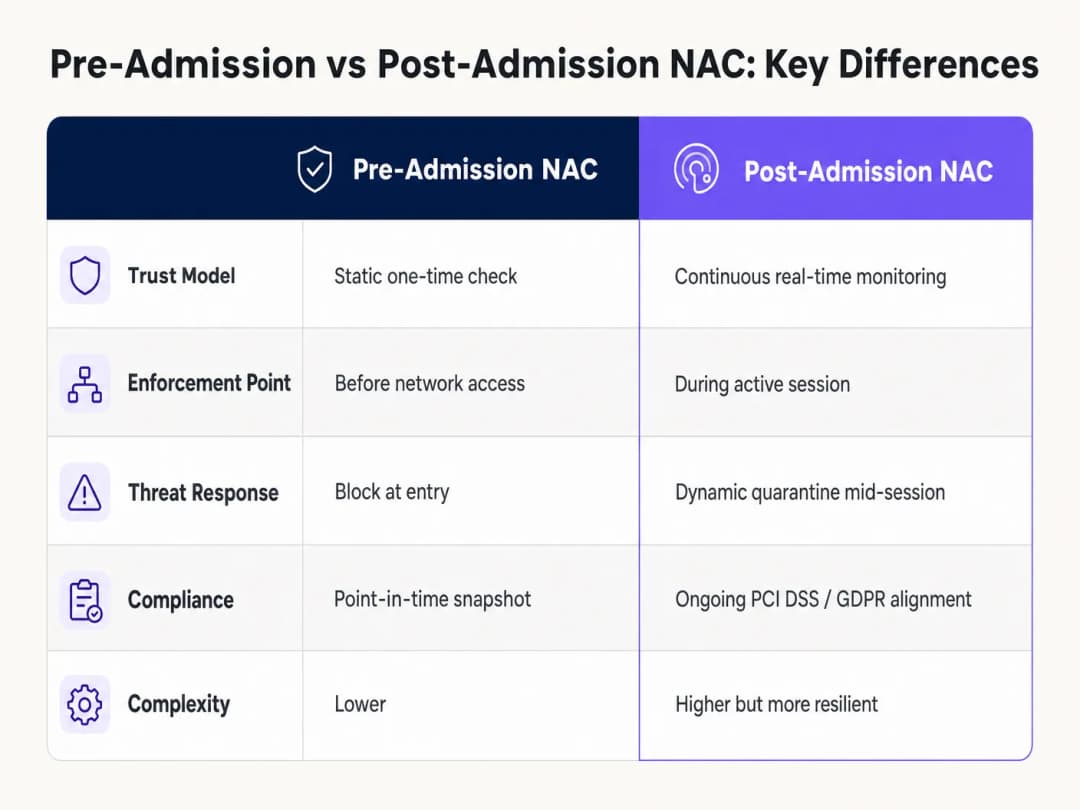
O NAC tradicional depende de IEEE 802.1X, MAC Authentication Bypass (MAB) ou portais cativos para verificar a identidade e a postura antes de conceder o acesso. Uma vez admitido, um dispositivo tem normalmente acesso sem entraves à sua VLAN ou microsegmento atribuído durante a sessão. Este modelo tem uma falha fundamental: trata a admissão como um evento binário e único. O cenário de ameaças não funciona dessa forma.
O NAC de Pós-Admissão introduz um motor de políticas dinâmico que monitoriza continuamente as sessões ativas. Se um dispositivo começar a fazer varrimentos de sub-redes internas, a gerar tráfego anómalo ou a tentar comunicar com servidores de comando e controlo (C2) conhecidos, a solução NAC altera dinamicamente os privilégios de rede desse dispositivo. Isto é alcançado através de pedidos RADIUS Change of Authorization (CoA) (RFC 5176), integração de API com controladores de LAN sem fios (WLCs) ou integração direta com arquiteturas SD-WAN - um tema explorado em profundidade no SD WAN vs MPLS: The 2026 Enterprise Network Guide.

Componentes Principais de uma Arquitetura de Monitorização Contínua de Confiança
Uma implementação de NAC pós-admissão de nível de produção requer quatro componentes integrados a trabalhar em conjunto.
A Ingestão de Telemetria é a base. O sistema deve ingerir dados em tempo real de WLCs, switches, firewalls e agentes de deteção e resposta de endpoints (EDR). Isto inclui dados NetFlow/IPFIX, registos de contabilidade RADIUS, registos de pedidos de DNS e métricas de visibilidade de aplicações de motores de inspeção profunda de pacotes (DPI). Sem uma telemetria abrangente, o motor de políticas opera às cegas.
O Motor de Análise Comportamental processa os fluxos de telemetria e compara-os com as linhas de base estabelecidas. Modelos de machine learning são cada vez mais utilizados para automatizar a construção de linhas de base e a pontuação de anomalias, reduzindo a carga de configuração manual. Para uma análise mais aprofundada sobre como a IA está a transformar este espaço, consulte The Future of Wi-Fi Security: AI-Driven NAC and Threat Detection e a sua versão em espanhol El Futuro de la Seguridad Wi-Fi: NAC Impulsado por IA y Detección de Amenazas.
A Aplicação Dinâmica de Políticas é o resultado operacional. A capacidade de enviar RADIUS CoA em tempo real para reiniciar uma porta, alterar uma atribuição de VLAN ou aplicar uma lista de controlo de acessos (ACL) restritiva é o que distingue o NAC pós-admissão de um sistema de monitorização passivo. Sem um CoA fiável, tudo o que tem é um sistema de alerta, não um sistema de aplicação de políticas.
A Camada de Integração liga o motor NAC ao ecossistema de segurança mais amplo: plataformas SIEM para correlação de eventos, feeds de inteligência de ameaças para enriquecimento de IPs maliciosos conhecidos e fornecedores de identidade para enriquecimento do contexto do utilizador. Em ambientes voltados para clientes, uma plataforma de WiFi Analytics fornece contexto ao nível da sessão que enriquece significativamente as decisões de políticas.
Referência de Normas e Protocolos
| Norma | Relevância para o NAC Pós-Admissão |
|---|---|
| IEEE 802.1X | Base da autenticação baseada em portas; fornece a vinculação de identidade que as políticas de NAC referenciam |
| RFC 5176 (RADIUS CoA) | O mecanismo de protocolo para a aplicação de políticas a meio da sessão |
| WPA3-Enterprise | Fornece uma proteção criptográfica mais forte para a troca de autenticação 802.1X |
| PCI-DSS v4.0 | Requer monitorização contínua do acesso à rede com capacidade de resposta automatizada |
| GDPR Artigo 32 | Exige medidas técnicas adequadas para garantir a confidencialidade e integridade contínuas |
| NIST SP 800-207 | O framework de Arquitetura Zero Trust que o NAC pós-admissão implementa diretamente |
Tem dúvidas sobre a sua configuração específica?
A nossa equipa trabalha com operadores de espaços, gestores de TI e engenheiros de rede em 80.000 espaços. Agende uma chamada de 20 minutos e mostraremos como outros profissionais na sua área o resolveram.
Guia de Implementação
A implementação de NAC pós-admissão requer uma abordagem faseada para evitar interrupções de rede em grande escala. Tentar ativar a aplicação ativa de políticas imediatamente é a causa mais comum de falha na implementação.
Fase 1: Visibilidade e Criação de Linhas de Base (Semanas 1-4)
Implemente a solução NAC em modo de apenas monitorização. Não devem ser configuradas ações de aplicação de políticas durante esta fase.
Primeiro, garanta que todos os Network Access Devices (NADs) estão a enviar dados de contabilidade RADIUS e telemetria de fluxo para o motor de políticas NAC. Configure a exportação NetFlow ou IPFIX em todos os switches geridos e WLCs. Verifique se o motor NAC está a receber e a analisar corretamente os registos antes de prosseguir.
Permita que o sistema observe os padrões de tráfego nos diferentes perfis de dispositivos. Isto é especialmente crítico em ambientes de saúde, onde os dispositivos IoT médicos têm padrões de tráfego altamente previsíveis, e em ambientes de retalho, onde os terminais de ponto de venda (POS) têm requisitos de comunicação bem definidos. O período de estabelecimento da linha de base deve abranger pelo menos um ciclo de negócios completo (normalmente quatro semanas) para captar a variação entre dias de semana e fins de semana.
Fase 2: Desenvolvimento e Teste de Políticas (Semanas 5-6)
Com as linhas de base estabelecidas, desenvolva políticas baseadas no risco. Defina acionadores de quarentena explícitos com base no risco de negócio, em vez de indicadores puramente técnicos.
Para um ambiente de retalho, um acionador crítico pode ser: qualquer tráfego da VLAN de convidados que tente encaminhar-se para subredes de VLAN de POS. Para a hotelaria, pode ser: qualquer dispositivo que gere mais de 500 tentativas de ligação SMB por minuto. Para a saúde: qualquer dispositivo autenticado por MAB que comunique com endereços IP externos fora da sua lista de destinos aprovados.
Teste cada política num ambiente de laboratório simulando as condições de acionamento. Verifique se o motor NAC identifica corretamente a anomalia, gera o pedido de CoA e se o NAD aplica a nova política dentro de uma janela de tempo aceitável (normalmente inferior a 500 milissegundos para acionadores críticos).
Fase 3: Implementação Gradual de Políticas (Semanas 7-10)
Ative a aplicação ativa de políticas primeiro em segmentos de rede de baixo risco. Uma VLAN de IoT exclusiva para funcionários é frequentemente um bom ponto de partida, pois os falsos positivos têm um impacto operacional limitado em comparação com as redes de convidados ou clínicas.
Comece com respostas de aplicação de políticas graduais. Em vez de desligar imediatamente os dispositivos, aplique uma ACL restritiva que permita o acesso básico à internet (HTTP/HTTPS para destinos aprovados), mas bloqueie todo o encaminhamento interno. Isto reduz o impacto de falsos positivos enquanto continua a conter as ameaças. Monitorize a fila de quarentena diariamente e ajuste os limites conforme necessário.
Estenda progressivamente a aplicação de políticas a segmentos adicionais, validando cada um antes de prosseguir. Garanta que o RADIUS CoA funciona de forma fiável - a porta UDP 3799 deve estar aberta entre o motor NAC e todos os NADs, e os segredos partilhados devem ser consistentes. Em implementações de hubs de transportes, onde os segmentos de rede podem abranger vários locais físicos, verifique os tempos de resposta de CoA através de ligações WAN.
Fase 4: Produção Total e Otimização Contínua
Assim que todos os segmentos estiverem sob aplicação ativa, estabeleça uma cadência de otimização contínua. Reveja os eventos de quarentena semanalmente, identifique falsos positivos recorrentes e ajuste as referências em conformidade. Integre o fluxo de eventos de NAC com o seu SIEM para correlação cruzada com eventos de segurança de endpoints e de perímetro.
Para implementações em Hospitality, considere ajustes sazonais nas referências - uma rede hoteleira em plena época de verão tem padrões de tráfego materialmente diferentes da mesma rede em janeiro. Sem atualizações, as referências estáticas irão gerar falsos positivos elevados durante os períodos de pico.
Melhores Práticas
Padronize no 802.1X sempre que possível. Embora o MAB seja necessário para dispositivos IoT sem interface de utilizador, o 802.1X fornece uma ligação de identidade criptográfica mais forte. Garanta que o WPA3-Enterprise é utilizado onde for suportado. Compreender o ambiente de RF subjacente é essencial - consulte Wi Fi Frequencies: A Guide to Wi-Fi Frequencies in 2026 para garantir que o desenho do seu espetro suporta a sobrecarga de gestão da monitorização contínua.
Utilize a micro-segmentação como um controlo complementar. Combine o NAC Pós-Admissão com a micro-segmentação de rede. Se um dispositivo for comprometido e a resposta CoA for atrasada por qualquer motivo, a micro-segmentação limita o raio de impacto ao próprio segmento do dispositivo. Os dois controlos são complementares, não redundantes.
Alinhe a política de aplicação com os mandatos de conformidade. Garanta que a sua monitorização contínua e procedimentos de resposta automatizada estão documentados para os auditores. O Requisito 10 do PCI-DSS v4.0 exige que todo o acesso aos recursos de rede seja registado e monitorizado. O Artigo 32 do GDPR exige medidas contínuas de confidencialidade e integridade. O NAC Pós-Admissão satisfaz diretamente ambos - mas apenas se os registos de auditoria forem retidos e os procedimentos de resposta automatizada forem formalmente documentados.
Considere o BLE para enriquecimento de contexto físico. Em ambientes onde a presença física importa - centros de conferências ou espaços comerciais, por exemplo - a integração de dados de beacons BLE pode enriquecer o contexto do motor de políticas de NAC. Um dispositivo que está autenticado na rede mas fisicamente localizado numa área restrita é um sinal de maior risco do que o mesmo dispositivo numa área pública. Consulte BLE Low Energy Explained for Enterprise para obter orientações de implementação.
Resolução de Problemas e Mitigação de Riscos
Falhas de CoA
O problema mais comum em implementações de NAC Pós-Admissão é a falha dos NADs no processamento de pedidos RADIUS CoA. Os sintomas incluem: o motor NAC regista uma transmissão CoA bem-sucedida, mas o dispositivo cliente permanece na rede com o acesso inalterado. Diagnostique capturando tráfego na porta UDP 3799 no NAD. As causas comuns incluem regras de firewall a bloquear a porta CoA, segredos partilhados RADIUS incompatíveis ou o CoA não estar explicitamente ativado na configuração do NAD. Valide sempre o CoA num teste controlado antes da entrada em produção.
Falsos Positivos e Disrupção Operacional
Linhas de base comportamentais excessivamente agressivas irão colocar dispositivos legítimos em quarentena. Isto é particularmente problemático em ambientes de hotelaria, onde o comportamento dos dispositivos dos convidados é imprevisível - streaming de vídeo, utilização de VPN e operações de cópia de segurança na nuvem podem ultrapassar os limites de anomalia se as linhas de base forem demasiado estreitas. Utilize sempre a abordagem de aplicação faseada e mantenha um processo de lista de permissões para dispositivos conhecidos como seguros que acionam alertas com frequência.
Escala e Capacidade de Processamento
A monitorização contínua gera volumes substanciais de telemetria. Num estádio ou num grande centro de conferências com 10.000 sessões simultâneas, o motor de políticas NAC e a infraestrutura de registos devem ser dimensionados para lidar com as taxas de escrita sem perder registos. A perda de telemetria cria pontos cegos. Dimensione a infraestrutura para picos de sessões simultâneas, e não para médias, e implemente o buffering de telemetria na camada do coletor para absorver picos repentinos.
Vendor Lock-In
Alguns fornecedores de NAC implementam extensões CoA proprietárias que apenas funcionam com o seu próprio ecossistema de hardware. Antes de finalizar a arquitetura de implementação, certifique-se de que o seu motor de políticas NAC suporta o padrão baseado em RFC 5176 CoA e que os seus NADs constam na matriz de compatibilidade testada do fornecedor.
ROI e Impacto no Negócio
A implementação de NAC pós-admissão proporciona um valor comercial mensurável que vai muito além da conformidade de segurança.
Redução do tempo médio de resposta (MTTR): A quarentena automatizada reduz o MTTR de horas - ou dias em ambientes sem uma equipa de SOC dedicada - para milissegundos. Para uma cadeia de retalho com 500 lojas, isto significa que um dispositivo comprometido numa filial é isolado antes de poder alcançar a rede POS, independentemente de haver ou não um engenheiro de rede no local.
Eficiência operacional: As equipas de operações de rede despendem significativamente menos tempo a rastrear manualmente dispositivos comprometidos. A quarentena automatizada com registo de auditoria detalhado reduz a carga de investigação e acelera os relatórios pós-incidente.
Proteção da marca e das receitas: Em ambientes abertos ao público, evitar que o dispositivo de um convidado se torne o trampolim para uma violação de maior dimensão protege a reputação do espaço. Uma violação de dados num ambiente hoteleiro ou de retalho acarreta não só sanções regulamentares ao abrigo do GDPR, mas também danos de reputação materiais que afetam diretamente as receitas.
Menores custos de conformidade: A monitorização contínua e automatizada com um registo de auditoria completo reduz o custo e o esforço das auditorias de conformidade. Demonstrar uma capacidade de resposta automatizada e em tempo real a um PCI QSA é substancialmente mais fácil do que apresentar documentação de processos manuais.
Definições Principais
NAC Pós-Admissão
A monitorização contínua e a aplicação dinâmica de políticas de segurança num dispositivo após lhe ter sido concedido o acesso inicial à rede, por oposição às verificações de pré-admissão que ocorrem apenas no momento da ligação.
Crucial para identificar dispositivos que fiquem comprometidos a meio da sessão ou que apresentem comportamentos maliciosos que não eram evidentes durante a fase de autenticação inicial. Diretamente relevante para qualquer ambiente com acesso de convidados ou de dispositivos não geridos.
Monitorização de Confiança Contínua
Um modelo de segurança no qual a confiança nunca é assumida de forma permanente; a postura, o comportamento e o contexto de um dispositivo são continuamente avaliados em relação a referências estabelecidas ao longo de toda a duração da sua sessão de rede.
A filosofia operacional que sustenta o NAC Pós-Admissão e uma implementação direta dos princípios da Arquitetura Zero Trust da NIST SP 800-207.
Alteração de Autorização (CoA)
Uma extensão RADIUS definida no RFC 5176 que permite a um servidor de políticas modificar dinamicamente os atributos de autorização de sessão de um cliente de rede ativo, incluindo alterar a atribuição de VLAN, aplicar ACLs ou terminar totalmente a sessão.
O mecanismo técnico de aplicação de políticas que distingue o NAC Pós-Admissão da monitorização passiva. Se o CoA não estiver a funcionar, o sistema não consegue aplicar políticas dinâmicas a meio da sessão.
Definição de Perfil Comportamental
O processo de estabelecer um padrão estatisticamente normal de atividade de rede para um tipo de dispositivo específico, função de utilizador ou segmento de rede ao longo de um período de observação definido.
A base da deteção de anomalias no NAC Pós-Admissão. As linhas de referência demasiado restritas geram falsos positivos; as linhas de referência demasiado amplas deixam passar ameaças reais. Normalmente requer um mínimo de quatro semanas de observação ao longo de um ciclo de atividade completo.
Bypass de Autenticação MAC (MAB)
Um método de acesso à rede que concede acesso com base unicamente no endereço MAC de um dispositivo, normalmente utilizado para dispositivos IoT headless que não conseguem suportar a autenticação 802.1X EAP.
Intrinsecamente vulnerável a ataques de falsificação de MAC. O NAC Pós-Admissão com definição de perfis de dispositivos é essencial para proteger qualquer ambiente que dependa de MAB, particularmente em implementações de saúde e de IoT industrial.
Dispositivo de Acesso à Rede (NAD)
O componente de hardware físico - normalmente um comutador gerido, controlador de LAN sem fios ou gateway VPN - que aplica políticas de acesso na periferia da rede e recebe instruções CoA do motor de políticas NAC.
O NAD é o ponto de aplicação de políticas. A sua compatibilidade com o RFC 5176 CoA e a fiabilidade do seu processamento de CoA são fatores críticos em qualquer arquitetura de NAC Pós-Admissão.
Telemetria
A recolha e transmissão automatizada e em tempo real de dados operacionais de rede - incluindo registos NetFlow/IPFIX, dados de contabilidade RADIUS, eventos de syslog e traps SNMP - a partir de dispositivos de rede para um motor de análise centralizado.
Fornece o fluxo de dados brutos necessário para o funcionamento do motor de análise comportamental do NAC. As lacunas na cobertura de telemetria criam pontos cegos onde os dispositivos comprometidos podem operar sem serem detetados.
Microsegmentação
A prática de arquitetura de rede que consiste em dividir uma rede em segmentos pequenos e isolados com controlos de acesso granulares entre eles, limitando o movimento lateral de um atacante ou de um dispositivo comprometido.
Um controlo complementar ao NAC Pós-Admissão. Se uma ação de aplicação de CoA for atrasada, a microsegmentação limita o raio de impacto de um dispositivo comprometido ao seu próprio segmento, impedindo-o de aceder a ativos críticos em segmentos adjacentes.
RADIUS (Remote Authentication Dial-In User Service)
Um protocolo de rede que fornece gestão centralizada de Autenticação, Autorização e Contabilização (AAA) para utilizadores que se ligam e utilizam um serviço de rede.
O protocolo fundamental tanto para a admissão inicial (Access-Request/Accept) como para a aplicação pós-admissão (CoA). A maioria das implementações de NAC empresariais é construída sobre uma infraestrutura RADIUS.
Exemplos Práticos
Uma grande cadeia de retalho que está a implementar Guest WiFi em 500 localizações necessita de garantir que os dispositivos de convidados comprometidos não conseguem fazer varrimentos (scanning) ou aceder à rede de Pontos de Venda (POS). A equipa de TI tem recursos locais limitados e necessita de uma solução automatizada e gerida centralmente. Como devem implementar o NAC Pós-Admissão?
- Implementar um motor de políticas NAC alojado na nuvem com um coletor de telemetria distribuído em cada filial, evitando a necessidade de hardware NAC local.
- Configurar todos os WLCs e switches das filiais para enviar registos de RADIUS accounting e dados NetFlow para o motor NAC central através de túneis encriptados.
- Definir um período de monitorização de base de quatro semanas que abranja os padrões de tráfego de dias úteis e fins de semana para a VLAN de convidados.
- Criar uma política de violação crítica: se qualquer tráfego da sub-rede da VLAN de convidados tentar encaminhar-se para a sub-rede da VLAN de POS (definida por intervalo de IP), o motor NAC emite imediatamente um RADIUS CoA para o WLC local.
- O CoA instrui o WLC a aplicar uma ACL de "Quarentena" ao endereço MAC do cliente específico, descartando todo o tráfego exceto DHCP e DNS, isolando eficazmente o dispositivo a meio da sessão.
- Configurar um alerta automatizado para o NOC central e registar o evento no SIEM para análise pós-incidente.
- Validar a funcionalidade de CoA em 10 locais piloto antes de proceder à implementação em todas as 500 localizações.
Uma rede hospitalar tem milhares de dispositivos IoT médicos sem ecrã (headless) que utilizam o MAC Authentication Bypass (MAB) para o acesso inicial. A equipa de segurança está preocupada com ataques de spoofing de MAC e com a incapacidade de detetar dispositivos comprometidos a meio da sessão. Como pode o NAC Pós-Admissão mitigar estes riscos?
- Implementar uma solução NAC com capacidades de criação de perfis de dispositivos que possa recolher assinaturas DHCP (fingerprints), user agents HTTP e características de fluxo de tráfego.
- Durante a fase de monitorização de base, criar um perfil para cada tipo de dispositivo: uma bomba de infusão comunica com um servidor interno específico na porta 443 a intervalos regulares; um sistema de monitorização de doentes comunica com um posto de enfermagem numa sub-rede interna específica.
- Configurar políticas de violação com base no desvio do perfil: se um dispositivo autenticado via MAB como uma bomba de infusão começar a comunicar com qualquer endereço IP externo, ou iniciar mais de 10 ligações por minuto para destinos internos não aprovados, acionar uma quarentena.
- Emitir um RADIUS CoA para o switch para mover a porta para uma VLAN de quarentena, isolando o dispositivo da rede clínica e preservando ao mesmo tempo a conectividade para investigação.
- Alertar simultaneamente a equipa de engenharia clínica e o SOC, fornecendo o endereço MAC do dispositivo, a porta do switch e a anomalia de tráfego específica que desencadeou a resposta.
Perguntas de Prática
Q1. A sua equipa de operações de rede reporta que a nova implementação de NAC Pós-Admissão está a gerar um volume elevado de falsos positivos, colocando em quarentena dispositivos legítimos de convidados num átrio de hotel movimentado. A equipa de apoio ao cliente está a escalar reclamações. Qual é a ação imediata mais adequada e que remediação a longo prazo deve planear?
Dica: Considere as fases de implementação e as características de tráfego específicas de uma rede de convidados na hotelaria.
Ver resposta modelo
Reverter imediatamente a política de aplicação de Active Quarantine para Monitor Only, ou aplicar uma ACL de aplicação gradual menos restritiva que limite o encaminhamento interno sem desligar o dispositivo. Rever as linhas de base comportamentais especificamente para a VLAN de convidados - os ambientes de hotelaria têm um tráfego de convidados inerentemente imprevisível, incluindo o uso de VPN, serviços de streaming e cópias de segurança na nuvem. Prolongar o período de definição da linha de base e alargar os limiares de anomalia antes de reativar a aplicação ativa. A longo prazo, implementar ajustes sazonais na linha de base e considerar um modelo de aplicação por níveis onde os dispositivos de convidados recebem uma resposta menos agressiva do que os dispositivos corporativos ou IoT.
Q2. Durante uma implementação piloto, o motor de políticas de NAC deteta com sucesso um comportamento anómalo e regista o evento com uma pontuação de anomalia de elevada confiança, mas o dispositivo cliente permanece na rede com o acesso inalterado. O NOC recebe o alerta, mas nenhuma ação de quarentena foi aplicada. Qual é a falha técnica mais provável e como a diagnostica?
Dica: Pense no protocolo e na porta específicos utilizados para a aplicação a meio da sessão.
Ver resposta modelo
A falha mais provável é que o RADIUS Change of Authorization (CoA) não está a funcionar corretamente entre o motor de NAC e o Dispositivo de Acesso à Rede (NAD). Diagnostique capturando o tráfego na porta UDP 3799 no NAD para confirmar se o pacote CoA está a chegar. Se estiver a chegar mas for rejeitado, verifique a configuração do segredo partilhado do RADIUS tanto no motor de NAC como no NAD. Se não estiver a chegar, verifique as regras de firewall entre o motor de NAC e o NAD. Verifique também se o CoA está explicitamente ativado na configuração de cliente RADIUS do NAD - muitos dispositivos requerem uma instrução de configuração separada para aceitar pedidos CoA.
Q3. Um grande centro de conferências está a planear uma implementação de NAC Pós-Admissão antes de uma grande feira comercial com uma previsão de 8.000 utilizadores de WiFi simultâneos. O diretor de TI está preocupado com a possibilidade de a infraestrutura de telemetria ficar sobrecarregada durante os picos de carga. Como deve a arquitetura ser desenhada para lidar com esta escala?
Dica: Considere a diferença entre o volume de telemetria em bruto e o volume de eventos processados, e onde na arquitetura a agregação deve ocorrer.
Ver resposta modelo
Implementar uma arquitetura de telemetria distribuída com coletores locais em cada nível da camada de acesso. Os dados brutos de NetFlow e de contabilização RADIUS devem ser agregados e pré-processados no coletor local antes de serem encaminhados para o motor central de políticas de NAC. Isto reduz o consumo de largura de banda WAN e a carga de processamento no motor central. Dimensione o motor de políticas central com base na taxa de eventos processados, e não no volume de telemetria em bruto. Implementar o buffering de telemetria na camada do coletor para lidar com condições de pico durante a carga máxima. Além disso, considere aplicar amostragem aos dados NetFlow (por exemplo, amostragem de 1 em cada 10 pacotes) para monitorização geral do tráfego, reservando a telemetria de taxa total para segmentos de dispositivos de alto risco. Valide a arquitetura sob carga de pico simulada antes do evento.
Q4. O CTO de uma cadeia de retalho pergunta se a implementação de NAC pós-admissão irá satisfazer o Requisito 10 do PCI-DSS v4.0 e reduzir o âmbito da sua auditoria QSA anual. Como o aconselha?
Dica: Considere o que o Requisito 10 do PCI DSS exige especificamente e que documentação um QSA irá solicitará solicitar.
Ver resposta modelo
O NAC pós-admissão apoia diretamente a conformidade com o Requisito 10 do PCI-DSS v4.0, fornecendo registo e monitorização automatizados e contínuos de todos os acessos aos recursos de rede e ambientes de dados de titulares de cartões. A capacidade de quarentena automatizada demonstra um mecanismo de resposta em tempo real, o que satisfaz o espírito do Requisito 10.7 (responder a falhas de controlos de segurança críticos). No entanto, para reduzir o âmbito da auditoria, o CTO deve garantir que: o registo de eventos do NAC é inviolável e mantido por pelo menos 12 meses; os procedimentos de resposta automatizados estão formalmente documentados; e o QSA pode analisar as evidências do sistema a operar em produção. A redução do âmbito é mais facilmente alcançada através da segmentação de rede (isolando o CDE) do que apenas através do NAC, mas o NAC reforça significativamente o pacote de evidências apresentado ao QSA.
Continue a ler esta série
PPSK WPA3: comparando funcionalidades e modelos de implementação
Este guia de referência técnica compara PPSK e WPA3-SAE, explicando as suas diferenças arquiteturais e modelos de implementação para ambientes multi-tenant. Oferece orientação prática para gestores de TI e promotores imobiliários sobre como obter redes WiFi seguras e isoladas utilizando as soluções baseadas em identidade da Purple.
Gestão de Largura de Banda para WiFi de Colaboradores: Shaping, QoS e Redução de Tráfego
Este guia detalha métodos práticos para gerir a largura de banda para o WiFi de colaboradores em espaços empresariais. Aborda a implementação de traffic shaping, QoS e como a implementação do Purple Shield reduz a carga da rede sem necessidade de atualizações de infraestrutura.
Como Reduzir o Número de SSIDs de WiFi Utilizando PSK por Dispositivo (iPSK, DPSK, MPSK)
Este guia de referência técnica autoritário explica como as equipas de TI podem eliminar a degradação de desempenho de WiFi causada pelo overhead de beacon de SSID, colapsando múltiplas redes dedicadas num único SSID utilizando PSK por dispositivo (xPSK). Abrange o ecossistema de fornecedores através de Cisco iPSK, HPE Aruba MPSK, Ruckus DPSK, Juniper Mist PPSK e Ubiquiti UniFi PPSK, com orientação prática de implementação sobre atribuição dinâmica de VLAN, ativação de IoT e conformidade com PCI-DSS. Os operadores de locais em hotelaria, retalho, estádios e organizações do setor público encontrarão orientações de arquitetura acionáveis e exemplos práticos reais.
Tem dúvidas sobre a sua configuração específica?
A nossa equipa trabalha com operadores de espaços, gestores de TI e engenheiros de rede em 80.000 espaços. Agende uma chamada de 20 minutos e mostraremos como outros profissionais na sua área o resolveram.