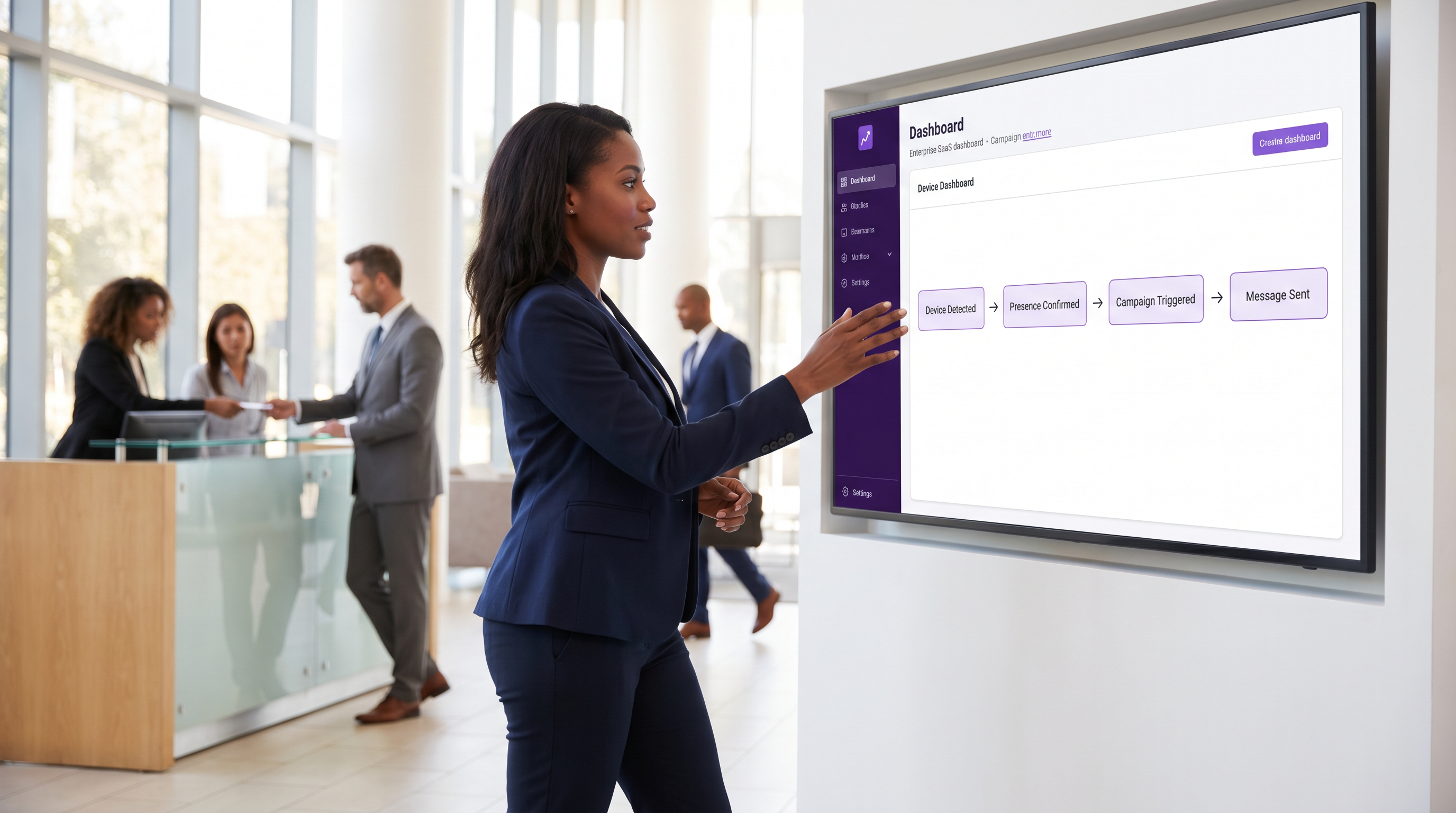
Automação de Marketing Orientada por Eventos Desencadeada pela Presença WiFi

Este guia de referência arquitetónica fornece aos líderes seniores de TI e operações um modelo para conceber automação de marketing orientada por eventos desencadeada pela presença WiFi. Abrange os requisitos de infraestrutura, gestão de latência, estratégias de deduplicação e estruturas de conformidade de privacidade necessárias para implementações em escala empresarial.

📖 5 min de leitura📝 1,005 palavras🔧 2 exemplos3 perguntas📚 8 termos-chave

🎧 Ouça este Guia

Ver Transcrição
Welcome to the Purple Technical Briefing Series. I'm your host, and today we're covering a topic that sits at the intersection of network infrastructure and revenue generation: WiFi presence automation — specifically, how to architect event-driven marketing systems where a guest's physical presence, detected through your WiFi network, becomes the trigger for personalised, real-time marketing campaigns. If you're a marketing technologist, a network architect, or a venue operations director, this briefing is for you. We'll move through the core architecture, the latency considerations that separate a good implementation from a frustrating one, the deduplication problem that every team underestimates, and the privacy frameworks you cannot afford to ignore. Let's get into it. --- SECTION ONE: WHY PRESENCE IS THE MOST VALUABLE MARKETING SIGNAL YOU'RE ALREADY COLLECTING Let me start with a question. Your venue — whether it's a hotel, a retail chain, a stadium, or a conference centre — already has WiFi infrastructure. You're already generating presence events every time a device associates with an access point. The question isn't whether you have the data. The question is whether you're doing anything useful with it. Traditional digital marketing operates on intent signals: someone searches for a product, clicks an ad, opens an email. Those are valuable, but they're all happening outside your venue. WiFi presence automation operates on a fundamentally different and arguably more powerful signal: physical proximity. The guest is already there. They've already made the decision to visit. Your job is to make that visit more valuable — for them and for you. The architectural challenge is converting a raw network event — a device association, a probe request, a DHCP lease — into a contextually relevant, personalised marketing action within a timeframe that's still useful. In a retail environment, that window might be two to five minutes. In a hotel, you have the entire stay. The architecture has to be designed around those constraints from day one. --- SECTION TWO: THE FOUR-LAYER ARCHITECTURE Let me walk you through the reference architecture we recommend for enterprise WiFi presence automation. It has four distinct layers, and getting the boundaries between them right is critical. Layer one is the Network Layer. This is your physical infrastructure: access points, controllers, and the RADIUS server that handles authentication. The key design decision here is what events you're surfacing from the network. You have three options. First, probe requests — passive signals from devices scanning for known networks. Second, association events — the moment a device successfully connects to your SSID. Third, authenticated session events — where you have a confirmed user identity tied to a device, typically via a captive portal login or 802.1X authentication. My strong recommendation is to build your automation on authenticated session events, not probe requests. Here's why. Since iOS 14 and Android 10, both Apple and Google have implemented MAC address randomisation by default. A device scanning for networks will present a randomised MAC address that changes per network and, in some implementations, per session. If you're building a presence detection system on probe-based MAC tracking, you're building on sand. Association events tied to a captive portal login give you a persistent, consent-linked identifier that survives MAC randomisation. Layer two is the Presence Engine. This is where raw network events are transformed into meaningful presence signals. Purple's platform handles this through the Event Stream Engine, which performs four critical functions. Probe detection and filtering — separating genuine dwell from drive-by signals. Association event processing — capturing the moment of authenticated connection. Dwell time calculation — determining how long a device has been present before a trigger fires. And deduplication — preventing the same device from triggering the same campaign multiple times within a suppression window. The deduplication component deserves particular attention. In a busy retail environment, a single device might associate, disassociate, and reassociate with your network multiple times in an hour as the guest moves between areas of the store. Without a robust deduplication engine, you'll fire the same welcome message three times in forty minutes. That's not personalisation — that's harassment. The suppression window needs to be configurable per campaign type, per venue type, and per user segment. Layer three is the Automation Layer. This is where business logic lives. In Purple's implementation, this is LogicFlow — a visual workflow engine that lets marketing and operations teams define trigger conditions, branching logic, and action sequences without writing code. The key architectural principle here is that the automation layer should be decoupled from the network layer. Changes to your campaign logic should not require changes to your network configuration, and vice versa. This separation of concerns is what allows marketing teams to iterate on campaigns without involving IT for every change. Layer four is the Delivery Layer. This is where the triggered action actually reaches the guest: an email, an SMS, a push notification, a webhook to your CRM, or an update to your loyalty platform. The critical design consideration here is that the delivery layer must respect the consent and preference data captured at the captive portal. If a guest opted into SMS but not email, your automation must honour that. This isn't just good practice — under GDPR and PECR, it's a legal requirement. --- SECTION THREE: LATENCY — WHAT'S ACCEPTABLE AND WHAT ISN'T Let me give you the numbers, because this is where a lot of implementations go wrong. End-to-end latency in a WiFi presence automation system is the time from a device associating with your network to the guest receiving the triggered communication. In a well-architected system on modern infrastructure, this should be achievable in under ten seconds for most venue types. But acceptable latency varies significantly by context. In a transport hub — an airport or a rail terminal — you might have a guest who connects to WiFi for three minutes while waiting for a gate change. Your trigger needs to fire within sixty to ninety seconds of connection, or the moment has passed. In a hotel, where the guest will be on-property for twelve to forty-eight hours, a ten-second or even thirty-second latency is entirely acceptable. The latency budget breaks down across three components. Network-to-platform latency: the time for the association event to travel from the access point controller to the Purple platform. In a cloud-connected deployment with a well-configured controller, this should be under one second. Platform processing latency: the time for the Event Stream Engine to classify the event, check deduplication, evaluate automation conditions, and dispatch the action. In Purple's architecture, this is typically under two seconds. Delivery channel latency: the time for the downstream channel — email provider, SMS gateway, push notification service — to deliver the message. This is the component you have least control over, and it's where most of the variance lives. SMS via a Tier 1 gateway is typically under five seconds. Email delivery can range from two seconds to two minutes depending on the recipient's mail server. The practical implication: if you need sub-ten-second end-to-end delivery, SMS or push notifications are your only reliable options. Email is not a real-time channel, and you should not architect your presence automation as if it were. --- SECTION FOUR: THE DEDUPLICATION PROBLEM IN DEPTH I want to spend a few minutes on deduplication because it's the component that most commonly causes production issues in presence automation deployments. The core problem is this: a single physical visit can generate dozens of network events. A guest walks into your hotel, connects to WiFi in the lobby, walks to their room, the device briefly loses signal and reconnects, they go to the restaurant and the device roams to a different access point. From the network's perspective, that's potentially four or five association events. From the guest's perspective, it's one visit. Your deduplication engine needs to operate at two levels. Device-level deduplication collapses multiple association events from the same device within a session window into a single presence event. A session window of fifteen to thirty minutes is appropriate for most venue types — if a device disassociates and reassociates within that window, it's treated as a continuation of the same session, not a new visit. Campaign-level deduplication prevents the same campaign from firing for the same guest within a suppression window. This window should be configurable per campaign. A welcome message should have a suppression window equal to the length of a typical stay — seven days for a hotel, twenty-four hours for a retail store. A time-sensitive offer might have a suppression window of just four hours. A loyalty points reminder might suppress for thirty days. The third deduplication consideration is cross-device deduplication. If a guest has previously connected to your network on their laptop and their phone, and both devices are present simultaneously, you should fire the campaign once, not twice. This requires a profile-linking capability — typically implemented via the email address or loyalty ID captured at the captive portal — that associates multiple devices with a single guest profile. --- SECTION FIVE: PRIVACY FRAMEWORKS — THE NON-NEGOTIABLES Let me be direct about the regulatory landscape, because I've seen implementations that were technically excellent but legally problematic. Under GDPR and the UK GDPR, processing a guest's location data — which is what WiFi presence detection effectively constitutes — requires a lawful basis. The two most commonly applicable bases are consent and legitimate interest. Consent is the cleaner option: the guest explicitly agrees to presence-based marketing at the captive portal. Legitimate interest requires a documented balancing test demonstrating that your interest in sending the communication does not override the guest's privacy rights. For most marketing use cases, consent is the safer and more defensible basis. PECR — the Privacy and Electronic Communications Regulations — adds an additional layer for electronic marketing. Sending a marketing SMS or email triggered by WiFi presence requires prior consent from the recipient, regardless of your GDPR lawful basis. This consent must be specific, informed, and freely given. A pre-ticked checkbox on a captive portal does not constitute valid PECR consent. On the technical side, MAC address randomisation has effectively ended the era of passive, consent-free device tracking. Any architecture that relies on tracking randomised MAC addresses without user consent is both technically unreliable and legally questionable. The correct approach is to use the authenticated session identifier — the email address or loyalty ID — as your primary tracking key, with the MAC address used only as a session-level correlation handle. PCI DSS compliance requires that your guest WiFi network be completely isolated from any network segment that processes payment card data. This means VLAN separation at minimum, with firewall rules preventing any traffic flow between the guest network and the payment network. Your presence automation platform should sit on or connect to the guest network segment, never the payment network. --- SECTION SIX: IMPLEMENTATION RECOMMENDATIONS AND COMMON PITFALLS Let me give you the five recommendations I give every client before they go live with a presence automation deployment. First: start with your data model, not your campaigns. Before you configure a single automation rule, define your guest identity model. What is the primary identifier? How do you handle multiple devices per guest? How do you link WiFi identity to your CRM or loyalty platform? Getting this wrong at the start creates technical debt that's expensive to unwind. Second: instrument your deduplication before you go live. Run the system in observation mode — logging events without firing campaigns — for at least two weeks before launch. This gives you real data on your association event frequency, your typical session patterns, and your re-visit rates. Use this data to calibrate your suppression windows. Third: design your consent flow before your campaign flow. The captive portal is not just a network access mechanism — it's your consent capture point. Every data processing activity you intend to perform must be disclosed and consented to at this point. Work with your legal team to ensure the consent language is specific enough to be valid under PECR. Fourth: test your latency under load. A presence automation system that performs well with ten concurrent connections may degrade significantly with a thousand. Load test your event processing pipeline at two to three times your expected peak concurrent device count before going live at a major event or peak trading period. Fifth: build suppression management into your operations workflow. Marketing teams will want to run multiple campaigns simultaneously. Without a clear suppression hierarchy — which campaign takes priority when multiple triggers fire simultaneously — you'll end up with guests receiving three messages in five minutes. Define the hierarchy before campaigns go live, not after the first complaint. --- RAPID-FIRE Q&A Question: Can I use WiFi presence automation without a captive portal? Answer: Technically yes, using probe-based detection, but practically no for any compliant marketing use case. Without a captive portal, you have no consent capture mechanism and no persistent guest identifier. You're tracking randomised MACs with no legal basis. Don't do it. Question: What's the minimum access point density for reliable presence detection? Answer: For dwell time accuracy within five metres, you need overlapping coverage from at least three access points. For zone-level presence — knowing a guest is in the store, not which aisle — one AP per zone is sufficient. Design your AP density to match your use case. Question: How do I integrate Purple's event stream with my existing CRM? Answer: Purple supports webhook-based event dispatch and native integrations via Zapier and direct API. For enterprise CRM platforms like Salesforce or HubSpot, the recommended approach is a webhook to a middleware layer that handles data transformation and CRM API calls. This keeps the integration loosely coupled and easier to maintain. --- SUMMARY AND NEXT STEPS WiFi presence automation is one of the highest-ROI applications of your existing network infrastructure. The technology is mature, the regulatory framework is clear, and the implementation patterns are well-established. The difference between a successful deployment and a problematic one comes down to three things: a robust identity model that survives MAC randomisation, a deduplication engine calibrated to your specific venue and visit patterns, and a consent architecture that satisfies both GDPR and PECR requirements. If you're evaluating Purple for this use case, the two components to focus on are the Event Stream Engine for presence signal processing and LogicFlow for automation logic. Both are designed to operate at enterprise scale with the configurability you need to serve multiple venue types and campaign types from a single platform. For your next steps: review your current captive portal consent language against PECR requirements, audit your existing WiFi infrastructure for AP density adequacy, and define your guest identity model before touching any automation configuration. Thank you for listening to the Purple Technical Briefing Series. Full documentation, architecture guides, and integration references are available at purple.ai.

Resumo Executivo

header_image.png

Para locais modernos — desde cadeias de retalho e grupos hoteleiros a estádios de grande escala — a infraestrutura de rede sem fios existente representa um ativo subutilizado para o envolvimento do cliente em tempo real. A automação de marketing orientada por eventos desencadeada pela presença WiFi transforma a conectividade de rede passiva num canal de envolvimento ativo. Este guia fornece um modelo arquitetónico definitivo para implementar a automação baseada em presença, focando-se na mecânica técnica de converter eventos de rede brutos em ações de marketing contextualmente relevantes e conformes. Ao preencher a lacuna entre a infraestrutura de rede e a tecnologia de marketing, os líderes de TI podem proporcionar um impacto comercial mensurável, mantendo padrões rigorosos de privacidade e segurança.

Ouça o podcast do briefing executivo:

Análise Técnica Detalhada: A Arquitetura de Quatro Camadas

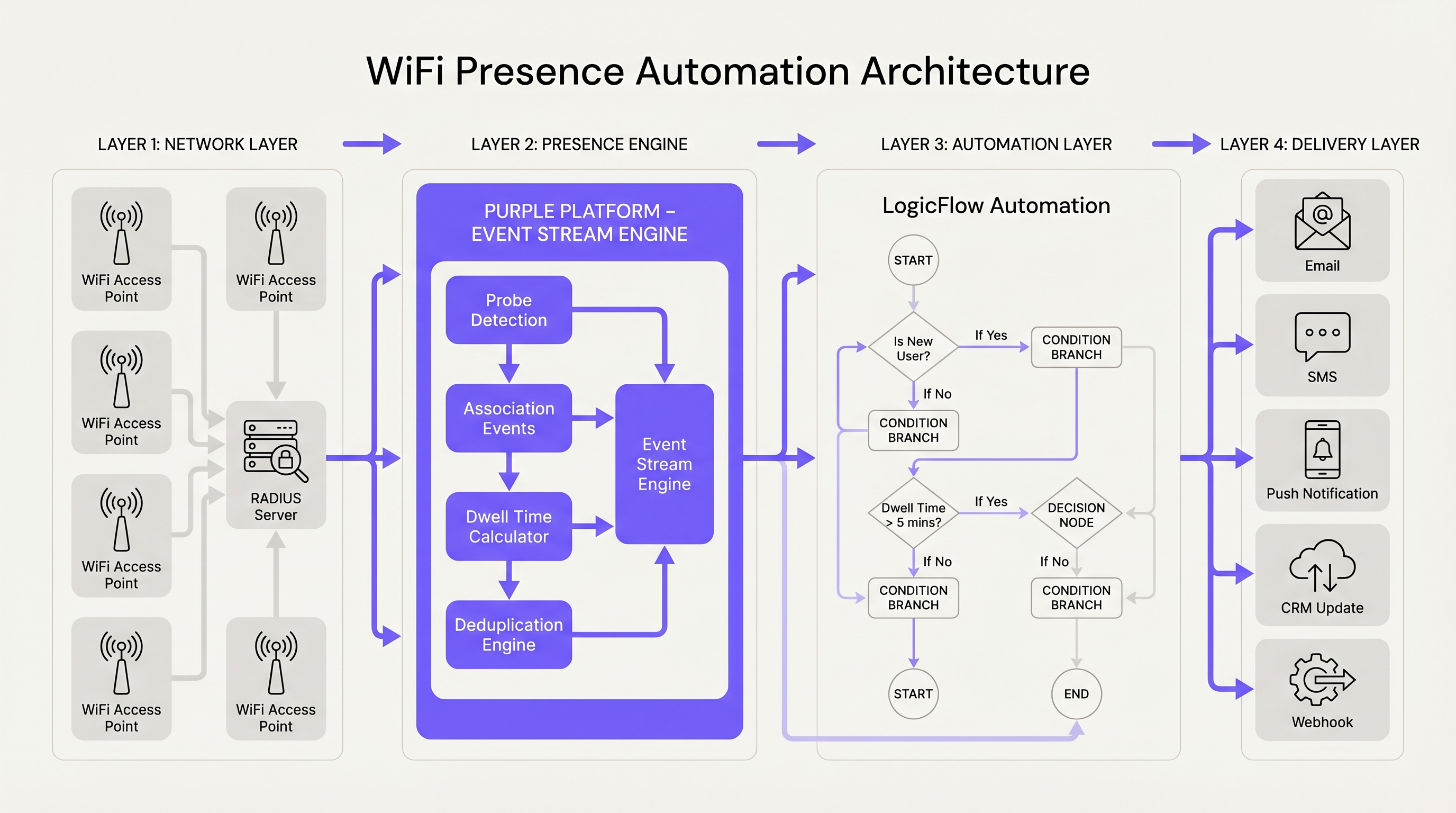
Projetar um sistema robusto de automação de presença WiFi requer uma abordagem desacoplada de quatro camadas. Esta separação de preocupações garante que as alterações à lógica de marketing não exigem reconfiguração da rede, e as atualizações de rede não quebram campanhas automatizadas.

Camada 1: A Camada de Rede

A base da deteção de presença depende da infraestrutura física — pontos de acesso, controladores de LAN sem fios e o servidor RADIUS. A decisão arquitetónica crítica nesta camada é determinar quais eventos de rede irão desencadear a automação a jusante. Enquanto os sistemas legados frequentemente dependiam de pedidos de sonda passivos, as implementações modernas devem priorizar eventos de sessão autenticados. Desde a introdução da aleatorização de endereços MAC por defeito nos sistemas operativos móveis modernos, o rastreamento baseado em sondas tornou-se tecnicamente não fiável e legalmente precário. Em vez disso, aproveitar eventos de associação ligados a um login de Captive Portal de Guest WiFi fornece um identificador persistente e vinculado ao consentimento que sobrevive à aleatorização de MAC.

Camada 2: O Motor de Presença

Os eventos de rede brutos são inerentemente ruidosos e requerem processamento antes de poderem desencadear a lógica de negócio. O Motor de Presença, alimentado pelo Event Stream da Purple, ingere eventos de associação e executa filtragem crítica. Isso inclui filtragem de deteção de sondas para eliminar sinais de 'passagem', cálculo do tempo de permanência para garantir que o dispositivo permaneceu no local por um limiar mínimo, e deduplicação sofisticada. Em ambientes de alta densidade como Retalho ou Hotelaria , uma única visita de um convidado pode gerar dezenas de eventos de associação e roaming. O Motor de Presença agrupa estes eventos num único e limpo sinal de 'presença'.
architecture_overview.png

Camada 3: A Camada de Automação

Uma vez estabelecido um sinal de presença limpo, este passa para a Camada de Automação. No ecossistema Purple, isto é gerido pelo LogicFlow. Esta camada avalia o evento de presença contra regras de negócio predefinidas, como segmentação de utilizadores, frequência de visitas e janelas de supressão de campanhas. Por exemplo, uma regra pode ditar que uma campanha de 'Bem-vindo de Volta' só é acionada se o utilizador não tiver visitado nos últimos 30 dias e tiver estado presente na rede por pelo menos cinco minutos.

Camada 4: A Camada de Entrega

A camada final é responsável por executar a ação. Isto pode ser o envio de um SMS, o envio de um e-mail, o acionamento de uma notificação push através de uma aplicação do local, ou o disparo de um webhook para atualizar um CRM externo. A Camada de Entrega deve aderir estritamente às preferências de consentimento capturadas durante a fase inicial de autenticação, garantindo a conformidade com as regulamentações de privacidade.

Guia de Implementação: Latência e Deduplicação

A implementação bem-sucedida depende da gestão de duas restrições técnicas críticas: latência de ponta a ponta e deduplicação de eventos.

Gerir a Latência de Ponta a Ponta

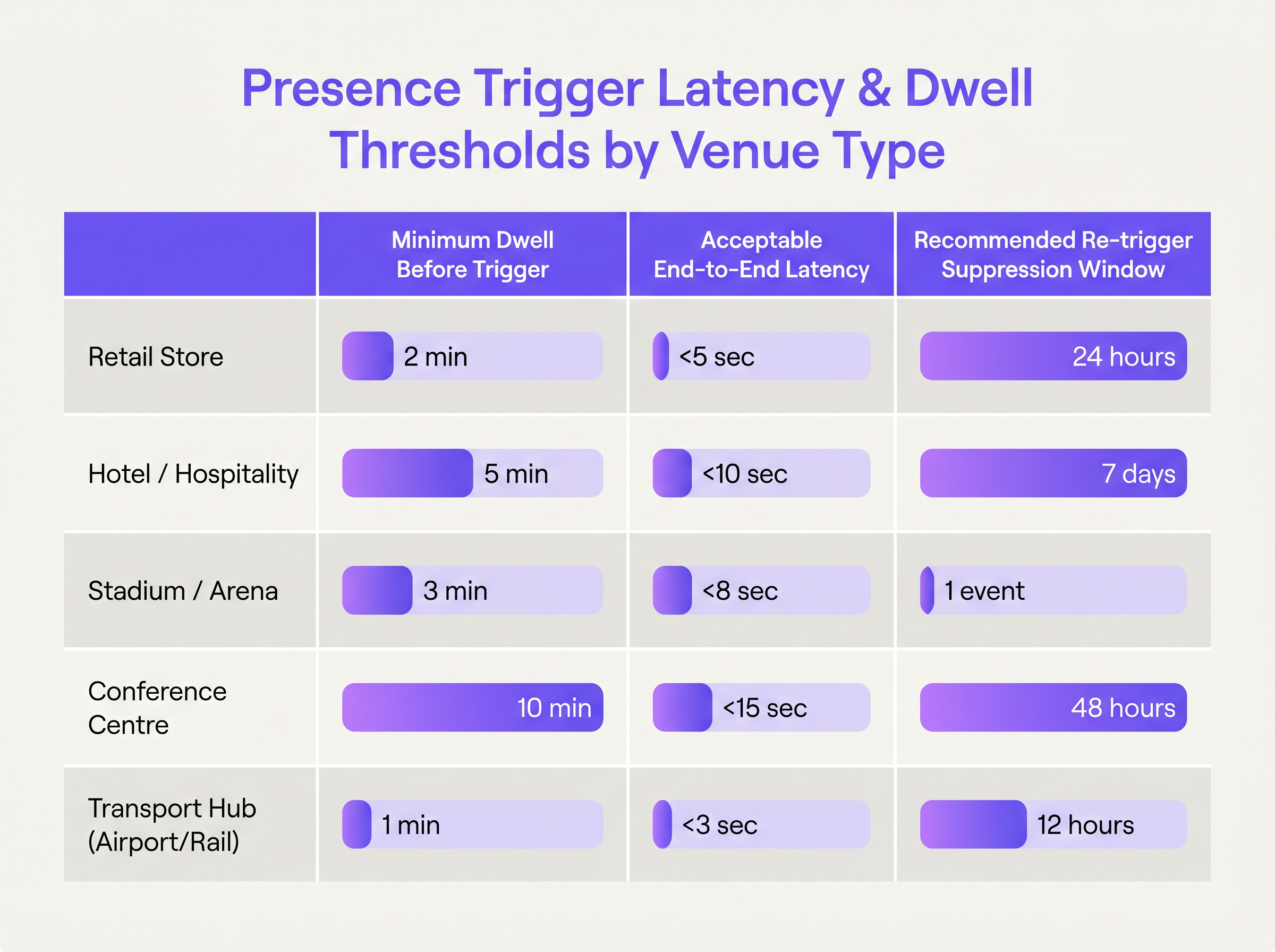
A latência na automação de presença é definida como o tempo decorrido entre um dispositivo associar-se à rede e o convidado receber a comunicação desencadeada. A latência aceitável varia significativamente por tipo de local. Num centro de Transporte , um gatilho deve ser acionado em segundos, enquanto uma implementação hoteleira pode tolerar maior latência.
latency_trigger_matrix.png

Para alcançar uma latência inferior a dez segundos, os arquitetos devem otimizar a transmissão de eventos da rede para a plataforma (tipicamente via syslog ou API push do controlador) e selecionar canais de entrega apropriados. SMS e notificações push são adequados para gatilhos em tempo real, enquanto o e-mail deve ser reservado para comunicações assíncronas devido a atrasos inerentes na entrega.

O Desafio da Deduplicação

A deduplicação deve ocorrer tanto ao nível do dispositivo quanto ao nível da campanha. A deduplicação ao nível do dispositivo envolve a definição de uma 'janela de sessão' — tipicamente de 15 a 30 minutos. Se um dispositivo se desassociar e reassociar dentro desta janela, é tratado como uma continuação da sessão existente em vez de uma nova visita. A deduplicação ao nível da campanha requer a configuração de janelas de supressão para evitar a fadiga de mensagens. Um erro comum é não implementar a deduplicação entre dispositivos, onde um utilizador se conecta com um smartphone e um laptop, resultando em gatilhos de campanha duplicados. Isto é mitigado ao ligar endereços MAC a um único perfil de utilizador autenticado (por exemplo, um endereço de e-mail) dentro do WiFi Analytics plataforma.

Estruturas de Privacidade e Conformidade

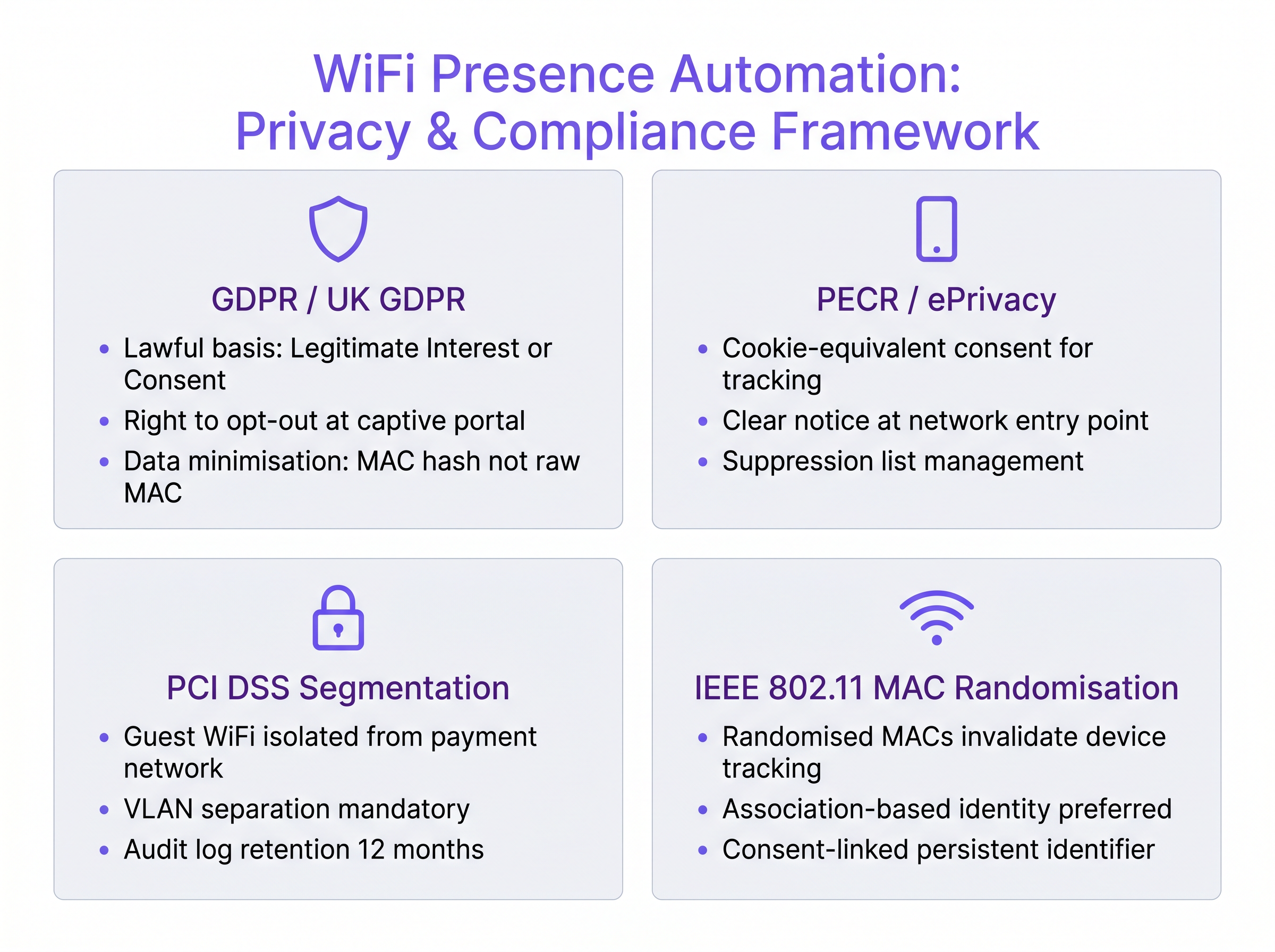
A implementação de automação baseada em presença exige estrita adesão a estruturas de privacidade e segurança. Um sistema tecnicamente impecável que viola os padrões de conformidade introduz um risco inaceitável para a empresa.
privacy_compliance_framework.png

Conformidade com GDPR e PECR

Ao abrigo do Regulamento Geral sobre a Proteção de Dados (GDPR), o tratamento de dados de localização requer uma base legal. Embora o 'Interesse Legítimo' seja por vezes utilizado, o 'Consentimento' explícito capturado no captive portal é a abordagem mais defensável para a automação de marketing. Além disso, as Regulamentações de Privacidade e Comunicações Eletrónicas (PECR) exigem consentimento específico e informado para comunicações de marketing eletrónicas (SMS, email). Caixas pré-selecionadas são inválidas; é necessário um opt-in ativo.

Segurança e Segmentação

De uma perspetiva de segurança de rede, a infraestrutura de WiFi para convidados deve ser estritamente segmentada das redes corporativas e de pagamento. Em ambientes que processam dados de titulares de cartões, a conformidade com PCI DSS exige separação de VLAN e isolamento de firewall. A plataforma de automação de presença deve interagir apenas com o segmento de rede de convidados isolado. Para mais informações sobre como proteger o acesso à rede, consulte o nosso guia sobre Aruba ClearPass vs Cisco ISE: Comparação de Plataformas NAC .

ROI e Impacto no Negócio

O valor comercial da automação de marketing orientada por eventos é medido no aumento da taxa de conversão e na eficiência operacional. Ao mudar de marketing de "batch-and-blast" para um envolvimento em tempo real e contextualmente relevante, os locais geralmente observam um aumento de 3x a 5x nas taxas de envolvimento. Por exemplo, um estádio que aciona uma oferta de merchandising por SMS 15 minutos depois de um fã se conectar à rede capitaliza o tempo de permanência de alta intenção. Além disso, a integração destes eventos de presença em fluxos de trabalho empresariais mais amplos — como Conectar Eventos WiFi a Mais de 1.500 Aplicações com Zapier e Purple — permite que as equipas de TI automatizem tarefas operacionais, como alertar a equipa quando um convidado VIP chega às instalações. Semelhante aos ganhos de eficiência de rede discutidos em Os Principais Benefícios do SD WAN para Empresas Modernas , a automação de fluxos de trabalho de marketing reduz a sobrecarga manual e garante uma execução consistente em escala.

Termos-Chave e Definições

MAC Randomisation

A privacy feature in modern operating systems where a device broadcasts a randomly generated MAC address instead of its true hardware address when scanning for networks.

Crucial for IT teams to understand because it invalidates legacy presence analytics systems that rely on passive probe tracking.

Probe Request

A frame sent by a client device to discover available 802.11 networks within its proximity.

Useful for footfall counting, but insufficient for marketing automation due to lack of identity and consent.

Association Event

The moment a wireless client successfully connects and authenticates to an Access Point.

The primary, reliable trigger point for event-driven marketing automation.

Dwell Time

The continuous duration a device remains associated with the network during a single visit.

Used as a condition in automation logic to differentiate between a transient passerby and an engaged customer.

Suppression Window

A defined period during which a specific automated campaign will not fire again for the same user, regardless of trigger conditions being met.

Essential for preventing message fatigue and maintaining a positive user experience.

Captive Portal

A web page that the user of a public-access network is obliged to view and interact with before access is granted.

The critical juncture for capturing user identity and securing legal consent for marketing automation.

LogicFlow

A visual workflow automation engine that evaluates presence events against business rules to trigger downstream actions.

Allows marketing teams to manage campaign logic without requiring network engineers to alter infrastructure configurations.

VLAN Segmentation

The practice of partitioning a physical network into multiple distinct broadcast domains.

A mandatory security requirement to isolate guest WiFi traffic from corporate or payment processing systems.

Estudos de Caso

A 400-room resort hotel wants to trigger a 'Welcome to the Spa' SMS offer when a guest connects to the WiFi network near the spa facilities. They are currently using probe requests for detection, but the marketing team reports that the campaign is firing inconsistently, and some guests are receiving the message multiple times a day.

  1. Migrate from probe-based detection to authenticated association events. Probe requests use randomised MAC addresses, causing the system to treat a single device as multiple new visitors. 2. Implement Location-Based Triggers using specific Access Point (AP) MAC addresses located in the spa zone, rather than the general venue SSID. 3. Configure a Dwell Time Threshold of 3 minutes to filter out guests merely walking past the spa to the elevators. 4. Set a Campaign Suppression Window of 7 days to ensure a guest only receives the offer once per typical stay, preventing message fatigue.
Notas de Implementação: This solution addresses the root cause of the inconsistency (MAC randomisation) while implementing necessary business logic (dwell time and suppression) to protect the guest experience. It correctly shifts the trigger from passive scanning to active, authenticated presence.

A large retail chain wants to integrate their WiFi presence events with their central CRM (Salesforce) to update customer profiles in real-time when they enter a store. The IT team is concerned about API rate limits being exceeded during peak weekend trading hours.

  1. Do not use direct, synchronous API calls from the WiFi controller to the CRM for every association event. 2. Route all association events through the Purple Event Stream Engine to perform device-level deduplication, collapsing multiple micro-disconnects into a single 'Visit Started' event. 3. Configure a webhook in LogicFlow to send only the processed 'Visit Started' event to an enterprise integration middleware (e.g., Zapier or a custom AWS Lambda function). 4. Implement a queuing mechanism in the middleware to batch CRM updates or apply rate-limiting logic before pushing the data to Salesforce.
Notas de Implementação: This architecture demonstrates a mature understanding of enterprise system integration. By using the presence engine to filter noise and middleware to handle API constraints, the design protects the downstream CRM from being overwhelmed by raw network telemetry.

Análise de Cenários

Q1. A stadium IT director wants to send a push notification via the venue's mobile app the moment a fan connects to the WiFi at the entrance gates. They are currently seeing a 45-second delay between connection and notification delivery. Where should they investigate first to reduce latency?

💡 Dica:Consider the components of the latency budget: Network-to-platform, Platform processing, and Delivery channel.

Mostrar Abordagem Recomendada

They should investigate the network-to-platform event transmission. In a high-density environment like a stadium, if the wireless controller is batching syslog events or API updates rather than streaming them in real-time, it introduces significant artificial latency before the automation platform even receives the trigger signal. Secondary investigation should verify the push notification gateway's processing queue.

Q2. A retail marketing team requests that the IT department configure the network to track all devices walking past their storefront windows to trigger a 'Come Inside' SMS campaign. How should the IT architect respond?

💡 Dica:Consider the technical reality of modern mobile devices and the legal requirements for electronic marketing.

Mostrar Abordagem Recomendada

The IT architect must reject the request on both technical and compliance grounds. Technically, tracking devices outside the store relies on passive probe requests, which use randomised MAC addresses, making reliable identification impossible. Legally, under PECR and GDPR, sending an SMS requires explicit, prior opt-in consent, which cannot be obtained from a device merely walking past. The architect should propose an alternative: triggering campaigns only for users who have previously authenticated via the captive portal and explicitly opted into SMS marketing.

Q3. During testing of a new presence automation deployment in a hospital waiting room, the system is correctly identifying devices, but the 'Welcome to the Clinic' email is firing every time a patient's device roams between two adjacent access points. What configuration is missing?

💡 Dica:Consider how the system differentiates between a network roaming event and a new visit.

Mostrar Abordagem Recomendada

The system is missing device-level deduplication (specifically, a session window configuration). The Event Stream Engine needs to be configured to recognise that a disassociation followed immediately by a reassociation to a different AP within the same venue constitutes a roaming event within an ongoing session, not a new visit. The session window should be set to at least 15-30 minutes to collapse these micro-events.