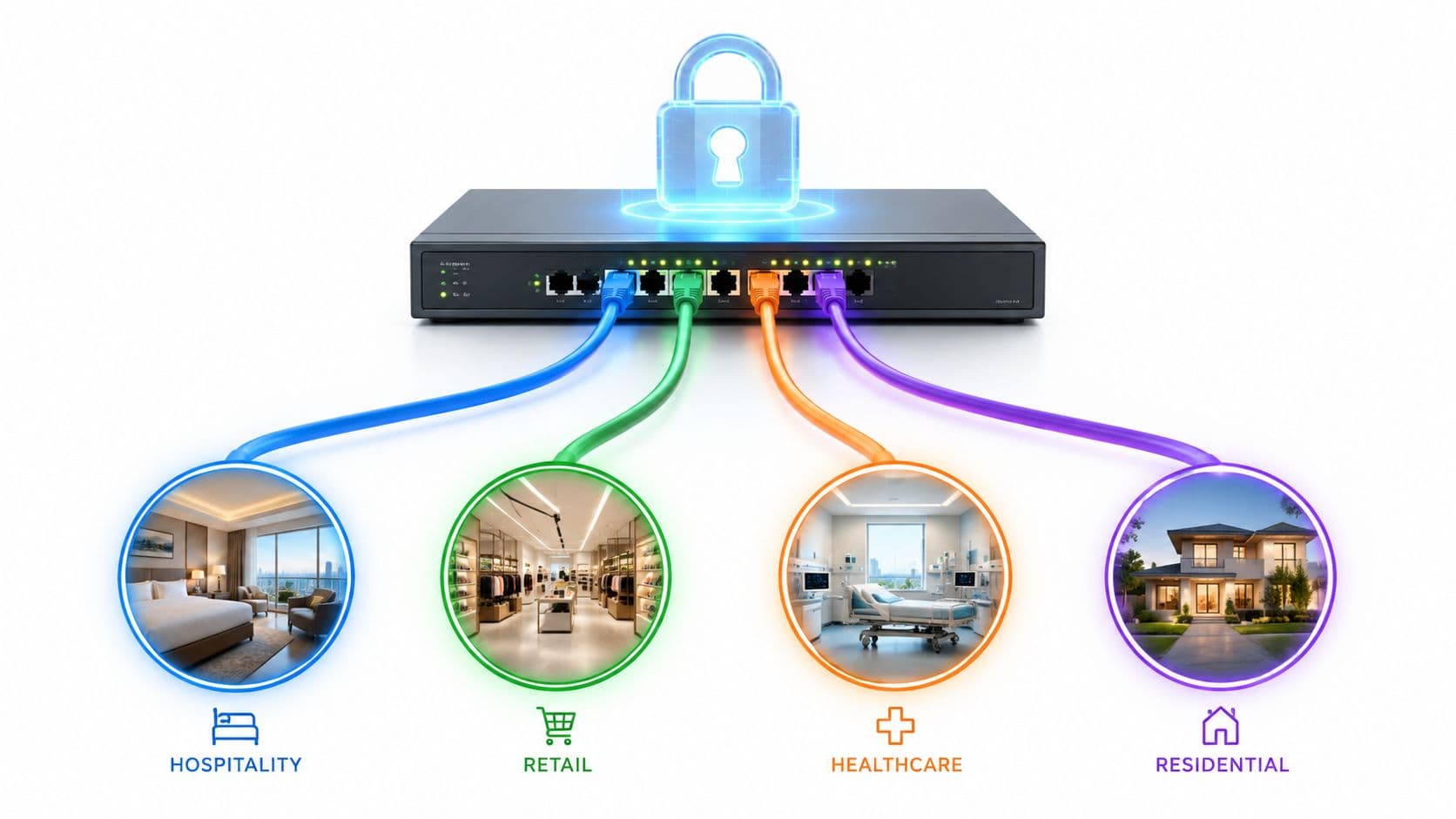
It's a busy Saturday night in a UK café-bar. The Wi-Fi password is written on the wall, staff, guests and contractors join the same wireless network, and the EPOS till sits only a few clicks away from devices nobody in the business manages. A journalist connects with a laptop, while a guest's infected machine begins scanning for anything else it can reach.
That shared-password model creates a visibility problem before it creates a security problem. The team may know that a device is connected, but not who is using it, whether it belongs on the network, or what it should be allowed to access.
Network Access Control, or NAC, is policy-driven gatekeeping at the wired and wireless edge. It decides who and what may connect, checks relevant conditions, and places the connection into an appropriate network segment before normal communication begins. The network access control benefits are therefore broader than blocking unknown laptops. NAC can reduce the blast radius of an incident, automate onboarding and revocation, support audit evidence, and give operators a clearer view of how their network is being used.
The trade-off is practical. NAC needs integration work, a reliable identity or device data source, carefully designed policies, and a cultural move away from shared pre-shared keys. It should be treated as an operational control, not a magic appliance.
Why Network Access Control Matters for Modern Venues
A hotel may have guests checking email, employees using business applications, contractors connecting for a short job, and payment or building systems running continuously. If every connection receives similar access because users share one password, a problem on a guest device can reach far beyond the guest network. The business impact is measured in interrupted services, investigation time, and the number of systems exposed.
NAC changes the access decision from “which socket or access point?” to “which identity or device, under which policy?” A staff member can receive access to internal applications, while a guest on the same wireless infrastructure gets internet access only. A reception terminal can follow a restricted rule, even if it uses the same switching estate as a conference laptop.
Practical rule: If the network cannot identify a connection and explain why it has access, the organisation has limited control over its attack surface.
The UK baseline is clear: venues still need secure configuration, access control, patching, backups, and staff awareness. The Cyber Security Breaches Survey 2025 technical report found that 43% of UK businesses and 30% of UK charities experienced a cyber breach or attack in the previous 12 months. NAC would not prevent every incident. It gives those baseline controls an identity-aware enforcement point, helping limit how far a compromised connection can move.
The practical network access control benefits are business outcomes:
- Smaller blast radius: Segmentation restricts the systems a compromised device can reach.
- Better device hygiene: Posture checks can separate managed, compliant endpoints from unknown or risky ones.
- Clearer accountability: Identity-based access provides a record instead of relying on anonymous shared credentials.
- Less manual work: Joiner, mover and leaver changes can update network policy.
- Stronger evidence: Authentication events and policy decisions support reviews and investigations.
- More useful service data: Connection records can inform guest experience and operational decisions.
NAC requires integration, dependable identity or device data, carefully tested policies, and a fallback plan for outages. It is an operational control, not a magic appliance. Its value appears when the venue can connect access decisions to measurable outcomes: fewer reachable systems, faster revocation, clearer investigations, and less disruption when one device is compromised.
Security Benefits of Segmentation and Posture Checks
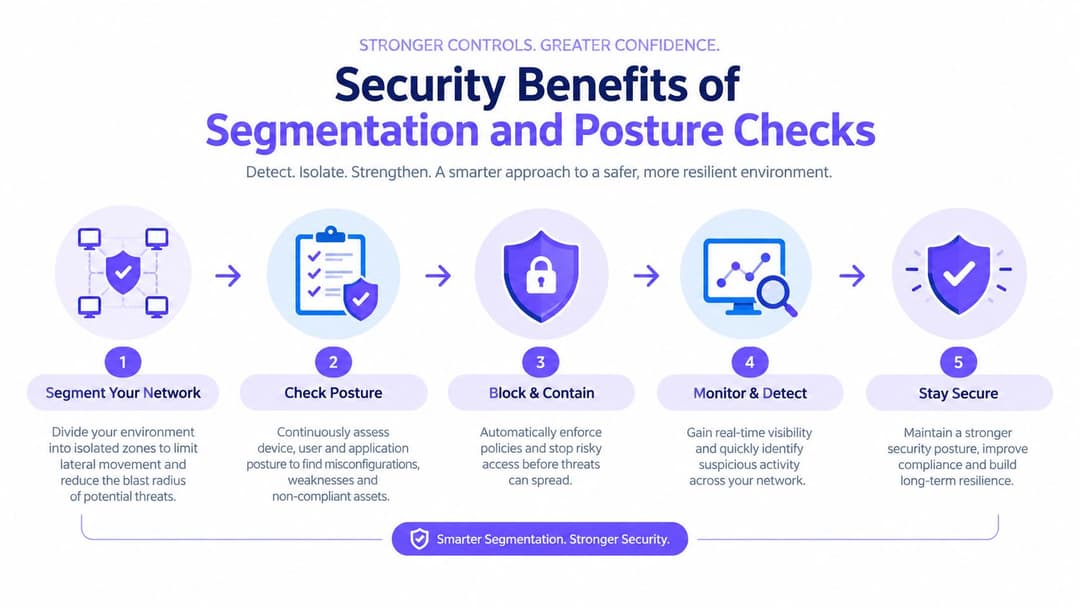
A compromised device is less dangerous when it has fewer places to go. NAC reduces that blast radius by controlling which systems a connection can reach. As noted earlier, breach costs vary by incident and organisation size. The operational point is steadier: limiting reachable systems can reduce the chance that one stolen credential or infected endpoint becomes a wider outage.
Segmentation creates controlled paths
A dynamic VLAN places a connection in the appropriate broadcast domain through policy, rather than requiring a separate physical network for every role. One wireless estate can carry staff, point-of-sale, guest and facilities traffic, while firewall rules determine the destinations available to each group.
The outcome depends on the role, not just the SSID. A staff member might need rota systems and internal applications. A guest should normally receive internet access only. A payment terminal may contact its approved payment services without reaching the wider corporate network. That separation gives operators a practical way to measure exposure, such as the number of systems reachable from each device class.
Posture checks add a condition to identity
Authentication answers, “Who is connecting?” Posture assessment adds, “Is this device currently suitable for the requested access?” NAC can use 802.1X and RADIUS for wired or wireless authentication, then evaluate signals such as operating-system updates, endpoint protection, MDM enrolment or a controlled health check.
A contractor's laptop shows how the decision can change. If it fails the patch requirement, NAC can place it in a remediation VLAN with access only to approved update resources. After the device meets policy, the network can re-evaluate the session and assign its intended role. RADIUS Change of Authorisation, or CoA, can support that transition without asking the user to disconnect manually.
The evidence has limits. Posture checks are only as dependable as the endpoint, identity and management data behind them. Legacy tills, printers, cameras and other IoT or operational devices may not support agent-based assessment. Profiling and narrowly scoped policies are often safer than treating every device as if it can provide identical evidence.
For hospitality operators, these controls also protect the systems that process orders and payments. The systec POS-Technology GmbH security resource provides context for POS security, while this enterprise Wi-Fi security guide connects wireless design with identity and policy enforcement. NAC still requires integration, tested rules, reliable device data and an outage fallback. It is an operational control whose value appears in fewer reachable systems, faster revocation, clearer investigations and less disruption after compromise.
Identity-Based Access with SSO, Certificates and Passpoint
Shared passwords fail in two ways. They're difficult to revoke for one person, and they provide weak evidence about which individual or device made a connection. Identity-based access replaces that common secret with a decision built from user identity, device identity and policy context.
A venue can climb this ladder in stages rather than redesigning everything at once.
First, a captive portal can authenticate staff against a directory such as Microsoft Entra ID, Okta or Google Workspace. SAML or OIDC can pass the authentication result to the access workflow, while guest vouchers or property-management integrations handle visitors who don't belong in the staff directory.
The stronger step is certificate authentication. A small internal certificate authority or SCEP workflow can issue machine certificates to managed laptops, EPOS terminals and approved tablets. The device then authenticates automatically, without asking staff to remember or share a Wi-Fi password. Directory changes can trigger revocation, which is much more precise than changing a password across an entire venue.
Passpoint and OpenRoaming address the guest experience. A visitor who has enrolled a device profile can reconnect automatically at participating locations, avoiding repeated portal forms and reducing pressure on reception or front-of-house teams. The security benefit comes from encrypted, identity-aware onboarding rather than an open network protected only by a password.
Consider a conference attendee who connects through OpenRoaming on the first day. If that person later becomes a temporary staff member, the organisation can issue a separate certificate-backed staff profile and apply a staff policy to the same access infrastructure. The access point doesn't need a new SSID for every change in status.
| Mechanism | Best use case | User effort | Strength |
|---|---|---|---|
| Captive-portal SSO | Staff and contractor onboarding | Sign-in through an approved identity provider | Better accountability than a shared password |
| Machine certificates | Managed laptops, terminals and tablets | Usually silent after provisioning | Strong device identity and easier revocation |
| Guest vouchers | Short-term visitors and events | Code or assisted enrolment | Simple expiry and temporary access |
| Passpoint | Returning guests and managed guest profiles | Initial profile enrolment | Frictionless, encrypted connection |
| OpenRoaming | Federated access across participating venues | Authenticate through a trusted provider | Reduces repeated sign-in across locations |
Teams considering this model can review identity-based networking as part of their design research. The important architectural question is not whether every user needs the same mechanism. It's whether each connection receives the least access appropriate to its identity and purpose.
Operational Gains from Automation and Multi-Tenant Management
A legacy rollout often depends on a chain of manual tasks. An engineer creates a site configuration, adds RADIUS details, assigns VLANs, provisions credentials and tests each SSID. When a property opens late or a policy changes during a busy period, the team repeats the work under pressure.
An automated NAC model moves those decisions into templates and integrations. A hospitality group can define a standard policy for staff, guests, POS and facilities, then adapt it for each property's network identifiers and local requirements. Certificates, access roles and onboarding flows can be provisioned from a central tenant instead of rebuilt site by site.
Compare the two operating models
| Operating model | Typical working pattern | Main exposure |
|---|---|---|
| Manual, site-by-site | Static assignments, local changes and engineer-led troubleshooting | Inconsistent policy and configuration drift |
| Centralised automation | Templates, directory integration and reusable access rules | A bad template can spread unless governance is strong |
| Multi-tenant orchestration | Shared standards with property-level isolation | Poor tenant separation can create data and administration risks |
The benefit isn't just speed. Fewer manual changes mean fewer opportunities to place a till in the wrong segment, leave a contractor active after a project ends, or apply a guest rule to a staff network. Those errors can create both security exposure and avoidable service tickets.
Multi-tenant design also gives an operator a controlled way to isolate a problem property. A misbehaving site can be placed under a stricter policy or temporarily separated from group-wide services without changing every other venue. Central teams gain consistency, while local operators retain only the permissions they need.
Automation still requires ownership. Someone must approve templates, review exceptions, maintain identity sources and test failure behaviour. Vendors also differ in how cleanly they separate tenant data and administrative roles, so procurement should examine isolation and audit controls rather than accepting “cloud-managed” as a complete answer.
The practical operational gain is therefore repeatability. A repeatable access decision is easier to troubleshoot, easier to review and less likely to depend on one engineer remembering an undocumented change.
Business Value, Analytics and ROI
NAC becomes easier to fund when the business case includes customer experience and information quality. Guest Wi-Fi can become a consent-based first-party touchpoint, allowing a venue to connect an approved email or identity to visit context and CRM workflows instead of relying entirely on anonymous traffic.
The conversion path should be designed carefully. A portal can request consent, explain the value exchange and pass permitted data to a CRM connector. Passpoint or OpenRoaming can remove repeated friction for returning visitors, while the venue still needs clear privacy notices, appropriate retention and a lawful basis for any marketing activity.
That makes analytics useful only when someone acts on it. A hotel group might compare connection failures, support contacts and repeat-visit signals across properties. A shopping centre could examine where guest connectivity complaints coincide with weaker engagement. These outputs are operational indicators, not automatic proof that a network change caused a commercial result.
Commercial discipline: A dashboard has no return unless a team uses its findings to change a campaign, fix a service problem or protect a valuable customer journey.
A sensible ROI model should list costs and attributable outcomes separately:
| Metric | Legacy shared password | NAC with Passpoint or SSO |
|---|---|---|
| Guest identification | Often anonymous or inconsistently captured | Consent-based identity can be linked to an access event |
| Credential management | Password changes affect many users | Profiles, vouchers or identities can be revoked individually |
| Marketing connection | Manual export or limited data | CRM and marketing integrations can receive permitted fields |
| Operational evidence | Basic connection records | User, device and policy events can support analysis |
| Investment test | Low initial complexity, higher control limitations | Licence and integration cost weighed against support, security and marketing outcomes |
Use a conservative model. Include implementation, licences, integration and ongoing administration. Then compare them with measurable helpdesk effort, recovered campaign value, reduced credential handling and revenue that can be reasonably attributed to repeat engagement. Avoid assuming that every connection becomes a booking or that every saved support interaction is pure profit.
A Wi-Fi ROI calculator can help structure those assumptions. The result will depend on data quality and operational discipline, not on the presence of analytics alone.
Compliance and Reporting Aligned to UK Guidance
Compliance teams rarely need another disconnected security console. They need evidence that access rules exist, that people apply them consistently, and that the organisation can investigate exceptions. NAC can provide part of that evidence by recording authentication attempts, posture decisions, role assignments, policy changes and revocations.
This aligns with the UK National Cyber Security Centre's introduction to zero trust network access. The NCSC describes removing implicit trust from users, devices, services and networks as a core design principle. NAC supports that principle by asking for identity and device context before allowing communication, rather than treating an internal location as proof of trust.
Turn policy into an evidence trail
For a regulated or audited environment, useful records include:
- Authentication context: Which identity or certificate requested access.
- Device context: Which endpoint, terminal or device profile made the request.
- Policy result: Which rule allowed, restricted, quarantined or denied the connection.
- Change history: Who altered the policy and when.
- Lifecycle action: When access was revoked after a role or device change.
That evidence can support access-control reviews associated with Cyber Essentials Plus, PCI DSS, ISO 27001 and UK GDPR, but NAC doesn't make an organisation compliant by itself. The controls must match the scope, risks and obligations of the specific environment.
A payment environment might use segmentation and tightly limited paths around terminals. A healthcare provider may need stronger controls around clinical devices and records. A hospitality operator handling guest data must still manage privacy notices, retention and processor relationships. NAC contributes technical evidence, while governance teams decide how that evidence meets the relevant requirement.
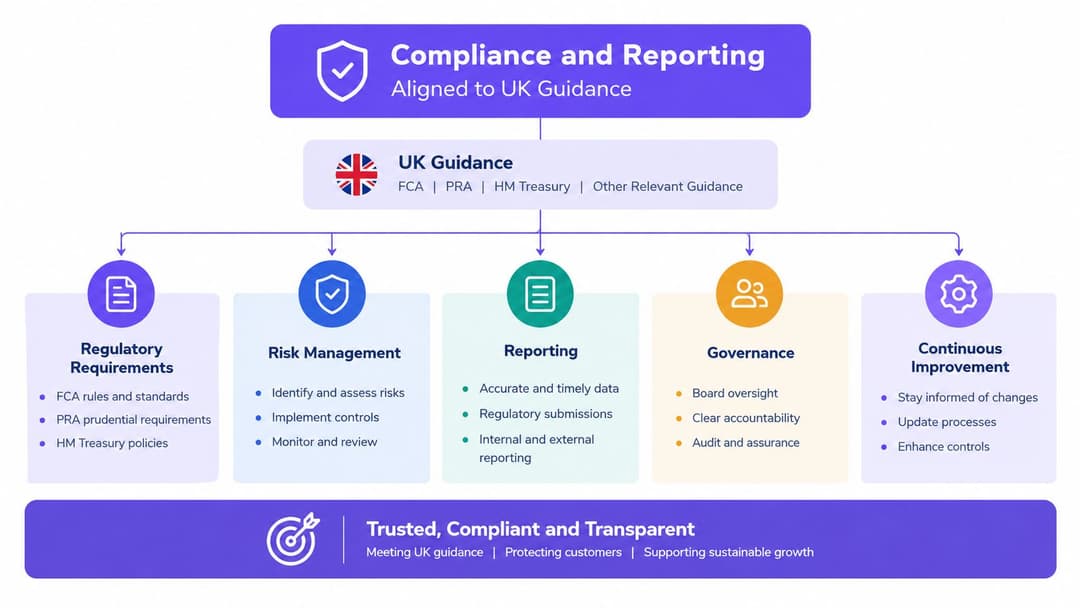
The limit matters. NAC covers connections that touch the controlled network. Physical ports, unmanaged IoT, rogue infrastructure and systems outside the enforcement path need complementary safeguards. Its strongest role is as connective tissue between technical policy and the documentation an auditor or incident investigator needs.
Use Cases for Hospitality, Retail, Healthcare and Residential
The network access control benefits look different depending on the operational problem. A venue shouldn't begin with a product feature. It should begin with the connection that creates the most risk, friction or administrative work.
Hospitality
Hotels, bars and event venues often manage short-lived guest relationships alongside permanent staff identities. A per-stay Passpoint profile or temporary guest credential can expire at checkout, while staff access remains tied to the employee or managed device. That reduces the need to reset a shared room or lobby password and limits the risk of a credential being reused at another property.
The outcome is a shorter onboarding journey for guests and fewer front-desk interventions. The hotel still needs a clear consent and privacy process, particularly if guest identity is connected to marketing systems.
Retail
Retail networks combine payment terminals, handheld stock devices, office systems, cameras and smart labels. NAC can profile these device classes, place them into separate segments and block an unregistered handheld from reaching the payment environment.
The outcome is a tighter payment boundary and better evidence when a device behaves unexpectedly. Segmentation doesn't replace payment security controls, but it reduces unnecessary routes between operational systems.
Healthcare
A clinician's managed tablet should receive a different policy from a personal phone, even when both connect inside the same building. Certificate-backed identity can bind approved devices to defined access, while administrators can revoke a stolen tablet's credential without changing switch configurations throughout the estate.
The outcome is more controlled access to clinical applications and a clearer record of which device made a request. BYOD policy, endpoint management and application-level permissions remain necessary because NAC alone can't protect every route to a patient record.
Residential buildings
Build-to-rent, student housing and multi-dwelling properties need to serve residents, contractors, visitors and smart-home equipment without exposing building systems. OpenRoaming can simplify resident onboarding, while private segments can isolate lifts, access systems, cameras and other facilities equipment.
A central platform can apply different policies to each group, but property managers should verify tenant isolation, administrator separation and the handling of resident data before deployment.
| Sector | Pain point | NAC capability applied | Expected outcome |
|---|---|---|---|
| Hospitality | Shared guest credentials and front-desk resets | Expiring guest profiles and identity-aware access | Smoother guest access and less credential handling |
| Retail | Mixed POS, handheld and IoT traffic | Profiling, segmentation and device policy | Reduced unnecessary reach into payment systems |
| Healthcare | Stolen or unmanaged devices near sensitive applications | Certificates, posture checks and rapid revocation | Stronger device accountability and controlled clinical access |
| Residential | Residents and building systems sharing infrastructure | Federated onboarding and private segments | Easier resident connectivity with better facilities isolation |
Implementation Metrics and a Practical Next Step
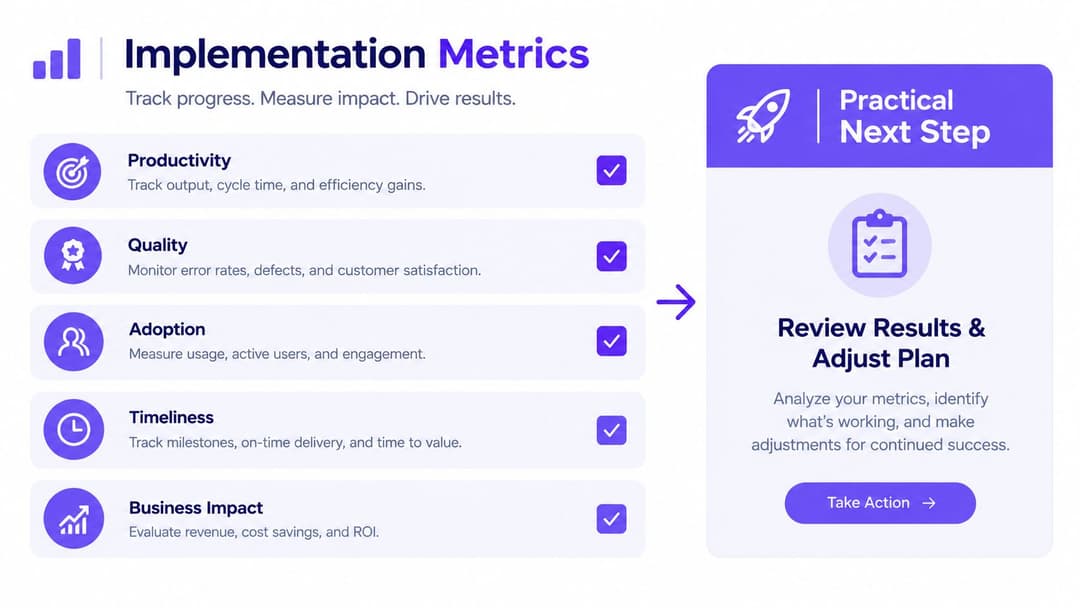
NAC shouldn't be judged by how many policy screens the platform contains. Judge it by whether the organisation can isolate a risky device faster, revoke access more reliably and explain why each important connection was allowed.
Start with a small scorecard:
- Time to isolate: Measure the interval between a confirmed alert and quarantine.
- Onboarding throughput: Record how many approved devices staff can provision in a working period.
- Failed-authentication rate: Compare failures by SSID, site, device type and user group.
- Posture non-compliance: Track how often devices fail the conditions for their intended role.
- Revocation time: Measure the time from a stolen credential or directory change to effective denial.
Pair each technical measure with a business signal. Guest experience surveys can reveal whether stronger authentication creates friction. Helpdesk contacts can show whether onboarding improved. Clinician login complaints can expose a policy that is secure but impractical. Tenant churn indicators or property complaints can help residential operators assess whether connectivity is supporting retention.
The most useful first step doesn't require a vendor demonstration. Choose one SSID or wired access zone, list every device class that uses it, and score each connection against two questions:
- How confident are we about the identity of this user or device?
- How sensitive are the systems this connection can reach?
That exercise will expose where shared credentials, unmanaged devices or broad VLAN access create the largest gap. It also gives finance a pilot scope based on risk and measurable outcomes, rather than a request to “improve network security” in the abstract.
NAC is best understood as a blast-radius and recovery investment. It won't stop every breach, but it can make access decisions narrower, device changes more visible and containment more repeatable.
Purple provides cloud-native RADIUS authentication and 802.1X network access control for wired and wireless environments, with guest onboarding, identity-based access and integrations for common network platforms. Visit Purple to assess how identity-aware Wi-Fi, OpenRoaming and multi-tenant policy management could fit your venue or property pilot.