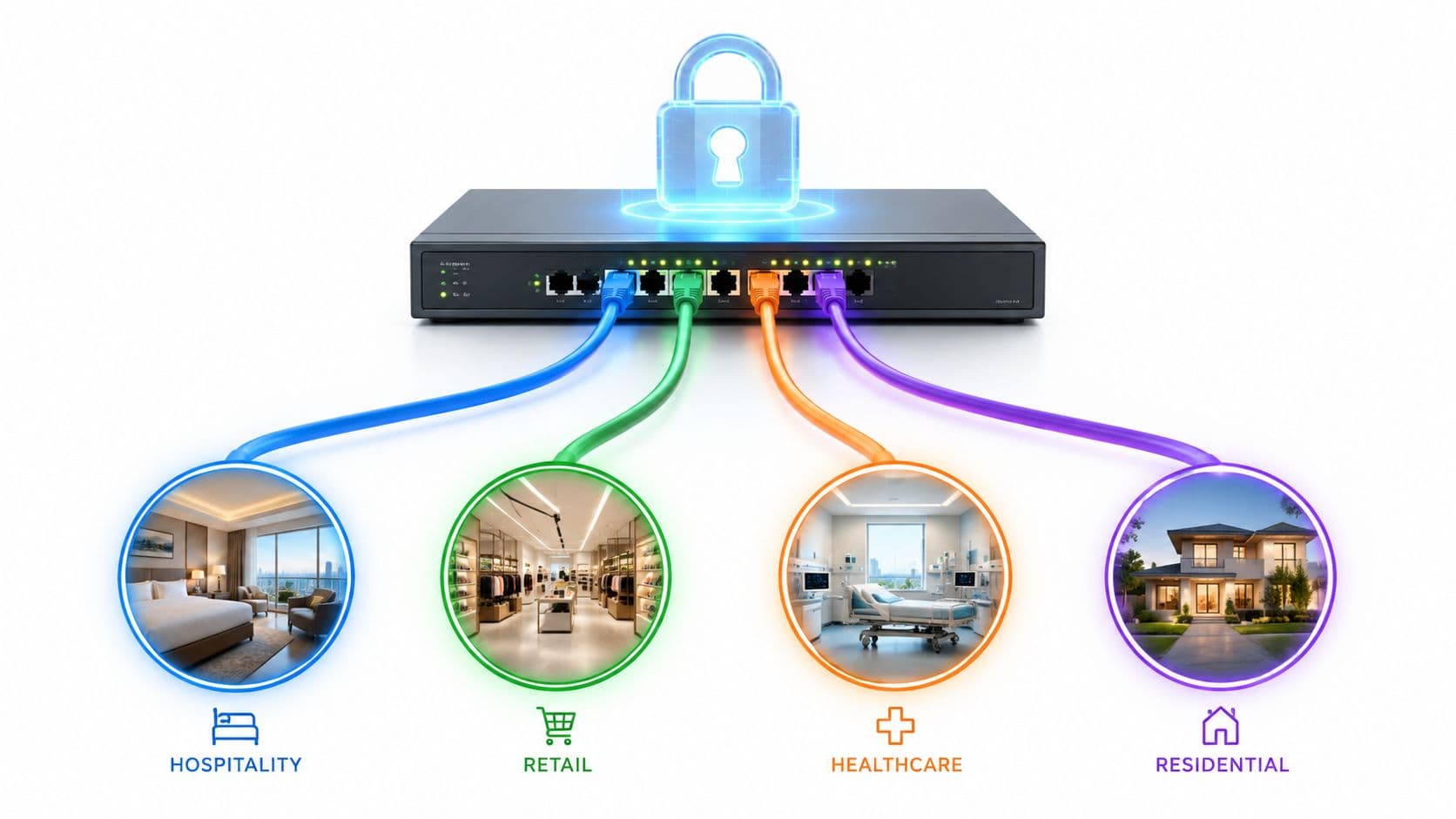
The most common advice in the single tenant vs multi tenant debate is also the least useful: single tenant is secure, multi tenant is cheap, and the decision ends with a procurement scorecard. That framing fails in the buildings where network design has the greatest commercial impact.
In a hotel, student residence, build-to-rent block, hospital campus, or flexible workspace, the decisive question is who controls the network boundary. A dedicated platform can still leak traffic through poor policy. A shared physical fabric can protect every tenant when identity, authentication, routing, and revocation are designed properly. Tenant count is only the label. Boundary control is the architecture.
UK housing evidence makes this distinction difficult to ignore. Government analysis identified 459,262 developments that are or could be mixed tenure, containing 3.33 million social dwellings, equal to 79% of the 4.21 million social dwellings identified in official housing statistics. Yet the mean social-tenant ratio was 80%, while the median was 97%, showing that developments can contain several tenures while remaining heavily concentrated in one type of occupancy. Purpose-built flats represented 54% of identified multi-dwelling developments, with a median social-tenant ratio of 91%, compared with 50% for converted flats. The property form changes the operational boundary problem, not just the tenancy contract. (UK government analysis of mixed tenure in English social housing)
Why the Single Tenant vs Multi Tenant Question Is Bigger Than SaaS
Enterprise teams often inherit this discussion from SaaS procurement. They compare dedicated instances with shared application infrastructure, then assume the same conclusion applies to a physical building. It doesn't. In shared properties, the more important question is whether the operator can keep one resident, guest, department, or contractor inside the correct access and policy boundary.
A single-tenant deployment usually gives engineers a cleaner physical separation. That helps with audit scope, change control, and fault containment. It doesn't remove operational risk. A poorly patched controller, weak administrator credentials, misconfigured firewall rule, or badly scoped authentication service can compromise a dedicated environment just as effectively as a shared one.
Multi-tenant networking creates a different responsibility. The operator shares access points, switches, controllers, uplinks, and often the management plane, then uses logical controls to separate users. Those controls must work across the wireless, authentication, routing, DNS, monitoring, and support layers. A tenant isn't isolated merely because it has a different SSID or splash page.
The practical boundary is not the SSID. It is the complete chain from identity to authorisation, traffic forwarding, telemetry, and revocation.
Three boundaries to test
Treat the architecture as three separate questions:
- Physical boundary: Which radios, switches, controllers, circuits, and appliances are shared?
- Identity boundary: How does the network know which person, device, room, department, or company is connecting?
- Management boundary: Who can create credentials, change policy, inspect telemetry, approve access, and revoke it?
This approach matters in hospitality and residential networks because users don't care whether the vendor calls the design cloud-native, shared, or dedicated. They expect their devices to connect easily and their neighbours' devices to remain separate. Staff expect access to disappear when their directory account is disabled. Operators expect one support workflow rather than a separate infrastructure estate for every room or occupier.
UK fire-safety policy offers a useful parallel. The Fire Safety Act 2021 clarified that the Fire Safety Order applies to the structure, external walls, balconies, and flat entrance doors in multi-occupied residential buildings with two or more sets of domestic premises. Related regulations came into force on 23 January 2023, while historical HMO controls developed after serious fires and formalised a distinct risk category for multi-occupied buildings. (UK government mixed-tenure research and fire-safety context)
The lesson for network architects is direct. Shared occupation deserves explicit controls, but the answer isn't automatically dedicated hardware. It is a demonstrable boundary that matches the building's risk, commercial model, and operating capability.
Single Tenant and Multi Tenant Architectures Explained
In networking, single tenant means one organisation or occupier receives a dedicated infrastructure stack or a dedicated operational instance. That may include separate access points, controllers, VLANs, authentication realms, monitoring, and management permissions. The design limits shared dependencies, which makes the environment easier to reason about when the organisation owns every endpoint and policy decision.
A hospital trust, defence site, or corporate campus may choose this model for core traffic because its internal identity, compliance, and incident-response processes need a tightly controlled estate. Dedicated infrastructure can also support bespoke radio planning, unusual device requirements, and change windows that would be difficult to coordinate across unrelated tenants.
Multi tenant networking uses a common physical fabric while applying logical controls per organisation, household, room, department, or service. VLANs, VRFs, RADIUS attributes, identity-based private pre-shared keys, firewall policy, and policy engines can create separate access contexts without duplicating every appliance.
The physical network is shared. The security context and user experience should not be. A hotel chain might operate one centrally managed platform across properties, while a student accommodation provider might map each resident or unit to a separate policy and credential context.
Single tenant vs multi tenant networking at a glance
| Dimension | Single Tenant | Multi Tenant |
|---|---|---|
| Physical isolation | Dedicated infrastructure or operational instance | Shared switches, access points, controllers, or circuits |
| Logical isolation | Usually simpler because fewer tenants share the environment | Essential, enforced through identity, VLANs, VRFs, firewall rules, and policy |
| Management plane | Dedicated or tightly scoped to one organisation | Centralised, with tenant-aware administration and delegated permissions |
| Cost scaling | Repeats infrastructure and operational work per tenant | Shares infrastructure and concentrates management |
| Typical context | Regulated enterprise, defence, healthcare core, dedicated corporate estate | Hospitality, student housing, BTR, managed services, shared workplaces |
| Main failure mode | Duplicated estates drift apart or become under-maintained | A policy or identity error can affect multiple tenants |
Teams comparing deployment patterns can use this multi-tenant WiFi architecture guide as a practical reference, but the design still needs to be tested against the actual building and operating model.
The choice isn't between secure and insecure. It is between physical separation with higher duplication and logical separation with higher design and governance demands.
Side-by-Side Comparison Across the Criteria That Matter
The architecture decision belongs to the building and operating model, not the SaaS label. A healthcare network, student residence, BTR property, and hotel may all deliver WiFi as a utility, yet their acceptable failure boundaries, support responsibilities, and traffic patterns differ.
Choose single tenant when a fault must stay inside one organisation's physical estate. Engineers can change a controller, firewall, or authentication service without coordinating a shared maintenance window. That benefit lasts only when each dedicated environment receives proper patching, monitoring, documentation, and recovery testing. Dedicated infrastructure gives control, not automatic resilience.
Choose multi tenant when one operator must deliver repeatable service across many occupiers or properties. A shared fabric supports standard policy, central monitoring, and consistent onboarding. The operator then carries a larger governance burden: credentials, traffic, telemetry, and administrative access must remain correctly scoped for every tenant.
Five criteria that decide the design
| Criterion | Single Tenant | Multi Tenant | Anchor Point |
|---|---|---|---|
| Isolation | Physical separation limits the shared blast radius | Logical separation must hold across every control layer | Isolation strength increases with the degree of separation, from shared schema to database-per-tenant |
| Security | Fewer shared dependencies create a clearer audit boundary | Central controls improve consistency, but one policy error can affect multiple tenants | Security follows identity assurance, configuration, patching, and monitoring, not the architecture label |
| Cost | Hardware, licences, support paths, and maintenance repeat for each tenant | Shared infrastructure improves utilisation and reduces repeated work | Per-tenant cost rises as isolation increases. The detailed cost comparison appears in the next section (UK SaaS architecture comparison) |
| Performance | Dedicated capacity avoids contention between tenants | Shared capacity requires admission control, QoS, and active monitoring | The operator needs explicit controls for noisy neighbours and high-demand devices |
| Operations | Each environment may be simpler, but the estate becomes repetitive | One platform can run efficiently, provided identity and policy automation are mature | Single tenant concentrates operational work per environment. Multi tenant concentrates it in governance and the control plane |
Isolation is a design property
Test isolation through traffic flows, not diagrams. Can one resident discover another resident's device? Can a guest reach staff services? Can a support administrator view another tenant's session data? Does a deprovisioned identity lose access immediately, including from devices that were previously authorised?
The same tests apply to both models. A dedicated controller does not answer them automatically, and a shared controller does not make them impossible. The decisive issue is where enforcement occurs, how administrators are scoped, and how much common infrastructure lies underneath each tenant.
In student housing and BTR, residents expect private access even though the building shares switching, wireless, and upstream connectivity. Hotels face the same boundary between guest, staff, and operational services. Healthcare adds managed clinical equipment and legacy systems, so the policy model must protect those dependencies without making routine support unworkable.
Performance follows the demand pattern
Hotels see concentrated demand around check-in, events, and evening use. Student accommodation combines dense device populations with frequent turnover. Healthcare mixes managed equipment, personal devices, and specialist systems. Single tenant can reserve capacity, while multi tenant can meet the same demand when the operator measures airtime, applies QoS, and separates critical traffic from recreational use.
WiFi is now a utility in these properties. A service interruption affects resident experience, guest operations, and commercial outcomes, not merely a technical dashboard.
The practical test is simple: can the operator observe contention before users report it, identify the responsible tenant or service, and change policy without rebuilding the network? If not, the selected isolation model is incomplete.
Cost, Scale, and the Hidden Overhead of Isolation
Dedicated infrastructure looks simple in a project plan. Each tenant receives its own controllers, switches, access points, licences, monitoring integrations, identity stores, firmware schedule, and support process. The bill includes the engineering time required to deploy, document, test, patch, and recover every copy.
Single-tenant design also duplicates operational work. Engineers maintain separate templates, review similar alerts in different consoles, repeat firmware validation, and preserve independent recovery procedures. That separation earns its cost when a tenant needs a distinct compliance boundary or unusual technical controls. It becomes margin erosion when every tenant receives the same service and no policy requires physical separation.
The cost comparison from earlier still applies, but network operators must account for expenses that SaaS tables do not show. A separate controller licence may carry its own contract scope. Each additional platform can require a support agreement, a maintenance window, and firmware validation before deployment. Engineers also spend time testing authentication, monitoring, failover, and tenant handoff across multiple environments. At a busy UK student housing, BTR, or hospitality portfolio, those hours affect service margin as directly as hardware.
Per-tenant cost breakdown
| Cost line item | Single Tenant, per tenant | Multi Tenant, per tenant | Notes |
|---|---|---|---|
| Physical infrastructure | Dedicated or reserved stack | Shared fabric allocation | Single tenant repeats equipment and site work |
| Controller and platform licensing | Separate instance or licence scope | Shared platform, tenant-aware licensing | Contract terms can change the result |
| Identity and authentication | Separate realm or dedicated integration | Shared service with scoped policies | Multi tenant needs strong tenant mapping |
| Monitoring | Separate dashboards and alert paths | Central dashboard with tenant filters | Poor filtering can create an access-control risk |
| Support and change management | Tenant-specific windows and runbooks | Standardised workflows with exceptions | Standardisation improves scale only when policy is mature |
| Recovery and testing | Separate recovery plans | Shared platform recovery plus tenant validation | The operator must prove tenant-level restoration |
A shared platform lowers duplication only when the operator can enforce tenant boundaries consistently. It needs policy templates, staged deployment, configuration validation, tenant-scoped logs, and tested rollback. Without those controls, one shared console can turn an isolation problem into an access-control problem.
The network design should be tested before production changes. Teams can use an iPSK subnet designer to model identity-based segmentation, check subnet allocation, and expose address or policy conflicts early.
Pay for physical isolation when the business requires a physical boundary. Don't pay for it merely because the design team hasn't built a trustworthy logical one.
The right answer is often hybrid. Keep clinical, payment, building-management, or corporate traffic on a tightly controlled dedicated path. Use a shared, tenant-aware network for guests, residents, contractors, and other variable populations. That allocation puts isolation where failure carries commercial, regulatory, or safety consequences, while shared infrastructure handles demand that benefits from scale.
Real-World Scenarios for Enterprise IT and Network Operators
The architecture decision becomes clearer when the owner, user, and failure impact are named. A network for one organisation is not automatically a single-tenant problem, and a network serving many people is not automatically a multi-tenant problem.
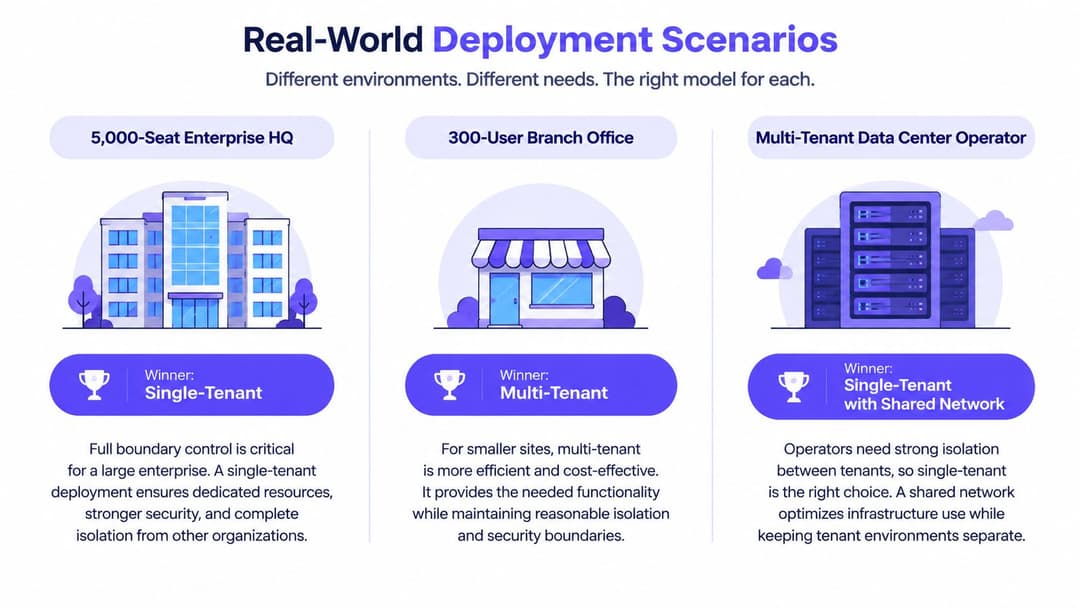
Scenario one, a 5,000-seat enterprise campus
A large enterprise campus with strict data-residency requirements should default to single tenant for core services. The deciding factor is not headcount. It is the need to align the physical, administrative, and audit boundaries.
Dedicated controllers, authentication services, management access, and traffic paths make ownership easier to demonstrate. Security teams can restrict administrator access to the organisation's staff, define a single change process, and investigate incidents without filtering unrelated tenant activity.
Guest access can still use a separate logical service. The core employee network shouldn't depend on the same policy path as transient visitors, contractors, or event attendees.
Scenario two, a multi-site hospitality group
A hospitality group operating properties under one brand should generally choose multi tenant. A central network operations centre needs consistent onboarding, captive portal policy, reporting, and incident response across hotels, restaurants, and venues. Duplicating the full management estate at every property would make standardisation harder, not safer.
The boundary still needs to exist at the property, guest, staff, and service level. Guest devices shouldn't reach point-of-sale systems. Staff identities shouldn't inherit guest permissions. A property team should see the information required for its work without receiving unrestricted access to every site.
The trade-off is clear. Centralised control wins, provided the operator can enforce tenant-aware administration and traffic policy.
Scenario three, UK BTR and student housing
In build-to-rent and purpose-built student accommodation, a hybrid multi-tenant model usually wins. Residents expect apartment-level or room-level privacy, but the operator benefits from one property-wide physical network, one support model, and centralised service management.
UK student housing evidence shows 93% of surveyed landlords in Scotland use a single tenancy agreement, while 7% use multiple tenancy agreements. That suggests administrative simplicity still influences operating models. (UK student housing evidence)
Connectivity in these buildings is increasingly an operator-delivered utility rather than a contract each resident signs. In Save the Student's National Student Accommodation Survey 2026, 80% of students said their rent covered at least one extra service, and 48% said broadband was bundled in, behind only water (63%), electricity (61%) and gas (54%). Delivering it reliably is the harder half: Jisc's 2024/25 survey of 15,398 UK higher education students found 60% reported WiFi connectivity problems on or off campus. (Save the Student, National Student Accommodation Survey 2026; Jisc Digital Experience Insights 2024/25)
The network therefore needs to deliver a private experience without turning every resident into a separate infrastructure project. Identity-based access, per-unit policy, simple billing, and immediate revocation matter more than the architecture label.
Delivering Tenant Isolation Without Duplicating the Network
Modern identity-driven networking provides a third option between one physical stack per tenant and an uncontrolled shared network. The operator shares the fabric, then binds access to an individual, unit, room, department, or device identity.
iPSK is a practical starting point for residential and mixed-device environments. Instead of issuing one shared password to an entire building, the operator assigns distinct private keys and maps them to a policy context. A key can identify a flat, room, resident, device group, or service class, depending on the operational requirement.
Build the control plane in layers
- Map identity to access. Use RADIUS attributes, directory groups, or a managed identity service to associate a user or device with the correct tenant policy.
- Apply role-based controls. Staff, residents, guests, contractors, and building systems should receive different permissions. Teams evaluating this layer can review role based access control software for a broader explanation of policy by role.
- Separate traffic. Use VLANs, VRFs, firewall rules, and service policies to stop lateral movement between tenants and protect operational systems.
- Automate lifecycle events. Provision access when a resident or employee is approved, and revoke it when the directory or property-management record changes.
- Scope telemetry. Central monitoring should give operators useful health data without exposing one tenant's identity or session information to another tenant.
SSO through Entra ID or Okta can bind corporate access to established identity governance. That works well for staff and managed users. iPSK remains useful for residents, visitors, legacy devices, and equipment that can't complete a modern enterprise authentication flow.
Purple's identity-based networking platform is one example of a control-plane approach that supports tenant-specific access across shared infrastructure, including iPSK and integrations with enterprise identity providers. Its value in this architecture is not the existence of another SSID. It is the ability to connect identity, policy, onboarding, and revocation without requiring a separate physical network for every occupier.

The design still needs testing. Validate that a credential cannot cross its intended policy, that device onboarding doesn't bypass segmentation, that administrators have tenant-scoped permissions, and that revocation reaches active sessions. A shared physical network can deliver a private tenant experience, but only when the operator treats identity and policy as production infrastructure.
Which Architecture Should You Choose and When
Use single tenant when the organisation needs a dedicated physical boundary, not merely a separate login. Regulated healthcare, payment environments, defence, and high-sensitivity enterprise workloads should start there for core services. The architecture simplifies evidence collection and reduces shared dependencies, although it still demands disciplined patching, monitoring, and identity management.
Use multi tenant when the operator serves many customers, occupiers, rooms, departments, or properties and the service depends on repeatable delivery. Hospitality, student housing, BTR, managed services, and shared workspaces usually gain more from centralised operations than from duplicating hardware. The condition is strict tenant-aware policy, not a relaxed security standard.
Use hybrid when one site contains both high-sensitivity internal services and large volumes of transient or residential users.
Architecture recommendation matrix
| Scenario | Recommended Model | Why |
|---|---|---|
| Regulated enterprise core, healthcare clinical systems, or payment traffic | Single tenant | The physical and audit boundary should match the organisation's control boundary |
| SaaS provider or managed service operator serving many customers | Multi tenant | Shared infrastructure supports repeatable policy, central operations, and efficient expansion |
| Hotel group with central guest services | Multi tenant | One operating model supports consistent identity, support, and service delivery across properties |
| BTR, student housing, or flexible workspace | Hybrid multi tenant | Shared infrastructure works with per-occupier identity, policy, billing, and revocation |
| Corporate site with employee and guest networks | Hybrid | Keep sensitive corporate traffic tightly controlled while applying tenant-aware guest access |
| Environment with repeated noisy-neighbour incidents or audit findings | Reassess, then isolate the affected services | The current boundary is failing, regardless of the architecture label |
Migration decisions should follow the same logic. Inventory traffic classes, identities, device types, management roles, and failure domains before selecting a platform. Red flags include unexplained cross-tenant visibility, inconsistent policy between sites, slow access revocation, support teams with excessive administrative reach, and tenant churn caused by missing controls or feature delays.
Ask one question before signing the design: who owns the network boundary, and do they need dedicated hardware or dedicated policy?
The steering-document summary is simple:
- Choose single tenant when physical isolation is a business or compliance requirement.
- Choose multi tenant when scale depends on shared infrastructure and mature identity controls.
- Choose hybrid when sensitive core traffic and high-volume shared access coexist.
Purple provides identity-based networking for shared buildings, including tenant-level access controls and iPSK-based separation on common infrastructure. Visit Purple to assess whether its approach fits your student housing, BTR, hospitality, healthcare, or enterprise guest-network design, then test the boundary with your own identity, revocation, and traffic policies.