
Data encryption and network cipher suite auditor
Evaluate your organisation's wireless security protocols, transport layer ciphers, and regulatory compliance status against UK GDPR, PCI DSS 4.0, and HIPAA requirements.
A guest arrives at a hotel, joins the WiFi, opens a work laptop and sends an email containing confidential business information. At the same time, a receptionist signs into the property management system, a maintenance contractor checks a staff portal, and another visitor opens a banking app. All of these activities depend on one question: can an unauthorised person read the data while it moves through the network or sits inside a system?
That's where data encryption comes in. Encryption transforms readable information into an unintelligible form that only an authorised device, user or service can decode. For UK organisations, it's more than a technical preference. The ICO's encryption guidance treats it as an appropriate risk-based safeguard for personal data in transit and at rest, while the UK government's Cyber Security Breaches Survey 2025/2026 shows that encryption adoption still has room to improve.
The important point for IT administrators and hospitality operators is that encryption isn't a single switch. It works across WiFi, web sessions, databases, authentication systems and backups. It also supports the move away from shared passwords towards identity-based, certificate-backed access.
How Encryption Protects Every WiFi Connection
A business traveller connecting to hotel WiFi expects the network to carry their traffic safely. If the wireless link provides no effective encryption, someone on the same network may be able to inspect transmitted packets with readily available packet-capture tools. They might not immediately see every password or message, because many applications add their own protection, but the network itself would offer little confidentiality.
What is data encryption in this situation? It's the process of taking plaintext, such as an email request or login transaction, and applying a cryptographic algorithm and key to produce ciphertext. The ciphertext looks random to anyone who doesn't have the required key. The authorised recipient uses the corresponding cryptographic process to recover the original information.
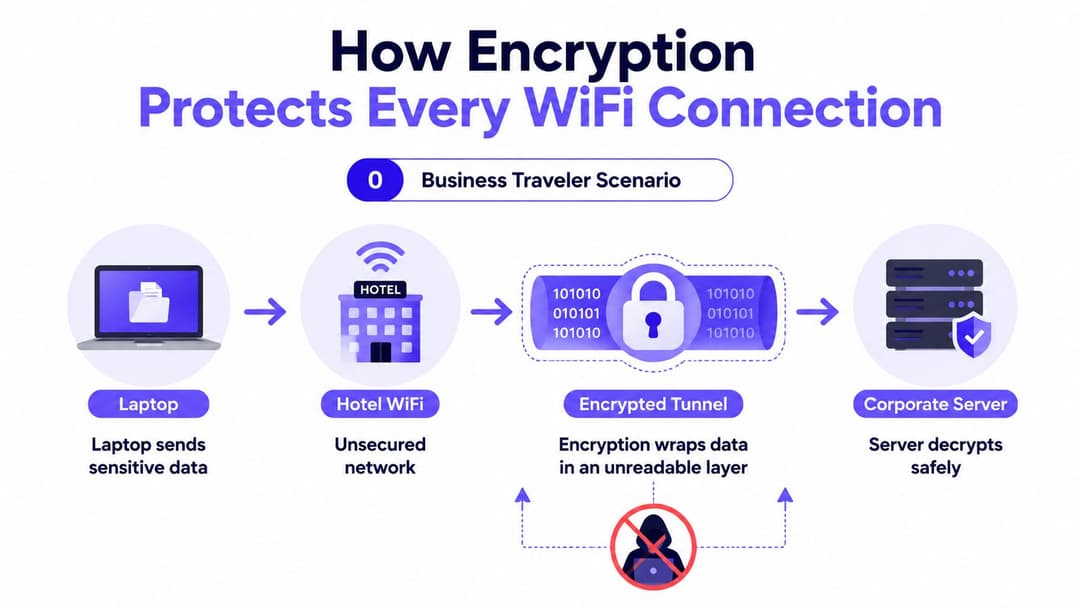
Encryption works in layers
A modern connection can use several protective layers at once:
- WiFi encryption: WPA3 protects the wireless link between a device and the access point.
- Transport encryption: TLS protects sessions such as HTTPS websites, application APIs and some infrastructure communications.
- Application encryption: An application may encrypt particular messages or records before sending them through the network.
These layers solve different problems. WPA3 helps prevent other wireless users from reading traffic over the local link. HTTPS protects the connection between a browser and its destination. Application-level encryption can protect selected content even after it reaches an intermediary service.
A hotel operator therefore shouldn't assume that WPA3 alone protects a guest's entire journey. The access point, gateway, DNS services, web application, authentication server and destination database all have their own security responsibilities. A weakness in one layer can expose metadata, credentials, records or administrative traffic, depending on where the failure occurs.
Practical rule: Treat encryption as a chain of controls, not as a property of the WiFi password.
Encryption enables identity-based WiFi
Traditional guest and staff networks often rely on a shared pre-shared key. That key may be printed on a card, displayed on a welcome page or known by too many employees. The wireless cipher can be strong, but the access model becomes difficult to control when the same secret is shared across people and devices.
Enterprise WiFi changes that model. WPA3-Enterprise can use 802.1X and certificate-based authentication to connect a person or device identity to the network session. The network can then apply different access policies to staff, contractors, guests and managed equipment. For a practical introduction to enterprise wireless authentication, see WPA3-Enterprise and identity-based WiFi.
This is why encryption matters beyond privacy. It provides the protected session that makes passwordless, identity-aware access practical. A device can prove its identity, establish session keys and receive network access without exposing a universal password to every user.
Symmetric, Asymmetric, and Hashing Explained
Cryptography uses different tools for different jobs. Symmetric encryption protects data efficiently, asymmetric cryptography helps two parties establish trust and exchange secrets, and hashing verifies integrity or represents information as a one-way digest.
Symmetric encryption uses one shared secret
Symmetric encryption uses the same secret key, or related secret material, to encrypt and decrypt data. A useful hospitality analogy is a hotel keycard. The access system recognises the credential when it secures or grants entry to a room, and the system can process large numbers of door events quickly.
The advantage is performance. Once a WiFi session has established a symmetric key, the access point and client can encrypt substantial volumes of traffic without repeatedly using a slower public-key operation. AES is a common symmetric encryption family used in secure network and storage systems.
The difficult part is key distribution. Both sides need access to the right secret, but an administrator must prevent unauthorised users from obtaining it. Modern protocols therefore use asymmetric cryptography during the setup phase, then rely on symmetric encryption for the ongoing session.
Asymmetric cryptography separates public and private keys
Asymmetric cryptography uses a key pair. The public key can be distributed, while the private key must remain controlled by its owner. A padlock provides a simple analogy. Anyone can close the padlock, but only the person holding the private key can open it.
In enterprise WiFi, a certificate binds a public key to an identity approved by a certificate authority. During an EAP-TLS authentication exchange, the client and authentication service use certificates and cryptographic proofs to establish that they're communicating with trusted parties. The process supports device and user authentication without handing a shared password to the network.
Certificate chains also underpin roaming models such as Passpoint and OpenRoaming. The device trusts approved certificate authorities, presents its credentials and establishes a protected session with the participating network. The user experience can feel automatic, but the underlying trust decision is based on cryptographic identity.
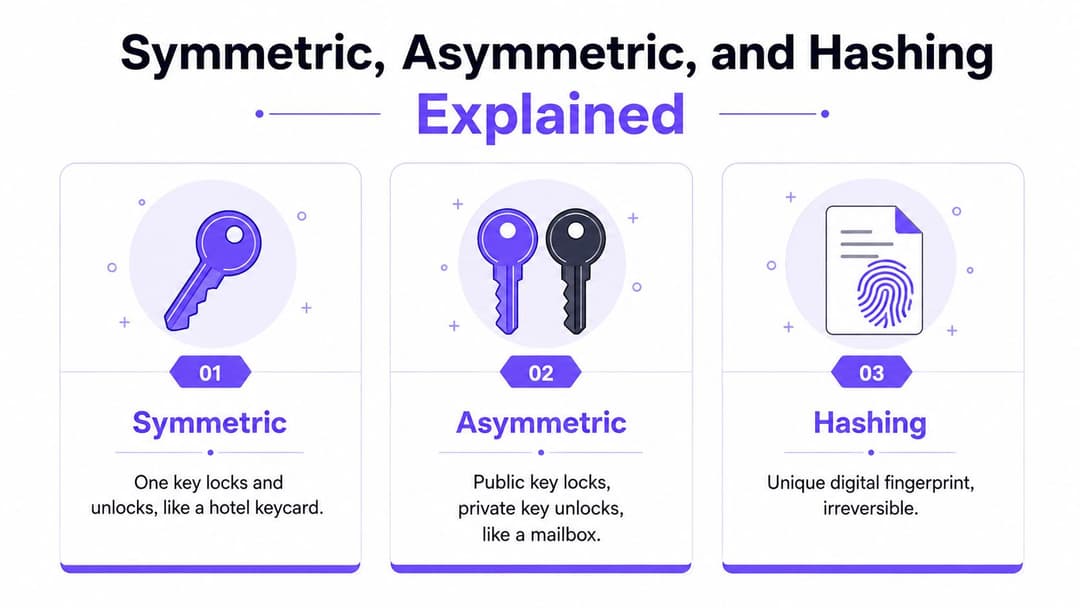
Hashing creates a one-way fingerprint
A cryptographic hash turns input data into a fixed-format digest. It's like a fingerprint for a file. If the file changes, the digest should change, but the original file can't normally be reconstructed from the digest alone.
Hashing helps systems check password representations, downloaded firmware, configuration files and message integrity. It isn't encryption because there's no intended decryption process. A hashed password shouldn't be recoverable as the original password, while encrypted data must be recoverable by an authorised system.
A real WiFi workflow may combine all three methods:
- Asymmetric cryptography verifies identities and helps establish shared session material.
- Symmetric encryption protects the data exchanged after authentication.
- Hashing checks whether certificates, firmware, configurations or messages have been altered.
That layered design explains why cryptography isn't one algorithm. Each method addresses a different operational problem.
Encryption in Transit Versus Encryption at Rest
A guest checks in on a phone, joins WiFi, opens a payment page and receives a confirmation email. Several systems handle that information along the way. Encryption in transit protects it while it moves between those systems. Encryption at rest protects the copies stored in databases, devices and backups. A secure WiFi connection alone does not cover the complete data journey.
Encryption in transit applies between a device and an access point, an access point and a gateway, or an application and its server. WPA3 protects the wireless segment, while TLS protects many web and application sessions. A VPN can create another encrypted tunnel across an untrusted network, although it cannot secure a compromised endpoint. In passwordless, certificate-based WiFi such as Passpoint or OpenRoaming, identity checks establish trust before protected traffic flows. That trust still depends on certificate validation and correctly configured network paths.
Encryption at rest protects information held after collection. Examples include guest profiles in a customer relationship system, staff records in an HR platform, RADIUS accounting logs, property management data and backup archives on network storage. Protection may apply at disk, volume, database, file or application level. Access controls and key protection determine whether stored encryption remains useful when administrators, services or attackers reach the storage layer.
| Aspect | Encryption in Transit | Encryption at Rest |
|---|---|---|
| Primary purpose | Protect data while it crosses a network | Protect stored data if storage or a device is accessed |
| Hospitality example | A guest's browser session using HTTPS over protected WiFi | Guest records stored in a property management database |
| Typical controls | WPA3, TLS, VPN tunnels and protected authentication links | Full-disk, volume, database, file or application encryption |
| Main exposure | Interception, rogue access points, compromised network paths | Lost devices, stolen storage, unauthorised database access or exposed backups |
| Operational dependency | Correct protocol configuration and trustworthy endpoint validation | Secure keys, access controls, backups and recovery procedures |
| Audit question | Which links carry personal or confidential data, and are they encrypted? | Which systems retain that data, and are the records and backups protected? |
Audit the whole data journey
Begin with a data-flow map, not a product list. Trace a payment transaction from the guest device through the wireless network, gateway, payment application and storage systems. Run the same exercise for staff credentials, tenant records, CCTV-related systems and support tickets.
At each stage, document the control and its owner:
- Device to access point: Confirm the wireless security mode, certificate trust and authentication method.
- Network to application: Verify TLS and certificate validation for web and API traffic.
- Application to database: Check whether service-to-service traffic is encrypted.
- Database to backup: Confirm that exports, snapshots and archives receive separate protection.
- Administrator access: Require encrypted management sessions and strong identity controls.
The UK government survey found that 14% of businesses and 22% of charities said they held personal data that wasn't protected by techniques such as anonymisation or encryption, while 77% of businesses and 69% of charities said they did protect personal data in that way, as reported in the Cyber Security Breaches Survey 2025/2026. The comparison reinforces a practical audit point: review stored records and recovery copies, not only guest and staff traffic crossing the wireless network.
Algorithms and Protocols That Secure Modern Networks
Secure networking depends on how algorithms work together inside a protocol. AES may protect the traffic efficiently, while certificates establish identity and TLS protects an application connection. Weak configuration, poor authentication or exposed private keys can still defeat those controls.
AES handles the data volume
AES is a symmetric encryption algorithm built for efficient bulk protection. During a wireless session, an access point and client exchange many frames, so symmetric cryptography performs most of the data protection after authentication completes.
AES-256 is also used to protect stored information. The NCSC's cloud security guidance recommends encrypting customer data at rest with a standardised symmetric algorithm and mode that provides confidentiality and integrity. It also advises against writing data to disk in unencrypted form.
Key length alone does not secure a system. Administrators must protect key material, select an authenticated encryption mode where appropriate and remove deprecated configurations. Keys should remain separate from the encrypted data. If an attacker obtains both, the intended protection may be bypassed.
RSA and ECC support certificate trust
RSA and ECC are asymmetric cryptographic approaches used for certificates and digital signatures. They allow a device to verify an authentication service and prove possession of a private key.
In enterprise WiFi, this supports 802.1X with EAP-TLS. A user or device does not submit a shared wireless password. The authentication service checks the certificate chain, while the device proves control of its private key. A single lost or compromised device can then be blocked without changing access for every other connection.
That model underpins passwordless certificate-based access in deployments using WPA3-Enterprise, Passpoint and OpenRoaming. The practical advantage is a device-specific identity, rather than one venue password copied across guest rooms, staff devices or contractors.
ECC can suit newer infrastructure because it provides strong public-key operations with comparatively compact keys. RSA remains common in existing certificate estates, so IT teams must inspect their trust chains and device compatibility before choosing a replacement.
TLS protects application and infrastructure links
TLS protects HTTPS sessions, APIs, portals and communications between network components. A guest may use WPA3 for the local wireless connection and TLS for the booking, payment or support application beyond the access point. These controls protect different parts of the journey and must be validated separately.
Protocol versions, cipher settings and certificate validation all matter. Current standardised configurations should replace obsolete algorithms and protocol versions. A connection can be encrypted yet still lack trustworthy identity if the client does not correctly validate the service certificate.
WPA3, Passpoint and OpenRoaming change access control
WPA2-PSK relies on a shared secret that can spread beyond its intended audience. WPA3-Enterprise uses enterprise authentication for managed networks. Passpoint and OpenRoaming extend that identity model across participating networks, allowing a trusted device profile or certificate to authenticate without repeated entry of a venue-specific password.
The operational question becomes “Which identity is this device allowed to use, and who can revoke it?” Encryption protects the resulting session. Certificates, trust chains and access policy decide who receives that session and whether the organisation can withdraw access cleanly.
Key Management and Certificate Best Practices
Encryption fails operationally when organisations protect the data but mishandle the keys. A certificate can be technically valid and still create risk if its private key is copied, its issuing authority is no longer trusted or its expiry isn't monitored.
Manage the certificate lifecycle
A reliable certificate process covers issuance, deployment, renewal, rotation and revocation. An enterprise PKI or cloud certificate authority can integrate with a device-management platform and an identity provider such as Entra ID, Google Workspace or Okta. Automatic enrolment reduces manual handling and lets administrators connect access decisions to a device or user record.
Short-lived certificates can reduce the value of a stolen credential, but they also create an operational requirement. Devices need reliable renewal paths, accurate time settings and a clear response when a certificate expires. Guest onboarding should never expose a private key to venue staff or require an operator to copy credentials between devices.
Revocation remains essential when a laptop is lost, an employee leaves or a device is compromised. Certificate Revocation Lists and Online Certificate Status Protocol can help authentication services reject credentials that should no longer work. Teams must test the complete path, from the directory change or incident response action through the certificate authority, RADIUS service and wireless controller.
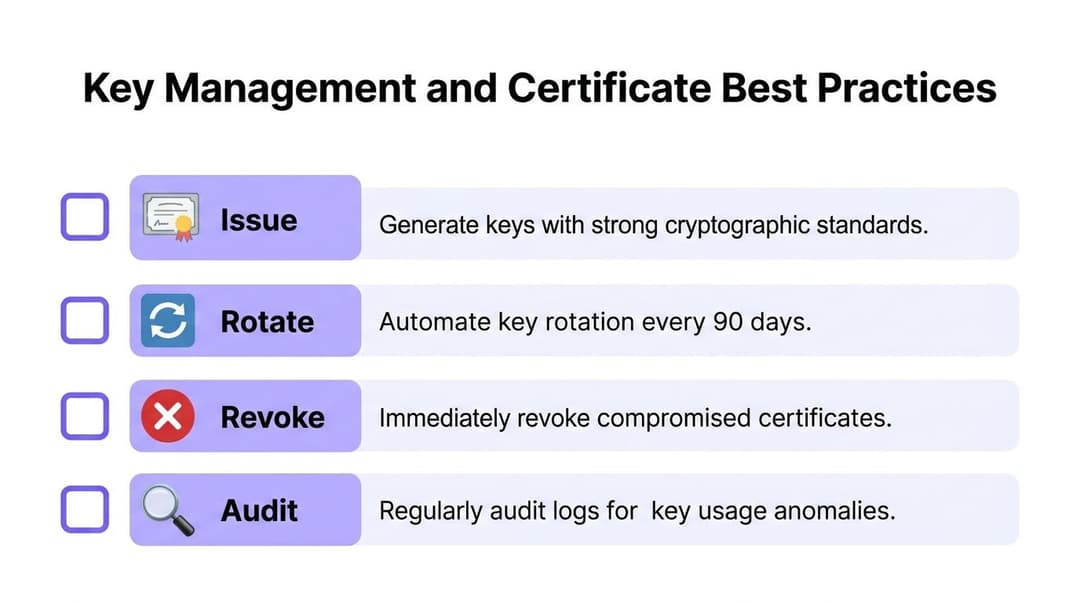
Use an audit checklist
A certificate deployment deserves the same attention as a firewall rulebase. Check the following:
- Trust stores: Remove expired, obsolete or unauthorised root and intermediate authorities from managed devices.
- Private keys: Keep private keys inside device TPMs or approved hardware security modules where the architecture supports it.
- RADIUS validation: Confirm that authentication servers validate certificate chains, names and intended usage rather than merely accepting any certificate.
- Revocation testing: Disable a test identity and verify that access stops across controllers, access points and roaming services.
- Renewal monitoring: Alert before certificates expire, then test renewal on representative device types.
- Separation of duties: Restrict who can issue certificates, change trust anchors or access key-management systems.
- Logging: Record issuance, renewal, revocation and authentication events so administrators can investigate unusual activity.
Key-management principle: Store encrypted data and its keys separately, then prove through testing that a compromised identity can be revoked quickly.
The NCSC recommends current standardised cryptographic algorithms and separate protection for key material. Teams can also review how a platform handles encryption, storage and access controls in its data and security overview, but the same questions should be asked of every supplier.
UK Compliance and Post-Quantum Readiness
UK GDPR doesn't impose encryption universally in every situation. The ICO describes it as an appropriate safeguard for personal data in transit and at rest, with the decision based on the risks involved. That risk-based approach means an organisation should be able to explain what personal data it holds, where it travels, who can access it and why the selected controls are proportionate.
The ICO's draft updated encryption guidance links encryption to UK GDPR Article 32(1)(a) and Article 5(1)(f). For a hotel, retailer, healthcare provider or property manager, that makes encryption part of a broader security decision covering guest, patient, staff or tenant information.
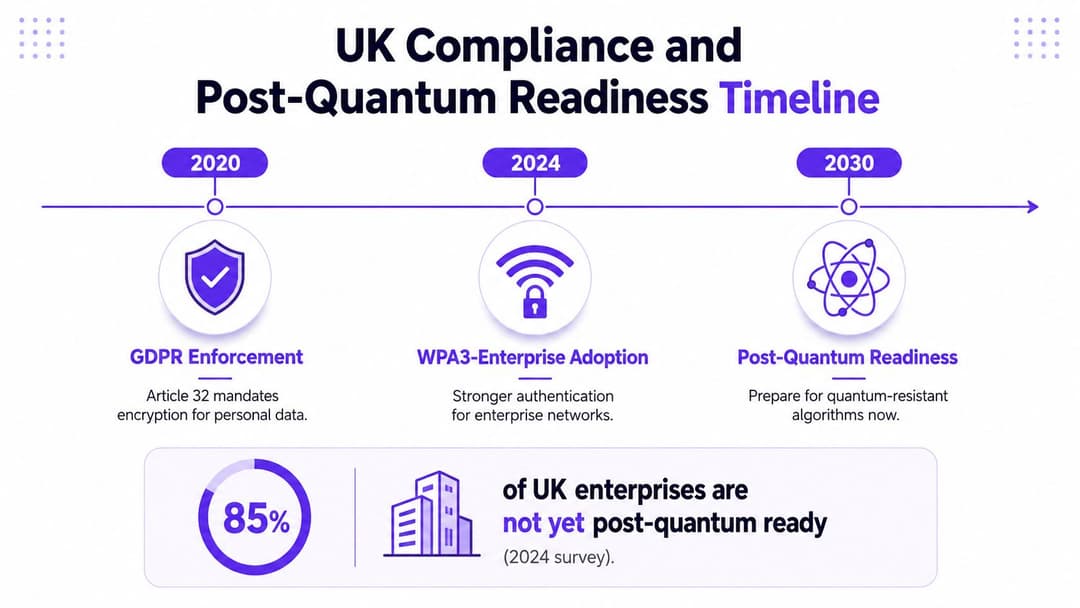
Compliance needs evidence, not labels
Calling a network “secure” doesn't demonstrate appropriate protection. IT teams should retain evidence of:
- the data categories carried over each network;
- the encryption and authentication controls applied to each connection;
- the algorithms and protocol versions permitted;
- certificate issuance and revocation procedures;
- key-storage arrangements;
- incident response and recovery testing.
The NCSC's cloud guidance says customer data at rest should be encrypted and that no data should be written to disk in unencrypted form. Its advice is especially relevant to hosted property systems, cloud backups and managed authentication services.
Physical and technical security also overlap. If an organisation suspects unauthorised surveillance or tampering around a communications room, a specialist resource such as UK bug sweeping services may form part of a wider investigation. That service doesn't replace encryption, access control or monitoring, but it addresses a different risk in the same protection plan.
Prepare for cryptographic change
Post-quantum readiness is now a planning issue, not a reason to replace every network immediately. The NCSC's 2025 annual review says organisations should create an initial migration plan covering the whole estate and identifying services that depend on cryptography.
Start with an inventory. Record certificate authorities, wireless controllers, RADIUS servers, VPNs, applications, hardware security modules, firmware-signing processes and long-lived encrypted records. Ask vendors whether their products can receive cryptographic updates without a complete hardware replacement.
This is crypto-agility, the ability to change algorithms, certificate profiles or key-establishment methods as standards evolve. It connects current compliance work with future resilience because teams that understand their cryptographic estate can identify weak configurations today and plan upgrades before a technology becomes difficult to replace.
Building a Passwordless Encrypted WiFi Strategy
A shared WiFi password remains a weak point even when the underlying encryption is strong. Once the secret appears on a noticeboard, booking email or staff group chat, administrators can't reliably identify who used it, revoke one person's access or apply policy to a specific device.
Certificate-based access binds the encrypted session to an identity. WPA3-Enterprise, Passpoint and OpenRoaming can authenticate a managed device or user through certificates and trusted identity services. A staff member can receive access based on their directory status, while a departed employee's access can be removed without changing every other user's credentials.
A practical migration can begin with the existing network:
- Audit shared networks: List every PSK, its users, connected devices and business purpose.
- Separate identities: Create distinct policies for staff, contractors, guests, tenants and operational equipment.
- Connect identity services: Integrate the wireless platform with a RADIUS service, cloud identity provider and device-management system.
- Issue certificates: Provision user or device certificates through managed enrolment, keeping private keys under device control.
- Pilot and monitor: Test authentication, roaming, renewal, revocation and fallback behaviour.
- Retire shared keys: Remove legacy PSKs once the replacement has proved reliable.
Purple's passwordless WiFi approach is one option for automating certificate provisioning and connecting access policies to identities. Operators should assess it alongside their existing wireless infrastructure, directory services, compliance requirements and post-quantum roadmap.
A useful completion checklist is straightforward:
- Enable WPA3-Enterprise where supported.
- Adopt certificate-grade access instead of universal passwords.
- Integrate MDM and identity services for controlled provisioning.
- Monitor certificate expiry and revocation continuously.
- Plan for algorithm agility and future cryptographic migration.
Purple can help hospitality, retail, healthcare and property teams replace shared WiFi passwords with identity-based encrypted access, while integrating with existing network and directory environments. Visit Purple to assess a passwordless WiFi strategy that protects guest and staff connectivity and gives your team a practical path towards stronger certificate management.