
How to leverage SMS text message marketing to increase return visits
This technical reference details the architecture and implementation of SMS text message marketing for venue operators. It explains how to capture verified phone numbers via Guest WiFi, maintain GDPR and CCPA compliance, and automate campaigns to increase return visits and revenue.
Listen to this guide
View podcast transcript
Executive Summary
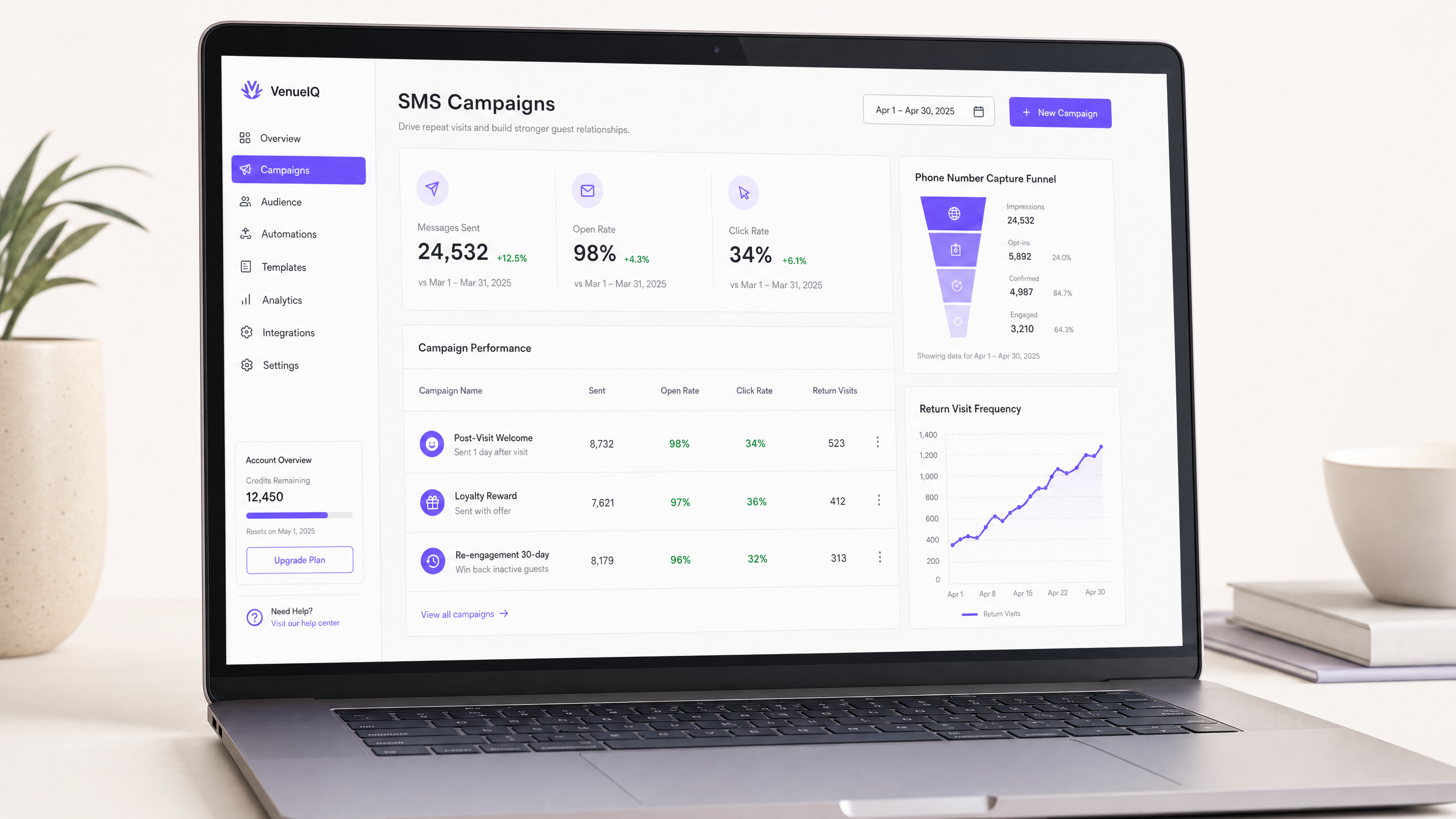
Most venues face a critical gap between first-time visitors and repeat guests. While email has historically bridged this gap, its 20-30% open rate limits impact. SMS text message marketing offers a structural advantage, delivering 98% open rates and driving measurable return visits. This guide details the architecture for capturing verified phone numbers through Guest WiFi captive portals, maintaining strict GDPR and CCPA compliance, and deploying automated SMS campaigns. For IT managers and venue operations directors across Hospitality , Retail , and stadiums, SMS represents the most direct channel to activate first-party data. By using Purple Engage, venues can consolidate data capture, consent logging, and campaign execution into a single cloud overlay, reducing integration complexity while delivering return visit uplifts exceeding 20%.
Technical Deep-Dive
The foundation of effective SMS text message marketing is the data capture layer. Relying on point-of-sale data entry or manual sign-ups introduces friction and data quality issues. The modern approach uses the venue's existing WiFi infrastructure as the primary data ingestion point.
Architecture of WiFi Data Capture
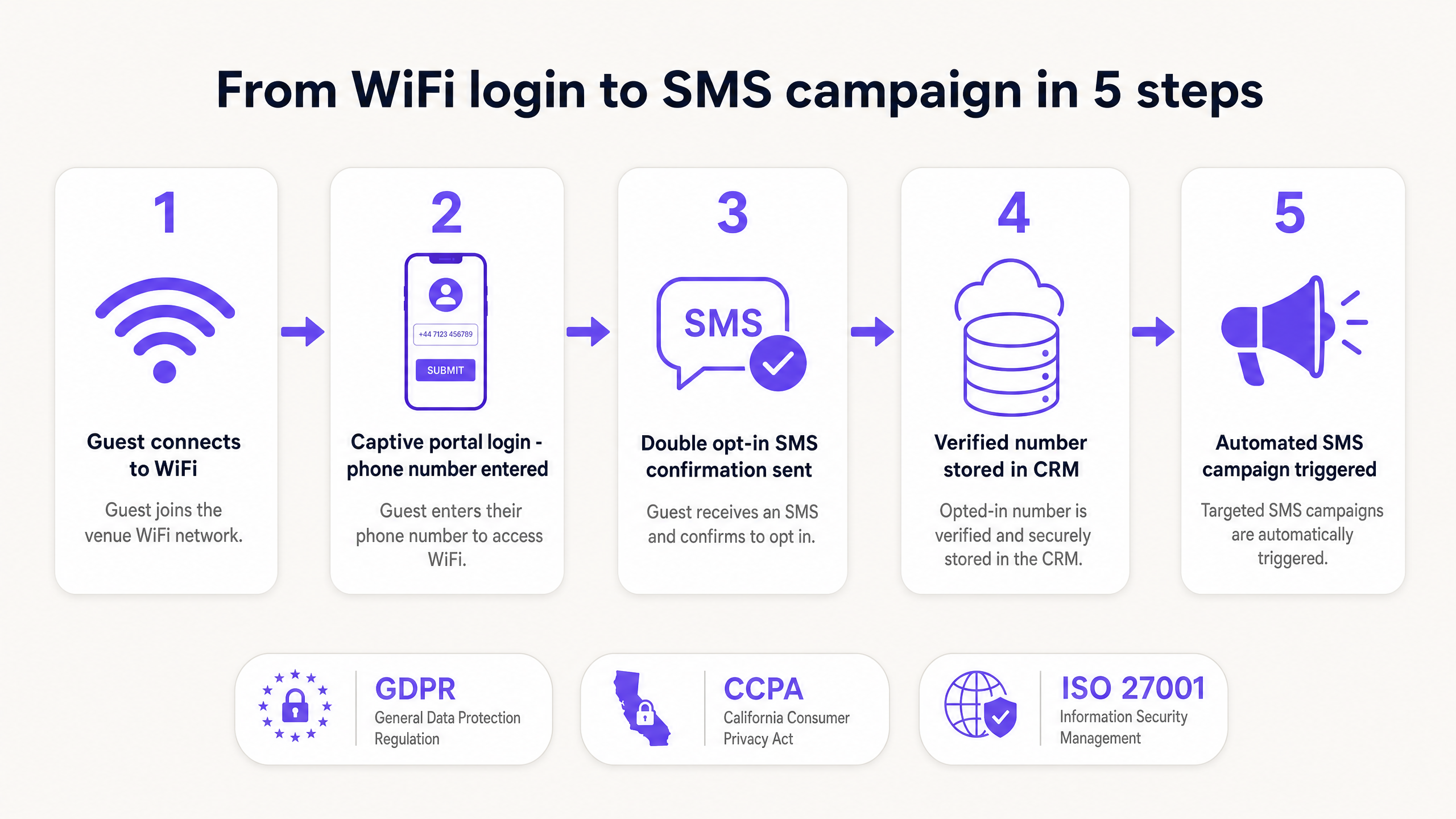
When a visitor attempts to connect to the Guest WiFi network, the hardware controller redirects traffic to a cloud-hosted captive portal. During this authentication flow, Purple Engage requests the user's mobile number. To verify the number and establish consent, the system uses a double opt-in mechanism.
- The user enters their phone number.
- Purple sends an immediate SMS containing a verification code or link.
- The user inputs the code or clicks the link to complete authentication.
- The network grants internet access via RADIUS.
This flow guarantees that the number is active, belongs to the device owner, and that explicit consent has been recorded. The process is hardware-agnostic, functioning as a cloud overlay across Cisco Meraki, HPE Aruba, Ruckus, Juniper Mist, Ubiquiti UniFi, Cambium, Extreme, and Fortinet infrastructure.
Compliance Framework
Operating an SMS text message marketing programme requires strict adherence to regional regulations, primarily GDPR in the UK and EU, and the TCPA and CCPA in the US. The penalties for non-compliance are severe, with TCPA violations costing up to $1,500 per message.
The Purple Engage double opt-in flow satisfies the GDPR requirement for consent that is freely given, specific, informed, and unambiguous. The system logs the exact timestamp, IP address, MAC address, and the specific terms the user agreed to. This provides a complete audit trail. Furthermore, the platform automatically processes "STOP" replies, removing the number from active campaign lists without manual intervention, fulfilling the right to withdraw consent.
Implementation Guide
Deploying an SMS text message marketing programme requires coordination between IT and marketing teams. The implementation follows three phases: data capture setup, segment definition, and campaign automation.
Phase 1: Captive Portal Configuration
Configure the captive portal to prioritise phone number capture. If you offer multiple login methods (e.g., email, social media), ensure the SMS option is prominent. The opt-in language must be clear, stating the frequency of messages and the type of content. Do not pre-tick consent boxes; conscious-choice opt-ins are mandatory for compliance.
Phase 2: Audience Segmentation
Batch-and-blast SMS campaigns fail. They drive high opt-out rates and damage brand trust. You must use WiFi Analytics to segment your audience based on actual visit behaviour.
Key segmentation parameters include:
- Visit frequency: First-time vs. repeat visitors.
- Dwell time: Brief visits vs. extended stays.
- Location data: Which zones or departments the guest spent time in.
- Recency: Time since the last visit.
Phase 3: Campaign Automation
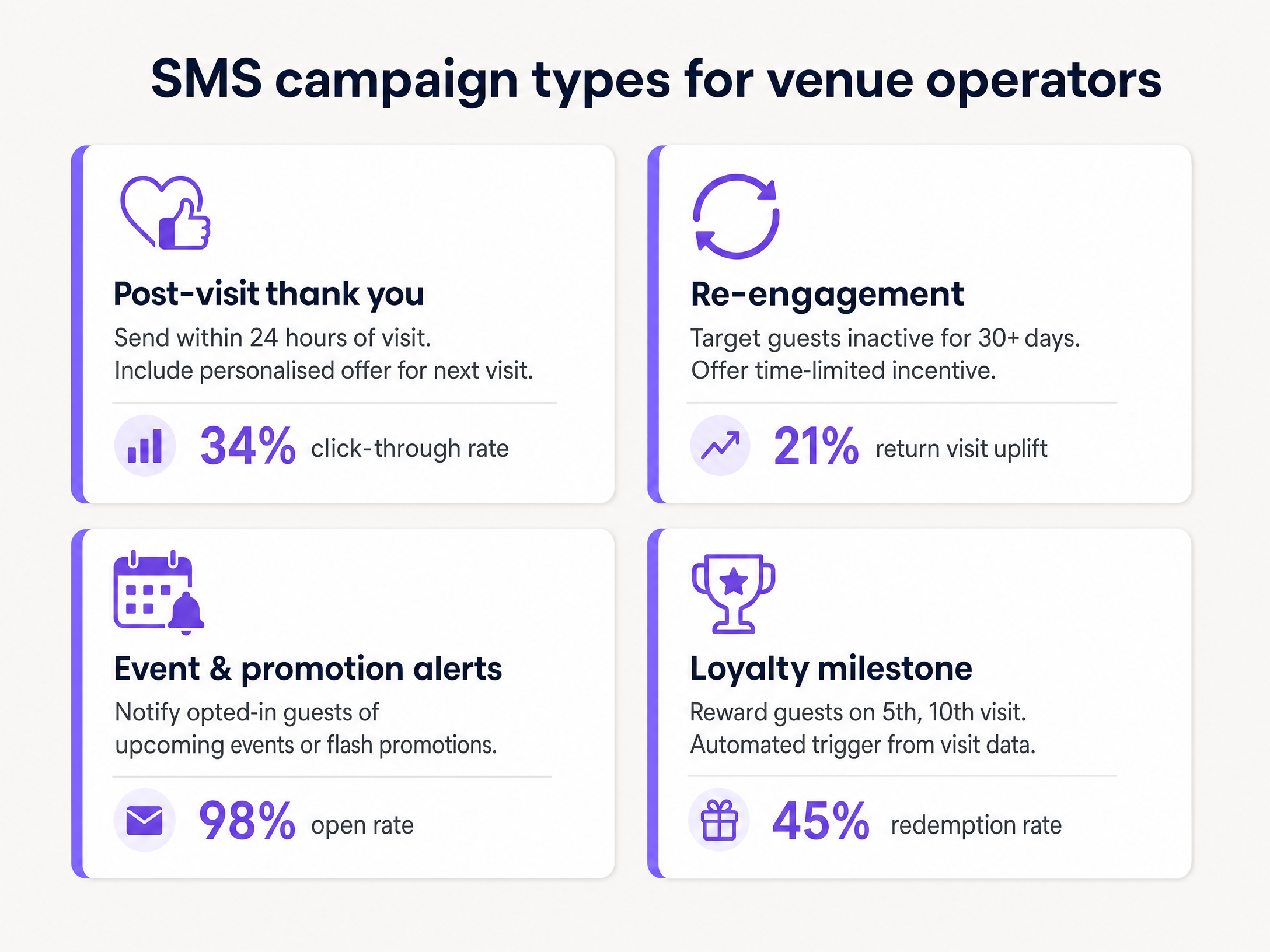
Once segments are defined, configure automated triggers. Automation ensures messages reach guests at the optimal moment without manual effort.
Best Practices
To maximise the impact of SMS text message marketing, adhere to these industry-standard practices.
Frequency Limits
Over-messaging is the primary driver of unsubscribes. Limit promotional SMS to two to four messages per month per user. Transactional messages, such as booking confirmations or WiFi login codes, do not count towards this limit, provided they contain no marketing content.
Send-Time Optimisation
Timing dictates engagement. Send messages between 09:00 and 20:00 in the recipient's local time zone. For retail and hospitality, Thursday and Friday afternoons often yield the highest conversion rates for weekend offers. For B2B or conference venues, Tuesday mornings perform strongly.
Concise Copywriting
An SMS message is limited to 160 characters. Write direct, action-oriented copy. State the offer clearly, include a single call-to-action (CTA), and provide a tracked link. Always include the brand name and the mandatory opt-out instruction (e.g., "Reply STOP to opt out").
Troubleshooting & Risk Mitigation
Even well-architected programmes encounter friction. Address these common failure modes early.
High Opt-Out Rates
If your opt-out rate exceeds 2% per campaign, your messaging is either too frequent or irrelevant. Review your segmentation logic. Ensure you are not sending generic offers to highly specific visitor profiles.
Low Captive Portal Conversion
If visitors abandon the WiFi login process at the phone number entry stage, review the portal design. Ensure the value exchange is clear. The user must understand that providing their number grants them fast, secure internet access. Simplify the UI and remove unnecessary form fields.
Deliverability Failures
Carrier filtering can block messages that appear spammy. Avoid excessive capitalisation, multiple exclamation marks, and generic URL shorteners like bit.ly, which carriers often flag. Use a dedicated short code or a verified 10DLC (10-Digit Long Code) in the US to ensure high deliverability rates.
ROI & Business Impact
SMS text message marketing delivers measurable business outcomes. The primary metric is the uplift in return visits among the targeted segment compared to a control group.
Consider a 200-room hotel that captures 1,000 new verified phone numbers per month. By deploying a 30-day re-engagement campaign offering a 10% direct booking discount, the hotel can bypass Online Travel Agency (OTA) commissions. If the campaign converts at 5% (50 bookings), and the average booking value is £300, the campaign generates £15,000 in direct revenue. With SMS costs averaging £0.03 per message, the campaign cost is £30. The ROI is exceptional.
Purple's platform, operating across 80,000+ live venues and processing 440 million logins in 2024, demonstrates that venues leveraging automated SMS campaigns see an average 21% increase in return visits within 90 days of deployment. By treating Guest WiFi as a data asset, venues transform an IT cost centre into a measurable marketing channel.
Key Definitions
Captive Portal
A web page that a user must view and interact with before access is granted to a public WiFi network. Used by venues to capture user data and consent.
IT teams deploy captive portals to manage network access, while marketing teams use them to build first-party databases.
Double Opt-In
A consent mechanism where a user provides their phone number and must then confirm their subscription by replying to or clicking a link in an initial SMS.
Essential for GDPR and CCPA compliance, proving the number is valid and the user explicitly consented to marketing.
First-Party Data
Information a company collects directly from its customers or visitors, rather than purchasing it from a third party.
Phone numbers captured via venue WiFi are highly valuable first-party data, offering a direct line to verified visitors.
Dwell Time
The duration a device remains connected to or visible to the WiFi network within a specific zone.
Used to segment audiences. A shopper dwelling for 45 minutes receives different SMS offers than one who stayed for 5 minutes.
10DLC (10-Digit Long Code)
A standard 10-digit phone number that is registered and approved by mobile carriers for sending high-volume A2P (Application-to-Person) SMS messages.
Required in the US to ensure high deliverability and avoid carrier filtering for marketing campaigns.
Opt-Out Rate
The percentage of recipients who unsubscribe from an SMS campaign after receiving a message.
A key health metric. Rates above 2% indicate poor segmentation or over-messaging.
Click-Through Rate (CTR)
The percentage of recipients who click the link included in the SMS message.
Measures the effectiveness of the offer and the copy. SMS CTRs typically range from 15% to 35%.
Cloud Overlay
A software layer that integrates with existing hardware infrastructure to provide additional functionality without requiring hardware replacement.
Purple Engage operates as a cloud overlay, adding data capture and SMS marketing capabilities to existing Cisco Meraki or Aruba networks.
Worked Examples
A 40-location retail chain wants to increase return visits from weekend shoppers. They currently capture emails but see low engagement. How should they implement SMS text message marketing?
- Reconfigure the Guest WiFi Captive Portal to capture phone numbers with a double opt-in SMS flow, ensuring GDPR/CCPA compliance.
- Use Purple Engage to segment users who visited on a Saturday or Sunday and dwelled for more than 20 minutes.
- Automate a 'Post-visit thank you' SMS to trigger 24 hours after the visit, offering a 15% discount valid for their next weekend visit.
- Automate a 'Re-engagement' SMS to trigger if the user does not return within 45 days, featuring a time-limited flash sale.
A large stadium needs to drive food and beverage sales during half-time. How can SMS text message marketing support this objective?
- Capture fan phone numbers via the Guest WiFi portal as they log in upon entering the stadium.
- Segment the audience based on their connection location (e.g., East Stand vs. West Stand).
- Schedule a targeted SMS campaign to deploy 15 minutes before half-time.
- The message offers a specific promotion (e.g., 'Beat the queue: Show this text for a £5 pie and pint combo at Kiosk 4') directed to the nearest concession stand based on the user's location data.
Practice Questions
Q1. A hotel marketing director wants to send a weekly SMS blast to all 50,000 guests in their database featuring the restaurant's Sunday roast special. As the IT Manager, how do you advise them?
Hint: Consider frequency limits, segmentation, and the risk of high opt-out rates.
View model answer
Advise against the batch-and-blast approach. Sending weekly messages to the entire database will cause a spike in opt-outs due to over-frequency and irrelevance. Recommend segmenting the audience to target only guests who have previously dined in the restaurant or connected to the WiFi in the F&B zones. Limit the frequency to a maximum of two messages per month to preserve the database quality.
Q2. During a network upgrade, the venue operations team suggests disabling the double opt-in SMS verification to speed up the WiFi login process. What is the technical and business risk?
Hint: Think about data quality and regulatory compliance (GDPR/CCPA).
View model answer
Disabling double opt-in introduces severe compliance and data quality risks. Without verification, users can input fake numbers, rendering the database useless for marketing. More critically, it removes the explicit proof of consent required by GDPR and CCPA. Sending marketing SMS without verified consent exposes the venue to significant legal penalties, including TCPA fines of up to $1,500 per message.
Q3. A retail chain has captured 10,000 phone numbers but is seeing a 0% return visit uplift from their SMS campaigns. They are sending messages at 21:00 on Sunday evenings. What is the likely issue and the recommended fix?
Hint: Evaluate the send-time optimisation strategy.
View model answer
The send time is inappropriate. 21:00 on a Sunday is outside the optimal engagement window and may frustrate recipients, leading to ignores or opt-outs. Recommend adjusting the send-time window to between 09:00 and 20:00 in the local time zone. For retail, testing Thursday or Friday afternoons is advisable to capture weekend shopping intent.