
How to Improve Customer Experience in Restaurants
This authoritative technical reference guide details how restaurant IT leaders and venue operators can leverage enterprise guest WiFi, analytics, and CRM integration to transform the dining experience. It covers architecture, data capture strategies, and real-world ROI to drive repeat visits and loyalty.
Video overview
Listen to this guide
View podcast transcript
Part of our core series: WiFi Marketing Guide →
Executive Summary
For the modern hospitality venue, guest WiFi is no longer a cost centre — it is a critical data acquisition channel and a foundational pillar of the customer experience. IT managers, CTOs, and venue operations directors face a dual challenge: delivering secure, high-throughput connectivity while simultaneously capturing actionable first-party data. This guide details how to improve the restaurant customer experience by transforming standard network infrastructure into a revenue-generating analytics engine. By integrating guest WiFi with CRM systems and loyalty programmes, restaurants can enable personalised engagement, optimise venue operations, and significantly increase repeat bookings.
Technical Deep-Dive: Architecture and Data Capture
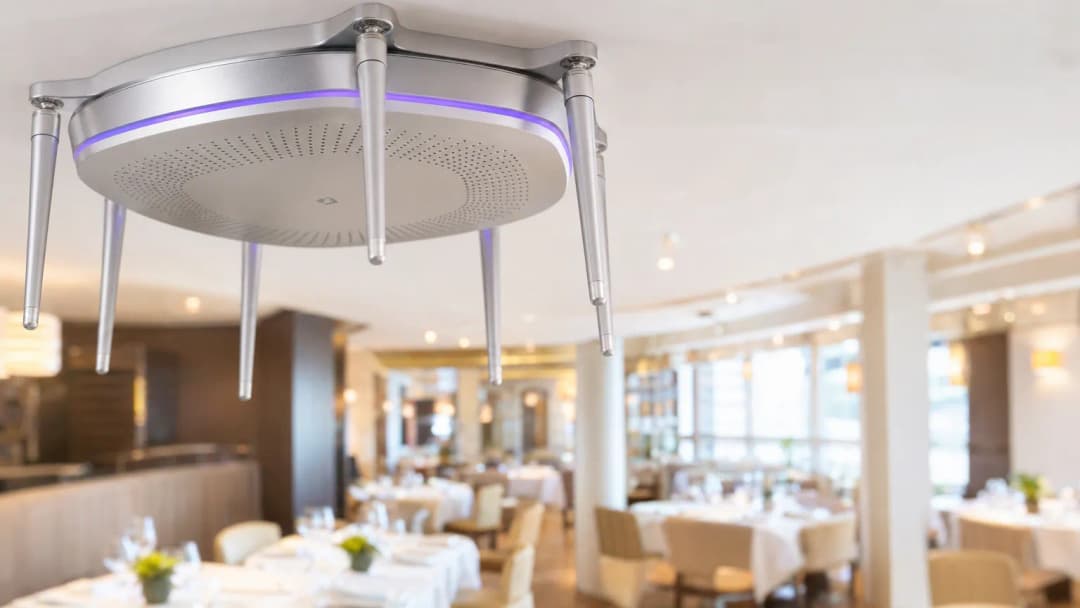
To understand how to improve the customer experience in a restaurant environment, we must first examine the underlying technical architecture. A robust deployment requires high-density access points (APs) capable of handling concurrent connections without performance degradation. The transition to Wi-Fi 6 (IEEE 802.11ax) is essential for reducing latency in dense environments like a busy restaurant floor.
The Captive Portal as a Data Gateway
The captive portal is the primary interface for guest interaction. When users connect, they are redirected to a branded login page. This is the core of what restaurant WiFi marketing is. In place of a shared WPA3 password, guests authenticate via email, phone number, or social media. This connectivity-for-data exchange enables venues to build comprehensive guest profiles.
Seamless Authentication and OpenRoaming
To reduce friction, enterprise-grade solutions leverage seamless authentication. Technologies such as Passpoint (Hotspot 2.0) and OpenRoaming allow devices to connect automatically after the initial setup. Purple acts as a free identity provider for OpenRoaming under the Connect licence, ensuring a secure, frictionless experience while still enabling data capture.

Got questions about your specific setup?
Our team works with venue operators, IT managers, and network engineers across 80,000 venues. Book a 20-minute call and we will show you how others like you solved it.
Implementation Guide: Deployment and Integration
Deploying WiFi for marketing requires a strategic approach to RF design and systems integration.
RF Planning and Heatmapping
Before deployment, conduct a thorough site survey. Restaurant environments present unique RF challenges, including interference from kitchen equipment (microwave ovens) and signal attenuation caused by thick walls or metal fixtures. Heatmapping ensures optimal AP placement to eliminate dead zones and guarantee consistent throughput.
CRM and Analytics Integration
The value of restaurant guest WiFi lies in the data. The captive portal must integrate seamlessly via API with existing CRM and marketing automation platforms. When a guest logs in, their MAC address is tied to their profile. This enables presence analytics — tracking dwell time, visit frequency, and cross-venue movement. For a fuller picture of connectivity, see What is a Leased Line? Dedicated Business Internet to ensure a reliable backhaul network.
Hospitality WiFi Best Practices
- Brand the portal: Ensure the captive portal reflects the restaurant's brand identity. Use clean UI elements and avoid overly complex forms.
- Prioritise security: Implement client isolation on the guest SSID to prevent lateral movement between connected devices. Ensure compliance with PCI DSS for payment networks and GDPR for data handling.
- Personalise the experience: Leverage the captured data to deliver targeted offers. If a guest is a regular, trigger an automated email or SMS with a loyalty reward. See How Personalisation Increases Customer Loyalty and Sales for deeper insights.
- Manage bandwidth: Implement traffic shaping at the gateway to prioritise critical applications (such as point-of-sale systems) over guest video streaming.
Troubleshooting and Risk Mitigation
Common Failure Modes
- Co-channel interference: Poor AP placement or incorrect channel configuration can cause interference and degrade performance. Use dynamic radio management to optimise channel selection.
- Captive portal drop-off: If the login process is too long or fails to load, guests will abandon the connection. Monitor authentication success rates and optimise the portal for mobile devices.
- MAC randomisation: Modern operating systems (iOS, Android) use randomised MAC addresses to enhance privacy. While this complicates tracking, devices typically retain the same random MAC for a specific SSID. Encouraging users to install a loyalty app provides a persistent identity, mitigating the issue.
ROI and Business Impact
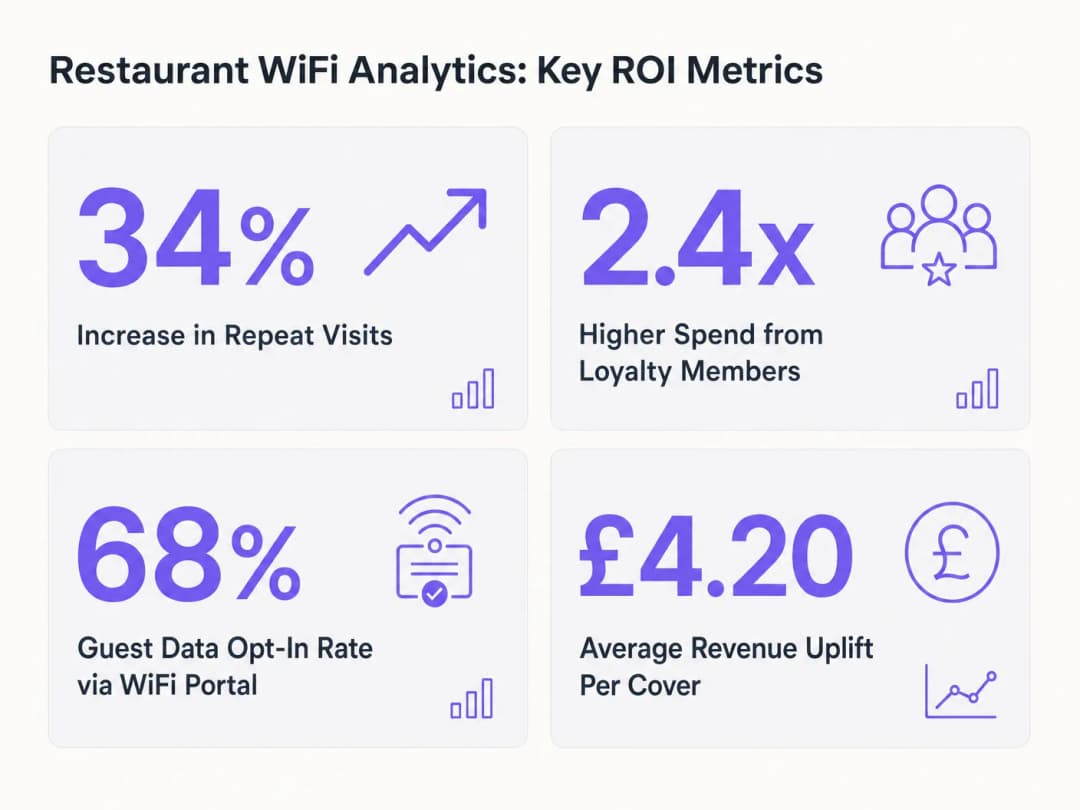
The ultimate goal of deploying an enterprise-grade WiFi analytics platform is measurable ROI. By analysing presence data and campaign performance, venues can quantify the impact of their WiFi strategy. Key metrics include growth in repeat visits, opt-in rates for marketing communications, and uplift in average revenue per cover. For example, a targeted email campaign aimed at guests who haven't visited in 30 days — triggered by their absence from the network — can significantly drive return footfall.
Key Definitions
Captive Portal
A web page that the user of a public-access network is obliged to view and interact with before access is granted.
The primary mechanism for data capture in restaurant WiFi deployments.
Presence Analytics
The use of WiFi network data (like probe requests and MAC addresses) to track the physical location and movement of devices within a venue.
Used by operations directors to measure dwell time, foot traffic patterns, and repeat visit rates.
MAC Randomisation
A privacy feature in modern OS where the device uses a temporary, random MAC address instead of its true hardware address when connecting to networks.
An important consideration for IT teams when designing tracking and loyalty systems, requiring strategies like persistent SSIDs or app integrations.
Client Isolation
A security feature that prevents devices connected to the same wireless network from communicating directly with one another.
Crucial for protecting guest devices from potential threats originating from other compromised devices on the public network.
OpenRoaming
A roaming federation service enabling an automatic and secure WiFi experience globally.
Reduces friction for guests by allowing seamless, automatic connection to the restaurant's network without manual login, while still supporting secure authentication.
Traffic Shaping
The control of computer network traffic to optimise or guarantee performance, improve latency, or increase usable bandwidth for some kinds of packets by delaying other kinds.
Used to ensure that critical restaurant operations (like POS systems) are not impacted by heavy guest WiFi usage.
First-Party Data
Information a company collects directly from its customers and owns.
The primary output of a successful WiFi marketing strategy, highly valuable for personalised CRM campaigns.
Dwell Time
The length of time a visitor spends in a specific area or venue.
A key metric derived from presence analytics, used to understand customer engagement and optimise table turnover rates.
Worked Examples
A 150-cover fine dining restaurant in a historic building with thick stone walls is experiencing poor WiFi coverage and low captive portal completion rates.
- Conduct a predictive and active RF site survey to identify attenuation caused by the stone walls. 2. Deploy additional WiFi 6 APs in strategic locations, potentially using directional antennas for specific zones. 3. Simplify the captive portal to require only an email address or social login, reducing friction. 4. Implement OpenRoaming to allow seamless reconnection for returning guests.
A fast-casual chain with 50 locations wants to understand cross-venue loyalty and standardise their marketing data collection.
- Deploy a unified enterprise WiFi management platform across all 50 locations. 2. Configure a single, standardised captive portal that feeds data into a centralised CRM. 3. Utilise presence analytics to track MAC addresses across different venues, identifying customers who visit multiple locations. 4. Create segmented marketing campaigns based on visit frequency and location preferences.
Practice Questions
Q1. A new marketing director wants to capture 15 different data points (including physical address and birthday) on the captive portal to build detailed profiles. As the IT manager, how should you advise them?
Hint: Consider the relationship between form length and conversion rates.
View model answer
Advise against it. Long forms cause high abandonment rates. Recommend capturing only essential data (e.g., email or phone number) initially. Use progressive profiling - capturing additional data points during subsequent visits or through post-visit email surveys - to build the profile over time without causing friction at the point of connection.
Q2. Your restaurant chain is experiencing intermittent POS connectivity issues during peak dining hours. The POS and guest WiFi share the same physical infrastructure. What is the immediate technical remediation?
Hint: Look at bandwidth allocation and network segregation.
View model answer
Implement traffic shaping and Quality of Service (QoS) rules at the gateway to prioritise POS traffic over the guest SSID. Additionally, ensure the POS system is on a separate, hidden VLAN with dedicated bandwidth allocation to prevent guest usage from impacting critical operations.
Q3. A venue operator is concerned that MAC randomisation in newer iOS devices will completely break their presence analytics and loyalty tracking. How do you explain the reality of the situation and the mitigation strategy?
Hint: How do devices handle MAC randomisation for known networks?
View model answer
Explain that while the MAC is randomised, devices typically use the same randomised MAC address for a specific SSID upon returning. Therefore, repeat visits to the same venue can still be tracked. To build a more robust, cross-venue identity, recommend integrating the WiFi authentication with a loyalty app or utilising OpenRoaming, which provides a persistent identity beyond the hardware MAC.
Continue reading in this series
How to leverage SMS in marketing to increase return visits
This technical reference guide outlines how enterprise venues can integrate WiFi analytics with SMS marketing engines to drive repeat visits. It details the architecture required to capture real-time presence data, trigger automated SMS campaigns based on physical behaviour, and measure the direct impact on return rates. By aligning network infrastructure with marketing automation, IT and operations teams can establish a high-yield channel for customer retention.
First-party data marketing: a comprehensive guide for businesses
This guide explains how to build a robust first-party data marketing strategy using enterprise Guest WiFi networks. It covers the technical architecture for secure data capture via captive portals, GDPR-compliant consent workflows, CRM integration patterns, and automated campaign deployment. Venue operators across hospitality, retail, events, and public-sector environments will find actionable guidance for turning passive visitors into a high-quality, owned marketing audience.
Customer data management platform: a comprehensive guide for businesses
This guide explains how venue operators can deploy a customer data management platform to unify fragmented visitor data. It covers technical architecture, integration strategies, and the critical role of Guest WiFi in building first-party data profiles.
Got questions about your specific setup?
Our team works with venue operators, IT managers, and network engineers across 80,000 venues. Book a 20-minute call and we will show you how others like you solved it.