
Integrating WeChat WiFi Login: Capturing Engagement via Social Captive Portals
This guide details how to integrate WeChat WiFi authentication into enterprise captive portals, covering the OAuth 2.0 architecture, RADIUS integration, and step-by-step deployment across Cisco Meraki, HPE Aruba, and Juniper Mist hardware. It gives IT managers and network architects a practical framework for capturing first-party data from WeChat's 1.3 billion users while driving engagement via Official Account follows and post-login redirects.
Video overview
Listen to this guide
View podcast transcript
Part of our core series: Captive Portal Guide →
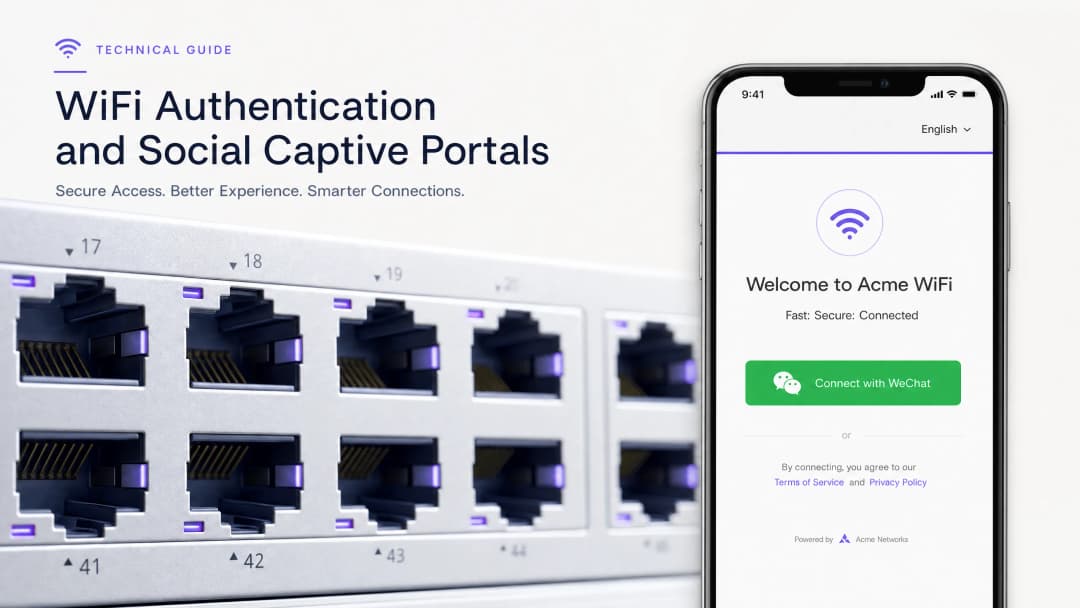
Executive Summary
Integrating WeChat WiFi login transforms a standard Captive Portal into a strategic first-party data engine for Chinese visitors and the wider WeChat ecosystem. For IT managers and network architects, deploying WeChat login via OAuth 2.0 and RADIUS requires balancing frictionless guest access with secure, compliant data collection. This guide details the technical architecture, implementation steps, and security considerations for deploying WeChat WiFi authentication on enterprise network hardware including Cisco Meraki, HPE Aruba, Ruckus, and Juniper Mist. It shows how Purple's Guest WiFi platform mediates the OAuth flow, maps profile data to your CRM, and drives engagement through post-login redirects to your WeChat Official Account.
WeChat has over 1.3 billion monthly active users, and World Tourism Organization data indicates that Chinese travellers were projected to spend $255 billion internationally in 2023. For hotels, luxury retail, airports, and conference centres, offering WeChat WiFi login is a direct channel to that demographic. Purple operates across more than 80,000 active venues and recorded 440 million logins in 2024, giving us direct insight into what succeeds and what fails in production deployments.
Technical Deep Dive
How WeChat WiFi Authentication Works
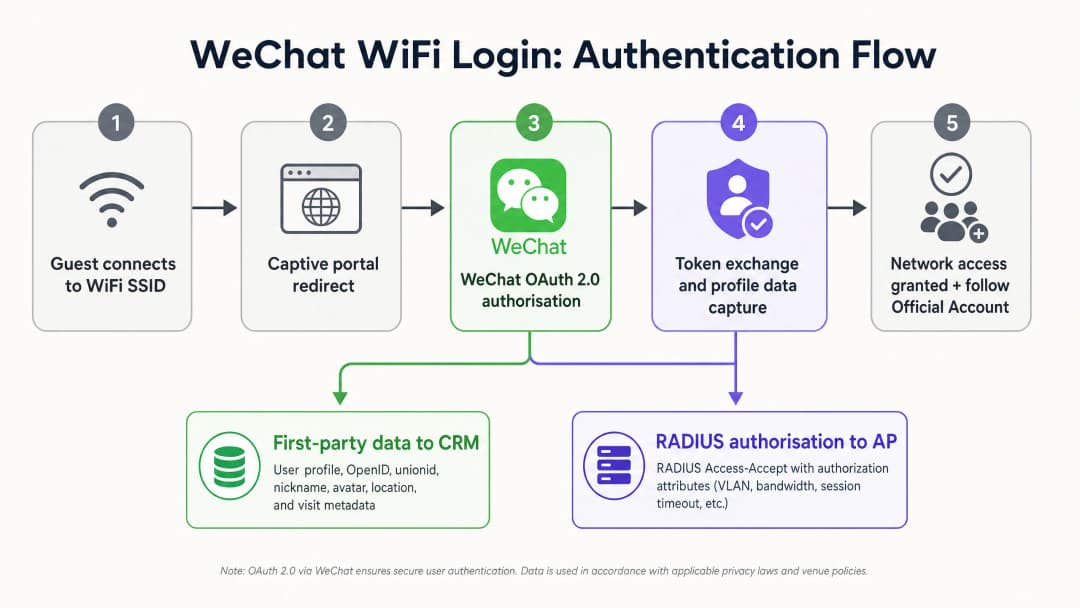
WeChat WiFi authentication replaces manual form entry with an OAuth 2.0 flow integrated directly into the Captive Portal experience. The sequence involves five components communicating in a defined order:
- The guest device connects to the venue SSID.
- The access point (AP) intercepts unauthenticated HTTP traffic and redirects the device to a Captive Portal hosted by Purple.
- The user selects the WeChat login option on the portal page.
- The portal initiates an OAuth 2.0 authorisation request to the WeChat open platform API, passing the venue's AppID and redirect URI.
- The WeChat client opens on the device and prompts the user to authorise the connection.
- WeChat returns an authorisation code to the redirect URI.
- The Purple platform exchanges the authorisation code for an access token and retrieves the user's profile data: OpenID, unionid, nickname, avatar, and registered location.
- Purple signals the RADIUS server to send an Access-Accept message to the access point.
- The access point grants internet access and applies the configured policies (VLAN assignment, bandwidth limits, session timeout).
- The portal redirects the user to the venue's WeChat Official Account or a custom landing page.
Account Type Requirements
This is the most common single point of failure in WeChat WiFi deployments. You must use a verified WeChat Service Account (服务号). Subscription Accounts do not expose the OAuth 2.0 web authorisation APIs required for Captive Portal integration. The table below summarises the key differences:
| Feature | Service Account | Subscription Account |
|---|---|---|
| OAuth 2.0 WiFi login | Yes | No |
| API access level | Full | Restricted |
| Push messages per month | 4 | 30 |
| Chat list placement | Yes (as a contact) | No (folded into the subscriptions folder) |
| WeChat Pay integration | Yes | No |
| Verification required | Yes | Yes |
Obtaining a verified Service Account requires either a Chinese business licence or a special overseas application process through Tencent, which carries a $99 annual verification fee and a two-to-four-week review period.
The Walled Garden: The Most Critical Network Configuration
The walled garden (also known as the pre-authentication whitelist) defines the IP addresses and domains a device can reach before completing Captive Portal authentication. If the WeChat API domains are not in the walled garden, the device cannot initiate the OAuth handshake, and the login fails silently in the background.
At a minimum, the following domains must be whitelisted:
*.weixin.qq.com*.wechat.com*.wx.qq.comres.wx.qq.commp.weixin.qq.com- The WeChat CDN IP ranges (consult Tencent's published IP range documentation, as these change periodically)
On Cisco Meraki, configure this under Wireless > Access Control > Walled Garden. On HPE Aruba, use the Captive Portal Profile whitelist. On Juniper Mist, configure the Guest Portal allowed domains list.
RADIUS Integration and Policy Enforcement
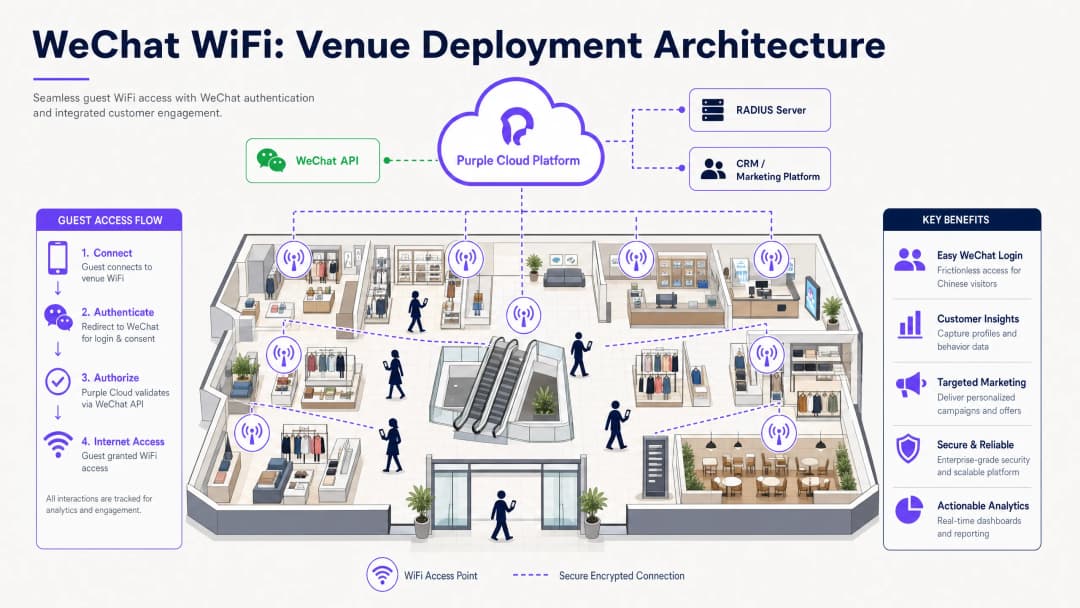
In this architecture, Purple operates as a RADIUS proxy. After a successful WeChat OAuth exchange, Purple sends a RADIUS Access-Accept message to the venue's wireless controller. The Access-Accept message can carry standard RADIUS attributes to enforce per-user policies:
Tunnel-TypeandTunnel-Private-Group-IDfor VLAN assignment (isolating guest traffic from the corporate network, in line with IEEE 802.1X segmentation best practice)Session-Timeoutfor automatic disconnection after a defined periodWISPr-Bandwidth-Max-UpandWISPr-Bandwidth-Max-Downfor bandwidth limiting
The architecture is hardware-agnostic. Purple integrates with Cisco Meraki, HPE Aruba, Ruckus, Juniper Mist, Ubiquiti UniFi, Cambium, Extreme, and Fortinet without firmware changes or on-premises servers.
Got questions about your specific setup?
Our team works with venue operators, IT managers, and network engineers across 80,000 venues. Book a 20-minute call and we will show you how others like you solved it.
Implementation Guide
Step 1: Configure the WeChat Developer Account
Log in to the WeChat Official Accounts Platform (mp.weixin.qq.com). Navigate to Settings and Development > Security Centre > Web Authorisation Domains. Enable OAuth 2.0 web authorisation and add your Captive Portal domain as an authorised callback domain (for example, wifi.yourvenue.com). WeChat will only return authorisation codes to domains registered here - a mismatch causes silent failures.
Obtain your AppID and AppSecret from the Settings and Development > Basic Configuration panel. Store the AppSecret securely; treat it as a private key.
Step 2: Configure Purple
In the Purple portal, navigate to Authentication > Social Login and enable WeChat. Enter the AppID and AppSecret. Design the Captive Portal splash page using Purple's drag-and-drop editor. Position the WeChat login button as the primary call to action (CTA) above the fold.
Configure the post-authentication redirect. Options include:
- The venue's WeChat Official Account follow page (recommended for engagement)
- A promotional landing page hosted within a WeChat Mini Program
- A survey page using Purple's WiFi Analytics tools
- A loyalty programme enrolment page
Enable MAC address caching under Authentication > Return Visitor Settings. Set the cache duration to match your typical visit frequency (7 days is recommended for retail, 30 days for hotels). Returning visitors connect automatically without seeing the portal again, while their visit is still registered in the analytics dashboard.
Step 3: Configure the Network Hardware
On your wireless controller, configure the guest SSID to use an external Captive Portal. Enter the Purple portal URL as the splash page URL. Add the WeChat domains to the walled garden. Set the RADIUS server IP address and shared secret provided by Purple.
Before going live, test the complete flow with a mobile device. Specifically:
- Connect to the guest SSID.
- Confirm the Captive Portal loads in the Captive Portal Assistant (CPA) mini-browser.
- Tap the WeChat login button and confirm the WeChat client opens.
- Authorise the connection and confirm internet access is granted.
- Confirm the post-login redirect fires correctly.
Best Practices
Optimise the walled garden. A misconfigured walled garden is the leading cause of WeChat login failures in production. Test before launch, and re-test after any network firmware update, as some controllers reset whitelist entries during upgrades.
Drive post-login engagement. The moment after authentication is the point of highest attention in the guest WiFi experience. Redirect users to your Official Account follow page. Visitors who follow your account remain reachable via push notifications long after they leave the venue.
Implement MAC caching for returning visitors. Requiring repeat authentication on every visit degrades the experience. MAC caching removes friction for returning visitors while still logging the visit for analytics. See Purple's WiFi Analytics for dwell-time and return-visit reporting.
Apply data minimisation. Request only the WeChat profile fields your CRM actually uses. Requesting unnecessary permissions increases authorisation drop-off and adds GDPR compliance complexity. For most venues, OpenID, nickname, and avatar are sufficient for personalisation.
Isolate guest traffic via VLANs. Assign WeChat-authenticated guests to a dedicated VLAN, isolated from your corporate or POS networks. This satisfies PCI DSS network isolation requirements and limits the blast radius of any guest-side security incident. For a complete treatment of WiFi security architecture, see our enterprise WiFi security guide.
Comply with GDPR and PIPL. Display a clear privacy notice on the splash page before the user initiates the WeChat OAuth flow. The notice must identify the data controller, list the categories of data collected from WeChat, state the legal basis for processing, and link to the full privacy policy. For detailed guidance, see our WiFi GDPR compliance guide.
Troubleshooting and Risk Mitigation
OAuth Redirect Mismatch
If the callback URL registered in the WeChat developer console does not exactly match the URL Purple uses for the redirect, WeChat returns an error code and blocks the authorisation. Check for protocol mismatches (HTTP vs HTTPS), trailing slashes, and subdomain differences. The registered domain must be an exact string match.
Captive Portal Assistant (CPA) Interference
Mobile operating systems use CPA mini-browsers to detect and handle Captive Portal networks. These mini-browsers often lack the ability to open native apps, which breaks the WeChat app hand-off in the OAuth flow. Mitigations include:
- Implementing a JavaScript redirect that detects the CPA environment and opens the full system browser before initiating the OAuth flow.
- Displaying clear instructions on the splash page telling users to open the page in a full browser if the WeChat button does not respond.
Token Expiry and Stale Sessions
WeChat access tokens expire after two hours. If your platform does not refresh the token, the user's CRM record stops updating after the initial session. Configure Purple's token refresh settings to maintain an active token for the duration of the guest's visit.
Geopolitical and Regulatory Risk
WeChat is subject to Chinese government regulation and Tencent platform policy. API access can be suspended or modified without notice. To mitigate this risk, ensure your Captive Portal supports multiple authentication methods (email, SMS, other social logins) so that a WeChat API outage does not take your entire guest WiFi offline. Purple's multi-channel portals natively support this fallback architecture.
ROI and Business Impact
Deploying WeChat WiFi authentication delivers measurable returns across three dimensions.
Higher data capture rates. Social login removes the friction of form filling. Venues using Purple's social login options report authentication completion rates 20-30% higher than comparable email-only portals (Purple internal data, 2024). At a venue handling 500 guest WiFi connections per day, a 25% uplift means 125 additional verified profiles captured daily.
Official Account follower growth. Redirecting authenticated users to the Official Account follow page converts transient footfall into a reachable digital audience. A hotel with 200 WeChat-authenticated visitors per day achieving a 40% follow rate gains 80 new Official Account followers daily - followers who can receive targeted push notifications about return-visit offers, loyalty programme updates, and seasonal promotions.
Operational visibility. Purple's WiFi Analytics platform correlates WeChat-authenticated sessions with dwell time, visit frequency, and zone-level movement data. This gives venue operations directors the data to optimise staffing, layout, and promotional timing. For hospitality venues, this data integrates directly with PMS systems to enrich guest profiles.
For retail environments, WeChat authentication combined with Purple's analytics platform replicates e-commerce-grade data richness in a physical store setting - a capability that grows increasingly valuable as third-party cookie deprecation reduces the effectiveness of digital retargeting.
For related guidance, see our WiFi GDPR compliance guide and our enterprise WiFi security guide. To learn how Purple deploys in specific verticals, see our hospitality, retail, healthcare, and transport pages.
Key Definitions
OAuth 2.0
An industry-standard authorisation protocol that allows a user to grant a third-party application access to their account data on another service without sharing their password. In WeChat WiFi authentication, the Captive Portal is the third-party application and WeChat is the identity provider.
The underlying mechanism for all social WiFi login. IT teams encounter it when configuring the AppID, AppSecret, and redirect URI in the WeChat developer console and the Purple platform.
Captive portal
A web page that intercepts a device's network traffic and requires the user to authorise or accept terms before granting internet access. It operates by redirecting all HTTP requests to the portal URL until authentication is complete.
The user-facing component of the WeChat WiFi login system. Purple hosts and manages the Captive Portal as a cloud overlay on top of the venue's existing hardware.
Walled garden
A pre-authentication whitelist of IP addresses and domains that a device can reach before completing Captive Portal login. Required to allow the device to communicate with WeChat's authentication servers during the OAuth flow.
The most commonly misconfigured element in WeChat WiFi deployments. Must be configured at the SSID level on the wireless controller.
RADIUS
Remote Authentication Dial-In User Service. A networking protocol providing centralised authentication, authorisation, and accounting for network access. After a successful WeChat OAuth exchange, Purple sends a RADIUS Access-Accept message to the access point to grant internet access.
The protocol that connects the Purple identity platform to the venue's network hardware. IT teams configure RADIUS server IP addresses and shared secrets in the wireless controller.
WeChat Service Account (服务号)
A category of WeChat Official Account designed for businesses, offering full API access including OAuth 2.0 webpage authorisation. Appears as a contact in the user's chat list. Requires Chinese business registration or overseas verification.
The mandatory account type for WeChat WiFi login. Subscription accounts cannot be used for this purpose.
OpenID
A unique identifier assigned by WeChat to a specific user for a specific Official Account. Two different Official Accounts will receive different OpenIDs for the same user.
The primary key used by the CRM to identify and track individual users across WiFi sessions.
Unionid
A unique identifier assigned by WeChat to a specific user across all Official Accounts and Mini Programs registered under the same WeChat open platform account. Allows cross-product user recognition.
Relevant for brands with multiple WeChat touchpoints (e.g., a retail chain with both a WiFi portal and a shopping Mini Program) that want to unify the user profile across all interactions.
MAC address caching
A network feature that stores a device's unique hardware identifier (MAC address) after initial authentication, allowing the network to automatically grant access on subsequent connections without presenting the Captive Portal again.
Used to improve the return visitor experience. Purple logs the return visit for analytics even when the portal is not displayed.
Captive Portal Assistant (CPA)
The mini-browser automatically launched by iOS and Android when they detect a network requiring Captive Portal authentication. CPAs have limited functionality and may not support native app callouts required for the WeChat OAuth flow.
IT teams must test the WeChat login flow specifically within the CPA environment and implement JavaScript detection to redirect to the full system browser if necessary.
VLAN
Virtual Local Area Network. A logical network segment that isolates traffic from other segments on the same physical infrastructure. Used to separate guest WiFi traffic from corporate or POS networks.
RADIUS attributes returned by Purple can assign WeChat-authenticated guests to a specific VLAN, satisfying PCI DSS network segmentation requirements.
Worked Examples
A luxury retail brand in London wants to offer seamless WiFi to Chinese tourists while increasing followers on their WeChat Official Account. They currently use Cisco Meraki access points and a standard email-capture portal. Their IT team has two weeks to deploy before a major Chinese New Year campaign.
Week one: Register and verify a WeChat Service Account if not already in place (allow two to four weeks for Tencent approval, so this step should have started earlier - if not, use a verified third-party Chinese entity as an interim measure). Configure the WeChat developer console with the callback domain matching the Purple portal URL. In the Purple platform, enable WeChat social login, input the AppID and AppSecret, and design the splash page with WeChat as the primary login option. Configure the post-authentication redirect to the brand's WeChat Official Account follow page. Week two: In the Meraki dashboard, update the guest SSID to point to the Purple portal URL. Add all WeChat API domains to the Meraki walled garden under Wireless > Access Control. Set RADIUS server details. Test the full flow end-to-end from an iOS and Android device. Enable MAC caching for 30-day return visitor recognition. Go live.
A 15,000-capacity stadium is hosting a series of international events with significant Chinese-speaking attendees. The IT director reports that 35% of guests abandon the WiFi login form before completing it. The network runs HPE Aruba access points managed via Aruba Central.
Deploy Purple's captive portal with WeChat as the primary social login option alongside email and SMS fallbacks. Configure the Aruba Central captive portal profile to redirect to Purple and add WeChat domains to the allowed list. Implement a JavaScript CPA detection script on the splash page to force the OAuth flow into the native system browser, bypassing the Aruba CPA mini-browser. Configure RADIUS attributes to assign authenticated fans to a dedicated guest VLAN, isolated from the stadium's operational network. Set session timeout to four hours to cover a typical event duration without requiring re-authentication. Post-authentication, redirect fans to a WeChat Mini Programme hosting the event programme, live scores, and a food ordering service.
Practice Questions
Q1. Your venue's new WeChat WiFi login is failing. Guests tap the WeChat button on the splash page, but the page times out before the WeChat app opens. The Cisco Meraki dashboard shows the SSID is online and the Purple portal URL is correctly configured. What is the most likely cause and how do you fix it?
Hint: Consider what network access the device has before it completes authentication.
View model answer
The walled garden on the Meraki SSID is misconfigured. The device cannot reach WeChat's API domains before authentication, so the OAuth handshake cannot initiate. Fix: navigate to Wireless > Access Control in the Meraki dashboard, locate the Walled Garden section, and add the required WeChat domains including *.weixin.qq.com, *.wechat.com, and *.wx.qq.com. Test by attempting the login flow again from a device that has not previously connected to the SSID.
Q2. A marketing director wants to use their existing WeChat Subscription Account (订阅号) to enable WiFi login because it allows daily article publishing to followers. They ask you to configure the integration. How do you respond?
Hint: Review the API access levels for different WeChat account types.
View model answer
Advise them that a Subscription Account cannot be used for WiFi authentication. The OAuth 2.0 webpage authorisation APIs required for captive portal integration are only available to verified Service Accounts (服务号). They will need to register a Service Account. This requires a Chinese business licence or an overseas application through Tencent's special process, which takes two to four weeks and costs $99 annually. The Subscription Account can remain active for content publishing; the two account types serve different purposes and can coexist.
Q3. After a successful WeChat WiFi deployment, the IT team notices that users who authenticated three weeks ago are no longer appearing in the CRM with updated visit data, even though they are connecting to the network. What is the likely cause?
Hint: Consider the session management settings configured in Purple and the MAC cache duration.
View model answer
The MAC cache duration is likely set to a value shorter than three weeks (e.g., 14 days), so returning users are being granted access via MAC cache without triggering a new authentication event or CRM update. Alternatively, the WeChat access token for those users has expired and the platform is not refreshing it. Fix: extend the MAC cache duration to 30 days in Purple's return visitor settings, and ensure the token refresh configuration is active. Also confirm that Purple is logging MAC-cached visits as return visit events in the analytics dashboard, even when the portal is not displayed.
Q4. Your venue operates in both the UK and mainland China. You want to deploy a unified WeChat WiFi authentication system. What compliance obligations must you address before going live?
Hint: Two distinct privacy regimes apply to the two geographies.
View model answer
You must comply with both GDPR (applicable to users in the UK and EU) and China's Personal Information Protection Law (PIPL, applicable to users in mainland China). Key requirements include: displaying a clear privacy notice on the splash page before initiating the OAuth flow, identifying the data controller and listing the categories of data collected from WeChat, stating the legal basis for processing under each regime (legitimate interests or consent under GDPR; consent under PIPL), providing a mechanism for users to withdraw consent and request deletion, and ensuring data transfer mechanisms are in place if WeChat profile data flows between jurisdictions. Consult Purple's GDPR compliance guide and your legal counsel for jurisdiction-specific requirements.
Continue reading in this series
Ubiquiti UniFi guest portal not redirecting: causes and fixes
This guide isolates a UniFi guest portal redirect failure by following the guest state, redirect, pre-authorisation route and controller authorisation in sequence. It gives venue IT teams a sourced method to address guest-network versus Hotspot confusion, external portal hand-offs, current UniFi OS account requirements and DNS isolation testing.
Cisco Meraki splash page not working: a troubleshooting flowchart
This practical day-two guide isolates where a Cisco Meraki splash flow has failed: client authorisation, HTTP redirect initiation, walled-garden reachability or RADIUS sign-on. It gives venue IT teams a controlled evidence path, so they can restore Guest WiFi without making broad changes to a live estate.
Enterprise Guest WiFi Setup Guide: VLAN Segmentation, Security, and Captive Portals
This technical guide shows IT teams how to set up Guest WiFi as a controlled internet-access service, using VLAN segmentation, firewall policy and a captive portal. It also explains how Purple's registration forms and onboarding controls support a proportionate visitor experience without weakening the boundary around staff, payment and operational systems.
Got questions about your specific setup?
Our team works with venue operators, IT managers, and network engineers across 80,000 venues. Book a 20-minute call and we will show you how others like you solved it.