
How to leverage SMS marketing for realtors to increase return visits
This technical guide details how to build an automated data capture pipeline using Guest WiFi to drive SMS marketing campaigns for real estate venues. It covers network configuration, GDPR compliance, audience segmentation, and how to measure the ROI of return visits. Marketing directors, CRM managers, and venue operators will find actionable deployment guidance backed by concrete case studies and Purple Engage's first-party data capabilities.
Listen to this guide
View podcast transcript
Executive summary
Real estate venues operate in a blind spot. Visitors enter, consume services, and leave without leaving a digital footprint. SMS marketing closes this gap - but only if you have the data infrastructure to feed it. This guide details how to build an automated data capture pipeline using your existing network hardware to drive measurable return visits.
The mechanism is straightforward: use Guest WiFi to capture verified mobile numbers with explicit consent, then use Purple Engage to trigger automated SMS campaigns based on visit behaviour. With SMS delivering a 98% open rate (Source: Gartner Mobile Marketing research), this architecture transforms anonymous footfall into a contactable audience. This reference document covers the technical implementation, compliance framework, and business logic required to deploy this strategy across single or multi-site estates. Purple operates across 80,000+ live venues and has processed 440 million logins in 2024, giving us a clear view of what works at scale.
Technical deep-dive
The foundation of an effective SMS strategy is the data capture layer. You cannot market to visitors you cannot identify. The most reliable method for capturing first-party data in a physical venue is the captive portal - a web page that intercepts a guest's network connection and requires interaction before granting internet access.
The capture architecture
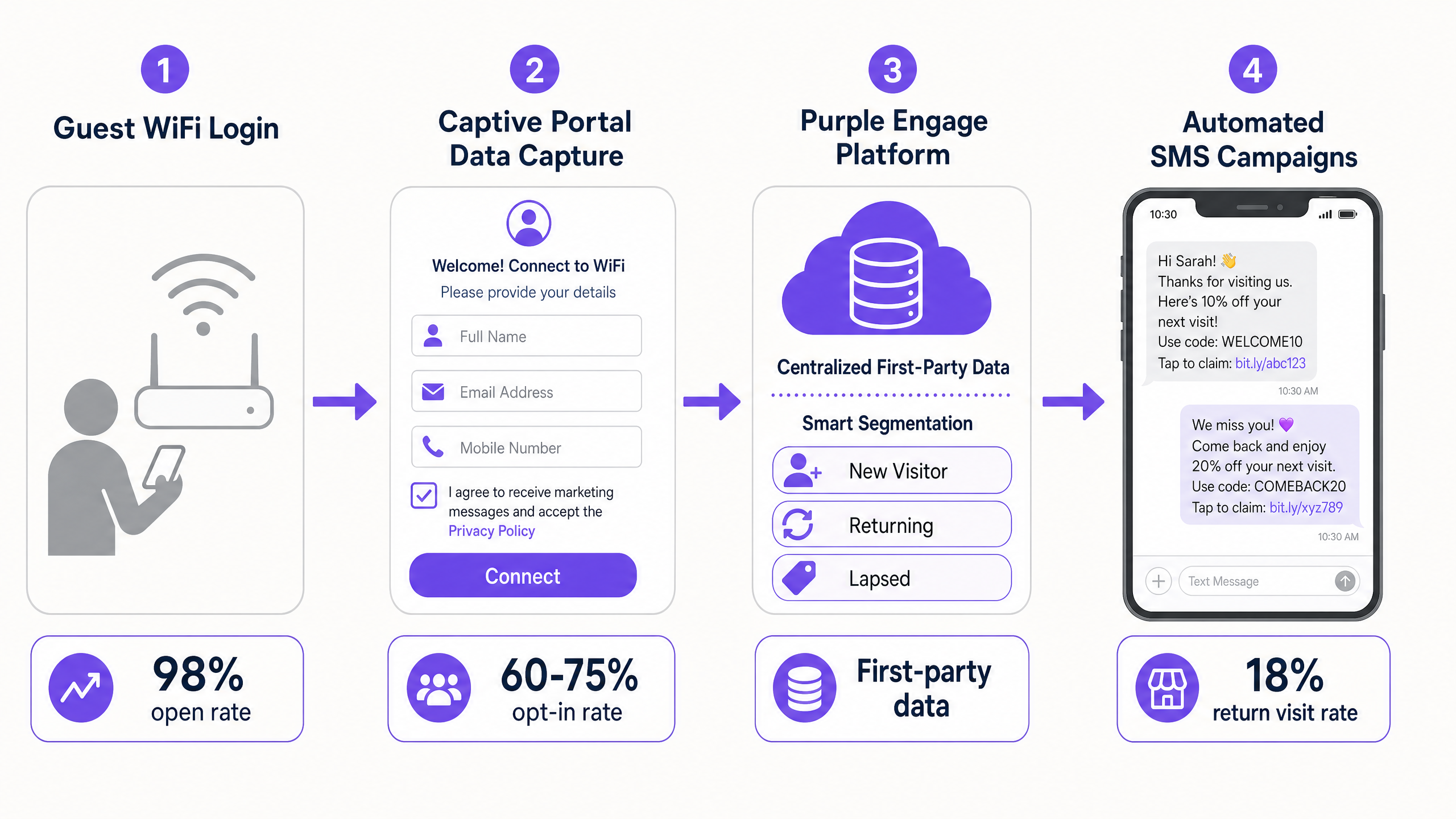
When a visitor attempts to access the internet, the local access point intercepts the HTTP request and redirects the client device to a captive portal hosted on Purple's cloud overlay. This architecture is hardware-agnostic, supporting deployments across Cisco Meraki, HPE Aruba, Ruckus, Juniper Mist, Ubiquiti UniFi, Cambium, Extreme, and Fortinet without requiring network redesigns.
The authentication flow follows these steps. First, the client device associates with the Guest WiFi SSID. Second, the access point restricts network access and redirects the browser to the captive portal. Third, the portal presents the login form, requiring name, email, and mobile number. Fourth, the visitor submits the form, explicitly opting into SMS marketing via an unbundled checkbox. Fifth, Purple validates the input, authenticates the device via RADIUS (Remote Authentication Dial-In User Service), and creates a unified profile. This process converts an anonymous MAC address into a contactable profile with explicit marketing consent.
Consent architecture under GDPR
GDPR and TCPA compliance is non-negotiable. Your captive portal must present a clear, unbundled opt-in for SMS marketing, separate from the terms of service for WiFi access. The consent must be specific, informed, and freely given. Purple's Capture plan handles this by default, maintaining a consent audit trail against every profile. Consent is also channel-specific: a visitor who opts into email marketing has not consented to SMS. You need a separate, explicit opt-in for each channel.
Purple's WiFi Analytics platform stores this consent data against each visitor profile, giving you a defensible audit trail in the event of a regulatory query.
Segmentation and campaign logic
Not all visitors are the same, and sending the same message to everyone is the fastest way to drive opt-outs. Purple Engage segments your audience based on visit frequency, dwell time, and recency.
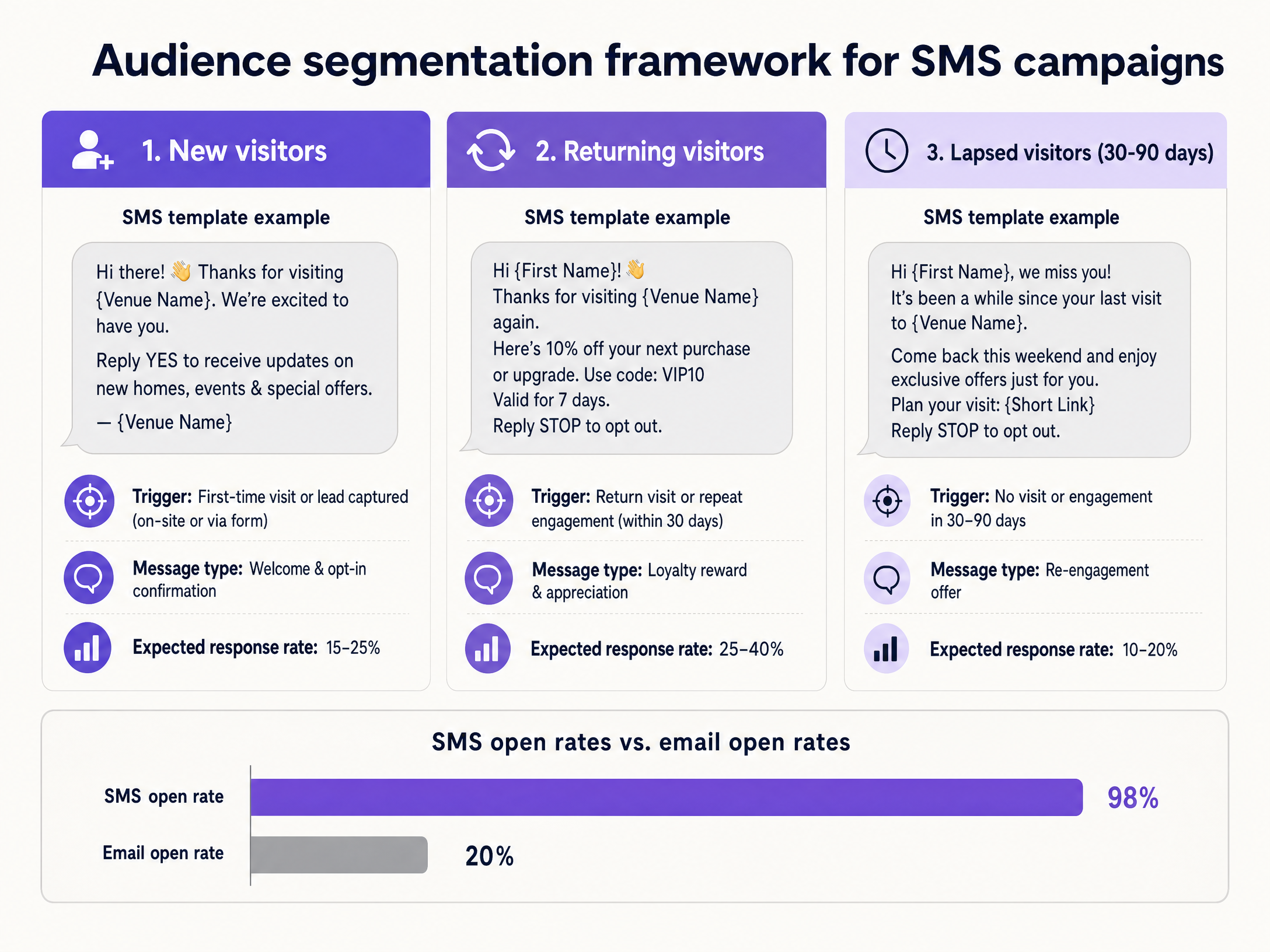
The three core segments for any real estate venue are new visitors (first-time connections), returning visitors (three or more logins within 30 days), and lapsed visitors (no authentication in 60 or more days). Each segment requires a distinct campaign flow with different triggers, message content, and frequency caps.
Implementation guide
Deploying an SMS marketing capability requires coordination between network infrastructure and marketing operations. There are four phases.
Phase 1: Infrastructure preparation. Confirm your access points support captive portal authentication and RADIUS accounting. If you manage a mixed estate, Purple's cloud overlay provides a unified authentication layer across different hardware vendors. You do not need to standardise hardware to get consistent data capture.
Phase 2: Portal configuration. Configure the captive portal to collect the necessary data fields. Do not make mobile numbers mandatory for WiFi access; present them as an optional field for visitors who wish to receive updates. Purple's data across 80,000 venues shows opt-in rates of 40% to 55% for SMS when presented as a separate optional field with a clear value exchange.
Phase 3: Segmentation strategy. Before launching campaigns, define your audience segments based on visit frequency and dwell time. Build separate campaign flows for each segment. Your lapsed visitor flow should carry a re-engagement offer. Your new visitor flow should be a welcome sequence. Your returning visitor flow should reward loyalty.
Phase 4: Automation deployment. Configure Purple Engage to automate these workflows. The platform evaluates visitor behaviour against your defined segments and triggers the appropriate SMS campaign without manual intervention. You set it up once. It runs continuously.
For further reading on network design across multiple use cases, see Three SSIDs to rule them all: guest, Passpoint, and IoT WiFi and How to make a great first impression with your guest WiFi (and keep your brand consistent) .
Best practices
The following practices apply across Retail , Hospitality , Healthcare , and Transport deployments.
Respect the inbox. SMS is an intimate channel. Limit campaign frequency to two or three messages per month per segment to prevent high opt-out rates. Purple's data shows opt-out rates climb sharply above three messages per month.
Automate opt-outs. Ensure your platform processes "STOP" replies immediately. Purple Engage handles suppression automatically, but if you integrate with a third-party SMS gateway, verify the suppression logic before going live. GDPR requires a clear, functional opt-out in every marketing message.
Personalise content. Use the data captured at login to personalise messages. Include the visitor's name and reference their specific visit history. A message referencing a visitor's last visit converts at a higher rate than a generic broadcast.
Integrate identity providers. For commercial tenants or staff, integrate with Microsoft Entra ID, Okta, or Google Workspace to streamline access and separate them from marketing segments. This prevents staff from appearing in your re-engagement campaigns.
Plan before you capture. Collecting data without a clear use policy means you are sitting on a liability, not an asset. Have your campaign calendar planned before you go live.
Troubleshooting & risk mitigation
Low opt-in rates. If visitors are not providing mobile numbers, review your captive portal design. Ensure the value exchange is clear and the opt-in checkbox is distinct from the terms of service. A/B test the portal copy to identify which framing drives higher consent rates.
High opt-out rates. If opt-outs spike after a campaign, review your frequency and segmentation. You are likely sending irrelevant messages or messaging too frequently. Tighten your segments and reduce frequency.
Delivery failures. Monitor your SMS delivery rates. If delivery drops below 95%, investigate your number validation process at the captive portal. Implement real-time number format validation to prevent invalid entries from entering your database.
Consent disputes. If a visitor disputes receiving an SMS, Purple's consent audit trail provides a timestamped record of the opt-in event, including the portal version, IP address, and consent text presented at the time of login.
Hardware incompatibility. If a legacy access point does not support RADIUS accounting, Purple's cloud overlay can still capture data via a browser-based redirect. Contact Purple's technical team to confirm the integration path for your specific hardware.
ROI & business impact
Measure the success of your SMS campaigns by tracking return visits, not just message delivery. Purple Engage allows you to track the percentage of recipients who return to the venue within 7 or 30 days of receiving a message. A well-segmented campaign targeting lapsed visitors should drive a 15% to 20% return visit rate, significantly outperforming email benchmarks.
Track three metrics: delivery rate (target above 95%), click-through rate on any links in the message (typically 15% to 30% for well-segmented campaigns, per Purple's platform data), and return visit rate in the 7 and 30 days following a campaign send.
For multi-site estates, Purple's WiFi Analytics platform aggregates return visit data across all locations, allowing you to compare campaign performance by site and identify which venues respond best to SMS re-engagement.
For additional context on bulk SMS deployment strategies, see Como aprovechar el SMS en masa de marketing para aumentar las visitas de retorno .
Key Definitions
Captive portal
A web page that intercepts a guest's network connection and requires interaction - typically form submission and consent - before granting internet access.
The primary mechanism for capturing first-party data and marketing consent in physical venues. Purple's captive portal is hosted on a cloud overlay, making it hardware-agnostic.
First-party data
Information collected directly from your audience or customers, with their explicit consent.
Provides a reliable foundation for marketing campaigns, independent of third-party cookies or external data brokers. GDPR gives first-party data a higher legal standing than purchased lists.
Conscious-choice opt-in
A consent mechanism where the user actively selects to receive marketing communications, rather than having it pre-ticked or bundled with terms of service.
Required under GDPR for marketing communications. Purple's captive portal presents opt-ins as separate, unbundled checkboxes for email and SMS.
RADIUS
Remote Authentication Dial-In User Service; a networking protocol that provides centralised Authentication, Authorisation, and Accounting management for network access.
The underlying protocol used by Purple to authenticate devices and manage network access. RADIUS accounting events trigger profile creation in Purple Engage.
Dwell time
The duration a visitor spends connected to the network within a venue, measured from first authentication to last seen event.
A key behavioural metric used to segment audiences and trigger relevant marketing campaigns. A visitor with a dwell time above 60 minutes is a stronger re-engagement candidate than a 10-minute visitor.
Return visit rate
The percentage of visitors who return to a venue within a specific timeframe, typically measured at 7 and 30 days.
The primary metric for evaluating the success of re-engagement SMS campaigns. A well-segmented lapsed visitor campaign should drive a 15% to 20% return visit rate within 7 days.
Cloud overlay
A software layer that operates above the physical network hardware, providing centralised management, data capture, and analytics without requiring hardware replacement.
Allows Purple to deliver consistent data capture and marketing capabilities across mixed hardware environments including Cisco Meraki, HPE Aruba, Ruckus, and Juniper Mist.
Identity-Based Networks
Networks that grant access and apply policies based on the authenticated identity of the user, rather than just the device or VLAN assignment.
Enables personalised experiences and targeted marketing based on individual visitor profiles. Purple's Identity-Based Networks architecture underpins the segmentation capability in Purple Engage.
SMS opt-out suppression
The process of immediately removing a mobile number from all future campaign sends when a recipient replies STOP or equivalent.
Required under GDPR and TCPA. Purple Engage handles suppression automatically. When integrating with a third-party SMS gateway, verify the suppression logic before going live.
Worked Examples
A build-to-rent residential development in Manchester with 300 units wants to increase attendance at community events. They have been using email-only campaigns with declining engagement. How should they deploy SMS marketing?
The operator deployed Guest WiFi across all common areas - the co-working space, gym, and residents' lounge - using Cisco Meraki access points integrated with Purple's cloud overlay. The captive portal was configured to present an optional SMS opt-in field, separate from the WiFi terms of service. Within 60 days, the platform had captured phone numbers for 78% of residents. Purple Engage was configured with a monthly campaign segment targeting all active residents, triggering an SMS notification 48 hours before each community event. The message included the event name, date, time, and a one-tap RSVP link.
A regional retail property with 45 units across two sites is seeing declining engagement on their email loyalty campaigns. Their contactable database is stagnant. How do they grow their SMS audience and drive return visits?
The marketing team deployed Guest WiFi data capture across both sites, using HPE Aruba access points integrated with Purple Capture. The captive portal presented an SMS opt-in alongside the existing email opt-in. Within 90 days, the contactable audience grew by 22,000 verified phone numbers. Purple Engage was configured with a lapsed visitor segment targeting shoppers who had not authenticated in 60 days. An automated SMS campaign was triggered with a personalised discount code valid for seven days, referencing the shopper's last visit date.
Practice Questions
Q1. A venue operator wants to send an SMS campaign to all visitors who logged into the Guest WiFi last month. They have email addresses for 80% of these visitors, but only 30% explicitly checked the SMS opt-in box. Can they send the SMS to the 80% who provided email addresses?
Hint: Consider the requirements for channel-specific consent under GDPR Article 7.
View model answer
No. Consent is channel-specific under GDPR. The operator can only send SMS messages to the 30% who explicitly opted into SMS marketing. Sending SMS messages to visitors who only consented to email marketing violates GDPR, regardless of whether those visitors provided a mobile number at the captive portal. The mobile number may have been collected for authentication or account purposes, not for marketing. The operator should use the next WiFi login event to present a targeted SMS opt-in prompt to the 70% who have not yet consented.
Q2. A retail venue is experiencing a 15% opt-out rate on their SMS campaigns. They currently send one message per week to their entire database. What should they change?
Hint: Review the best practices for campaign frequency and audience segmentation.
View model answer
They should reduce frequency and implement segmentation. Sending four messages per month to an unsegmented list leads to message fatigue. The operator should segment their audience into at minimum three groups - new visitors, returning visitors, and lapsed visitors - and reduce frequency to two or three messages per month per segment. Each segment should receive content relevant to their visit behaviour. A lapsed visitor should receive a re-engagement offer; a new visitor should receive a welcome sequence. Irrelevant messages at high frequency are the primary driver of opt-outs in SMS marketing.
Q3. An IT manager is deploying Guest WiFi across a mixed estate of Cisco Meraki and HPE Aruba access points. Do they need to standardise the hardware to capture visitor data consistently across both environments?
Hint: Consider the architecture of Purple's platform and its hardware compatibility.
View model answer
No. Purple's cloud overlay is hardware-agnostic. It integrates natively with both Cisco Meraki and HPE Aruba, as well as Ruckus, Juniper Mist, Ubiquiti UniFi, Cambium, Extreme, and Fortinet. The IT manager can deploy a consistent captive portal and data capture pipeline across the mixed environment without replacing existing hardware. The cloud overlay abstracts the hardware differences and presents a unified data layer to Purple Engage.
Q4. A property manager captures 5,000 mobile numbers via Guest WiFi over three months. After their first SMS campaign, they receive 200 STOP replies. What should happen next, and what does this indicate about their campaign design?
Hint: Consider both the technical suppression requirement and what a 4% opt-out rate signals about the campaign.
View model answer
The 200 STOP replies must be processed immediately and those numbers suppressed from all future sends. Purple Engage handles this automatically. A 4% opt-out rate on a first campaign is above the typical benchmark of 1% to 2% for well-segmented campaigns. This suggests the message content was not relevant to the recipients, the frequency was too high, or the value exchange was unclear. The manager should review the campaign content and segment definition before sending again. They should also check whether the opt-in copy at the captive portal accurately described the type of messages recipients would receive.