
How to leverage SMS marketing restaurant to increase return visits
This guide details how restaurant operators and their IT teams can use Guest WiFi infrastructure to capture verified guest phone numbers and automate SMS marketing campaigns that drive return visits. It covers the full technical architecture from captive portal configuration and GDPR-compliant data capture through to audience segmentation and automated trigger-based messaging in Purple Engage. Venue operations directors and marketing managers will find actionable deployment steps, real-world case studies, and a clear ROI framework.
Listen to this guide
View podcast transcript
Executive summary
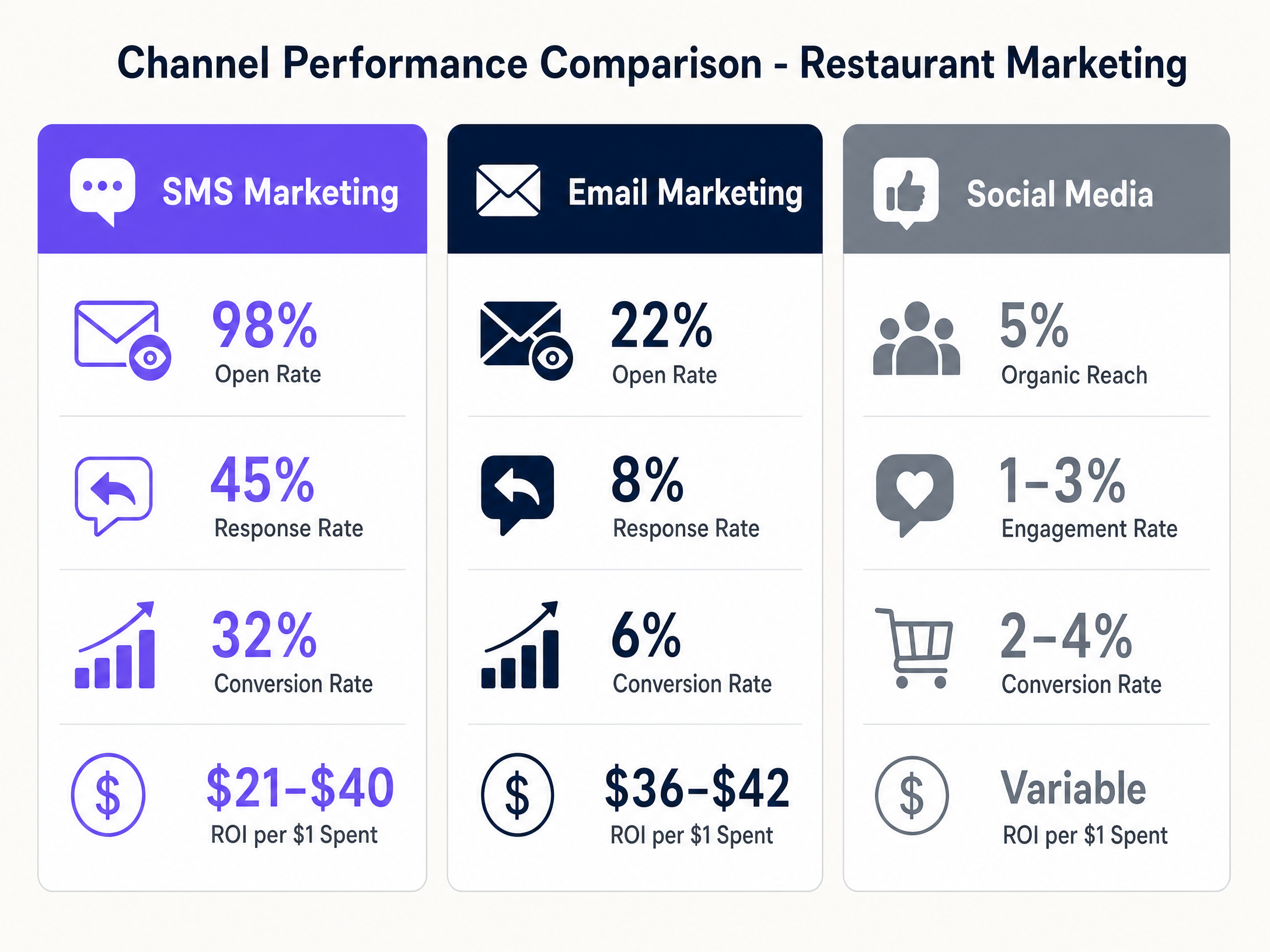
Restaurant operators face a persistent challenge: turning anonymous foot traffic into a reachable, loyal audience. Guest WiFi is already deployed in most venues, yet the majority use it only to provide internet access. By connecting your wireless infrastructure to Purple Engage, you capture verified guest phone numbers at login and automate SMS campaigns that bring guests back. SMS delivers a 98% open rate compared to email's 22%, and guests who opt in to SMS visit 46% more frequently than those who do not, according to data from California Fish Grill's deployment with Olo Engage. Purple operates as a hardware-agnostic cloud overlay, integrating with Cisco Meraki, HPE Aruba, Ruckus, Juniper Mist, Ubiquiti, UniFi, Cambium, Extreme Networks, and Fortinet without requiring hardware replacement. This guide covers the technical architecture, GDPR and TCPA compliance requirements, segmentation strategy, and the automation workflows that convert a single WiFi login into a long-term marketing relationship.
Technical deep-dive
How the data capture architecture works
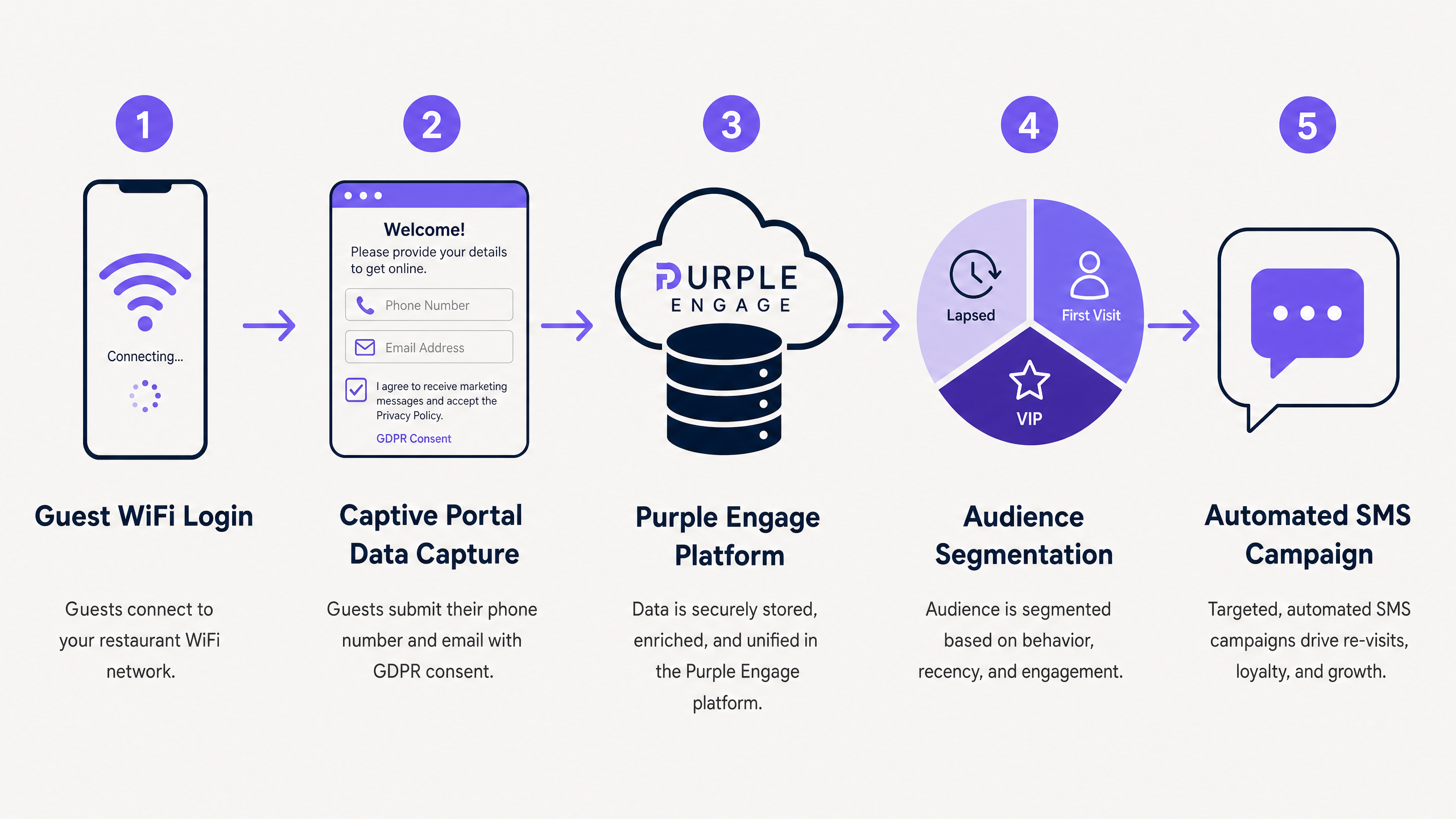
The foundation of any restaurant SMS marketing programme is the reliable, compliant capture of verified guest phone numbers. This requires configuring your wireless LAN infrastructure to intercept unauthenticated guest traffic and redirect it through a captive portal before granting internet access.
When a guest connects to the Guest WiFi SSID, the wireless LAN controller (or cloud-managed access point) intercepts the initial HTTP request and issues a redirect to the Purple captive portal. This portal is hosted in Purple's cloud infrastructure, which maintains 99.999% uptime and holds ISO 27001 certification. The guest sees a branded login screen on their device. You configure the authentication method within the Purple portal editor.
To build an SMS marketing database, you have two options. First, SMS authentication: the guest enters their mobile number and receives a one-time passcode (OTP) via text message. They must enter the correct OTP to gain internet access. This guarantees the integrity of every number in your database. Second, form-fill with a mandatory mobile number field: faster for the guest, but without OTP verification, you risk collecting invalid numbers. For any venue where data quality is a priority, SMS authentication is the correct choice.
Compliance architecture
Capturing phone numbers for marketing purposes introduces mandatory compliance requirements under three frameworks:
- GDPR (EU and UK): You must obtain freely given, specific, informed, and unambiguous consent before sending marketing SMS messages. The opt-in checkbox on the captive portal must be unchecked by default. You must link to your Privacy Policy. Purple records the MAC address, timestamp, and consent status, creating an auditable trail.
- CCPA (California): You must disclose what data you collect and provide a clear opt-out mechanism. Purple's portal templates include the required disclosures.
- TCPA (United States): Prior express written consent is required before sending marketing text messages. Non-compliance carries statutory damages of $500 to $1,500 per message.
Purple's captive portal templates are pre-configured for GDPR compliance. Your IT team must review the portal configuration against your organisation's legal requirements before go-live.
Network configuration requirements
For the captive portal to function correctly, your network team must configure the walled garden - the set of pre-authentication access control entries (ACEs) that allow traffic to specific domains before the guest is authenticated. The walled garden must permit traffic to the Purple portal domains, the SMS gateway API endpoints used for OTP delivery, and any DNS resolution required for these services. On Cisco Meraki, this is configured in the Splash page settings under the walled garden ranges. On HPE Aruba, the equivalent is configured in the captive portal profile. Consult the Purple integration documentation for the specific IP ranges and domains required for each hardware platform.
Implementation guide
Step 1: Audit your existing infrastructure
Before any configuration, map your current Guest WiFi deployment. Identify the hardware vendor, firmware version, and current captive portal or splash page configuration. Confirm that your hardware appears on the Purple hardware compatibility list (Cisco Meraki, HPE Aruba, Ruckus, Juniper Mist, Ubiquiti UniFi, Cambium, Extreme, Fortinet). Identify whether you currently capture any guest contact data and whether existing consent records are GDPR-compliant.
Step 2: Configure the Purple RADIUS integration
Purple operates as a cloud overlay using RADIUS for authentication. Configure your wireless controller or access points to point to the Purple RADIUS servers. Set the Guest WiFi SSID to use the Purple splash page or captive portal. Test the redirect flow on a client device before proceeding.
Step 3: Design the portal and configure data capture
Within the Purple portal editor, design a branded login experience that reflects your restaurant's identity. Select SMS authentication as the login method. Configure the form to capture the guest's name and mobile number. Add the marketing opt-in checkbox - unchecked by default - with clear language such as: "I agree to receive marketing messages from [Restaurant Name]. You can unsubscribe at any time."
Step 4: Build audience segments in Purple Engage
Once data flows into Purple Engage, create dynamic audience segments based on physical visit behaviour. Purple tracks device MAC addresses to monitor visit frequency and dwell time across your venues. Recommended segments for restaurant SMS marketing include:
| Segment | Definition | Recommended trigger |
|---|---|---|
| First-time visitor | One WiFi login, no prior history | Welcome message with first-visit offer |
| Regular guest | Three or more visits in 30 days | Loyalty reward or VIP access offer |
| Lapsed guest | No visit in 60 days | Re-engagement offer with incentive |
| High-value guest | Top 10% by visit frequency | Exclusive preview or event invitation |
Step 5: Automate SMS campaigns
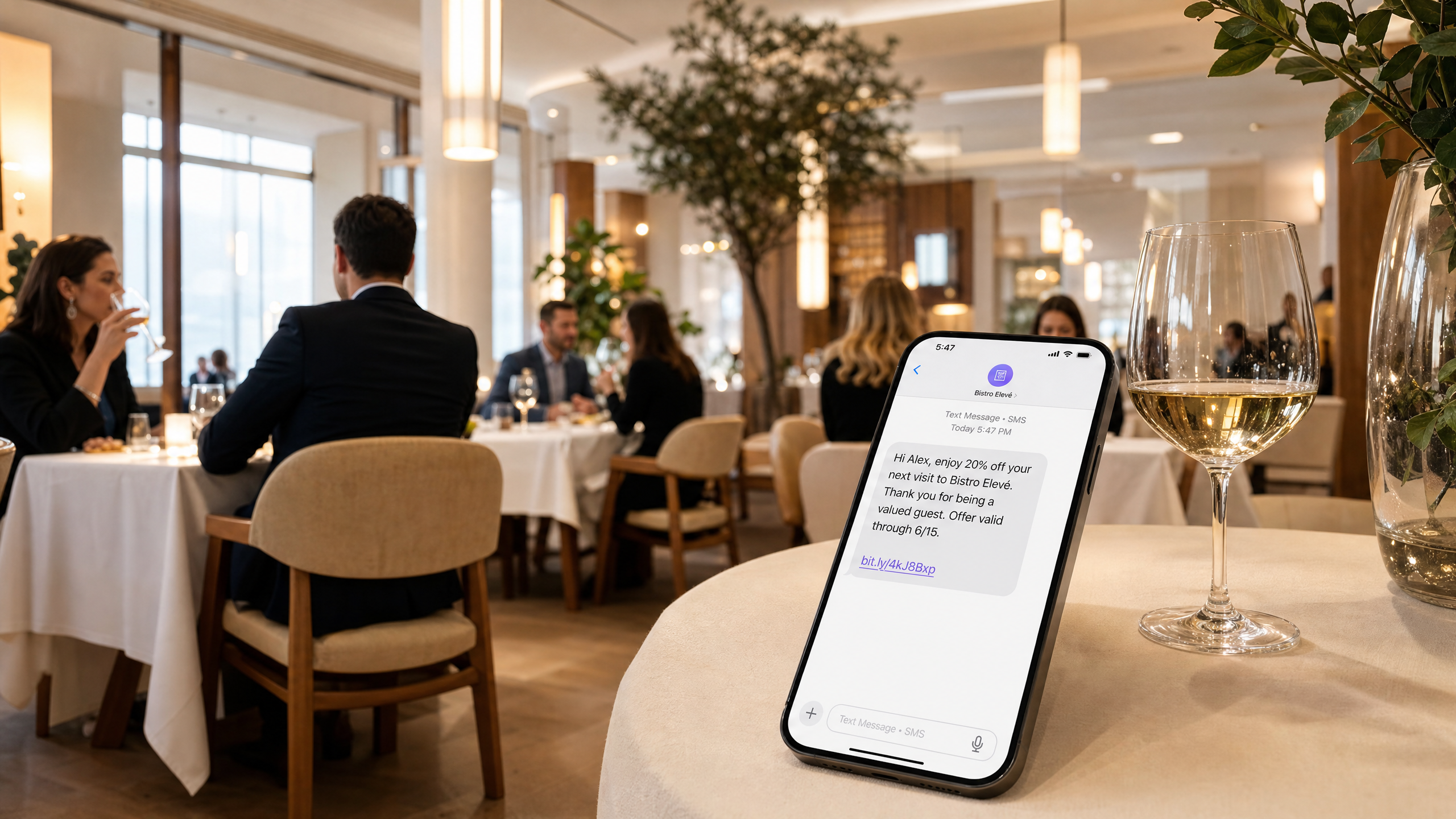
Build automated workflows in Purple Engage triggered by segment membership. For example: when a device MAC address enters the 'Lapsed guest' segment (no visit for 60 days), automatically send an SMS: "We have missed you. Enjoy 20% off your next visit this week. Show this message to your server." Set a suppression window of 30 days to prevent the same guest from receiving the message repeatedly.
Best practices
Prioritise timing over volume. Send messages when guests are making dining decisions: mid-morning for lunch promotions, late afternoon for dinner offers. A message sent at 10:30am for a lunch special outperforms the same message sent at 2pm.
Limit frequency to protect list health. Two to four SMS messages per month is the recommended ceiling for restaurant marketing. Exceeding this frequency increases opt-out rates and reduces the perceived value of each message. Treat each SMS as a premium communication, not a broadcast channel.
Use first-party data for personalisation. Purple Engage records visit history against each phone number. Use this data to personalise messages. A guest who visits every Friday evening is a different audience to a guest who visited once six months ago. Generic blasts underperform targeted messages by a significant margin.
Integrate SMS with email. Use email for broad communications - newsletter updates, seasonal menu changes, event announcements. Reserve SMS for time-sensitive, high-conversion messages. As Olo's research notes: email sparks interest; SMS closes the deal.
Test and iterate. Run A/B tests on message copy, send timing, and offer type. Purple Engage tracks redemption rates against each campaign. Use this data to refine your approach over successive campaigns.
For more on how Guest WiFi and WiFi Analytics work together to power these campaigns, see our product documentation. If you are deploying across a hospitality or retail estate, the segmentation and automation principles in this guide apply directly.
See also: How to leverage SMS marketing for restaurants to increase return visits
Troubleshooting and risk mitigation
Low opt-in rates. If fewer than 30% of guests are opting in to marketing, review the portal design and value proposition. Ensure the benefit of opting in is clearly stated - for example, "Join our WiFi and get exclusive offers." If the form is too long, reduce it to name and mobile number only. Every additional field reduces completion rates.
High SMS delivery failure rates. If a significant proportion of your SMS sends fail, you are likely holding unverified numbers. Migrate to SMS authentication (OTP) to ensure every number in the database is active and reachable.
Compliance audit failures. Conduct a quarterly review of your Purple Engage consent records. Verify that every opted-in number has a corresponding consent timestamp and that the opt-in wording on the portal matches your current Privacy Policy. If you update your Privacy Policy, review whether existing consents remain valid.
Poor campaign redemption rates. If guests receive messages but do not visit, the issue is typically relevance or timing. Review the segment definition - are you targeting the right audience? Review the offer - is the incentive compelling enough to prompt a visit? Review the send time - are you reaching guests when they are making dining decisions?
Hardware upgrade disruptions. If you replace access points or wireless controllers, the captive portal redirect may break temporarily. Before any hardware change, test the Purple portal redirect on the new hardware in a staging environment. Update the walled garden configuration on the new hardware before cutting over guest traffic.
ROI and business impact
SMS marketing carries a per-message cost that email does not. The ROI case rests on the lift in visit frequency and average order value that opted-in guests deliver.
The data is clear. California Fish Grill found that SMS-opted-in guests visited every 120 days on average, compared to 175 days for non-opted-in guests - a 46% improvement in visit frequency - and had a 4% higher average order value and a 69% higher guest lifetime value (Olo Engage, 2026). Starbucks reported a 50% increase in offer redemption rates for SMS subscribers compared to non-subscribers (Bloom Intelligence, citing Statista 2023). Gartner's 2022 research found SMS marketing campaigns achieve an average conversion rate of 32%, compared to 6% for email and 7% for push notifications.
To calculate the ROI for your venue, use this framework:
- Baseline visit frequency: How often does an average guest visit per year without SMS?
- Incremental visits from SMS: Based on the 46% frequency improvement benchmark, model the additional visits per opted-in guest per year.
- Average spend per visit: Multiply incremental visits by average cover value.
- Campaign cost: Number of SMS sends multiplied by cost per message.
- Net ROI: (Incremental revenue - campaign cost) / campaign cost.
For a restaurant with 1,000 opted-in guests, an average cover of £25, and a 46% improvement in visit frequency, the incremental annual revenue from SMS alone can justify the programme cost many times over.
Purple Engage provides campaign-level analytics showing message delivery rates, opt-out rates, and - when combined with the WiFi presence data - the change in visit frequency for guests who received each campaign. This closes the attribution loop between marketing spend and physical footfall.
Key Definitions
Captive portal
A web page that a user of a public access network must interact with before internet access is granted. Used by restaurants to present branded login screens and capture guest data.
The primary interface where restaurants capture guest phone numbers and marketing consent. Configured within Purple and delivered via your existing wireless hardware.
SMS authentication (OTP)
A login method where the user provides their mobile number and receives a one-time passcode via text message to verify their identity before gaining network access.
Essential for ensuring the accuracy of the phone numbers collected for the SMS marketing database. Prevents invalid or fake numbers from entering Purple Engage.
First-party data
Information a business collects directly from its guests and owns entirely, without reliance on third-party platforms or data brokers.
Phone numbers captured via Guest WiFi are first-party data. They are not subject to third-party platform policy changes and cannot be revoked by a social media network or advertising platform.
MAC address
A unique identifier assigned to a network interface controller, used as a network address in communications within a network segment.
Purple uses the MAC address to track device presence, visit frequency, and dwell time across visits. This enables behavioural segmentation without requiring the guest to log in on every visit.
Walled garden
A pre-authentication access control configuration that allows traffic to specific domains or IP ranges before a guest completes the captive portal login.
IT teams must configure the walled garden to allow traffic to the Purple portal domains and SMS gateway endpoints. Without this, the captive portal page will not load on guest devices.
TCPA
Telephone Consumer Protection Act; US legislation that restricts the use of automated telephone equipment and requires prior express written consent before sending marketing SMS messages.
Non-compliance carries statutory damages of $500 to $1,500 per message. Purple's portal templates include the required consent language, but your legal team must review the specific wording.
Dynamic segmentation
The automatic categorisation of guests into audience groups based on real-time behavioural data, such as visit frequency or time since last visit.
Purple Engage uses dynamic segmentation to automatically move guests between audience groups as their behaviour changes. This enables trigger-based campaigns that fire without manual intervention.
Cloud overlay
A software architecture that sits on top of existing physical infrastructure to provide additional services without requiring hardware replacement.
Purple operates as a cloud overlay. Restaurants do not need to replace their existing Cisco Meraki or HPE Aruba access points. Purple integrates via RADIUS and the captive portal redirect.
Suppression window
A defined period during which a guest who has already received a specific automated message is excluded from receiving it again.
Set suppression windows on all automated SMS campaigns in Purple Engage to prevent the same guest from receiving the same re-engagement message repeatedly, which would increase opt-out rates.
Worked Examples
A 15-location casual dining chain currently offers Guest WiFi on Cisco Meraki hardware. They capture email addresses via a basic splash page but experience a 40% invalid email rate and low email engagement. The marketing director wants to launch an SMS re-engagement programme targeting lapsed customers.
The IT team reconfigures the Cisco Meraki splash pages to redirect to the Purple captive portal. They select SMS authentication as the login method, requiring guests to verify their mobile number via OTP before gaining internet access. The portal is designed with a clear, unchecked marketing opt-in checkbox and a link to the Privacy Policy. Within Purple Engage, the marketing team creates a 'Lapsed Guest' segment defined as any device MAC address with no WiFi connection recorded across any of the 15 locations in the past 60 days. An automated SMS campaign is configured to trigger when a guest enters this segment, sending: 'We have missed you at [Brand Name]. Enjoy a complimentary starter on your next visit - valid for 14 days. Show this message to your server.' A 30-day suppression window prevents repeat sends. Campaign performance is tracked via the Purple Engage analytics dashboard, monitoring redemption rates and the subsequent change in visit frequency for recipients.
A stadium hospitality operator needs to drive traffic to specific food and beverage concessions during halftime. Their email campaigns are not read until after the event. The venue uses HPE Aruba access points across 12 zones.
The venue uses Purple Guest WiFi to capture fan phone numbers during the initial login when they enter the stadium. The captive portal uses SMS authentication to verify numbers. Using the zone-level presence analytics in Purple Engage, the operations team identifies which access points (and therefore which concourse zones) have the highest fan density. Thirty minutes before halftime, the team sends a targeted SMS blast to opted-in fans in specific zones, offering a fast-track discount code for the nearest concession stand: 'Halftime in 30 mins. Skip the queue at Gate C Grill with code HALF20 for 20% off. Valid today only.' The offer code is tracked at the point of sale to measure redemption directly.
Practice Questions
Q1. Your marketing director wants to send a weekly SMS blast to all 10,000 numbers in your Guest WiFi database promoting the weekend specials. What is your technical and strategic recommendation?
Hint: Consider the impact of frequency on opt-out rates, the capabilities of Purple Engage segmentation, and the difference between broadcast and trigger-based messaging.
View model answer
Advise against a weekly blast to the entire database. High-frequency, unsegmented SMS campaigns produce high opt-out rates and erode the perceived value of each message. The correct approach is to use Purple Engage to segment the audience by visit recency and behaviour. Configure an automated campaign that targets guests who have not visited in the past 14 days with a weekend offer. Limit broad promotional texts to two per month maximum. This preserves list health, improves relevance, and delivers higher redemption rates than a weekly blast.
Q2. During a planned network upgrade, the IT team is replacing existing Ruckus access points with new Juniper Mist hardware across a 20-location restaurant chain. What steps are required to ensure SMS data capture continues without interruption?
Hint: Purple is a hardware-agnostic cloud overlay. The core platform configuration does not change, but the hardware-side configuration must be replicated.
View model answer
No changes are required within the Purple Engage platform itself. The existing portal design, SMS authentication flow, audience segments, and automated campaigns continue to operate. The IT team must configure the new Juniper Mist controllers to point to the Purple RADIUS servers and replicate the walled garden settings (permitted domains and IP ranges for the Purple portal and SMS gateway) on the new hardware. Test the captive portal redirect on a staging access point before cutting over live guest traffic. Conduct a post-migration test to confirm OTP delivery is functioning correctly.
Q3. A venue operator reports that their SMS marketing database has grown to 8,000 numbers over 12 months, but campaign delivery failure rates are running at 35%. How do you diagnose and resolve this?
Hint: A 35% delivery failure rate indicates a data quality problem at the point of capture, not a sending infrastructure issue.
View model answer
A 35% delivery failure rate indicates that a significant proportion of the phone numbers in the database are invalid, inactive, or incorrectly formatted. This is a data capture problem. The venue is likely using a basic form-fill login without OTP verification, allowing guests to enter any number to gain internet access. The resolution is to switch the captive portal authentication method to SMS authentication (OTP). Going forward, every new number added to the database will be verified as active at the point of capture. For the existing database, run a list hygiene process to remove numbers with repeated delivery failures. Purple Engage's campaign analytics will show which numbers have never successfully received a message.
Q4. A restaurant group operating in both the UK and the United States wants to run a single SMS marketing programme across all venues. What compliance considerations must the IT and legal teams address before launch?
Hint: GDPR and TCPA have different consent requirements. The captive portal configuration must meet the stricter of the two standards in each jurisdiction.
View model answer
The UK venues must comply with UK GDPR, which requires freely given, specific, informed, and unambiguous consent. The opt-in checkbox must be unchecked by default. The US venues must comply with TCPA, which requires prior express written consent for marketing messages. Both frameworks require a clear opt-out mechanism in every message (e.g., 'Reply STOP to unsubscribe'). The safest approach is to configure the Purple captive portal to meet the stricter standard - GDPR - across all venues globally. This means unchecked opt-in by default, explicit consent language, and a link to the Privacy Policy. Purple records consent timestamps and MAC addresses, providing the audit trail required under both frameworks. The legal team must review the specific opt-in wording for each jurisdiction before go-live.