
How to leverage marketing automation SMS to increase return visits
This technical guide details how venue operators and IT managers can deploy SMS marketing software integrated with Guest WiFi to drive measurable return visits. It covers deployment architecture, GDPR compliance, and proven automation triggers.
Listen to this guide
View podcast transcript
Executive Summary
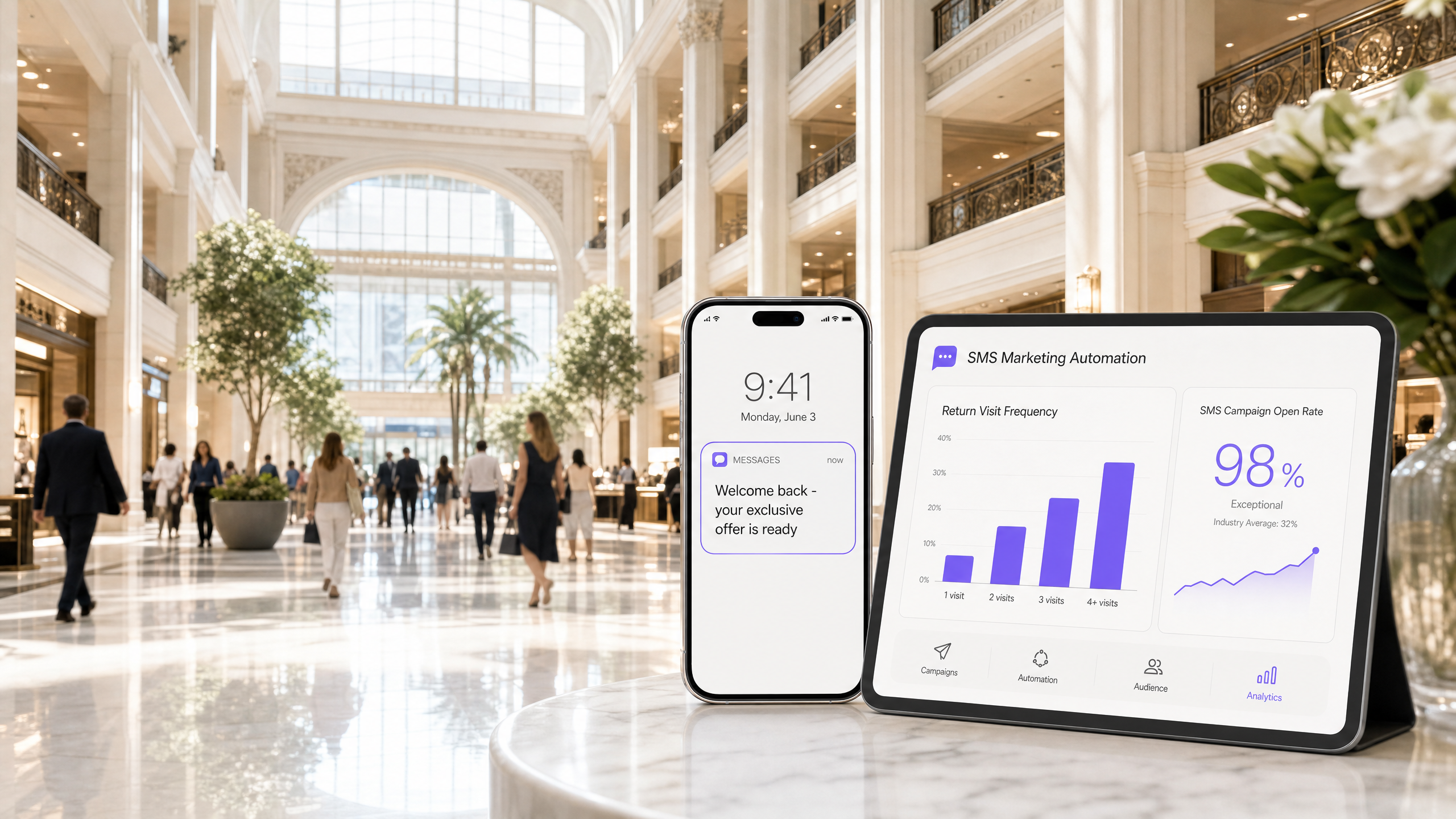
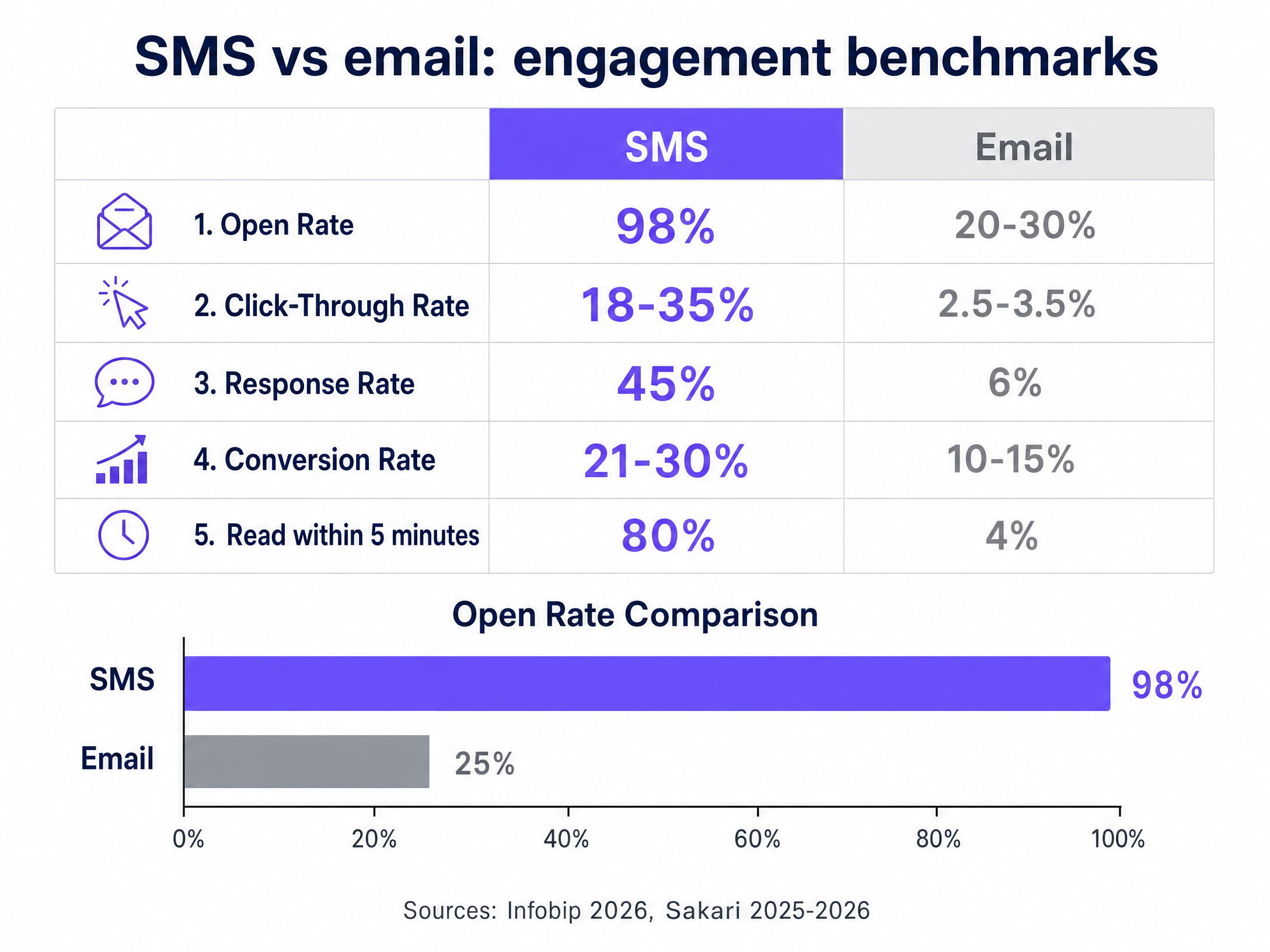
Marketing automation SMS delivers a 98% open rate, with 80% of messages read within five minutes of delivery [1]. For physical venues - from retail chains to hospitality groups - this channel provides a direct mechanism to drive return visits. The technical foundation relies on integrating Guest WiFi infrastructure with an SMS automation engine. By capturing verified mobile numbers and GDPR-compliant consent at the captive portal login stage, you build a first-party data asset. This guide details the architecture, compliance requirements, and implementation steps to deploy SMS marketing automation using Purple Engage across enterprise networks.
Technical Deep-Dive
The integration of WiFi analytics and SMS automation requires a structured data flow from the access point to the messaging gateway.
Data Capture Architecture
The process begins at the edge network. When a venue user connects to the Guest WiFi, the network controller (such as Cisco Meraki, HPE Aruba, Ruckus, Juniper Mist, or Ubiquiti UniFi) redirects the user to a cloud-hosted captive portal. This portal serves as the primary data ingestion point. Instead of relying on email capture alone, the authentication flow requires a mobile phone number.
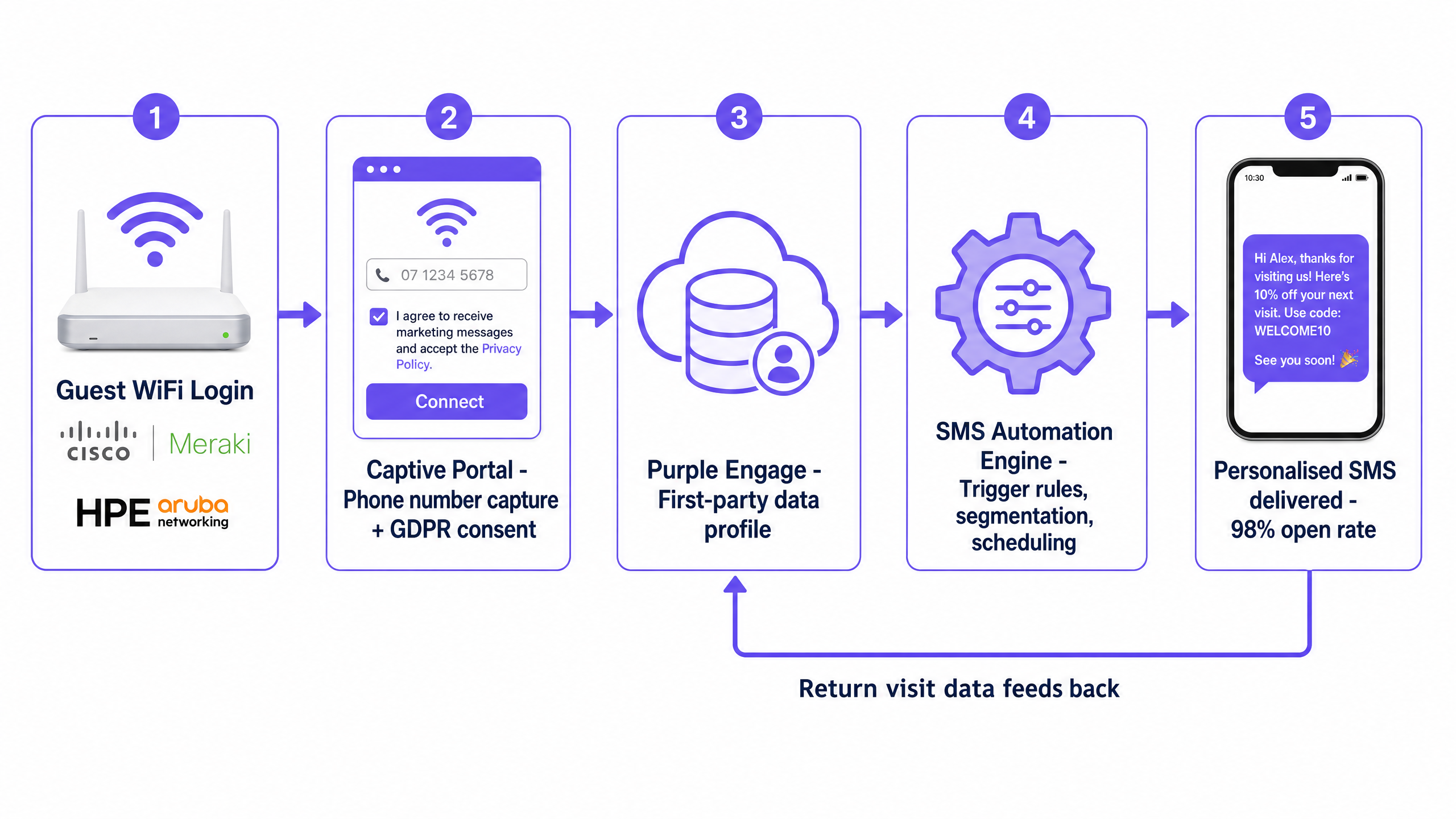
At this exact point, Purple Engage records the mobile number, the MAC address, the IP address, and the explicit consent timestamp. This data synchronises to the central profile database. As the user moves through the venue, the network continues to log dwell time and location data, enriching the profile.
Compliance and Consent Mechanics
GDPR Article 7 requires that consent must be freely given, specific, informed, and unambiguous. You cannot bundle SMS marketing consent with general terms of service. The captive portal must present a distinct, unticked checkbox for marketing communications. Purple records the exact version of the consent text displayed to the user at the time of opt-in. This metadata travels with the user profile, ensuring that any subsequent SMS campaign has a verifiable audit trail.
The Performance Differential
Email marketing remains a core component of digital strategy, but SMS serves a different function. SMS is built for urgency and high-visibility interventions.
Implementation Guide
Deploying marketing automation SMS requires coordination between network engineering and CRM teams. Follow these steps to establish the pipeline.
1. Configure the Captive Portal
Update your Guest WiFi splash page to mandate phone number authentication. Ensure the input field enforces E.164 formatting (e.g., +44 instead of a leading zero) to prevent delivery failures at the SMS gateway. Add the specific marketing opt-in checkbox.
2. Establish Trigger Rules
Do not attempt complex segmentation on day one. Implement three core triggers within Purple Engage:
- The Welcome Trigger: Fires 24 hours after a first-time visit. This establishes the channel and sets expectations.
- The Lapsed Visitor Trigger: Fires when a previously active visitor has not connected to the network for 30 or 45 days. This message should contain a time-limited incentive to return.
- The Loyalty Trigger: Fires when a visitor crosses a specific visit threshold (e.g., their fifth visit).
3. Define Send Windows and Frequency Caps
Configure the automation engine to restrict message delivery to appropriate local hours, typically between 09:00 and 20:00. Set a hard frequency cap of two promotional messages per month per user. Over-frequency is the primary driver of SMS opt-outs.
Best Practices
To maximise the impact of your WiFi Analytics , adhere to these operational standards.
- Personalise Every Message: Use the data gathered from the WiFi profile. A message addressing "Sarah" regarding her recent visit to the "Manchester store" performs significantly better than a generic broadcast.
- Include Clear Opt-Out Mechanics: Every message must include a clear path to unsubscribe, such as "Reply STOP". The automation engine must process these requests instantly and suppress the number from all future campaigns.
- Integrate with Existing Systems: Ensure your SMS data flows into your central CRM or identity provider, such as Microsoft Entra ID or Okta.
For more on network design, see our guide on Three SSIDs to rule them all: guest, Passpoint, and IoT WiFi .
Troubleshooting & Risk Mitigation
Implementations typically fail due to data hygiene or compliance gaps.
Data Formatting Errors
If your captive portal allows free-text entry for phone numbers, your SMS gateway will reject a high percentage of messages. You must enforce strict validation at the point of entry. Use dropdown country codes and regex validation to ensure every number matches the E.164 standard.
Consent Drift
When data moves from Purple Engage to a third-party CRM, the consent metadata must move with it. If a user opts out via an email campaign, that preference must synchronise back to the SMS automation engine. Isolate your data flows to ensure opt-outs are universally respected.
ROI & Business Impact
Success is measured by incremental return visits. By tracking the MAC address of the device, Purple Engage can definitively attribute a physical return visit to a specific SMS campaign. If you send a win-back SMS to 1,000 lapsed visitors and 150 of them connect to the venue WiFi within seven days, you have a hard attribution model.
For a 200-site Retail chain, converting just 5% of lapsed visitors into active shoppers yields a measurable revenue uplift that far exceeds the cost of the SMS gateway and the underlying WiFi infrastructure. The same logic applies across Hospitality , Healthcare , and Transport sectors.
Audio Briefing
Listen to the 10-minute technical briefing on implementing SMS automation:
References
[1] Infobip. "SMS marketing statistics: Key figures for 2026." https://www.infobip.com/blog/sms-marketing-statistics [2] Sakari. "SMS Marketing Statistics: Data-Backed Insights for 2025–2026." https://sakari.io/blog/sms-marketing-statistics-data-backed-insights-for-2025-2026
Key Definitions
Captive Portal
A web page that a user must view and interact with before access is granted to a public WiFi network. Used by Purple to capture first-party data.
This is the primary ingestion point for mobile numbers and consent.
E.164 Standard
The internationally recognised standard formatting for phone numbers, requiring a plus sign followed by the country code and the subscriber number.
Essential for ensuring SMS gateways can successfully deliver automated messages.
Conscious-choice Opt-in
An explicit, unticked checkbox that a user must actively select to grant marketing consent.
Required for GDPR Article 7 compliance when building an SMS database.
Trigger Rule
A predefined set of conditions within an automation engine that, when met, automatically initiates a specific action, such as sending an SMS.
Used to automate welcome messages, win-back campaigns, and loyalty rewards based on WiFi presence data.
First-party Data
Information a company collects directly from its customers and owns entirely.
Guest WiFi transforms anonymous foot traffic into a proprietary, first-party data asset.
Dwell Time
The duration a device remains connected to or visible to the WiFi network within a venue.
Used to segment visitors. A user who stays for two hours receives different messaging than someone who stays for ten minutes.
MAC Address
A unique identifier assigned to a network interface controller for use as a network address in communications within a network segment.
Used by Purple to recognise returning devices and attribute physical visits to specific marketing campaigns.
Frequency Cap
A strict limit on the number of marketing messages a single user can receive within a defined timeframe.
Critical for preventing list fatigue and minimising SMS opt-out rates.
Worked Examples
A 150-location pub group needs to drive Tuesday evening footfall. They currently capture 10,000 emails a week via Guest WiFi but see only a 2% conversion rate on their Tuesday promotional emails.
The group updates their captive portal to capture mobile numbers with explicit SMS consent. They configure Purple Engage to trigger an SMS at 15:00 on Tuesdays to any user who has visited the pub in the last 30 days but never on a Tuesday. The message offers a specific, time-limited incentive valid only that evening.
A stadium operator wants to increase merchandise sales post-match but finds that fans ignore promotional emails sent the following day.
The stadium uses Guest WiFi to capture phone numbers at login. They set an automation rule to trigger an SMS exactly two hours after the final whistle, offering a 15% discount on online merchandise purchases for the next 24 hours. The message is segmented to target only fans who connected to the WiFi in the stadium that day.
Practice Questions
Q1. Your marketing team wants to export the list of phone numbers captured via Guest WiFi over the last six months and load them into a new SMS platform for a bulk broadcast. What is the primary compliance risk?
Hint: Consider what must accompany the phone number when it moves between systems under GDPR.
View model answer
The primary risk is consent drift. The marketing team must ensure that the specific consent metadata (timestamp, version of the opt-in text, and IP address) is exported alongside the phone numbers. Without this metadata, the new SMS platform cannot demonstrate that GDPR Article 7 consent was obtained for those specific users.
Q2. You have configured a win-back SMS campaign for visitors who have not connected to the network in 45 days. The campaign is active, but the SMS gateway is reporting a 15% delivery failure rate. What is the most likely technical cause?
Hint: Think about how data is entered at the captive portal stage.
View model answer
The most likely cause is improper data formatting at the point of capture. The captive portal is likely allowing users to enter numbers in local formats (e.g., starting with a 0 in the UK) rather than enforcing the E.164 international standard (e.g., +44). The solution is to implement strict regex validation on the splash page.
Q3. A retail venue wants to trigger an SMS offering a discount code while the shopper is still inside the store. Is this a recommended use case for SMS automation?
Hint: Consider the primary benefit of SMS compared to the immediate context of the user.
View model answer
While technically possible based on dwell time triggers, it is generally not the optimal use of SMS. SMS is best used to drive a return visit when the user is off-site. In-venue engagement is often better handled by redirecting the user to a specific landing page immediately after they authenticate on the captive portal, saving the SMS channel for high-urgency win-back campaigns.