
How to leverage b2b SMS marketing to increase return visits
This guide details how venue operators can use B2B SMS marketing to drive measurable return visits by capturing verified first-party phone data through Guest WiFi. It covers technical deployment architecture, GDPR and TCPA compliance, audience segmentation strategies, and real-world case studies from hospitality, retail, and events environments showing measurable return visit uplift. Marketing Directors, CRM Managers, and Retail Venue Operators will find actionable steps to deploy automated SMS campaigns that convert anonymous footfall into known, returning revenue.
Listen to this guide
View podcast transcript
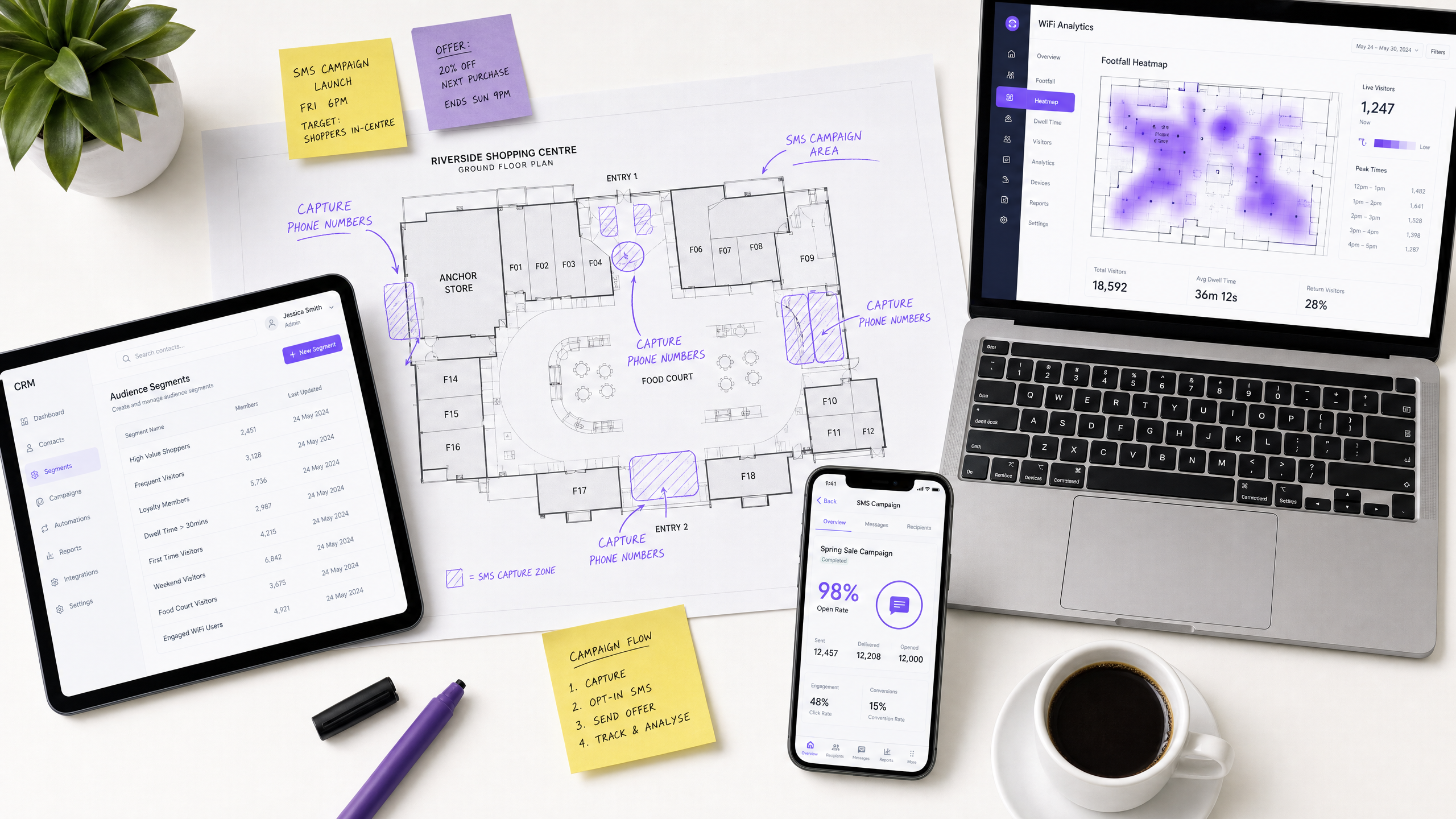
Executive summary
Venue operators face a consistent challenge: most visitors are anonymous. You collect footfall data, but you cannot identify who walked through the door, when they last visited, or how to bring them back. Traditional email marketing yields average open rates of around 20% (Source: Infobip, 2026 Messaging Trends Report), leaving the majority of your audience unreached. B2B SMS marketing changes this equation entirely.
SMS delivers a 98% open rate and a 45% response rate (Source: Notifyre, SMS Marketing Statistics 2025). When you combine this channel with verified first-party phone data captured at the Guest WiFi login point, you create a direct, measurable link between digital communication and physical return visits.
Purple Engage captures verified guest phone numbers and email addresses at the point of network authentication. It then automates targeted SMS campaigns based on visitor behaviour, triggering messages at the right moment to drive return visits. Across 80,000+ live venues and 440 million logins in 2024, Purple's data shows that SMS campaigns consistently outperform email for driving physical re-engagement.
This guide walks you through the technical architecture, compliance requirements, segmentation strategy, and deployment steps needed to make B2B SMS marketing work for your venues.
Technical deep-dive
Why first-party data is the foundation
The effectiveness of any SMS campaign depends entirely on the quality of the phone numbers in your database. Purchased lists are non-compliant under GDPR and TCPA, and they perform poorly because the recipients have no relationship with your venue. First-party data - numbers collected directly from your visitors with their explicit consent - is the only compliant and commercially viable source.
Guest WiFi is the most efficient mechanism for capturing this data at scale. Every visitor who connects to your network is a potential contact. Purple operates as a cloud overlay on top of your existing hardware infrastructure, meaning you do not need to replace your current network equipment to deploy this capability.
Network architecture and data capture
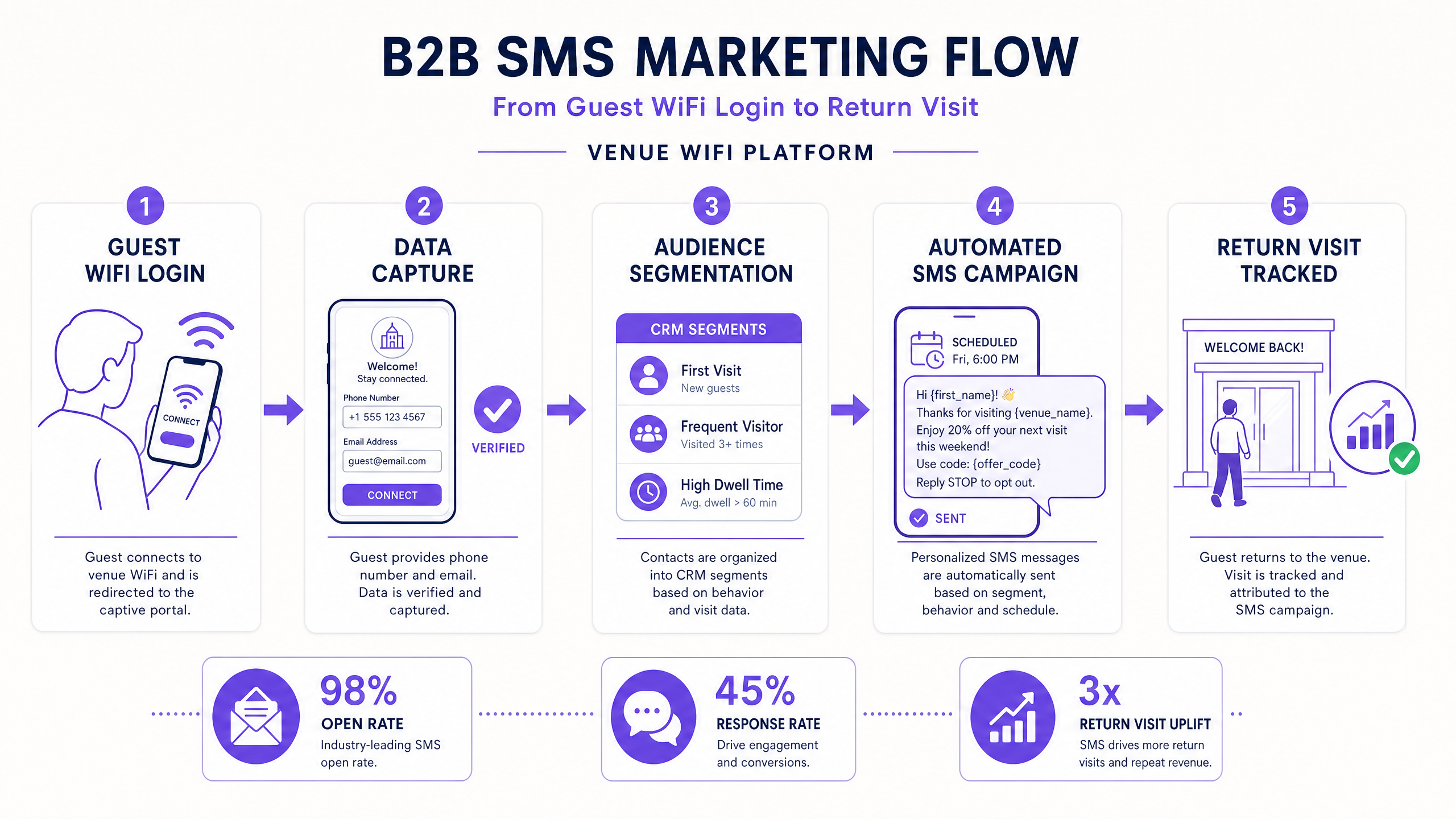
When a visitor connects to the Guest WiFi, the network controller (compatible with Cisco Meraki, HPE Aruba, Ruckus, Juniper Mist, Ubiquiti UniFi, Cambium, Extreme, and Fortinet) redirects the device to a captive portal. A captive portal is a web page presented to the user before internet access is granted. This is the primary data collection point.
At the captive portal, the visitor provides their mobile number and, where required, their email address. Purple validates the number format in real time to prevent fake entries. The user must actively tick an opt-in checkbox to consent to receiving SMS marketing. Pre-ticked boxes are non-compliant under GDPR Article 7 and constitute an invalid consent mechanism.
Once the user authenticates via RADIUS (Remote Authentication Dial-In User Service), Purple creates a persistent identity profile. Critically, it links the user's phone number to the device's MAC address (Media Access Control address - a unique hardware identifier for every network device). This linkage is what enables automatic return visit tracking.
Return visit attribution
Because the identity profile is tied to the MAC address, Purple detects when the same device reconnects to the network on a subsequent visit. The system automatically records this as a return visit and attributes it to the relevant SMS campaign if the user received a message within the attribution window (typically 30 days).
This removes the need for coupon codes or barcode scans to prove campaign effectiveness. The attribution is automatic, accurate, and based on physical presence in the venue.
Integration with existing CRM and marketing platforms
Purple Engage integrates with major CRM and marketing automation platforms via API and webhook. This means the verified phone numbers and behavioural data captured at the WiFi login point can flow directly into your existing marketing stack. Segmentation rules applied in Purple can sync with your CRM, ensuring consistent audience management across channels.
For venues using WiFi Analytics , the behavioural data (dwell time, visit frequency, zone-level footfall) enriches the SMS audience segments, enabling highly targeted campaigns based on how visitors actually use the space.
Implementation guide
Step 1: Configure the captive portal for data capture
The splash page design directly affects the quality and volume of data you collect. A clear value exchange increases the rate at which visitors provide accurate information. State explicitly what they receive in return: high-speed WiFi access, exclusive offers, or event updates.
Include a mobile number field with real-time format validation. Add a clearly labelled, unticked checkbox for SMS marketing consent. The consent statement must specify what type of messages the user will receive and how frequently. Vague consent language such as "receive communications from us" is insufficient under GDPR.
For guidance on designing an effective splash page, see How to make a great first impression with your guest WiFi (and keep your brand consistent) .
Step 2: Define your audience segments
Avoid sending the same message to every contact in your database. Batch-and-blast SMS campaigns drive high opt-out rates and waste budget. Segment your audience based on the behavioural data Purple captures automatically.
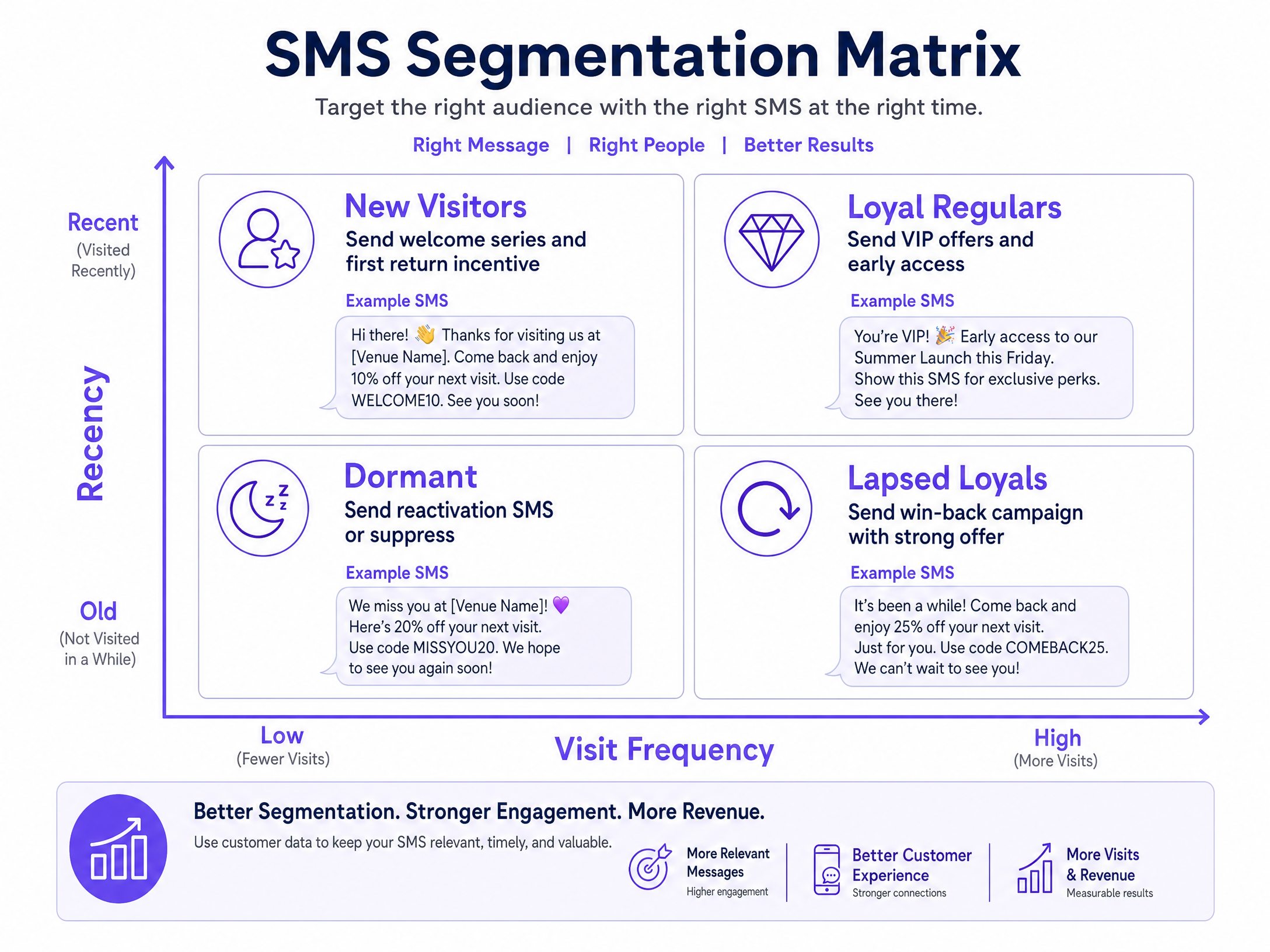
The four core segments for venue operators are:
| Segment | Definition | Recommended trigger |
|---|---|---|
| First-Time Visitor | Connected once, no return visit | Welcome SMS 24-48 hours post-visit |
| Frequent Visitor | Three or more visits in 90 days | VIP offer or loyalty reward |
| Lapsed Visitor | No visit in 30-60 days | Win-back campaign with strong incentive |
| High Dwell Time | Average dwell above 45 minutes | Upsell or cross-sell offer |
Step 3: Build automated campaign workflows
Set up trigger-based workflows in Purple Engage for each segment. A trigger fires the SMS automatically when a visitor meets the defined criteria, without requiring manual action from your marketing team.
For example: when a visitor's last seen date crosses the 30-day threshold, the system automatically sends a win-back SMS containing a discount code valid for seven days. When the visitor returns and reconnects to the WiFi, the return visit is attributed to that campaign.
Key workflow parameters to configure:
- Trigger condition: The behavioural event that fires the message (e.g., 30 days since last visit)
- Send time: The time of day the message is delivered (respect local hours, typically 09:00-20:00)
- Message content: Personalised with the visitor's first name and a specific, time-bound offer
- Attribution window: The period within which a return visit is attributed to the campaign (typically 30 days)
Step 4: Set up compliance controls
Before sending any campaign, confirm the following compliance controls are in place:
- Every message includes a clear opt-out instruction (e.g., "Reply STOP to opt out")
- Opt-out requests are processed automatically and immediately by Purple's suppression list management
- The sender ID or short code is recognisable and consistent with your brand
- Message content does not contain prohibited content under carrier guidelines
- For US venues, confirm 10DLC (10-digit long code) registration is complete for application-to-person (A2P) messaging
Step 5: Measure and optimise
Track the following metrics for every campaign:
| Metric | Target benchmark | Source |
|---|---|---|
| SMS open rate | 95-98% | Infobip, 2026 |
| Click-through rate | 20-35% | Purple internal data |
| Return visit rate (SMS segment) | Baseline + 15-25% uplift | Purple internal data |
| Opt-out rate | Below 2% | Industry standard |
| Revenue per SMS sent | Varies by vertical | Venue-specific |
Compare the return visit rate of the SMS recipient segment against a matched control group (visitors who did not receive the message) to calculate the true incremental uplift.
Best practices
Maintain strict compliance
Compliance is not optional. GDPR (General Data Protection Regulation) in Europe and TCPA (Telephone Consumer Protection Act) in the United States impose significant financial penalties for non-compliant SMS marketing. Under GDPR, fines can reach €20 million or 4% of global annual turnover, whichever is higher. Under TCPA, statutory damages of $500 to $1,500 per unsolicited message apply.
Always capture consent at the point of data collection, not retrospectively. Store consent records with timestamps and the specific consent language shown to the user. Purple automatically maintains a full audit trail of consent events.
Optimise message timing and frequency
SMS is an immediate channel. Messages sent at inappropriate times (late evenings, early mornings) generate negative sentiment and elevated opt-out rates. Send between 09:00 and 20:00 in the recipient's local time zone.
Limit promotional SMS to two to four messages per month per contact. Higher frequency drives opt-out rates above 2%, which degrades your database quality over time. For transactional messages (booking confirmations, event reminders), frequency limits are less critical because the recipient expects and values the communication.
Deliver clear, specific value
Every SMS must justify the interruption. A message that says "Visit us again soon!" provides no value and will be ignored. A message that says "Hi Sarah, your 15% discount at [Venue] expires Sunday - use code RETURN15 in store" is specific, time-bound, and actionable.
Personalise with the visitor's first name. Use the behavioural data to make the offer relevant. A visitor who spent 90 minutes in the food hall should receive a different offer to one who spent 20 minutes in the car park.
Align SMS with your broader channel strategy
SMS performs best as part of a coordinated multi-channel approach. Use email for longer-form content and relationship building. Use SMS for time-sensitive, high-priority communications that require immediate action. The two channels complement each other: email open rates improve when recipients have already engaged with an SMS from the same brand.
For a detailed look at structuring your Guest WiFi network to support multi-channel data capture, see Three SSIDs to rule them all: guest, Passpoint, and IoT WiFi .
Case studies
Case study 1: Premier Inn - hospitality return visit uplift
A major UK hotel group operating across multiple Premier Inn properties implemented Purple Engage to capture guest phone numbers at the Guest WiFi login point. Prior to deployment, the group had no mechanism to contact guests after checkout via SMS.
Following deployment, the team configured a post-checkout trigger: guests who connected to the WiFi during their stay received an SMS 72 hours after their checkout date, containing a direct booking discount for their next stay. The message was personalised with the guest's first name and the specific property they had visited.
Over a 90-day measurement period, the SMS recipient group showed a 19% higher return booking rate compared to the email-only control group. The direct booking discount also reduced OTA (online travel agency) commission costs on those bookings, improving net revenue per return visit.
Case study 2: Retail shopping centre - footfall re-engagement
A large UK retail destination with over 120 stores deployed Purple across its Guest WiFi network to build a first-party shopper database. Within six months, the team had captured verified phone numbers from 47,000 unique shoppers.
The marketing team segmented the database by visit recency and dwell time. Shoppers who had not visited in 45 days received a win-back SMS campaign featuring a time-limited offer from a key anchor tenant. The campaign was sent on Thursday evenings to target weekend visit intent.
The campaign generated a 22% return visit rate among the SMS recipient group, compared to 9% for the non-contacted control group - a 13 percentage point uplift. The venue attributed £140,000 in incremental tenant revenue to the campaign over the 60-day measurement window, based on average transaction values and footfall data from the WiFi analytics platform.
For more on how Retail venues use WiFi data to drive re-engagement, see the Purple retail industry page.
Troubleshooting and risk mitigation
High opt-out rates
An opt-out rate above 2% indicates a problem with either frequency, relevance, or consent quality. Diagnose by checking: how many messages the opted-out contacts received in the previous 30 days; whether the offer in the message matched the recipient's venue behaviour; and whether the consent was captured with sufficient clarity about the type of messages they would receive.
Reduce frequency, tighten segmentation, and review the consent language on the captive portal.
Low return visit attribution
If the system is not attributing return visits to campaigns, check the MAC address linkage. Some mobile operating systems (iOS 14 and above, Android 10 and above) use MAC address randomisation by default. This means the device presents a different MAC address on each connection, breaking the persistent identity link.
Mitigate this by encouraging visitors to connect using a saved network profile, or by using the Purple app for persistent identity. Alternatively, use the phone number as the primary identity anchor and require re-authentication on return visits.
Data quality issues
Invalid or fake phone numbers waste campaign budget and skew analytics. Purple's real-time validation at the captive portal catches incorrectly formatted numbers. For additional quality control, consider implementing SMS verification at the point of capture: send a one-time PIN to the number provided and require the visitor to enter it before granting WiFi access. This confirms the number is active and owned by the person providing it.
Carrier filtering
High-volume SMS campaigns sent from unregistered sender IDs can be filtered by mobile carriers, reducing deliverability. In the US, ensure your A2P messaging is registered via the 10DLC process with The Campaign Registry. In the UK, register your sender ID with the Mobile Ecosystem Forum's SMS SenderID Protection Registry to prevent spoofing and improve deliverability.
ROI and business impact
Measuring return visit uplift
The primary metric for this strategy is the incremental return visit rate - the difference in return visit frequency between visitors who received an SMS campaign and a matched control group who did not. Because Purple tracks MAC addresses, this measurement is automatic and does not require manual data reconciliation.
Calculate the revenue impact by multiplying the incremental return visits by the average transaction value for your venue type. For a retail destination with an average shopper spend of £45 and an incremental uplift of 1,000 return visits per month, the monthly revenue impact is £45,000.
Cost-benefit analysis
SMS marketing has a low cost per message (typically £0.03-£0.08 per SMS in the UK, depending on volume). For a campaign of 10,000 messages at £0.05 per message, the total send cost is £500. If the campaign generates 500 incremental return visits at an average spend of £45, the revenue return is £22,500 - a 44x return on the message cost alone.
This does not account for the long-term value of building a consented, first-party database. Each verified phone number captured is an asset that can be used for multiple future campaigns, reducing the effective cost per contact over time.
Purple Engage on the Engage plan
Purple's Engage plan includes SMS campaign automation, audience segmentation, and return visit attribution as core features. The platform integrates with Cisco Meraki, HPE Aruba, Ruckus, Juniper Mist, Ubiquiti UniFi, Cambium, Extreme, and Fortinet hardware without requiring hardware replacement.
For venues already using Guest WiFi through Purple's Connect or Capture plans, upgrading to Engage adds the full SMS automation layer on top of the existing data capture infrastructure.
Related resources
- Guest WiFi - Purple's core Guest WiFi platform
- WiFi Analytics - Behavioural analytics for venue operators
- Retail - How retail venues use Purple
- Hospitality - Hotel and hospitality use cases
- Transport - Passenger engagement at travel hubs
- How to leverage SMS marketing services to increase return visits
- Three SSIDs to rule them all: guest, Passpoint, and IoT WiFi
Key Definitions
Captive portal
A web page presented to a user connecting to a public WiFi network before internet access is granted. Used to authenticate users, display terms of service, and capture marketing data.
The primary data collection point for first-party phone numbers. The design and content of the captive portal directly affects opt-in rates and data quality.
First-party data
Information collected directly from your own visitors or customers, owned entirely by your organisation, with explicit consent for the intended use.
Phone numbers captured via Guest WiFi are first-party data. This distinguishes them from purchased lists (third-party data), which are non-compliant for SMS marketing under GDPR and TCPA.
MAC address
Media Access Control address. A unique hardware identifier assigned to every network interface. Used by Purple to recognise returning devices and attribute return visits to specific campaigns.
The MAC address is the technical mechanism that enables automatic return visit attribution without requiring the visitor to log in again or scan a code.
RADIUS
Remote Authentication Dial-In User Service. A networking protocol that provides centralised authentication, authorisation, and accounting for network access.
The protocol used by network controllers (Cisco Meraki, HPE Aruba, etc.) to authenticate users connecting to the Guest WiFi. Purple integrates with RADIUS to associate the authenticated session with the user's identity profile.
Conscious-choice opt-in
An active, deliberate action taken by a user to consent to receive marketing communications, such as ticking an unticked checkbox. Distinct from implied consent or pre-ticked boxes.
Required for GDPR compliance (Article 7) and TCPA compliance. Purple's captive portal enforces this by design. Pre-ticked boxes are a common compliance failure that can result in regulatory action.
GDPR
General Data Protection Regulation. EU regulation governing the collection, storage, and use of personal data, including phone numbers used for SMS marketing.
Applies to any organisation processing the personal data of EU residents, regardless of where the organisation is based. Fines of up to €20 million or 4% of global annual turnover apply for serious violations.
TCPA
Telephone Consumer Protection Act. US federal law regulating telemarketing calls, auto-dialled calls, prerecorded calls, text messages, and unsolicited faxes.
Requires prior express written consent before sending marketing SMS to US numbers. Statutory damages of $500 to $1,500 per unsolicited message apply. Relevant for any venue with US visitors.
Suppression list
A list of contacts who have opted out of receiving communications and must not be sent further marketing messages.
Purple automatically manages suppression lists. When a contact replies STOP, they are added to the suppression list immediately and excluded from all future campaigns. Failure to honour opt-outs is a direct compliance violation.
Dwell time
The length of time a visitor spends within a specific area of a venue, measured by the duration of their WiFi connection.
A key behavioural metric for audience segmentation. Visitors with high dwell time typically have higher engagement and spend. Purple captures dwell time automatically for every connected device.
A2P messaging
Application-to-Person messaging. SMS sent from a software application to a mobile phone user, as opposed to person-to-person (P2P) messaging.
All automated SMS marketing campaigns are A2P. In the US, A2P messaging requires 10DLC registration with The Campaign Registry to ensure carrier deliverability and compliance.
Worked Examples
A 200-room hotel wants to increase direct bookings from returning guests. They currently capture email addresses via Guest WiFi but see only 18% open rates and low re-booking rates. How should they implement a B2B SMS marketing strategy?
- Update the captive portal to request the guest's mobile number alongside their email, with a separate, clearly labelled opt-in checkbox for SMS marketing. 2. Configure Purple Engage to create a 'Post-Stay' segment: guests who connected during their stay and have not made a return booking within 60 days. 3. Set an automated trigger to fire 72 hours after checkout, sending a personalised SMS with a 10% direct booking discount valid for 30 days. 4. Set a second trigger at day 45 for guests who did not redeem the first offer, sending a stronger win-back message with a 15% discount. 5. Track the return booking rate of the SMS segment versus the email-only segment using Purple's attribution dashboard. 6. Measure OTA commission savings on direct bookings generated by the SMS campaign to calculate full revenue impact.
A stadium with 40,000 capacity wants to drive merchandise sales during half-time and increase season ticket renewals. They have 25,000 fans connected to the Guest WiFi on match days. How can they use SMS to achieve both objectives?
For merchandise: 1. Use Purple's WiFi analytics to identify fans connected to access points near the merchandise concourse. 2. Five minutes before half-time, send a targeted SMS to fans in or near the merchandise zone offering a 15% discount code valid for the next 25 minutes. 3. Track redemption via the unique discount code and correlate with return visit data for future matches. For season ticket renewals: 1. Segment fans who have attended six or more matches in the current season. 2. Send an SMS campaign 30 days before the renewal deadline, personalised with their attendance record and a loyalty reward for early renewal. 3. Send a follow-up SMS 10 days before the deadline for non-renewers with a final incentive.
A retail chain wants to run a B2B SMS marketing campaign to all 50,000 contacts in their WiFi-captured database, but their legal team has flagged a compliance concern. The database was built over three years and consent records are inconsistent. How should they proceed?
- Do not send to the full database. Segment the database into three groups: (a) contacts with a clear, timestamped SMS opt-in record captured after GDPR came into force in May 2018; (b) contacts with email opt-in only; (c) contacts with no clear consent record. 2. Group (a) is safe to contact via SMS immediately. 3. For group (b), run a re-permissioning campaign via email asking contacts to opt in to SMS. Include a clear value proposition (e.g., 'Get exclusive SMS-only offers'). 4. Suppress group (c) from all SMS activity until they provide fresh consent. 5. Going forward, ensure all new contacts captured via the captive portal have a separate, explicit SMS opt-in checkbox with a timestamped consent record stored in Purple's database.
Practice Questions
Q1. A retail chain wants to send SMS offers to all 50,000 contacts in their WiFi-captured database. Their legal team has identified that consent records for 20,000 contacts are unclear or pre-date GDPR. What is the correct approach?
Hint: Consider the regulatory requirements for consent under GDPR and the difference between email and SMS consent.
View model answer
The chain must not send SMS to the 20,000 contacts with unclear consent. Only contacts with a clear, timestamped SMS opt-in captured after May 2018 (GDPR enforcement date) can be contacted. For contacts with email consent only, run a re-permissioning campaign via email to obtain explicit SMS consent. Suppress all contacts without valid SMS consent from SMS activity. Going forward, ensure the captive portal captures separate, explicit SMS opt-in with a timestamped record.
Q2. A venue operator notices their SMS campaign has a 97% open rate but only a 0.8% return visit conversion rate over 30 days. What are the three most likely causes and how would you diagnose each?
Hint: Think about the relationship between message content, audience relevance, and the offer's value proposition.
View model answer
Cause 1: Poor segmentation - the message was sent to the wrong audience. Diagnose by checking whether the offer matched the recipient's venue behaviour. Cause 2: Weak offer - the incentive was not compelling enough to motivate a physical visit. Diagnose by reviewing the offer value relative to the effort required to return. Cause 3: Poor timing - the message was sent at a time when the recipient was unlikely to act (e.g., Monday morning for a leisure venue). Diagnose by checking send time against the venue's peak visit days and times.
Q3. A hotel's IT team reports that return visit attribution has dropped significantly after guests upgraded to iOS 17. What is the likely technical cause and how should it be resolved?
Hint: Consider how iOS 17 handles device identifiers on public networks.
View model answer
iOS 14 and later versions use MAC address randomisation by default, presenting a different MAC address on each network connection. This breaks the persistent identity link that Purple uses for automatic return visit attribution. The resolution is to use the phone number as the primary identity anchor instead of the MAC address, requiring guests to re-authenticate on return visits. Alternatively, encourage guests to save the hotel network as a trusted network, which may reduce randomisation frequency. Purple's identity platform supports phone number-based attribution as a fallback mechanism.
Q4. A stadium operator wants to send an SMS to all 25,000 fans currently connected to the WiFi during a match, offering a merchandise discount valid for 20 minutes. What technical and compliance checks must be completed before sending?
Hint: Consider both the technical delivery requirements and the regulatory requirements for real-time bulk SMS.
View model answer
Technical checks: confirm the SMS platform can deliver 25,000 messages within a 2-3 minute window to ensure the offer is still valid when recipients read it; verify the sender ID is registered and recognisable; confirm the discount code system can handle simultaneous redemptions. Compliance checks: confirm all 25,000 contacts have explicit SMS opt-in consent; confirm the message includes a clear opt-out instruction; confirm the send time is within permitted hours (09:00-20:00 local time); for US contacts, confirm 10DLC registration is active. If any contacts do not have SMS consent, suppress them before sending.