
How to leverage software for SMS marketing to increase return visits
This guide explains how venue operators can use software for SMS marketing to drive measurable increases in return visits. It covers the technical architecture for capturing verified phone numbers at the WiFi login, segmentation strategies using first-party data, and the legal requirements under GDPR and PECR.
Listen to this guide
View podcast transcript
Executive Summary
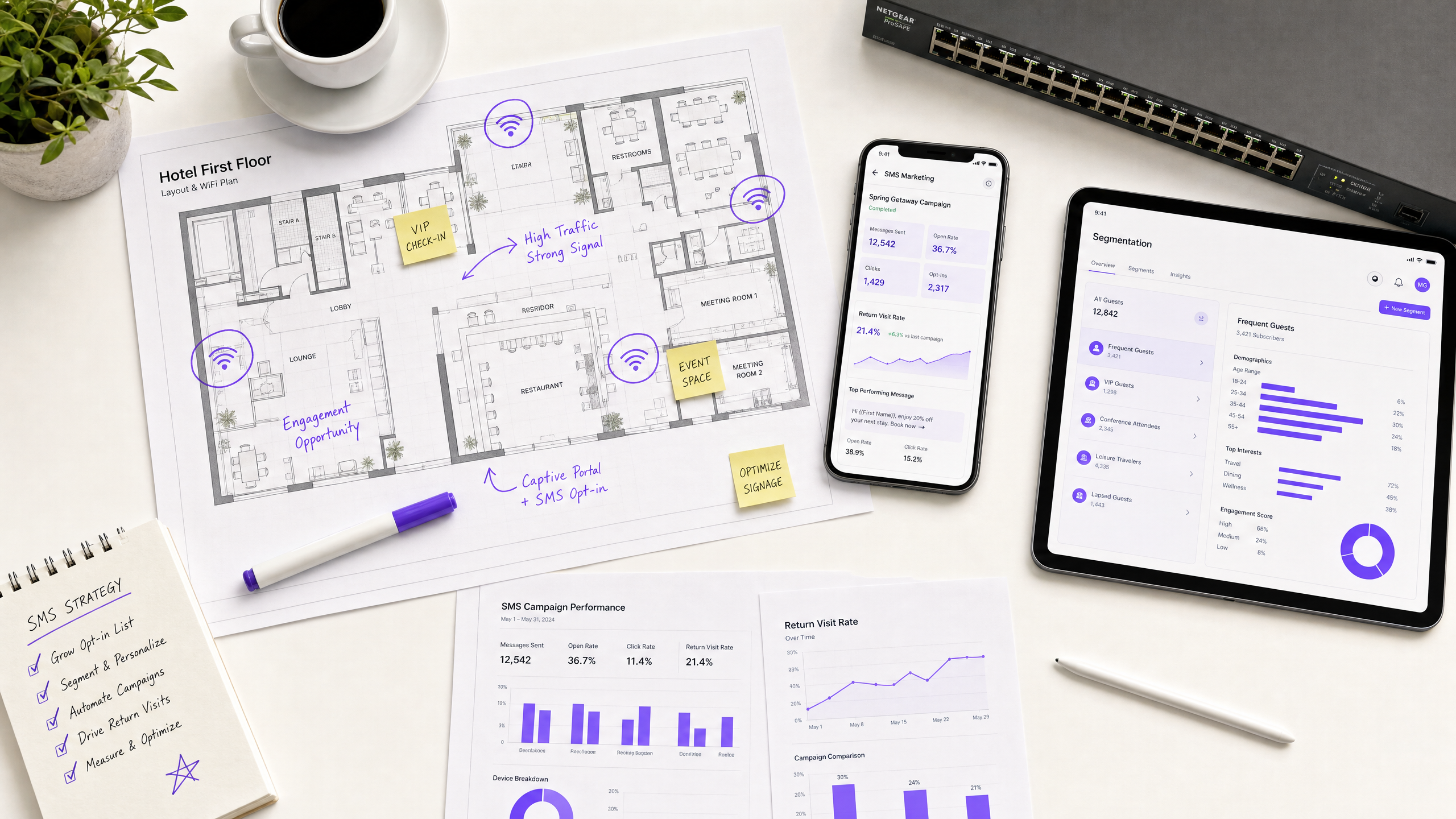
Physical venues face a persistent data gap. Millions of visitors walk through your doors annually, yet most leave without providing a reliable way to reach them again. Software for SMS marketing solves this problem by converting anonymous foot traffic into a verified, reachable audience.
This guide details how to build the data infrastructure required for effective SMS marketing. It explains how to capture verified phone numbers at the WiFi login, store consent records securely, and deploy automated campaigns that drive return visits. The technical approach focuses on using Purple Engage as a cloud overlay across your existing network hardware to create a compliant, high-ROI marketing channel.
Listen to the technical briefing podcast:
Technical Deep-Dive: The Data Capture Architecture
The foundation of any SMS campaign is a verified, compliant contact list. Capturing this data requires a seamless integration between your network infrastructure and your marketing platform.
Purple operates as a hardware-agnostic cloud overlay. It integrates directly with enterprise network controllers - including Cisco Meraki, HPE Aruba, Ruckus, Juniper Mist, Ubiquiti UniFi, Cambium, Extreme, and Fortinet - to intercept the connection flow.
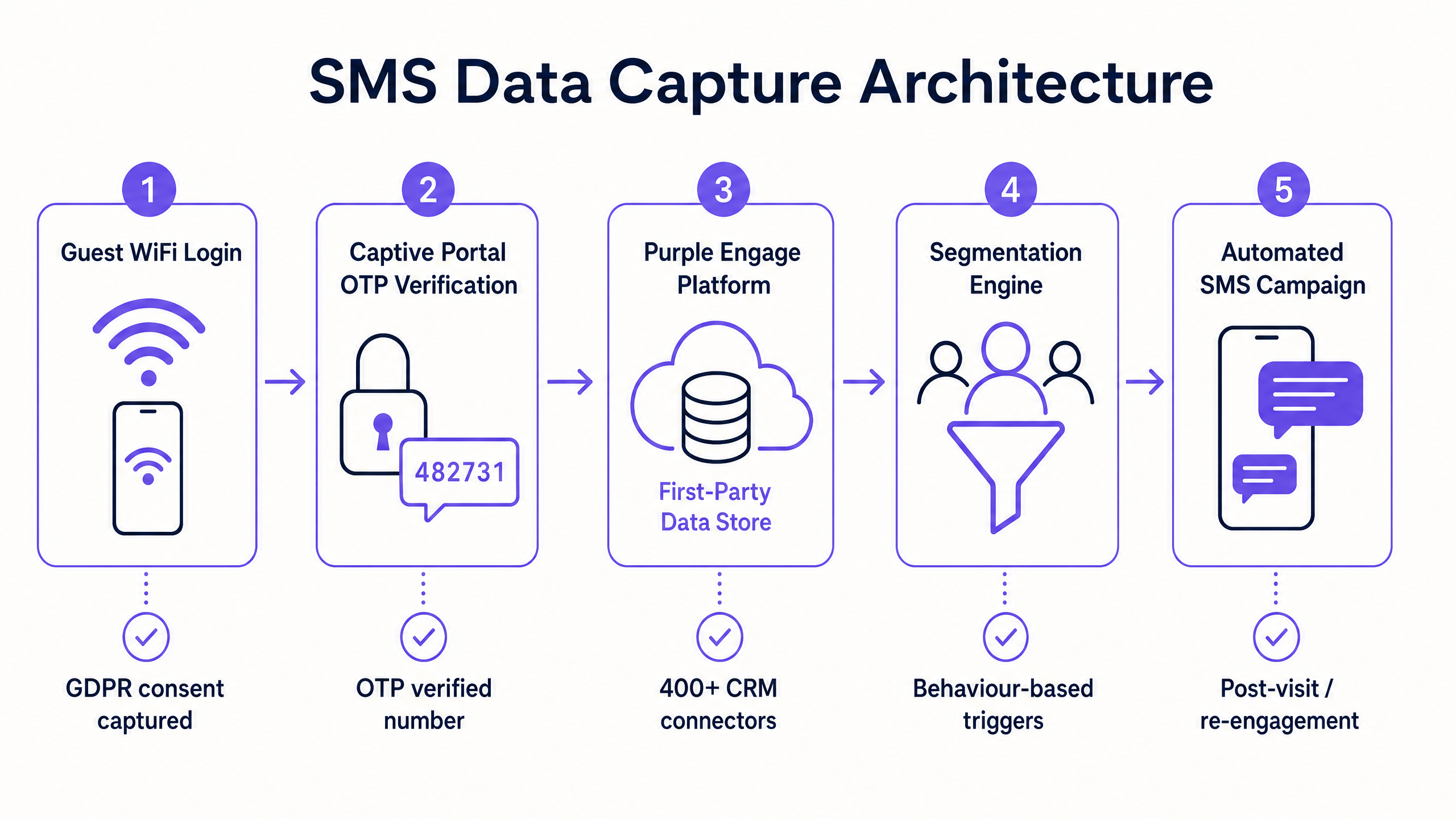
When a venue user attempts to access the Guest WiFi , they are redirected to a captive portal. If they select SMS authentication, the architecture executes the following sequence:
- Number Entry: The user inputs their mobile number.
- OTP Generation: The Purple RADIUS server generates a 6-digit One-Time Passcode (OTP) and sends it via an integrated SMS gateway.
- Verification: The user enters the OTP.
- Consent Logging: The system records the verified number, timestamp, MAC address, and explicit marketing opt-in status.
- Authorisation: The RADIUS server returns an Access-Accept message, authorising network access.
This OTP verification step is critical. It eliminates the problem of fake numbers that plague standard form fills, ensuring your SMS list maintains a 99.9% deliverability rate. It also creates an irrefutable audit trail for compliance.
Implementation Guide: Building Automated Campaigns
Once the data capture infrastructure is operational, the focus shifts to campaign execution. The most effective strategy uses triggered automation rather than generic broadcasts.
Step 1: Define the Segmentation Logic
Purple Engage acts as the segmentation engine. It uses WiFi Analytics to track visit frequency, dwell time, and zone movement. You can use these metrics to build dynamic segments:
- First-Time Visitors: Users with exactly one recorded session.
- Frequent Guests: Users with more than five sessions in the last 30 days.
- Lapsed Visitors: Users who previously visited weekly but have not connected in 45 days.
Step 2: Configure the Triggers
Integrate Purple Engage with your existing CRM via our connector library. Set up automated workflows based on the segments defined above.
The Post-Visit Follow-Up Trigger an SMS 24 hours after a user disconnects from the network. This capitalises on recent engagement. A retail venue might send: "Thanks for visiting us yesterday. Show this text for 15% off your next purchase." Purple data indicates this specific trigger drives a 24% average increase in return visits.
The Lapsed Re-Engagement Configure a time-delay trigger. If a frequent guest's MAC address is not detected for 45 days, fire an SMS: "We have not seen you in a while. Come back this week for a complimentary upgrade."
Step 3: Integrate and Scale
If you operate across multiple verticals, such as Retail or Hospitality , standardise the opt-in flow across all properties. A unified approach ensures consistent data collection and simplifies compliance auditing.
Best Practices
- Explicit Consent is Non-Negotiable: Under GDPR Article 6 and PECR Regulation 22, SMS marketing requires explicit, freely given consent. You cannot bundle this consent with the general terms of service. The captive portal must present a separate, unticked checkbox for marketing communications.
- Control Frequency: Over-messaging is the primary driver of opt-outs. Limit promotional SMS to four to six messages per month per contact.
- Time it Right: Schedule sends between 11:00 AM and 2:00 PM local time. Avoid early morning and late evening broadcasts.
- Use UTM Tracking: Append UTM parameters to every link in your SMS messages. This allows you to track conversions and attribute return visits directly to specific campaigns.
Troubleshooting & Risk Mitigation
Failure Mode 1: High Bounce Rates
- Cause: Capturing unverified numbers via standard form fields.
- Mitigation: Implement OTP verification. Never add an unverified number to your SMS marketing database.
Failure Mode 2: Compliance Breaches
- Cause: Bundling marketing consent with network access, or failing to record opt-in timestamps.
- Mitigation: Use a compliant captive portal that enforces separate consent checkboxes and logs the exact timestamp and IP/MAC address of the opt-in event.
Failure Mode 3: Audience Fatigue
- Cause: Sending generic broadcast messages to the entire database.
- Mitigation: Rely on triggered, behaviour-based campaigns. A message sent based on actual visit data is inherently more relevant than a scheduled blast.
ROI & Business Impact
The business case for software for SMS marketing is compelling, driven by exceptional engagement metrics.
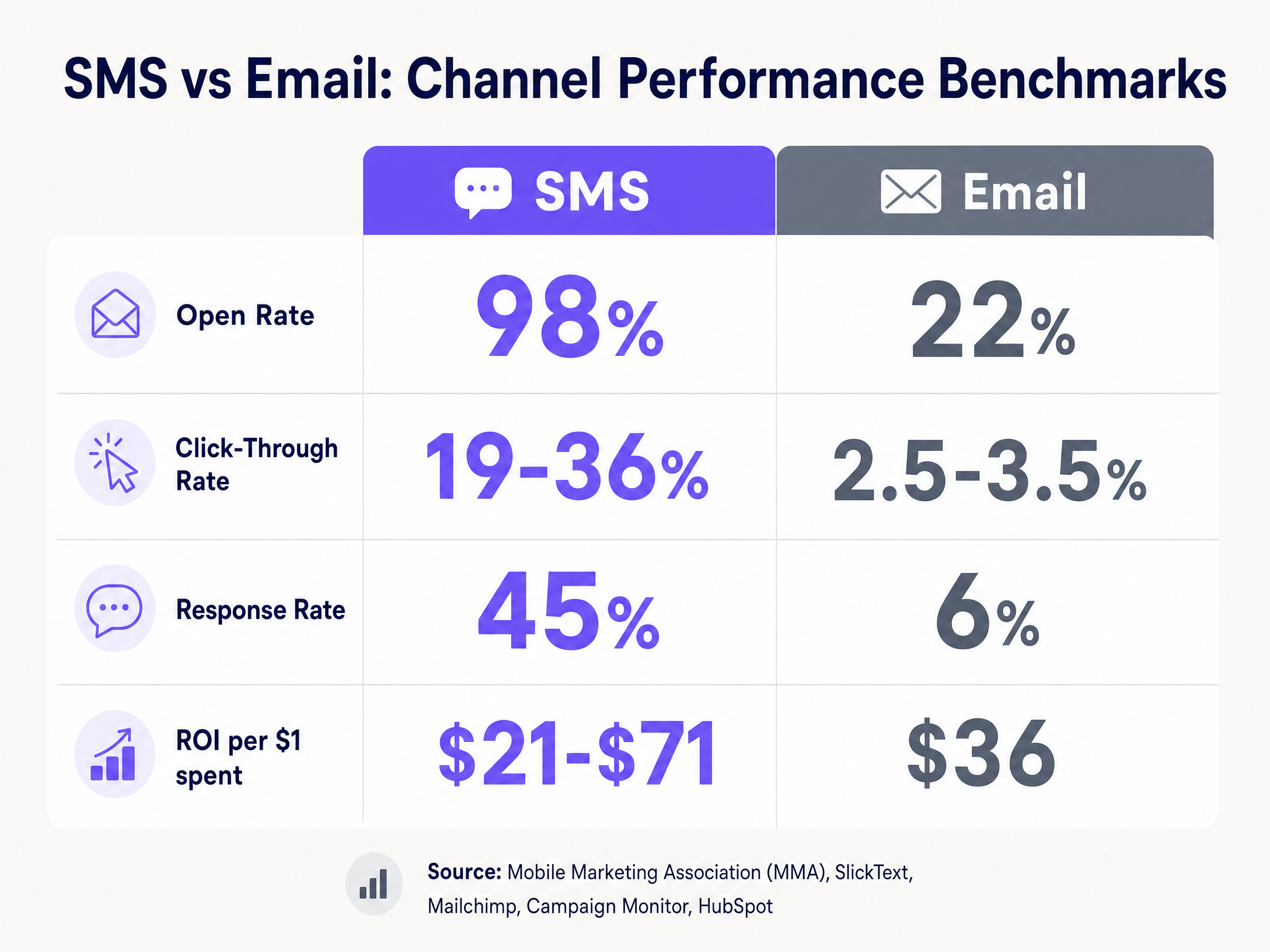
- Open Rates: SMS achieves 98% open rates, with 90% read within three minutes.
- Click-Through Rates: Triggered SMS campaigns generate CTRs of 19-36%, compared to 2.5-3.5% for email.
- Conversion: Well-optimised SMS programmes convert at 21-30%.
- Financial Return: Industry data places average SMS marketing ROI at $21 to $71 for every $1 spent.
To measure success, track the Return Visit Uplift. Compare the visit frequency of users who opted into SMS against a control group of users who opted out. In a 250-room hotel implementation, automated SMS campaigns drove a 31% increase in direct bookings from repeat guests, significantly reducing OTA commission costs.
Key Definitions
First-Party Data
Information collected directly from your audience or customers, rather than purchased from a third party.
Crucial for building a compliant SMS list, as it relies on a direct relationship established at the venue.
OTP (One-Time Passcode)
A unique, automatically generated string of characters used to authenticate a user for a single login session.
Used during WiFi login to verify that the mobile number provided is real and active.
Captive Portal
A web page that a user must view and interact with before accessing a public network.
The primary interface where venues capture guest data and secure marketing consent.
RADIUS
Remote Authentication Dial-In User Service; a networking protocol that provides centralised authentication and authorisation.
The underlying protocol Purple uses to manage WiFi access and trigger the SMS OTP process.
GDPR
General Data Protection Regulation; the primary law regulating how companies protect EU citizens' personal data.
Dictates that SMS marketing consent must be explicit, informed, and freely given.
PECR
Privacy and Electronic Communications Regulations; UK laws specifically governing electronic marketing, including SMS.
Works alongside GDPR to strictly regulate how and when venues can send marketing texts.
Triggered Campaign
An automated marketing message sent in response to a specific user action or event.
The most effective type of SMS marketing, such as sending a discount 24 hours after a venue visit.
UTM Parameters
Urchin Tracking Module codes appended to a URL to track the source, medium, and campaign name.
Essential for measuring the exact ROI and return visit rate generated by specific SMS links.
Worked Examples
A 250-room hotel needs to increase direct bookings from repeat guests to reduce OTA commission costs. They currently capture email addresses at check-in but see low engagement.
The hotel deploys Purple Engage across their HPE Aruba network. They configure the captive portal to require SMS OTP authentication for Guest WiFi access, including a clear, separate opt-in for marketing. Over 12 months, they build a verified database of 18,000 unique numbers. They implement three automated triggers: a post-checkout follow-up offering a direct booking discount, a 60-day lapsed guest re-engagement, and a seasonal promotion targeted at guests who visited during the same period last year.
A 12-site retail chain wants to drive return visits and increase average transaction value, but struggles to identify shoppers once they leave the store.
The chain standardises Purple on Cisco Meraki hardware across all 12 sites. Shoppers connecting to WiFi authenticate via SMS and opt in to marketing. The marketing team uses WiFi Analytics to track dwell time in specific zones. They configure a trigger: if a shopper spends more than 10 minutes in the footwear zone, they receive a post-visit SMS with a 10% discount on shoes. Lapsed shoppers receive a generic re-engagement offer after 30 days.
Practice Questions
Q1. A stadium operator wants to text all 40,000 fans in their database about season ticket renewals. They plan to send the message at 8:00 AM on a Monday. What are the two primary risks with this approach?
Hint: Consider the rules regarding campaign segmentation and optimal delivery times.
View model answer
First, a generic broadcast to 40,000 people ignores segmentation; they should target fans based on previous attendance or purchasing behaviour. Second, 8:00 AM is too early and risks high unsubscribe rates. The optimal send time is between 11:00 AM and 2:00 PM.
Q2. Your marketing team wants to increase the size of the SMS database. They propose making the marketing opt-in checkbox ticked by default on the captive portal. Why must you reject this proposal?
Hint: Review the compliance requirements under European and UK data protection laws.
View model answer
You must reject it because pre-ticked boxes do not constitute valid consent under GDPR and PECR. Consent must be explicit, conscious, and freely given via an unticked checkbox.
Q3. A retail venue reports a 15% bounce rate on their recent SMS campaign. They currently capture phone numbers via a standard web form on their website. How can they eliminate this bounce rate?
Hint: Think about how Purple handles authentication at the network level.
View model answer
They should implement OTP (One-Time Passcode) authentication via the Guest WiFi captive portal. This ensures that every number added to the database is verified as real and active at the point of entry.