
How to leverage SMS marketing company to increase return visits
This guide explains how venue operators can work with an SMS marketing company and Guest WiFi infrastructure to drive measurable return visits. It covers the five-stage data acquisition architecture, behavioural trigger design, GDPR and CCPA compliance requirements, and the direct business impact of moving from broadcast messaging to automated, segmented campaigns. Marketing directors, CRM managers, and retail venue operators will find actionable implementation steps and worked examples from hospitality, retail, and events environments.
Listen to this guide
View podcast transcript
Executive summary
For IT managers and venue operations directors, the value of a physical venue is directly tied to the frequency of return visits. Yet most venues fail to capitalise on the data generated during those visits. When a guest connects to Guest WiFi , they leave a digital footprint. An effective SMS marketing strategy converts that footprint into a verified contact and an automated re-engagement loop.
SMS is not about sending generic discount codes to purchased lists. It is a precision tool. SMS delivers a 98% open rate, compared to 20% for email [1]. When deployed using behavioural triggers - such as a message sent 24 hours after a first visit - click-through rates routinely exceed 25%. This guide explains the technical architecture required to capture first-party data securely, segment audiences based on visit behaviour, and automate SMS campaigns that drive measurable return visits across Hospitality , Retail , and stadium environments.
Listen to the companion podcast briefing:
Technical deep-dive
The foundation of any high-converting SMS marketing strategy is the data acquisition layer. Without verified, first-party phone numbers and explicit consent, an SMS campaign is non-compliant and ineffective. Purple Engage provides the infrastructure to capture this data securely at scale, across more than 80,000 live venues.
The data acquisition architecture
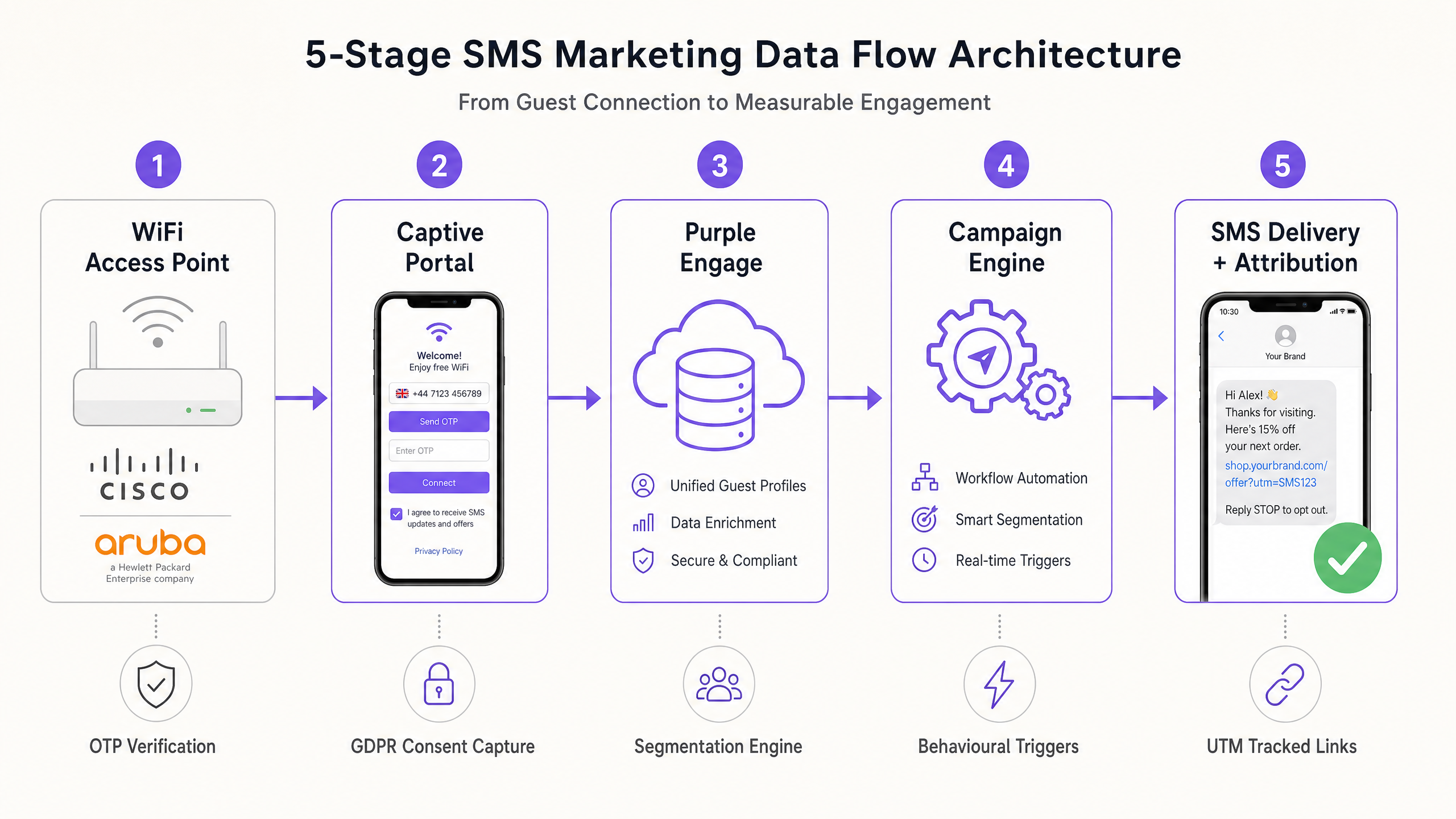
The process begins at the venue access point. When a device attempts to connect to the network, the controller - whether Cisco Meraki, HPE Aruba, Ruckus, Juniper Mist, or Ubiquiti UniFi - routes the unauthenticated traffic to a captive portal. This portal is the primary data capture interface. For a deeper look at how to structure your network for guest, staff, and IoT traffic, read Three SSIDs to rule them all: guest, Passpoint, and IoT WiFi .
To ensure data validity, the portal must enforce One-Time Passcode (OTP) verification. When a visitor enters their phone number, the system sends a temporary code via SMS. The visitor must enter this code to gain network access. This step eliminates fake numbers and ensures the contact database is 100% deliverable. A database built on OTP-verified numbers consistently outperforms purchased lists on every metric: open rate, click-through rate, and conversion.
Consent management and GDPR compliance
Capturing the number is only the first step. You must also capture explicit marketing consent. GDPR and the UK Privacy and Electronic Communications Regulations (PECR) require conscious-choice opt-ins. The consent checkbox cannot be pre-ticked, and it must be separate from the general terms of service. The language must be specific: "I agree to receive marketing messages from [Brand] via SMS."
Purple Engage records the consent timestamp, the specific language presented to the visitor, and the IP address. This creates an immutable audit trail. When you integrate with an SMS marketing company, this consent status must sync in real-time via API or webhook to ensure opted-out users are immediately suppressed from all future broadcasts. Purple is ISO 27001 certified, GDPR and CCPA compliant, and B Corp certified.
Segmentation architecture
Raw data is not a strategy. The return-visit impact of SMS marketing comes from segmenting your contact database by visit behaviour and sending messages that are contextually relevant to each group. Purple Engage tracks visit frequency, dwell time, venue location, and event attendance, giving you the inputs to build four high-performing segments.
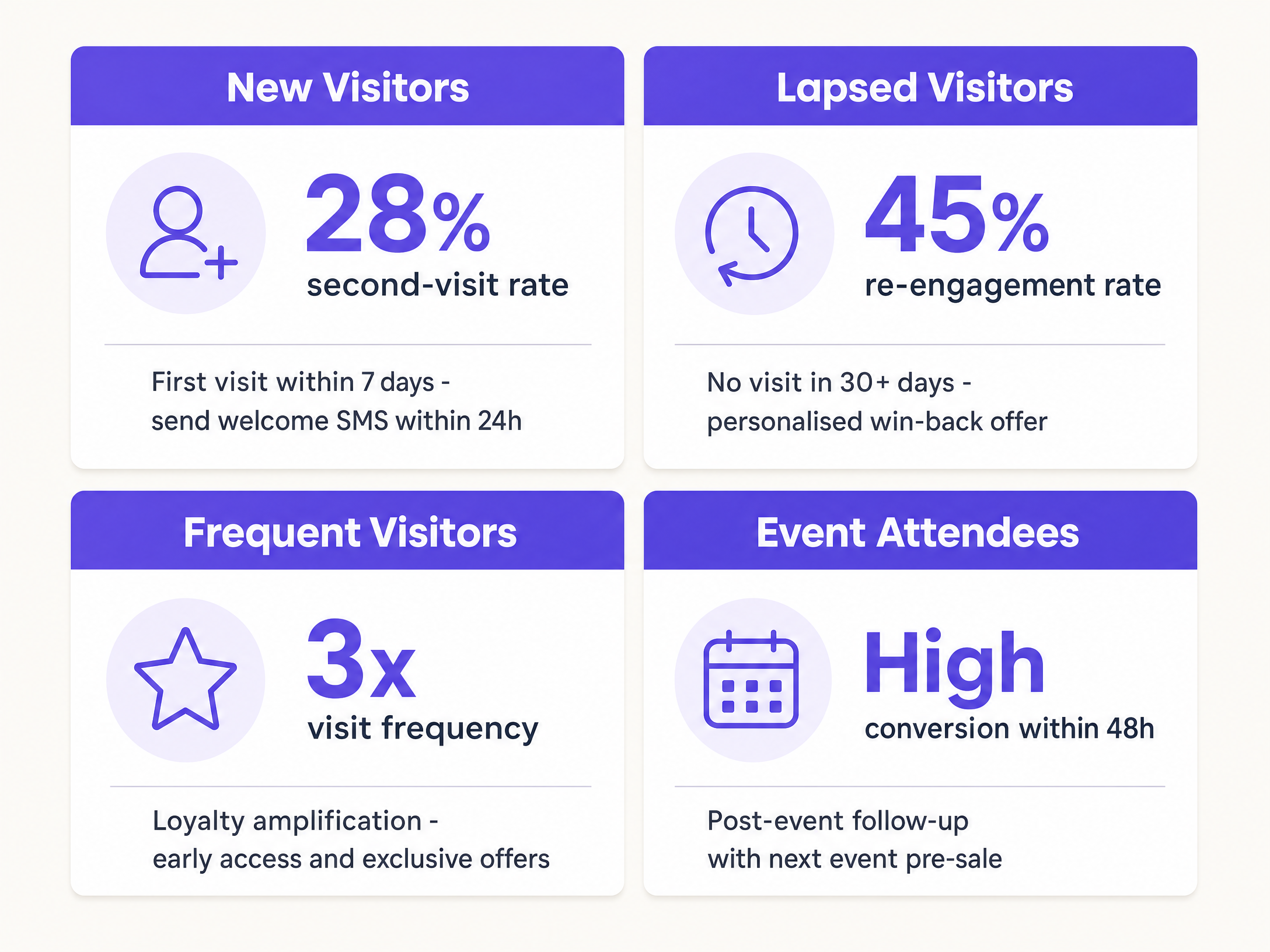
The four segments that drive the highest return-visit rates are as follows. New visitors are first-time guests who connected to your WiFi within the last seven days. A welcome SMS with a small incentive, sent within 24 to 48 hours of their first visit, captures them while the experience is still fresh. Purple data shows a 28% second-visit rate from this segment when the follow-up is sent within that window. Lapsed visitors are people who visited your venue 30 or more days ago and have not returned. A targeted re-engagement SMS, personalised to their visit history, achieves a re-engagement rate of around 45%. Frequent visitors are your highest-value guests. The goal here is frequency amplification rather than re-engagement. Venues using this segment correctly see visit frequency increase by a factor of three compared to non-targeted guests. Event attendees are a warm prospect for the next event. An SMS sent within 48 hours of their visit, referencing the specific event, converts at rates significantly above standard promotional messages.
For a broader view of how first-party data fits into your overall marketing stack, read the Customer data platform: a comprehensive guide for businesses .
Implementation guide
Deploying an SMS marketing programme requires tight integration between your network hardware, your WiFi Analytics platform, and your SMS delivery provider. The following steps apply regardless of which SMS marketing company you select.
Step 1: Configure the captive portal. Design the captive portal to prioritise phone number capture. Keep the interface clean and the value exchange clear. For example: "Connect to free WiFi and receive 15% off your next visit." The phone number field must be mandatory, and OTP verification must be enforced. For guidance on first impressions, read How to make a great first impression with your guest WiFi (and keep your brand consistent) .
Step 2: Establish real-time data flow to the SMS provider. Integrate Purple Engage with your chosen SMS marketing company using webhooks rather than batch exports. When a visitor logs in, the webhook pushes their verified phone number, visit timestamp, venue location, and consent status to the SMS platform instantly. This enables immediate, location-specific triggers. A daily CSV export introduces up to 24 hours of latency, which destroys the effectiveness of time-sensitive triggers.
Step 3: Define behavioural triggers. Do not rely on manual broadcasts. Set up automated triggers based on visit behaviour. The four highest-converting triggers are: the 24-hour new visitor welcome; the 30-day lapsed visitor win-back; the 48-hour event attendee follow-up; and the loyalty amplifier sent on a visitor's fifth visit.
Step 4: Set frequency caps. Configure your frequency caps before you launch. Two to three promotional messages per month is the ceiling for most venue types. Unsubscribe rates climb above 3.5% per send when frequency exceeds this threshold.
Step 5: Implement UTM tracking. Every link in every SMS must carry UTM parameters. This is the only way to close the attribution loop and prove which campaigns drove physical return visits. Without UTM tracking, you cannot optimise.
Best practices
To maximise return visits and minimise opt-outs, adhere to these industry-standard recommendations.
Personalise based on location data. If you operate a retail chain, do not send a generic message. Use the location data captured by the WiFi network to reference the specific store the shopper visited. "Thanks for visiting our Manchester Arndale store" converts higher than "Thanks for visiting us."
Keep messages under 160 characters. Standard SMS messages are 160 characters. Messages that exceed this fragment into multiple units, increasing cost and reducing readability. If you need more space, use a tracked link to a mobile-optimised landing page.
Use a verified sender ID. For high-volume venue programmes, a dedicated short code or verified sender ID gives you better deliverability and brand recognition. Long numbers work for low-volume testing but do not scale to national retail or stadium programmes.
Test send times by segment. SMS messages sent within five minutes of a user action achieve click-through rates of up to 36% [2]. Scheduled broadcasts to a full list achieve around 9%. Test and refine your trigger timing by segment.
Troubleshooting and risk mitigation
Even with a solid architecture, SMS campaigns can fail. The following failure modes are the most common.
High opt-out rates. If your opt-out rate exceeds 2% per campaign, you are either sending too frequently or your messaging lacks relevance. Review your segmentation. Are you sending a discount code for a coffee shop to someone who only visits your stadium venue? Refine the data filters in your customer data platform.
Low click-through rates. If open rates remain high but click-through rates drop below 10%, the call-to-action is weak. Ensure the link is clearly visible, uses a tracked UTM parameter, and leads to a mobile-optimised landing page.
Data synchronisation failures. If your SMS provider is not receiving real-time updates from the WiFi network, check the API rate limits and webhook error logs. A failed sync means automated triggers will not fire, and opted-out users might receive messages, violating GDPR.
OTP delivery failures. If OTP delivery rates drop below 95%, check your SMS provider's routing for specific mobile networks. Some providers have poor coverage on certain carriers. Use a provider with direct carrier connections rather than grey-route aggregators.
ROI and business impact
The business impact of a properly executed SMS marketing strategy is highly measurable. Because every SMS contains a tracked link, and every return visit is logged by the WiFi network, you can close the attribution loop entirely.
Industry benchmarks show that SMS marketing delivers an ROI of $21 to $41 for every $1 spent [3]. When you eliminate the cost of acquiring phone numbers by capturing them via your existing Guest WiFi infrastructure, that ROI increases significantly. Brands that integrate SMS into their omnichannel strategies see a 47.7% lift in customer engagement [4].
The table below summarises the key performance benchmarks you should use to evaluate your programme.
| Metric | SMS benchmark | Email benchmark | Source |
|---|---|---|---|
| Open rate | 98% | 20-28% | Sender, 2024 |
| Click-through rate | 18% | 2.5% | Sender, 2024 |
| Response rate | 45% | 6% | Business.com |
| ROI per $1 spent | $21-$41 | $36-$40 | Upcity, 2023 |
| Messages read within 3 min | 90% | N/A | Validity, 2023 |
By moving from generic broadcast emails to targeted, behavioural SMS triggers, venue operators transform their physical spaces into active customer retention engines.
References
[1] Sender. (2024). SMS Open Rates. https://www.sender.net/blog/sms-open-rates/ [2] Simple Texting. (2024). SMS Marketing Statistics. https://simpletexting.com/blog/2024-texting-and-sms-marketing-statistics/ [3] Upcity. (2023). SMS Marketing Survey. https://upcity.com/experts/sms-marketing-survey-2023/ [4] Omnisend. (2024). Omnichannel Marketing Statistics. https://www.omnisend.com/resources/statistics/
Key Definitions
Captive portal
The web page that a user is required to view and interact with before access is granted to a public WiFi network. It serves as the primary data capture interface for phone numbers and marketing consent.
IT teams configure captive portals on Cisco Meraki, HPE Aruba, Ruckus, and other controllers. The design of the portal directly determines the quality and quantity of first-party data captured.
First-party data
Information a company collects directly from its own visitors and owns entirely, as opposed to second-party data (shared from a partner) or third-party data (purchased from a data broker).
Phone numbers captured via Guest WiFi are first-party data. They are more accurate, more compliant, and more effective than purchased lists because the visitor provided them voluntarily in exchange for network access.
One-Time Passcode (OTP)
A password that is valid for only one login session or transaction, typically delivered via SMS to the phone number provided by the user.
IT teams use OTP during WiFi login to verify that the phone number entered by the visitor is real, active, and in their possession. This eliminates fake numbers and ensures 100% deliverability on the resulting SMS list.
Behavioural trigger
An automated marketing message sent in response to a specific user action, such as connecting to WiFi for the first time or not returning to a venue for 30 days.
Behavioural triggers outperform scheduled broadcasts because they are contextually relevant to the recipient's recent experience. A message sent 24 hours after a first visit converts at 28% second-visit rate vs significantly lower rates for generic broadcasts.
Webhook
A method of real-time data transfer where a server automatically sends data to another system when a specific event occurs, without requiring the receiving system to poll for updates.
Webhooks are used to push newly captured phone numbers from Purple Engage to an SMS marketing company instantly upon WiFi login. This enables real-time triggers and eliminates the latency introduced by batch CSV exports.
Conscious-choice opt-in
A consent mechanism where the user must take a deliberate, affirmative action - such as ticking an empty checkbox - to agree to marketing communications. Pre-ticked boxes do not constitute valid consent under GDPR.
This is a strict requirement under GDPR and the UK Privacy and Electronic Communications Regulations (PECR) when capturing phone numbers for SMS marketing. Purple Engage records the consent timestamp and language for audit purposes.
UTM parameters
Short text codes appended to URLs that allow analytics platforms to identify the source, medium, and campaign name of traffic arriving at a web page.
Every link sent in an SMS campaign must include UTM parameters so the venue can attribute return visits and revenue to the specific message. Without UTM tracking, it is impossible to calculate the ROI of individual campaigns.
Attribution loop
The process of connecting a marketing message to a specific customer action, such as a physical return visit to a venue.
By combining SMS click data (UTM parameters) with WiFi login data (return visit timestamp), venue operators can prove exactly which campaigns drove physical return visits. This closes the attribution loop and enables data-driven budget allocation.
Short code
A five or six-digit phone number used by businesses to send high-volume SMS messages. Short codes offer better deliverability, higher throughput, and stronger brand recognition than standard long numbers.
For national retail chains or stadium operators sending millions of messages, a dedicated short code is essential. Long numbers are suitable for low-volume testing but are often filtered by carrier spam detection at scale.
Worked Examples
A 200-room hotel wants to increase direct bookings and reduce reliance on Online Travel Agencies (OTAs). They currently capture guest emails via WiFi but see only a 12% open rate on promotional campaigns. How should they restructure their data capture and re-engagement architecture?
The IT team updates the Cisco Meraki captive portal to require a phone number and OTP verification for Guest WiFi access. They configure Purple Engage to capture explicit marketing consent, separate from the terms of service, using the language: 'I agree to receive marketing messages from [Hotel Brand] via SMS.' They integrate the data via webhook to their SMS marketing company, enabling real-time data transfer. They build an automated trigger: 24 hours after a guest's last WiFi session ends (indicating checkout), an SMS is sent offering a 15% discount on their next direct booking, bypassing the OTA. A second trigger fires at 30 days post-stay for lapsed guest re-engagement. Every SMS link carries UTM parameters tagged to the specific campaign and property.
A national retail chain wants to drive footfall to underperforming stores during mid-week slumps. They have a database of 50,000 phone numbers but experience high opt-out rates (4.2% per campaign) when they send broadcast texts. What segmentation and targeting changes are required?
The venue operations director implements strict segmentation using Purple Engage data. Instead of a national broadcast, they isolate a segment of 'Frequent Visitors' who have connected to the WiFi at the specific underperforming locations within the last 90 days. They send a highly targeted SMS on a Tuesday morning: 'Show this text at our [Specific Location] store today for a free coffee with any purchase.' The message references the specific store by name, uses a tracked link to a mobile landing page, and is capped at two sends per month per shopper. A control group of 10% of eligible shoppers receives no SMS, allowing the team to measure incremental footfall lift.
Practice Questions
Q1. A stadium operations director wants to send an SMS to all 40,000 fans who attended Saturday's match to promote ticket sales for the next fixture. They plan to send the message at 9:00 AM on Monday as a single broadcast to the full list. What is the primary risk with this approach, and what change would you recommend?
Hint: Consider the impact of broadcast volume on list health and the difference between broadcast and segmented messaging.
View model answer
The primary risk is a high opt-out rate due to unsegmented broadcast messaging. While the timing (within 48 hours of the event) is appropriate, sending a mass broadcast to 40,000 fans without segmenting based on attendance history or engagement levels will likely push opt-out rates above the 3.5% threshold. The director should segment the list into first-time attendees (who need a welcome and next-event incentive), season ticket holders (who need early access or loyalty recognition), and lapsed fans who attended this match after a long absence (who need a re-engagement offer). Each segment receives a different message. The broadcast approach treats all 40,000 fans as identical, which they are not.
Q2. Your IT team has deployed a new captive portal across 50 retail locations. The portal asks for an email address and a phone number, but the phone number field is optional. After one month, the marketing team reports that the SMS database has grown by only 2% of total logins. What architectural change is required, and what compliance consideration must accompany it?
Hint: Consider the balance between user friction and data acquisition priorities, and the consent requirements for mandatory fields.
View model answer
The IT team must redesign the captive portal to make the phone number a mandatory field for network access, and implement OTP verification. While making fields optional reduces login friction, it fails the primary business objective of building a first-party SMS database. The value exchange (free WiFi) justifies the requirement for a verified phone number. The compliance consideration is that making the phone number mandatory does not automatically mean the visitor has consented to marketing. A separate, explicit, non-pre-ticked consent checkbox must be added for SMS marketing. The visitor can provide their phone number (mandatory for access) without consenting to marketing. The SMS marketing list is built only from those who tick the consent box.
Q3. A hotel chain is syncing data from Purple Engage to their SMS marketing company via a daily CSV export at midnight. They want to implement a 24-hour new visitor welcome SMS. After launch, they find the campaign is underperforming with a 4% click-through rate against an expected 25%. What is the most likely architectural cause, and how do you fix it?
Hint: Analyse the difference between batch processing and real-time data transfer for behavioural triggers.
View model answer
The daily CSV export introduces a latency of up to 24 hours before the SMS provider even receives the new guest's data. If a guest logs in at 8:00 AM on Monday, their data is not exported until midnight. The SMS provider does not trigger the 24-hour welcome message until Tuesday or Wednesday, missing the critical window of relevance. A message sent 36 to 48 hours after a visit is no longer contextually relevant - the guest has moved on. The fix is to replace the daily CSV export with a real-time webhook integration. When a new visitor completes OTP verification, the webhook pushes their data to the SMS provider within seconds. The 24-hour trigger then fires at the correct time, while the experience is still fresh.