
How to leverage marketing bulk SMS to increase return visits
This guide details how venue operators can use their existing Guest WiFi infrastructure to build a compliant, high-performing marketing bulk SMS engine that drives measurable return visits. It covers the full technical architecture from phone number capture at the captive portal through to audience segmentation, campaign dispatch, and ROI measurement via presence analytics. Marketing Directors, CRM Managers, and Retail Venue Operators will find concrete implementation steps, GDPR and PECR compliance guidance, and real-world scenarios from hospitality and retail environments.
Listen to this guide
View podcast transcript
Executive summary
Email marketing open rates sit at 22%. SMS open rates sit at 98%, with 80% read within five minutes [Sakari, 2025]. If you operate a physical venue and need to drive footfall this week, email is too slow. You need a direct, verified line to your visitors.
This guide explains how to use marketing bulk SMS to increase return visits. The approach starts with your Guest WiFi network. When visitors connect, they authenticate via a captive portal. Purple Engage captures their phone number and explicit consent at that moment. That first-party data then feeds a segmentation engine that isolates lapsed visitors, VIPs, and first-timers. From there, you deploy targeted bulk SMS campaigns and measure the outcome through network authentication data.
The result is a closed-loop system: you know who received the message, and you know who came back. No modelling, no guesswork. Purple operates across 80,000+ live venues and has processed 440 million logins in 2024, giving us a clear view of what works at scale.
Technical deep-dive
Why SMS outperforms email for return-visit campaigns
The core challenge for venue operators is recency. A visitor who came in three weeks ago is already fading from memory. Email sits in an inbox competing with dozens of other messages. SMS arrives directly on the lock screen.
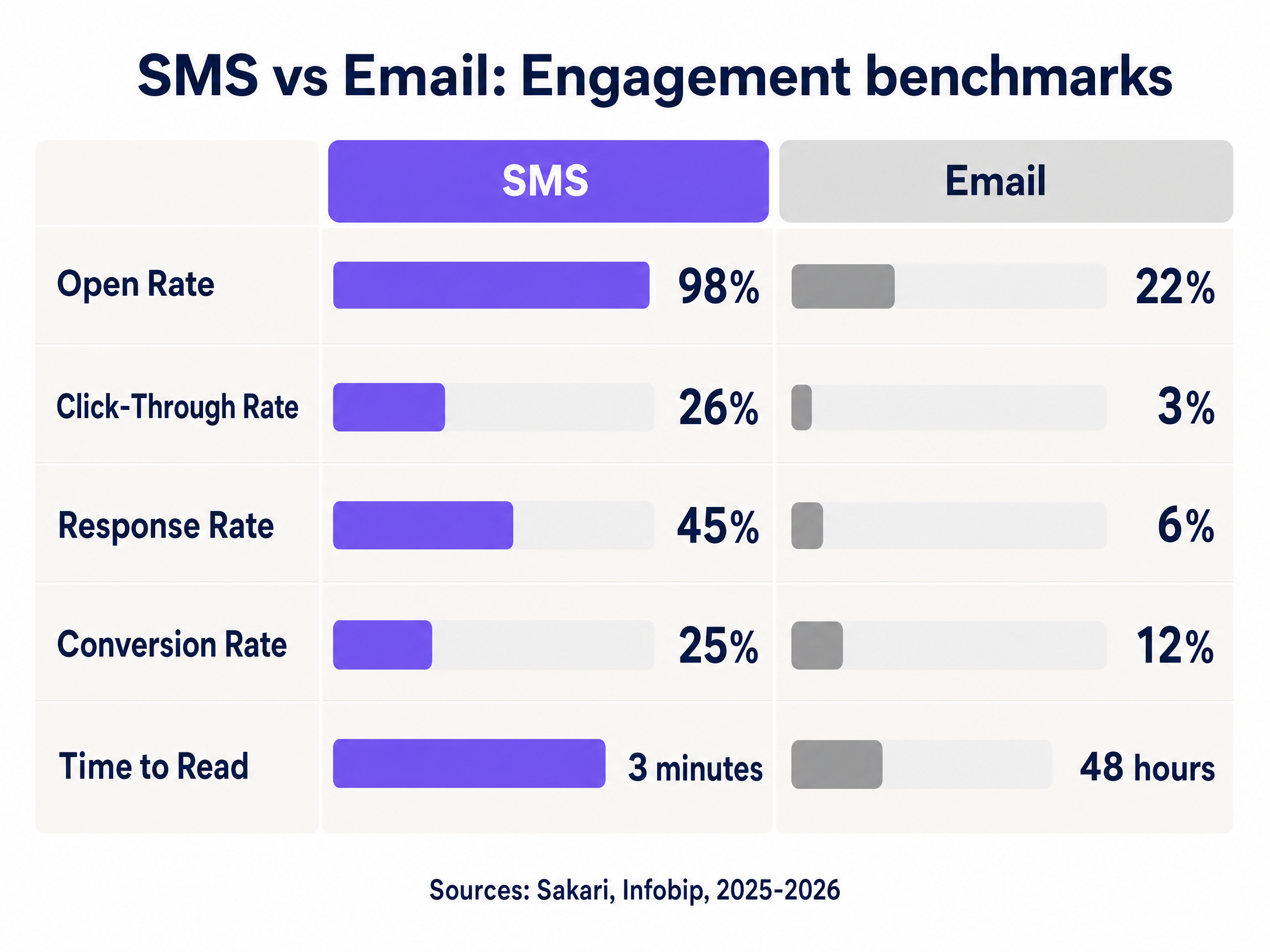
The engagement gap is significant. SMS delivers a 98% open rate versus 22% for email. Click-through rates average 26% for SMS against 3% for email [Sakari, 2025; Infobip, 2026]. For hospitality and retail specifically, SMS conversion rates sit between 21% and 30% [Sakari, 2025]. These are not marginal improvements - they represent a fundamentally different level of audience reach.
For retail venues, the time-to-read metric is particularly valuable. 80% of SMS messages are read within five minutes of delivery. That makes SMS the only viable channel for same-day promotions, flash sales, or event-day communications.
The data capture architecture
Effective marketing bulk SMS requires verified, consented phone numbers. The most reliable source in a physical venue is the Guest WiFi network. When a visitor connects to the network, they pass through a captive portal - a web page presented before full internet access is granted. This is the primary data collection point.
Purple operates as a cloud overlay, meaning the captive portal and data capture layer work across the major hardware vendors without requiring infrastructure changes. The platform integrates with Cisco Meraki, HPE Aruba, Ruckus, Juniper Mist, Ubiquiti UniFi, Cambium, Extreme, and Fortinet.
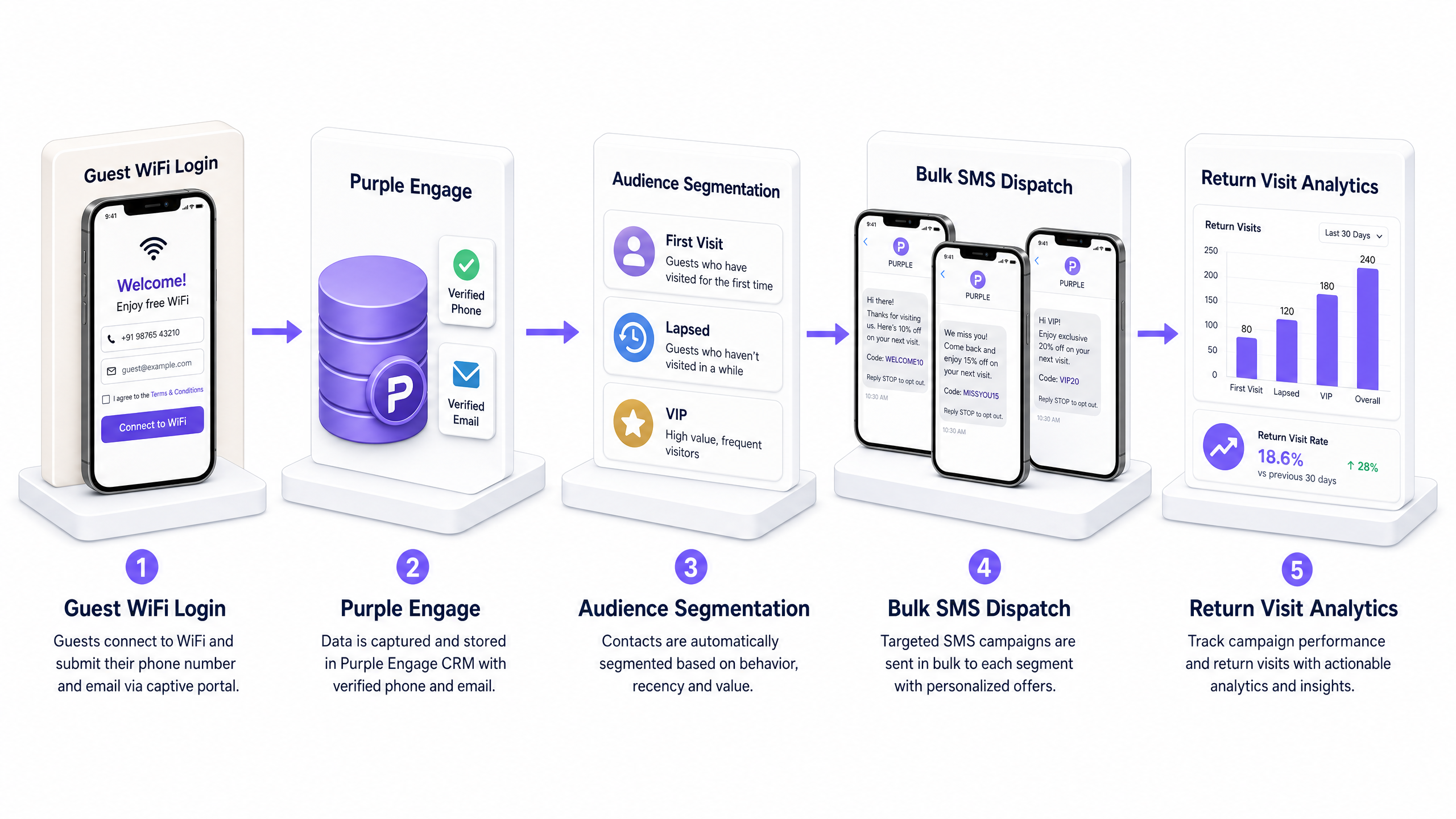
During authentication, the visitor provides their mobile number. Purple Engage validates the format and, optionally, sends an OTP (one-time passcode) to confirm the number is live and belongs to the visitor. This verification step eliminates invalid numbers before they enter the database, protecting deliverability rates.
At the same time, the visitor is presented with explicit, unbundled consent checkboxes for SMS marketing. These must be unticked by default. Under GDPR and PECR, consent must be freely given, specific, informed, and unambiguous [ICO]. Pre-ticked boxes do not constitute valid consent.
Presence analytics and segmentation
The data collected at login is not just a phone number. Purple Engage ties each contact to a presence analytics profile. The platform records the MAC address of the device, the date and time of each visit, the duration of each session, and the venue location. This behavioural data is what enables meaningful segmentation.
Batch-and-blast SMS fails. Sending the same message to every contact in your database drives opt-outs and damages deliverability. The approach that works is segmenting contacts by behaviour and sending messages that are directly relevant to each group.
The three core segments for return-visit campaigns are:
| Segment | Definition | Recommended trigger |
|---|---|---|
| First-Time Visitor | Authenticated once, no return visit | 24-48 hours after first visit |
| Lapsed Visitor | No authentication in 30+ days | Rolling daily check |
| VIP | Authenticated 5+ times in 30 days | Exclusive offers, early access |
Purple Engage automates the segment membership. As a visitor's behaviour changes - for example, moving from Active to Lapsed - they are automatically added to the relevant campaign flow.
Campaign automation and dispatch
Once segments are defined, campaigns are configured as automated flows. A flow consists of a trigger condition, a time window, and a message template. For example:
- Trigger: Contact enters 'Lapsed (30 Days)' segment
- Condition: Send only between 10:00 and 16:00 local time
- Action: Send SMS template 'Win-Back Offer'
- Message: 'We miss you at [Venue]. Show this text for 15% off your next visit. Reply STOP to opt out.'
The platform handles bulk dispatch at scale, managing carrier routing, delivery receipts, and opt-out processing. Unsubscribe requests are processed immediately and the contact is suppressed from all future campaigns.
Implementation guide
Step 1: Audit your captive portal
Review your existing Guest WiFi splash page. Confirm it collects mobile numbers and includes clear, unbundled SMS marketing consent checkboxes. If your current portal does not collect phone numbers, this is the first configuration change to make in Purple Engage. See how to make a great first impression with your guest WiFi for guidance on splash page design.
Step 2: Enable OTP verification
Activate one-time passcode verification for mobile number collection. This adds a single extra step for the visitor but eliminates invalid numbers from your database. A clean list with 95% deliverability is more valuable than a large list with 60% deliverability.
Step 3: Define your segments
In Purple Engage, configure the three core segments: First-Time Visitor, Lapsed (30 Days), and VIP. Set the criteria based on your venue's visit patterns. A hotel may define 'Lapsed' as 90 days; a daily-visit coffee shop may define it as seven days.
Step 4: Build your message templates
Write three message templates - one per segment. Each message must:
- Be under 160 characters to avoid multi-part SMS charges
- Include a clear value proposition (discount, exclusive access, or useful information)
- Include an opt-out instruction ('Reply STOP to opt out')
- Include your venue name for sender identification
Step 5: Configure automation rules
Set up the trigger logic for each campaign flow. Define the send window (time of day and day of week). Set a frequency cap to ensure no contact receives more than four messages per month across all campaigns.
Step 6: Test and validate
Before activating campaigns, send test messages to internal numbers. Confirm the opt-out flow works correctly. Verify that contacts who reply STOP are immediately suppressed. Check that delivery receipts are being logged in Purple Engage.
Step 7: Monitor and optimise
After launch, review the WiFi Analytics dashboard weekly. Track delivery rate, click-through rate, and - most importantly - the return visit rate for each segment. Adjust message content and timing based on performance data.
Best practices
Respect frequency limits. Over 53% of SMS opt-outs occur because venues send too many messages [Sakari, 2025]. Set a hard cap of four promotional messages per contact per month. Every message must justify its place.
Send at the right time. A lunch promotion sent at 11:00 converts. The same offer sent at 21:00 annoys. A Friday evening event needs promotion on Thursday or Friday morning, not the previous weekend. Use Purple Engage's time-window settings to enforce this.
Keep messages short and specific. 160 characters is your limit for a single-part SMS. Use that constraint to your advantage - it forces clarity. One offer, one call to action, one opt-out instruction.
Use personalisation where you have the data. Including the visitor's first name or referencing their last visit ('We haven't seen you since March') increases relevance and conversion rates.
Never import unverified lists. Only send SMS to contacts who provided explicit consent through your captive portal. Purchased lists or legacy databases without documented SMS consent are a compliance risk and a deliverability risk.
Test send times. Hospitality venues typically see strongest SMS engagement between 11:00 and 14:00 and between 17:00 and 19:00. Retail venues see strong engagement on Thursday and Friday afternoons. Test your specific audience and adjust.
Troubleshooting and risk mitigation
High bounce rates. If delivery rates fall below 90%, the most common cause is invalid phone numbers in the database. Enable OTP verification on the captive portal to prevent invalid numbers entering the system. Run a number validation pass on any existing contacts imported before OTP was enabled.
High opt-out rates. If unsubscribe rates exceed 3% per send, review message frequency and relevance. The most common causes are over-communication (more than four messages per month) and irrelevant content (sending the same offer to all segments rather than tailoring by behaviour).
Compliance breaches. Fines under PECR can reach £500,000 [ICO]. Fines under GDPR can reach 4% of global annual turnover. Never send SMS to a contact who has not provided explicit, documented consent. Maintain consent records in Purple Engage and do not delete them.
Deliverability degradation. If your sender ID or short code is flagged by carriers, delivery rates will drop. This typically happens when opt-out requests are not processed promptly or when message content triggers spam filters. Ensure opt-outs are processed within 24 hours and avoid spam trigger words ('FREE', 'WIN', 'CLAIM NOW') in message templates.
Low click-through rates. If CTR falls below 10%, the message content or offer is not compelling enough. A/B test two versions of the message with different offers or calls to action. Review the offer value - a 5% discount rarely motivates a return visit; 15-20% is a more effective threshold for lapsed visitors.
ROI and business impact
Measuring the ROI of a bulk SMS campaign is straightforward when tied to WiFi analytics. The measurement methodology is deterministic rather than modelled.
After dispatching a campaign to the 'Lapsed (30 Days)' segment, you monitor Purple Engage to see how many devices from that specific segment authenticate on the network within the campaign window (typically seven days). This count represents confirmed return visits attributable to the campaign.
Example calculation:
| Metric | Value |
|---|---|
| SMS sent | 1,000 |
| Cost per SMS | £0.04 |
| Total campaign cost | £40 |
| Return visits tracked | 150 |
| Average spend per visit | £22 |
| Revenue generated | £3,300 |
| ROI | 8,150% |
This is a conservative example. Industry data places SMS marketing ROI between £21 and £71 for every £1 spent [Sakari, 2025]. The key advantage of the WiFi-based attribution model is that it does not rely on unique discount codes or UTM parameters - the network itself provides the attribution signal.
For transport and healthcare venues, the ROI model shifts from revenue to operational metrics: reduced no-show rates, improved passenger flow, and higher satisfaction scores. The measurement approach remains the same - track how many SMS recipients subsequently authenticate on the WiFi network.
Related reading: Three SSIDs to rule them all: guest, Passpoint, and IoT WiFi - for the network architecture that underpins this data capture strategy.
Also see: How to leverage bulk SMS marketing to increase return visits for the companion implementation guide.
References
[1] Sakari, "SMS Marketing Statistics: Data-Backed Insights for 2025-2026", sakari.io [2] Infobip, "SMS marketing benchmarks: Key stats by industry", infobip.com, 2026 [3] Information Commissioner's Office (ICO), "Guide to PECR: Electronic mail marketing", ico.org.uk
Key Definitions
First-party data
Information collected directly from your own visitors or customers, with their knowledge and consent.
Phone numbers collected via the Guest WiFi captive portal are first-party data. They are more reliable than third-party data because the visitor provided them directly, and more compliant because consent was captured at the point of collection.
Captive portal
A web page that a user must view and interact with before gaining access to a public WiFi network.
This is the primary data capture point for SMS marketing. The portal collects the mobile number, validates it, and presents the consent checkboxes before granting network access.
Presence analytics
Data derived from mobile devices interacting with WiFi access points, recording visitor location, dwell time, visit frequency, and recency.
Presence analytics is what enables meaningful audience segmentation. Without it, you have a list of phone numbers. With it, you have a behavioural profile for each contact.
Bulk SMS
The simultaneous dispatch of a single SMS message to a large number of recipients, typically via an API or marketing platform.
Bulk SMS dispatch is managed by Purple Engage, which handles carrier routing, delivery receipts, and opt-out processing at scale.
OTP (one-time passcode)
A single-use numeric code sent to a mobile number to verify that the number is valid and belongs to the person submitting it.
Enabling OTP verification on the captive portal eliminates invalid phone numbers before they enter the database, protecting deliverability rates and reducing wasted spend.
PECR (Privacy and Electronic Communications Regulations)
UK regulations that govern electronic marketing, including SMS. They sit alongside UK GDPR and are enforced by the ICO.
PECR requires explicit, specific consent before sending promotional SMS messages to individuals. The soft opt-in exception that applies to email does not cleanly apply to SMS in the same way.
Deterministic attribution
Attributing a conversion (such as a return visit) directly to a specific marketing action, without relying on statistical modelling.
When a contact receives an SMS and subsequently authenticates on the venue's WiFi network, that is a deterministic attribution. The network provides the conversion signal directly.
Frequency cap
A limit on the number of marketing messages a single contact can receive within a defined time period.
Setting a frequency cap of four messages per month in Purple Engage prevents over-communication, which is the leading cause of SMS opt-outs.
Lapsed visitor segment
A dynamic audience segment containing contacts who have not authenticated on the venue's WiFi network within a defined number of days.
The lapsed segment is typically the highest-priority target for return-visit SMS campaigns. These are visitors who have demonstrated interest in the venue but have not returned recently.
Worked Examples
A 150-site pub chain wants to drive footfall on Tuesday evenings, currently their lowest revenue period. They have 45,000 contacts in Purple Engage with verified phone numbers and SMS consent. How should they structure the campaign?
The IT and Marketing teams configure Purple Engage to build a dynamic segment of 'Weekend-Only Visitors' - contacts whose last five visits all occurred on Friday, Saturday, or Sunday. This segment contains approximately 12,000 contacts. On Tuesday at 15:00, they dispatch a bulk SMS to this segment: 'Beat the mid-week slump at [Venue]. Show this text for 2-for-1 mains tonight only. Reply STOP to opt out.' The message is 128 characters, fits in a single SMS, and includes a clear time-bound offer. They set the campaign to run automatically every Tuesday for four weeks. They track success by monitoring how many devices from the 'Weekend-Only' segment authenticate on the Guest WiFi between 17:00 and 22:00 each Tuesday, comparing against the four Tuesdays prior to the campaign launch.
A large retail shopping centre has 80,000 contacts who visited during the Christmas trading period (November 15 to December 31) but have not returned by March 1. The marketing team wants to re-engage this segment before the Easter trading period. What is the recommended approach?
The venue operators use Purple Engage to filter contacts with a 'Last Seen' date between November 15 and December 31 and no subsequent authentication. This produces the 'Christmas Lapsed' segment. They schedule a campaign for the Thursday before Good Friday at 11:00: 'Spring has arrived at [Shopping Centre]. Enjoy exclusive VIP parking and a free coffee on us this Easter weekend. Tap to claim: [short URL]. Reply STOP to opt out.' The free coffee offer is fulfilled via a QR code on the landing page, redeemable at any of the centre's three coffee outlets. The campaign cost is approximately £3,200 for the SMS plus £2,400 for the coffee redemptions (estimated 30% claim rate). They track return visits via WiFi authentication over the Easter weekend.
Practice Questions
Q1. You want to send an SMS campaign promoting a Friday evening event at your venue. When should you dispatch the message, and why?
Hint: Consider the average time-to-read for SMS and the lead time visitors need to plan an evening out.
View model answer
Dispatch the message on Thursday evening between 18:00 and 20:00, or on Friday morning between 10:00 and 12:00. SMS has a 98% open rate with 80% of messages read within five minutes, so there is no benefit to sending it days in advance. However, sending it on Friday afternoon risks missing visitors who need to make plans earlier in the day. Thursday evening or Friday morning gives recipients enough time to plan while the urgency of the upcoming event is still relevant.
Q2. Your marketing team wants to upload a spreadsheet of 8,000 customer phone numbers collected via a paper sign-up sheet at your venue two years ago. They want to add these to Purple Engage and include them in the next bulk SMS campaign. What must you verify, and what is the risk if you proceed without verification?
Hint: Review the consent requirements under GDPR and PECR for SMS marketing.
View model answer
You must verify that every number on that list has documented, explicit opt-in consent specifically for SMS marketing. A paper sign-up sheet from two years ago is unlikely to meet the current GDPR and PECR standard for SMS consent unless it included a clear, unbundled checkbox for SMS marketing with specific wording. If you cannot produce that documentation, you cannot legally send SMS to those contacts. The risk of proceeding without verification includes ICO enforcement action, fines of up to £500,000 under PECR, and reputational damage. The correct action is to exclude the list or run a re-consent campaign via a channel where you do have valid consent (such as email, if that consent exists).
Q3. After running a bulk SMS campaign to your 'Lapsed (30 Days)' segment for four weeks, your return visit rate is 8% and your opt-out rate is 4.5%. What do these metrics tell you, and what changes would you make?
Hint: Compare these figures against the benchmarks for SMS marketing and identify the likely causes.
View model answer
An 8% return visit rate is a reasonable starting point but has room for improvement. A 4.5% opt-out rate is above the healthy benchmark of below 3.5%, which indicates a problem with message relevance or frequency. The first action is to review the message content - is the offer compelling enough for a lapsed visitor? A 5% discount rarely motivates a return visit; 15-20% is typically the threshold. The second action is to review frequency - are contacts receiving other SMS campaigns in addition to this one, pushing them over the four-per-month threshold? Set a frequency cap across all campaigns. The third action is to review timing - test sending at different times of day and days of week to find the highest-engagement window for your specific audience.
Q4. A new hotel property is being added to your portfolio. The IT team is deploying HPE Aruba access points. The marketing team wants SMS marketing live within 30 days of opening. What are the three most critical configuration steps to prioritise?
Hint: Think about the sequence: you cannot send SMS until you have numbers, and you cannot have numbers until the capture flow is configured.
View model answer
The three critical steps in sequence are: First, configure the captive portal on the HPE Aruba network to collect mobile numbers with OTP verification and explicit, unbundled SMS marketing consent checkboxes. This is the foundation - without it, no compliant data can be collected. Second, connect the captive portal to Purple Engage so that verified phone numbers and consent records are synced in real-time. Third, build the three core automation flows (First-Time Visitor, Lapsed, VIP) with message templates and send-window rules before the property opens, so that campaigns activate automatically as the database builds. Attempting to run manual campaigns before the automation is configured wastes the first 30 days of data collection.