
How to leverage SMS in marketing to increase return visits
This technical guide explains how venue operators can use their existing Guest WiFi infrastructure to capture verified phone numbers and automate SMS marketing campaigns that drive measurable return visits. It covers data flow architecture, GDPR and TCPA compliance, audience segmentation strategies, and ROI benchmarks drawn from hospitality and retail deployments. The guide is aimed at Marketing Directors, CRM Managers, and IT teams who need a practical implementation roadmap, not a theoretical overview.
Listen to this guide
View podcast transcript
Executive summary
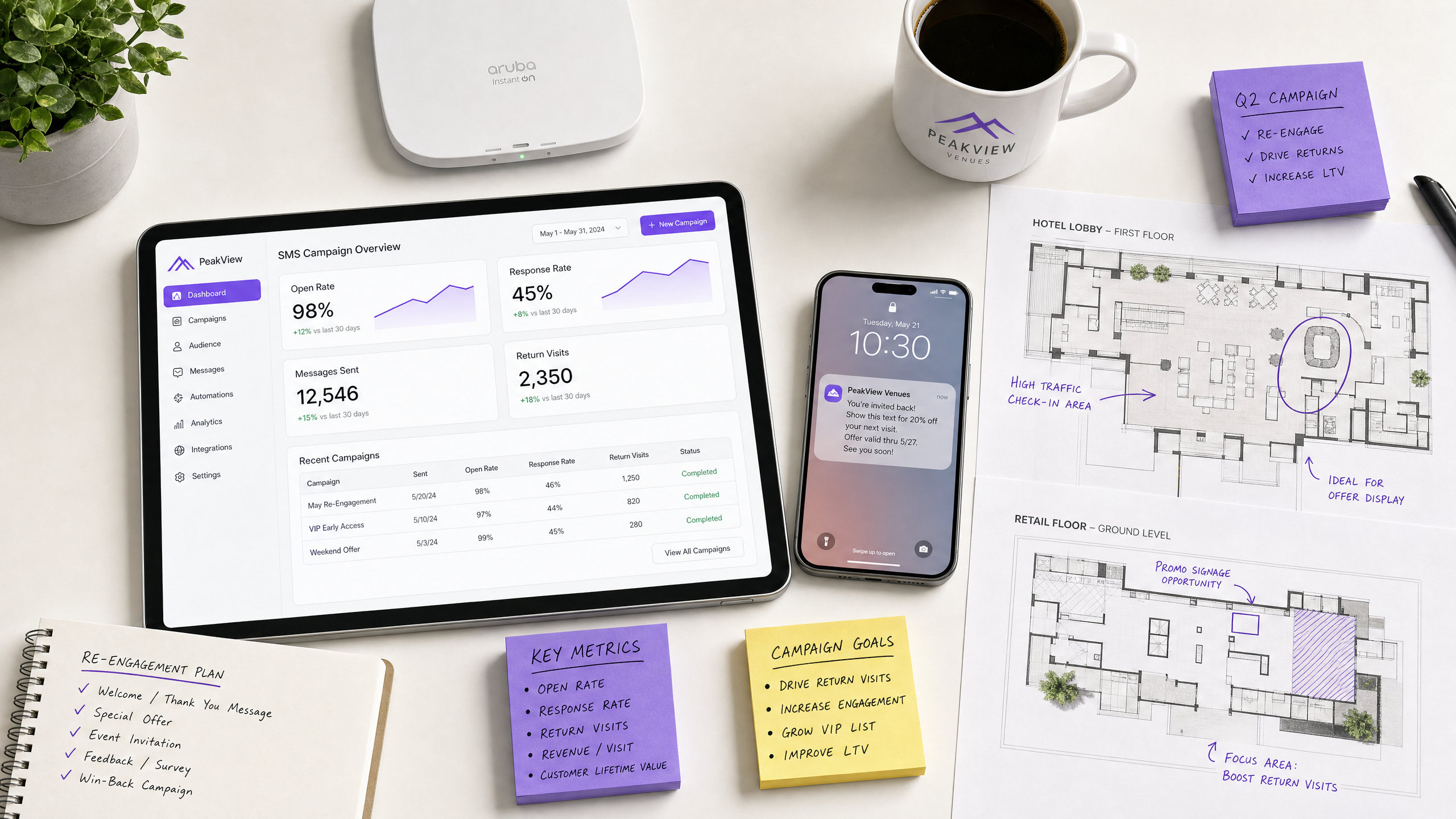
Venue operators face a persistent revenue challenge: most guests connect to the WiFi, leave the premises, and never return. Email marketing captures a fraction of this audience, but with open rates hovering around 20%, it lacks the immediacy required to drive consistent footfall. SMS marketing solves this visibility problem. With a 98% open rate and 90% of messages read within three minutes of delivery, SMS is the most direct channel available to IT and marketing teams today.
This guide details how to implement an SMS marketing strategy using your existing Guest WiFi infrastructure. By reconfiguring the captive portal to capture verified phone numbers via a double opt-in flow, venues can build a first-party data asset that is both GDPR-compliant and immediately actionable. We cover the technical architecture required to route this data into WiFi Analytics , the segmentation rules that drive a 45% response rate, and the compliance frameworks that protect your organisation. Two real-world implementation scenarios - a 200-room hotel and a 45-store retail chain - demonstrate the measurable outcomes you can expect within 90 days.
Technical deep-dive
Building a compliant, high-conversion SMS marketing engine requires tight integration between your network hardware, the captive portal, and the CRM layer. Purple operates as a hardware-agnostic cloud overlay across enterprise access points including Cisco Meraki, HPE Aruba, Ruckus, Juniper Mist, Ubiquiti UniFi, Cambium, Extreme, and Fortinet. You do not need to replace your network stack to deploy this.
Data capture and consent architecture
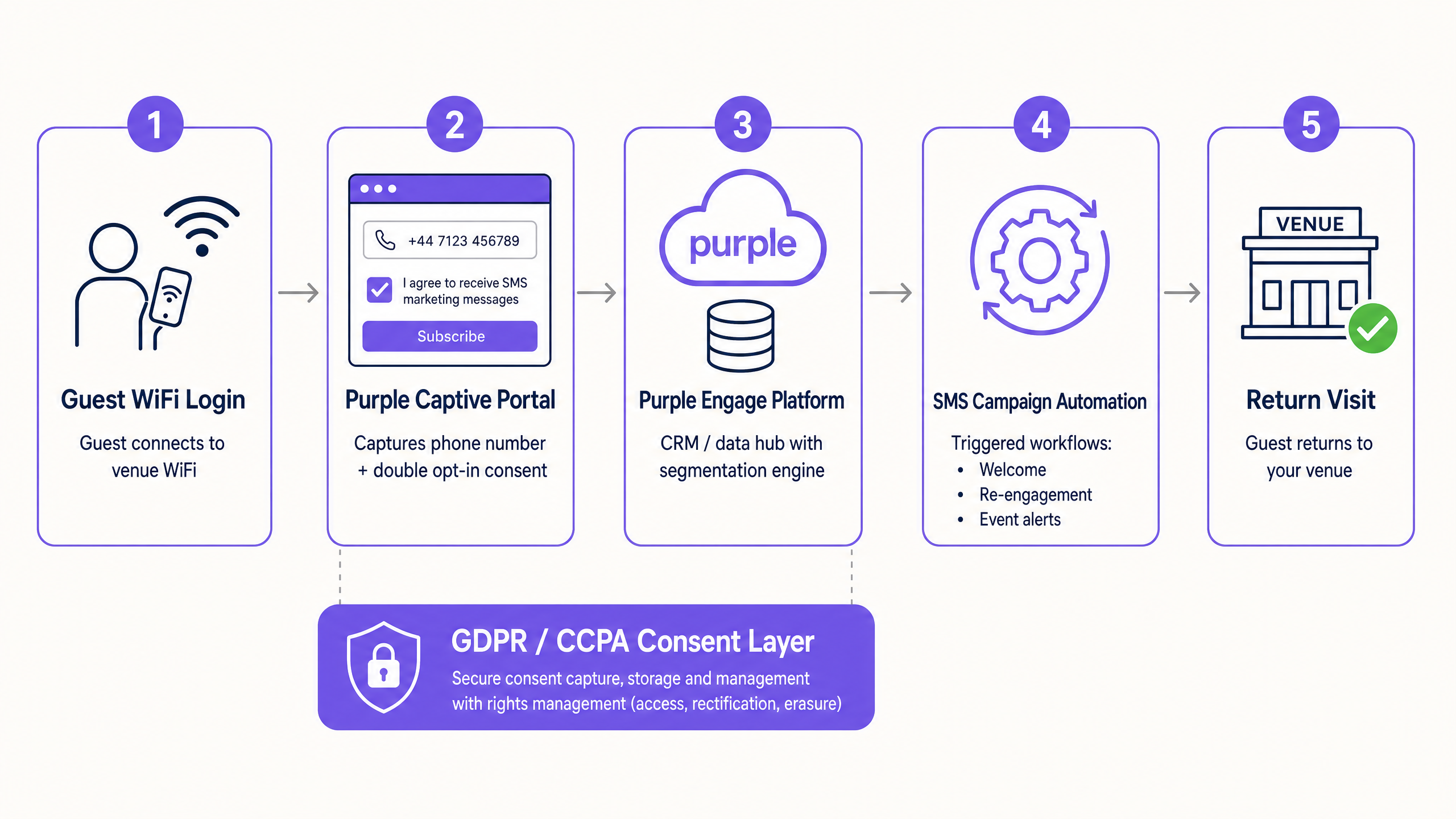
The foundation of SMS in marketing is the initial data capture event. When a visitor connects to the Guest WiFi, the network redirects them to a captive portal. To build an SMS audience, the authentication flow must be configured to request a mobile number alongside the standard login fields. However, capturing the number is only the first step. To comply with GDPR in the UK and Europe, and TCPA in the United States, you must secure explicit, documented consent before sending any promotional messages.
The technical mechanism for this is the double opt-in flow. The guest enters their phone number and actively checks a consent box agreeing to receive marketing communications. The captive portal triggers an API call to the SMS gateway, sending a verification code to the number provided. The guest enters the code to complete authentication and gain internet access. Purple Engage then generates a timestamped consent record, logging the MAC address, IP address, phone number, and the exact consent language agreed to. This record is immutable and auditable.
This flow prevents invalid number entries, verifies the number is active and owned by the person logging in, and provides a defensible audit trail for any regulatory inquiry.
Integration and data flow
Once consent is secured, the data flows into Purple Engage. The platform acts as the central identity provider and segmentation engine. It links the phone number to the guest's MAC address, allowing the system to track subsequent physical visits to the venue without requiring the guest to log in again. This physical presence data is the key differentiator between a WiFi-sourced SMS list and a purchased one.
Because Purple has collected 29 billion data points across 80,000+ live venues, the segmentation engine can identify patterns that a standard CRM cannot. It can detect that a specific device has not appeared on the network in 45 days, or that a device has visited five times in the last month. These behavioural signals drive the automated workflows that make SMS marketing genuinely relevant rather than generic.
The platform integrates with leading CRM and marketing automation tools, allowing the SMS data to feed into your broader omnichannel stack. Brands that integrate SMS into omnichannel strategies see a 47.7% lift in customer engagement, according to Omnisend data. This is consistent with what we observe across our 80,000+ venue deployments.
Implementation guide
Deploying an SMS marketing strategy requires coordination between IT and marketing teams. The following sequence establishes a compliant, automated programme from a standing start.
Step 1: Configure the captive portal
Access the Purple portal and navigate to the Guest WiFi configuration settings. Update the login journey to require a phone number field. Enable the double opt-in verification requirement - this is not optional if you are operating in the UK, EU, or US. Ensure the consent language on the portal explicitly states that the number will be used for promotional SMS marketing and references your privacy policy URL. Purple Engage provides a compliant consent template that satisfies GDPR Article 7 requirements and TCPA express written consent standards.
For venues on the Hospitality plan, the portal can be customised with your brand identity, including logo, colour scheme, and welcome message. A well-designed portal improves opt-in rates. A first impression matters - see our guide on how to make a great first impression with your guest WiFi for design recommendations.
Step 2: Define audience segments
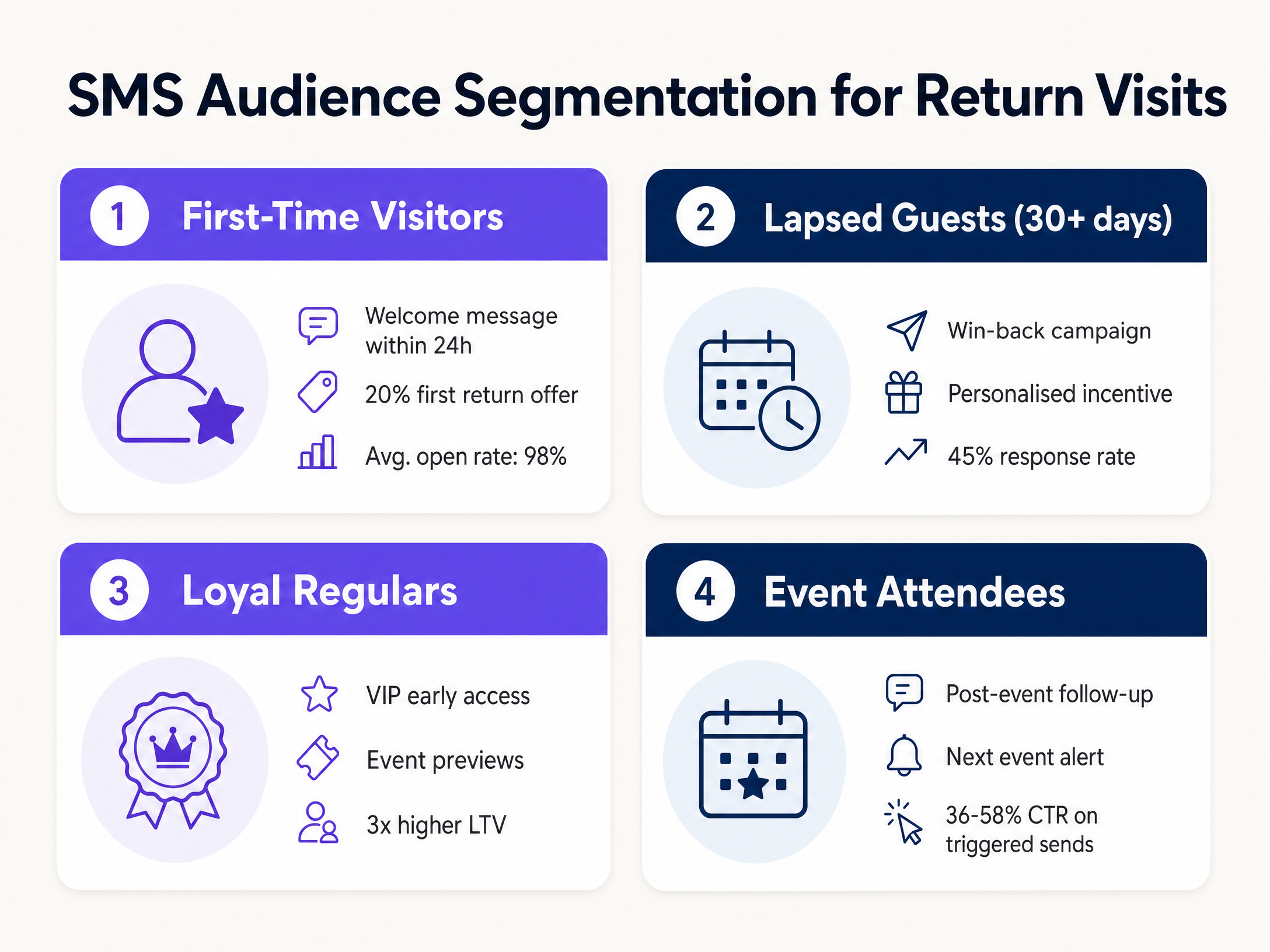
Do not send broadcast messages to your entire database. Purple Engage allows you to create dynamic segments based on visitor behaviour. The four segments that consistently drive the highest return visit rates are detailed in the infographic below.
For Retail operators, add a fifth segment based on store location, so shoppers near a specific branch receive location-relevant offers rather than generic promotions.
Step 3: Build automated workflows
Configure triggered campaigns for each segment. For first-time visitors, set a rule to send a welcome SMS 24 hours after their initial login, including a specific return incentive such as a 20% discount on their next visit. For lapsed guests, configure a win-back campaign triggered at the 45-day mark. For loyal regulars, set up a monthly VIP preview message. For event attendees, trigger a post-event follow-up within 48 hours.
Each workflow should include a suppression rule: once a user responds or returns, remove them from the win-back sequence and move them to the loyal regulars segment. This prevents guests from receiving irrelevant messages after they have already re-engaged.
Step 4: Establish attribution tracking
To measure return visits, use Purple Analytics. Because the SMS campaign targets users whose MAC addresses are known, Purple can report exactly how many recipients of a specific campaign physically returned to the venue within the conversion window. Set a 14-day conversion window as your default. Use unique promo codes per campaign as a secondary attribution signal, particularly useful for Transport and Healthcare venues where physical re-authentication may not always be captured.
Best practices
To maximise return on investment from your SMS marketing platform, apply these operational rules consistently.
Cap frequency at two messages per month. Sending more than two promotional messages per week is the primary driver of opt-outs, accounting for 53% of unsubscribes according to Omnisend data. Set a hard frequency cap in your automation rules. One to two messages per month is the optimal range for most venue types.
Provide a clear opt-out in every message. Every SMS must include a simple opt-out mechanism such as "Reply STOP to cancel." Purple Engage processes these requests automatically, instantly removing the number from all active segments and updating the consent record.
Time your sends precisely. Schedule messages for when guests are most likely to act. For a restaurant, send weekend reservation prompts on Thursday afternoon. For retail, send flash sale alerts at 10:00 AM on Saturday. For a stadium, trigger in-venue messages during the 80th minute of a match when the crowd is still present.
Personalise the content. Use dynamic fields to insert the guest's first name and reference their specific location or last visit. "Hi James, it has been a while - your usual table at our Manchester restaurant is free this Friday" converts significantly higher than a generic broadcast. Personalisation requires first-party data. That data comes from your WiFi login flow.
Test before scaling. Before sending to your full audience, send to a test segment of 200 to 500 users. Measure open rate, response rate, and opt-out rate before committing to the full send.
Troubleshooting & risk mitigation
When deploying SMS marketing, IT and operations teams must monitor for these specific failure modes.
High delivery failure rates. If SMS delivery fails consistently above 5%, the captive portal is likely accepting invalid or mistyped numbers. Enforce the double opt-in verification step at login. Do not grant internet access until the SMS verification code is entered correctly. This single change typically reduces invalid numbers to under 1%.
Compliance exposure. A single TCPA violation can result in fines of $500 to $1,500 per message sent. A GDPR enforcement action can reach 4% of global annual turnover. Never manually import unverified lists into Purple Engage. Rely exclusively on the first-party data captured through the Guest WiFi portal, where consent is explicitly documented and timestamped. Purple is ISO 27001 certified and GDPR-compliant by design.
Audience churn. If your opt-out rate exceeds 3% per campaign, your messaging is either too frequent or irrelevant. Review your segmentation rules. Ensure you are not sending generic offers to loyal regulars, or win-back messages to guests who visited last week.
Attribution gaps. If you cannot tie SMS sends to physical return visits, your reporting will understate the channel's value. Ensure Purple Analytics is configured to track MAC address re-authentication events against your campaign send lists. Without this, you are relying on coupon redemptions alone, which typically undercount actual return visits by 40 to 60%.
ROI & business impact
The financial case for SMS in marketing is well-evidenced. Industry data places ROI at £21 to £41 for every £1 spent, with some seasonal campaigns reporting returns as high as £71 per £1 according to Attentive 2024 data. This efficiency is driven by the low cost of transmission - typically £0.03 to £0.07 per message in the UK - combined with exceptionally high engagement rates.
Hotel scenario. A 200-room property using Purple Engage on an HPE Aruba network configures the captive portal to capture phone numbers with a double opt-in flow. Within 90 days, the venue builds an SMS audience of 4,200 verified guests. Three campaign types run: a 24-hour welcome message, a 30-day win-back, and a monthly event alert. Return visit rate increases by 22% in the first quarter. Revenue per available room rises by 14%. The cost of the SMS programme is approximately £168 per month (4,200 messages at £0.04 each). The ROI on a single return booking at £120 average daily rate covers the entire monthly programme cost.
Retail scenario. A mid-size retail chain with 45 stores deploys Purple Guest WiFi across all locations. Shoppers who connect and opt in receive a welcome SMS with a loyalty offer. The chain segments by store location and visit recency. Lapsed shoppers who have not visited in 60 days receive a personalised win-back message. The chain records a 31% increase in return visits from the SMS audience compared to non-opted guests over a 90-day period.
The table below summarises the key performance benchmarks you should use to evaluate your programme.
| Metric | SMS | Advantage | |
|---|---|---|---|
| Open rate | 98% | 20-30% | SMS 4x higher |
| Response rate | 45% | 6% | SMS 7x higher |
| Click-through rate | 18-35% | 2.5-3.5% | SMS 10x higher |
| Time to open | 3 minutes | 6+ hours | SMS immediate |
| ROI per £1 spent | £21-£41 | £36-£42 | Comparable |
| Opt-out rate | 0-3.5% | 1-2% | Comparable |
Sources: Emarsys Customer Loyalty Index 2025, Omnisend 2024, Attentive 2024, Sakari SMS Marketing Statistics 2025-2026.
For further reading on related SMS and WiFi marketing strategies, see our guides on Como alavancar a plataforma de marketing por SMS para aumentar as visitas de retorno and রিটার্ন ভিজিট বাড়ানোর জন্য কীভাবে SMS মার্কেটিং প্ল্যাটফর্মের সুবিধা নেওয়া যায় . For network architecture context, see Three SSIDs to rule them all: guest, Passpoint, and IoT WiFi .
Key Definitions
Double opt-in
A two-step verification process where a user provides their phone number and then confirms consent by entering a code sent via SMS before being granted network access.
Essential for GDPR Article 7 and TCPA compliance. Provides an immutable, timestamped consent record that is auditable in the event of a regulatory inquiry.
Captive portal
The web page that a visitor is required to view and interact with before access is granted to a public Guest WiFi network.
The primary data capture mechanism for building a first-party SMS audience. Purple's captive portal is configurable to require phone numbers and display compliant consent language.
First-party data
Information collected directly from your audience or guests, rather than purchased from a data broker or inferred from third-party tracking.
Highly valuable because it is verified, consented, and specific to your venue. The phone numbers captured via the Guest WiFi portal are first-party data.
MAC address
A unique hardware identifier assigned to a network interface controller, used as a network address in communications within a network segment.
Used by Purple Analytics to track physical presence and attribute return visits to specific SMS campaigns, without requiring the guest to log in again on subsequent visits.
Triggered workflow
An automated sequence of messages dispatched when a user meets specific criteria or performs a specific action, such as connecting to WiFi for the first time or not returning for 30 days.
Allows venue operators to send timely, relevant messages without manual intervention. The trigger condition is defined once in Purple Engage and runs continuously.
TCPA
Telephone Consumer Protection Act. US federal legislation restricting telemarketing calls and the use of automated text messages to consumers.
Requires express written consent before sending promotional texts to US numbers. Violations carry statutory damages of $500 to $1,500 per message sent without consent.
Dynamic segmentation
The automated grouping of users into audience categories based on real-time behavioural data, such as last visit date, total visit count, or location.
Ensures SMS campaigns are highly relevant to each recipient. Purple Engage updates segment membership continuously as new visit data arrives from the network.
Cloud overlay
A software layer that sits on top of existing network hardware infrastructure to provide additional data capture, analytics, and marketing automation functionality.
How Purple integrates with existing Cisco Meraki, HPE Aruba, or Ruckus access points to provide SMS data capture and campaign automation without requiring hardware replacement.
Conscious-choice opt-in
A consent mechanism where the user actively selects a checkbox or confirms a choice, rather than being opted in by default or through pre-ticked boxes.
Required under GDPR for marketing communications. Purple's captive portal uses conscious-choice opt-ins to ensure consent is freely given, specific, and unambiguous.
Worked Examples
A mid-size retail chain with 45 stores needs to increase footfall during the Q3 slow season. They have Purple Guest WiFi deployed across all locations but currently only capture email addresses. How should they implement an SMS strategy to drive return visits?
Step 1: The IT team updates the Purple captive portal across all 45 sites to require a phone number field with double opt-in verification enabled. The consent language is reviewed by the legal team to ensure GDPR and TCPA compliance. Step 2: The marketing team uses Purple Engage to build a 'Lapsed Shopper' segment, targeting devices not seen on the network in the last 60 days, filtered by store location. Step 3: An automated SMS workflow is configured to send a time-limited 15% discount code to this segment, personalised with the guest's first name and the specific store location nearest to their last visit. Step 4: A suppression rule is added so that any user who redeems the code or re-authenticates on the network within 14 days is removed from the win-back sequence. Step 5: Purple Analytics is configured to track MAC address re-authentication events from the campaign send list, providing exact attribution for return visits.
A stadium operator wants to drive merchandise sales immediately after a match, but their email campaigns have a 2-hour delay in open rates, missing the post-game window entirely.
Step 1: The operator configures the Guest WiFi portal to capture SMS consent during the pre-match login surge, when fans are queuing and willing to engage. Step 2: In Purple Engage, they create an 'Active Attendee' segment of devices currently authenticated on the network. Step 3: At the 80-minute mark of the match, they trigger an SMS broadcast to this segment: 'Beat the queues - show this text for 10% off all merchandise at the East Stand store for the next 45 minutes. Reply STOP to opt out.' Step 4: Post-match, Purple Analytics reports on how many devices from the SMS send list were detected at the merchandise point-of-sale WiFi zone within the 45-minute window.
Practice Questions
Q1. A hotel marketing director wants to send a promotional SMS to 5,000 phone numbers extracted from an old booking system spreadsheet. They plan to upload this list to Purple Engage and begin sending immediately. What is the primary risk, and what is the correct approach?
Hint: Consider the regulatory requirements for sending automated marketing messages and the difference between transactional and promotional consent.
View model answer
The primary risk is a severe compliance violation under GDPR and TCPA. The venue lacks documented, explicit consent for SMS marketing for these imported numbers - booking consent does not cover promotional messaging. Sending to this list without verified marketing consent could result in TCPA fines of $500 to $1,500 per message and GDPR enforcement action up to 4% of global annual turnover. The correct approach is to rely exclusively on first-party data captured through the Guest WiFi captive portal, where the double opt-in process creates a timestamped, legally defensible consent record. The imported list should not be used for SMS marketing unless each number can be matched to a documented marketing consent record.
Q2. Your venue has successfully captured 10,000 verified phone numbers. You send a broadcast message to the entire list every Friday afternoon. Over three weeks, your opt-out rate climbs to 8% per send. How should you diagnose and fix this?
Hint: Evaluate both the frequency of the sends and the relevance of the content to each recipient.
View model answer
An 8% opt-out rate indicates the programme is failing on two fronts: frequency and relevance. Weekly broadcasts to an unsegmented list are the primary cause. The fix requires three changes. First, stop weekly broadcasts to the full list immediately. Second, use Purple Engage to segment the audience into first-time visitors, lapsed guests, loyal regulars, and event attendees. Third, configure triggered workflows for each segment with a frequency cap of one to two messages per month. The opt-out rate should return below 3% within two campaign cycles once segmentation is applied.
Q3. A retail venue wants to prove the exact ROI of an SMS campaign designed to drive weekend footfall. The marketing team wants to use coupon code redemptions as the sole attribution method. The IT team argues this understates the true impact. Who is correct, and what is the recommended attribution model?
Hint: Consider how the Guest WiFi network tracks physical device presence independently of coupon redemption.
View model answer
The IT team is correct. Coupon redemptions typically undercount actual return visits by 40 to 60%, because many returning guests do not redeem the code even if the SMS influenced their decision to visit. The recommended attribution model uses Purple Analytics to track MAC address re-authentication events. Because Purple Engage links each phone number to the device's MAC address, the platform can report exactly how many devices from the SMS campaign send list physically re-authenticated on the Guest WiFi network during the conversion window. This provides a more accurate return visit count. Coupon codes should be used as a secondary signal, not the primary one.