
Comparing Controller-Based vs. Cloud-Managed Access Points
This technical reference guide compares controller-based and cloud-managed Access Point architectures for enterprise environments. It provides IT leaders with a vendor-neutral framework for evaluating deployment models, total cost of ownership, and integration capabilities with guest intelligence platforms like Purple.
Listen to this guide
View podcast transcript
Executive Summary
For enterprise venue operators, the architectural decision between controller-based and cloud-managed Access Points (APs) defines the operational agility, security posture, and total cost of ownership (TCO) of their network for the next five to seven years. As venues across Hospitality , Retail , and Transport digitise their physical spaces, WiFi is no longer merely an amenity; it is the critical transport layer for IoT sensors, Point-of-Sale (POS) systems, and guest intelligence platforms.
Historically, the high-density demands of stadiums and large conference centres mandated on-premises Wireless LAN Controllers (WLCs) to handle complex RF coordination and seamless roaming. However, modern cloud-managed architectures, augmented by AI-driven radio resource management (RRM), have closed this performance gap significantly while eliminating the operational overhead of managing physical controller appliances.
This technical reference guide provides network architects and IT directors with a vendor-neutral framework for evaluating AP architectures. It details the technical distinctions in control plane management, examines real-world deployment scenarios, and outlines how these architectures integrate with enterprise Guest WiFi and WiFi Analytics platforms to drive measurable business outcomes.
Technical Deep-Dive: Architecture and Control Planes
The fundamental distinction between controller-based and cloud-managed APs lies in where the management and control planes reside, and how the APs interact with the rest of the network infrastructure.
Controller-Based Architecture
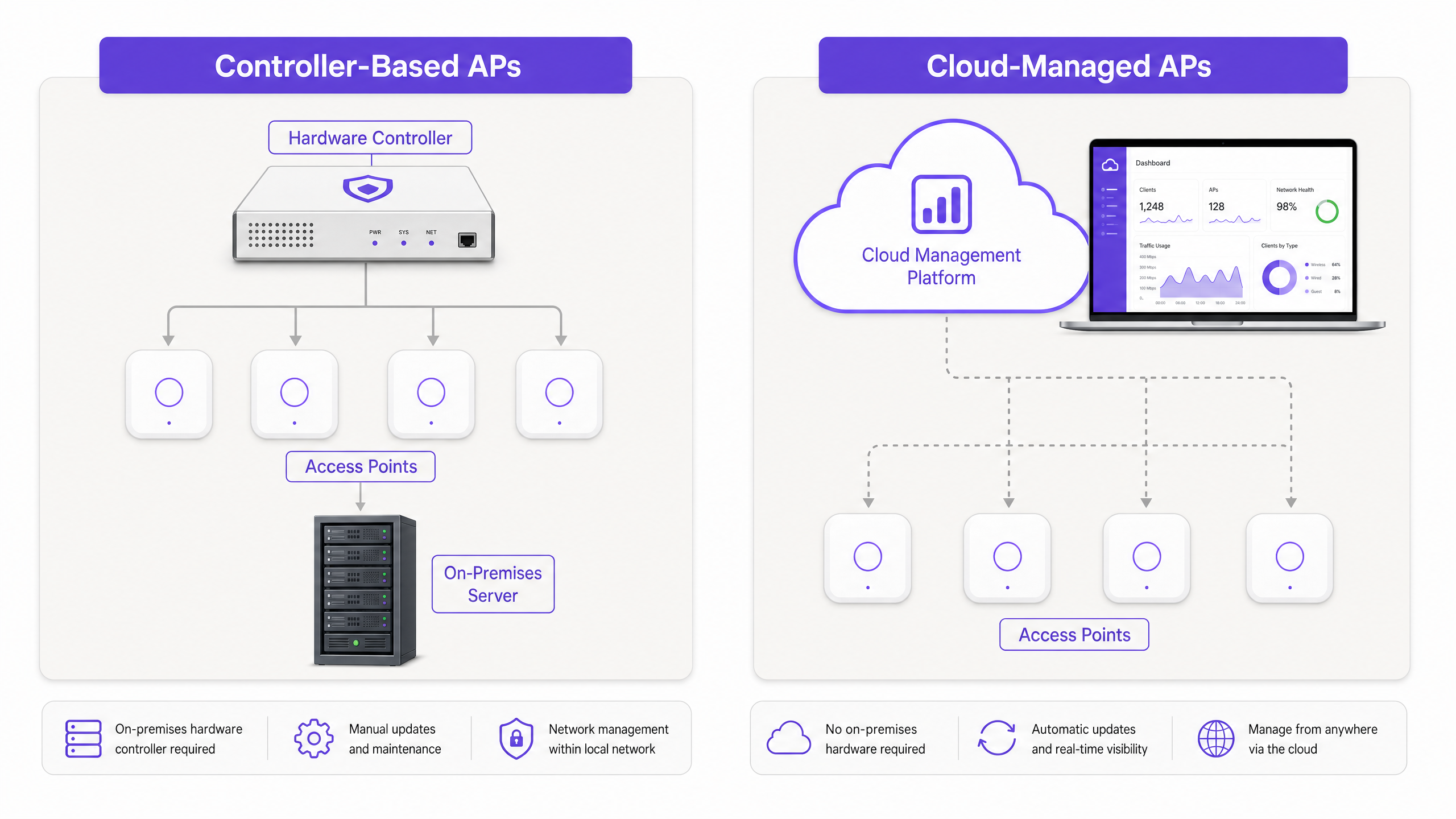
In a traditional controller-based model, "lightweight" APs terminate their management and often their data traffic at a centralised hardware or virtual appliance—the Wireless LAN Controller (WLC). The APs handle the physical Layer 1 and Layer 2 radio frequency (RF) functions, but the intelligence is centralised.
- Protocol Reliance: The APs communicate with the WLC using the Control and Provisioning of Wireless Access Points (CAPWAP) protocol (RFC 5415).
- Centralised Processing: Roaming decisions, authentication handshakes (such as 802.1X/EAP), and dynamic RF channel assignments are processed by the controller.
- Data Plane Tunneling: In many deployments, client data traffic is tunnelled back to the WLC before breaking out onto the wired network. This allows for centralised policy enforcement and simplified VLAN management across a large campus, but it creates a potential bottleneck.
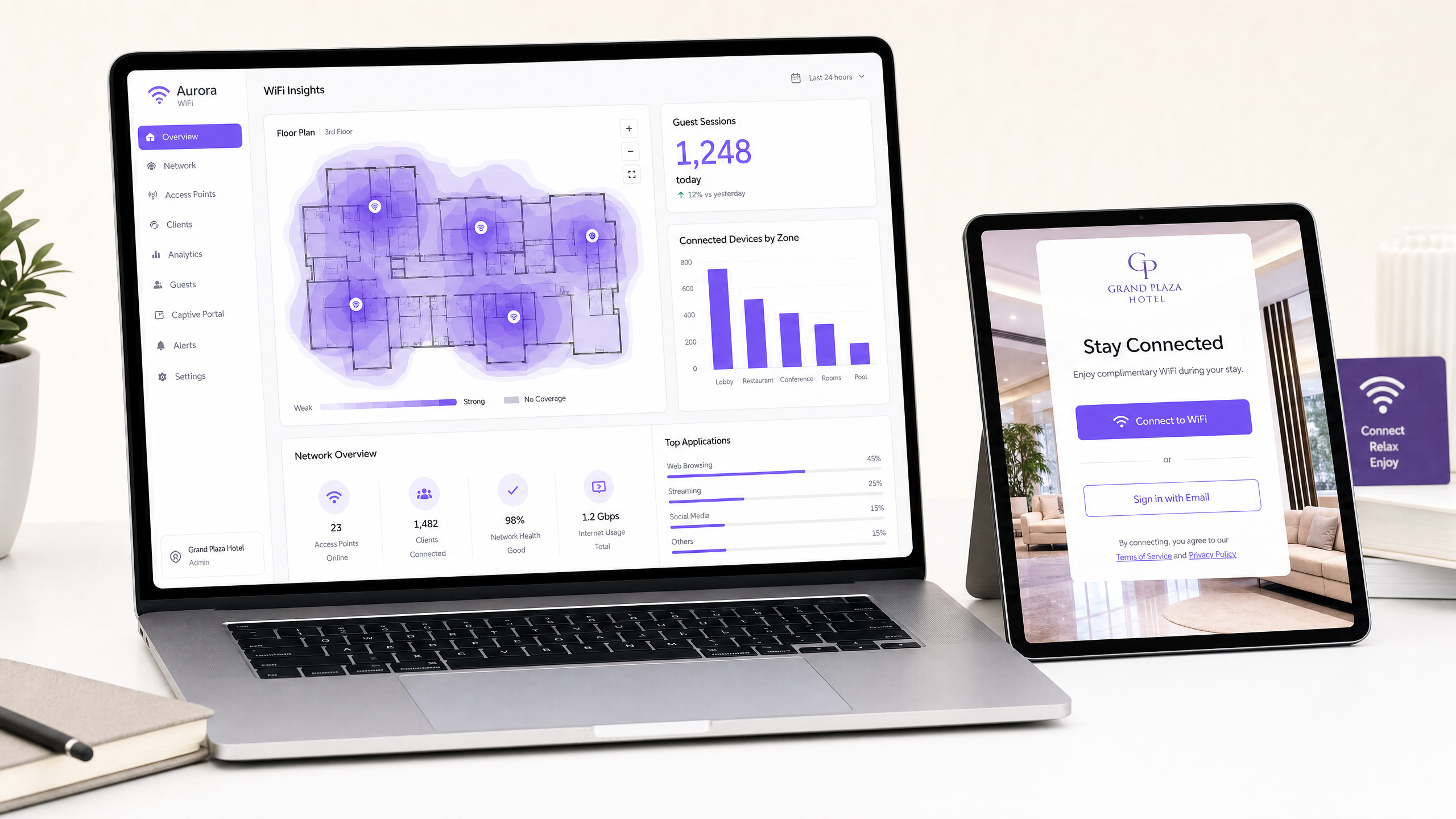
Advantages for High-Density Environments: Controller-based systems excel in ultra-high-density environments (e.g., stadiums, large auditoriums). Because the WLC has a real-time, holistic view of the RF environment across hundreds of APs, it can coordinate co-channel interference mitigation and manage 802.11r Fast BSS Transition (FT) roaming with millisecond precision.
Cloud-Managed Architecture
Cloud-managed architectures decentralise the control plane. The APs themselves are "fat" or autonomous in terms of local RF management and data forwarding, but they are centrally orchestrated via a cloud-hosted management platform.
- Out-of-Band Management: The AP establishes a secure management tunnel (typically HTTPS/TLS) to the vendor's cloud. Configuration, telemetry, and firmware updates flow through this connection.
- Local Breakout: Client data traffic is not tunnelled to the cloud. It breaks out locally at the switch port the AP is connected to.
- Local Survivability: If the internet connection to the cloud drops, the AP continues to serve existing clients, authenticate new clients (if local RADIUS or PSK is used), and route traffic. However, the IT team loses real-time visibility and the ability to push configuration changes until the connection is restored.
Security and Compliance Implications
Both architectures support enterprise-grade security standards, including WPA3-Enterprise, 802.1X authentication, and rogue AP detection. However, the compliance burden differs.
With cloud-managed systems, IT teams must ensure the vendor's cloud platform meets relevant regulatory requirements (e.g., SOC 2 Type II, ISO 27001) and that data residency aligns with GDPR or local privacy laws. For highly sensitive environments requiring strict air-gapping—such as certain government or defence facilities—a controller-based system operating entirely within the local LAN remains the standard.
For environments handling payment data, both architectures can achieve PCI DSS compliance. However, network segmentation is critical. The guest network, corporate devices, and POS terminals must be isolated onto separate VLANs, regardless of the AP architecture.
Implementation Guide: Deployment and Integration
The operational impact of your chosen architecture becomes most apparent during deployment and ongoing management, particularly in multi-site scenarios.
Zero-Touch Provisioning vs. Staged Deployment
Cloud-Managed: The primary operational advantage of cloud-managed APs is Zero-Touch Provisioning (ZTP). An AP can be shipped directly to a remote retail store or hotel. When plugged in, it acquires an IP address via DHCP, reaches out to the cloud, downloads its pre-configured profile, and begins broadcasting. This eliminates the need for expensive "truck rolls" or deploying highly skilled network engineers to remote sites.
Controller-Based: Deploying controller-based APs typically requires more staging. The AP must be able to discover the WLC (often via DHCP Option 43 or DNS resolution). Firmware must often be manually aligned between the WLC and the APs. For a multi-site rollout, this often requires staging the hardware centrally before shipping, or deploying engineers to each site.
Integrating Guest Intelligence and Analytics
Deploying the physical APs is only the foundation. To extract business value from the network, venues must integrate their hardware with guest intelligence platforms like Purple.
Purple operates as a hardware-agnostic overlay, integrating seamlessly with both controller-based and cloud-managed systems from major vendors (Cisco, Meraki, Aruba, Ruckus, Extreme).
- Authentication and Onboarding: Purple handles the captive portal presentation and authentication (via social login, form fill, or How a wi fi assistant Enables Passwordless Access in 2026 ). The AP architecture simply needs to support RADIUS authentication and accounting, redirecting unauthenticated users to the Purple portal.
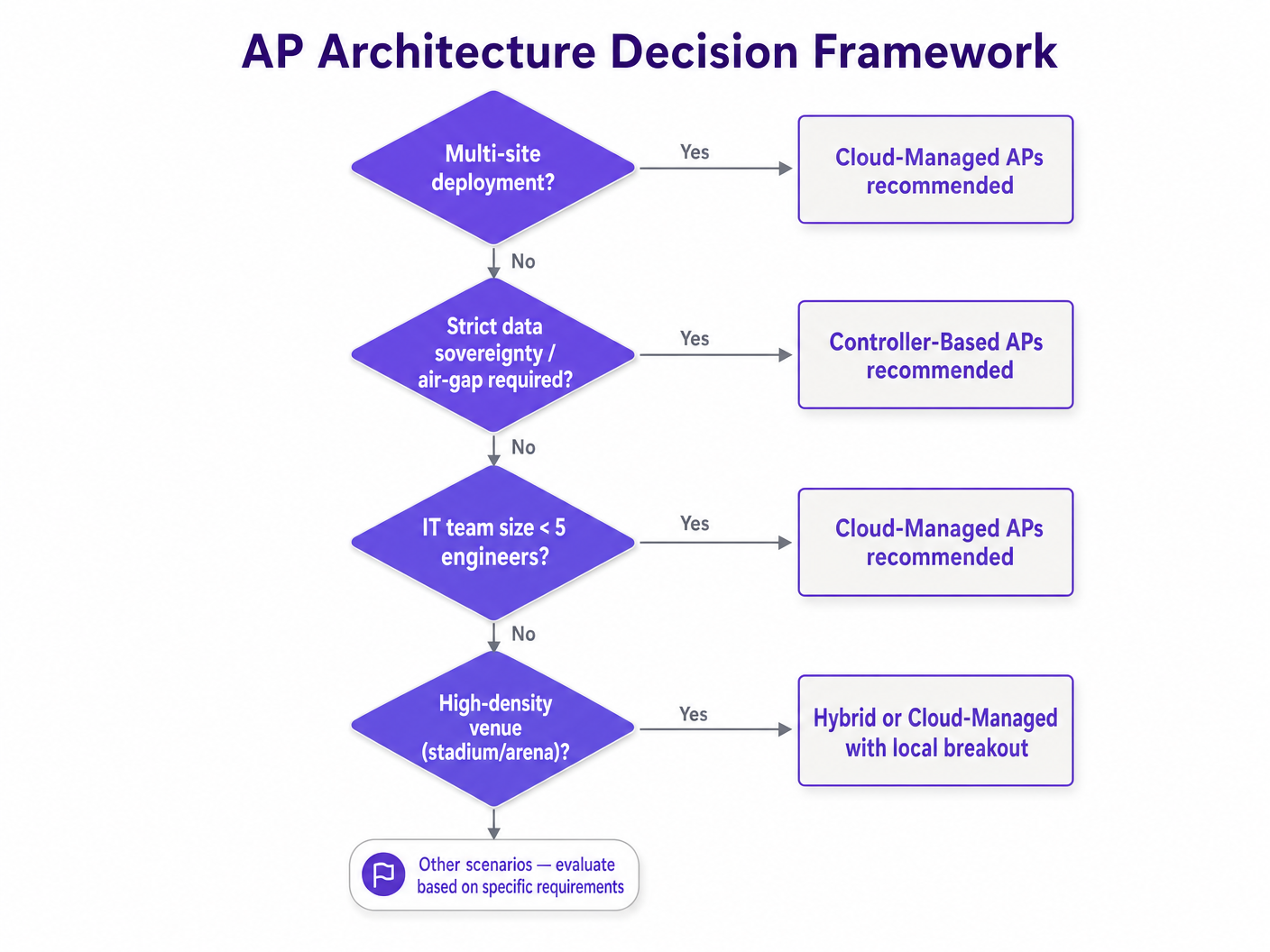
- Analytics Data: Purple ingests presence and location data from the APs to power its analytics dashboard. Whether the data is pushed via API from a cloud dashboard or sent directly from a local WLC, the resulting insights—dwell times, return rates, and footfall—are identical. For a deeper dive into how this data is generated, see our guide on Heatmapping vs Presence Analytics: Technical Differences .
Best Practices and Risk Mitigation
Regardless of the architecture selected, certain foundational best practices mitigate deployment risks and ensure long-term stability.
- Prioritise Management Traffic: For cloud-managed deployments, the APs' connection to the cloud is critical. Ensure that management traffic is QoS-prioritised on the WAN circuit. If the venue shares an internet connection for both guest traffic and management, a saturated link during peak hours can cause the APs to appear offline to the cloud dashboard.
- Staged Firmware Upgrades: Cloud platforms often push firmware updates automatically. While this ensures security patches are applied promptly, it introduces the risk of unexpected bugs. Configure your cloud dashboard to stage updates—testing new firmware on a small subset of APs (e.g., the IT office) before rolling it out to the entire estate.
- Design for Density, Not Just Coverage: Modern deployments rarely fail due to lack of signal; they fail due to capacity exhaustion or co-channel interference. Conduct proper predictive and active RF surveys, ensuring appropriate channel overlap and transmit power settings, particularly in high-density zones like lobbies or conference rooms. For insights into improving the overall experience, review How To Improve Guest Satisfaction: The Ultimate Playbook .
- Standardise VLAN Architecture: Implement a consistent VLAN schema across all sites. Isolate management interfaces, corporate devices, IoT sensors, and guest traffic.
ROI & Business Impact
The decision between controller-based and cloud-managed APs should be driven by a Total Cost of Ownership (TCO) analysis over a 5-to-7-year lifecycle.
- Capital Expenditure (CapEx): Controller-based systems often have higher initial CapEx due to the cost of the WLC appliances and associated redundancy requirements. Cloud-managed APs typically have lower hardware costs but require ongoing subscription licensing.
- Operational Expenditure (OpEx): Cloud-managed systems consistently demonstrate lower OpEx in multi-site deployments. The savings generated by Zero-Touch Provisioning, centralised troubleshooting, and automated firmware management often offset the recurring licensing costs.
- Business Agility: The ability to deploy new sites rapidly, push network-wide policy changes instantly, and integrate seamlessly with analytics platforms provides a tangible business advantage, particularly in fast-moving sectors like retail and hospitality.
By selecting the architecture that aligns with their operational capabilities and site topology, and layering a hardware-agnostic intelligence platform like Purple on top, enterprise IT teams can transform their WiFi network from a necessary cost centre into a strategic, revenue-enabling asset.
Key Definitions
WLC (Wireless LAN Controller)
A centralised hardware or virtual appliance that manages configuration, RF coordination, and security policies for multiple 'lightweight' access points.
The core component of a controller-based architecture, representing both a powerful management tool and a potential single point of failure.
CAPWAP
Control and Provisioning of Wireless Access Points. A standard protocol (RFC 5415) used by WLCs to manage a collection of APs.
The tunnel through which controller-based APs receive instructions and often route client data traffic.
Zero-Touch Provisioning (ZTP)
The ability to deploy network hardware at a remote site without manual configuration; the device automatically connects to a cloud platform to download its profile.
The primary driver for operational expenditure (OpEx) savings in multi-site cloud-managed deployments.
Local Survivability
The ability of a cloud-managed AP to continue routing local traffic and authenticating users even if the WAN connection to the cloud dashboard is lost.
A critical evaluation metric for cloud platforms, ensuring that a WAN outage does not result in a complete LAN failure.
Out-of-Band Management
An architecture where management traffic (telemetry, configuration) is separated from user data traffic.
The foundational security principle of cloud-managed APs, ensuring user data remains on the local network.
802.11r (Fast BSS Transition)
An IEEE standard that permits continuous connectivity aboard wireless devices in motion, with fast and secure handoffs from one AP to another.
Crucial for seamless roaming in high-density environments; historically handled better by centralised controllers.
Data Sovereignty
The concept that digital data is subject to the laws of the country in which it is located.
A key consideration when evaluating cloud-managed platforms to ensure compliance with regulations like GDPR.
Air-Gapped Network
A network security measure employed to ensure that a secure computer network is physically isolated from unsecured networks, such as the public Internet.
Environments requiring true air-gapping mandate the use of on-premises controller-based architectures.
Worked Examples
A national retail chain is deploying guest WiFi across 300 mid-sized stores. They have a lean central IT team of four engineers and no on-site technical staff. They require analytics to track dwell time and footfall.
Deploy cloud-managed APs across all locations. Utilise Zero-Touch Provisioning (ZTP) to ship APs directly to store managers, who simply plug them into the PoE switch. Configure the cloud dashboard to push a standardised SSIDs and VLAN configuration. Integrate the cloud controller with Purple via API/RADIUS for captive portal and analytics.
A newly constructed 60,000-seat sports stadium requires pervasive WiFi for fan engagement, ticketing, and POS systems. The environment will experience massive, simultaneous client onboarding and requires seamless roaming as crowds move through concourses.
Deploy a controller-based architecture with redundant high-availability WLC appliances in the on-site data centre. Utilise high-density directional antennas. Configure the WLC for aggressive load balancing, band steering, and 802.11r Fast BSS Transition.
Practice Questions
Q1. A boutique hotel chain is upgrading its WiFi across 15 properties. The IT Director wants to move to cloud-managed APs but the Compliance Officer is concerned about PCI DSS compliance for the point-of-sale (POS) terminals in the restaurants. What is the correct architectural approach?
Hint: Consider how data plane traffic is handled in cloud-managed deployments and the requirements of network segmentation.
View model answer
Cloud-managed APs are fully suitable, provided proper network segmentation is implemented. The IT team must configure separate VLANs for guest WiFi and the POS network. Because cloud-managed APs utilise out-of-band management, the POS data traffic will break out locally and will not traverse the vendor's cloud, satisfying PCI DSS requirements for the data plane. The vendor's cloud platform must hold appropriate security attestations (e.g., SOC 2) for the management plane.
Q2. During a peak trading event, the primary WAN link at a retail store fails. The store falls back to a low-bandwidth 4G connection. The cloud-managed APs remain online, but the IT team reports they cannot push configuration changes to the store via the dashboard. Why is this happening, and how should the network have been designed to prevent it?
Hint: Consider the relationship between management traffic, data traffic, and QoS on constrained links.
View model answer
The APs are operating in 'local survivability' mode. The low-bandwidth 4G connection is likely saturated by essential POS or guest traffic, causing the management tunnels (HTTPS/TLS) to the cloud controller to drop or time out. To prevent this, the network architect should have implemented Quality of Service (QoS) rules on the edge router/firewall to guarantee a minimum bandwidth allocation and prioritise the AP management traffic over the failover link.
Q3. A university campus with an existing controller-based architecture wants to deploy Purple for guest analytics. The network team states they cannot integrate because they do not use cloud-managed APs. Is this correct?
Hint: Consider Purple's integration methodology and hardware dependencies.
View model answer
No, this is incorrect. Purple is hardware-agnostic and does not require a cloud-managed architecture. The university's existing Wireless LAN Controllers (WLCs) can be configured to integrate with Purple using standard RADIUS authentication and accounting protocols, redirecting guest traffic to the Purple captive portal. The analytics data will be generated identically to a cloud-managed deployment.