
Customer data platform software: a comprehensive guide for businesses
Customer data platform software centralises fragmented visitor and shopper data from network infrastructure, point-of-sale systems, and CRM platforms into a single unified profile, enabling real-time personalisation and automated marketing at scale. For venue operators and IT leaders, deploying a CDP turns anonymous WiFi logins into verified, actionable first-party data assets. This guide covers the technical architecture, implementation phases, GDPR compliance requirements, and measurable business outcomes for hospitality, retail, events, and public-sector environments.
Listen to this guide
View podcast transcript
Executive summary
Customer data platform software solves a structural fragmentation problem that affects every multi-site venue operator. As your organisation scales across physical and digital touchpoints, customer data scatters across point-of-sale terminals, loyalty applications, property management systems, and network infrastructure. A customer data platform (CDP) ingests this fragmented data, applies identity resolution to build a persistent unified profile per individual, and activates that profile across engagement channels in real time.
For IT leaders and marketing directors, deploying a CDP shifts the architecture from siloed databases to a centralised intelligence layer. When you integrate network access logs with transaction histories, you create a single source of truth. Purple captures first-party data through Guest WiFi authentication, feeding verified email and phone records directly into your data ecosystem. Purple processed 440 million logins in 2024 (Purple internal data), demonstrating the scale of first-party data available through network authentication alone. This guide details the technical architecture, implementation requirements, and business outcomes of deploying customer data platform software in complex enterprise environments.
Technical deep-dive
Customer data platform software operates on a continuous cycle of ingestion, resolution, and activation. Unlike a static data warehouse, a CDP requires real-time processing capabilities to handle streaming events from edge devices, network controllers, and web applications.
Architectural components
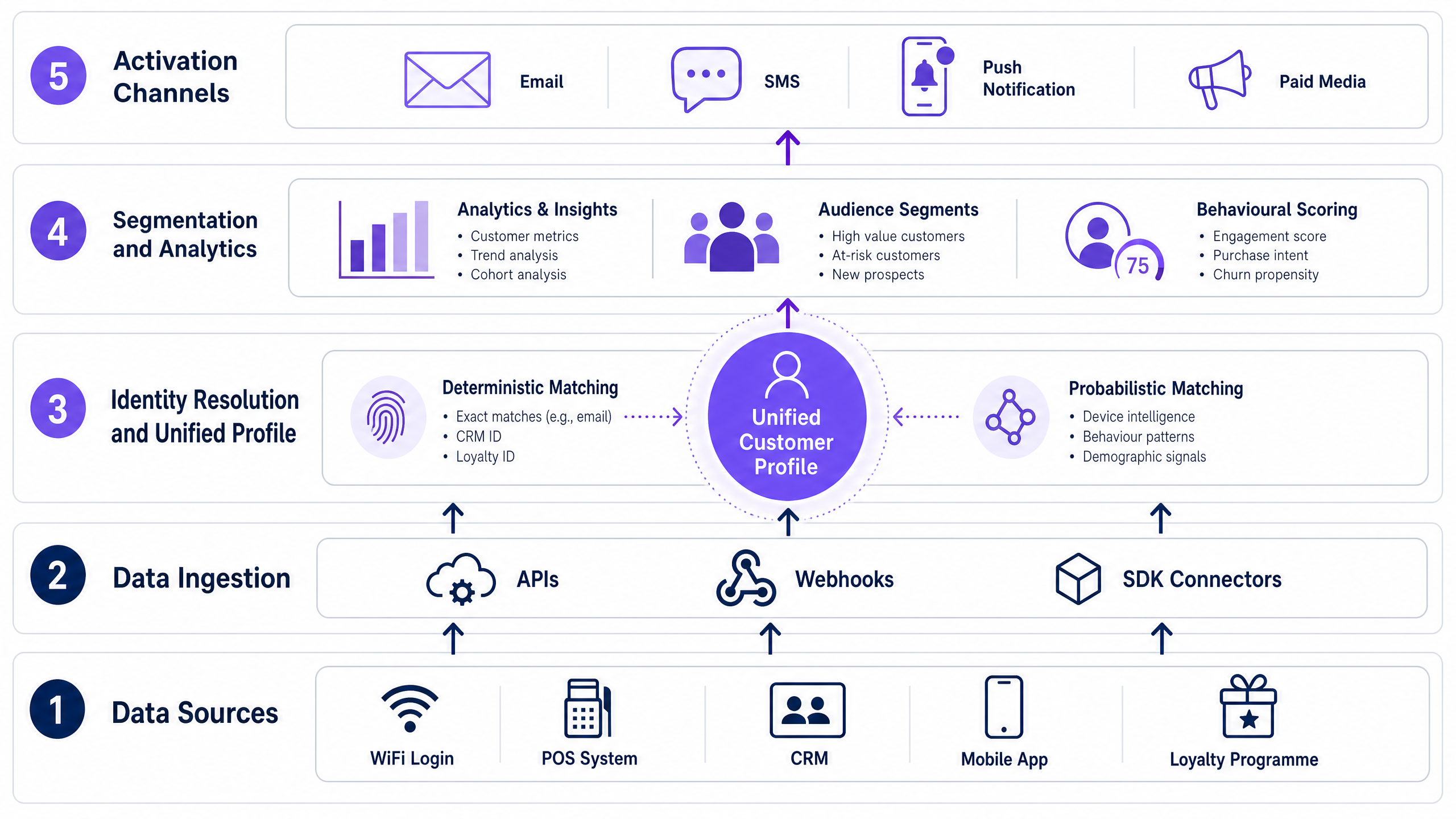
A standard enterprise deployment consists of four primary layers. The data ingestion layer handles the collection of structured and unstructured data. It requires robust API gateways and webhook receivers to process events from hardware vendors including Cisco Meraki, HPE Aruba, Ruckus, Juniper Mist, Ubiquiti UniFi, Cambium, Extreme, and Fortinet. This layer must handle high-velocity streaming data, particularly when processing location analytics and authentication events from 802.1X (the IEEE standard for port-based network access control) and captive portal logins.
The identity resolution engine sits at the core of the architecture. Raw data arrives with disparate identifiers. A shopper might authenticate on the Guest WiFi using an email address, make a purchase using a loyalty card, and browse the mobile app using a device ID. The resolution engine uses deterministic matching (exact identifiers such as email or phone number) and probabilistic matching (behavioural patterns, shared device IDs) to stitch these records into a single persistent profile. Accuracy here is non-negotiable - a misconfigured resolution engine causes profile collapse, where two distinct individuals merge into one record.
The segmentation and processing layer applies business logic and machine learning models to the unified profiles. This layer recalculates segment membership dynamically as new events arrive. For a retailer with 40 stores, this means a shopper who purchases in-store at 14:00 is removed from the digital retargeting campaign for that product by 14:05.
The activation layer pushes audience segments to downstream systems via API integrations with marketing automation tools, advertising networks, and operational platforms. The critical requirement here is low latency. Batch processing is insufficient for time-sensitive venue scenarios.
The role of first-party data
The depreciation of third-party cookies forces organisations to rely on first-party data. Guest WiFi serves as a critical acquisition channel. When a visitor authenticates at a venue, Purple captures their verified contact details and consent preferences through conscious-choice opt-ins. This data flows into the CDP, providing a deterministic identifier that anchors the unified profile. Purple has collected 29 billion data points across 80,000+ live venues (Purple internal data), providing the data density needed for accurate identity resolution.
For a deeper look at how WiFi Analytics integrates with downstream data systems, Purple's analytics platform provides the structured event stream that feeds the CDP ingestion layer.
Security and compliance standards
Enterprise IT teams must ensure the CDP complies with stringent security frameworks. The architecture must support role-based access control (RBAC), data encryption at rest and in transit using TLS 1.3, and automated data retention policies aligned with your GDPR obligations.
When handling personal data, compliance with GDPR and CCPA is non-negotiable. The platform must provide mechanisms to process data subject access requests (DSARs) and deletion requests across all connected systems. Purple maintains ISO 27001 certification, GDPR compliance, CCPA compliance, and Cyber Essentials certification. All data collection uses conscious-choice opt-ins, ensuring the consent records that flow into the CDP are legally sound.
Implementation guide
Deploying customer data platform software requires careful planning and cross-functional alignment between IT, marketing, and operations. Rushing this process is the single most common cause of failed deployments.
Phase 1: Data auditing and taxonomy definition
Before configuring any software, audit your existing data sources. Identify every system that captures visitor information, including CRM platforms, point-of-sale terminals, property management systems, loyalty applications, and network infrastructure. For each source, document the data schema, update frequency, and the identifiers it uses.
Define a standardised data taxonomy. Agree on naming conventions for events, attributes, and identifiers across all teams. If your POS system logs a purchase as transaction_complete and your e-commerce platform logs it as order_placed, the CDP will treat these as separate behaviours. Standardise these schemas before ingestion begins. This governance step takes time but prevents months of data quality issues downstream.
Phase 2: Integration and ingestion
Begin with your highest-fidelity data sources. Connect your CRM and identity providers - Microsoft Entra ID, Okta, or Google Workspace - first. These systems provide the deterministic identifiers needed for accurate identity resolution.
Next, integrate your network infrastructure. Configure your wireless controllers to forward authentication events and location data to the platform. Purple simplifies this process by acting as a hardware-agnostic cloud overlay, capturing data from diverse hardware environments and forwarding clean, structured payloads to the CDP regardless of whether the underlying infrastructure is Cisco Meraki, HPE Aruba, or Ruckus. See Three SSIDs to rule them all: guest, Passpoint, and IoT WiFi for guidance on structuring your network to separate Guest WiFi data streams cleanly.
Phase 3: Identity resolution configuration
Configure the matching rules within the resolution engine. Start with strict deterministic rules to avoid merging distinct profiles incorrectly. Configure the system to merge profiles only when an exact email match occurs. As confidence in data quality improves, introduce probabilistic matching based on shared device IDs or IP addresses.
Implement exclusion lists for common generic email addresses (e.g., info@, admin@, noreply@). These addresses appear frequently in corporate environments and will cause incorrect profile merges if not excluded.
Phase 4: Activation and testing
Before activating data across all channels, run controlled tests. Create a test segment and push it to a single downstream system - an email marketing platform, for example. Verify that the segment membership matches expectations and that the data payload contains the correct attributes. Check that GDPR consent flags propagate correctly to the receiving system.
Best practices
Successful deployments share several common characteristics. These vendor-neutral recommendations apply across hospitality, retail , healthcare , and transport environments.
Prioritise first-party data acquisition. A CDP is only as valuable as the data it ingests. Venues must implement robust acquisition strategies. Deploying a captive portal on your Guest WiFi provides a reliable method to capture verified contact details and consent. Purple Engage automates this process, turning anonymous venue visitors into known profiles and automating the follow-up marketing campaigns. For guidance on making that first digital touchpoint count, see How to make a great first impression with your guest WiFi .
Implement strict data governance. Establish clear ownership of the data taxonomy. Changes to event names or attribute definitions must pass through a formal approval process. Without strict governance, the platform accumulates redundant or conflicting data, degrading the accuracy of unified profiles.
Design for real-time activation. Batch processing is insufficient for modern engagement strategies. If a shopper connects to the Guest WiFi in a retail store, the platform must process that event and trigger an in-store offer within seconds. Ensure your integration architecture supports low-latency event streaming via webhooks rather than scheduled polling.
Maintain hardware agnosticism. Enterprise environments frequently feature mixed hardware deployments. A university campus might use Cisco Meraki in lecture halls and HPE Aruba in student accommodation. Your data architecture must abstract this complexity. Purple provides a cloud overlay that normalises data across all major hardware vendors, ensuring consistent data formats reach the CDP regardless of the underlying infrastructure.
Centralise consent management. Every consent record captured at the network edge must flow into the CDP and propagate to all downstream activation systems. This is the only way to guarantee that a deletion request under GDPR removes the individual from every system in your stack.
Troubleshooting and risk mitigation
Even well-planned deployments encounter challenges. Anticipate these common failure modes and implement appropriate mitigation strategies before they affect production data.
Profile collapse
Profile collapse occurs when the identity resolution engine incorrectly merges distinct individuals into a single profile. This typically happens when venues use shared devices or when visitors use generic email addresses.
Mitigation: Implement exclusion lists for common generic emails. Configure the resolution engine to require multiple matching attributes before merging profiles that share only a device ID. Set a minimum confidence threshold for probabilistic matches and review merged profiles in a staging environment before promoting rules to production.
Latency in activation
If downstream systems receive audience updates hours after the triggering event, time-sensitive campaigns fail. This often results from relying on batch API endpoints rather than streaming webhooks.
Mitigation: Audit the API capabilities of your activation channels. Where possible, configure event-driven webhooks rather than scheduled polling. Allocate sufficient compute resources to the segmentation engine to prevent processing queues from building up during peak periods, such as a stadium event with 50,000 concurrent connections.
Integration fragility
Point-to-point API integrations frequently break when vendors update their endpoints or alter data schemas. A single broken integration can corrupt the unified profiles for an entire customer segment.
Mitigation: Use an enterprise service bus or middleware layer to manage API connections. This abstracts the complexity and provides a central point for monitoring integration health, handling retries, and alerting on failures. Document the schema version for every integration and implement automated schema validation on inbound data.
Consent propagation failures
If a visitor withdraws consent in the CDP but that deletion does not propagate to a connected email platform, you face a GDPR violation.
Mitigation: Implement end-to-end consent propagation testing as part of your deployment acceptance criteria. Log every deletion request and its propagation status across all connected systems. Set up automated alerts for propagation failures.
ROI and business impact
Customer data platform software requires significant investment. Enterprise deployments typically exceed £100,000 annually when licensing, integration, and ongoing engineering costs are included (CDP Institute, 2024). You must measure the business impact to justify this expenditure.
Case study 1: Hospitality - Premier Inn
A 200-room hotel property integrated its Guest WiFi authentication data with its CDP and loyalty programme. Guests who connected to the WiFi at check-in were matched against loyalty records within seconds. By the time a guest visited the on-site restaurant, the marketing platform had already served a personalised dining offer based on their previous stay history. The integration produced a measurable uplift in food and beverage spend per stay and reduced the time to build a personalised email campaign from three days to four hours. Premier Inn, part of the Whitbread group, uses Purple across its estate to capture guest data at the network edge.
Case study 2: Retail - in-store suppression
A fashion retailer operating 40 stores integrated its point-of-sale system with a CDP to eliminate wasted digital ad spend. Shoppers who completed an in-store purchase were still being retargeted online for the same product, damaging brand perception and wasting budget. By feeding POS transaction events into the CDP and activating suppression lists in real time, the retailer removed purchasers from retargeting campaigns within five minutes of the in-store transaction. This reduced wasted retargeting spend by an estimated 18% in the first quarter post-deployment. For retail operators, this single use case frequently justifies the entire CDP investment.
Measuring success
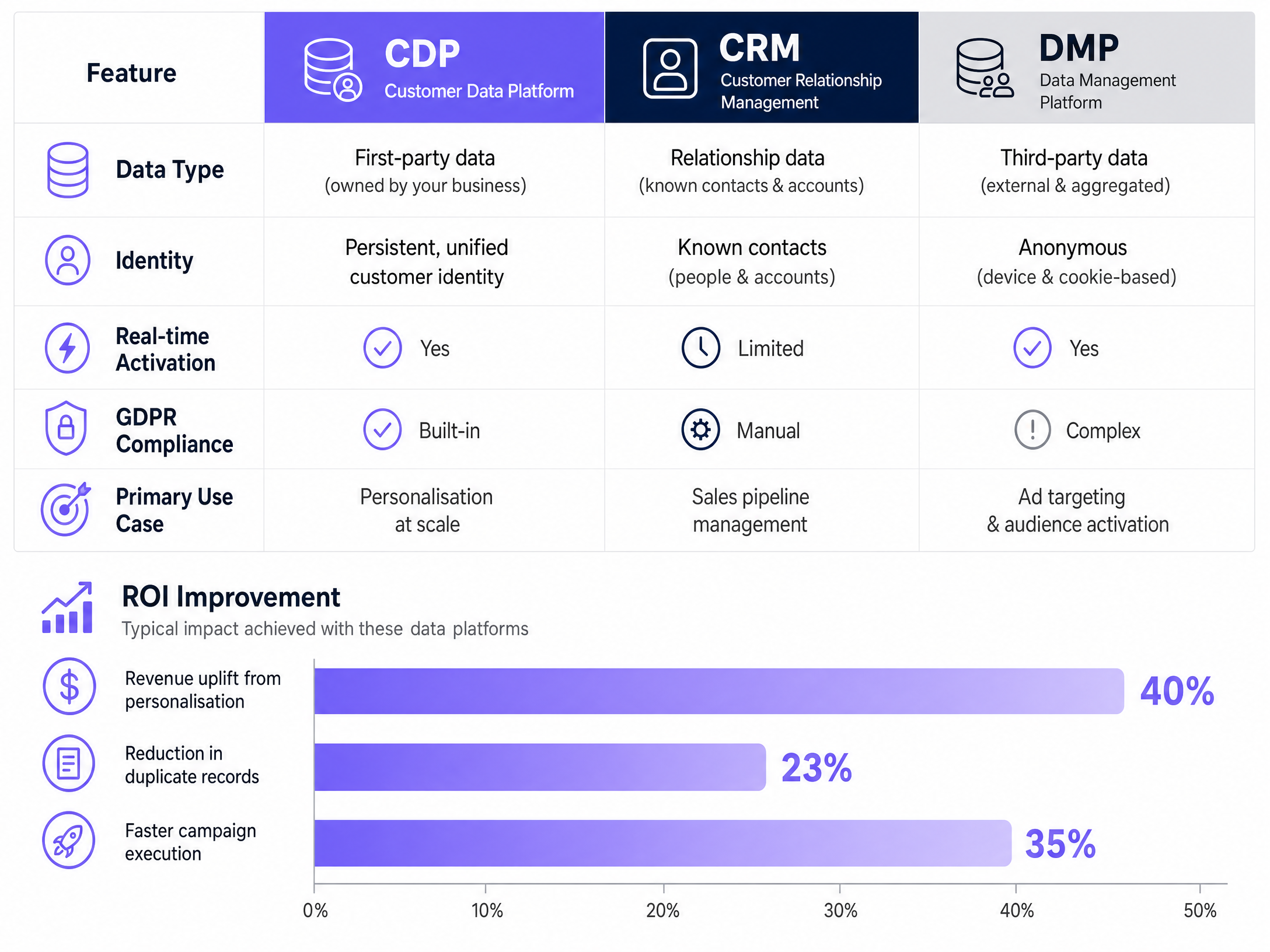
Define your key performance indicators before deployment, not after. The table below provides a framework for measuring CDP impact across the primary venue verticals.
| Vertical | Primary KPI | Secondary KPI | Measurement method |
|---|---|---|---|
| Hospitality | Revenue per guest stay | Repeat visit rate | PMS integration |
| Retail | Return on ad spend (ROAS) | In-store conversion rate | POS + ad platform data |
| Events/stadiums | Spend per attendee | Dwell time by zone | Ticketing + location data |
| Transport | Retail conversion rate | Passenger satisfaction score | POS + NPS survey |
| Higher education | Student engagement score | Retention rate | Student information system |
For transport operators, Manchester Airports Group (MAG) uses network data to understand passenger flow and optimise retail placement, driving non-aeronautical revenue. Integrating this location intelligence with a CDP enables MAG to correlate dwell time data with retail conversion, providing evidence for commercial tenant negotiations.
Purple has operated since 2012 and serves 80,000+ live venues across 350 million unique users. All Purple proof points cited in this guide are from Purple internal data unless otherwise attributed.
Key Definitions
Customer data platform (CDP)
Packaged software that ingests customer data from multiple sources, applies identity resolution to build persistent unified profiles, and makes those profiles available in real time for personalisation, analytics, and automated activation across channels. Coined by David Raab in 2013 and defined by the CDP Institute as software that builds a persistent, unified customer database accessible to other systems.
IT teams encounter this when the marketing director asks why the email platform, CRM, and loyalty system all hold different records for the same customer. The CDP is the architectural answer to that question.
Identity resolution
The process of stitching together customer records from different systems using deterministic matching (exact identifiers such as email address or phone number) and probabilistic matching (behavioural patterns, shared device IDs, fuzzy logic) to produce a single persistent profile per individual.
This is the core technical capability that differentiates a CDP from a data warehouse. Without accurate identity resolution, every downstream segmentation and activation capability degrades.
First-party data
Data collected directly from your own customers or visitors through your own channels - WiFi login portals, loyalty programmes, point-of-sale systems, and owned websites. First-party data is owned by your organisation and collected with explicit consent, making it the most legally sound and commercially valuable data type in a post-cookie environment.
Marketing directors encounter this term when discussing the depreciation of third-party cookies. For venue operators, Guest WiFi authentication is the primary first-party data acquisition channel.
Deterministic matching
Identity resolution using exact, known identifiers such as email address, phone number, or loyalty ID. Two records with the same email address are definitively the same person. Deterministic matching produces high-confidence merges but requires a shared identifier to exist across both records.
IT teams configure this as the first matching rule in the CDP's resolution engine. It is the safest starting point because it produces no false positives when the identifier is genuinely unique.
Probabilistic matching
Identity resolution using statistical inference across multiple signals - shared device IDs, IP addresses, behavioural patterns, and demographic attributes - to estimate the likelihood that two records belong to the same individual. Produces more matches than deterministic methods but introduces a false positive rate.
IT teams introduce probabilistic matching after validating deterministic merge accuracy. The risk is profile collapse - merging two distinct individuals because they share a device or IP address.
Captive portal
A web page displayed to network users before they are granted access to the internet. In a venue context, the captive portal is the login screen that visitors see when they connect to the Guest WiFi. It captures consent and contact details, generating the first-party data that anchors the unified profile in the CDP.
Network architects configure captive portals on the wireless controller. For CDP deployments, the captive portal is the primary data acquisition touchpoint and must be configured to forward authentication events to the CDP ingestion layer.
Profile collapse
A data quality failure in which the identity resolution engine incorrectly merges two or more distinct individuals into a single unified profile. Common causes include shared devices, generic email addresses, and overly aggressive probabilistic matching thresholds.
IT teams discover profile collapse when marketing campaigns are sent to the wrong person or when a customer complains about receiving communications addressed to someone else. Prevention requires strict matching rules, exclusion lists for generic identifiers, and regular data quality audits.
Real-time activation
The ability of a CDP to push audience segment updates and individual profile data to downstream systems - email platforms, SMS gateways, advertising networks, personalisation engines - within seconds of a triggering event, rather than on a scheduled batch basis.
Venue operators require real-time activation for time-sensitive use cases such as in-venue offers, post-purchase suppression, and location-triggered campaigns. Batch activation, which typically runs on hourly or daily schedules, is insufficient for these scenarios.
802.1X
An IEEE standard for port-based network access control that provides an authentication framework for devices connecting to a network. In enterprise WiFi deployments, 802.1X is used for staff and corporate device authentication, typically in conjunction with a RADIUS server and identity providers such as Microsoft Entra ID or Okta.
Network architects encounter 802.1X when designing Staff WiFi authentication. For Guest WiFi, captive portals are more common because 802.1X requires client-side configuration that is impractical for public visitors.
GDPR (General Data Protection Regulation)
EU regulation (2016/679) that governs the collection, processing, and storage of personal data for individuals in the European Economic Area. For CDP deployments, GDPR requires lawful basis for processing, explicit consent for marketing communications, the ability to fulfil data subject access requests (DSARs), and the right to erasure (deletion) across all connected systems.
IT and legal teams encounter GDPR requirements throughout the CDP deployment. The most technically complex requirement is ensuring that deletion requests propagate automatically to every downstream system connected to the CDP.
Worked Examples
A 200-room hotel group wants to personalise the guest experience across its estate. Guests currently connect to the WiFi at check-in, but the authentication data sits in a separate system from the loyalty programme and the property management system. How should the IT team architect the CDP integration to unify these data sources and enable real-time personalised offers?
Start with a data audit across the three systems: the WiFi authentication platform (Purple), the loyalty programme, and the property management system (PMS). Identify the common identifiers - in this case, email address is the primary deterministic key, with loyalty ID as a secondary key. Configure Purple to forward authentication events to the CDP ingestion layer via webhook within 30 seconds of login. Map the PMS guest record schema to the CDP's unified profile schema, standardising field names and data types. Configure the identity resolution engine to merge profiles on exact email match first. Once a guest authenticates on the WiFi, the CDP fires an event to the marketing automation platform, which queries the unified profile for dining preferences from previous stays and serves a personalised offer via SMS or in-app notification. Set up a suppression rule to prevent the same offer being served twice within a 24-hour window.
A stadium operator with 55,000 capacity wants to use its CDP to increase in-venue retail spend per attendee. The current average spend is £12 per head. The stadium has WiFi infrastructure from Juniper Mist and a ticketing system that captures email addresses at purchase. How should the operator configure the CDP to segment attendees and trigger contextual offers during the event?
Integrate the ticketing system as the primary data source, using the email address captured at ticket purchase as the deterministic identifier. Before the event, the CDP builds a pre-populated profile for every ticket holder, enriched with historical spend data from previous events. On event day, configure the Juniper Mist network to forward location zone events to the CDP ingestion layer. As attendees move through the venue, the CDP updates their location attribute in real time. Configure segmentation rules to identify attendees who have been in the concourse zone for more than three minutes without a recent transaction. Activate this segment via push notification or SMS with a time-limited food and beverage offer. Integrate the POS system to feed transaction events back into the CDP, closing the feedback loop and suppressing the offer once a purchase is made.
A retail chain with 40 stores is preparing for a CDP deployment. The IT director is concerned about GDPR compliance, specifically around ensuring that consent withdrawals propagate correctly across all connected systems. What architecture and testing procedures should the team implement?
Implement a centralised consent management layer within the CDP that acts as the single source of truth for all consent records. Every consent capture point - the WiFi login portal, the e-commerce checkout, the loyalty sign-up form - must write consent records to this central layer, not to individual system databases. Configure event-driven webhooks to propagate consent changes to all downstream systems (email platform, SMS platform, advertising audiences, CRM) within 60 seconds of the change event. Implement a consent propagation log that records the timestamp, system, and status of every propagation event. For testing, create a dedicated test profile and execute a full deletion request. Verify that the deletion propagates to all connected systems within the defined SLA. Run this test monthly as part of your operational compliance checks. Document the propagation architecture in your Records of Processing Activities (ROPA) as required under GDPR Article 30.
Practice Questions
Q1. Your organisation operates a chain of 25 [hospitality](/industries/hospitality) venues. The marketing director wants to send a personalised re-engagement email to guests who visited more than 90 days ago but have not returned. The IT team has Guest WiFi authentication data in Purple, a loyalty database, and an email platform. The three systems currently share no common identifiers. How do you architect the CDP integration to enable this campaign?
Hint: Focus on establishing a common identifier before attempting to build the segment. Consider which system has the highest data quality for email addresses.
View model answer
First, establish email address as the primary deterministic key across all three systems. Export a sample of records from each system and compare email address quality and format consistency. Standardise to lowercase and trim whitespace before ingestion. Configure Purple to forward authentication events to the CDP with the email address as the primary identifier. Import the loyalty database as a batch source, mapping loyalty ID and email address. Connect the email platform as an activation destination. Configure the identity resolution engine to merge profiles on exact email match. Build the segment rule: last_visit_date < today minus 90 days AND email_opt_in = true. Activate this segment to the email platform as a suppressed audience for the re-engagement campaign. Set up a suppression rule to remove guests from the segment immediately when they make a new visit.
Q2. A stadium operator is deploying a CDP ahead of a major concert season. The IT director raises a concern: during peak ingestion - when 50,000 attendees connect to the WiFi within 30 minutes of gates opening - the CDP's segmentation engine may not keep pace with the event stream, causing activation delays. How do you architect the system to handle this load?
Hint: Consider separating the ingestion and segmentation workloads. Think about which segments need to be pre-calculated versus which need real-time recalculation.
View model answer
Separate the ingestion and segmentation workloads architecturally. Pre-calculate static segments (e.g., loyalty tier, historical spend band, previous event attendee) before the event day, using the ticketing data imported 48 hours in advance. On event day, the CDP only needs to process the real-time WiFi authentication event and match it to the pre-built profile - a lightweight operation. Reserve real-time segmentation for dynamic rules that require the live location event (e.g., attendee in concourse zone for more than three minutes). Allocate dedicated compute resources to the ingestion layer to handle the burst load. Configure the wireless controllers to stagger authentication events using a backoff mechanism to smooth the peak. Set up a queue-depth monitoring alert to detect processing backlogs before they cause activation delays.
Q3. A university IT team is deploying a CDP to unify student data across the WiFi network, the student information system, and the library management system. The data protection officer raises a concern that the CDP could be used to monitor individual student behaviour in ways that exceed the original consent scope. How do you design the architecture to prevent this?
Hint: Consider the principle of purpose limitation under GDPR Article 5(1)(b). Think about technical controls rather than just policy controls.
View model answer
Implement purpose limitation at the data architecture level, not just in policy documents. Configure the CDP to store WiFi location data as aggregated zone-level dwell time rather than individual movement logs. Set a data retention policy that automatically deletes raw authentication events after seven days, retaining only the aggregated attributes. Implement role-based access control so that only the marketing and student services teams can access unified profiles, and only for defined use cases (e.g., student wellbeing outreach, library resource recommendations). Configure audit logging for all profile access and segment queries. Require a documented use case justification for any new segment or activation rule before it is deployed to production. Present the architecture to the data protection officer for sign-off before go-live, and document it in the Records of Processing Activities as required under GDPR Article 30.
Q4. A retail operator has deployed a CDP and connected it to their email platform and digital advertising network. Three months in, the marketing team reports that customers are still receiving retargeting ads for products they purchased in-store. The IT team confirms that the POS integration is active and sending transaction events. What are the most likely causes of the failure and how do you diagnose them?
Hint: Work backwards from the activation channel. The problem could be in the event processing, the segmentation rule, the activation API, or the advertising platform's audience update latency.
View model answer
Diagnose in four steps. First, verify that the POS transaction events are arriving at the CDP ingestion layer with the correct schema and within the expected time window. Check the ingestion logs for errors or schema mismatches. Second, verify that the identity resolution engine is correctly matching the POS transaction to the unified profile. If the POS system uses a different identifier (e.g., loyalty card number rather than email), the transaction may be creating a new orphan profile rather than updating the existing one. Third, verify that the suppression segment rule is correctly configured and that the segment membership is updating in real time when a transaction event arrives. Fourth, check the advertising platform's audience update latency. Many programmatic advertising platforms process audience updates on a 24-hour cycle, meaning that even if the CDP suppresses the profile immediately, the advertising platform may continue serving ads until the next audience sync. If this is the cause, negotiate a real-time audience API with the advertising platform or accept the latency and set expectations with the marketing team accordingly.