
Klinik audiologi PPSK usm: comparing features and deployment models
This technical guide details how Private Pre-Shared Key (PPSK) WiFi architecture provides enterprise-grade segmentation for specialist healthcare clinics without the complexity of 802.1X. It covers deployment models, hardware configurations, and best practices for securing medical IoT devices and clinical staff networks.
Listen to this guide
View podcast transcript
Executive Summary
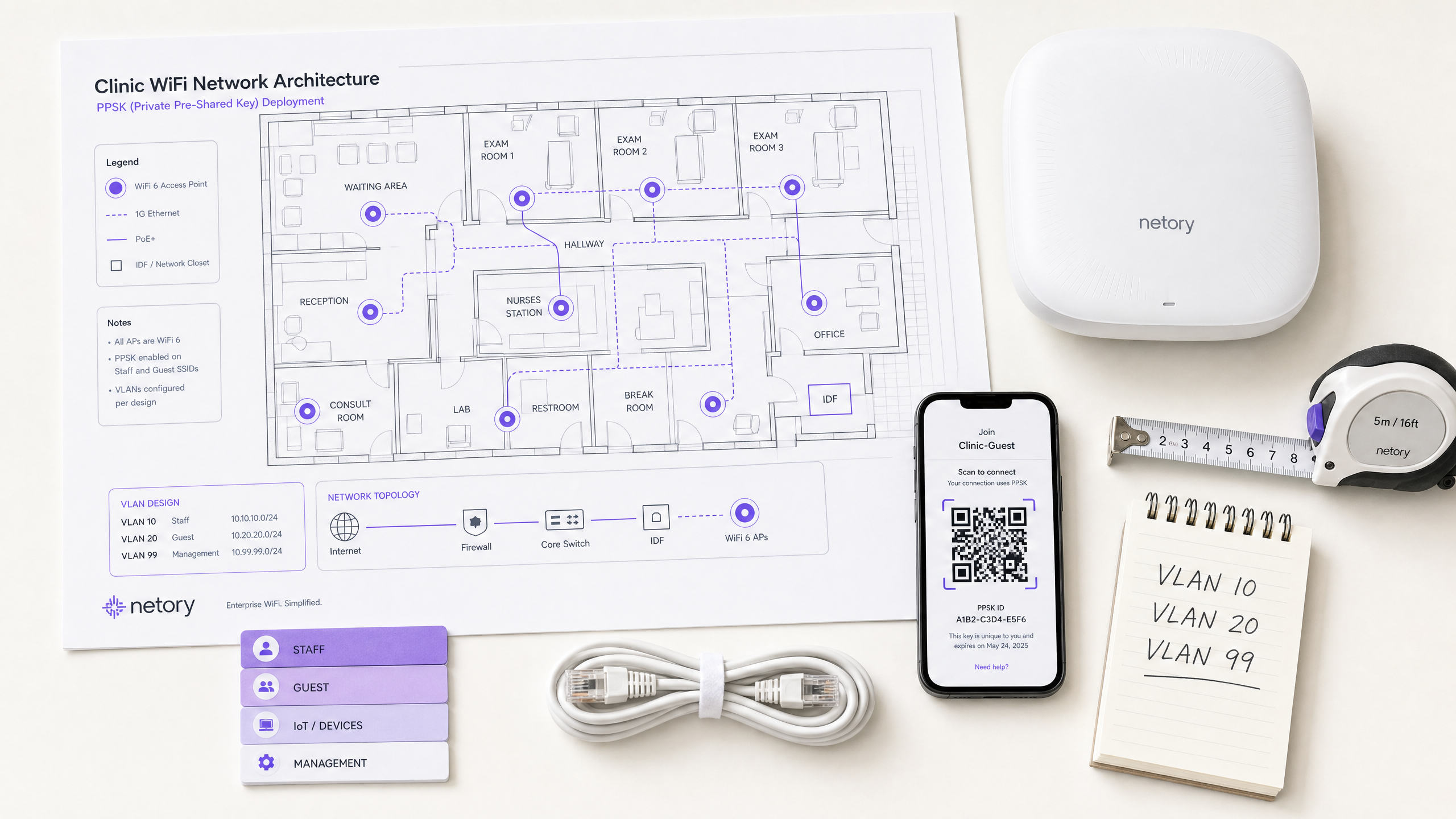
Deploying enterprise WiFi in specialist healthcare environments like an audiology clinic requires balancing stringent data governance with operational simplicity. The traditional WPA2 Personal approach fails at scale because a single shared password offers no segmentation. Conversely, full 802.1X authentication is robust but often incompatible with medical IoT devices and diagnostic equipment. Private Pre-Shared Key (PPSK) bridges this gap.
PPSK allows network architects to assign a unique password to each device or user group on a single SSID, automatically mapping them to isolated VLANs. This technical reference guide explores PPSK architecture, compares it against standard PSK and 802.1X, and details deployment models specifically tailored for healthcare and university clinic environments. Purple's multi-tenant WiFi solution integrates seamlessly with these architectures, providing secure traffic isolation while supporting complex device ecosystems.
Technical Deep-Dive
The Problem with Standard PSK and 802.1X
In a typical university health sciences clinic, the network must support clinical staff laptops, patient smartphones, and specialised medical equipment like audiometers and hearing aid programmers.
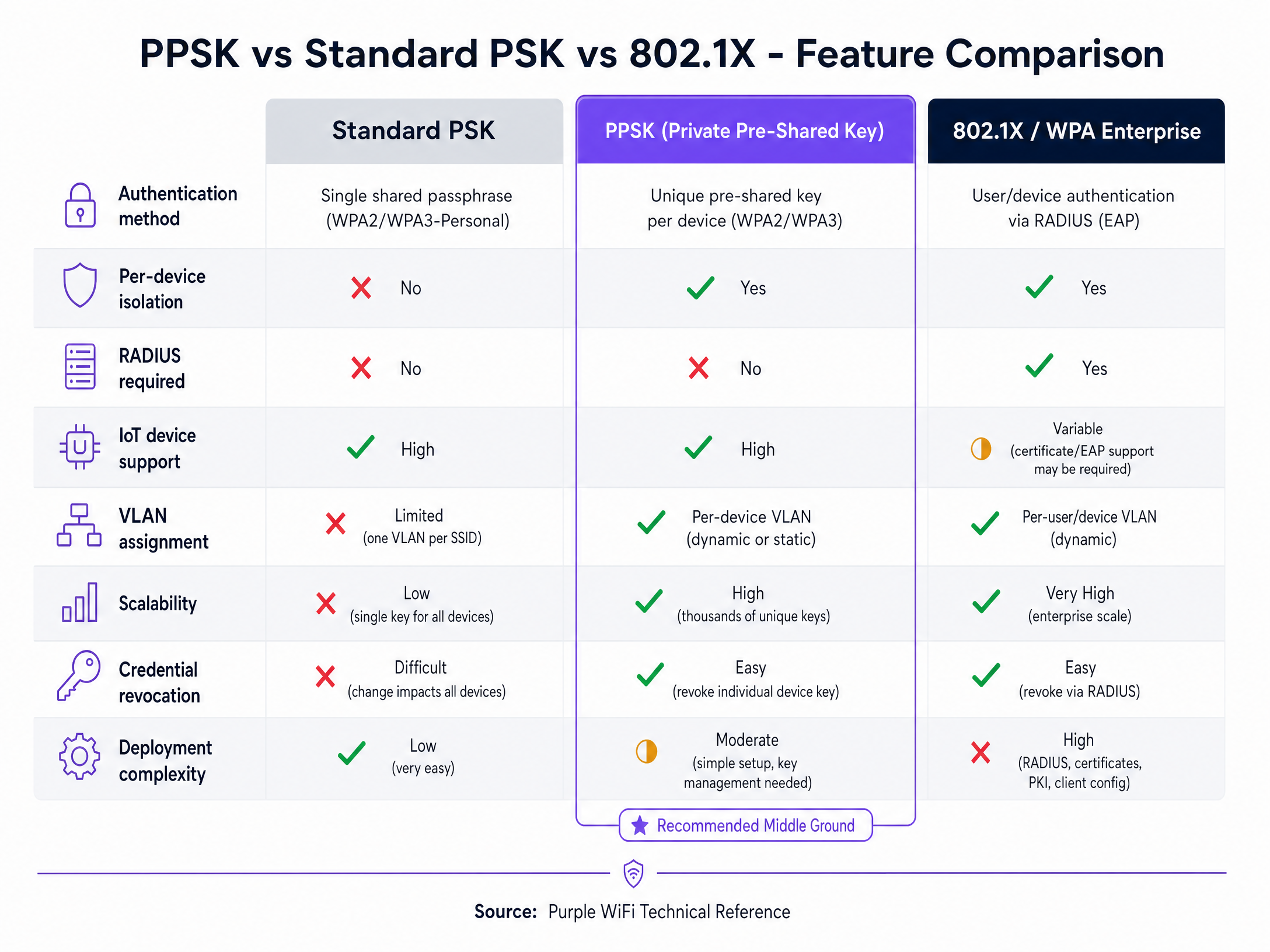
A standard PSK network uses one passphrase for all devices. This presents a critical security flaw: if a staff member leaves, you must rotate the password for every device in the clinic to revoke their access. This operational overhead is unsustainable.
Enterprise 802.1X solves the revocation issue by requiring a RADIUS server and an identity provider (such as Microsoft Entra ID, Okta, or Google Workspace) to authenticate each user individually. However, 802.1X requires a supplicant—a software component that handles the Extensible Authentication Protocol (EAP) exchange. While managed corporate laptops support EAP-TLS or PEAP, most medical IoT devices do not.
How PPSK Bridges the Gap
PPSK (Private Pre-Shared Key) operates at the WPA Personal layer but introduces enterprise-grade segmentation. When a device connects, it presents its unique pre-shared key during the WPA2 or WPA3 four-way handshake. The access point, or its cloud controller, looks up this key in the PPSK database and identifies the corresponding VLAN. The device is then placed into that isolated network segment.
This mechanism allows you to maintain a single SSID—reducing management overhead and preserving airtime—while enforcing strict segmentation. A compromised patient device on VLAN 20 cannot access the clinical diagnostic equipment on VLAN 99.
Vendor Terminology
The underlying technology is identical, but vendors use different nomenclature:
- Cisco Meraki: iPSK (Identity PSK)
- HPE Aruba: PPSK
- Juniper Mist: ePSK
- Extreme Networks: Private PSK
- Ubiquiti UniFi: PPSK
- Cambium: ePSK
Implementation Guide
Deploying a PPSK network in a specialist clinic requires careful planning. Purple recommends a hybrid architecture for healthcare environments.
Step 1: Logical Network Design
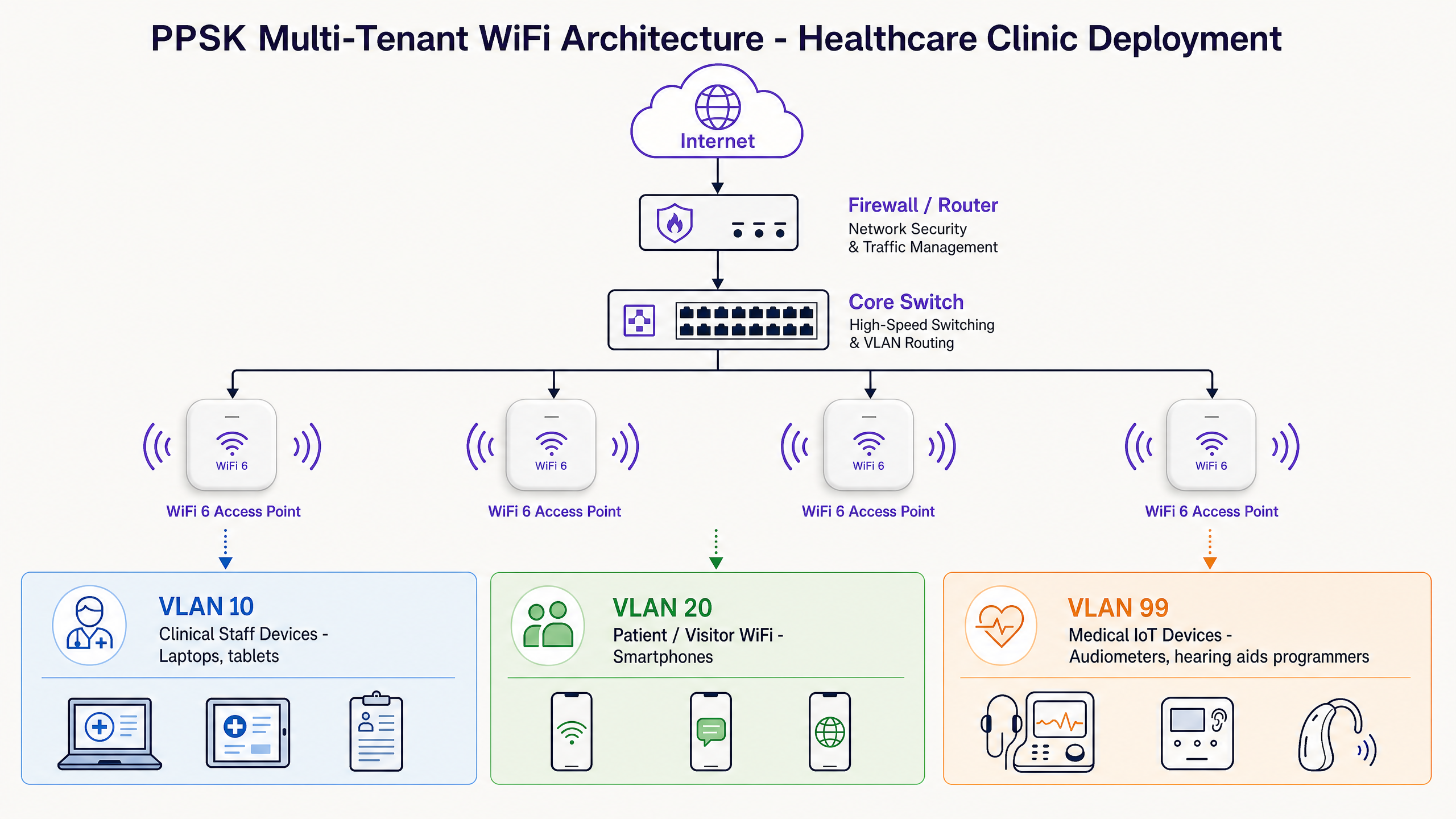
Before configuring hardware, map your device categories and assign VLANs. A typical clinic deployment includes:
- VLAN 10: Clinical Staff (Laptops, tablets)
- VLAN 20: Patient / Visitor WiFi (Smartphones)
- VLAN 99: Medical IoT (Audiometers, diagnostic tools)
- VLAN 100: Building Management (HVAC, security cameras)
Ensure your DHCP scopes are sized correctly. Use RFC 1918 private addressing. A /24 subnet provides 254 usable addresses, which is generally sufficient for individual clinic departments, but consider a /23 for larger visitor networks.
Step 2: Authentication Strategy
Implement a hybrid authentication model to maximise security and compatibility:
- Clinical Staff: Use 802.1X tied to Microsoft Entra ID or Okta for managed devices.
- Medical IoT & Building Systems: Use PPSK to assign unique keys to specific devices or vendor groups, placing them on isolated VLANs.
- Patients & Visitors: Deploy a captive portal via Purple Guest WiFi to capture first-party data and enforce terms of use.
Step 3: Hardware Configuration
Configure your access points to support the required SSIDs. Purple integrates with Cisco Meraki, HPE Aruba, Ruckus, Juniper Mist, Ubiquiti UniFi, Cambium, Extreme, and Fortinet.
Ensure trunk ports between your distribution switches and access points permit all necessary VLANs. If deploying WiFi 6E, verify that your vendor supports WPA3-SAE with PPSK, as WPA3 is required for 6 GHz operation.
Best Practices
- Limit SSID Proliferation: Every broadcast SSID consumes valuable airtime for beacon frames. Keep SSIDs to a maximum of four per radio. Use PPSK to serve multiple VLANs from a single SSID. For deeper insights on SSID management, refer to Three SSIDs to rule them all: guest, Passpoint, and IoT WiFi .
- Automate Key Distribution: Do not rely on manual key distribution. Use vendor APIs to integrate PPSK generation with your facility management or HR onboarding systems.
- Isolate High-Risk IoT: Never place IoT devices on the same VLAN as clinical staff. Even with PPSK, a compromised IoT device can perform lateral attacks against other devices on the same subnet.
- Validate Trunk Ports: A common deployment failure is missing VLAN tags on switch trunk ports. Test every VLAN assignment thoroughly before the clinic goes live.
Troubleshooting & Risk Mitigation
Silent Traffic Drops
If devices authenticate successfully but cannot reach the internet or internal servers, the issue is almost always a missing VLAN tag on a switch trunk port. Verify the configuration between the access point and the core switch.
6 GHz Band Incompatibility
If devices cannot connect via PPSK on the 6 GHz band, verify that your access points support WPA3-SAE with PPSK. Some platforms (such as Ubiquiti UniFi as of 2025) only support PPSK with WPA2, restricting those clients to the 2.4 GHz and 5 GHz bands.
DHCP Exhaustion
In environments with high patient turnover, short lease times are critical. If devices fail to obtain an IP address on the visitor VLAN, reduce the DHCP lease time to 2 hours or increase the subnet size to a /23.
ROI & Business Impact
Implementing PPSK reduces IT operational overhead significantly. By eliminating the need for global password resets when staff leave, IT teams spend less time reconfiguring devices and managing support tickets.
Furthermore, the robust segmentation provided by PPSK supports compliance with healthcare data governance standards (such as HIPAA and GDPR) by ensuring that patient data on clinical VLANs is isolated from visitor traffic and vulnerable IoT devices. When combined with Purple's WiFi Analytics , clinic administrators gain actionable insights into visitor dwell times and facility utilisation, driving better operational decisions.
Key Definitions
PPSK (Private Pre-Shared Key)
A wireless security method where each device or user group is assigned a unique passphrase that maps to a specific VLAN on a single SSID.
Crucial for securing IoT devices and multi-tenant environments where standard 802.1X is unsupported or too complex.
802.1X
An IEEE standard for port-based network access control that provides an authentication mechanism to devices wishing to attach to a LAN or WLAN.
The gold standard for enterprise staff networks, requiring a RADIUS server and client-side supplicant.
VLAN (Virtual Local Area Network)
A logical subnetwork that groups a collection of devices from different physical LANs, isolating their broadcast traffic.
Used in PPSK deployments to separate clinical staff, patients, and medical IoT devices for security and performance.
SSID (Service Set Identifier)
The primary name associated with an 802.11 wireless local area network.
Reducing the number of broadcast SSIDs is critical for optimising WiFi performance in dense clinic environments.
RADIUS
Remote Authentication Dial-In User Service; a networking protocol that provides centralised Authentication, Authorization, and Accounting management.
Required for 802.1X deployments, and optionally used as a backend database for enterprise PPSK deployments.
Supplicant
A software client on a device that communicates with the authenticator (access point) in an 802.1X network.
The lack of supplicant support on medical IoT devices is the primary reason clinics deploy PPSK.
WPA3-SAE
Simultaneous Authentication of Equals; the secure key establishment protocol used in WPA3-Personal networks.
Required for PPSK deployments operating on the 6 GHz WiFi band.
Trunk Port
A network switch port configured to carry traffic for multiple VLANs simultaneously using 802.1Q tagging.
A common point of failure in PPSK deployments if the required VLANs are not explicitly permitted on the trunk.
Worked Examples
A university audiology clinic needs to secure 40 diagnostic devices that do not support 802.1X supplicants. The IT team wants to avoid creating a dedicated SSID just for these devices to preserve airtime. How should they configure the network?
The IT team should implement PPSK on the primary clinic SSID. They generate a unique PPSK for the diagnostic equipment and configure the access points to map that specific key to an isolated medical IoT VLAN (e.g., VLAN 99). This allows the devices to connect securely using standard WPA2/WPA3 protocols while remaining completely segmented from clinical staff and visitor traffic.
A multi-tenant healthcare facility is experiencing intermittent connectivity issues for patient smartphones on the visitor WiFi network during peak hours. Staff devices on the same access points are unaffected.
The issue is likely DHCP exhaustion on the visitor VLAN. The IT team should reduce the DHCP lease time on the visitor VLAN from the default 24 hours to 2 hours. If the issue persists, they should expand the DHCP scope from a /24 subnet (254 addresses) to a /23 subnet (510 addresses).
Practice Questions
Q1. You are deploying a new WiFi network for a 50-room audiology clinic. The clinic uses a mix of modern corporate laptops and legacy diagnostic tools. Which authentication architecture provides the best balance of security and compatibility?
Hint: Consider the capabilities of the legacy diagnostic tools.
View model answer
A hybrid architecture. Deploy 802.1X for the modern corporate laptops to ensure individual accountability, and use PPSK for the legacy diagnostic tools, placing them on an isolated IoT VLAN.
Q2. During a network upgrade, an IT manager decides to create a separate SSID for every department in the clinic to ensure traffic isolation. Why is this a poor design choice, and what is the recommended alternative?
Hint: Think about the impact of management frames on wireless airtime.
View model answer
Creating multiple SSIDs causes SSID proliferation, which consumes excessive airtime for beacon frames and degrades overall network performance. The recommended alternative is to broadcast a single SSID and use PPSK to map different departments to their respective isolated VLANs.
Q3. A clinic successfully deploys PPSK. Devices connect and receive the correct IP addresses for their assigned VLANs, but devices on the Medical IoT VLAN cannot communicate with the central server. Devices on the Clinical Staff VLAN work perfectly. What is the most likely configuration error?
Hint: The issue is occurring at the wired network layer, not the wireless layer.
View model answer
The most likely error is a missing VLAN tag on a switch trunk port. The trunk link between the access point and the distribution switch is likely permitting the Clinical Staff VLAN but missing the explicit permit statement for the Medical IoT VLAN.
Continue reading in this series
Uu PPSK pdf: comparing features and deployment models
This technical reference guide compares Private Pre-Shared Key (PPSK) WiFi architecture against traditional 802.1X and standard PSK deployments. It provides network architects and IT managers with vendor-neutral implementation strategies for multi-tenant residential, IoT, and BTR environments.
Uu PPSK pdf: comparing features and deployment models
This technical reference guide compares Private Pre-Shared Key (PPSK) WiFi architecture against traditional 802.1X and standard PSK deployments. It provides network architects and IT managers with vendor-neutral implementation strategies for multi-tenant residential, IoT, and BTR environments.
Uu PPSK 2023: comparing features and deployment models
This technical reference guide compares Unique per-User Private Pre-Shared Key (UU PPSK) WiFi architecture against traditional shared PSK and 802.1X deployments, with a specific focus on the 2023 landscape of vendor implementations and platform capabilities. It provides property developers, BTR operators, and MDU landlords with actionable deployment strategies, VLAN architecture guidance, and automated lifecycle management workflows. The guide covers three deployment models, real-world case studies, and the compliance implications of each authentication approach.