
Segment customer data platform: a comprehensive guide for businesses
This guide details the technical architecture and business implementation of a segment customer data platform for venue operators and enterprise IT teams. It covers how to capture verified first-party data via Guest WiFi, unify it through identity resolution, and activate dynamic audience segments across marketing channels. Purple Engage automates this pipeline, turning your network infrastructure into a measurable revenue asset.
Listen to this guide
View podcast transcript
Executive summary
A segment customer data platform (CDP) solves the most persistent problem in venue marketing: data silos. Your WiFi infrastructure, point-of-sale system, CRM, and email platform each hold fragments of the same visitor's story. The CDP stitches those fragments together. For IT managers and venue operations directors at hotels, retail chains, stadiums, and conference centres, this is not a theoretical benefit. It is the difference between sending a generic email blast and triggering a personalised SMS offer while a shopper is still on the floor. Purple Engage captures verified guest email and phone data at WiFi login and automates marketing campaigns directly from that first-party data. This guide covers the technical architecture behind a segment CDP, how to deploy it across enterprise hardware, and how to measure the business impact. Purple operates across 80,000+ live venues and has processed 440 million logins (Purple internal data, 2024), giving us direct visibility into what works at scale.
Technical deep-dive
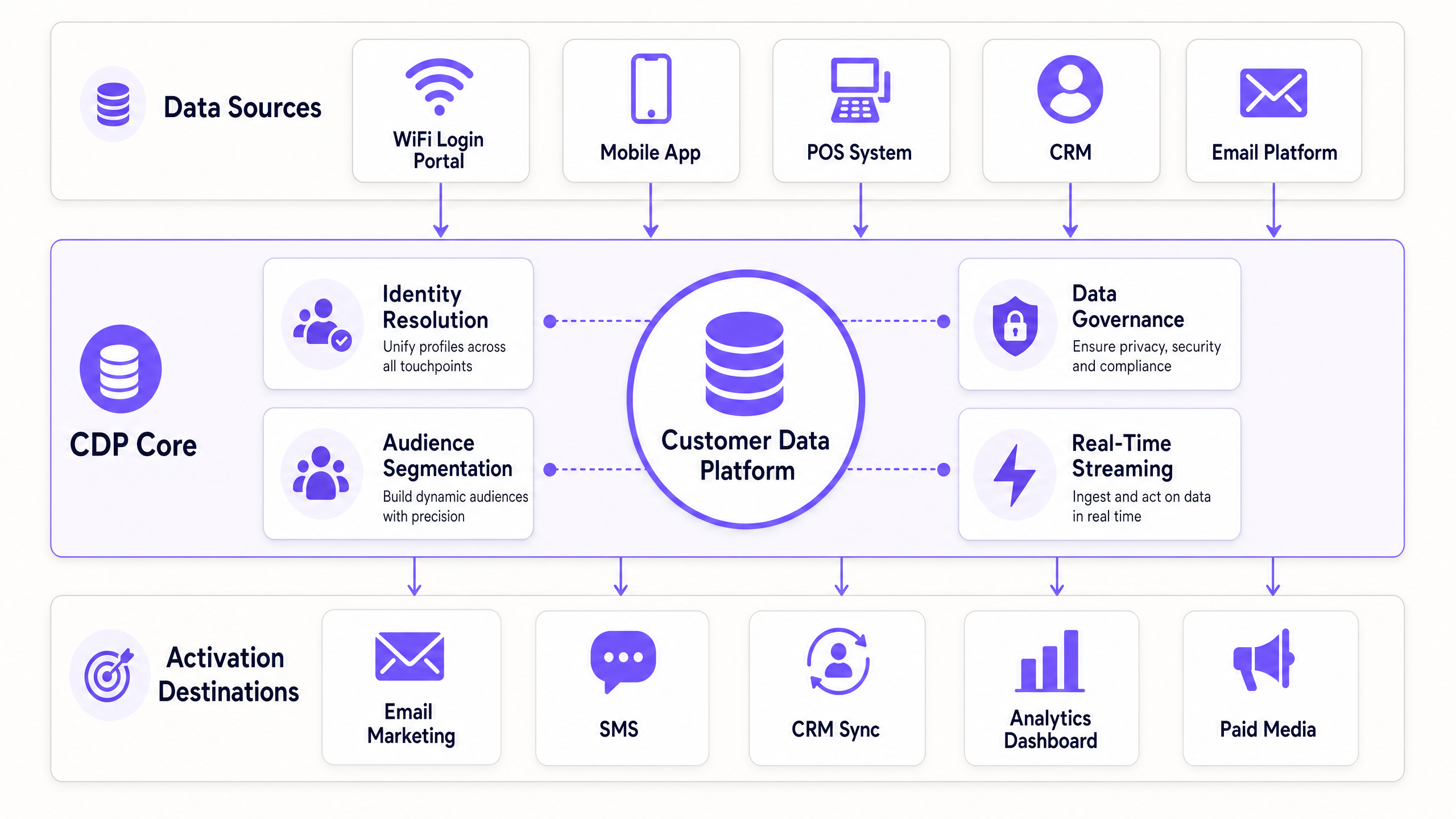
A segment customer data platform operates as the central nervous system for your venue's data. It ingests raw event data from your WiFi login portal, point-of-sale systems, and mobile applications, normalises that data, resolves identities across touchpoints, and builds dynamic audience segments for downstream activation.
Data ingestion and normalisation
Your network hardware generates substantial telemetry. Access points from Cisco Meraki, HPE Aruba, Ruckus, Juniper Mist, Ubiquiti UniFi, Cambium, Extreme, and Fortinet track device MAC addresses, dwell times, and roaming patterns. However, this raw data lacks business context. A segment CDP bridges this gap by linking anonymous device data to known identities captured through the captive portal.
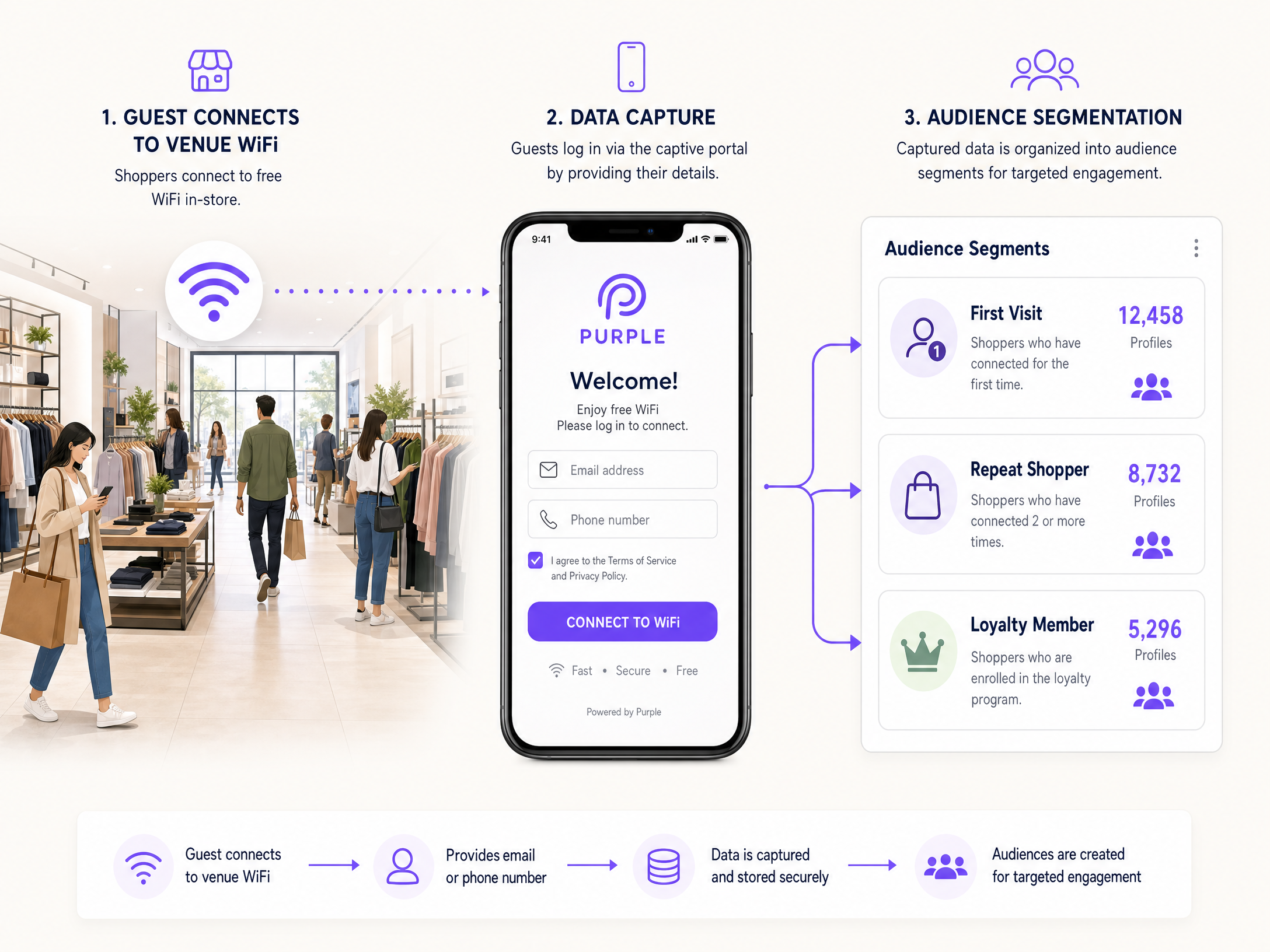
When a visitor authenticates via the Guest WiFi , the platform captures their email address or phone number as a conscious-choice opt-in. This event triggers an API call to the central data hub. The platform normalises the incoming payload, ensuring consistent formatting for fields like timestamps, device types, and location identifiers. Without normalisation, a single visitor's data from three different source systems can appear as three separate records.
Identity resolution
Identity resolution is the process of stitching together multiple data points to form a single, coherent profile. A shopper might visit your retail venue, connect to the Guest WiFi using their email, and later make a purchase using a loyalty card. The segment CDP uses deterministic matching to link the MAC address, email, and loyalty ID into one unified profile.
This unified profile allows you to track the complete visitor lifecycle. You can identify first-time visitors, measure visit frequency, and calculate dwell times accurately. Deterministic matching relies on exact identifier matches, such as an email address or phone number. This approach delivers higher accuracy than probabilistic matching, which infers identity from behavioural patterns alone.
Audience segmentation and activation
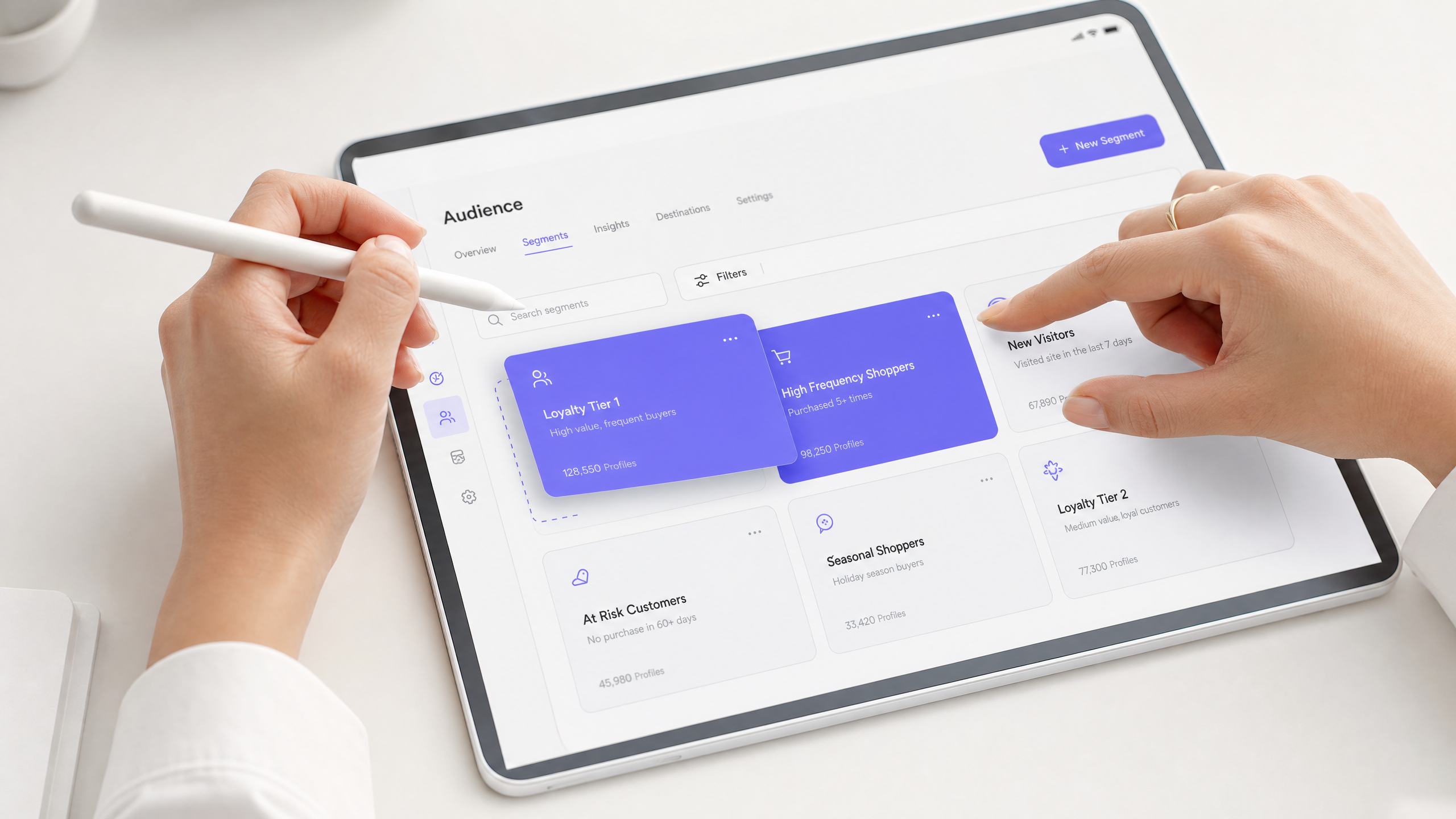
Once profiles are unified, the platform builds dynamic audience segments. You define rules based on behaviour, demographics, or transaction history. For example, you can define a segment of shoppers who have visited more than three times in a month and stayed longer than 45 minutes. The platform continuously evaluates profiles against these rules and updates segment membership in real time.
These segments are activated by syncing them to downstream destinations. You can push a "High-Value Repeat Shoppers" segment to your email marketing tool or SMS platform. Purple Engage automates this process, triggering targeted campaigns the moment a visitor meets the segment criteria. For more on automated campaign strategies, see our guide on how to leverage tools for SMS marketing to increase return visits .
Implementation guide
Deploying a segment customer data platform requires alignment between IT, marketing, and operations. Follow this phased approach to ensure a secure and scalable rollout.
Phase 1: Infrastructure readiness
Begin by auditing your existing network hardware. Ensure your access points and controllers support standard integration protocols, specifically RADIUS for authentication and REST APIs for event streaming. Purple is hardware-agnostic and integrates directly with Cisco Meraki, HPE Aruba, Ruckus, Juniper Mist, Ubiquiti UniFi, Cambium, Extreme, and Fortinet.
Configure your Guest WiFi networks to use a captive portal for authentication. Define your data capture requirements: decide whether you need email addresses, phone numbers, or custom fields like postal codes. Implement conscious-choice opt-ins to ensure compliance with GDPR and CCPA. The captive portal is your primary data collection point, so invest time in its design. A well-designed portal directly affects data quality. For guidance on portal design, read our post on how to make a great first impression with your guest WiFi .
Phase 2: Data governance and privacy
Data privacy is non-negotiable. Your implementation must comply with GDPR, CCPA, and any applicable local regulations. Define clear data retention policies before you go live. Purple automatically manages data lifecycle rules, ensuring inactive profiles are purged according to your specifications.
Implement role-based access control (RBAC) to restrict system access. Ensure your identity providers, such as Microsoft Entra ID, Okta, or Google Workspace, are integrated for secure staff authentication. Purple maintains ISO 27001, GDPR, CCPA, and Cyber Essentials certifications, providing a verified security foundation for your data.
Phase 3: Integration and testing
Connect your segment CDP to your downstream tools. Configure API webhooks to send event data to your CRM and marketing platforms the moment an authentication event occurs. Test the data flow end-to-end. Verify that a login event on the Guest WiFi successfully creates or updates the corresponding record in your CRM within an acceptable latency threshold.
Phase 4: Go-live and iteration
Launch in a single venue first. Monitor data quality, segment accuracy, and API reliability for two weeks before rolling out across your estate. Establish a weekly review cadence to assess segment performance and refine audience rules based on campaign results.
Best practices
To maximise the value of your segment customer data platform, follow these industry-standard practices.
Standardise naming conventions. Define a strict taxonomy for event names and profile attributes before you write a single line of integration code. Consistent naming prevents data fragmentation and simplifies audience building. An event called "wifi_login" in one system and "guest_connect" in another will create duplicate records.
Prioritise first-party data. Rely on data captured directly from your visitors rather than third-party cookies. First-party data is more accurate, more durable, and compliant with GDPR and CCPA. Purple's captive portal captures verified data at the point of WiFi authentication, giving you a clean, consent-backed dataset.
Implement real-time activation. Configure your platform to trigger actions immediately. Sending an SMS offer while a shopper is still in the venue yields significantly higher conversion rates than sending an email the following day. Real-time webhooks are essential for this.
Audit integrations regularly. Review your API connections and data flows monthly. API token expirations or upstream schema changes can silently break your data pipeline, causing gaps in your audience segments.
For network design considerations that support multi-segment data capture, read our guide on Three SSIDs to rule them all: guest, Passpoint, and IoT WiFi .
Troubleshooting and risk mitigation
Even with careful planning, implementations encounter issues. Address these common failure modes proactively.
Data silos and mismatched identities. If visitors use different email addresses or phone numbers across touchpoints, the platform may create duplicate profiles. Mitigate this by implementing strict validation rules on your captive portal. Require email verification or SMS one-time password (OTP) to ensure data accuracy at the point of entry.
MAC address randomisation. Modern iOS and Android devices randomise their MAC addresses to prevent passive tracking. This means your hardware controller may report a higher unique device count than your CDP's unified profile count. The CDP resolves this discrepancy by anchoring identity to the email or phone number provided at login, not the MAC address.
API rate limiting. High-traffic venues like stadiums can generate thousands of events per minute. This volume can overwhelm downstream APIs, leading to dropped data. Implement message queuing and batch processing to manage API load. Purple's cloud overlay is engineered for 99.999% uptime (Purple internal SLA data), handling massive concurrency without data loss.
Privacy compliance failures. Failing to capture explicit consent can result in significant regulatory penalties. Ensure your captive portal clearly displays terms of service and privacy policies. Use distinct checkboxes for marketing opt-ins, separating them from the network access agreement. For healthcare and public-sector venues, apply additional data minimisation principles in line with sector-specific regulations.
ROI and business impact
A segment customer data platform delivers measurable value across marketing, operations, and IT.
| Business function | Metric | Expected impact |
|---|---|---|
| Marketing | Email campaign open rate | Segmented campaigns outperform broadcast emails by 14-26% (Mailchimp industry benchmarks) |
| Operations | Footfall accuracy | MAC-to-profile resolution eliminates device randomisation inflation |
| IT | Integration overhead | Centralised CDP reduces point-to-point integrations between systems |
| Revenue | Repeat visit rate | Automated win-back campaigns target lapsed visitors with precision |
For marketing teams, the platform reduces acquisition costs by building targeted audiences from existing visitors. A retail chain can identify lapsed shoppers and deliver automated win-back campaigns via SMS or email. Explore our WiFi Analytics capabilities for detailed footfall and dwell time reporting.
For operations, accurate dwell time analytics allow venue directors to measure the impact of physical layout changes on visitor flow. For IT, centralising data collection and identity resolution reduces the operational overhead of managing disparate systems. The result is a secure, scalable infrastructure that directly supports revenue generation.
For hospitality operators, Purple Engage integrates with property management systems to trigger personalised guest communications at check-in. For retail operators, the platform supports location-based offers triggered by zone dwell time. Explore our solutions for retail , hospitality , healthcare , and transport verticals.
Key Definitions
First-party data
Information a company collects directly from its customers or visitors, such as email addresses captured via a Guest WiFi captive portal.
Essential for compliance and accuracy, particularly as third-party cookies are phased out. IT teams must secure the systems that capture and store this data.
Identity resolution
The process of linking multiple identifiers, such as a MAC address, email address, and loyalty ID, to a single, unified customer profile.
Essential for tracking the complete visitor journey across different devices and touchpoints within a venue. Without it, a single visitor appears as multiple anonymous records.
Deterministic matching
Merging profiles based on exact matches of unique identifiers, such as an email address or phone number.
Provides higher accuracy than probabilistic matching. IT teams should enforce email validation at the captive portal to maximise match rates.
Captive portal
A web page that a visitor on a public-access network must view and interact with before network access is granted.
The primary data collection point for venue operators. IT must ensure it loads within two seconds, integrates securely with the authentication backend, and captures explicit consent.
API webhook
A method for an application to deliver real-time data to another application by sending an HTTP POST request when a specified event occurs.
Used to instantly notify downstream marketing tools when a visitor connects to the WiFi or enters a specific zone. Webhooks replace slow batch syncs for time-sensitive campaigns.
Role-based access control (RBAC)
A method of restricting system access based on the defined roles of individual users within an organisation.
Mandatory for maintaining data security and complying with ISO 27001. Ensures only authorised staff can view, export, or modify customer segments.
Data silo
A repository of data that remains under the control of one department and is isolated from the rest of the organisation.
The primary problem a segment CDP solves. Silos prevent a unified view of the visitor, blocking effective marketing and accurate operations reporting.
Dwell time
The amount of time a visitor spends in a specific physical location, measured by tracking their device's connection to the WiFi network.
A key metric for venue operations to assess layout effectiveness and for marketing to trigger location-based offers at the right moment.
Conscious-choice opt-in
A marketing consent mechanism where the visitor actively selects a checkbox or confirms agreement to receive communications, separate from accepting network access terms.
Required under GDPR for marketing communications. IT must ensure the captive portal presents opt-in checkboxes as distinct, unchecked by default, and clearly labelled.
Worked Examples
A 200-room hotel needs to unify guest data from their property management system (PMS) and their Guest WiFi network to trigger personalised welcome emails upon arrival.
- Configure the Guest WiFi captive portal to capture the guest's email address and booking reference at login. 2. Integrate the segment CDP with the hotel's PMS via REST API, mapping the booking reference field as the shared identifier. 3. Set up an identity resolution rule to merge profiles based on the email address, using deterministic matching. 4. Create a dynamic segment for 'Checked-in Guests' triggered by the WiFi authentication event occurring within the check-in time window. 5. Sync this segment to the email marketing platform to trigger the welcome email workflow within 60 seconds of authentication. 6. Suppress the trigger for guests who have already received the email to prevent duplicates.
A large retail venue wants to identify shoppers who visit the food court but do not make a purchase, in order to send them a targeted discount code.
- Deploy location analytics using Cisco Meraki access points to track device dwell times in the food court zone. 2. Connect the POS system to the segment CDP to ingest transaction events, tagged with the venue zone identifier. 3. Build an audience segment defined as: Location = Food Court AND Dwell Time greater than 15 minutes AND Transaction Count = 0 within the same session. 4. Push this segment to the SMS marketing tool via a real-time webhook. 5. Automate an SMS delivery containing a 10% discount code valid for the next 60 minutes. 6. Apply a frequency cap of one message per visitor per day to prevent over-messaging.
Practice Questions
Q1. Your marketing team wants to trigger an SMS offer to visitors exactly five minutes after they log into the Guest WiFi. Your current CRM sync runs a batch process every hour. How do you re-architect the data flow to support this requirement?
Hint: Consider the difference between batch processing and real-time event streaming.
View model answer
Replace the hourly batch sync with a real-time integration. Configure the segment CDP to fire an API webhook directly to the SMS marketing tool the moment the WiFi authentication event occurs. The webhook payload should include the visitor's phone number and location ID. The SMS tool then applies a five-minute delay before sending. This eliminates the batch latency and ensures the offer reaches the visitor while they are still on-site.
Q2. A stadium IT director notices that the segment CDP reports 20% fewer unique visitors than the hardware controller's raw MAC address count. What is the most likely cause, and how do you resolve it?
Hint: Think about modern mobile operating system privacy features and how they affect device tracking.
View model answer
The discrepancy is caused by MAC address randomisation in iOS and Android devices. The hardware controller counts each randomised MAC as a unique device. The segment CDP resolves these temporary MAC addresses to a single unified profile once the visitor authenticates via the captive portal using a consistent identifier, such as an email address. The 20% gap represents the proportion of visitors who connected but did not authenticate. To reduce this gap, optimise the captive portal experience to increase login completion rates.
Q3. You are deploying a segment CDP across 50 retail locations spanning the UK and California. How do you ensure compliance with both GDPR and CCPA within a single platform?
Hint: Consider how data collection policies can be applied dynamically based on venue location.
View model answer
Implement location-aware captive portals with dynamic data governance rules. The captive portal detects the venue location and displays the legally required consent mechanisms: explicit opt-in checkboxes for GDPR in UK venues, and a 'Do Not Sell My Personal Information' link for CCPA in California venues. Within the CDP, configure data retention policies tagged by region, ensuring European data is purged automatically if consent is withdrawn. Maintain separate compliance audit logs for CCPA data subject requests. Purple's ISO 27001 and GDPR certifications provide a compliant foundation for this architecture.