
Customer data platform cdp: a comprehensive guide for businesses
This guide gives Marketing Directors, CRM Managers, and Retail Venue Operators a practical, vendor-neutral reference for deploying a Customer Data Platform (CDP) in physical venue environments. It covers the technical architecture from data ingestion through identity resolution to real-time activation, with specific guidance on using Guest WiFi as the primary first-party data engine. Two real-world case studies - a hotel and a multi-location retail chain - demonstrate measurable outcomes from CDP deployment.
Listen to this guide
View podcast transcript
Executive summary
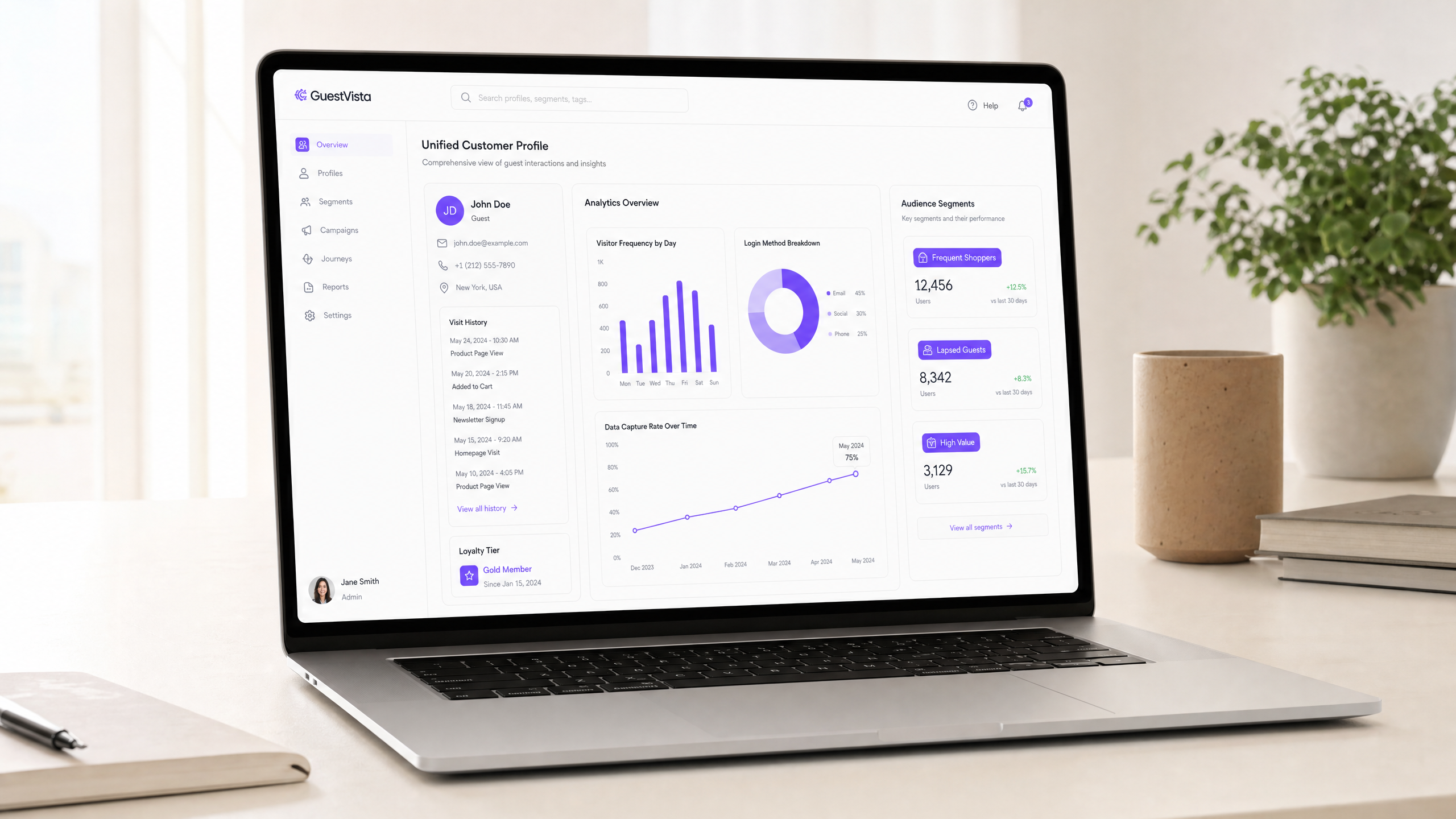
Customer data is structurally fragmented. Your point-of-sale system tracks transactions, your CRM holds email addresses, and your Guest WiFi logs physical presence in real time. Without a central unification engine, these systems operate in silos, forcing marketing and operations teams to rely on batch exports and manual analysis.
A customer data platform (CDP) solves this fragmentation. It is purpose-built software that ingests first-party data from every touchpoint, uses identity resolution to build a persistent, unified profile for each venue user, and activates that profile in real time across execution channels. For IT leaders and network architects, deploying a CDP means shifting from managing disparate databases to governing a single, compliant data pipeline.
Purple has processed 440 million logins in 2024 across 80,000+ live venues, generating 29 billion data points (Purple internal data, 2024). Every one of those logins is a verified, consent-based first-party data event - the raw material a CDP needs to function. This guide covers the technical architecture, deployment strategies, and business impact of enterprise CDPs, with a specific focus on using Guest WiFi as a primary data engine.
Technical deep-dive
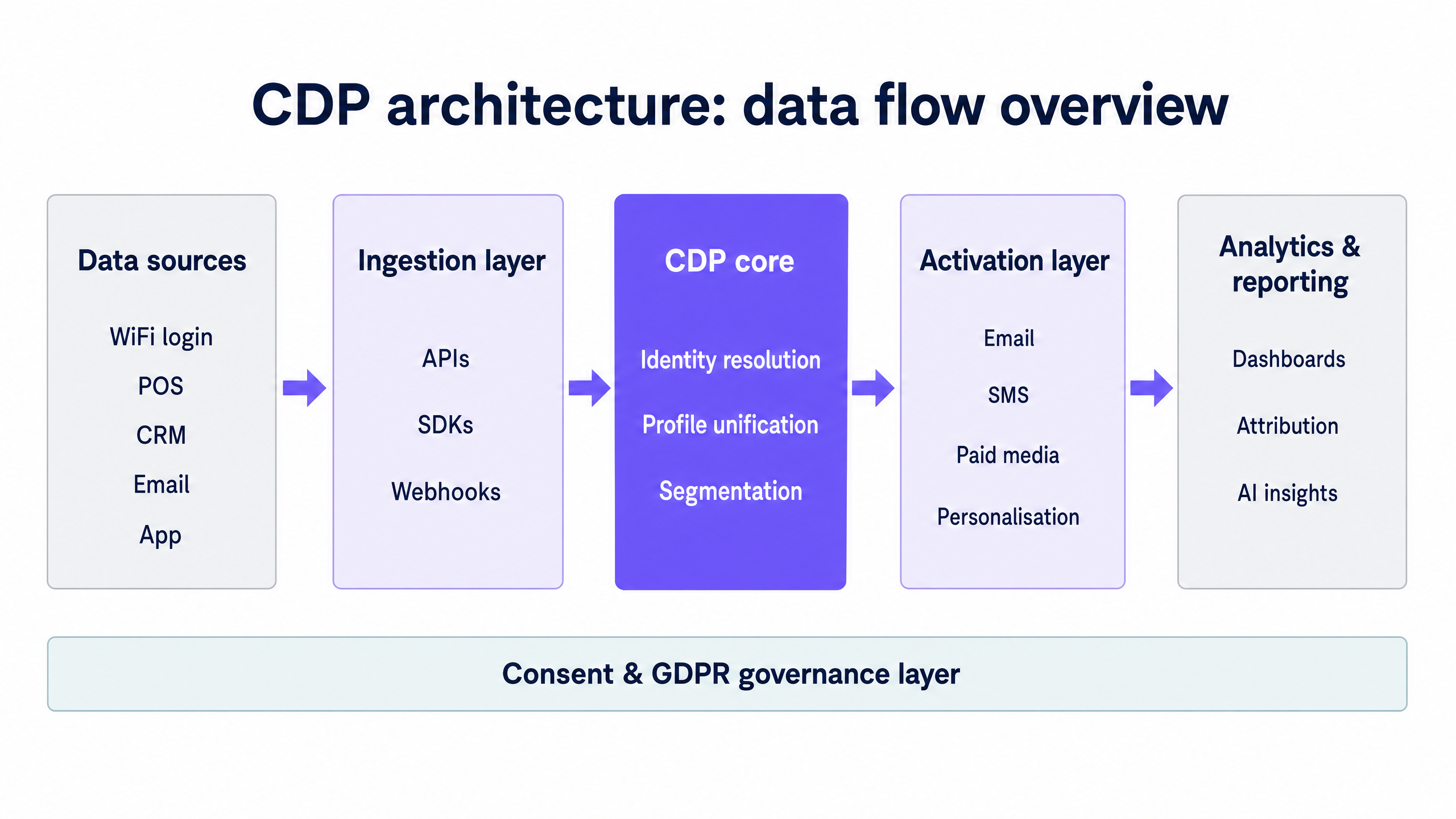
To understand how a CDP functions, you must look at its core architecture. A CDP operates on a continuous cycle known as the Customer Intelligence Loop: Collect, Unify, Understand, Decide, and Engage. Each stage depends on the previous one, and the loop runs continuously in real time.
The ingestion layer
A CDP connects to source systems via APIs, SDKs, and webhooks. The goal is to capture structured, semi-structured, and unstructured data in real time. For physical venues, the most critical data source is the Guest WiFi network. When a shopper logs into the WiFi via a captive portal, the network hardware - whether Cisco Meraki, HPE Aruba, Ruckus, Juniper Mist, or Ubiquiti UniFi - captures the device MAC address and authentication details. Purple pushes this data to the CDP via API, establishing a baseline digital identity tied to physical presence.
Purple Engage captures verified guest email and phone data at login and automates marketing campaigns, meaning the ingestion layer is pre-built and pre-validated. You do not need to build custom connectors for the WiFi data source.
Identity resolution and profile unification
Raw data arrives with conflicting identifiers. A user might connect to the WiFi using Microsoft Entra ID, make a purchase using a loyalty card, and open an email on a different device. The CDP core uses two matching techniques to stitch these fragments together.
Deterministic matching links records using exact, unique identifiers such as an email address or phone number. This is the most accurate method and requires strict data validation at the point of entry. Probabilistic matching links records based on behavioural patterns, device signatures, or statistical inference when exact identifiers are unavailable. It is less precise but essential for building profiles before a user authenticates.
The result is a single customer view - a persistent, cross-device profile that updates dynamically as new data arrives. One retail brand discovered that 23% of their "unique" customers were duplicates across email, loyalty, and POS systems (CDP Institute, 2024). Unification corrected their lifetime value calculations and reduced wasted marketing spend.
The activation layer
Data storage is not the end goal; activation is. Once a profile is unified and segmented, the CDP pushes instructions to downstream systems. If a high-value fan enters a stadium and connects to the network, the CDP evaluates their profile and triggers an SMS with a targeted merchandise offer. This requires millisecond latency and well-tested API integrations with execution platforms.
The activation layer is where WiFi Analytics data translates into measurable commercial impact. Dwell time, visit frequency, and location data derived from the network feed directly into the segmentation engine, enabling campaigns that a CRM alone cannot generate.
CDP vs CRM vs DMP: the structural difference
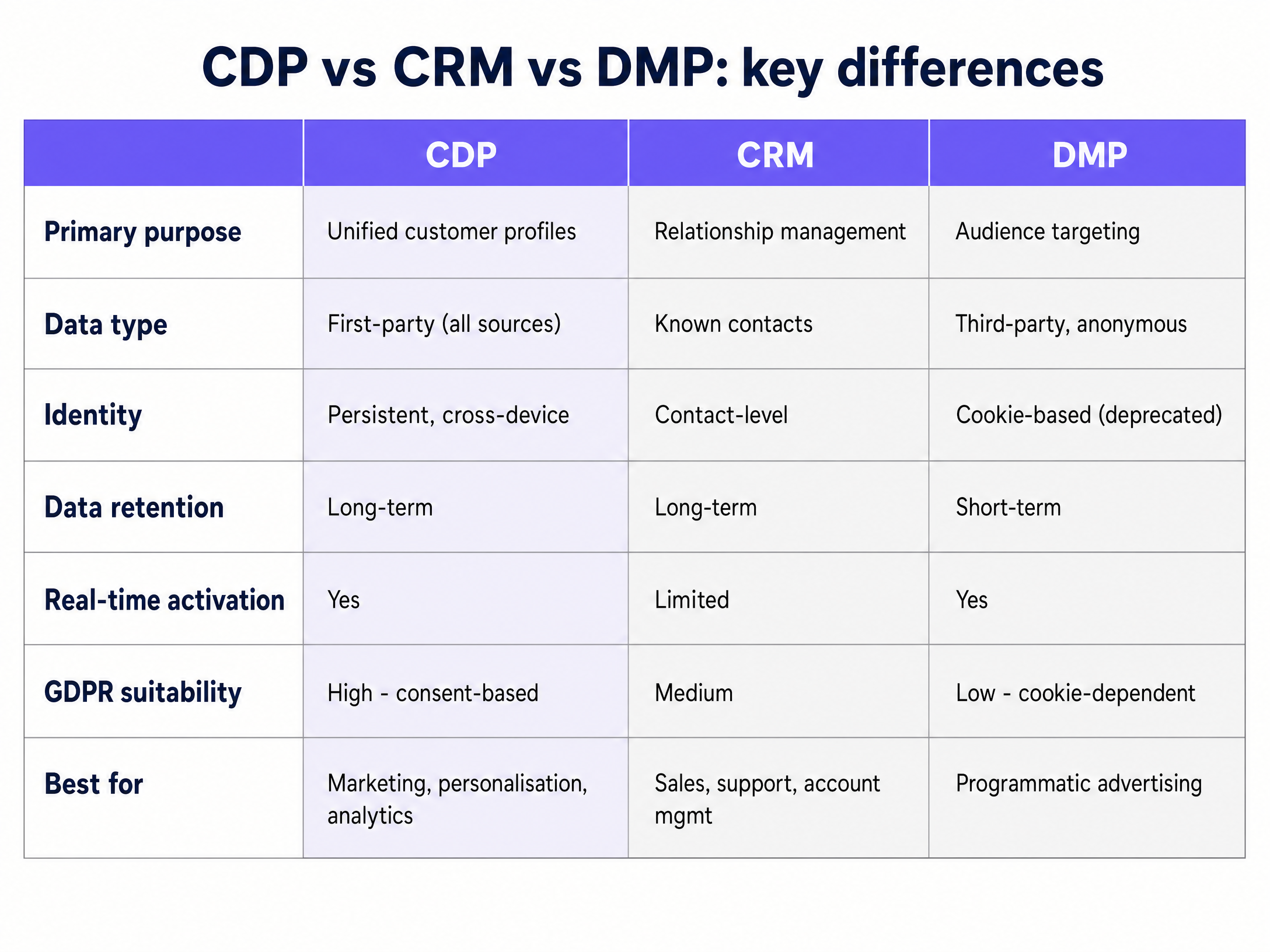
A CRM manages relationships with known contacts for sales and support. It relies on manual data entry and batch updates. A data management platform (DMP) targets anonymous audiences via third-party cookies - a mechanism that is now deprecated across major browsers. A CDP unifies first-party data from all sources, builds persistent cross-device identities, and activates that data in real time. The three tools are not interchangeable. You need a CRM for pipeline management and a CDP for data unification and activation. The DMP is obsolete for most venue operators.
Implementation guide
Deploying a CDP requires a phased approach. Attempting a big-bang integration of all enterprise systems simultaneously is the most common failure mode.
Phase 1: establish the data baseline
Start with your most reliable source of first-party data. For physical venues, this is Guest WiFi. Configure your hardware to route authentication data to Purple. Ensure the captive portal mandates conscious-choice opt-ins to capture verified email addresses and phone numbers. Connect Purple to the CDP via API to establish the foundational user profiles. At this stage, you should also define your data schema - standardise naming conventions so that a "visit" in the WiFi analytics platform means the same thing as a "visit" in the CRM.
Phase 2: integrate high-value touchpoints
Once the baseline is stable, integrate your CRM and email marketing platform. This allows the CDP to match physical venue visits with digital engagement. If a resident in a Multi-Tenant WiFi environment logs in, the CDP can verify their status against the property management system and assign the correct VLAN automatically. For retail operators, integrate the POS system to match purchase transactions with WiFi-derived profiles.
Phase 3: enable real-time activation
Configure the activation layer to trigger specific workflows. Set up rules to send automated campaigns based on dwell time, visit frequency, or specific location data. Use Purple Engage to automate email and SMS sequences directly from the CDP segment output. Test these workflows thoroughly - validate that the end-to-end latency from WiFi login to SMS delivery is under 60 seconds.
Phase 4: scale and optimise
Once the core loop is validated, expand the data sources. Integrate survey responses, loyalty programme data, and in-app behaviour. Use the CDP's segmentation engine to build predictive audiences - guests likely to churn, shoppers likely to upgrade, fans likely to purchase merchandise. Feed these segments back into paid media platforms to reduce customer acquisition cost.
Best practices
Prioritise first-party data. Third-party cookies are deprecated. Focus entirely on data collected directly from your venue users via secure, authenticated channels. Guest WiFi is the most reliable physical-world data source available to venue operators. For guidance on how to make the most of the login touchpoint, see how to make a great first impression with your Guest WiFi .
Standardise naming conventions. Enforce strict data schemas across all ingested sources before connecting them to the CDP. A mismatch in field names between the POS and the CRM will corrupt identity resolution.
Automate compliance. Use the CDP to centralise consent management. When a user requests data deletion under GDPR or CCPA, the CDP must automatically propagate that request to all connected systems. Purple is GDPR and CCPA certified, meaning the consent records captured at WiFi login are already structured for downstream compliance automation.
Validate identity at the point of entry. Use Purple Verify to authenticate phone numbers via SMS before passing data to the CDP. This eliminates fake email addresses and ensures deterministic matching accuracy.
Separate network SSIDs by user type. Deploy three SSIDs - Guest WiFi, Staff WiFi, and IoT - to ensure that staff and device data do not contaminate the guest profile pool. For a detailed architecture guide, see three SSIDs to rule them all: guest, Passpoint, and IoT WiFi .
Troubleshooting & risk mitigation
Identity resolution failures
If the CDP generates duplicate records, the problem almost always originates at the ingestion layer. Common causes include users submitting unverified email addresses at the captive portal, inconsistent field formatting between source systems, and missing phone numbers that prevent deterministic matching. Resolve this by enforcing email validation at the portal and deploying Purple Verify for phone number confirmation.
Latency in activation
If a promotional SMS arrives 20 minutes after a shopper leaves the store, the activation layer has failed. This is typically caused by relying on batch processing instead of real-time event streaming. Ensure your CDP and connected APIs support webhook-based, real-time data transfer. Audit the end-to-end latency from WiFi login event to activation trigger at least monthly.
Consent management gaps
A user who revokes marketing consent via one channel must have that revocation propagated to all connected systems automatically. If the CDP does not handle this, you face a GDPR compliance risk. EU data protection authorities issued over 2.1 billion euros in GDPR fines in 2023 alone (GDPR Enforcement Tracker, 2024). Centralise consent management in the CDP and test the revocation workflow before go-live.
Data schema drift
As source systems are updated or replaced, field names and data types can change without warning. Implement schema validation at the ingestion layer and set up automated alerts for any field that stops populating. A silent schema change can corrupt months of profile data before it is detected.
ROI & business impact
Measuring the success of a CDP deployment requires tracking specific business outcomes, not just technical metrics.
Data capture rate is the foundational metric: what percentage of venue users are successfully identified and profiled? For hospitality operators, a data capture rate above 60% is achievable with an optimised captive portal. For retail venues, 40-50% is a realistic target in the first six months.
Return visit rate measures whether personalised, automated campaigns are driving repeat visits. Track this by comparing the return visit frequency of profiled users against anonymous users. A well-configured CDP with automated email and SMS campaigns typically increases return visit rates by 15-25% within the first year (Purple internal data, 2024).
Customer acquisition cost (CAC) should decrease as you shift marketing spend from third-party advertising to direct, first-party engagement. When you can target a specific segment - say, shoppers who visited twice in the last 30 days but have not returned - with a personalised offer via SMS, you eliminate the cost of broad-reach advertising to reach that same person.
Direct booking rate is the key metric for hospitality and transport operators. When a CDP enables you to identify guests who booked via an online travel agent and trigger a direct booking incentive during their stay, you reduce commission costs directly. For a Premier Inn-scale operation, shifting even 5% of OTA bookings to direct represents significant margin improvement.
For SMS-specific activation strategies that complement CDP deployment, see how to increase return visits with SMS marketing .
Key Definitions
Customer Data Platform (CDP)
Packaged software that builds a persistent, unified customer database accessible to other systems for real-time activation. Coined by David Raab in 2013 and defined by the CDP Institute as software that creates a persistent, unified customer database accessible to other systems.
Essential for IT teams tasked with breaking down data silos and enabling automated, personalised marketing across physical and digital channels.
Identity resolution
The process of stitching together fragmented data records from multiple systems into a single, unified profile using deterministic and probabilistic matching techniques.
The core technical function of a CDP. Poor identity resolution generates duplicate profiles and corrupts analytics. Validate accuracy by auditing duplicate rates monthly.
First-party data
Information a business collects directly from its customers with explicit consent, via owned channels such as a website, mobile app, or Guest WiFi captive portal.
The foundation of modern data strategy following the deprecation of third-party cookies. GDPR and CCPA compliance is significantly simpler when all data is first-party.
Deterministic matching
Linking data records using exact, unique identifiers such as an email address or phone number.
The most accurate method for identity resolution. Requires strict data validation at the point of entry - use Purple Verify to confirm phone numbers before ingestion.
Probabilistic matching
Linking data records based on behavioural patterns, device signatures, or statistical inference when exact identifiers are unavailable.
Used to build partial profiles for anonymous users before they authenticate. Less precise than deterministic matching; use it to enrich profiles, not as the primary matching method.
Activation layer
The component of a CDP that pushes segmented audience data to execution channels such as email, SMS, paid media, or personalisation engines in real time.
Where the technical data infrastructure translates into measurable business impact. Requires real-time, webhook-based API integrations to avoid batch processing latency.
Captive portal
A web page that a user must view and interact with before access is granted to a public network. The primary mechanism for capturing first-party data and consent in physical venues.
The most important data ingestion point for venue operators. The design and authentication options on the captive portal directly determine data capture rate and profile quality.
Single customer view
An aggregated, consistent, and holistic representation of all data known about an individual, built by the CDP's identity resolution and profile unification engine.
The ultimate output of the CDP core. Every downstream system - email platform, SMS tool, paid media - consumes the single customer view to personalise its output.
Conscious-choice opt-in
A consent mechanism where a user actively selects a checkbox or confirms a preference, rather than having consent pre-ticked or implied by continued use.
Required under GDPR for marketing communications. Purple's captive portal enforces conscious-choice opt-ins by default, ensuring all captured data meets the consent standard.
Data capture rate
The percentage of venue users who are successfully identified and profiled by the CDP, calculated as identified profiles divided by total unique visitors.
The foundational KPI for CDP deployment in physical venues. A rate below 30% indicates a problem with the captive portal design or authentication options.
Worked Examples
A 400-location retail chain wants to identify high-value shoppers who visit physical stores but rarely open marketing emails. They currently use Cisco Meraki hardware for Guest WiFi, a legacy CRM updated weekly via CSV export, and a standalone email platform. The marketing team cannot identify which email subscribers are also frequent in-store visitors.
Deploy a CDP to unify these three systems. Configure the Cisco Meraki access points to authenticate via Purple, capturing MAC addresses and verified emails at the captive portal. Connect Purple to the CDP via API. The CDP ingests this real-time WiFi data alongside the weekly CRM export and the email platform's engagement data. The identity resolution engine uses the email address as the deterministic key to match WiFi logins with CRM records and email engagement history. The marketing team creates a segment in the CDP for 'Frequent In-Store Visitors with Low Email Engagement' - defined as more than four visits in 90 days and an email open rate below 10%. The CDP pushes this segment to a paid social media platform via the activation layer. The retailer targets these specific shoppers with a personalised social ad, bypassing the ineffective email channel. Simultaneously, the CDP flags these users in the CRM as 'High Physical Engagement' for the sales team.
A 50,000-capacity stadium needs to manage network access for fans during events while capturing data to drive merchandise sales and build direct relationships. They need to comply with GDPR, avoid network congestion during half-time, and demonstrate ROI to the board within 12 months.
Deploy an identity-based network architecture using Extreme Networks hardware. Fans authenticate via a Purple captive portal using social login or email, with explicit GDPR consent captured at the point of login. The authentication data flows into the CDP, which builds a profile for each attendee. To manage congestion, the network assigns bandwidth limits based on user profiles - authenticated fans receive higher bandwidth than unauthenticated devices. The CDP identifies fans who have attended more than three matches this season and triggers an automated SMS via Purple Engage offering a 15% discount at the club shop, sent at the 60-minute mark when the fan is confirmed as still on-site. For the board ROI case: track merchandise revenue attributed to CDP-triggered SMS campaigns, the increase in direct ticket sales to profiled fans versus OTA sales, and the reduction in network support tickets due to improved authentication management.
Practice Questions
Q1. Your marketing director wants to launch a personalised email campaign targeting shoppers who have visited the flagship store more than five times but have not made an online purchase. Your current stack includes HPE Aruba access points, a legacy CRM updated weekly via CSV export, and an email platform. The CRM data is updated weekly via CSV export. What is the architectural flaw in the current setup, and how does a CDP resolve it?
Hint: Consider the latency of data transfer and the ability to link physical presence to digital identity in real time.
View model answer
The architectural flaw is twofold. First, the reliance on batch processing via weekly CSV exports means the CRM is always at least seven days out of date. A shopper who visited five times this week will not appear in the segment until next week's export. Second, there is no identity resolution engine linking the HPE Aruba WiFi login to the CRM record - the two systems hold the same person under different identifiers with no automated matching. To resolve this, deploy a CDP to ingest real-time authentication data from the Guest WiFi via Purple and the HPE Aruba integration. The CDP uses the email address captured at the captive portal as the deterministic key to match the WiFi login with the CRM record. The identity resolution engine builds a unified profile that includes both physical visit history and online purchase history. The marketing team creates a segment for 'Frequent In-Store Visitors with Zero Online Purchases' and the CDP pushes this segment to the email platform instantly via the activation layer, without waiting for the weekly CSV cycle.
Q2. A hospital IT manager is deploying a CDP to manage patient and visitor communications. They plan to ingest data from the Guest WiFi, the appointment scheduling system, and the patient portal. What is the primary compliance risk, and how should the architecture be designed to mitigate it?
Hint: Think about consent granularity and the segregation of protected health information from standard marketing data.
View model answer
The primary risk is mixing protected health information (PHI) from the appointment scheduling system and patient portal with standard marketing data from the Guest WiFi, without explicit, granular consent for each use case. Under GDPR, consent for network access does not imply consent for marketing communications, and it certainly does not imply consent for processing health data. The architecture must enforce strict data segregation at the ingestion layer. The Guest WiFi captive portal must use separate, granular consent checkboxes - one for network access, one for marketing communications - and must never be pre-ticked. The CDP must maintain separate consent flags per data source and per use case. PHI from the scheduling system and patient portal must be processed in a separate, access-controlled data environment with role-based permissions that prevent marketing teams from accessing it. The activation layer must validate consent flags before triggering any communication. Use Purple's GDPR-certified consent capture as the foundation for the WiFi data stream.
Q3. You are evaluating two CDP vendors. Vendor A uses probabilistic matching based on third-party cookie data as its primary identity resolution method. Vendor B uses deterministic matching based on authenticated first-party identifiers as its primary method, with probabilistic matching as a secondary enrichment layer. Which vendor is the correct choice for a long-term enterprise strategy, and why?
Hint: Consider the current state of third-party cookie support across major browsers and the implications for identity resolution accuracy.
View model answer
Vendor B is the correct choice. Third-party cookies are deprecated across major browsers including Chrome, Safari, and Firefox. A CDP that relies on cookie-based probabilistic matching as its primary identity resolution method is building on an obsolete foundation. The match rates will degrade continuously as cookie support is removed, and the profiles generated will become increasingly inaccurate. Vendor B's architecture - deterministic matching as the primary method, probabilistic as enrichment - is aligned with the current reality of the data landscape. For physical venue operators, the Guest WiFi captive portal provides a reliable stream of authenticated, deterministic identifiers (verified email addresses and phone numbers) that feed directly into Vendor B's primary matching engine. This produces accurate, persistent profiles that do not degrade over time.