
How to leverage SMS bulk marketing to increase return visits
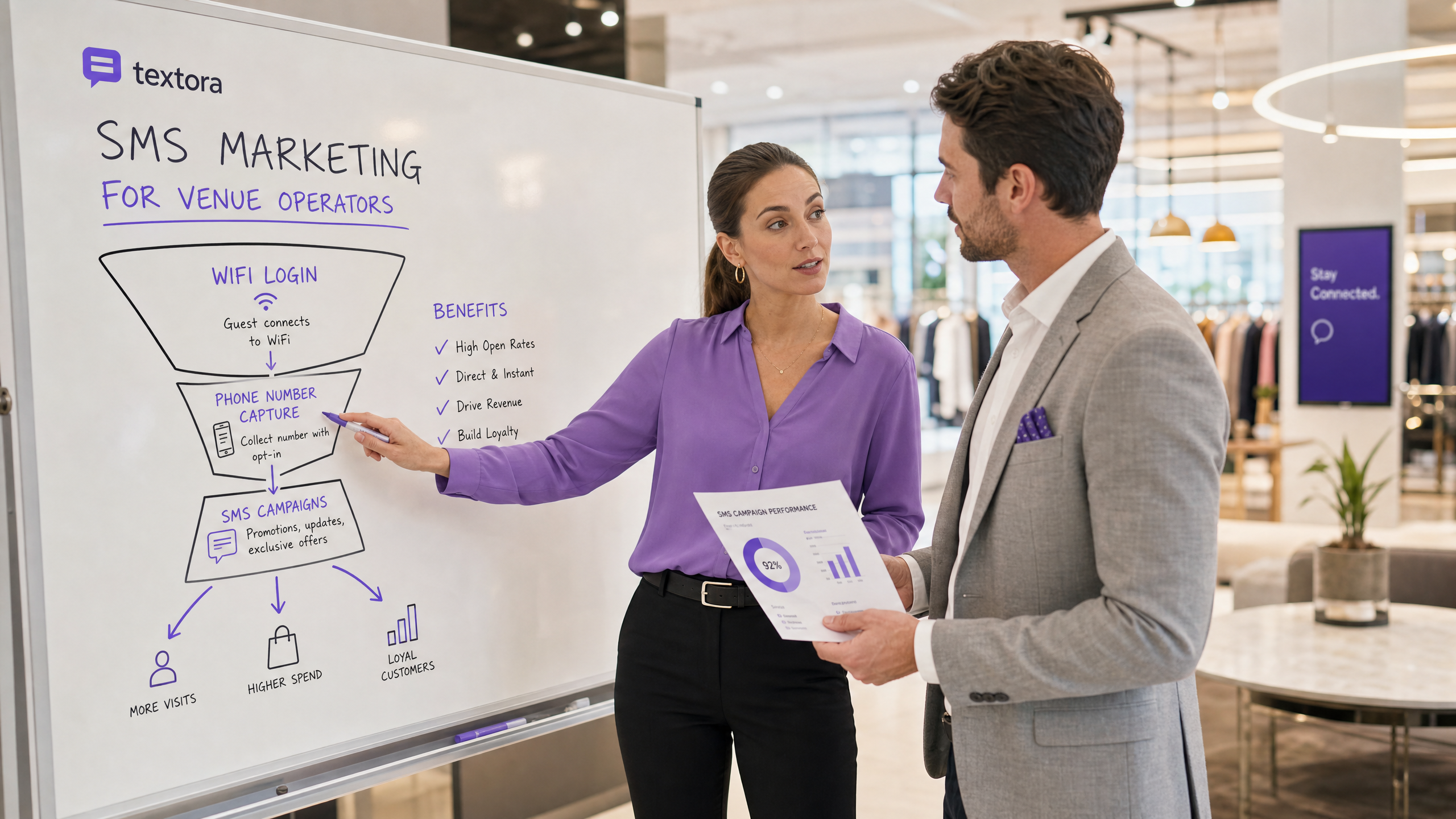
This guide details the technical architecture and business implementation of SMS bulk marketing for venue operators. It explains how to capture verified first-party data via Guest WiFi to drive targeted, high-ROI re-engagement campaigns that increase return visits.
Listen to this guide
View podcast transcript
Executive Summary
SMS bulk marketing offers a structural advantage over email for venue operators seeking to increase return visits. With open rates at 98% and reading rates within five minutes at 90%, it remains the most direct channel to your visitors [1]. The challenge for IT managers and marketing directors is not the channel itself, but the data quality feeding it. This guide details how to build an automated data capture pipeline using your existing Guest WiFi infrastructure. By capturing verified mobile numbers at the captive portal with explicit GDPR-compliant consent, you generate first-party data with venue-level context. We cover the deployment architecture across leading hardware vendors, compliance frameworks for data processing, and proven strategies for increasing return visits across hospitality, retail, and event venues.
Technical Deep-Dive
The core of a high-return SMS strategy is the data capture architecture. Most venues operate a disconnected stack: network hardware provides access, while marketing teams buy third-party lists. The modern approach unifies this using an identity-based cloud overlay.
The Data Capture Pipeline
The data capture pipeline operates in five distinct stages, transforming an anonymous MAC address into a consented, targetable identity.
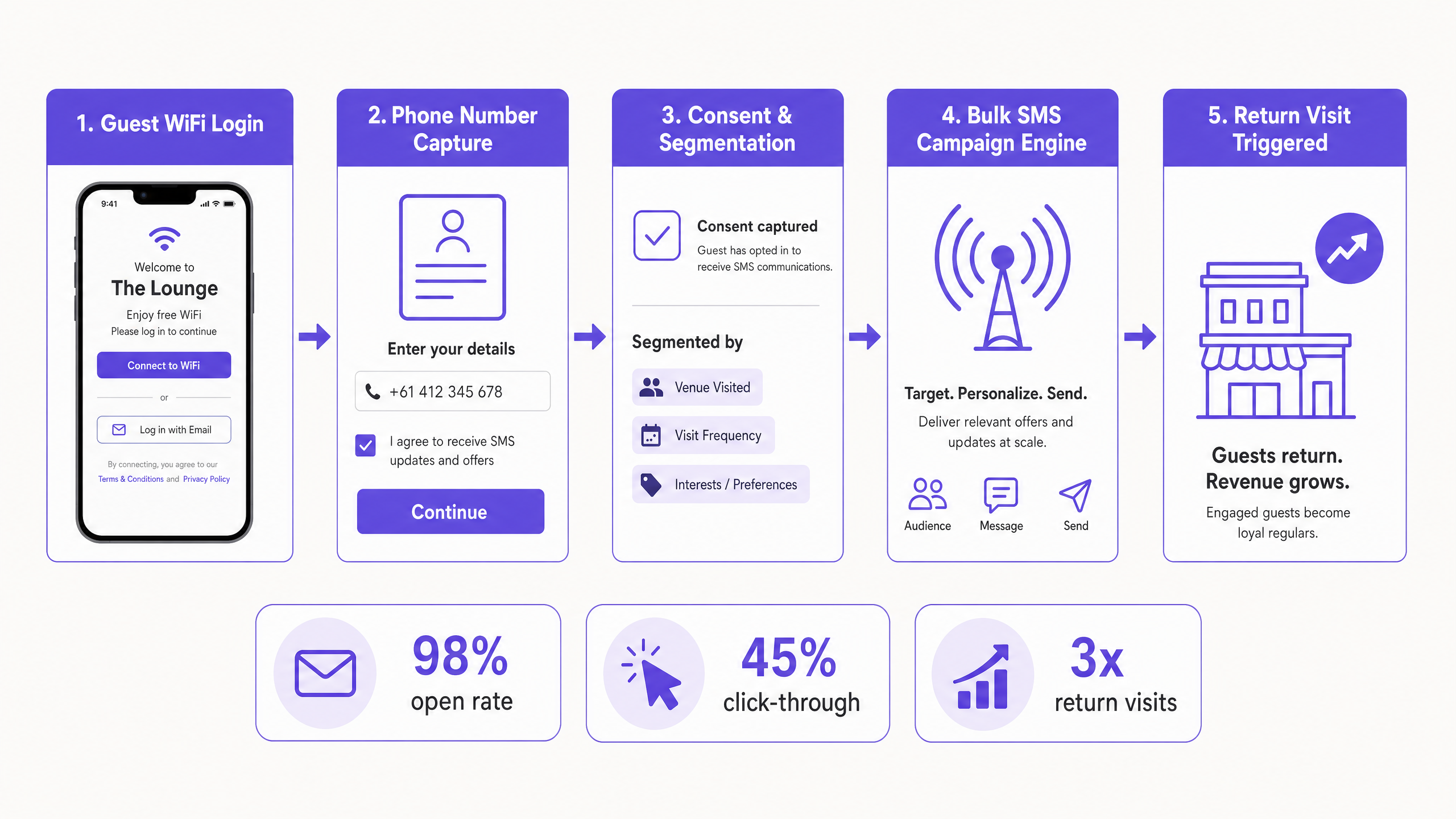
- Network Access Request: A visitor attempts to connect to the Guest WiFi SSID. The access point (AP) intercepts the request and redirects the device to an external captive portal using a RADIUS server.
- Authentication & Data Capture: The Purple captive portal loads on the device. To gain access, the visitor inputs their mobile number. This is verified data because the user physically types it to receive the service.
- Consent & Segmentation: Crucially, the portal presents a separate, unbundled opt-in checkbox for SMS marketing. Once checked, the identity is tagged with the specific venue, date, time, and device type.
- Campaign Engine: The data flows securely into the Purple Engage CRM. Marketing teams build segments (e.g., 'visitors who have not returned in 30 days') and dispatch messages through carrier-grade infrastructure.
- Attribution Loop: When the visitor returns and their device probes the network, the AP recognises the MAC address. Purple records the return visit, closing the attribution loop for the campaign.
Hardware Integration
Deploying this pipeline does not require a network rip-and-replace. Purple operates as a hardware-agnostic cloud overlay. It integrates natively with enterprise hardware including Cisco Meraki, HPE Aruba, Ruckus, Juniper Mist, Ubiquiti UniFi, Cambium, Extreme, and Fortinet. Configuration involves pointing the APs' RADIUS authentication and accounting traffic to Purple's cloud servers and whitelisting the captive portal domains (Walled Garden).
Implementation Guide
Deploying an SMS bulk marketing capability requires coordination between IT, Legal, and Marketing. Follow this step-by-step approach to ensure a secure, compliant rollout.
Phase 1: Network Configuration
- Provision the Captive Portal: Configure your Purple Capture plan to present a mobile number field as the primary authentication method.
- Configure RADIUS: Update your wireless LAN controller (WLC) or cloud dashboard to point authentication to Purple's RADIUS servers.
- Test the Flow: Verify that devices are successfully redirected to the portal, authentication succeeds, and the device is granted access via the defined VLAN.
Phase 2: Compliance and Consent
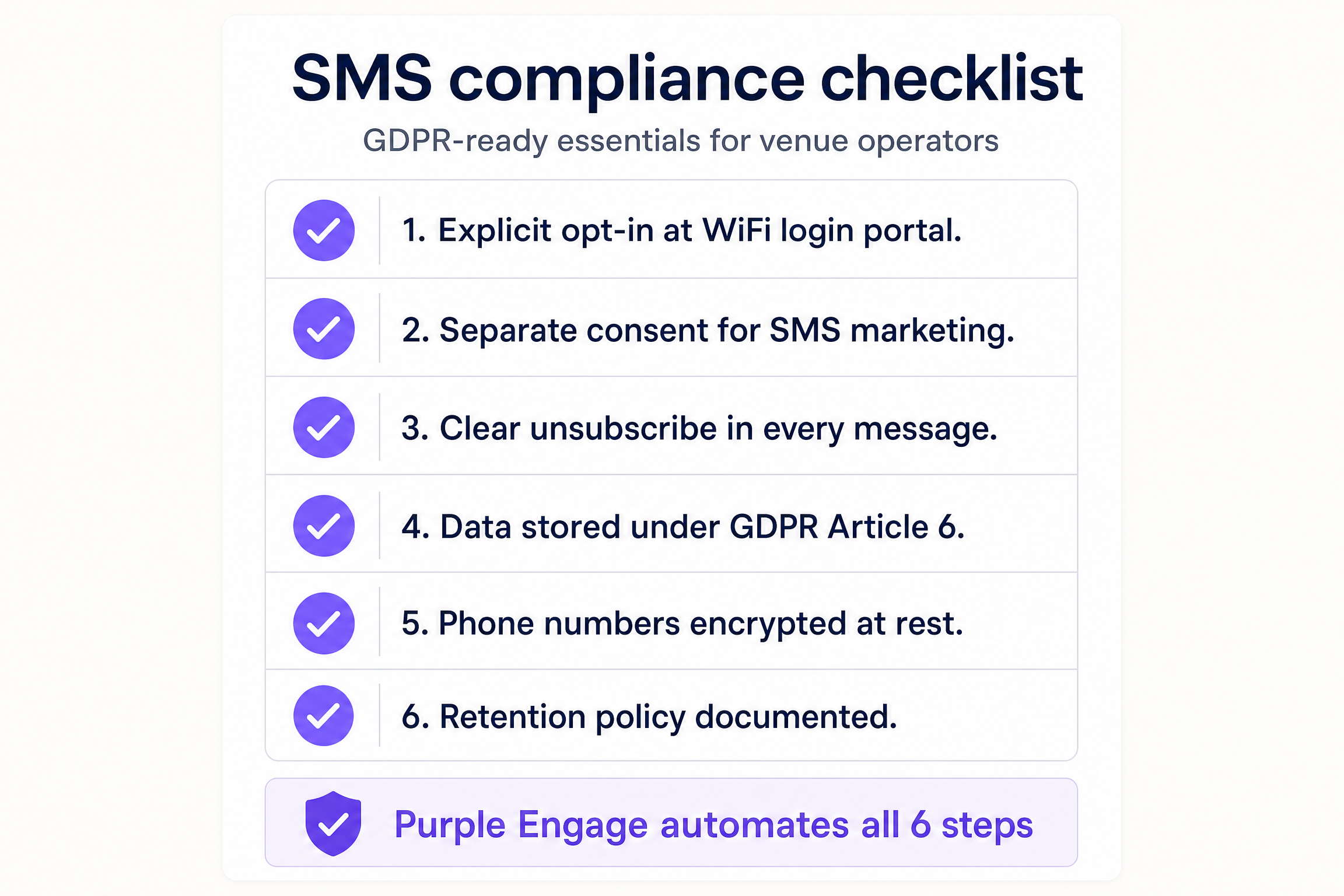
- Separate Opt-Ins: Ensure the SMS marketing opt-in is a separate, unticked checkbox. Do not bundle it with the WiFi Terms of Service.
- Update Privacy Policy: Link to a clear privacy policy explaining data retention and processing under GDPR Article 6.
- Legal Review: Have your data protection officer review the consent flow and the Purple data processing agreement.
Phase 3: Campaign Execution
- Build the Database: Allow 30 to 60 days of normal venue operation to build a statistically significant database of consented numbers.
- Define Segments: In Purple Engage, create segments based on venue location and visit recency.
- Launch Initial Campaign: Start with a simple win-back offer for visitors who have not returned in 60 days. Monitor delivery rates, opt-outs, and return visits.
Best Practices
To maximise the return on investment from your SMS campaigns, adhere to these industry-standard recommendations.
- Frequency Capping: SMS is a high-attention channel. Limit messages to four to six per month per contact to prevent high opt-out rates.
- Clear Attribution: Always measure success by tracking WiFi reconnections. If you send an offer to 5,000 people, the only metric that matters is how many of those MAC addresses reappear on your network within the campaign window.
- Localised Relevance: Segment your database by the specific venue visited. A shopper in Manchester is unlikely to respond to an offer for a store in London.
- Value Exchange: Ensure every message provides clear value: an exclusive discount, early access, or critical event information. Do not send generic brand updates via SMS.
Troubleshooting & Risk Mitigation
When deploying SMS bulk marketing at scale, teams typically encounter specific failure modes. Here is how to mitigate them.
| Failure Mode | Root Cause | Mitigation |
|---|---|---|
| High Opt-Out Rates | Sending too frequently or irrelevant content | Implement frequency caps in Purple Engage and segment audiences by venue and visit history. |
| Low Data Capture Rate | Captive portal is too complex or slow to load | Simplify the portal to ask only for mobile number and consent. Ensure the Walled Garden is correctly configured. |
| Legal Compliance Challenges | Bundled consent or missing privacy links | Strictly separate WiFi access terms from marketing opt-ins. Use Purple's pre-built compliance templates. |
| Delivery Delays | Inadequate SMS gateway throughput | Use an enterprise-grade provider with direct carrier connections, capable of handling bulk sends without queuing. |
ROI & Business Impact
The business case for SMS bulk marketing rests on its exceptional engagement metrics. With average open rates of 98% and an ROI ranging from $21 to $71 for every $1 spent [2], the channel outperforms email significantly.
For a retail venue, capturing 10,000 numbers and achieving a 5% return visit rate on a win-back campaign generates 500 additional footfall events. If the average transaction value is £40, that single campaign generates £20,000 in gross revenue. Because the data is first-party and captured via existing Guest WiFi infrastructure, the customer acquisition cost is exceptionally low.
Listen to our technical briefing podcast for a deeper dive into real-world implementation scenarios:
References
[1] Forbes / Infobip. SMS marketing statistics: Key figures for 2026. https://www.infobip.com/blog/sms-marketing-statistics [2] MessageFlow. SMS Marketing Benchmarks 2026: CTR, Open Rates by Industry. https://messageflow.com/blog/sms-marketing-benchmarks
Key Definitions
Captive Portal
A web page that a user of a public access network is obliged to view and interact with before access is granted.
This is the primary data capture point where venue operators collect mobile numbers.
MAC Address
A unique identifier assigned to a network interface controller for use as a network address in communications.
Used to track devices and attribute return visits when a guest reconnects to the network.
First-Party Data
Information a company collects directly from its customers and owns.
Data captured via Guest WiFi is highly valuable first-party data, unlike purchased third-party lists.
Opt-In
Express permission given by a customer to a business to send them marketing communications.
Crucial for GDPR compliance; must be granular, specific, and freely given.
Cloud Overlay
A software architecture that sits on top of existing physical infrastructure without requiring hardware replacement.
Allows Purple to integrate with existing Cisco Meraki, Aruba, or Ruckus access points.
Walled Garden
A restricted environment that controls the user's access to web content and services.
Used to allow devices to reach the captive portal before full internet access is granted.
RADIUS
Remote Authentication Dial-In User Service; a networking protocol that provides centralized authentication, authorization, and accounting.
The protocol used by the access point to communicate with Purple's servers to authenticate the guest.
Frequency Capping
Limiting the number of times a specific user sees a specific advertisement or receives a message within a given timeframe.
Essential in SMS marketing to prevent subscriber fatigue and high opt-out rates.
Worked Examples
A 350-room hotel group needs to increase its return visit rate, which is currently under 8%. They have HPE Aruba access points installed.
- Deploy Purple Engage as a cloud overlay on the existing HPE Aruba hardware. 2. Configure the captive portal to capture mobile numbers with an explicit, unbundled SMS opt-in. 3. Over 90 days, build a database of 14,000 consented numbers. 4. Run a targeted win-back campaign offering a 15% loyalty rate to guests who stayed more than 60 days ago. 5. Track return visits via WiFi reconnection.
A retail chain with 45 stores wants to use WiFi data for SMS marketing but the legal team has blocked it due to GDPR concerns.
- Update the captive portal to ensure the SMS marketing opt-in is a separate, unticked checkbox, entirely decoupled from the WiFi terms of service. 2. Update the privacy policy to define the lawful basis for processing (consent) under Article 6. 3. Ensure data is processed under a compliant DPA. 4. Implement automated opt-out handling in the campaign engine.
Practice Questions
Q1. Your venue currently asks users to tick a single box that says 'I agree to the Terms of Service and to receive marketing communications' before granting WiFi access. Is this approach recommended?
Hint: Consider the GDPR requirements for consent.
View model answer
No. This approach is non-compliant under GDPR. Consent for marketing must be unbundled from the terms of service required to access the network. You must provide a separate, unticked checkbox specifically for SMS marketing opt-in.
Q2. You have dispatched an SMS campaign to 10,000 past visitors offering a 20% discount code. How should you measure the primary success of this campaign?
Hint: Think about the data captured by the network hardware.
View model answer
While tracking the use of the discount code is useful, the primary measure of success should be tracking WiFi reconnections. Purple can track how many of the MAC addresses associated with the 10,000 phone numbers reconnect to the network within the campaign window, providing a definitive measure of return visits.
Q3. A retail client wants to send a weekly SMS blast to their entire database promoting new stock. What advice should you give them?
Hint: Consider subscriber fatigue and segmentation.
View model answer
Advise against this strategy. Sending weekly blasts to the entire database will likely lead to high opt-out rates. Instead, recommend frequency capping (maximum 4-6 messages per month) and segmenting the audience based on the specific venue they visited and their visit recency to ensure relevance.