
How to leverage SMS marketing for business to increase return visits
This guide details how venue operators can use existing Guest WiFi infrastructure to capture verified phone numbers and deploy automated SMS marketing campaigns. It covers the technical architecture, GDPR compliance requirements, and specific implementation steps needed to drive return visits across retail and hospitality environments.
Listen to this guide
View podcast transcript
Executive summary
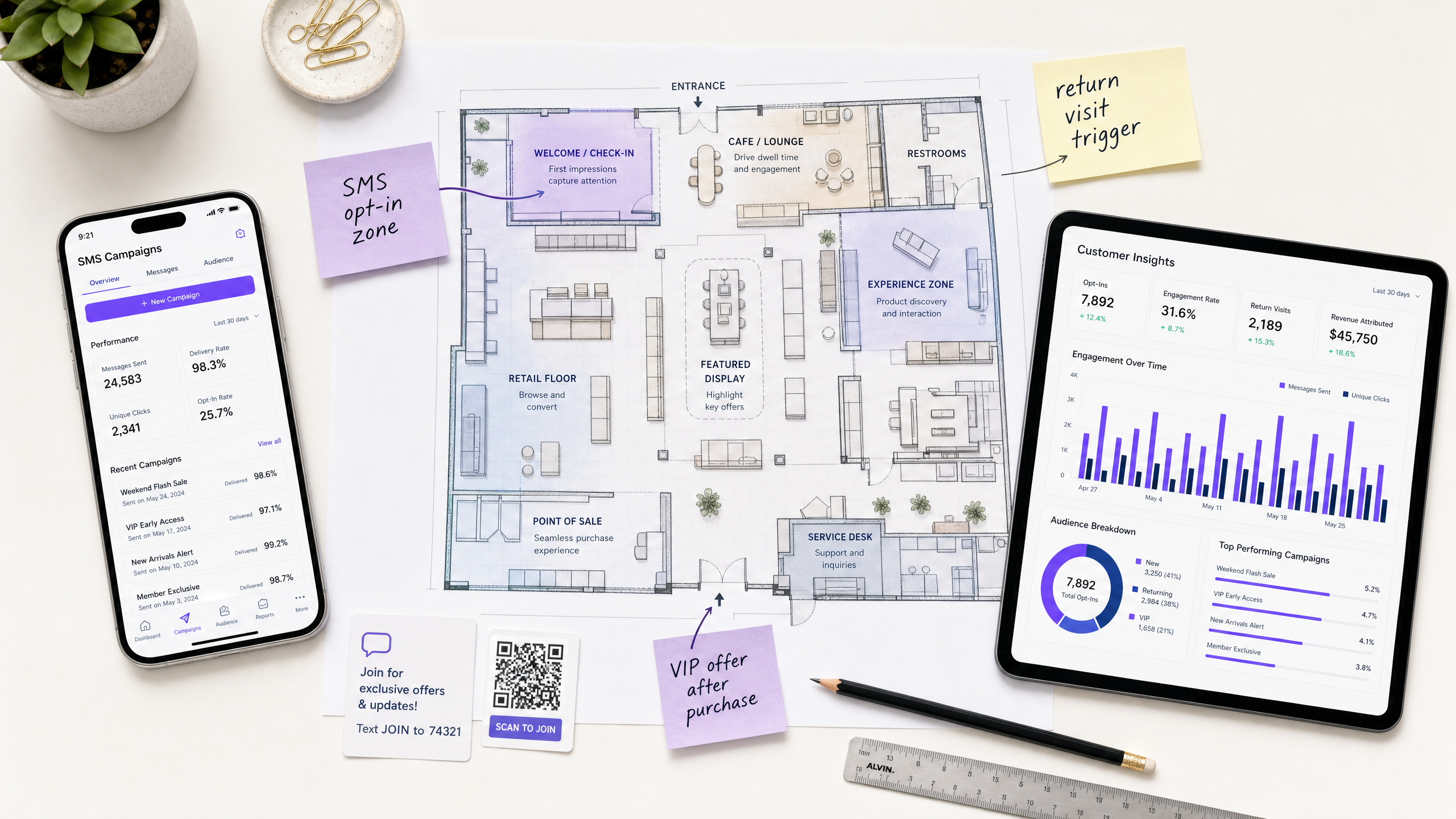
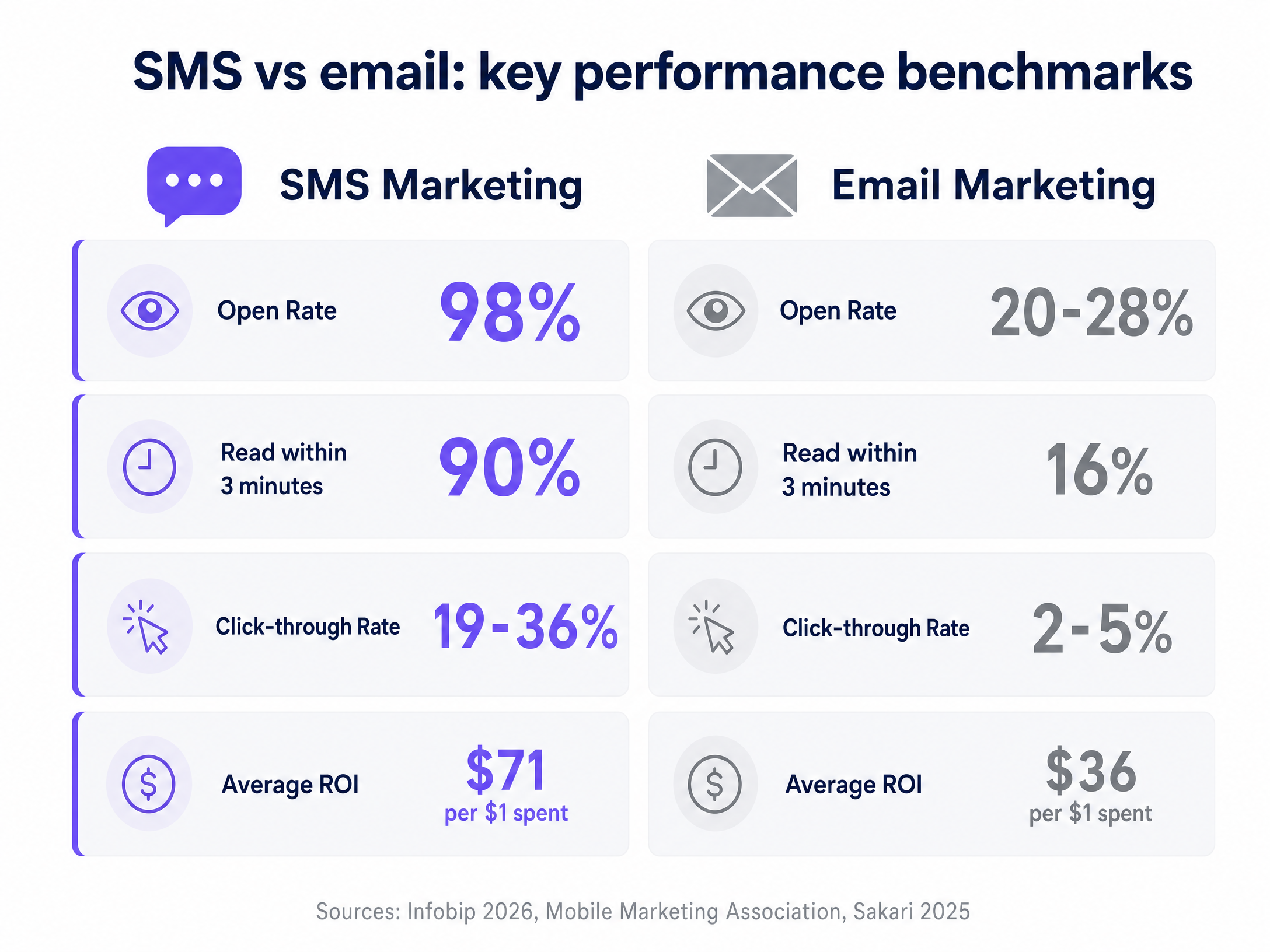
SMS marketing achieves a 98% open rate and a 7100% ROI, yet many venue operators struggle to implement it effectively due to poor data quality. This guide outlines how to use your existing Guest WiFi infrastructure to capture verified phone numbers at the point of login, ensuring GDPR compliance and high data accuracy. By integrating Purple Engage with hardware from Cisco Meraki, HPE Aruba, Ruckus, Juniper Mist, Ubiquiti UniFi, Cambium, Extreme, or Fortinet, you can automate segmented SMS campaigns that drive return visits. We will cover the technical deployment architecture, compliance requirements, and specific trigger logic used by operators like Premier Inn and McDonald's to increase footfall.
Technical deep-dive
The foundation of effective SMS marketing for business is verified first-party data. When a visitor connects to your Guest WiFi, they pass through a captive portal. This presents a conscious-choice opt-in moment. The Purple cloud overlay manages this portal, regardless of your underlying hardware.
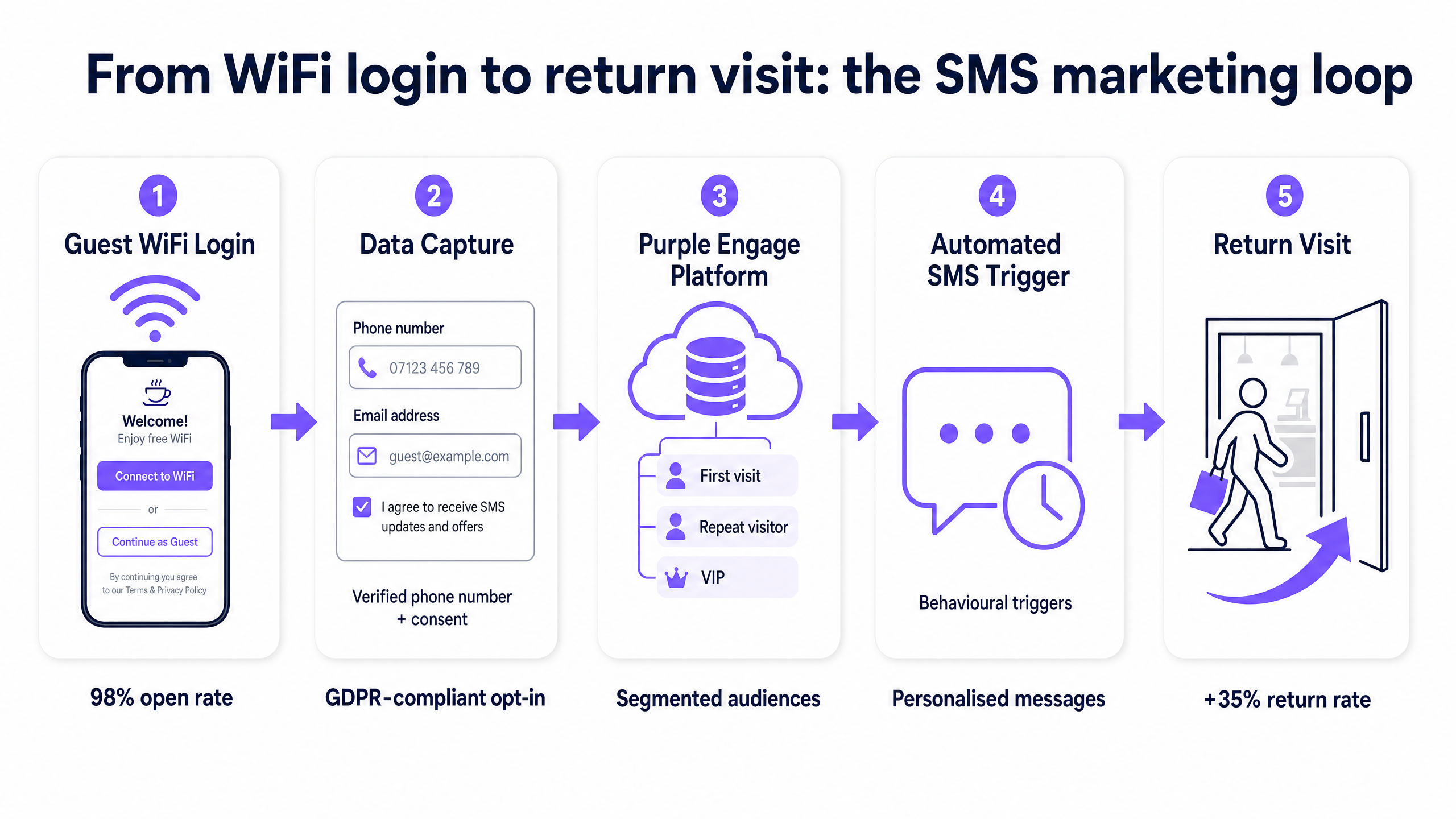
The data capture flow
The architecture relies on a seamless transition from network access to CRM entry:
- Network connection: The device associates with the Guest WiFi SSID.
- Captive portal interception: The hardware controller redirects HTTP traffic to the Purple splash page.
- Authentication and consent: The visitor provides their phone number and explicitly ticks a box consenting to SMS marketing. This satisfies GDPR and PECR requirements in the UK.
- Data validation: Purple verifies the format of the phone number and logs the MAC address, timestamp, and location data.
- CRM synchronisation: The verified profile enters the Purple Engage database, ready for segmentation.
Identity-Based Networks
This approach shifts the focus from managing devices (MAC addresses) to managing known identities. By linking a verified phone number to a device MAC address, Purple Engage can track subsequent visits automatically. When the device is seen again, the platform logs a return visit without requiring the user to log in again, providing accurate frequency data for SMS triggers.
Implementation guide
Deploying an automated SMS marketing system requires careful configuration of both the network layer and the marketing automation platform.
Step 1: Configure the captive portal
Your splash page must be optimised for data capture while maintaining a fast connection experience.
- Add a mandatory phone number field to the login form.
- Include a separate, unticked checkbox for SMS marketing consent. Do not bundle this with the general terms and conditions.
- Clearly state the frequency of messages (e.g., "Maximum 2 messages per month").
Step 2: Define audience segments
Do not send broadcast messages to your entire database. Segment your audience based on behaviour:
- First-time visitors: Users with exactly one recorded visit.
- Repeat visitors: Users with two to four visits.
- VIPs: Users with five or more visits.
- Lapsed visitors: Users who have not connected to the network in the last 30 days.
Step 3: Configure automated triggers
Set up automated campaigns in Purple Engage based on the segments defined above.
- The win-back trigger: If a visitor has not returned in 21 days, send a re-engagement SMS with a time-limited offer.
- The VIP reward: When a visitor logs their fifth visit, trigger an SMS thanking them for their loyalty with an exclusive discount.
Best practices
To maximise the effectiveness of your SMS marketing for business, adhere to these standards:
- Keep it brief: SMS messages are limited to 160 characters. Get to the point immediately.
- Include your brand name: Always start the message with your brand name so the recipient knows who is contacting them.
- Clear call to action: Include a single, trackable link.
- Respect frequency limits: Send a maximum of two to three promotional messages per month to avoid high opt-out rates.
- Timing matters: Do not send messages between 21:00 and 08:00. Mid-morning or mid-afternoon typically yields the highest engagement.
Troubleshooting and risk mitigation
Implementing SMS marketing carries specific compliance and operational risks.
Compliance failures
The most significant risk is violating GDPR or PECR. You must maintain an auditable record of consent for every phone number. Ensure every SMS includes a clear opt-out mechanism (e.g., "Reply STOP to unsubscribe"). Purple Engage automatically processes these opt-outs and updates the user profile to prevent future messages.
High opt-out rates
If your opt-out rate exceeds 2%, your messaging is either too frequent or irrelevant. Review your segmentation logic and ensure your offers provide genuine value. A 10% discount on a high-margin item is more effective than a generic newsletter update.
Poor data quality
If visitors enter fake phone numbers to access the WiFi, your delivery rates will drop. To mitigate this, implement SMS verification during the login process, where the user must enter a code sent to their device before gaining internet access. While this adds friction, it guarantees 100% data accuracy.
ROI and business impact
The primary metric for success is the return visit rate. By tracking the number of visitors who receive an SMS and subsequently reconnect to the Guest WiFi within a specified window, you can accurately measure the campaign's impact on footfall.
For example, a 150-room hotel implemented a 21-day win-back SMS trigger. Over 90 days, the campaign achieved a 34% click-through rate and generated 180 direct bookings, bypassing OTA commissions of 15% to 25%.
Listen to our technical briefing podcast for a deeper dive into the architecture and implementation strategies:
Key Definitions
Captive portal
The web page that a user must interact with before gaining access to a public WiFi network.
This is the primary data capture point for building an SMS marketing database.
Identity-Based Networks
A network architecture that associates device MAC addresses with verified user identities (like a phone number).
This allows venue operators to track return visits and trigger behavioural SMS campaigns without requiring users to log in repeatedly.
First-party data
Information a company collects directly from its customers and owns entirely.
Guest WiFi captures high-quality first-party data, reducing reliance on third-party advertising platforms.
Conscious-choice opt-in
The requirement that a user actively agrees to receive marketing communications, typically by ticking an empty checkbox.
This is a fundamental requirement for GDPR and PECR compliance when running SMS marketing campaigns.
MAC address
A unique identifier assigned to a network interface controller.
Purple uses the MAC address to recognize returning devices and measure the success of SMS campaigns by tracking subsequent network connections.
Automated trigger
A rule set in a marketing platform that automatically sends a message when a specific condition is met.
Triggers based on dwell time or days since last visit ensure SMS messages are relevant and timely.
PECR
Privacy and Electronic Communications Regulations. The UK law that governs electronic marketing, including SMS.
Venue operators must comply with PECR alongside GDPR to avoid significant fines.
Cloud overlay
A software platform that operates on top of existing physical network hardware.
Purple functions as a cloud overlay, meaning venues do not need to replace their Cisco Meraki or HPE Aruba access points to implement SMS data capture.
Worked Examples
A 150-room hotel property is capturing guest email addresses through Guest WiFi but not phone numbers, resulting in low engagement with win-back campaigns.
The hotel added a phone number field to their captive portal with explicit SMS consent. They configured Purple Engage to trigger an automated SMS to any guest who checked out and had not made a new booking within 21 days. The SMS included a direct booking link and a 10% return discount.
A fashion retailer with 12 stores wants to increase weekend footfall using their database of 18,000 opted-in shoppers.
The retailer used Purple Engage to send a single broadcast SMS at 10:00 on a Saturday morning, announcing a weekend flash sale. The message was 147 characters and included a trackable link.
Practice Questions
Q1. A retail venue wants to start SMS marketing and plans to add a pre-ticked consent box to their WiFi login page to maximise list growth. Is this advisable?
Hint: Consider the requirements of GDPR and PECR regarding explicit consent.
View model answer
No. Under GDPR and PECR, consent must be freely given, specific, informed, and unambiguous. Pre-ticked boxes do not constitute valid consent. The venue must use an unticked box that requires a conscious choice from the user to opt in.
Q2. You have segmented your database and want to send a broadcast SMS to 10,000 lapsed visitors. The message text is 185 characters long. What is the technical implication?
Hint: Consider the standard character limit for a single SMS message.
View model answer
The message exceeds the 160-character limit for a single SMS. It will be split into two segments and concatenated on the recipient's device. This will double the sending cost for the campaign. The message should be edited down to 160 characters or fewer.
Q3. A hotel wants to measure the exact ROI of an SMS campaign designed to drive food and beverage sales in their restaurant. How should they configure the campaign?
Hint: Consider how to track the transition from receiving the digital message to making a physical purchase.
View model answer
The hotel should include a unique, trackable discount code in the SMS (e.g., 'Show this text for 15% off dinner'). When the code is redeemed at the restaurant's point of sale, the revenue can be directly attributed to the SMS campaign, providing an accurate ROI calculation.