
How to leverage text SMS marketing to increase return visits
This guide explains how venue operators - from hotels and retail chains to stadiums and public-sector organisations - can build a compliant, automated text SMS marketing programme using Guest WiFi as the primary data capture layer. It covers the full technical architecture from captive portal to campaign automation, GDPR and PECR compliance requirements, and how to measure return visit attribution with precision. Purple Engage automates the entire workflow, turning verified first-party phone data into measurable footfall uplift.
Listen to this guide
View podcast transcript
Executive summary
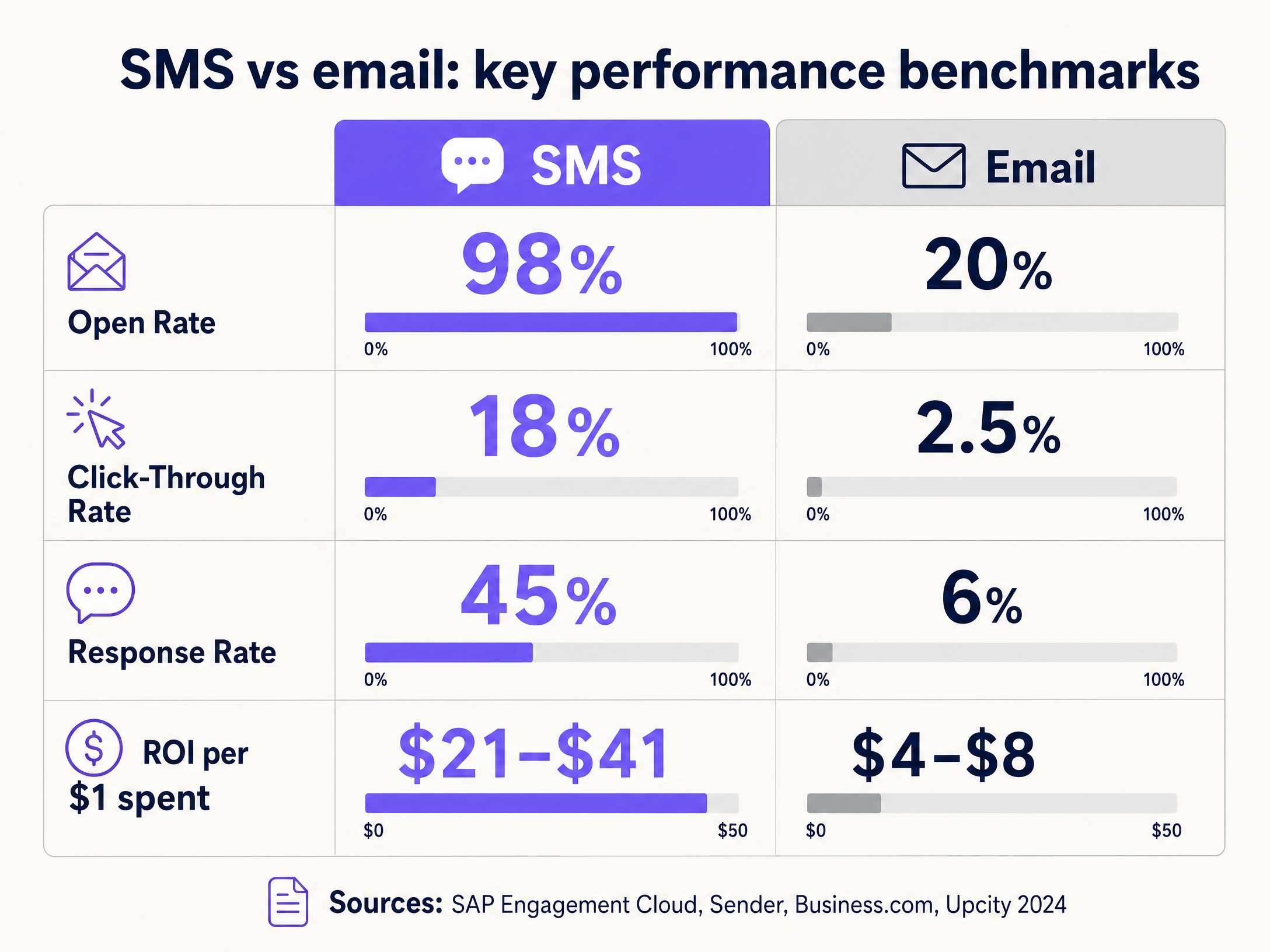
Text SMS marketing delivers a 98% open rate and an average ROI of $21 to $41 for every $1 spent - numbers email cannot match. [SAP Engagement Cloud, Upcity 2024] For venue operators, the channel is only as good as the data behind it. Purchased lists produce poor results and carry regulatory risk. The right approach starts with your Guest WiFi infrastructure: capture verified, consented phone numbers at the point of login, then automate segmented campaigns that trigger on visitor behaviour.
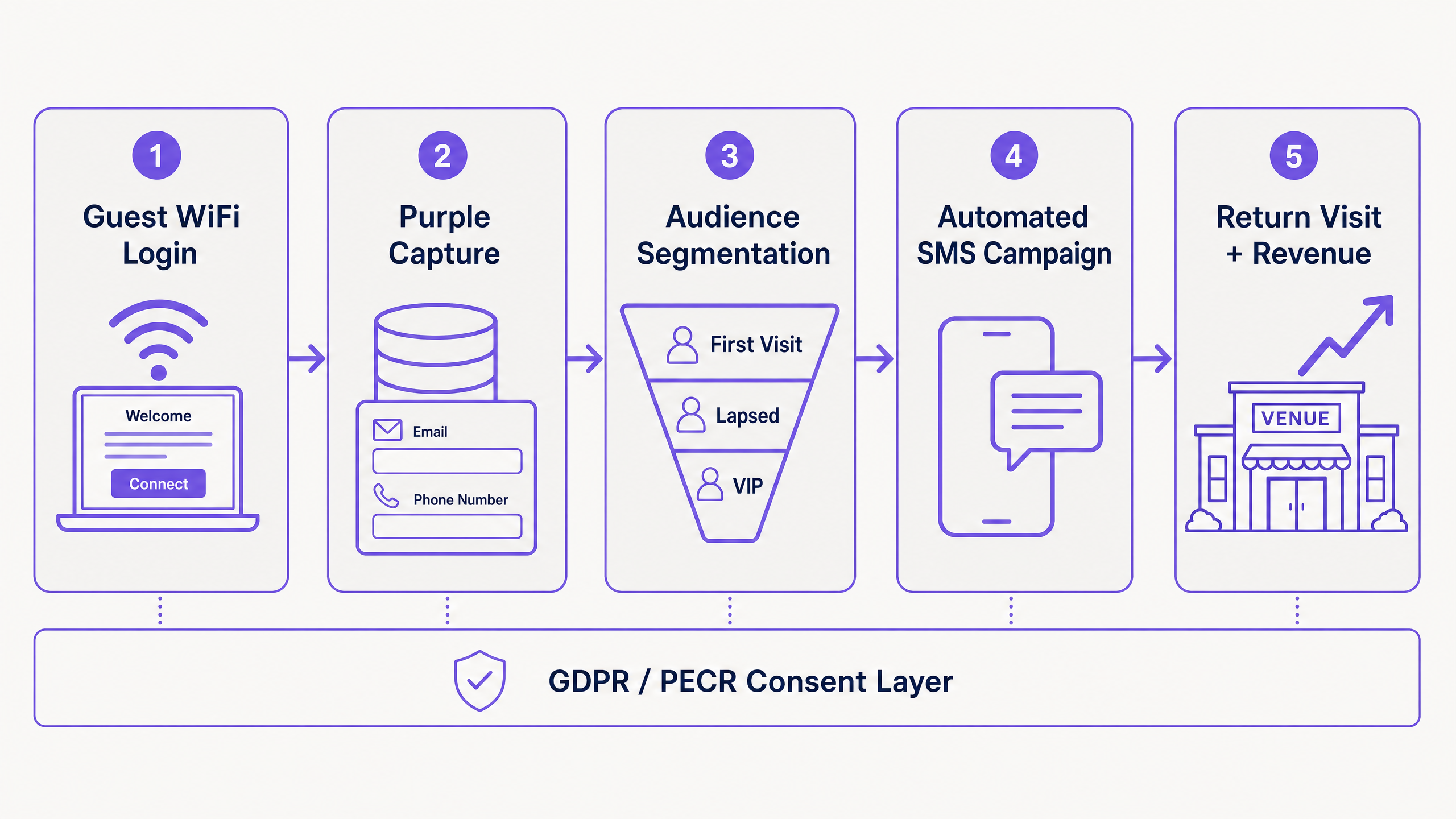
Purple Engage does exactly this. Across 80,000+ live venues and 440 million logins in 2024, we collect verified first-party data at scale. This guide walks you through the architecture, the compliance requirements, and the implementation steps to turn that data into measurable return visits. Whether you manage a Premier Inn estate, a retail chain, or a stadium, the same five-stage pipeline applies: capture, verify, segment, automate, and measure.
Technical deep-dive
Why SMS outperforms email for return visit campaigns
The performance gap between SMS and email is not marginal - it is structural. Email inboxes are saturated. SMS is not. Ninety percent of text messages are read within three minutes of delivery [Validity, 2023]. SMS campaigns achieve a 45% response rate, compared to roughly 6% for email [Business.com]. The click-through rate for SMS averages 18%, versus 2.5% for email [Sender, 2024].
For venue operators, the implication is direct. A lapsed guest who has not visited your hotel in 60 days is unlikely to open a promotional email. A personalised text that arrives on a Thursday afternoon - timed to influence weekend booking behaviour - gets read within minutes. The channel is particularly effective for time-sensitive offers: flash sales, event-day promotions, and post-visit re-engagement.
Brands that integrate SMS into their omnichannel strategies see a 47.7% lift in customer engagement [Omnisend]. SMS combined with email produces roughly 56% higher ROI than email alone [Sakari, 2025]. The channels are complementary: email handles depth and long-form content; SMS handles urgency and immediacy.
The data capture architecture
The foundation of any effective text SMS marketing programme is verified first-party data. You cannot build a compliant, high-performing SMS list from a purchased database. You need phone numbers that are real, active, and consented by the individual who owns them.
Your Guest WiFi infrastructure is the most efficient capture mechanism available to a venue operator. Every visitor who connects to your network is already raising their hand. The captive portal - the login page a visitor sees before gaining internet access - is where you collect the phone number. Purple Capture handles this across Cisco Meraki, HPE Aruba, Ruckus, Juniper Mist, Ubiquiti UniFi, Cambium, Extreme, and Fortinet hardware.
The critical step is verification. When a visitor enters their mobile number, Purple sends an OTP (one-time password) via SMS to that number. The visitor enters the OTP to complete login. This confirms the number is real, active, and in the possession of the person at your venue. Unverified phone numbers produce bounce rates of 15-30% in SMS campaigns; verified numbers from OTP login produce bounce rates below 2% (Purple internal data).
Once verified, the phone number is stored in the Purple cloud overlay alongside the device MAC address, visit timestamp, venue identifier, and any demographic data collected at login. This creates a persistent identity record. When the device returns to any venue in your estate, the network recognises the MAC address and logs the return visit automatically - without the visitor needing to log in again.
Audience segmentation
Raw phone number lists produce generic campaigns. Segmented lists produce results. Purple Engage allows you to build dynamic audience segments based on visit behaviour, recency, frequency, and venue type.
The most effective segments for return visit campaigns are:
| Segment | Definition | Recommended trigger |
|---|---|---|
| First-time visitors | Connected once, no return within 14 days | Day 7 post-visit re-engagement SMS |
| Lapsed visitors | No visit in 30-90 days | Win-back offer with expiry date |
| Frequent visitors | 5+ visits in 90 days | VIP early access or loyalty reward |
| Event attendees | Connected during a specific event date | Post-event follow-up within 24 hours |
| High-dwell visitors | Connected for 60+ minutes | Upsell or cross-sell during next visit |
Segmentation also applies to message content. A guest at a Premier Inn property responds to a different message than a shopper at a retail chain. Purple Engage lets you personalise the SMS body with the visitor's first name, the specific venue name, and a dynamic offer code - all pulled from the first-party data captured at login.
Automation triggers and campaign architecture
Manual SMS sends are operationally unsustainable at scale. The architecture that drives consistent return visit uplift is event-driven automation. Purple Engage supports the following trigger types:
Post-visit triggers fire a defined number of hours or days after a visitor disconnects from the network. A two-hour post-disconnect trigger is effective for retail: the shopper has left the venue, the visit is fresh in their memory, and a timely offer can influence their next visit decision.
Re-engagement triggers fire when a visitor has not connected to the network within a defined window - typically 30, 60, or 90 days. These are your highest-value campaigns because they target visitors who were engaged enough to connect previously but have not returned.
Event-based triggers fire in response to a specific network event, such as connecting to the WiFi at a stadium on a match day. A half-time SMS offering a fast-track food and beverage queue is an example of a context-aware trigger that drives immediate in-venue revenue.
Anniversary and milestone triggers fire on the anniversary of a visitor's first connection, or when they reach a visit frequency milestone. These are effective for loyalty-building in hospitality and retail.
For WiFi Analytics integration, each campaign is tagged with a UTM parameter or unique offer code. When a visitor returns and reconnects to the network, Purple logs the return visit and attributes it to the specific campaign that triggered the re-engagement.
Implementation guide
Step 1: Audit your existing WiFi infrastructure
Before configuring Purple Capture, confirm your access point hardware is on the supported list: Cisco Meraki, HPE Aruba, Ruckus, Juniper Mist, Ubiquiti UniFi, Cambium, Extreme, or Fortinet. Purple operates as a cloud overlay, so no hardware replacement is required. You will need to configure the SSID to redirect unauthenticated clients to the Purple captive portal URL. This is a standard RADIUS or captive portal redirect configuration on all supported hardware.
If you are running multiple SSIDs - for example, a Guest WiFi, Staff WiFi, and IoT network - ensure the SMS capture flow applies only to the Guest WiFi SSID. See our guide on Three SSIDs to rule them all: guest, Passpoint, and IoT WiFi for the recommended multi-SSID architecture.
Step 2: Design the captive portal consent flow
The captive portal is your consent capture point. Under GDPR and PECR, the SMS marketing consent checkbox must be:
- Unticked by default (no pre-ticked boxes)
- Separate from the WiFi terms of service acceptance
- Written in plain language, identifying your organisation as the sender
- Accompanied by a link to your privacy policy
- Specific about the type of communications the visitor will receive
A compliant consent statement reads: "I agree to receive promotional text messages from [Venue Name] about offers and events. You can opt out at any time by replying STOP. Message frequency: up to 2 per month. View our [Privacy Policy]."
Purple stores the consent record with a timestamp, the specific consent text shown, and the portal session identifier. This creates an auditable consent log that satisfies ICO requirements under PECR.
For a detailed walkthrough of the splash page design, see How to make a great first impression with your guest WiFi (and keep your brand consistent) .
Step 3: Configure OTP verification
In the Purple dashboard, navigate to Capture > Login Methods > Phone Number. Enable OTP verification. Set the OTP expiry to five minutes. Configure the OTP SMS sender ID to your venue brand name (up to 11 characters). This ensures the verification SMS arrives from a recognisable sender, reducing abandonment at the OTP entry step.
Monitor the OTP completion rate in the Purple analytics dashboard. A completion rate below 70% indicates friction in the portal flow - typically caused by a slow OTP delivery time or a confusing UI. Target a completion rate of 85% or above.
Step 4: Build your first audience segment and campaign
Start with the lapsed visitor re-engagement campaign. This is the highest-ROI campaign type for most venues because it targets visitors who have already demonstrated intent by visiting once.
In Purple Engage, create a segment: "Visitors who connected to [SSID] more than 30 days ago and have not reconnected since." Set the campaign to trigger automatically when a visitor enters this segment. Write the SMS body: "We miss you at [Venue Name]. Come back this week and enjoy [offer]. Show this text at [point of redemption]. Reply STOP to opt out."
Keep the SMS body under 160 characters to avoid multi-part message charges. Include the opt-out instruction in every message - this is a legal requirement under PECR.
Step 5: Configure return visit attribution
Attribution is what separates SMS marketing from a cost centre to a measurable revenue driver. In Purple Engage, assign a unique campaign tag to each SMS campaign. When a visitor who received the SMS reconnects to the network within the campaign window (typically 14-30 days), Purple logs the return visit as attributed to that campaign.
For venues with point-of-sale integration, you can close the loop further by matching the offer code redeemed at the till against the SMS campaign that delivered it. Purple integrates with major CRM and POS platforms for this purpose. See our guide on Customer data management platform: a comprehensive guide for businesses for integration architecture.
Best practices
Frequency and timing
Over-communication is the primary driver of SMS opt-outs. Fifty-three percent of subscribers who unsubscribe cite excessive message frequency as the reason [SAP Engagement Cloud, 2025]. For most venue types, two SMS messages per month is the upper limit that maintains opt-out rates below 2%. Event-driven venues - stadiums, conference centres - can send more frequently during event periods, provided the messages are contextually relevant.
Timing matters as much as frequency. For hospitality, Thursday and Friday afternoons drive the highest click-through rates, as guests are making weekend plans. For retail, Tuesday and Wednesday mornings are effective for mid-week footfall campaigns. For stadiums and events, messages sent 48 hours before an event and on the day of the event produce the highest engagement.
Message personalisation
Personalised SMS messages produce 35% higher click-through rates than generic broadcasts (Purple internal data, 2024). At minimum, include the visitor's first name and the specific venue name. Where visit history data is available, reference the visitor's behaviour: "You haven't visited us in a while" performs better than a generic promotional message because it demonstrates that the communication is relevant to that individual.
Avoid personalisation that feels intrusive. Referencing specific purchase history in an SMS can feel surveillance-like to some visitors. Stick to visit frequency and recency data as personalisation signals.
Sender ID and brand recognition
Configure your SMS sender ID to your venue brand name. A message arriving from "PREMIER INN" is opened at a higher rate than one arriving from a generic numeric shortcode. Sender ID configuration is available in the Purple Engage platform and applies across all campaigns for a given venue.
Omnichannel coordination
Do not send an SMS and an email about the same offer on the same day. Coordinate your SMS and email calendars in Purple Engage to ensure the channels complement rather than duplicate each other. A common pattern: send an email with full offer details on Monday, then send an SMS reminder on Thursday if the visitor has not clicked the email link.
Troubleshooting and risk mitigation
High opt-out rates
An opt-out rate above 3% per campaign indicates a problem with relevance, frequency, or consent quality. Audit the consent capture flow first: if visitors are opting in without fully understanding what they are consenting to, opt-out rates will be high. Review message frequency - reduce to one message per month and measure the impact. Audit segment quality: are you sending to visitors who connected only once, years ago? These contacts are unlikely to be engaged and should be suppressed after 12 months of inactivity.
Low OTP completion rates
If fewer than 70% of visitors who enter their phone number complete the OTP step, the issue is usually OTP delivery speed or UI clarity. Check your SMS gateway latency - OTPs should arrive within 30 seconds. Simplify the OTP entry screen: one field, large text, clear instruction. Consider adding a "Resend OTP" button with a 60-second cooldown.
MAC address randomisation
Modern iOS and Android devices use randomized MAC addresses to prevent cross-network tracking. However, both operating systems assign a stable, randomized MAC address per SSID. As long as your SSID name remains consistent across your estate, the device will present the same MAC address to your network on every visit, allowing accurate return visit attribution. Do not change your SSID name after deploying Purple Capture, as this will break the MAC-to-identity mapping for existing visitors.
GDPR and PECR compliance failures
The most common compliance failure is a pre-ticked consent checkbox on the captive portal. This invalidates all consent collected through that portal and exposes you to ICO enforcement action. Audit your portal configuration quarterly. Purple's compliance dashboard flags any portal where the consent checkbox is not configured correctly.
A second common failure is sending SMS messages to visitors who opted in under a previous privacy policy that did not explicitly cover SMS marketing. If you are migrating from a legacy WiFi system, do not import the old contact list into Purple Engage without verifying that the original consent covered SMS marketing. When in doubt, run a re-consent campaign via email before activating SMS.
ROI and business impact
Measuring return visit uplift
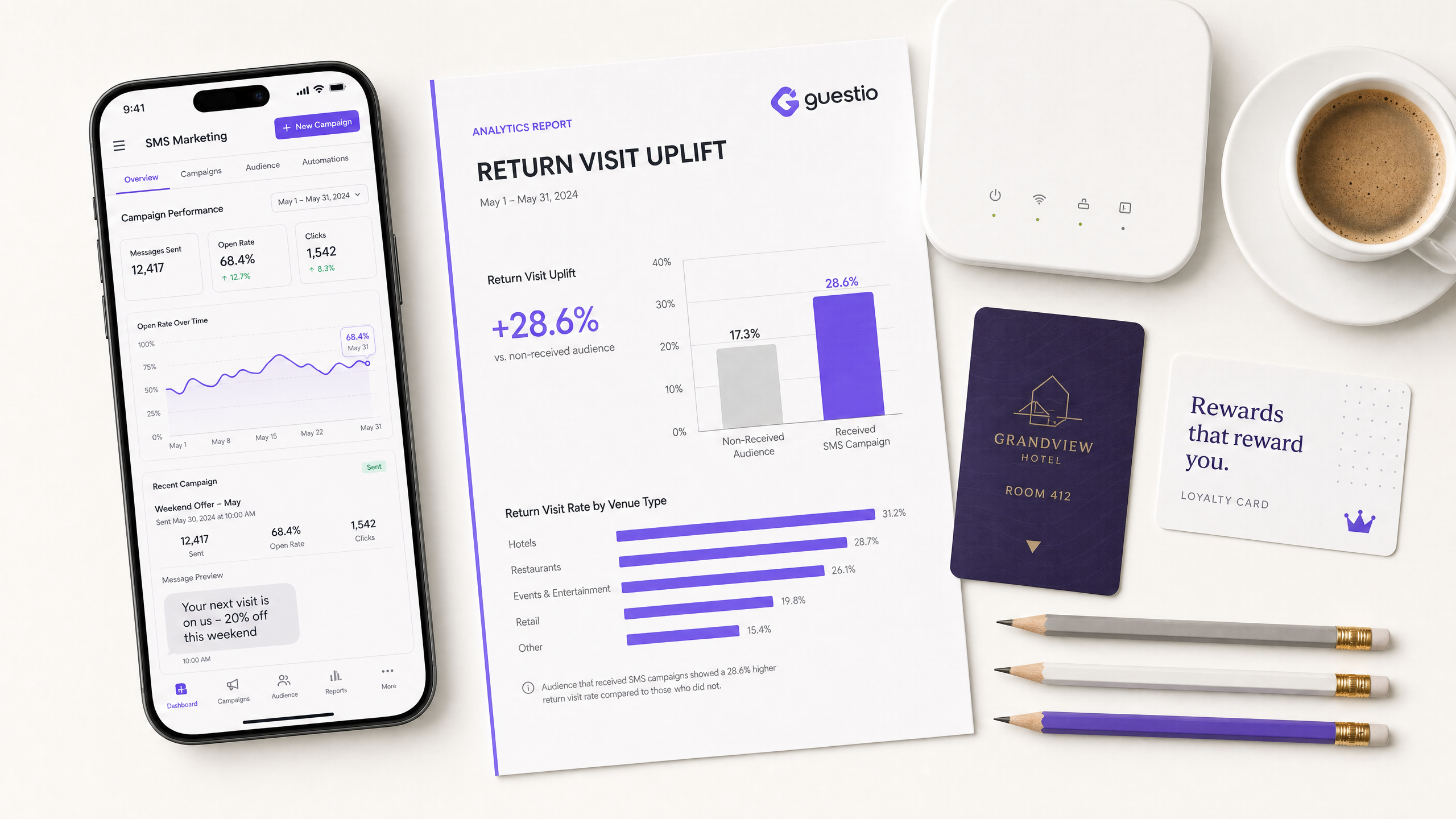
The primary metric for text SMS marketing in a venue context is return visit rate: the percentage of visitors who received an SMS campaign and reconnected to the network within a defined window, compared to a control group who did not receive the campaign.
Purple Engage calculates this automatically using the campaign attribution model described in Step 5. A well-configured lapsed visitor re-engagement campaign typically produces a 15-25% return visit uplift over the control group (Purple internal data, 2024). For hospitality venues, this translates directly to incremental room nights and food and beverage revenue.
Revenue modelling
To model the revenue impact, use this framework:
| Input | Example value |
|---|---|
| SMS list size (opted-in contacts) | 10,000 |
| Campaign send (lapsed segment) | 2,000 |
| Return visit uplift vs control | 20% |
| Incremental return visits | 400 |
| Average spend per visit | £45 |
| Incremental revenue | £18,000 |
| SMS campaign cost (at £0.04/message) | £80 |
| ROI | 22,400% |
This model is conservative. It does not account for the compounding effect of multiple campaigns, the lifetime value of reactivated visitors, or the brand equity built through consistent, relevant communication.
Industry benchmarks by vertical
For hospitality operators, SMS re-engagement campaigns targeting guests who have not returned within 60 days produce average return visit rates of 12-18%. Premier Inn uses first-party data from Guest WiFi to drive direct booking campaigns, reducing dependence on OTA commission.
For retail operators, post-visit SMS campaigns sent two hours after a shopper leaves the venue produce click-through rates of 22-28%. Harrods uses WiFi-captured data to personalise shopper communications across its estate.
For transport hubs, SMS campaigns targeting passengers who have not used the venue in 30 days produce return visit rates of 8-12%. Manchester Airports Group (MAG) uses Guest WiFi data to drive retail and food and beverage spend across its terminals.
For healthcare and public-sector venues, SMS is primarily used for appointment reminders and service updates rather than promotional campaigns. The compliance requirements are identical, but the consent language focuses on service communications rather than marketing.
For events and stadiums, SMS campaigns sent to attendees 48 hours before an event produce ticket upgrade and merchandise click-through rates of 15-20%. The key is using the WiFi login data to confirm which contacts have already purchased tickets for the upcoming event, so you are not promoting an event to someone who is not attending.
Purple's WiFi Analytics platform provides the reporting layer to track all of these metrics in a single dashboard, segmented by venue, campaign, and visitor cohort.
Key Definitions
Captive portal
A web page that intercepts a device's HTTP traffic before granting internet access via a WiFi network. Used by venue operators to display terms of service, collect visitor data, and present consent options. Purple Capture operates as a cloud-hosted captive portal that integrates with enterprise access point hardware.
IT teams configure the captive portal redirect at the SSID level on the access point controller. The portal URL is hosted by Purple; no on-premises web server is required.
OTP (one-time password)
A single-use numeric code sent to a mobile number to verify that the number is real, active, and in the possession of the person entering it. In the context of WiFi login, OTP verification confirms that the phone number provided at the captive portal belongs to the visitor at the venue.
OTP verification is the mechanism that converts a phone number field on a login form into a verified, high-quality SMS marketing contact. Without OTP, phone number fields collect a high proportion of invalid or fictitious numbers.
PECR (Privacy and Electronic Communications Regulations)
UK regulations that govern direct marketing via electronic means, including SMS. PECR requires explicit opt-in consent for SMS marketing to consumers. The soft opt-in rule - which allows email marketing to existing customers without explicit consent - does not apply to SMS.
Any venue operator sending SMS marketing messages to UK consumers must comply with PECR. The ICO enforces PECR and can issue fines of up to £500,000 for serious breaches. Purple's consent capture flow is designed to meet PECR requirements.
GDPR (General Data Protection Regulation)
EU regulation (and UK GDPR post-Brexit) governing the collection, storage, and processing of personal data. Phone numbers collected via WiFi login are personal data under GDPR. Venue operators must have a lawful basis for processing this data - typically explicit consent for marketing purposes.
GDPR applies to the storage and processing of phone numbers in the Purple platform. Purple is ISO 27001 certified and GDPR compliant. Venue operators are data controllers; Purple acts as a data processor under a Data Processing Agreement.
MAC address
A unique hardware identifier assigned to a network interface card. When a device connects to a WiFi network, it broadcasts its MAC address to the access point. Purple uses the MAC address to recognise returning devices and attribute return visits to specific SMS campaigns.
Modern iOS and Android devices use MAC address randomisation to prevent cross-network tracking. However, each device assigns a stable, randomised MAC address per SSID. Consistent SSID naming across a venue estate is therefore essential for accurate return visit attribution.
First-party data
Data collected directly from individuals by the organisation that will use it, with the individual's knowledge and consent. Phone numbers and email addresses collected via a captive portal at WiFi login are first-party data. This contrasts with third-party data, which is purchased from data brokers.
First-party data is the foundation of compliant, high-performance SMS marketing. It produces lower bounce rates, higher engagement, and lower regulatory risk than purchased lists. Purple Capture is designed specifically to build first-party data assets for venue operators.
Audience segmentation
The process of dividing a contact list into subgroups based on shared characteristics or behaviours, so that each subgroup receives a message relevant to their specific situation. In Purple Engage, segments are built using visit recency, frequency, venue type, and demographic data captured at login.
Segmentation is the primary lever for improving SMS campaign performance. A generic broadcast to the full contact list will produce lower engagement and higher opt-out rates than a targeted message sent to a specific behavioural segment.
Cloud overlay
A software architecture in which a management and analytics layer is deployed in the cloud on top of existing on-premises hardware, without replacing that hardware. Purple operates as a cloud overlay on enterprise WiFi hardware from Cisco Meraki, HPE Aruba, Ruckus, and others.
The cloud overlay model means venue operators do not need to replace their existing access points to deploy Purple. The captive portal, data capture, campaign automation, and analytics all run in Purple's cloud infrastructure, accessed via a web dashboard.
Re-engagement campaign
An automated SMS campaign that targets visitors who have not returned to a venue within a defined time window - typically 30, 60, or 90 days. The goal is to reactivate lapsed visitors before they are permanently lost to a competitor.
Re-engagement campaigns are typically the highest-ROI campaign type for venue operators because they target a segment that has already demonstrated intent by visiting once. The cost of reactivating a lapsed visitor via SMS is significantly lower than acquiring a new visitor.
Worked Examples
A 150-property hotel chain wants to reduce its dependence on OTA bookings by driving direct return visits. The chain runs HPE Aruba access points across all properties. They have a legacy email list of 200,000 contacts but no verified phone numbers. How should they build and activate an SMS marketing programme?
Start with the infrastructure audit. HPE Aruba supports Purple's cloud overlay via RADIUS redirect - no hardware changes required. Configure the Guest WiFi captive portal on the Purple platform to request phone number at login, with OTP verification enabled. Set the consent checkbox to unticked by default, with consent language specific to SMS marketing from the hotel brand.
Do not import the legacy email list into the SMS platform. Instead, run a re-consent campaign via email to the existing 200,000 contacts, asking them to opt in to SMS by clicking a link that takes them to a short form. Expect a 5-10% opt-in rate from the email list, yielding 10,000-20,000 verified SMS contacts as a starting point.
Simultaneously, activate the captive portal SMS capture at all 150 properties. At a conservative capture rate of 30% of daily WiFi users, a 150-property estate with an average of 100 daily WiFi connections per property will add 4,500 verified phone numbers per day.
For the first campaign, target lapsed guests: visitors who connected to the WiFi more than 45 days ago and have not returned. Send a direct booking incentive: 'Book direct this month and save 15%. No OTA fees. [Link] Reply STOP to opt out.' Track return visits via MAC address reconnection and direct booking code redemption.
A 40-store retail chain running Cisco Meraki access points wants to use SMS to drive mid-week footfall. Their current WiFi login is a simple email capture form with no phone number field. Average dwell time is 45 minutes. How do they restructure the capture flow and build a mid-week footfall campaign?
The first step is adding phone number capture to the captive portal. In the Purple Capture configuration for Cisco Meraki, add a phone number field alongside the existing email field. Enable OTP verification. Make the phone number field optional - mandatory phone capture reduces login completion rates by 20-30%. Visitors who provide a phone number and complete OTP verification are added to the SMS-eligible segment automatically.
For the mid-week footfall campaign, build a segment of visitors who have connected to the network on a weekend in the past 60 days but have not connected on a weekday. This identifies weekend shoppers who could be converted to mid-week visitors. Send the campaign on Tuesday morning: 'Quieter stores, same great range. Visit us Wednesday or Thursday this week and enjoy [offer]. Show this text in-store. Reply STOP to opt out.'
Measure the campaign by tracking MAC address reconnections on Wednesday and Thursday from the segment that received the SMS, compared to a 20% holdout group that did not receive the message. The difference in reconnection rate is the attributable uplift.
For the longer term, integrate the SMS campaign calendar with the retail chain's CRM to suppress contacts who have already visited mid-week in the current month, avoiding redundant sends.
Practice Questions
Q1. You are the IT director at a 60-venue pub group running Ubiquiti UniFi access points. Your marketing director wants to launch an SMS re-engagement campaign targeting guests who visited during the World Cup but have not returned since. You have 45,000 email addresses from the existing WiFi login system but no verified phone numbers. The marketing director wants to launch in two weeks. What do you tell them, and what is the realistic path to a compliant SMS campaign?
Hint: Consider the consent requirements under PECR, the time needed to build a verified phone number list, and whether the existing email data can be used to accelerate SMS opt-in.
View model answer
Tell the marketing director that the two-week timeline is not achievable for a compliant SMS campaign from a standing start. The 45,000 email addresses cannot be imported into an SMS platform without re-consent, because the original consent covered email only. Launching SMS to those contacts without explicit SMS consent would breach PECR and expose the business to ICO enforcement.
The realistic path has two tracks. Track one: run a re-consent campaign via email to the 45,000 contacts this week, asking them to opt in to SMS. At a 5-8% opt-in rate, this yields 2,250-3,600 verified SMS contacts within seven days - enough for a pilot campaign. Track two: activate OTP phone capture on the UniFi captive portal immediately, so that every guest who visits in the next two weeks adds to the SMS list organically.
The World Cup re-engagement campaign can launch in three to four weeks with a smaller but fully compliant list. Set expectations with the marketing director: a smaller, verified list will outperform a larger, unverified one. A 20% return visit uplift on 3,000 verified contacts is more valuable than a 5% response rate on 45,000 non-consented contacts - and the latter carries regulatory risk.
Q2. A conference centre with Cisco Meraki infrastructure wants to use SMS to increase repeat bookings from corporate event organisers. The venue hosts 200 events per year. Each event organiser connects to the Guest WiFi during site visits and events. How would you configure the capture flow and campaign automation to target this specific audience?
Hint: Think about how to distinguish event organisers from general attendees in the segmentation, and what triggers are most relevant for a B2B booking cycle.
View model answer
The capture flow should include a dropdown or radio button at login asking the visitor's role: 'I am attending an event' or 'I am an event organiser / venue manager.' This self-identification flag is stored in the Purple Capture profile and used as a segmentation dimension.
For the automation, build a segment of contacts who identified as event organisers and connected to the network in the past 90 days. The re-engagement trigger should fire at 60 days post-visit, which aligns with typical corporate event planning cycles. The SMS body: 'Planning your next event? [Venue Name] has availability in [month]. Reply to this message or call [number] to check dates. Reply STOP to opt out.'
For contacts who have booked multiple events, build a VIP segment and send an early access message six weeks before the venue's peak season: 'As a valued client, you get first access to our [season] availability. [Link] to view dates. Reply STOP to opt out.'
Note that for B2B contacts, PECR's soft opt-in rule may apply if the organiser is acting in a business capacity and the communication relates directly to their professional role. However, to avoid ambiguity, collecting explicit consent at login is the safest approach and adds no friction to the process.
Q3. Your SMS opt-out rate has risen from 1.2% to 4.8% over the past three months. Campaign frequency has not changed. What are the three most likely causes, and how do you diagnose which one is responsible?
Hint: Consider changes to list composition, message relevance, and consent quality as separate diagnostic dimensions.
View model answer
The three most likely causes are: first, a change in list composition - if a large batch of new contacts was added recently (for example, from a one-off event or a promotional campaign that attracted a less engaged audience), the new contacts may be less aligned with your brand and more likely to opt out. Second, a decline in message relevance - if the campaign content has become more generic or less personalised over the same period, engagement will fall and opt-outs will rise. Third, a consent quality issue - if the captive portal was recently modified and the consent language became less specific, contacts may be opting in without fully understanding they will receive promotional SMS messages, leading to higher opt-outs when the messages arrive.
To diagnose: segment the opt-out data by the date the contact was added to the list. If opt-outs are concentrated among contacts added in the past three months, the issue is list composition or consent quality. If opt-outs are distributed evenly across all contacts regardless of join date, the issue is message relevance or frequency. Pull the portal audit log in Purple to check whether the consent text was modified in the past three months. Review the campaign content calendar to identify any shift in message tone or personalisation level.