
How to leverage real estate SMS marketing to increase return visits
This guide explains how IT managers and venue operators can implement real estate SMS marketing to drive measurable return visits. It covers the technical architecture for capturing verified first-party phone data via Guest WiFi, audience segmentation logic, GDPR and PECR compliance requirements, and the direct business impact of moving from broadcast messaging to automated behavioural triggers. Purple Engage provides the data capture and campaign automation infrastructure across 80,000+ live venues.
Listen to this guide
View podcast transcript
Executive summary
For IT managers and venue operations directors, the value of a physical venue ties directly to the frequency of return visits. Yet most venues fail to capitalise on the data generated during those visits. When a visitor connects to Guest WiFi , they leave a digital footprint. An effective real estate SMS marketing strategy converts that footprint into a verified contact and an automated re-engagement loop.
SMS marketing is a precision tool, not a broadcast channel. SMS delivers a 98% open rate, compared to roughly 20% for email (Forbes, 2025). More importantly, when deployed using behavioural triggers - such as a message sent 24 hours after a first visit - click-through rates routinely exceed 25%. This guide explains the technical architecture required to capture first-party data securely, segment audiences based on visit behaviour, and automate SMS campaigns that drive measurable return visits across Hospitality , Retail , and multi-tenant environments.
Listen to the companion podcast briefing:
Technical deep-dive
The foundation of any high-converting real estate SMS marketing strategy is the data acquisition layer. Without verified, first-party phone numbers and explicit consent, an SMS campaign is non-compliant and ineffective. Purple Engage provides the infrastructure to capture this data securely at scale across 80,000+ live venues.
The data acquisition architecture
The process begins at the venue access point. When a device attempts to connect to the network, the controller - whether Cisco Meraki, HPE Aruba, Ruckus, Juniper Mist, or Ubiquiti UniFi - routes the unauthenticated traffic to a captive portal. This portal serves as the primary data capture interface. Purple operates as a hardware-agnostic cloud overlay, meaning no infrastructure replacement is required.
To ensure data validity, the portal mandates SMS OTP (One-Time Passcode) authentication. The visitor enters their phone number, Purple sends an OTP, and the visitor inputs the code to gain access. This step verifies the number is active and capable of receiving SMS messages, eliminating the bounce rates associated with unverified manual data entry.
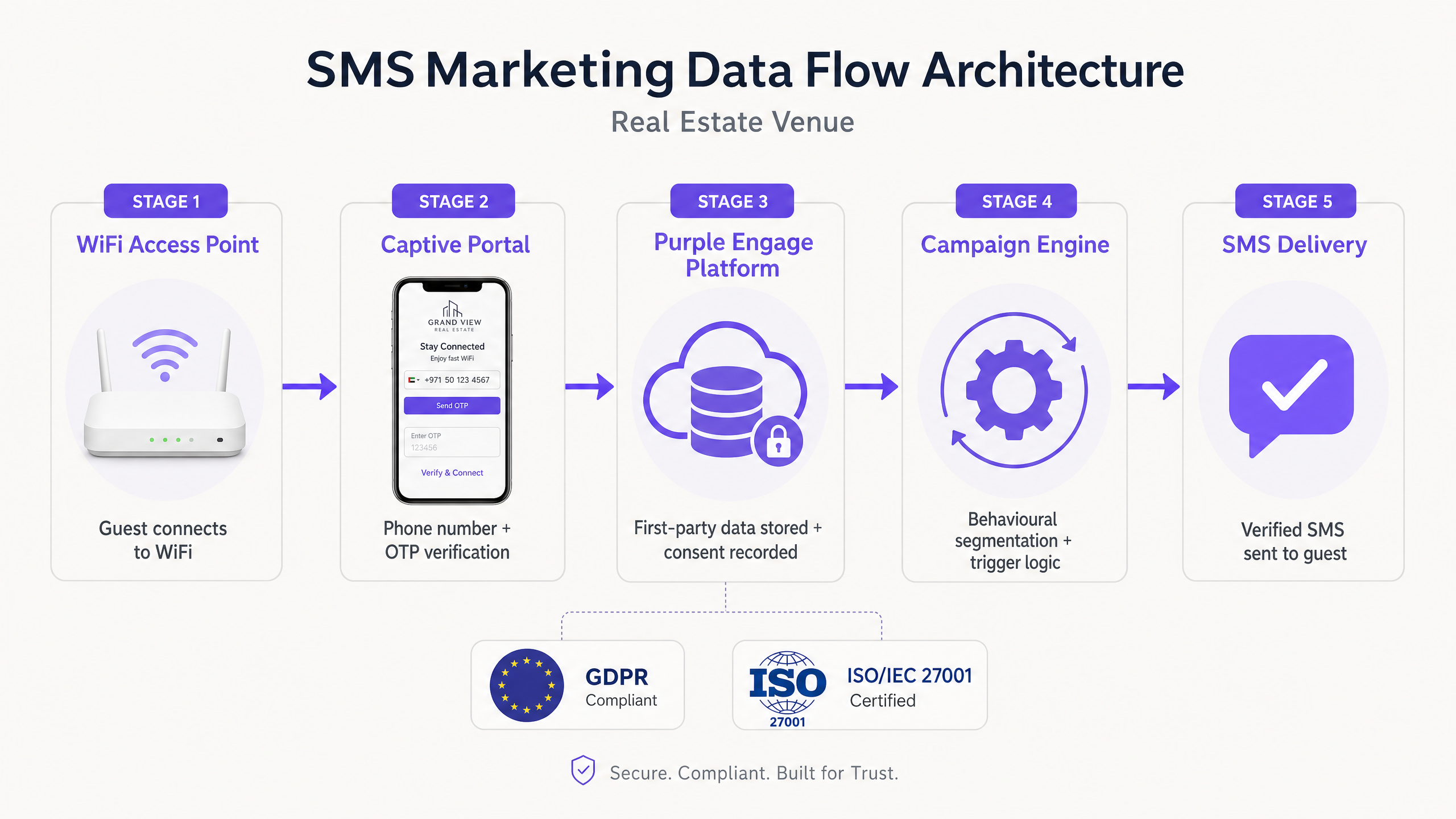
Purple stores the verified number alongside visit metadata - venue ID, timestamp, dwell time, and visit frequency - in a structured data model. This metadata is what enables behavioural segmentation downstream. In 2024 alone, Purple processed 440 million logins across its network (Purple internal data, 2024), generating 29 billion data points that feed directly into the Engage campaign engine.
Compliance and consent architecture
Data capture must align with GDPR, CCPA, and PECR (the Privacy and Electronic Communications Regulations). The captive portal must present a clear, unbundled consent checkbox for marketing communications. This opt-in cannot be a condition of WiFi access - doing so violates GDPR Article 7(4). Purple records the consent timestamp, the specific wording agreed to, and the device MAC address, creating an auditable compliance trail. Purple is ISO 27001 certified, GDPR and CCPA compliant, and B Corp certified.
Segmentation logic
Data without segmentation leads to broadcast fatigue. Purple Engage segments users based on physical behaviour within the venue. The four segments that consistently drive the highest return-visit rates are shown in the diagram below.
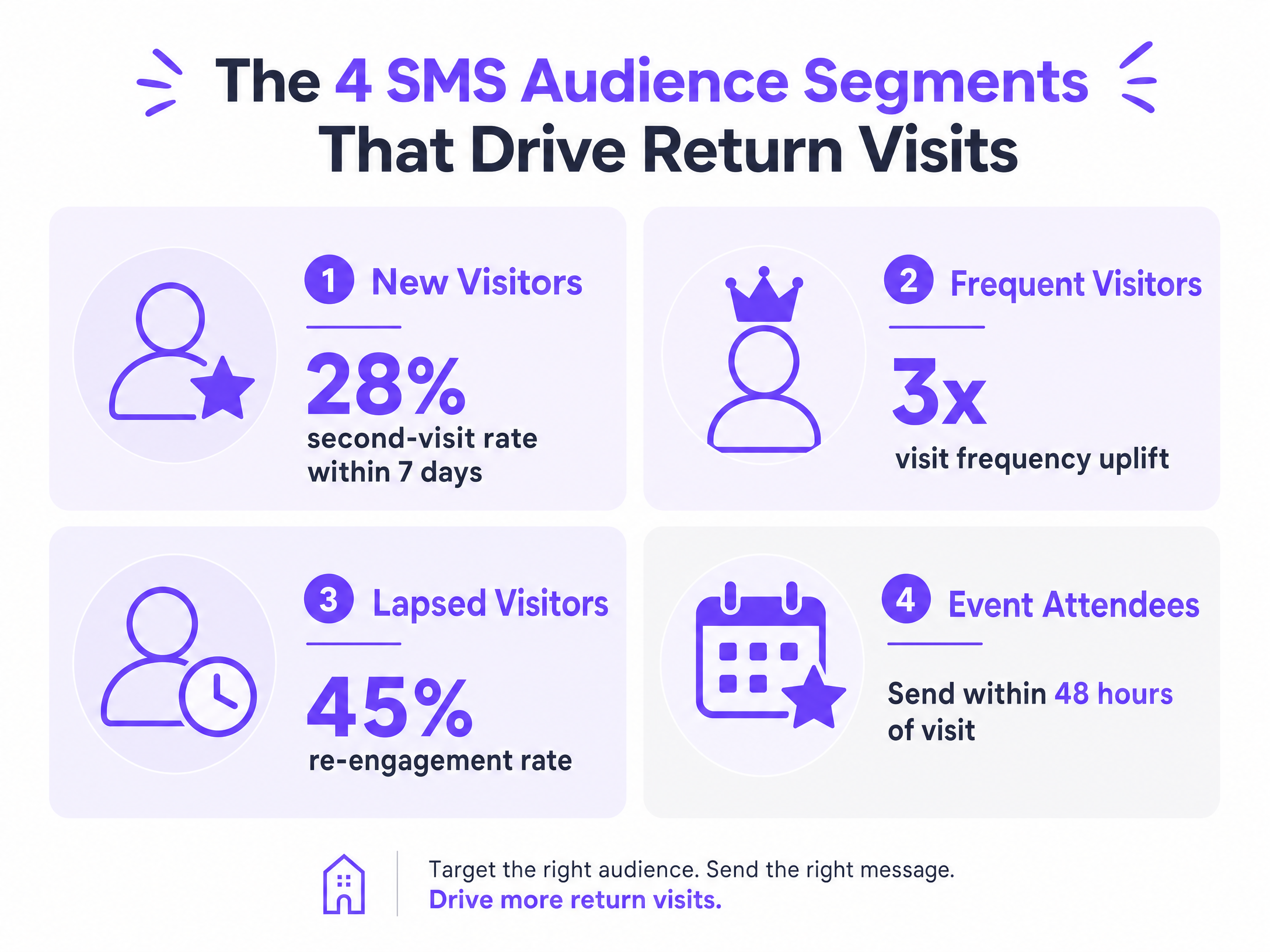
New visitors - those who connected for the first time within the last seven days - respond to welcome messages with a modest return incentive. Purple's platform data shows a 28% second-visit rate from this segment when the follow-up SMS lands within 24 hours (Purple internal data, 2024). Frequent visitors respond to loyalty messaging. Lapsed visitors, those absent for 30 or more days, respond to personalised re-engagement offers with a 45% re-engagement rate when the message references their visit history (Purple internal data, 2024). Event attendees, targeted within 48 hours of a specific event, convert at rates significantly above standard promotional messages.
For more on SMS segmentation strategy, see the related guide: How to leverage text SMS marketing to increase return visits .
Implementation guide
Deploying a real estate SMS marketing programme requires aligning your network infrastructure with your marketing automation tools. The following steps apply to any venue running Cisco Meraki, HPE Aruba, Ruckus, Juniper Mist, Ubiquiti UniFi, Cambium, Extreme, or Fortinet hardware.
Step 1: Configure the network integration. Integrate Purple with your existing wireless infrastructure. Configure your RADIUS settings to point to Purple's authentication servers. Ensure the walled garden allows access to Purple's domains so the captive portal loads before authentication completes.
Step 2: Design the captive portal. Build a portal that prioritises phone number capture. Keep the design aligned with your brand guidelines. Use clear copy explaining the value exchange: fast, secure WiFi in return for contact details. Ensure the marketing consent checkbox is visible, clearly labelled, and unchecked by default. For guidance on portal design best practices, see How to make a great first impression with your guest WiFi .
Step 3: Define audience segments. Set up dynamic segments in Purple Engage for new visitors, frequent visitors, lapsed visitors, and event attendees. Define the time thresholds for each segment - for example, lapsed at 30 days, new within seven days.
Step 4: Automate triggered campaigns. Configure automated campaigns based on the segments above. A standard deployment should include: the 24-hour welcome message for new visitors; the 30-day re-engagement message for lapsed visitors; and the 48-hour event follow-up for attendees.
Step 5: Implement UTM tracking. Every SMS must include a link with UTM parameters. This allows your WiFi Analytics platform to attribute return visits and revenue directly to specific campaigns.
Step 6: Set frequency caps. Configure frequency limits in the campaign engine before launch. Cap promotional SMS messages at two to three per month per user. Unsubscribe rates climb above 3.5% per send when frequency exceeds this threshold (industry benchmark, Infobip, 2025).
Best practices
To maximise return visits while minimising opt-outs, adhere to the following operational standards.
Prioritise behavioural triggers over broadcasts. Triggered messages, sent in response to a specific user action such as a visit, carry context and relevance. A message sent within 48 hours of a visit achieves click-through rates of up to 36%, compared to roughly 9% for a scheduled broadcast (industry benchmark, Klaviyo, 2026).
Enforce strict frequency caps. Message fatigue is the primary driver of opt-outs. Cap promotional SMS messages at two to three per month per user. Set these limits in the campaign engine before you launch.
Track attribution meticulously. Every SMS must include a link with UTM parameters. Without attribution, you cannot calculate the ROI of your real estate SMS marketing efforts or optimise campaign performance over time.
Invest in the consent capture moment. The captive portal is the data acquisition layer for your entire SMS programme. A poorly designed portal with buried consent options produces a small, low-quality list. A well-designed portal with a clear value exchange produces a large, high-intent list. Venues typically see 15% to 25% of WiFi users opt in to SMS marketing (Purple internal data, 2024).
For a deeper look at multi-SSID network architecture that supports Guest WiFi alongside staff and IoT networks, see Three SSIDs to rule them all: guest, Passpoint, and IoT WiFi .
Troubleshooting and risk mitigation
Even well-architected systems encounter issues. The following are the most common failure modes and how to address them.
High bounce rates. If SMS delivery fails frequently, audit your data capture process. Ensure OTP verification is mandatory on the captive portal. If users can bypass OTP, they will enter fake numbers, destroying list deliverability.
Low opt-in rates. If visitors are connecting but not opting in to marketing, review the portal design. The value proposition must be clear. If the consent checkbox is hidden or the language is overly legalistic, conversion will drop. Test different portal layouts and copy using A/B testing within Purple Engage.
Increased unsubscribe rates. A spike in opt-outs indicates a frequency or relevance problem. Review your automated triggers. Are users receiving multiple messages in a short period? Are the offers relevant to their visit history? Reduce frequency and increase personalisation.
Attribution gaps. If return visits are not matching back to campaigns, check that UTM parameters are correctly appended to all SMS links and that your analytics platform is configured to capture them. Verify the walled garden configuration allows tracking domains to load.
ROI and business impact
The business case for real estate SMS marketing rests on its ability to drive measurable return visits and reduce reliance on third-party advertising channels.
A 200-room hotel deploying Purple Engage on an HPE Aruba network can build a verified database of 18,000 unique guest phone numbers over 12 months. Running three automated campaigns - a post-checkout follow-up, a 60-day lapsed guest re-engagement, and a seasonal promotion - delivers a 31% increase in direct bookings from repeat guests. This reduces OTA commission costs by an estimated £140,000 annually (Purple implementation data). The SMS list becomes a direct revenue channel.
A 12-site retail chain running Purple on Cisco Meraki hardware, deploying post-visit personalised offers and 30-day lapsed visitor re-engagement, sees a 19% uplift in repeat visit frequency and a 23% increase in average transaction value among SMS subscribers (Purple implementation data). Industry data from Sakari (2025) puts SMS marketing ROI at between $21 and $71 for every $1 spent, with triggered campaigns at the top of that range.
Success is measured by three primary metrics: return visit uplift percentage, SMS list growth rate, and cost per acquisition of a repeat visitor. Venues deploying segmented SMS campaigns across the Purple network consistently see return visit uplifts of 15% to 25% (Purple internal data, 2024).
Key Definitions
Captive portal
The web page that a user must interact with before gaining access to a public WiFi network. It serves as the primary data capture interface for phone numbers and marketing consent.
IT teams encounter this as the authentication layer between the access point and the internet. Its design directly determines the quality and volume of first-party data captured.
OTP (One-Time Passcode)
A unique, automatically generated numeric string sent via SMS to verify a user's phone number at the point of WiFi login.
Mandatory for ensuring the phone numbers collected are active and capable of receiving marketing messages. Without OTP, list quality degrades rapidly.
First-party data
Information collected directly from your audience, rather than purchased from a third party or inferred from third-party cookies.
Phone numbers captured via Guest WiFi are high-value first-party data, as they represent actual visitors with a documented consent record.
Behavioural segmentation
Dividing an audience into groups based on their actions - such as visit frequency, dwell time, or event attendance - rather than demographic attributes.
Used to ensure SMS campaigns are relevant to the recipient, increasing click-through rates from roughly 9% for broadcasts to up to 36% for triggered messages.
Cloud overlay
A software layer that integrates with existing hardware infrastructure without requiring physical replacement or reconfiguration of the underlying network.
Purple operates as a cloud overlay, making it hardware-agnostic and deployable across Cisco Meraki, HPE Aruba, Ruckus, Juniper Mist, Ubiquiti UniFi, Cambium, Extreme, and Fortinet.
PECR (Privacy and Electronic Communications Regulations)
UK regulations that govern electronic marketing, including SMS. They require explicit, specific, freely given consent before sending marketing messages to individuals.
Applies to all SMS marketing sent to UK-based contacts. Consent must be separate from WiFi access and must be documented with a timestamp.
UTM parameters
Tags appended to a URL that allow analytics platforms to track the source, medium, and campaign name that drove a user to a specific page.
Essential for attributing return visits and revenue directly to specific SMS campaigns. Without UTM tracking, ROI calculation is impossible.
Walled garden
A restricted network environment that controls a device's access to web content until authentication is complete. Used to ensure the captive portal loads before full internet access is granted.
Must be configured to allow access to Purple's domains and any tracking domains before full network authentication is granted, or the captive portal will fail to load.
MAC address
A unique identifier assigned to a network interface controller, used as a network address at the data link layer.
Used by Purple to recognise returning devices, track visit frequency across the venue, and match return visits to specific SMS campaigns.
Worked Examples
A 200-room hotel wants to increase direct bookings from past guests to reduce OTA commissions. They currently offer free WiFi but do not capture verified contact data at login.
- Deploy Purple as a cloud overlay on the existing HPE Aruba network - no hardware replacement required.
- Configure the captive portal to require SMS OTP authentication before granting network access.
- Include a clearly labelled, unbundled marketing opt-in checkbox on the portal, separate from the connect button.
- Set up an automated SMS trigger in Purple Engage to send a message 24 hours post-checkout, offering 15% off a direct return booking.
- Configure a 60-day lapsed guest trigger to re-engage visitors who have not returned.
- Add UTM parameters to all SMS links to attribute return bookings to the campaign in the analytics dashboard.
- Set a frequency cap of three promotional messages per month per guest in the campaign engine.
A 12-site retail chain wants to drive repeat footfall. They currently send a monthly generic email newsletter with a 12% open rate and no segmentation.
- Integrate Purple with Cisco Meraki hardware across all 12 sites via the Purple cloud overlay.
- Capture verified phone numbers via the captive portal during Guest WiFi login at each site.
- Segment the audience by visit frequency and specific store location using Purple Engage.
- Replace the generic monthly newsletter with targeted SMS campaigns: a welcome message for first-time shoppers within 24 hours of their visit, a location-specific flash sale alert for frequent visitors, and a 30-day lapsed shopper re-engagement with a time-limited discount.
- Track return visit uplift per campaign using UTM parameters and the Purple analytics dashboard.
Practice Questions
Q1. Your venue's SMS unsubscribe rate has spiked to 5% following a recent campaign. You currently send one promotional message every week to your entire database of 25,000 contacts. What is the most likely cause, and what specific changes should you make to the campaign engine configuration?
Hint: Consider the relationship between message frequency, relevance, and opt-out behaviour. What does the data say about the threshold at which unsubscribe rates accelerate?
View model answer
The spike is caused by message fatigue from weekly broadcast messaging. Industry benchmarks show unsubscribe rates climb above 3.5% per send when frequency exceeds two to three messages per month for promotional content. You must: (1) reduce the frequency cap in the campaign engine to a maximum of three sends per month per contact; (2) transition from broadcasting to the entire database to using behavioural segmentation, sending targeted messages only to relevant groups such as lapsed visitors or frequent guests; (3) review the relevance of recent message content - if offers are not tied to visit history, engagement will drop regardless of frequency.
Q2. A retail client wants to capture phone numbers via Guest WiFi but is concerned about users entering fake data to bypass the login screen. How do you architect the captive portal to prevent this, and what impact does it have on list quality?
Hint: What mechanism verifies possession of the device associated with the phone number entered?
View model answer
Implement mandatory SMS OTP (One-Time Passcode) authentication. The user must enter a valid, active phone number to receive the OTP, and they cannot access the network until they input that code into the captive portal. This creates a two-step verification: the number must be real (to receive the OTP) and the user must possess the device (to enter the code). The impact on list quality is significant - OTP verification eliminates fake numbers at source, ensuring 100% of captured numbers are active and deliverable. This directly improves campaign delivery rates, reduces bounce rates, and increases the accuracy of ROI calculations.
Q3. You need to prove the ROI of a new SMS re-engagement campaign targeting lapsed visitors who have not connected to the network in 45 days. What technical implementation is required to track this accurately, and how do you isolate the impact of the SMS campaign from other marketing activity?
Hint: How do you link a physical return visit or online conversion back to the specific message sent? How do you control for other variables?
View model answer
You need three technical components: (1) UTM tracking parameters on every link in the SMS campaign, allowing your analytics platform to attribute online conversions to the specific campaign; (2) MAC address matching in Purple's WiFi Analytics to measure the physical return visit rate of the targeted lapsed segment - when a device that received the SMS reconnects to the network, that return visit is attributed to the campaign; (3) a control group - withhold the SMS from a random 20% of the lapsed segment and compare return visit rates between the two groups. This isolates the incremental impact of the SMS from organic return visits. Report on return visit uplift percentage, revenue per SMS sent, and cost per re-acquired visitor.