Saltar al contenido principal

Mejores prácticas de microsegmentación para redes WiFi compartidas

Esta guía de referencia técnica proporciona estrategias prácticas para implementar la microsegmentación en infraestructuras WiFi compartidas. Detalla cómo los gerentes de TI y los arquitectos de red pueden aislar de forma segura el tráfico de invitados, IoT y personal para mitigar riesgos, garantizar el cumplimiento y optimizar el rendimiento de la red.

📖 4 min de lectura📝 899 palabras🔧 2 ejemplos prácticos3 preguntas de práctica📚 8 definiciones clave

Escuchar esta guía

Ver transcripción del podcast
Micro-Segmentation Best Practices for Shared WiFi Networks — A Purple Technical Briefing [INTRODUCTION — approximately 1 minute] Welcome to the Purple Technical Briefing series. I'm your host, and today we're getting into one of the most operationally critical topics for any venue running shared WiFi infrastructure: wifi micro-segmentation. If you're managing network infrastructure across a hotel, a retail estate, a stadium, or a conference centre, you are almost certainly running guest devices, IoT systems, and staff endpoints on the same physical access layer. That is a significant security and compliance exposure — and micro-segmentation is the architectural response to it. Over the next ten minutes, we're going to cover the technical architecture, the implementation sequence, the compliance implications, and the real-world outcomes you should expect. This is a practitioner briefing, not a theory lecture — so let's get straight into it. [TECHNICAL DEEP-DIVE — approximately 5 minutes] Let's start with the fundamentals. Micro-segmentation, in the context of a shared WLAN, means enforcing granular, policy-driven isolation between device classes and user groups — at the network layer, not just at the application layer. The key distinction from traditional VLAN-based segmentation is granularity and dynamism. Traditional VLANs give you broad separation. Micro-segmentation gives you per-device, per-session, per-role policy enforcement. The foundational standards here are IEEE 802.1X for port-based network access control, and WPA3-Enterprise for the wireless authentication layer. When you combine 802.1X with a RADIUS back-end, you get dynamic VLAN assignment — meaning a device's network segment is determined at authentication time based on its credentials, certificate, or device profile. That is the engine of micro-segmentation on a WLAN. Now, let's talk about the three primary traffic classes you need to isolate in a venue environment. First: guest traffic. This is your highest-volume, lowest-trust segment. Guests connect via a captive portal — typically using email, social login, or SMS OTP — and they should receive internet-only access with no visibility of any internal network resources whatsoever. The guest segment should be a hard network boundary. Client isolation must be enabled within the segment so that guest devices cannot communicate with each other, which is critical for both security and GDPR compliance. Purple's guest WiFi platform handles this authentication and policy enforcement layer, and integrates directly with your RADIUS and access point infrastructure. Second: IoT devices. This is where most venue networks have their biggest exposure. Smart TVs, IP cameras, door access controllers, HVAC sensors, digital signage players, POS peripherals — these devices typically run embedded firmware with minimal security hardening, they rarely support 802.1X, and they are high-value targets for lateral movement attacks. The correct approach is to place all IoT devices on a dedicated, isolated segment with egress-only policies. IoT devices should only be able to reach their specific management platform — whether that's a building management system, a cloud IoT hub, or a vendor-specific controller. They should have zero access to guest segments, zero access to staff segments, and ideally no inbound connectivity from any other segment. MAC-based authentication or certificate-based onboarding via a dedicated IoT SSID is the standard deployment pattern here. Third: staff and corporate traffic. This segment carries your highest-trust, highest-sensitivity data — POS transactions, HR systems, back-office applications. It must be completely isolated from both guest and IoT segments. IEEE 802.1X with EAP-TLS — that is, certificate-based mutual authentication — is the gold standard for staff device onboarding. This eliminates credential-based attacks entirely. Staff devices should be enrolled via your MDM platform, with certificates provisioned automatically, so the authentication is transparent to the end user. Now, a word on the physical layer. One of the most common architectural mistakes I see is operators running separate SSIDs for each segment and assuming that provides isolation. It does not. SSID separation without proper VLAN tagging, firewall policy enforcement, and client isolation is security theatre. The access point must tag traffic to the correct VLAN at the radio level, and your upstream switching and firewall infrastructure must enforce inter-VLAN routing policies. If your firewall is permitting any-to-any traffic between VLANs because someone forgot to update the ACLs after a network change, your segmentation is worthless. For bandwidth management, each segment should have QoS policies applied. IoT devices typically need very low bandwidth — two to five megabits per second is sufficient for most sensor and signage workloads. Guest traffic should be rate-limited per device — ten megabits per second is a reasonable ceiling for most hospitality deployments — to prevent any single device from saturating the uplink. Staff traffic should be prioritised and uncapped, or at minimum given a guaranteed minimum bandwidth allocation. Let's also address WPA3. If you are deploying new infrastructure in 2025 or 2026, WPA3-Personal with Simultaneous Authentication of Equals — SAE — should be your baseline for guest SSIDs. SAE eliminates the offline dictionary attack vulnerability that plagued WPA2-PSK, which is particularly important for shared-password guest networks. For staff networks, WPA3-Enterprise with 192-bit mode is the appropriate configuration where your hardware supports it. Finally on the technical side: DNS filtering. Every guest segment should have DNS filtering applied at the resolver level. This gives you content policy enforcement, malware domain blocking, and an audit trail for compliance purposes. Purple's DNS filtering integration allows you to apply category-based blocking policies per network segment — so your guest segment blocks adult content and known malicious domains, while your IoT segment only resolves the specific domains required by your device fleet. [IMPLEMENTATION RECOMMENDATIONS AND PITFALLS — approximately 2 minutes] Let me give you the implementation sequence that works in practice. Start with a network audit. Before you touch a single configuration, document every device class on your network, every SSID, every VLAN, and every firewall rule. You cannot segment what you haven't inventoried. Use a network discovery tool — NMAP, your controller's built-in discovery, or a dedicated NAC solution — to build a complete device register. Step two: define your segmentation policy before you configure anything. Map each device class to a segment, define the inter-segment routing rules — which should almost always be deny-all with explicit permit exceptions — and get sign-off from your security and compliance teams before implementation. Step three: deploy in a test environment first. If you have a lab or a staging SSID, validate your VLAN tagging, RADIUS integration, and firewall policies before rolling out to production. The most common production incident I see is a misconfigured RADIUS server that drops all 802.1X authentications, taking down staff connectivity across a site. Step four: roll out by device class, not by location. Start with IoT isolation — it has the highest security impact and the lowest operational risk, since IoT devices don't have users complaining when they lose connectivity for ten minutes. Then roll out guest segmentation. Then staff. Step five: monitor and iterate. Deploy flow monitoring — NetFlow or sFlow — on your inter-VLAN routing points so you can detect any unexpected cross-segment traffic. Set up alerts for any traffic that violates your policy matrix. Review your segmentation policy quarterly. The pitfalls to avoid: number one, forgetting to enable client isolation within the guest segment. Number two, leaving management interfaces — access point admin consoles, switch management VLANs — reachable from guest or IoT segments. Number three, using the same pre-shared key across multiple SSIDs and calling it segmentation. And number four, failing to document your VLAN-to-segment mapping, which makes troubleshooting a nightmare six months later when the original engineer has left. [RAPID-FIRE Q AND A — approximately 1 minute] Let me run through some of the questions I get most frequently from network architects. "Do I need separate access points for each segment?" No. A single access point can broadcast multiple SSIDs, each mapped to a separate VLAN. The isolation happens at the switching and firewall layer, not at the radio layer. "How many SSIDs should I run?" Keep it to four or fewer per access point. Each additional SSID adds management overhead and consumes airtime for beacon frames. Consolidate where possible. "Can I use dynamic segmentation without 802.1X?" Yes — MAC-based RADIUS authentication or device fingerprinting via a NAC solution can assign devices to segments based on their MAC address or device profile. It's less secure than certificate-based auth but practical for IoT fleets. "Does micro-segmentation satisfy PCI DSS scope reduction?" Yes, if implemented correctly. A properly segmented cardholder data environment — where POS systems are on an isolated segment with no connectivity to guest or IoT networks — can significantly reduce your PCI DSS audit scope. Get your QSA involved early to confirm your architecture meets their requirements. [SUMMARY AND NEXT STEPS — approximately 1 minute] To summarise: wifi micro-segmentation on a shared WLAN is not optional for any venue operating at scale in 2025. It is the foundational security and compliance control that separates a professionally managed network from a liability. The three segments you must implement are guest, IoT, and staff — each with distinct authentication, routing, and bandwidth policies. The standards to build on are IEEE 802.1X, WPA3-Enterprise, and dynamic VLAN assignment via RADIUS. The compliance frameworks you satisfy are PCI DSS for payment systems and GDPR for guest data. Your next steps: conduct a device inventory this week, define your segmentation policy matrix, and engage your access point vendor and firewall team to validate your current infrastructure's capability to support dynamic VLAN assignment. Purple's platform provides the guest authentication, analytics, and DNS filtering layers that sit on top of your segmented infrastructure — giving you visibility and policy control across all your guest-facing segments from a single management console. Thanks for listening. For the full technical reference guide, architecture diagrams, and worked examples, visit purple dot ai.

header_image.png

Resumen Ejecutivo

Operar una infraestructura WLAN compartida sin una microsegmentación granular es una vulnerabilidad de seguridad significativa para los entornos modernos. A medida que el perímetro se disuelve, la red interna se convierte en la principal superficie de ataque. Esta guía detalla los principios arquitectónicos y las metodologías de implementación necesarias para aplicar un aislamiento de confianza cero entre el tráfico de invitados, las flotas de IoT y los puntos finales corporativos en una capa de acceso físico unificada.

Para los CTO y arquitectos de red en Hostelería , Comercio Minorista , Sanidad y Transporte , el mandato es claro: las VLAN tradicionales son insuficientes. Al implementar una microsegmentación dinámica y basada en políticas utilizando IEEE 802.1X y RADIUS, las organizaciones pueden reducir significativamente el alcance de su cumplimiento de PCI DSS y GDPR, al tiempo que mitigan el riesgo de movimiento lateral desde dispositivos integrados comprometidos.

Escuche el podcast informativo técnico para un resumen en audio:

Análisis Técnico Detallado

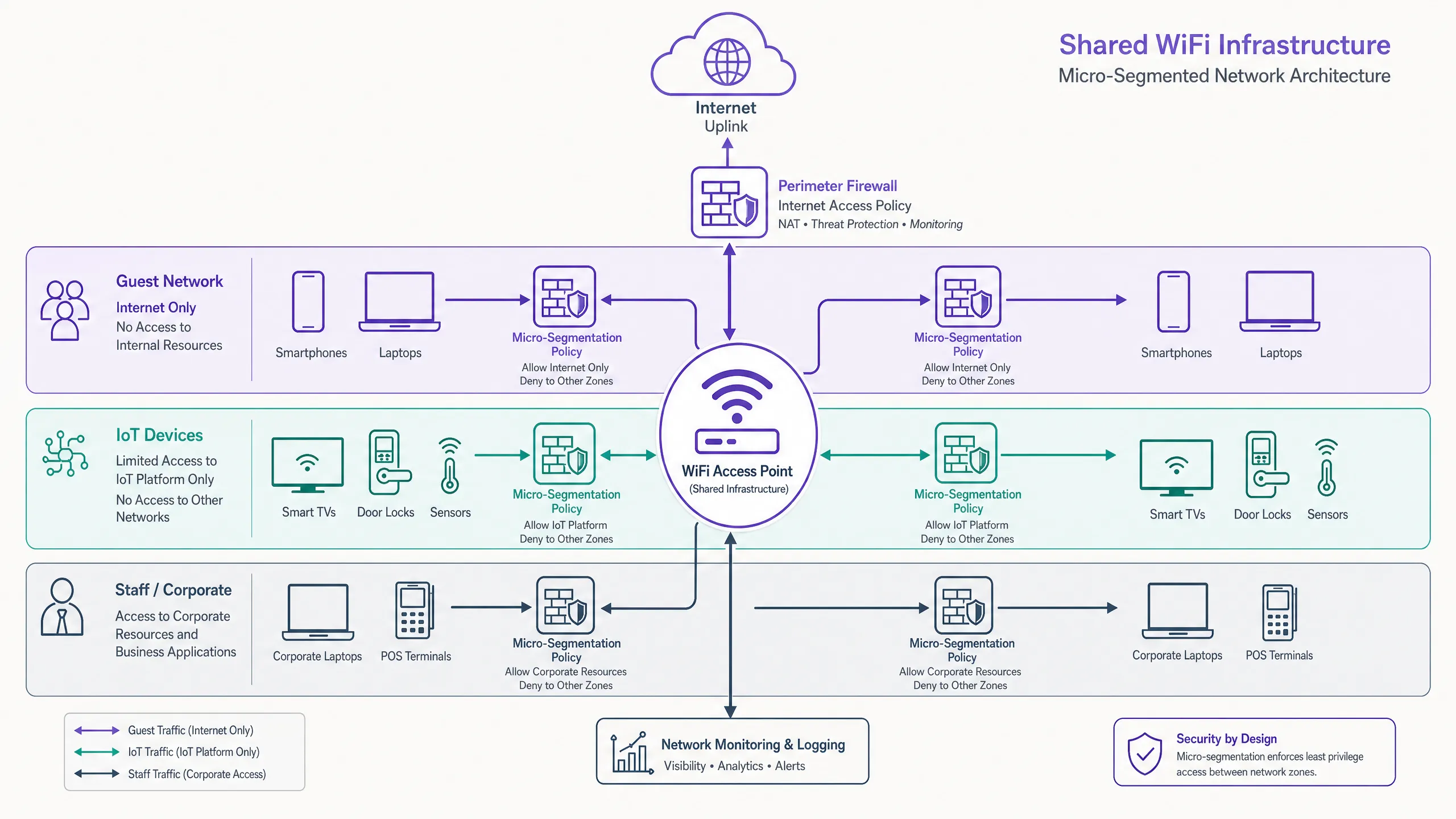
La microsegmentación en una WLAN compartida requiere ir más allá del mapeo estático de SSID a VLAN. Exige una aplicación de políticas dinámica y basada en la identidad en el borde.

La Capa de Autenticación: IEEE 802.1X y WPA3

La base de una segmentación efectiva es una autenticación robusta. Confiar únicamente en Claves Precompartidas (PSKs) a través de múltiples SSIDs proporciona una ilusión de separación. La verdadera microsegmentación aprovecha IEEE 802.1X para autenticar el dispositivo o usuario contra un backend RADIUS, asignando dinámicamente el cliente a la VLAN apropiada y aplicando Listas de Control de Acceso (ACLs) específicas basadas en la identidad.

Para las implementaciones modernas, WPA3 es innegociable. Las redes de invitados deben utilizar WPA3-Personal con Autenticación Simultánea de Iguales (SAE) para proteger contra ataques de diccionario offline, mientras que los segmentos corporativos deben exigir WPA3-Enterprise (modo de 192 bits donde el hardware lo permita).

Los Tres Segmentos Principales

  1. Tráfico de Invitados (No Confiable): Los invitados representan el segmento de mayor volumen y menor confianza. La autenticación se gestiona típicamente a través de un captive portal ( WiFi de Invitados ) utilizando correo electrónico, SMS o inicio de sesión social. El control crítico aquí es el Aislamiento de Clientes (aislamiento de Capa 2) para prevenir la comunicación peer-to-peer entre dispositivos de invitados. El tráfico debe ser estrictamente solo de internet, con filtrado DNS aplicado para bloquear dominios maliciosos. Consulte nuestra guía sobre ¿Qué es el filtrado DNS? Cómo bloquear contenido dañino en el WiFi de invitados para detalles de implementación.

  2. Dispositivos IoT (Semicofiables, Alto Riesgo): Los dispositivos IoT —desde televisores inteligentes hasta sensores HVAC— son conocidos por su deficiente higiene de seguridad. Deben residir en un segmento aislado con políticas de solo salida. Un dispositivo IoT solo debería poder comunicarse con su plataforma de gestión específica. La implementación de redes de seguimiento o sensores BLE Low Energy Explicado para Empresas requiere este estricto aislamiento para prevenir el movimiento lateral.

  3. Personal y Corporativo (Confiable): Este segmento maneja datos sensibles, incluyendo transacciones POS y sistemas de RRHH. El acceso debe requerir autenticación mutua basada en certificados (EAP-TLS). Los dispositivos corporativos deben ser registrados a través de MDM, asegurando una conectividad fluida y segura.

architecture_overview.png

Guía de Implementación

La implementación de la microsegmentación en un entorno de múltiples ubicaciones distribuidas requiere un enfoque metódico y por fases.

Fase 1: Descubrimiento y Auditoría de Red

No se puede segmentar lo que no se ve. Comience con una auditoría exhaustiva de todos los dispositivos conectados, mapeándolos a sus niveles de acceso de red requeridos. Utilice la monitorización de flujo (NetFlow/sFlow) para establecer una línea base de los patrones de comunicación normales.

Fase 2: Definición de Políticas

Defina su matriz de segmentación. Mapee cada clase de dispositivo a una VLAN específica y defina las reglas de enrutamiento inter-VLAN. La postura predeterminada debe ser denegar todo, con excepciones de permiso explícitas solo donde sea estrictamente necesario.

Fase 3: Configuración de la Infraestructura

Configure su servidor RADIUS para devolver los Atributos Específicos del Proveedor (VSAs) correctos para la asignación dinámica de VLAN. Asegúrese de que sus puntos de acceso y switches ascendentes estén configurados para etiquetar y troncalizar estas VLAN correctamente.

Fase 4: Despliegue por Fases

No intente una migración de "gran explosión". Comience aislando la flota de IoT; esto ofrece el mayor retorno de seguridad inmediato con una interrupción mínima para el usuario. Continúe con el segmento de invitados y, finalmente, migre los dispositivos corporativos al segmento seguro 802.1X.

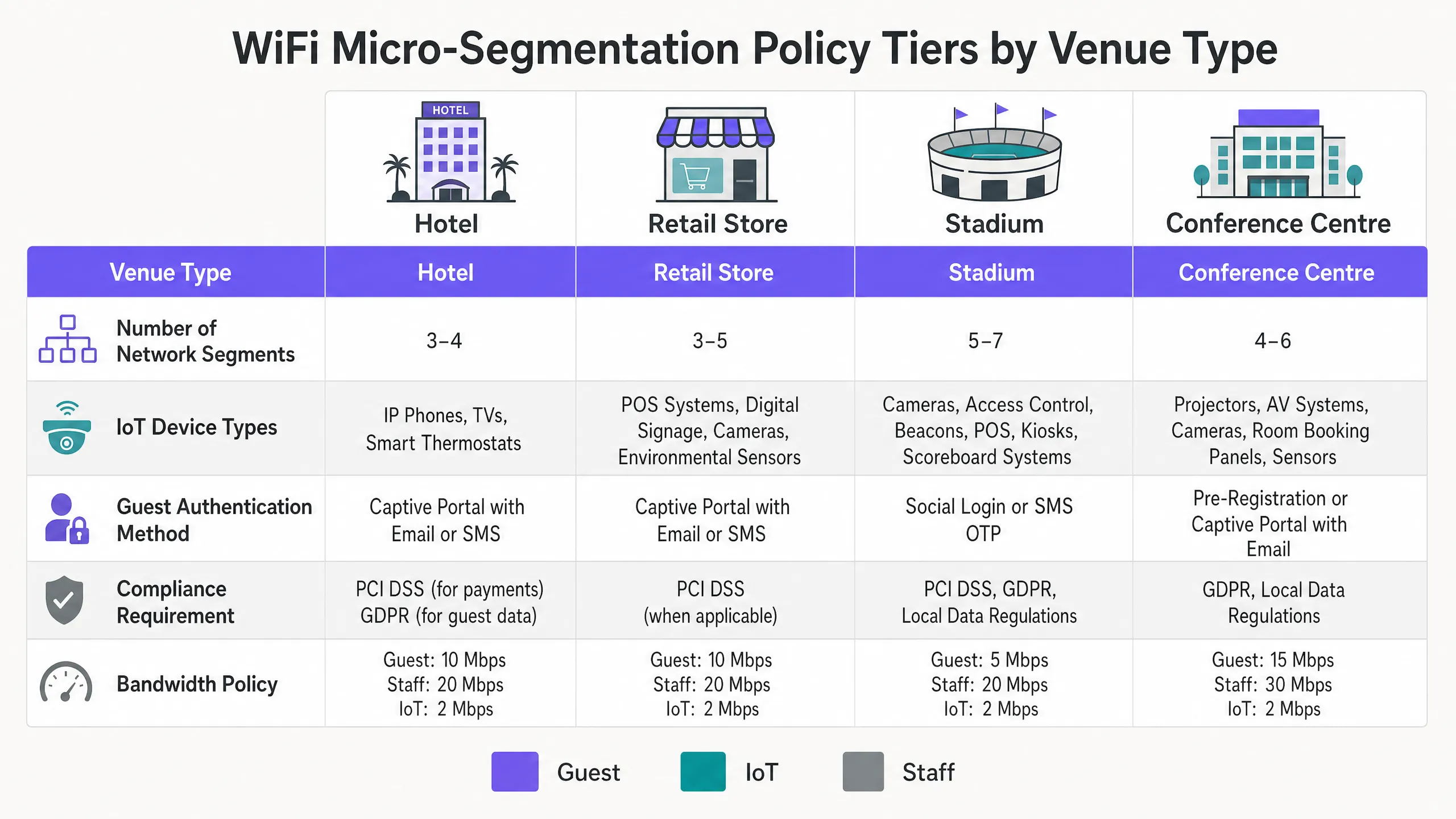
comparison_chart.png

Mejores Prácticas

  • Aplicar Aislamiento de Clientes: Habilite siempre el aislamiento de clientes en los SSIDs de invitados para prevenir ataques laterales entre dispositivos no confiables.
  • Utilizar Asignación Dinámica de VLAN: Abandone el mapeo estático de SSID. Use RADIUS para asignar VLANs basándose en el rol del usuario o el perfilado del dispositivo.
  • Implementar Filtrado DNS: Aplique políticas de filtrado DNS específicas de segmento para prevenir la comunicación de malware y hacer cumplir las políticas de uso aceptable.
  • Optimizar para su Entorno: Adapte su diseño de RF y estrategia de segmentación a su tipo de ubicación específica. Lea más sobre WiFi de Oficina: Optimice su Red Wi-Fi Moderna de Oficina y comprenda el impacto de Frecuencias Wi-Fi: Una Guía de Frecuencias Wi-Fi en 2026 .
  • LAproveche el análisis:** Utilice WiFi Analytics para monitorizar la utilización de segmentos e identificar comportamientos anómalos.

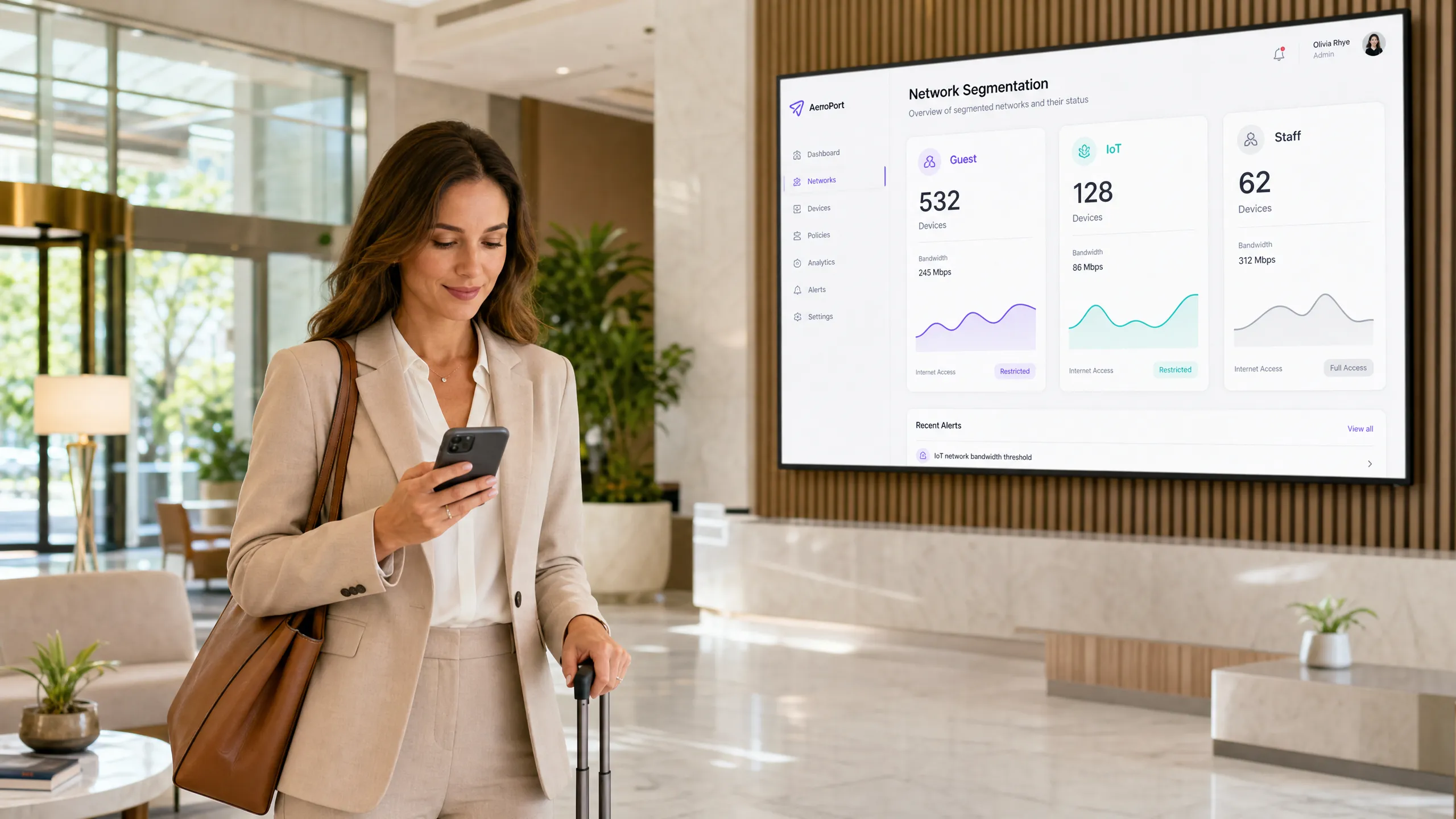
retail_segmentation_scene.png

Resolución de problemas y mitigación de riesgos

El modo de fallo más común en las implementaciones de microsegmentación es el enrutamiento inter-VLAN mal configurado. Si una regla de firewall permite inadvertidamente el tráfico entre los segmentos IoT y Corporativo, la segmentación se ve comprometida.

Errores comunes:

  • Exposición de la interfaz de gestión: Dejar las interfaces de gestión de AP o switches accesibles desde los segmentos de invitados o IoT. El tráfico de gestión debe residir en una VLAN fuera de banda dedicada y altamente restringida.
  • Fallos de RADIUS: Un servidor RADIUS mal configurado que descarte las autenticaciones 802.1X resultará en un fallo generalizado de conectividad para los dispositivos corporativos. Implemente una infraestructura RADIUS redundante.
  • Enrutamiento asimétrico: Asegúrese de que las rutas de tráfico de retorno estén correctamente definidas en sus políticas de firewall para evitar la pérdida de conexiones.

ROI e impacto empresarial

La implementación de una microsegmentación robusta ofrece un valor empresarial medible:

  1. Alcance de cumplimiento reducido: Al aislar criptográficamente los terminales POS y los sistemas de pago, se reduce significativamente el alcance y el coste de las auditorías PCI DSS.
  2. Mitigación de riesgos: Contener una posible brecha en un único segmento (por ejemplo, un reproductor de señalización digital comprometido) evita el movimiento lateral catastrófico hacia los sistemas corporativos centrales.
  3. Eficiencia operativa: La asignación dinámica de VLAN reduce la sobrecarga administrativa de configurar manualmente los puertos de switch y gestionar múltiples SSIDs estáticos.

Definiciones clave

Micro-Segmentation

The practice of dividing a network into granular, isolated zones to enforce strict security policies and contain potential breaches.

Essential for venue operators running diverse device types (Guest, IoT, Staff) on a single physical network infrastructure.

IEEE 802.1X

A standard for port-based network access control that provides an authentication mechanism to devices wishing to attach to a LAN or WLAN.

The engine for dynamic VLAN assignment and robust corporate device onboarding.

Dynamic VLAN Assignment

The process where a RADIUS server instructs the access point or switch which VLAN a client should be placed in upon successful authentication.

Allows a single SSID to securely serve multiple user roles without static configuration.

Client Isolation

A wireless network feature that prevents connected clients from communicating directly with each other.

A mandatory configuration for any guest WiFi network to prevent peer-to-peer attacks and ensure privacy.

MAC Authentication Bypass (MAB)

A technique used to authenticate devices that do not support 802.1X by using their MAC address as the credential.

Commonly used to onboard headless IoT devices like smart TVs or sensors onto a segmented network.

EAP-TLS

Extensible Authentication Protocol-Transport Layer Security; a highly secure authentication method requiring client and server certificates.

The gold standard for authenticating corporate devices and POS systems to prevent credential theft.

WPA3-Enterprise

The latest WiFi security standard for enterprise networks, offering stronger encryption and robust authentication.

Should be mandated for all new deployments to protect sensitive corporate and staff traffic.

Quality of Service (QoS)

Technologies that manage data traffic to reduce packet loss, latency, and jitter on the network.

Used in conjunction with segmentation to ensure critical applications (like POS) are prioritized over guest or IoT traffic.

Ejemplos prácticos

A 200-room hotel needs to deploy new smart TVs in every guest room, upgrade their POS systems in the restaurant, and provide high-speed guest WiFi, all on the existing physical network infrastructure. How should they architect the segmentation?

  1. Implement three distinct VLANs: Guest (VLAN 10), IoT (VLAN 20), and Corporate/POS (VLAN 30).
  2. Configure the APs to broadcast two SSIDs: 'Hotel_Guest' (Open with Captive Portal, mapped to VLAN 10) and 'Hotel_Secure' (802.1X).
  3. Enable Client Isolation on the 'Hotel_Guest' SSID.
  4. Use MAC-based RADIUS authentication (MAB) for the Smart TVs to dynamically assign them to VLAN 20.
  5. Use EAP-TLS certificate authentication for the POS terminals to assign them to VLAN 30.
  6. Configure the perimeter firewall to deny all inter-VLAN traffic, permitting VLAN 10 and 20 internet-only access, and restricting VLAN 30 to the corporate VPN tunnel.
Comentario del examinador: This approach minimizes SSID overhead while ensuring strict isolation. Using MAB for the TVs is a pragmatic solution since most embedded devices lack 802.1X supplicants. The strict firewall rules ensure PCI DSS compliance for the POS systems.

A large retail chain is experiencing network congestion and suspects their digital signage media players (IoT) are saturating the uplink, impacting the performance of their mobile POS tablets.

  1. Audit the current network configuration to confirm if digital signage and POS tablets share the same segment.
  2. Implement micro-segmentation by moving the digital signage players to a dedicated IoT VLAN.
  3. Apply Quality of Service (QoS) policies at the access switch or AP level: rate-limit the IoT VLAN to 5 Mbps per device, and prioritize traffic from the POS VLAN.
  4. Ensure the IoT VLAN has a strict egress-only firewall policy to the specific content delivery network (CDN) used by the signage vendor.
Comentario del examinador: This scenario highlights that micro-segmentation is not just for security; it is essential for traffic engineering. By isolating and rate-limiting the IoT devices, the critical path for revenue-generating POS traffic is protected.

Preguntas de práctica

Q1. You are deploying a new WiFi network for a large conference centre. The venue requires a public guest network, a dedicated network for AV equipment (projectors, digital signage), and a secure network for venue staff. You have been instructed to minimize the number of broadcasted SSIDs. How do you architect the wireless access layer?

Sugerencia: Consider how different device types authenticate and how RADIUS can dynamically assign VLANs.

Ver respuesta modelo

Broadcast two SSIDs. SSID 1 ('Conference_Guest'): Open network with a captive portal for guest access, mapped to a Guest VLAN with client isolation and internet-only firewall rules. SSID 2 ('Conference_Secure'): 802.1X enabled. Venue staff authenticate via EAP-TLS (certificates) and are dynamically assigned to the Staff VLAN. AV equipment authenticates via MAC Authentication Bypass (MAB) against the RADIUS server and is dynamically assigned to the isolated AV/IoT VLAN.

Q2. During a security audit, a penetration tester successfully compromises a smart thermostat in the hotel lobby. From the thermostat, they are able to access the hotel's reservation database server. What architectural failure allowed this, and how should it be remediated?

Sugerencia: Consider inter-VLAN routing policies and the principle of least privilege.

Ver respuesta modelo

The architectural failure is a lack of micro-segmentation and permissive inter-VLAN routing. The IoT device (thermostat) was either placed on the same VLAN as the corporate servers, or the firewall separating the VLANs allowed inbound traffic from the IoT segment to the corporate segment. Remediation: Move all thermostats to a dedicated IoT VLAN. Configure the perimeter firewall with a default-deny policy between VLANs. The IoT VLAN should only be permitted egress traffic to the specific cloud controller required for the thermostats, with no access to internal corporate resources.

Q3. A retail client complains that their guest WiFi is extremely slow during peak hours, and they notice that the POS systems are also experiencing latency. Both are running on the same physical access points. What is the most likely cause, and what are the recommended steps to resolve it?

Sugerencia: Think about bandwidth contention and traffic prioritization.

Ver respuesta modelo

The likely cause is bandwidth contention on the shared uplink, with guest traffic saturating the connection and impacting critical POS traffic. Resolution: Implement Quality of Service (QoS) and rate-limiting. 1. Ensure POS and Guest traffic are on separate VLANs. 2. Apply a rate-limit policy to the Guest VLAN (e.g., 5 Mbps per client) to prevent any single guest from hogging bandwidth. 3. Configure QoS rules on the switch and firewall to prioritize traffic originating from the POS VLAN over the Guest VLAN.