

Purple vs Cloud4Wi: Comparativa de Captive Portal y Marketing WiFi
Esta guía de referencia técnica ofrece una comparación directa y detallada de Purple y Cloud4Wi para implementaciones empresariales de Captive Portal y marketing WiFi. Cubre la paridad de características, las diferencias en los modelos de precios, las consideraciones arquitectónicas, la amplitud de la integración y los requisitos de cumplimiento para ayudar a los gerentes de TI, arquitectos de red y CTOs a tomar una decisión informada para su lista de preseleccionados. La guía incluye escenarios de implementación reales de hostelería y comercio minorista, un diagrama de arquitectura completo de Mermaid y un podcast de 10 minutos para directivos.
🎧 Escuchar esta guía
Ver transcripción

Resumen Ejecutivo
Al evaluar plataformas empresariales de WiFi para invitados, los líderes de TI y los arquitectos de red a menudo se ven obligados a elegir entre sistemas complejos y rígidos y herramientas ligeras que no logran escalar. Tanto Purple como Cloud4Wi han surgido como actores dominantes en el espacio de Captive Portal y análisis WiFi, pero abordan el mercado con filosofías fundamentalmente diferentes. Purple impulsa la disrupción del mercado a través de su nivel gratuito "Connect" y precios transparentes, funcionando como un proveedor de identidad gratuito para servicios como OpenRoaming, mientras ofrece un potente motor de marketing y análisis de WiFi para invitados . Cloud4Wi, por el contrario, mantiene un modelo de ventas empresarial tradicional con un fuerte énfasis en los servicios de localización en tiempo real (RTLS) y las implementaciones personalizadas.
Esta guía ofrece una comparación directa y técnica de Purple vs Cloud4Wi. Analizamos las capacidades del Captive Portal, los ecosistemas de integración, los marcos de cumplimiento y los modelos de precios. Para los CTOs y directores de operaciones de recintos que gestionan Comercio minorista , Hostelería o grandes espacios públicos, la decisión depende de si su prioridad es la implementación rápida con automatización de marketing integrada (Purple) o implementaciones empresariales altamente personalizadas y centradas en la ubicación (Cloud4Wi).
Análisis Técnico Detallado: Arquitectura y Capacidades Principales
Ambas plataformas operan como superposiciones basadas en la nube, agnósticas al hardware, que se integran con su infraestructura inalámbrica existente — Cisco, Fortinet, Aruba, Ruckus — a través de conexiones RADIUS y API. No se requiere el reemplazo de puntos de acceso. Sin embargo, sus conjuntos de características divergen significativamente al examinar la experiencia del Captive Portal y el manejo de datos posterior.
Captive Portal y Autenticación
El Captive Portal es el punto de ingesta crítico para los datos de primera parte. Purple ofrece un portal altamente personalizable que soporta más de 25 idiomas con detección automática de dispositivos. Proporciona diversos métodos de autenticación, incluyendo inicio de sesión social (Facebook, X, LinkedIn), formularios personalizados, click-to-connect e integración Passpoint sin interrupciones. Fundamentalmente, la autenticación basada en perfiles de Purple soporta una red de más de 440 millones de usuarios en todo el mundo, permitiendo un roaming sin fricciones en los recintos participantes sin interacciones repetidas con el portal.
Cloud4Wi también ofrece una sólida personalización del Captive Portal, soportando múltiples opciones de inicio de sesión, incluyendo OTPs y SSO empresarial. De manera similar, enfatizan la incorporación de Passpoint para la transición de usuarios de redes abiertas a conexiones seguras y cifradas. Si bien ambas plataformas logran paridad en la funcionalidad básica del Captive Portal, la automatización de marketing integrada de Purple y los flujos de trabajo transparentes de captura de datos proporcionan un camino más inmediato hacia el ROI para los equipos de marketing.
Análisis e Integración de Datos
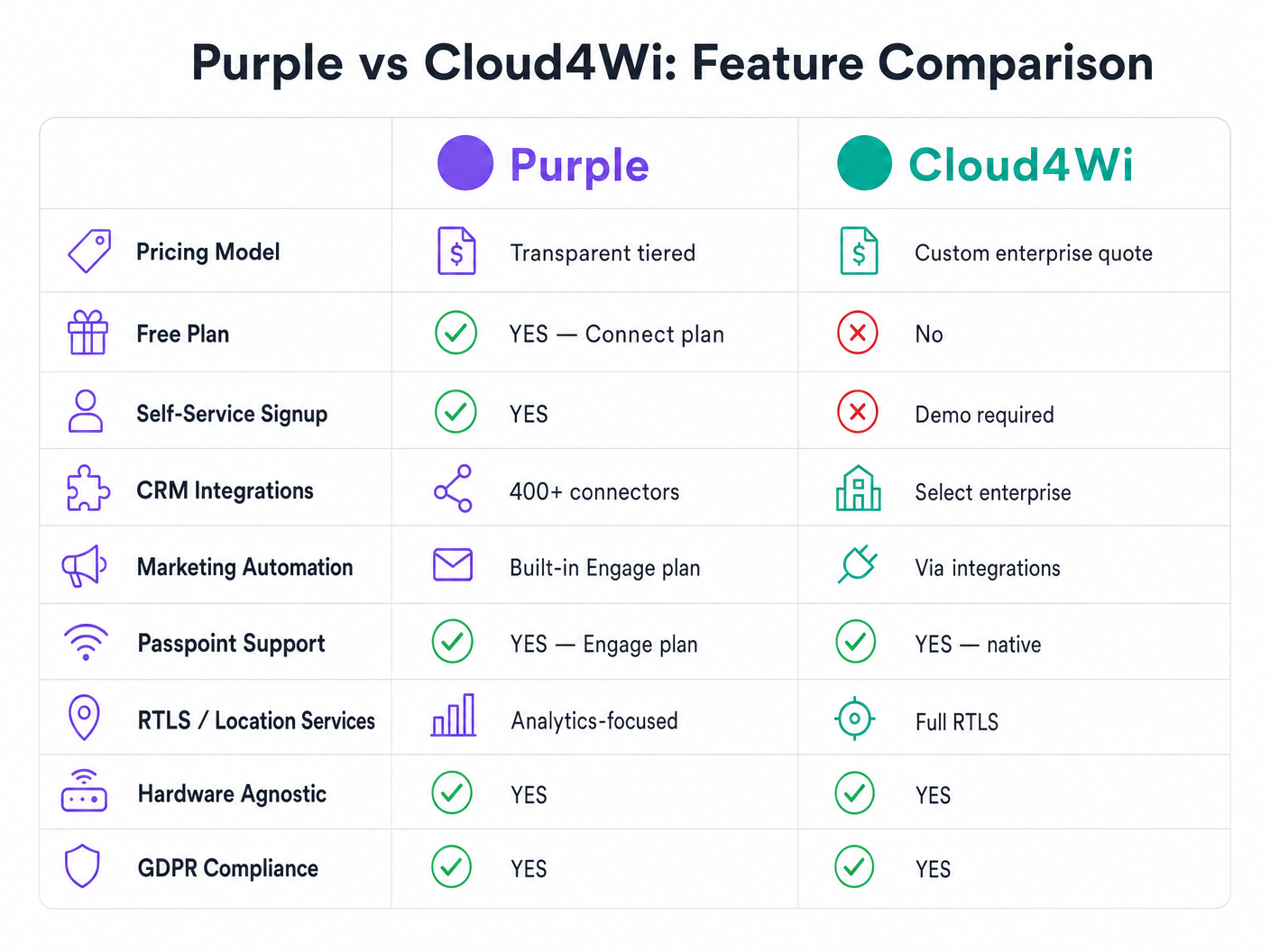
La utilidad de los datos es donde las plataformas se diferencian más claramente. La plataforma de Análisis WiFi de Purple está diseñada para convertir el tráfico peatonal anónimo en datos CRM accionables. Con más de 400 conectores nativos, Purple transfiere sin problemas los datos capturados a plataformas como Salesforce, HubSpot y Microsoft Dynamics. El nivel "Engage" incluye automatización de marketing integrada, permitiendo a los recintos activar comunicaciones personalizadas basadas en el tiempo de permanencia, la frecuencia de visitas y los perfiles demográficos.
Cloud4Wi se posiciona fuertemente en el espacio de los Servicios de Localización en Tiempo Real (RTLS). Mientras que Purple proporciona excelentes análisis de tráfico peatonal y tiempo de permanencia, la arquitectura de Cloud4Wi está profundamente integrada con el seguimiento de ubicación, ofreciendo una visibilidad granular de los patrones de movimiento de los visitantes. Para entornos que requieren capacidades precisas de Sistema de Posicionamiento Interior — como grandes aeropuertos o centros comerciales de varias plantas — Cloud4Wi ofrece una solución atractiva, aunque compleja.
Modelos de Precios: Disrupción vs Empresa Tradicional
El contraste más marcado entre Purple y Cloud4Wi reside en sus estrategias comerciales.
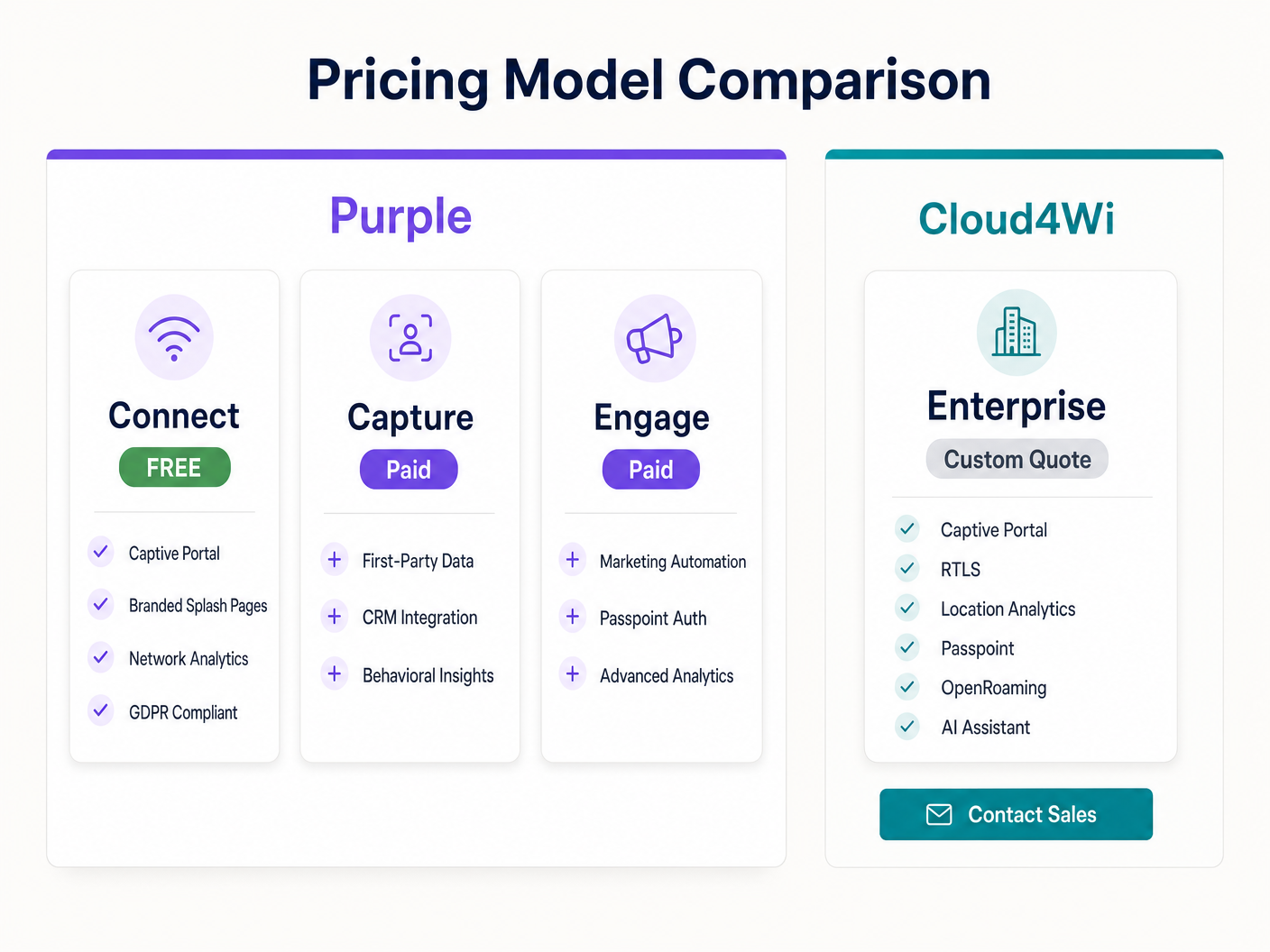
Purple emplea un modelo de precios transparente y por niveles diseñado para reducir la fricción y acelerar la implementación. El nivel fundacional, "Connect", es completamente gratuito, proporcionando un Captive Portal seguro, páginas de bienvenida personalizadas, análisis de red y cumplimiento GDPR. Este nivel mercantiliza eficazmente el WiFi básico para invitados, permitiendo a los equipos de TI implementar una solución conforme de inmediato sin un ciclo de adquisición. Las organizaciones pueden luego actualizar a los niveles "Capture" o "Engage" para una integración CRM avanzada, información sobre el comportamiento y automatización de marketing.
Cloud4Wi opera con un modelo de software empresarial tradicional. El precio es totalmente personalizado, requiriendo el contacto con su equipo de ventas para obtener un presupuesto. No hay un nivel gratuito ni registro de autoservicio. Este enfoque se alinea con su énfasis en implementaciones complejas y a gran escala, pero presenta una barrera de entrada significativa para las organizaciones que buscan implementaciones rápidas de prueba de concepto o una previsión de costes transparente.
| Dimensión | Purple | Cloud4Wi |
|---|---|---|
| Modelo de Precios | Niveles transparentes; nivel de entrada gratuito | Presupuesto empresarial personalizado |
| Nivel Gratuito | Sí (Connect) | No |
| Registro de Autoservicio | Sí | Demo requerida |
| Automatización de Marketing | Integrada (plan Engage) | Mediante integraciones de terceros |
| Conectores CRM | Más de 400 nativos | Empresarial selecto |
| RTLS / Servicios de Ubicación | Centrado en análisis | Motor RTLS completo |
| Soporte Passpoint | Sí (plan Engage) | Sí (nativo) |
| OpenRoaming | Sí (proveedor de identidad gratuito) | Sí |
| Agnóstico al Hardware | Sí | Sí |
| Cumplimiento GDPR / CCPA | Sí | Sí |
| AI Assistant | No | Sí (Hedy) |
| Filtrado de Contenido | Sí (complemento Shield) | No |
Guía de Implementación
La implementación de un Captive Portal empresarial requiere una cuidadosa coordinación entre los equipos de ingeniería de red y marketing. Independientemente de la plataforma elegida, los siguientes pasos garantizan una implementación segura, conforme y de alto rendimiento.
Paso 1 — Auditoría y Segmentación de Red. Documente su arquitectura de SSID, segmentación de VLAN y configuración del servidor RADIUS antes de interactuar con la plataforma del Captive Portal. El tráfico de invitados debe estar completamente aislado del tráfico corporativo a nivel de VLAN. Esto no es solo una buena práctica de seguridad; es un requisito de cumplimiento bajo PCI DSS si su establecimiento procesa pagos con tarjeta en la misma red física.
Paso 2 — Configuración del Walled Garden. El Walled Garden define los dominios y rangos IP a los que un dispositivo puede acceder antes de que se complete la autenticación. Asegúrese de que todos los recursos requeridos por el portal — APIs de inicio de sesión social, frameworks CSS, servidores de perfiles Passpoint y el propio dominio del portal — estén en la lista de permitidos de su controlador de red de área local inalámbrica. Un Walled Garden incompleto es la causa más común de fallos en la renderización del Captive Portal.
Paso 3 — Diseño de Cumplimiento y Consentimiento. La captura de datos de primera parte introduce obligaciones bajo GDPR, CCPA y marcos de privacidad regionales. Asegúrese de que el Captive Portal solicite explícitamente el consentimiento para el procesamiento de datos y las comunicaciones de marketing antes de la autenticación. Evite las casillas de consentimiento premarcadas. Tanto Purple como Cloud4Wi ofrecen gestión de consentimiento nativa, pero el lenguaje de aceptación específico y la granularidad deben ser configurados por su equipo legal.
Paso 4 — Transición a Passpoint. Utilice el inicio de sesión inicial del Captive Portal para solicitar a los usuarios que descarguen un perfil Passpoint. En todas las visitas futuras, su dispositivo se autenticará automáticamente utilizando el cifrado WPA2/WPA3-Enterprise, omitiendo el portal por completo. Esta es la mitigación definitiva para los problemas de aleatorización de direcciones MAC y mejora significativamente la experiencia del visitante recurrente.
Paso 5 — Integración con CRM y Pruebas de Flujo de Datos. Antes de la puesta en marcha, valide el flujo de datos de extremo a extremo desde el registro en el portal hasta la creación del registro en el CRM. Pruebe casos extremos, incluyendo el manejo de correos electrónicos duplicados, la propagación de banderas de consentimiento y el mapeo de campos. Los más de 400 conectores nativos de Purple simplifican considerablemente este paso en comparación con las integraciones de API personalizadas.

Mejores Prácticas
Varias prácticas estándar de la industria se aplican independientemente de la selección de la plataforma. Primero, minimice los campos del formulario de registro. Cada campo adicional requerido reduce notablemente las tasas de finalización; un nombre y una dirección de correo electrónico son el conjunto de datos mínimo viable para la mayoría de los casos de uso de marketing. Utilice el perfilado progresivo para enriquecer los registros en visitas posteriores en lugar de sobrecargar la experiencia de registro inicial.
Segundo, implemente la monitorización de red para la latencia de RADIUS. Una alta latencia entre el controlador de red de área local inalámbrica y los servidores RADIUS en la nube provoca tiempos de espera de autenticación y una mala experiencia de usuario. Monitoree los tiempos de respuesta de RADIUS y considere configuraciones RADIUS redundantes si su hardware lo soporta.
Tercero, alinee sus estándares de infraestructura WiFi con la elección de su plataforma. Si está evaluando Wi-Fi 6E vs Wi-Fi 7 para una nueva implementación, asegúrese de que la plataforma de Captive Portal elegida esté probada y certificada con el hardware que está implementando. Tanto Purple como Cloud4Wi son agnósticas al hardware, pero los entornos densos y de alto rendimiento requieren una cuidadosa planificación de RF para asegurar que la experiencia del portal no se degrade por la congestión de la red.
Resolución de Problemas y Mitigación de Riesgos
Incluso con plataformas robustas, las implementaciones de Captive Portal encuentran modos de fallo predecibles. Comprenderlos de antemano reduce significativamente el tiempo medio de resolución.
El Portal No Se Renderiza. La causa más común es un Walled Garden incompleto. Revise la documentación del proveedor y asegúrese de que todos los dominios requeridos estén en la lista de permitidos. Verifique si hay reglas de firewall excesivamente agresivas que puedan estar bloqueando las redirecciones HTTP utilizadas para activar el portal.
Tiempos de Espera de Autenticación. Generalmente causados por alta latencia o pérdida de paquetes entre el WLC y el punto final RADIUS en la nube. Monitoree los tiempos de respuesta de RADIUS y verifique si hay problemas en la ruta de red entre su sitio y la infraestructura en la nube del proveedor.
Desconexiones por Aleatorización de MAC. Los smartphones modernos rotan las direcciones MAC, rompiendo la persistencia de la sesión y forzando interacciones repetidas con el portal. La mitigación estratégica es implementar Passpoint, que utiliza una identidad basada en certificados en lugar de direcciones MAC.
Datos No Aparecen en el CRM. Generalmente causado por mapeos de campos mal configurados o fallos de autenticación de API. Verifique que los tokens OAuth y las claves API no hayan caducado, y revise los registros de errores de la integración tanto en el panel de la plataforma WiFi como en el CRM.
Fallos en la Auditoría de Consentimiento GDPR. Asegúrese de que la plataforma almacene las marcas de tiempo del consentimiento, el alcance del consentimiento y la versión específica del portal mostrada en el momento del consentimiento. Tanto Purple como Cloud4Wi proporcionan registros de auditoría de consentimiento, pero estos deben configurarse y conservarse de acuerdo con su política de retención de datos.
ROI e Impacto Comercial
La medida definitiva de una plataforma de Captive Portal es su capacidad para generar valor comercial medible. El enfoque de Purple se centra en un rápido tiempo de valor a través de su nivel Free Connect y la automatización de marketing integrada. Los establecimientos en Sanidad o Transporte pueden establecer rápidamente una red conforme y comenzar a capturar datos para impulsar programas de fidelización o la monetización de medios minoristas. Purple informa un ROI promedio del 873% en su base de clientes, impulsado principalmente por la captura de datos de primera parte y las campañas de marketing automatizadas.
La propuesta de valor de Cloud4Wi está ligada a la analítica de ubicación profunda y a complejas integraciones empresariales. Su implementación Guess para el comercio minoristamiento demuestra la escala del potencial: 35.000 contactos con consentimiento capturados al mes y más de un millón de "momentos" de ubicación en tiempo real revelados anualmente. Aunque la inversión inicial y el tiempo de implementación son mayores, las organizaciones que requieren datos RTLS granulares para optimizar los planos de planta o activar experiencias altamente localizadas pueden encontrar la inversión justificada.
Para las organizaciones que evalúan las implicaciones de la Arquitectura del Internet de las Cosas de su implementación de WiFi —especialmente aquellas que integran el análisis de WiFi con redes de sensores más amplias— las capacidades RTLS de Cloud4Wi proporcionan una capa de datos más rica. Purple, sin embargo, sigue siendo la opción más sólida para las organizaciones que priorizan el ROI de marketing, la amplitud de integración y la velocidad de implementación.
Términos clave y definiciones
Captive Portal
A web page that intercepts a user's web browser when attempting to connect to a public WiFi network, requiring interaction — authentication, payment, or accepting terms — before granting internet access.
The primary mechanism for capturing first-party data and ensuring legal compliance on guest networks. Both Purple and Cloud4Wi use captive portals as the entry point for their data capture and analytics pipelines.
Passpoint (Hotspot 2.0)
An industry standard (IEEE 802.11u) that streamlines network access, allowing devices to automatically and securely connect to WiFi networks using enterprise-grade WPA2/WPA3 encryption without requiring manual captive portal logins after the initial profile installation.
Essential for providing a cellular-like roaming experience and mitigating the impact of MAC address randomisation on analytics. Both Purple and Cloud4Wi support Passpoint, but it requires deliberate configuration.
RADIUS (Remote Authentication Dial-In User Service)
A networking protocol that provides centralised Authentication, Authorisation, and Accounting (AAA) management for users who connect and use a network service.
The core protocol used by both Purple and Cloud4Wi to communicate with the venue's wireless infrastructure to grant or deny internet access following captive portal authentication.
Walled Garden
A limited network environment that controls access to web content and services. In WiFi deployments, it refers to the specific IP addresses or domains a device can access before completing captive portal authentication.
IT teams must configure Walled Gardens correctly on their wireless LAN controllers to ensure the captive portal page, social login APIs, and Passpoint profile servers are accessible pre-authentication.
Real-Time Location Services (RTLS)
Technologies used to automatically identify and track the location of objects or people in real time, usually within a building or contained area, using WiFi signal triangulation, BLE beacons, or UWB.
A key differentiator for Cloud4Wi, requiring dense AP placement and specific network configurations to achieve high accuracy. Purple provides footfall and dwell time analytics but does not offer full RTLS.
First-Party Data
Information a company collects directly from its customers and owns outright, rather than purchasing from a third party or inferring from third-party cookies.
The primary ROI driver for marketing teams using platforms like Purple to capture emails, demographics, and behavioural data via the captive portal, particularly valuable in the post-third-party-cookie era.
MAC Randomisation
A privacy feature in modern operating systems (iOS 14+, Android 11+) that generates a random Media Access Control (MAC) address when connecting to WiFi networks, preventing long-term device tracking.
Forces IT teams to move away from MAC-based authentication and analytics toward identity-based solutions like Passpoint. Ignoring this renders loyalty analytics unreliable.
OpenRoaming
A WBA (Wireless Broadband Alliance) federation of WiFi networks that allows users to automatically connect securely across different venues without needing to register or log in repeatedly, using Passpoint as the underlying technology.
Purple acts as a free identity provider for OpenRoaming under its Connect licence, enabling seamless connectivity for users across participating venues globally.
PPSK (Private Pre-Shared Key)
A WiFi security mechanism that assigns a unique pre-shared key to each user or device, providing WPA2-level encryption without requiring a RADIUS server for every authentication event.
Supported by Cloud4Wi for device-level authentication in IoT and BYOD scenarios. Useful in environments where Passpoint is not feasible.
Casos de éxito
A 500-location retail chain needs to deploy a compliant guest WiFi solution across all stores within 30 days to support a new loyalty app launch. They have existing Cisco Meraki infrastructure but a limited IT budget for the current quarter.
Deploy Purple's 'Connect' tier immediately. Because Purple is hardware-agnostic and integrates natively with Meraki via RADIUS, the deployment requires no new hardware procurement. The Free Connect tier provides the necessary branded captive portal and GDPR compliance framework at zero software cost. The IT team can complete the configuration centrally via Purple's cloud dashboard and push the configuration to all 500 sites without on-site visits. Once the loyalty app is launched and budget is secured in the next quarter, the organisation can upgrade to the 'Capture' tier via a simple license change to begin piping first-party data directly into their CRM.
A large stadium with 60,000 capacity requires granular tracking of attendee movement to optimise concession stand staffing and manage crowd flow during halftime. They have a high-density Aruba network deployed and a significant capital budget.
In this specific scenario, Cloud4Wi's deep focus on Real-Time Location Services (RTLS) makes it the stronger candidate. The platform must be integrated with the Aruba analytics engine to process location data at the required granularity. The IT team must configure the network to support high-frequency location updates and ensure the captive portal clearly communicates the extent of location tracking to comply with privacy regulations. A phased rollout — starting with a single stand or section — is recommended to validate location accuracy before full deployment.
Análisis de escenarios
Q1. A hospital IT director needs to implement a guest WiFi portal that strictly complies with GDPR and HIPAA, while also allowing the marketing team to collect optional feedback surveys. They want to avoid a lengthy procurement process. Which platform architecture best suits this requirement, and what specific configuration steps are required?
💡 Sugerencia:Consider the procurement cycle, the availability of specific add-on features for feedback collection, and the compliance requirements for healthcare environments.
Mostrar enfoque recomendado
Purple is the recommended choice. The hospital can immediately deploy the 'Connect' tier to establish a GDPR-compliant captive portal without a lengthy enterprise procurement cycle. They can then add Purple's 'Surveys' add-on to collect the required feedback. The IT team must configure the consent management carefully to separate WiFi access consent from marketing communications consent, ensuring HIPAA-relevant data is not captured through the portal. Network segmentation must isolate guest WiFi from clinical systems.
Q2. Your network engineering team reports high drop-off rates on the captive portal splash page before users authenticate. The portal is deployed on a Fortinet FortiGate controller integrated with Cloud4Wi. What is the most likely architectural cause, and what is the remediation process?
💡 Sugerencia:Think about what network configurations are required for a device to load external resources before authentication is complete, and which specific Fortinet configuration may be involved.
Mostrar enfoque recomendado
The most likely cause is an incomplete Walled Garden configuration on the FortiGate. If the portal relies on external resources — such as Cloud4Wi's CDN for CSS and JavaScript, or social login APIs — that are not allowlisted, the page will fail to render correctly. The remediation process is to review Cloud4Wi's Fortinet integration documentation, extract the full list of required domains and IP ranges, and add them to the FortiGate's exempt list for pre-authentication traffic. After updating, clear the browser cache on a test device and re-test the portal flow.
Q3. The marketing team at a shopping mall wants to track returning visitors to measure loyalty, but the IT team notes that MAC randomisation on iOS 14+ and Android 11+ makes this data unreliable. The current deployment uses Purple's Capture tier. What technology should be implemented, and what does the user journey look like after implementation?
💡 Sugerencia:What standard replaces MAC address tracking with secure, certificate-based authentication, and which Purple pricing tier enables it?
Mostrar enfoque recomendado
The venue should upgrade to Purple's 'Engage' tier to unlock Passpoint and profile authentication. By prompting users to download a Passpoint profile during their initial captive portal interaction, subsequent visits will automatically authenticate using WPA2/WPA3-Enterprise encryption and certificate identity, entirely bypassing the MAC randomisation issue. The user journey becomes: first visit — portal interaction and Passpoint profile download; all subsequent visits — automatic, secure connection with no portal interaction. This provides accurate, persistent identity for loyalty analytics.




