
Sistemas de posicionamiento WiFi en interiores: cómo funcionan y cómo implementarlos
Esta guía detallada describe la arquitectura técnica, las estrategias de implementación y el valor empresarial de los sistemas de posicionamiento en interiores basados en WiFi. Proporciona a los arquitectos de red y directores de TI directrices prácticas sobre la ubicación de AP, la calibración de RF y la superación de la aleatorización de MAC para ofrecer análisis espaciales precisos.
Video overview
Escuchar esta guía
Ver transcripción del podcast
Parte de nuestra serie principal: Guía de WiFi Analytics →

Resumen Ejecutivo
Para los operadores de espacios empresariales, comprender el movimiento de los visitantes ya no es un lujo, sino un requisito fundamental para la eficiencia operativa y la optimización del negocio. Los sistemas de posicionamiento de WiFi en interiores transforman la infraestructura de red existente en un potente motor de análisis espacial. Al aprovechar las mediciones del Indicador de Fuerza de la Señal Recibida (RSSI) de sus puntos de acceso desplegados, estos sistemas proporcionan información útil sobre la afluencia, el tiempo de permanencia y las transiciones entre zonas sin necesidad de hardware adicional como balizas Bluetooth o sensores de banda ultraancha.
Esta guía de referencia técnica detalla la arquitectura, las consideraciones de despliegue y el impacto empresarial del posicionamiento en interiores basado en WiFi. Diseñada para arquitectos de red y directores de TI, ofrece una orientación independiente del fabricante sobre la configuración de los puntos de acceso, los estudios de cobertura y la calibración de radio, al tiempo que demuestra cómo la integración con plataformas como el WiFi Analytics de Purple transforma los datos de telemetría sin procesar en un ROI medible. Ya sea que gestione un hotel de 200 habitaciones, un entorno minorista de varias plantas o una gran instalación del sector público, esta guía proporciona la base técnica necesaria para desplegar análisis de posicionamiento de manera eficaz y de conformidad con las normativas.
Análisis técnico profundo: Arquitectura y estándares
El desafío fundamental de la localización en interiores es que las señales GPS no pueden penetrar de forma fiable los materiales de construcción de los edificios. En consecuencia, los espacios empresariales deben confiar en la infraestructura local de radiofrecuencia (RF). Dado su despliegue omnipresente para la conectividad, WiFi es una opción lógica.
Cómo funciona la trilateración RSSI
La métrica principal para la localización WiFi es el Indicador de Fuerza de la Señal Recibida (RSSI). Cada dispositivo con WiFi busca constantemente redes disponibles, midiendo la fuerza de la señal de los puntos de acceso (AP) cercanos. El RSSI se expresa en decibelios relativos a un milivatio (dBm), que normalmente oscila entre -30 dBm (excelente señal) y -90 dBm (señal inservible).
Las plataformas de localización en interiores utilizan la trilateración para estimar la ubicación de un dispositivo. Cuando tres o más AP con coordenadas físicas conocidas miden el RSSI de un dispositivo, el sistema calcula la distancia estimada desde cada AP. La intersección de estos radios de probabilidad determina la ubicación estimada.
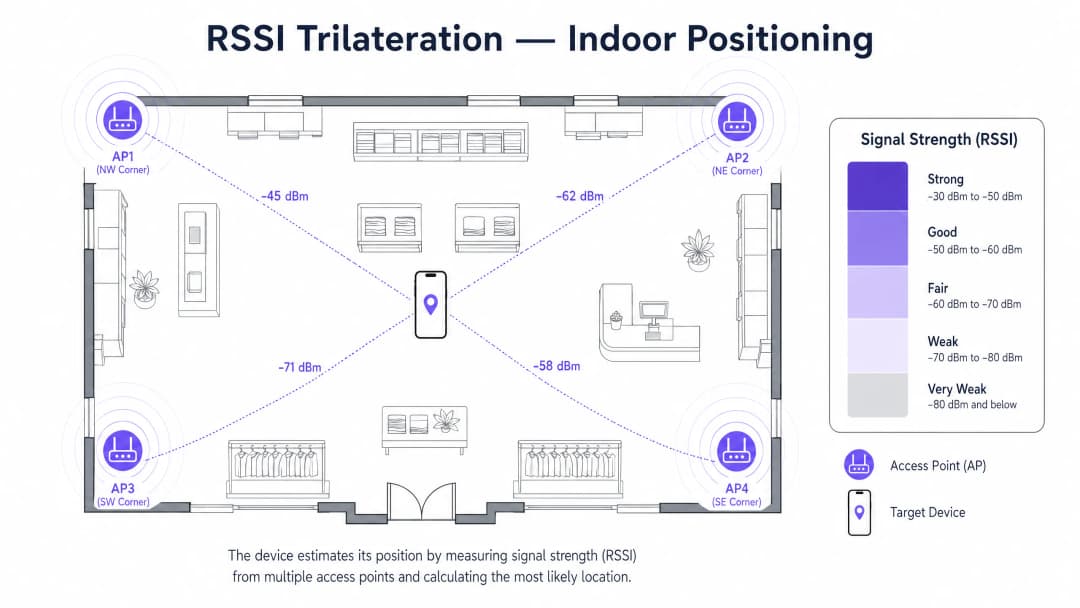
Aunque la trilateración proporciona la base matemática, el RSSI bruto es muy volátil debido a la propagación multitrayecto, la absorción por obstáculos físicos y las interferencias. Por lo tanto, los sistemas empresariales utilizan la huella digital de RF (RF fingerprinting) - un proceso de calibración en el que se registran mediciones empíricas de RSSI en ubicaciones conocidas para crear una base de datos de referencia. Durante el funcionamiento, el sistema compara las lecturas de RSSI en tiempo real con esta base de datos de huellas digitales utilizando algoritmos probabilísticos (como k-vecinos más cercanos o inferencia bayesiana) para mejorar significativamente la precisión.
Localización en el lado del dispositivo frente al lado de la infraestructura
Existen dos modelos de arquitectura principales para procesar los datos de localización:
- Localización en el lado del dispositivo: El dispositivo cliente (por ejemplo, un smartphone que ejecuta una aplicación específica) mide el RSSI de los AP cercanos, calcula su propia posición y, opcionalmente, la comunica a un servidor. Este enfoque escala bien, pero requiere el esfuerzo del usuario (instalación de la aplicación) y es susceptible a las restricciones de escaneo en segundo plano a nivel de sistema operativo.
- Localización en el lado de la infraestructura: Los AP de la red escuchan las solicitudes de sondeo (probe requests) emitidas por los dispositivos clientes. Los AP reenvían estas mediciones de RSSI a un controlador central o motor de análisis en la nube, que calcula la posición. Este es el modelo empresarial preferido, ya que no requiere software en el lado del cliente y proporciona análisis pasivos para todos los dispositivos emisores. La plataforma de Purple utiliza este enfoque en el lado de la infraestructura, correlacionando los datos de localización con perfiles autenticados a través del Captive Portal de Guest WiFi.
Estándares IEEE relevantes
Para optimizar la precisión de la localización, los arquitectos de red deben asegurarse de que su infraestructura sea compatible con enmiendas específicas de la norma IEEE 802.11:
- 802.11k (Radio Resource Measurement): permite que los puntos de acceso y los clientes intercambien información sobre el entorno de RF, proporcionando a la red una mejor visibilidad de la RSSI del cliente.
- 802.11v (BSS Transition Management): permite que la red dirija a los clientes a los puntos de acceso óptimos, mejorando indirectamente la calidad de la telemetría de ubicación al garantizar que los clientes estén conectados a los puntos de acceso con las mejores características de señal.
- 802.11ac (Wave 2) y 802.11ax (WiFi 6): aunque se centran principalmente en el rendimiento y la capacidad, las capacidades avanzadas de conformación de haces (beamforming) y MU-MIMO de estos estándares proporcionan un entorno de RF más estable, lo que beneficia la estabilidad de la RSSI.
- 802.11az (Next Generation Positioning): el estándar emergente para la medición del tiempo de vuelo (FTM, Fine-Time Measurement), que utiliza el tiempo de vuelo en lugar de la RSSI para lograr una precisión inferior al metro. Aunque todavía no es omnipresente, representa el futuro del posicionamiento WiFi.
Guía de implementación: despliegue y configuración
El despliegue de un sistema de posicionamiento en interiores requiere una planificación minuciosa. Un diseño de red que proporciona una excelente cobertura de datos no ofrece automáticamente una excelente precisión de ubicación.
Paso 1: estudio de cobertura de RF (Site Survey)
Un estudio predictivo por software no es suficiente para el posicionamiento. Debe realizar un estudio de RF activo sobre el terreno. Esto implica recorrer las instalaciones con herramientas especializadas de análisis de espectro para mapear la propagación real de la señal, identificar fuentes de interferencia (por ejemplo, sistemas de climatización, acero estructural) y detectar zonas sin señal. El estudio determina dónde deben añadirse o reubicarse los puntos de acceso para garantizar que cada zona rastreable tenga línea de visión o una fuerte penetración de al menos tres puntos de acceso. Para obtener una guía detallada sobre cómo proteger estos puntos de acceso una vez desplegados, consulte nuestra Access Point Security: Your 2026 Enterprise Guide.
Paso 2: estrategia de ubicación de los puntos de acceso
Para la conectividad, los puntos de acceso se suelen colocar en los pasillos para maximizar el área de cobertura. Para el posicionamiento, esto es contraproducente. Los puntos de acceso deben colocarse en el perímetro y en las esquinas de las zonas que desea rastrear, dirigiendo la señal de RF hacia el interior.
- Densidad: intente que al menos tres puntos de acceso detecten un dispositivo cliente en cualquier punto dado (normalmente a -75 dBm o mejor).
- Geometría: evite colocar los puntos de acceso en línea recta. Un patrón de triángulo equilátero o de rejilla escalonada proporciona la mejor geometría para los algoritmos de trilateración.
- Altura: monte los puntos de acceso a una altura uniforme, normalmente entre 3 y 4 metros. Una altura excesiva reduce la resolución de la RSSI horizontal requerida para un posicionamiento 2D preciso.
Paso 3: calibración del mapa de radio (Fingerprinting)
Una vez desplegada la infraestructura, debe calibrar el sistema. Esto implica cargar un plano de planta preciso y a escala en la plataforma de posicionamiento. A continuación, un técnico recorre el recinto, deteniéndose en puntos de cuadrícula definidos (normalmente cada 2 a 5 metros) para registrar muestras empíricas de RSSI. Este proceso de huella digital (fingerprinting) enseña al algoritmo cómo se comportan realmente las señales de RF en su entorno físico específico, teniendo en cuenta paredes, estanterías y otros obstáculos.
Paso 4: Integración de la plataforma y resolución de identidad
Las coordenadas X/Y brutas no sirven de nada sin un contexto empresarial. El motor de posicionamiento debe alimentar un panel de análisis. Además, los sistemas operativos móviles modernos utilizan la aleatorización de direcciones MAC para evitar el seguimiento pasivo de dispositivos no autenticados.
Para superar esto, el sistema de posicionamiento debe integrarse con la capa de autenticación de red. Cuando un usuario inicia sesión en el Guest WiFi (por ejemplo, a través de un Captive Portal), su dirección MAC aleatoria se asocia temporalmente con su perfil autenticado. Esto permite que plataformas como Purple proporcionen análisis completos y longitudinales al mismo tiempo que cumplen plenamente con las normativas de privacidad. Para recintos más pequeños que deseen implementar esta conectividad básica, consulte How to Set Up a WiFi Hotspot for Your Business (o la versión en portugués, Como Configurar um Hotspot WiFi para o Seu Negócio).
¿Tiene preguntas sobre su configuración específica?
Nuestro equipo trabaja con operadores de recintos, responsables de TI e ingenieros de redes en 80 000 espacios. Reserve una llamada de 20 minutos y le mostraremos cómo lo han solucionado otros profesionales como usted.
Buenas prácticas para entornos empresariales
Los distintos sectores presentan desafíos de RF únicos. Adaptar la estrategia técnica al entorno físico es esencial para un despliegue exitoso.
Hostelería y Sanidad
En entornos de Hospitality y Healthcare, el principal desafío es la atenuación de la señal causada por paredes densas, puertas cortafuegos y huecos de ascensor.
- Buena práctica: Despliegue AP dentro de las habitaciones en lugar de depender de los AP del pasillo para penetrar las paredes. Esta arquitectura de microceldas proporciona la firma de RF distintiva necesaria para una precisión a nivel de habitación.
Retail y Supermercados
Los entornos de Retail luchan contra la dinámica cambiante de la RF. Las estanterías metálicas, la densidad del inventario y las grandes multitudes absorben y reflejan las señales de RF, lo que significa que el entorno de RF cambia entre las horas de apertura y las horas punta.
- Buena práctica: Realice la calibración de radio durante el horario comercial con un tráfico de personas normal, no en una tienda vacía. Utilice algoritmos de calibración dinámica si son compatibles con su proveedor.
Transporte y Estadios
En los centros de Transport y grandes recintos para eventos, el desafío es la escala absoluta y la densidad de los AP. Una alta densidad de AP puede provocar interferencias en el mismo canal.
- Buena práctica: Gestione cuidadosamente la potencia de transmisión. Los AP deben configurarse con una potencia de transmisión más baja para reducir el tamaño de la celda y las interferencias, confiando en una mayor densidad de AP para proporcionar la cobertura superpuesta necesaria para el posicionamiento.

Resolución de problemas y mitigación de riesgos
A pesar de una planificación meticulosa, los sistemas de posicionamiento pueden sufrir degradación. Los equipos de TI deben supervisar y mitigar de forma proactiva estos fallos comunes.
1. El desafío de la aleatorización de direcciones MAC
Como se ha mencionado, iOS y Android aleatorizan las direcciones MAC para evitar el seguimiento pasivo. Si su sistema depende por completo de las solicitudes de sondeo pasivas, sus análisis mostrarán un número de visitantes enormemente inflado y cero visitantes recurrentes.
- Mitigación: Exija la autenticación a través de Captive Portal para el acceso de invitados. El intercambio de valor (WiFi gratuito a cambio de datos de contacto) proporciona la base legal y el mecanismo técnico para resolver la identidad. Asegúrese de que su red esté protegida contra la suplantación de identidad; consulte Protect Your Network with Strong DNS and Security para conocer las estrategias de refuerzo de la infraestructura.
2. Anomalías en el firmware
El comportamiento de los informes RSSI puede cambiar drásticamente entre las versiones de firmware de los puntos de acceso. Una actualización puede alterar la frecuencia con la que un punto de acceso informa sobre las solicitudes de sondeo o cómo calcula el valor RSSI.
- Mitigación: Estandarice el firmware en toda la implementación. Antes de implementar las actualizaciones de firmware del proveedor, pruébelas en un entorno de desarrollo para verificar que no degraden el flujo de análisis de ubicación.
3. Deriva ambiental
Un espacio reformado con nuevos elementos metálicos o tabiques reubicados invalidará el mapa de huella de radiofrecuencia existente, lo que provocará una degradación grave de la precisión de la ubicación.
- Mitigación: Implemente una política que requiera una revisión de TI de cualquier cambio físico significativo en el espacio. Programe la recalibración periódica del mapa de radio, especialmente en entornos dinámicos como las tiendas.
ROI e impacto empresarial
La justificación para implementar un sistema de posicionamiento en interiores radica en su capacidad para generar inteligencia empresarial procesable. Cuando se integra con plataformas como WiFi Analytics de Purple, la telemetría técnica se traduce directamente en valor empresarial.
Medir el éxito
El éxito debe medirse con respecto a KPI operativos específicos:
- Tasa de captura: El porcentaje del tráfico peatonal total que se conecta al WiFi y se convierte en un perfil autenticado y rastreable.
- Conversión de zona: Análisis del embudo de visitantes que se desplazan desde la entrada a zonas específicas de alto valor (por ejemplo, el restaurante de un hotel o un departamento específico en una tienda).
- Optimización del tiempo de permanencia: Identificar las áreas donde los visitantes pasan un tiempo excesivo (lo que indica cuellos de botella, como las colas de pago) frente a las áreas en las que permanecen por interés (lo que indica compromiso, como las salas de estar o las zonas de exposición).
Análisis coste - beneficio
La principal ventaja de costes del posicionamiento WiFi es que aprovecha los costes ya amortizados. Los AP, la conmutación y el cableado para la conectividad ya están desplegados. El coste incremental se limita a las licencias de software para la plataforma de análisis y la mano de obra para los estudios de cobertura y la calibración.
Los beneficios se materializan a través de la eficiencia operativa. Por ejemplo, un estadio puede desplegar de forma dinámica personal de seguridad o de restauración basándose en mapas de calor de densidad de multitudes en tiempo real. Una cadena de tiendas puede correlacionar los tiempos de permanencia en pasillos específicos con los datos del punto de venta para medir la eficacia de los expositores de cabecera. A medida que Purple continúa ampliando sus capacidades analíticas - reflejado recientemente en movimientos estratégicos como el nombramiento del VP Education Tim Peers para impulsar soluciones específicas para cada sector - la capacidad de extraer información contextual profunda de la infraestructura de red existente sigue siendo una propuesta de valor convincente para los líderes de TI empresariales.
Definiciones clave
RSSI (Indicador de fuerza de señal recibida)
Una medida del nivel de potencia de una señal de RF recibida por un dispositivo cliente desde un punto de acceso, expresada en decibelios negativos (dBm).
RSSI es el dato de telemetría sin procesar utilizado por los algoritmos de trilateración para estimar la distancia entre un dispositivo y un AP.
Trilateración
Una técnica matemática utilizada para determinar la ubicación midiendo la distancia desde tres o más puntos de referencia conocidos.
Este es el algoritmo central utilizado por la infraestructura para calcular las coordenadas X/Y basándose en los valores de RSSI de múltiples AP.
Huella de RF (RF Fingerprinting)
El proceso de medir y registrar empíricamente los valores de RSSI en coordenadas físicas específicas para crear una base de datos del entorno de radio único del recinto.
Esencial para superar la interferencia multitrayecto y mejorar la precisión más allá de la trilateración matemática básica.
Aleatorización de direcciones MAC
Una función de privacidad en los sistemas operativos móviles modernos mediante la cual el dispositivo transmite una dirección MAC falsa y rotativa al buscar redes.
Esto interrumpe los sistemas de seguimiento pasivo, lo que obliga a utilizar portales cautivos para autenticar a los usuarios y resolver su identidad.
Solicitud de sondeo (Probe Request)
Una trama de gestión transmitida por un dispositivo cliente para descubrir redes 802.11 disponibles en su entorno.
Los sistemas de posicionamiento del lado de la infraestructura escuchan estas solicitudes para recopilar los datos de RSSI necesarios para el cálculo de la ubicación.
802.11k/v
Estándares IEEE que permiten a los AP y a los clientes intercambiar información sobre el entorno de RF y gestionar el roaming.
La compatibilidad con estos estándares garantiza que la red tenga una mejor visibilidad del RSSI del cliente, mejorando la precisión del posicionamiento.
Interferencia multitrayecto
Un fenómeno por el cual las señales de radio alcanzan la antena receptora a través de dos o más trayectorias debido a la reflexión en superficies como el metal o el vidrio.
La propagación multitrayecto causa fluctuaciones en el RSSI, motivo por el cual se requiere el filtrado de huellas de RF para mapear el comportamiento real de la señal en el recinto.
Tiempo de permanencia
La duración durante la cual un dispositivo específico permanece dentro de una zona física delimitada.
Una métrica de negocio crítica derivada de los datos de posicionamiento, utilizada para medir el engagement en áreas comerciales o la longitud de las colas en centros de transporte.
Ejemplos prácticos
Un hotel de 300 habitaciones experimenta una precisión de ubicación deficiente (más de 15 metros) en los pasillos de las habitaciones, lo que imposibilita determinar en qué habitación específica se encuentra un dispositivo. La implementación actual utiliza AP de alta potencia espaciados cada 20 metros en los pasillos principales.
El equipo de TI debe realizar la transición de un modelo de cobertura centrado en pasillos a una arquitectura de microceldas. Deben implementar AP de placa de pared de menor potencia directamente dentro de las habitaciones de los huéspedes (por ejemplo, un AP por cada dos habitaciones). A continuación, deben realizar una nueva calibración de huella de RF. Esto genera firmas de RF distintas para cada habitación, lo que permite al sistema diferenciar entre un dispositivo en la habitación 101 y otro en la habitación 102.
Un cliente de retail a gran escala informa que su panel de WiFi Analytics pasivo muestra 10.000 visitantes únicos al día, pero los contadores de las puertas solo registran 2.000. Además, el panel muestra una tasa de visitantes recurrentes del 0%.
El sistema se ve afectado por la aleatorización de direcciones MAC de los dispositivos iOS y Android modernos. El equipo de TI debe configurar la plataforma de análisis para filtrar las direcciones MAC administradas localmente (aleatorizadas) del flujo de análisis pasivo. Para capturar datos longitudinales precisos, deben implementar un Captive Portal en la red WiFi de invitados, requiriendo que los usuarios se autentiquen. El motor de análisis rastreará entonces la sesión autenticada en lugar de la dirección MAC efímera.
Preguntas de práctica
Q1. ¿Está diseñando la distribución de los AP para una nueva tienda minorista diáfana de 5000 pies cuadrados. El requisito principal es un posicionamiento en interiores preciso para realizar el seguimiento del flujo de clientes. ¿Debería colocar los AP en línea recta a lo largo del pasillo central para maximizar la estética y simplificar el cableado?
Sugerencia: Considere cómo los algoritmos de trilateración calculan la distancia basándose en la intersección de círculos.
Ver respuesta modelo
No. Colocar los AP en línea recta proporciona una geometría pésima para la trilateración, ya que los círculos de probabilidad de intersección se solaparán en dos puntos (imágenes reflejadas a ambos lados de la línea), lo que imposibilita que el sistema determine en qué lado del pasillo se encuentra el cliente. Los AP deben colocarse en una configuración alterna o perimetral para rodear el área monitorizada.
Q2. Su establecimiento ha instalado recientemente una gran fuente de agua de cristal espejado de suelo a techo en el centro del vestíbulo principal. Poco después, la precisión del posicionamiento en el vestíbulo disminuye significativamente. ¿Cuál es la causa técnica más probable y cuál es la solución?
Sugerencia: Considere cómo interactúan las señales de RF con las superficies reflectantes.
Ver respuesta modelo
El cristal espejado y el agua están provocando una severa interferencia por propagación multitrayecto, reflejando las señales de RF y alterando los valores de RSSI recibidos por los AP. La solución consiste en realizar un nuevo estudio de cobertura de RF (site survey) y volver a calibrar el mapa de huellas de radio del vestíbulo, enseñando al algoritmo las nuevas características de RF del espacio.
Q3. Un directivo desea realizar el seguimiento del movimiento de absolutamente todas las personas que pasan por delante del escaparate, independientemente de si se conectan al WiFi de invitados. Explique por qué esto es técnicamente inviable y legalmente problemático.
Sugerencia: Piense en las funciones de privacidad de los OS móviles y en los requisitos de base legal de la GDPR.
Ver respuesta modelo
Técnicamente, los dispositivos iOS y Android utilizan la aleatorización de direcciones MAC al buscar redes, lo que significa que un único dispositivo que pase por delante aparecerá como múltiples dispositivos distintos e imposibles de rastrear. Legalmente, rastrear a personas sin su consentimiento o sin una base legal clara vulnera la GDPR. El enfoque correcto consiste en requerir que los usuarios se conecten al WiFi de invitados a través de un captive portal, obteniendo su consentimiento y permitiendo que el sistema rastree una sesión autenticada.
Continúe leyendo esta serie
Medición del ROI comercial de WiFi de invitados y Location Analytics
Esta referencia técnica muestra a los equipos de TI y de recintos cómo medir el ROI de WiFi de invitados mediante una cadena justificable que va desde el estado de la red y los datos consentidos hasta resultados operativos o comerciales validados. Separa la evidencia medible de las suposiciones, mapea Purple Connect, Capture y Engage con la capa de medición correcta y ofrece escenarios de planificación para hoteles, complejos comerciales y recintos de eventos.
Privacidad por diseño: Anonimización de datos de WiFi para el cumplimiento del GDPR
Esta guía autorizada detalla la arquitectura técnica y las estrategias de implementación para anonimizar los datos de WiFi para garantizar el cumplimiento del GDPR. Proporciona a los líderes de TI y arquitectos de red marcos de trabajo prácticos para equilibrar análisis sólidos de ubicaciones con requisitos estrictos de privacidad de datos.
Heatmapping frente a Presence Analytics: diferencias técnicas
Esta guía técnica autorizada detalla las diferencias arquitectónicas y operativas críticas entre el WiFi heatmapping y presence analytics para los operadores de recintos empresariales. Proporciona a los líderes de TI, arquitectos de red y directores de operaciones marcos de implementación listos para usar, escenarios de implementación reales y mejores prácticas independientes del proveedor para extraer el máximo ROI de su infraestructura inalámbrica existente.
¿Tiene preguntas sobre su configuración específica?
Nuestro equipo trabaja con operadores de recintos, responsables de TI e ingenieros de redes en 80 000 espacios. Reserve una llamada de 20 minutos y le mostraremos cómo lo han solucionado otros profesionales como usted.