
WiFi en Zoos y Parques Temáticos: Guía de Conectividad para Lugares de Gran Afluencia
Esta guía proporciona a los líderes de TI y arquitectos de red un marco integral para implementar WiFi de alto rendimiento en zoos y parques temáticos. Cubre la planificación de RF en exteriores, la implementación de Captive Portal, el filtrado de contenido seguro para la familia y estrategias para convertir la conectividad en análisis operativos accionables.
Escuchar esta guía
Ver transcripción del podcast
Resumen Ejecutivo
Para grandes recintos de ocio como zoos y parques temáticos, la implementación de un Guest WiFi fiable ya no es un lujo, sino un requisito operativo fundamental. Los visitantes esperan una conectividad fluida para acceder a mapas digitales, reservar horarios de atracciones y compartir sus experiencias en redes sociales. Al mismo tiempo, los operadores de los recintos confían en esta infraestructura para alimentar los sistemas de punto de venta, la venta de entradas móviles y la gestión de multitudes en tiempo real.
Sin embargo, las implementaciones en exteriores presentan desafíos de ingeniería únicos. Las densidades de público impredecibles, los entornos de RF complejos que involucran agua y follaje, y la necesidad de un filtrado de contenido robusto requieren un enfoque estratégico para el diseño de la red. Esta guía proporciona a los gerentes de TI, arquitectos de red y CTOs recomendaciones prácticas y neutrales respecto al proveedor para la arquitectura de redes inalámbricas de alta densidad en entornos exteriores de gran afluencia. Exploraremos la selección de puntos de acceso, las estrategias de backhaul, la optimización del Captive Portal y cómo aprovechar WiFi Analytics para generar un ROI tangible.
Análisis Técnico Detallado
Planificación de RF en Exteriores y Selección de Puntos de Acceso
La implementación de infraestructura inalámbrica en amplias áreas exteriores requiere hardware diseñado para condiciones adversas. Los puntos de acceso (AP) interiores fallarán rápidamente cuando se exponen a la humedad, las fluctuaciones de temperatura y la radiación UV.
Para las zonas exteriores, los equipos de TI deben especificar AP con una clasificación IP66 o IP67, lo que garantiza una protección completa contra la entrada de polvo y los chorros de agua a alta presión. Además, el hardware debe admitir un rango de temperatura de funcionamiento adecuado para el clima local, típicamente de -20°C a +60°C. En áreas accesibles al público, como colas o estructuras bajas, los cerramientos resistentes al vandalismo son obligatorios para proteger la inversión.
Desde una perspectiva de protocolo, IEEE 802.11ax (Wi-Fi 6) es el estándar base para nuevas implementaciones. La ventaja crítica de Wi-Fi 6 en entornos de gran afluencia es el Acceso Múltiple por División de Frecuencia Ortogonal (OFDMA). OFDMA permite que un solo canal de AP se subdivida en unidades de recursos más pequeñas, lo que permite la transmisión simultánea a múltiples clientes. Esto reduce significativamente la latencia y mejora la eficiencia en áreas densas como patios de comidas o exhibiciones de animales, donde cientos de dispositivos pueden competir por el tiempo de emisión. Si bien Wi-Fi 6E introduce la banda de 6 GHz, el coste adicional del hardware es actualmente difícil de justificar para la mayoría de las implementaciones en recintos exteriores, lo que convierte a Wi-Fi 6 en la opción pragmática para equilibrar rendimiento y presupuesto.
Arquitectura de Backhaul y Redundancia
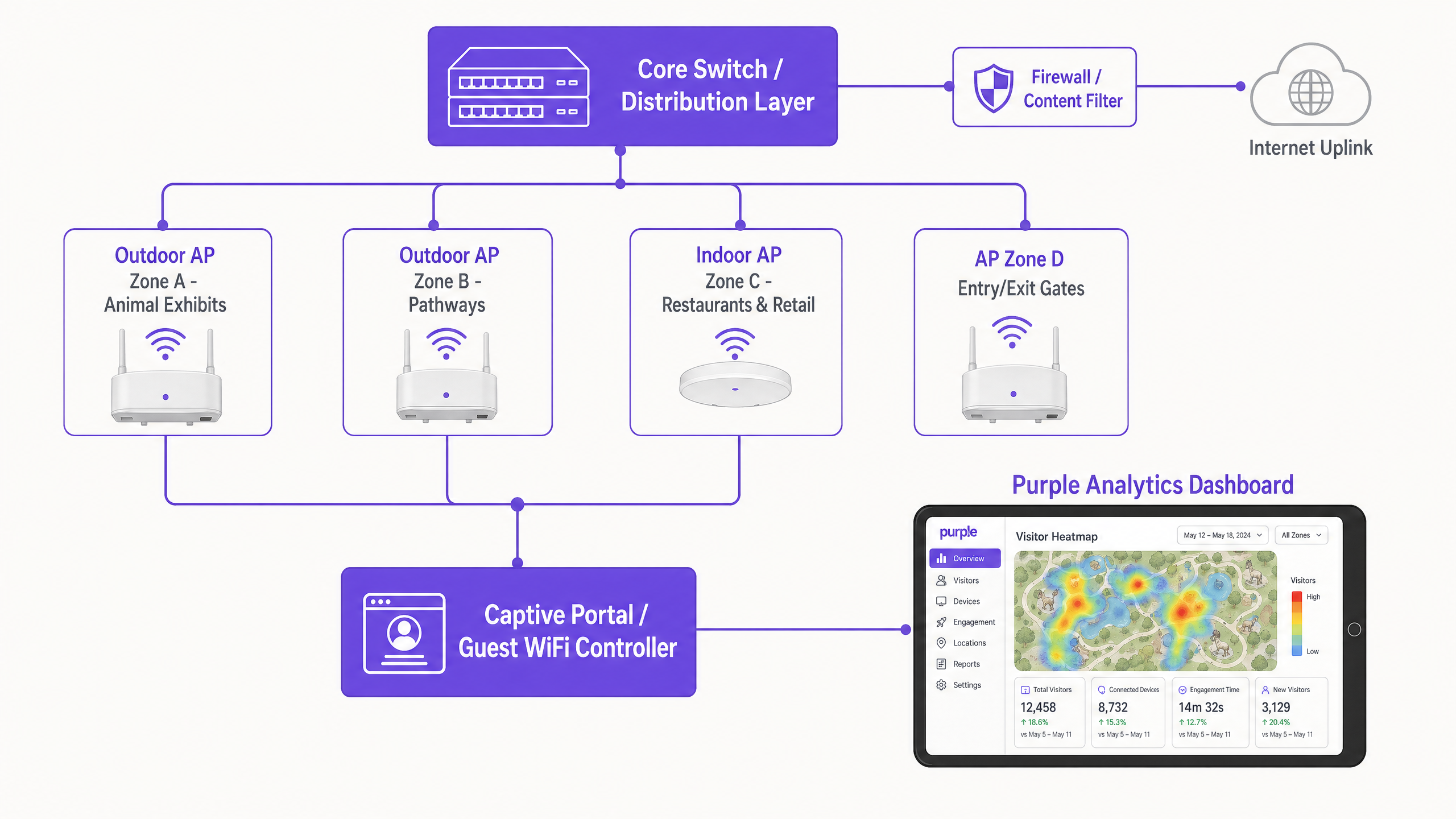
Un diseño de RF robusto es irrelevante si la infraestructura de backhaul no puede soportar el rendimiento agregado. Los zoos y parques temáticos a menudo abarcan decenas o cientos de hectáreas, lo que hace que el cableado de cobre tradicional sea inviable para conectar los switches de borde a la red central.
Normalmente se requiere un enfoque de backhaul híbrido:
- Anillos de Fibra Óptica: Implemente anillos de fibra monomodo para conectar los switches de distribución en todo el sitio. Esto proporciona un alto ancho de banda y resiliencia; si una ruta se interrumpe (p. ej., durante obras), el tráfico puede enrutarse en la dirección opuesta.
- Inalámbrico Punto a Punto: En áreas donde la excavación para fibra es ambientalmente sensible o prohibitivamente costosa (p. ej., a través de un lago o un denso bosque), los puentes inalámbricos punto a punto o punto a multipunto de alta capacidad proporcionan conectividad fiable.
- Power over Ethernet (PoE): Desde los switches de distribución, utilice cable Cat6A para proporcionar datos y energía a los AP individuales, asegurándose de que las tiradas no excedan el estándar de 100 metros.
Para el enlace de internet principal, la banda ancha de consumo es insuficiente. Los recintos deben adquirir una línea dedicada, como se detalla en nuestra guía What Is a Leased Line? Dedicated Business Internet , para garantizar un ancho de banda simétrico y Acuerdos de Nivel de Servicio (SLAs) estrictos.
Segmentación y Seguridad de la Red
La seguridad es primordial cuando se mezcla el acceso público de invitados con operaciones críticas del recinto. La red debe segmentarse lógicamente utilizando Redes de Área Local Virtuales (VLANs).
- Red de Invitados: Configurada con WPA3-Personal (o modo mixto WPA2/WPA3 para compatibilidad con dispositivos antiguos) y estrictamente aislada de todos los recursos internos. El aislamiento de clientes debe habilitarse a nivel de AP para evitar que los dispositivos de invitados se comuniquen entre sí.
- Red Operacional: VLANs dedicadas para terminales de punto de venta (POS), señalización digital y dispositivos IoT. El acceso debe protegerse utilizando IEEE 802.1X con autenticación basada en certificados para garantizar que solo los dispositivos propiedad de la empresa puedan conectarse.
Para obtener más información sobre cómo asegurar la infraestructura del recinto, consulte nuestro artículo: Protect Your Network with Strong DNS and Security .
Guía de Implementación
Paso 1: Estudio de Sitio Exhaustivo
Nunca confíe únicamente en el modelado predictivo para entornos exteriores. Realice un estudio de sitio de RF activo utilizando herramientas de análisis de espectro. Los árboles, las fuentes de agua y los cerramientos metálicos (como jaulas o estructuras de atracciones) absorben y reflejan las señales de RF de forma impredecible. El estudio debe mapear los requisitos de cobertura zona por zona, identificando las fuentes de interferencia y las ubicaciones óptimas de montaje de los AP.
Paso 2: Captive Portal y Flujo de Autenticación
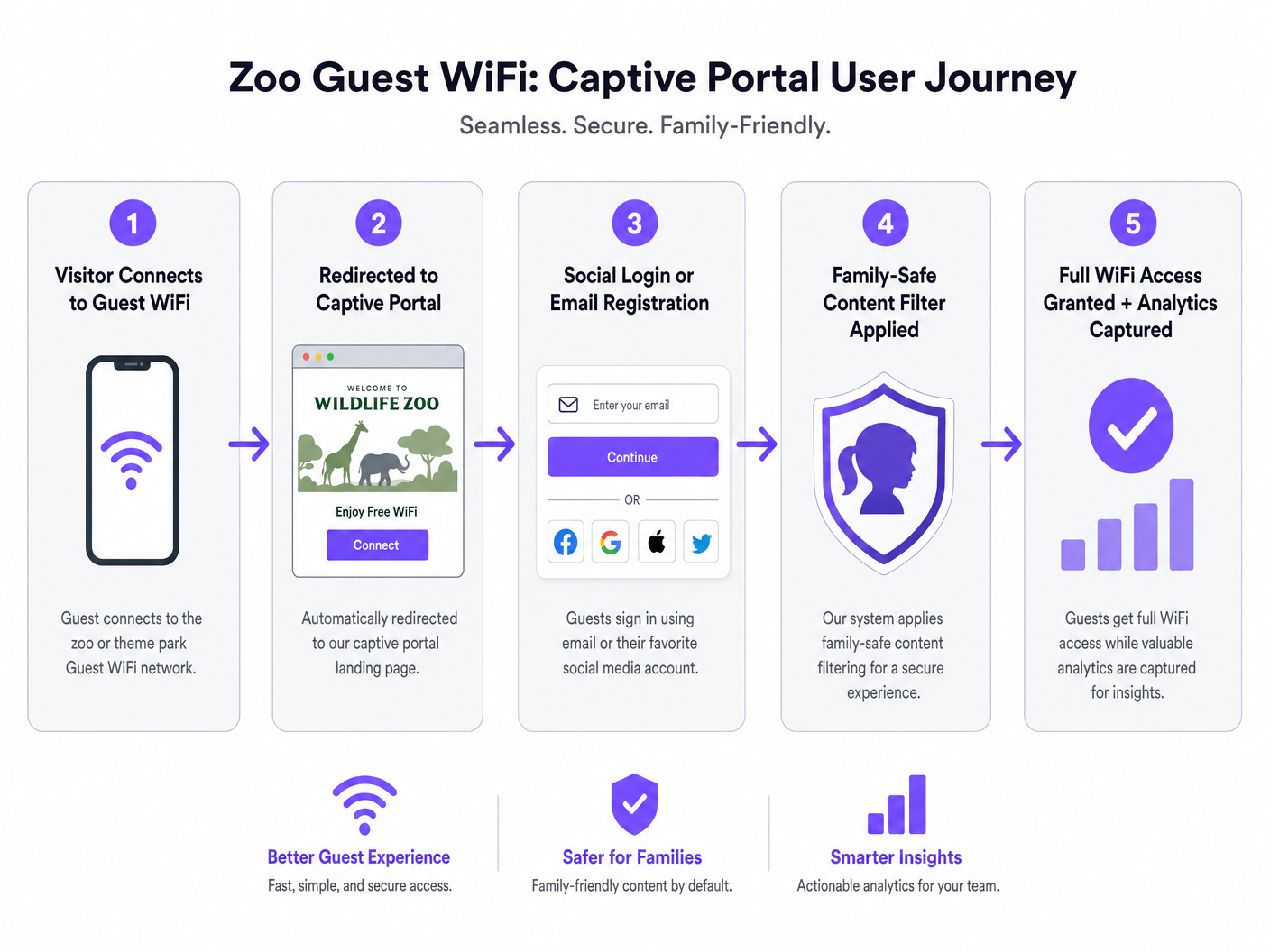
El Captive Portal es la puerta de entrada a la red de invitados y el mecanismo principal para la captura de datos. Una experiencia de incorporación fluidaLa eficiencia es fundamental para maximizar las tasas de conexión.
- Opciones de autenticación: Ofrezca inicio de sesión social (Facebook, Google, Apple) junto con el registro de correo electrónico tradicional. Los lugares que ofrecen inicio de sesión social suelen observar tasas de conexión entre un 30 y un 40% más altas que aquellos que dependen exclusivamente de formularios.
- Cumplimiento: Asegúrese de que el portal capture explícitamente el consentimiento para el procesamiento de datos y las comunicaciones de marketing, adhiriéndose estrictamente a GDPR o a las regulaciones de privacidad locales.
- Reautenticación sin fricciones: Utilice el almacenamiento en caché de direcciones MAC o plataformas como OpenRoaming para volver a conectar automáticamente a los visitantes recurrentes sin que tengan que completar el flujo del Captive Portal de nuevo.
Paso 3: Implementación de filtrado de contenido seguro para la familia
Los zoológicos y parques temáticos tienen el deber de proporcionar un entorno digital seguro. El filtrado de contenido basado en DNS es el método más eficiente para lograr esto a escala. Al interceptar las solicitudes DNS y bloquear la resolución de dominios categorizados como contenido para adultos, juegos de azar o violencia, los lugares pueden aplicar políticas de uso aceptable sin la latencia introducida por la inspección profunda de paquetes (DPI). Este filtrado debe aplicarse por defecto al SSID de invitados.
Mejores prácticas
- Diseño para densidad máxima, no promedios: Los lugares a menudo subestiman el número de dispositivos durante los períodos pico (por ejemplo, días festivos). Asuma 2-3 dispositivos por visitante (smartphone, smartwatch, tablet) y diseñe la densidad de APs en consecuencia. Una regla general es un AP por cada 500 metros cuadrados en zonas de alta densidad (zonas de restauración, pabellones de espectáculos) y uno por cada 1.000 metros cuadrados en zonas de tránsito de menor densidad.
- Priorice el recorrido del usuario: El Captive Portal debe estar optimizado para móviles y cargarse rápidamente. Cualquier retraso en la renderización del portal provocará el abandono.
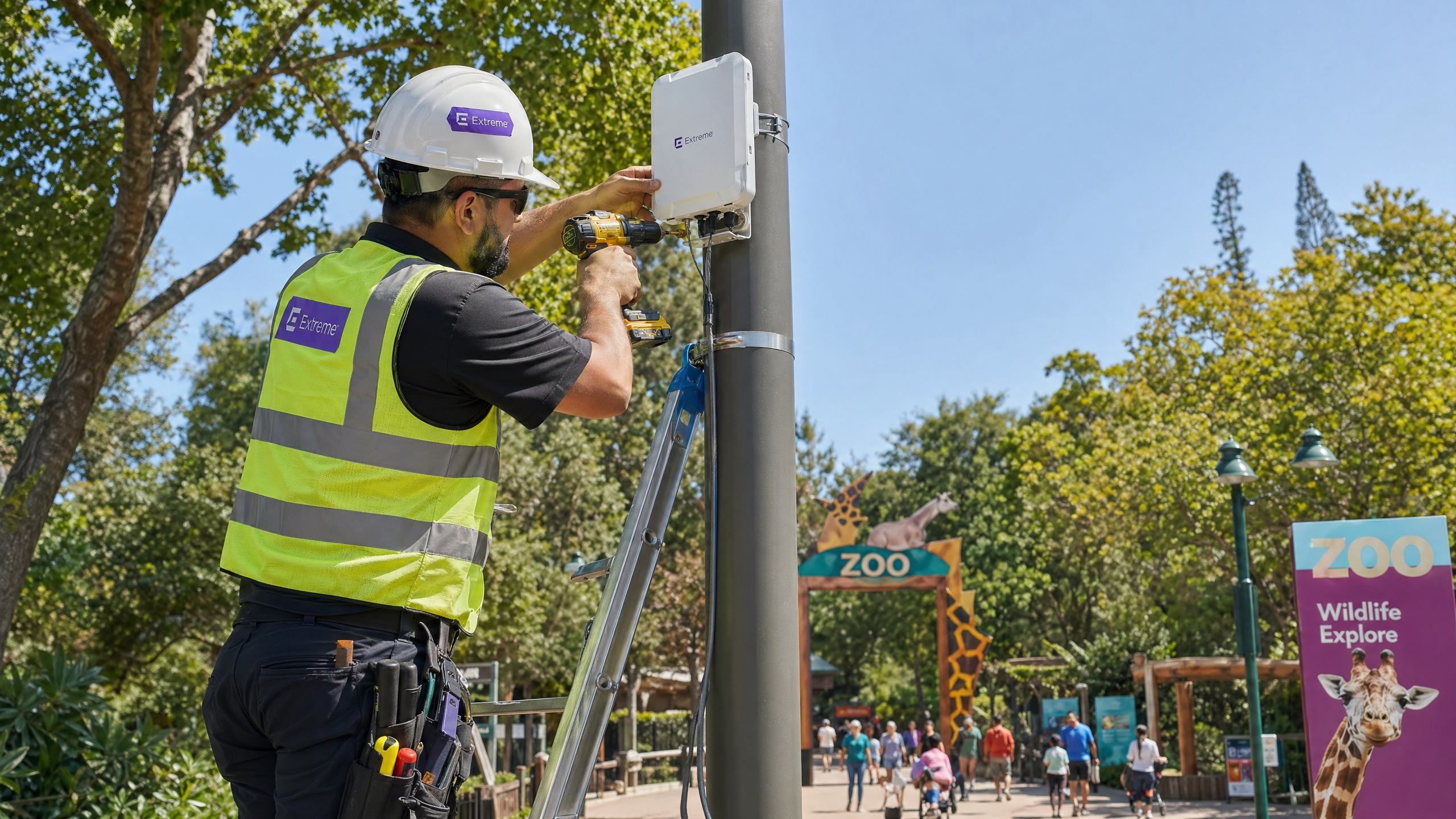
- Aproveche la infraestructura existente: Al montar APs exteriores, utilice columnas de iluminación existentes, postes de CCTV o fachadas de edificios para minimizar los costes de instalación y el impacto visual.
Solución de problemas y mitigación de riesgos
| Modo de fallo | Causa raíz | Estrategia de mitigación |
|---|---|---|
| Colapso de la red bajo carga | Densidad de APs insuficiente; falta de soporte OFDMA. | Actualice a infraestructura Wi-Fi 6; rediseñe los mapas de cobertura basándose en estimaciones de usuarios concurrentes máximos. |
| El Captive Portal no carga | Mala configuración de DNS; ajustes de seguridad agresivos del sistema operativo móvil. | Asegúrese de que el "walled garden" incluya todos los dominios necesarios para las API de inicio de sesión social y las URL de detección del Captive Portal (por ejemplo, captive.apple.com). |
| Rendimiento de roaming deficiente | Potencia de transmisión del AP demasiado alta, lo que hace que los clientes se "peguen" a APs distantes. | Implemente gestión dinámica de radio; reduzca la potencia de transmisión para animar a los dispositivos cliente a hacer roaming a APs más cercanos; habilite 802.11k/v/r. |
ROI e impacto empresarial
El caso de negocio para implementar WiFi de alto rendimiento va mucho más allá de la conectividad básica. Cuando se integra con una plataforma de análisis robusta, la red se convierte en un activo estratégico.
- Inteligencia operativa: Al rastrear direcciones MAC (incluso anonimizadas), los lugares pueden generar mapas de calor y analizar el flujo de visitantes. Estos datos identifican puntos de congestión, miden los tiempos de permanencia en exhibiciones específicas e informan sobre la dotación de personal y los despliegues de seguridad.
- Marketing y generación de ingresos: Los datos de primera parte capturados a través del Captive Portal se introducen directamente en el CRM del lugar. Esto permite campañas de correo electrónico post-visita dirigidas, la inscripción en programas de fidelización y ofertas personalizadas, impulsando visitas repetidas y aumentando el valor de vida del cliente.
- Experiencia del huésped mejorada: La conectividad fiable permite el uso de aplicaciones móviles específicas del lugar para la orientación, el pedido de comida móvil y la cola virtual, mejorando directamente las puntuaciones de satisfacción del huésped y reduciendo la fricción operativa.
Como se ha visto en implementaciones similares en los sectores de Hostelería y Minorista , la integración de conectividad y análisis transforma la infraestructura de TI de un centro de costes en una plataforma generadora de ingresos. Para más información sobre implementaciones temporales, consulte nuestra guía sobre WiFi para eventos: Planificación e implementación de redes inalámbricas temporales .
Definiciones clave
Captive Portal
A web page that intercepts a user's initial HTTP request on a public network, requiring authentication or acceptance of terms before granting internet access.
The primary mechanism for capturing visitor data and enforcing acceptable use policies in venue deployments.
OFDMA (Orthogonal Frequency Division Multiple Access)
A feature of Wi-Fi 6 that allows an AP to divide a wireless channel into smaller sub-channels (Resource Units), enabling simultaneous data transmission to multiple devices.
Critical for maintaining network performance in high-density areas like queues and food courts by reducing latency and overhead.
IP67 Rating
An ingress protection standard indicating a device is completely protected against dust and can withstand temporary immersion in water.
The minimum required environmental protection rating for hardware deployed in outdoor zoo and theme park environments.
Walled Garden
A limited environment that controls the user's access to web content and services prior to full authentication.
Must be configured to allow access to social media login APIs and captive portal detection URLs before the guest is fully connected.
DNS-Based Content Filtering
A security technique that blocks access to inappropriate websites by preventing the Domain Name System (DNS) from resolving restricted URLs into IP addresses.
The standard method for ensuring family-safe browsing on venue guest networks without impacting performance.
Client Isolation
A wireless security feature that prevents devices connected to the same AP or VLAN from communicating directly with one another.
Mandatory on guest networks to prevent lateral movement of malware and protect visitor devices from unauthorized access.
VLAN (Virtual Local Area Network)
A logical grouping of network devices that behave as if they are on the same physical network, regardless of their actual location.
Used to securely segment guest traffic from critical operational systems (e.g., point-of-sale, CCTV).
MAC Caching
A feature that remembers the Media Access Control (MAC) address of a previously authenticated device, allowing it to bypass the captive portal on subsequent visits.
Significantly improves the guest experience by providing frictionless connectivity for returning visitors.
Ejemplos prácticos
A regional zoo spanning 40 acres is upgrading its legacy Wi-Fi 4 network. The IT Director notes that during the summer holidays, the network in the main food court (a 2,000 sq metre outdoor plaza) completely fails, with guests unable to load the captive portal. How should the team architect the food court coverage?
- Upgrade to Wi-Fi 6 (802.11ax) APs with IP67 ratings to leverage OFDMA for high-density client handling.
- Deploy high-density directional antennas (patch antennas) rather than omnidirectional antennas to create smaller, focused RF cells. This minimizes co-channel interference.
- Install 4-6 APs around the perimeter of the food court, pointing inward, ensuring transmit power is lowered to encourage roaming and prevent cell overlap.
- Ensure the backhaul switch supporting this zone has at least a 10Gbps uplink to the core to handle the aggregated traffic.
A theme park marketing team wants to increase the number of email addresses captured via the guest WiFi. Currently, visitors must fill out a 5-field form (Name, Email, Phone, Postcode, DOB). The connection rate is only 12%. What technical and strategic changes should be implemented?
- Implement Social Login (Facebook, Google, Apple) on the captive portal to provide a one-click authentication option.
- Reduce the manual form fields to just Name and Email for users who prefer not to use social login.
- Enable 'Seamless Mac Authentication' (MAC caching) so returning visitors are automatically reconnected without seeing the portal again, improving the user experience.
- Ensure the walled garden configuration allows traffic to the social network authentication APIs before the user is fully authorized.
Preguntas de práctica
Q1. You are designing the WiFi coverage for a new 5-acre outdoor primate enclosure. The landscape architect has specified dense tree planting and a large central water feature. What are the primary RF considerations, and how should you position the APs?
Sugerencia: Consider how water and foliage interact with RF signals, particularly at 5GHz.
Ver respuesta modelo
Foliage (which contains water) and the central water feature will heavily absorb and reflect RF signals, particularly in the 5GHz band. Predictive modeling will be inaccurate here. You must conduct an active site survey. APs should be positioned at the perimeter facing inward using directional antennas to punch through the foliage, rather than relying on omnidirectional APs in the center. Ensure all hardware is IP67 rated due to the outdoor environment.
Q2. During a busy bank holiday weekend, the IT helpdesk receives reports that guests in the main plaza can connect to the WiFi network but cannot reach the internet. The captive portal does not load. The APs show high utilization but are online. What is the most likely cause, and how do you resolve it?
Sugerencia: Think about the IP addressing process before a device can reach the captive portal.
Ver respuesta modelo
The most likely cause is DHCP pool exhaustion. The sheer volume of devices (including those just passing through and probing the network) has consumed all available IP addresses in the guest VLAN. The mitigation is to reduce the DHCP lease time (e.g., to 30 minutes or 1 hour) to quickly reclaim IP addresses from devices that have left the area, and to expand the subnet size for the guest VLAN (/22 or /21 instead of a standard /24).
Q3. The venue's operations director wants to use WiFi analytics to track visitor dwell times at various exhibits to optimize staffing. However, they are concerned about GDPR compliance, as they are tracking MAC addresses. How do you architect the solution to provide analytics while maintaining compliance?
Sugerencia: Consider the difference between anonymized location data and personally identifiable information (PII).
Ver respuesta modelo
To maintain compliance, the WiFi analytics platform must anonymize or pseudonymize MAC addresses (e.g., via cryptographic hashing) immediately upon collection if the user has not authenticated. For users who do authenticate via the captive portal, explicit consent must be obtained to link their location data with their PII (email/social profile). The privacy policy must clearly state that location analytics are being gathered and provide an opt-out mechanism.
Continúe leyendo esta serie
Gestión del ancho de banda para WiFi de empleados: modelado, QoS y reducción de tráfico
Esta guía detalla métodos prácticos para gestionar el ancho de banda para el WiFi de empleados en entornos empresariales. Cubre el modelado de tráfico, la implementación de QoS y cómo el despliegue de Purple Shield reduce la carga de la red sin necesidad de actualizar la infraestructura.
¿Qué es una solicitud de sondeo (Probe Request)? Entendiendo cómo los dispositivos descubren redes
Esta guía de referencia técnica ofrece un análisis en profundidad de las solicitudes de sondeo IEEE 802.11, el escaneo activo frente al pasivo y el impacto de la aleatorización de MAC en el análisis de ubicaciones. Proporciona estrategias de implementación prácticas para que los arquitectos de red optimicen las implementaciones de alta densidad, mitiguen las 'tormentas de sondeo' y garanticen una recopilación de datos precisa y compatible con GDPR utilizando capas de identidad autenticadas.
Cómo solucionar el WiFi lento sin actualizar tu plan de internet
Una guía de referencia técnica completa para gerentes de TI y arquitectos de red sobre cómo optimizar el rendimiento del WiFi empresarial sin aumentar el ancho de banda del ISP. Cubre la sintonización de RF, la gestión de la densidad de clientes, la implementación de QoS y cómo aprovechar el análisis de WiFi para diagnosticar y resolver cuellos de botella.