
How to leverage SMS marketing text to increase return visits
This guide explains how venue operators - in hospitality, retail, events, and public-sector environments - can build compliant SMS marketing text campaigns using Guest WiFi data to drive measurable increases in return visits. It covers the technical architecture for capturing verified phone numbers via OTP at the captive portal, segmentation strategies inside Purple Engage, and the legal requirements under GDPR and PECR. Marketing Directors, CRM Managers, and Venue Operators will find concrete implementation steps, two real-world case studies, and ROI benchmarks to justify investment.
Listen to this guide
View podcast transcript
Executive summary
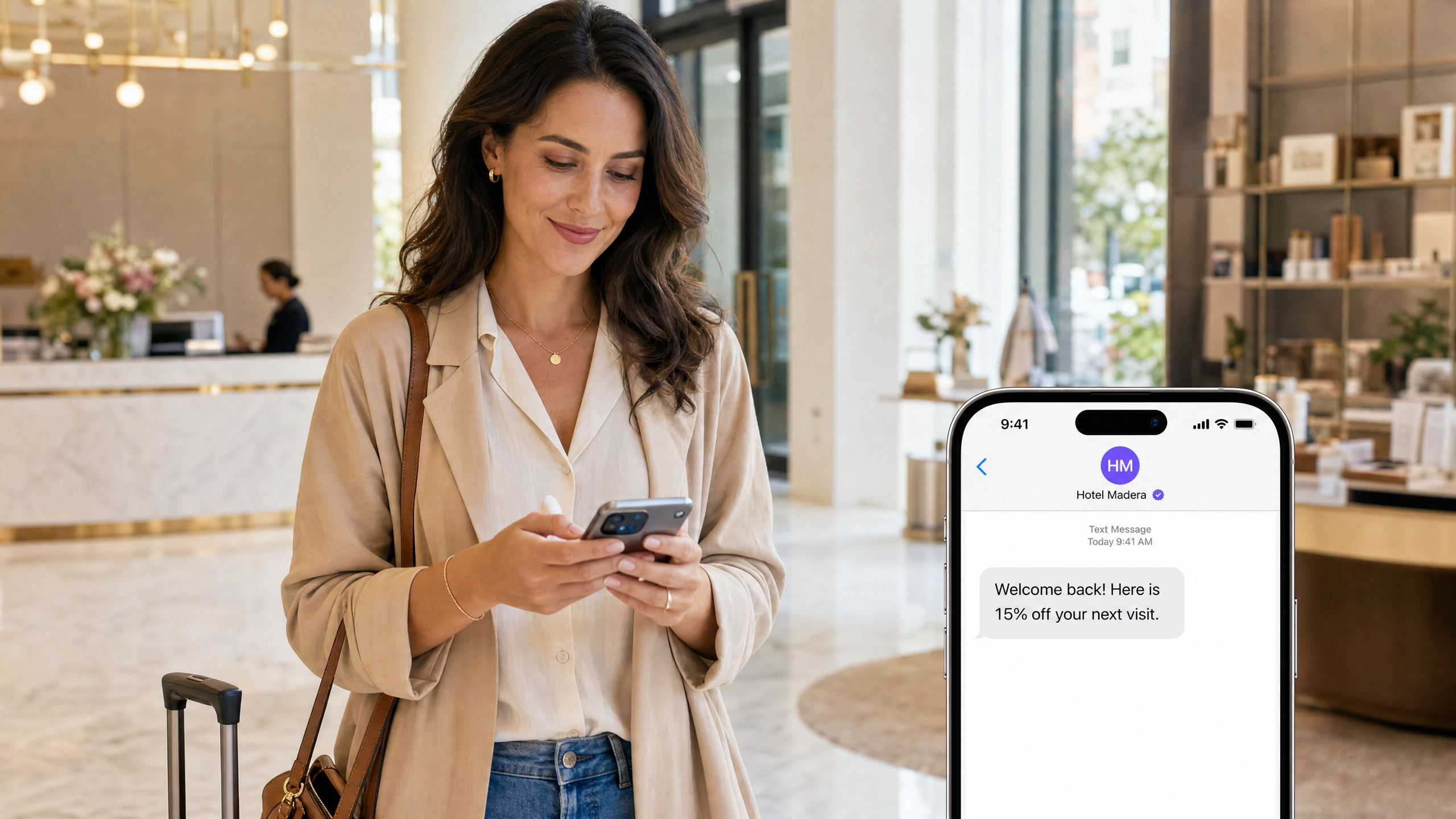
Physical venues face a persistent data gap. Millions of visitors walk through your doors annually, yet most leave without providing a reliable way to reach them again. SMS marketing text closes that gap - but only when it is built on verified, consent-compliant first-party data captured at the point of WiFi login.
This guide details how to build the data infrastructure required for effective SMS marketing. It explains how to capture verified phone numbers at the Guest WiFi login using OTP (one-time passcode) authentication, store consent records securely in line with GDPR and PECR, and deploy automated campaigns that drive return visits. The technical approach uses Purple Engage as a hardware-agnostic cloud overlay across your existing network infrastructure - whether that is Cisco Meraki, HPE Aruba, Ruckus, Juniper Mist, Ubiquiti UniFi, Cambium, Extreme, or Fortinet.
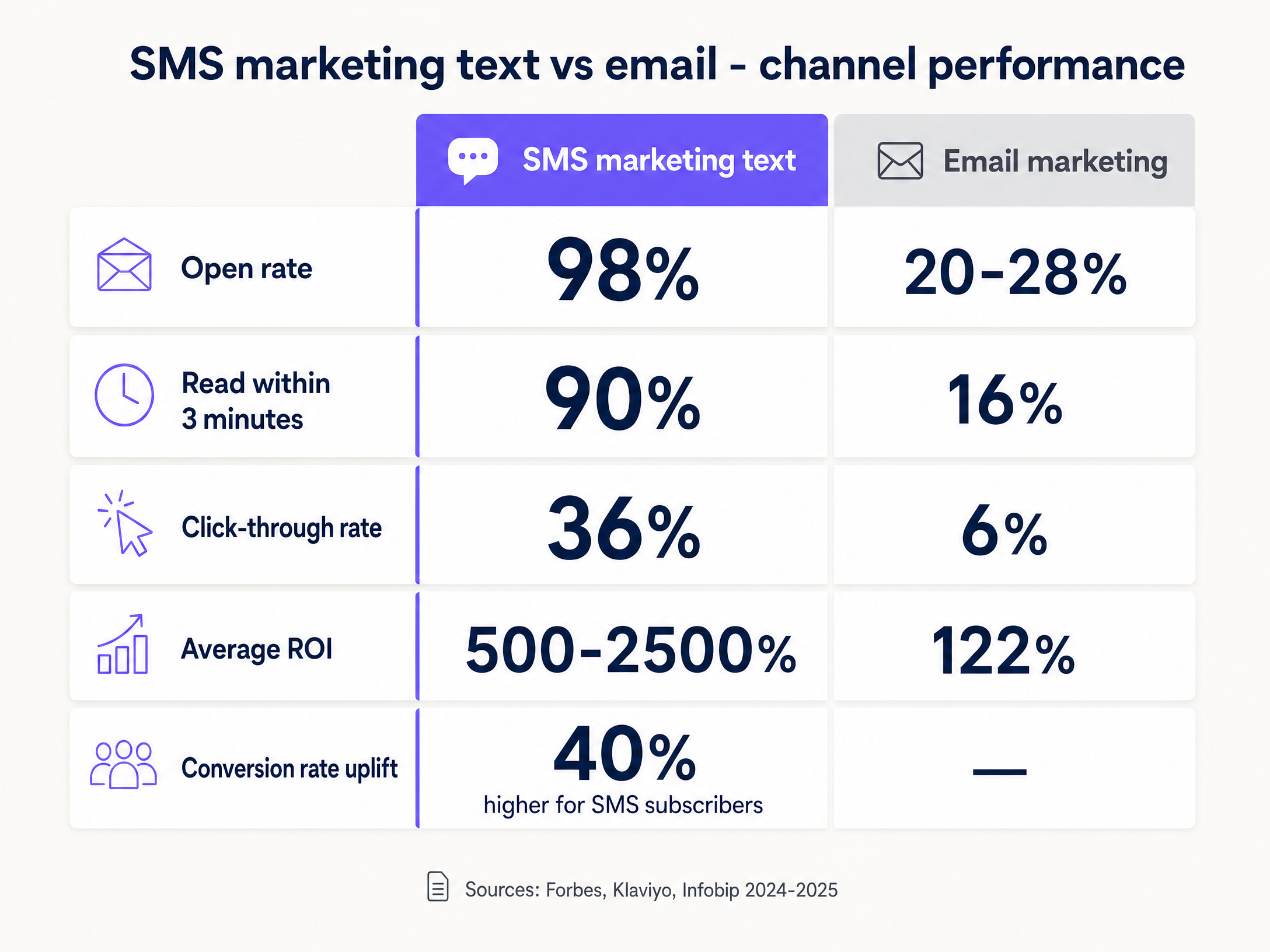
The channel performance case for SMS is unambiguous. Open rates sit at 98%, compared to 20-28% for email. 90% of messages are read within three minutes of delivery. Click-through rates for triggered campaigns reach 36%. Well-run SMS programmes return between 500% and 2,500% ROI depending on industry, list quality, and offer relevance (source: Forbes, text-em-all.com). These are not marginal improvements over email. They represent a different category of channel performance.
Technical deep-dive
The data capture architecture
The foundation of any SMS campaign is a verified, compliant contact list. Capturing this data requires seamless integration between your network infrastructure and your marketing platform.
Purple operates as a hardware-agnostic cloud overlay. It integrates with Cisco Meraki, HPE Aruba, Ruckus, Juniper Mist, Ubiquiti UniFi, Cambium, Extreme, and Fortinet. You do not need to replace your network infrastructure. Purple sits on top, captures guest data at login, and feeds it into the Engage marketing engine.
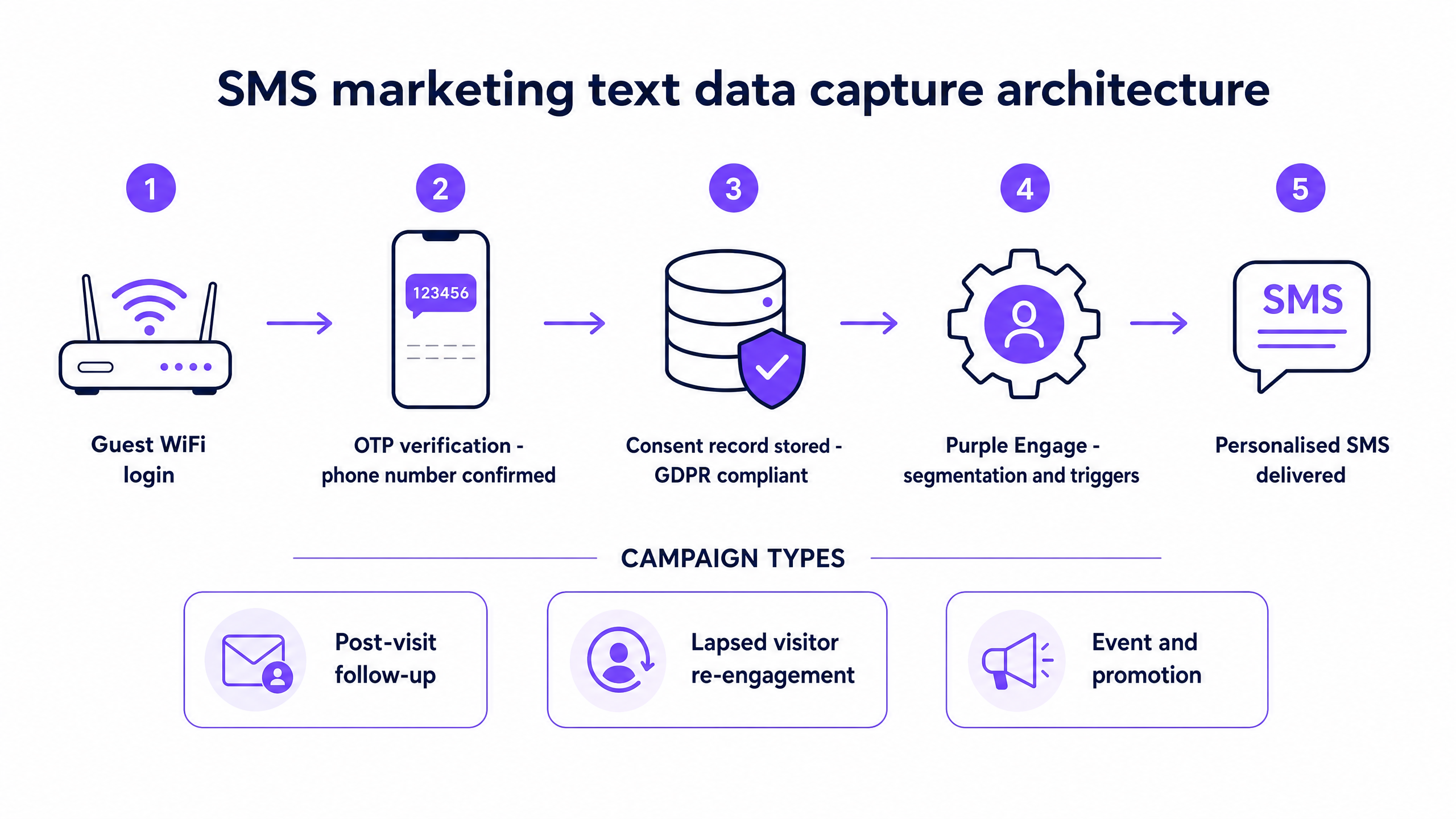
The captive portal is where phone number capture happens. When a guest selects SMS authentication, they enter their mobile number. Purple's gateway sends a verification OTP. The guest enters the code to connect. This OTP step does two things simultaneously: it verifies the number is real and active, and it creates a documented consent record. That consent record is what makes subsequent SMS marketing legally compliant under GDPR and PECR.
Consent architecture and GDPR compliance
GDPR (General Data Protection Regulation) and PECR (Privacy and Electronic Communications Regulations) require explicit, specific, freely given consent for SMS marketing. The consent must be separate from the WiFi access itself. You cannot make SMS opt-in a condition of connecting to the network.
Purple's captive portal handles this correctly by design. The opt-in checkbox is clearly labelled, separate from the connect button, and the consent record is timestamped and stored. Every contact in your SMS list has a documented legal basis under UK GDPR Article 6 and PECR Regulation 22.
The key data points stored per consent record are: phone number (verified via OTP), venue location, timestamp of consent, the specific marketing purpose consented to, and the IP address of the device. This data structure satisfies the accountability requirements under GDPR Article 5(2).
Segmentation and campaign triggers
Purple's WiFi Analytics platform tracks visit frequency, dwell time, and location behaviour per individual device. This behavioural data is the engine of effective SMS segmentation. Three campaign types consistently drive return visits:
| Campaign type | Trigger | Timing | Typical uplift |
|---|---|---|---|
| Post-visit follow-up | Guest departs venue | 24 - 48 hours after visit | 24% return visit increase (Purple platform data) |
| Lapsed visitor re-engagement | No visit for defined period | Day 30, 45, or 60 of absence | Reduces churn by targeting at-risk guests |
| Event and promotion-based | Segment match + campaign date | 48 - 72 hours before event or offer expiry | 40% higher conversion vs non-subscribers (Klaviyo, 2024) |
Implementation guide
Step 1: Configure the SSID and captive portal
Create a dedicated Guest WiFi SSID on your existing hardware. Purple's cloud overlay connects to the access point controller - whether Cisco Meraki, HPE Aruba, or any other supported vendor - via the vendor's API or RADIUS integration. The captive portal splash page is configured in the Purple dashboard. Set the authentication method to SMS OTP. This is the mechanism that verifies phone numbers and captures consent.
For venues with multiple sites, Purple's multi-site management console lets you deploy a consistent captive portal template across all locations while maintaining site-specific branding. See our guide on how to make a great first impression with your guest WiFi for splash page design best practices.
Step 2: Configure consent capture
Within the Purple captive portal builder, add a clearly labelled SMS marketing opt-in checkbox. The checkbox must be:
- Unchecked by default (pre-ticked boxes do not constitute valid consent under GDPR)
- Separate from the WiFi access button
- Accompanied by a clear description of what the guest is consenting to (e.g., "I agree to receive promotional SMS messages from [Venue Name]")
- Linked to your privacy policy
Purple stores the consent record automatically. You do not need to build a separate consent management system.
Step 3: Build your segmentation logic in Purple Engage
Purple Engage is the marketing automation layer that sits on top of the WiFi data. Once phone numbers are captured and consented, you define audience segments based on:
- Visit frequency (e.g., guests who visited more than three times in the last 90 days)
- Recency (e.g., guests who have not visited in 45 days)
- Location (e.g., guests who visited a specific site or zone within a site)
- Time of visit (e.g., guests who visit on weekday lunchtimes)
Purple Engage integrates with over 400 CRM and marketing connectors, including Salesforce, HubSpot, and Mailchimp. You can push segment data to your existing CRM or run campaigns natively within Engage.
Step 4: Configure automated campaign triggers
For each campaign type, configure the trigger event, the delay, and the message template. Purple Engage supports dynamic fields - you can personalise messages with the guest's first name, the venue name, and a unique offer code generated per send.
Example post-visit follow-up configuration:
- Trigger: Guest WiFi session ends
- Delay: 24 hours
- Segment filter: First-time visitors only
- Message: "Hi [First Name], thanks for visiting [Venue Name] yesterday. Here is 15% off your next visit: [CODE]. Valid for 30 days."
- UTM parameters:
utm_source=sms&utm_medium=engage&utm_campaign=post-visit-followup
Step 5: Implement UTM tracking and attribution
Every link in an SMS campaign must carry UTM parameters. Without them, you cannot attribute return visits and revenue to specific campaigns in your analytics platform. Purple Engage appends UTM parameters automatically when you configure the campaign. Map these parameters to your Google Analytics 4 or Adobe Analytics implementation to close the attribution loop.
For hospitality operators, connect Purple Engage to your property management system (PMS) to track whether an SMS recipient made a direct booking. For retail operators, connect to your EPOS system to track transaction value among SMS subscribers versus non-subscribers.
Best practices
Frequency and timing
61% of SMS unsubscribes are caused by excessive message frequency (source: Klaviyo, 2024). The rule of thumb is no more than four to six SMS messages per month per contact. Each send must have a clear, specific reason - a generic "we miss you" message without an offer will underperform and accelerate unsubscribes.
On timing: avoid sending before 9am or after 8pm local time. Midday sends (11am to 2pm) consistently outperform morning and evening sends across hospitality, retail, and events verticals. For transport operators, time sends to align with commuter patterns - early morning and early evening sends perform well for rail and airport venues.
Message length and content
SMS messages are limited to 160 characters per segment. Keep messages concise. Lead with the offer or reason to return, not with a greeting. Include a clear call to action and a trackable link. Avoid URL shorteners that obscure the destination - use branded short domains where possible.
List hygiene
Remove unsubscribes immediately. PECR requires you to honour opt-out requests without delay. Purple Engage handles unsubscribe processing automatically when a recipient replies STOP. Run a list hygiene check quarterly to remove numbers that have not engaged with any message in the last six months.
Multi-channel coordination
SMS and email work best together, not in competition. Use email for longer-form content, pre-arrival communications, and post-stay surveys. Use SMS for time-sensitive triggers, flash promotions, and re-engagement campaigns. Purple Engage supports both channels from the same platform, so you can coordinate sends and avoid messaging the same guest on both channels within the same 24-hour window.
For more on multi-channel WiFi marketing architecture, see Three SSIDs to rule them all: guest, Passpoint, and IoT WiFi .
Troubleshooting and risk mitigation
Unverified phone numbers
An SMS list built on unverified numbers produces high bounce rates, carrier blacklisting risk, and wasted spend. Purple's OTP verification step eliminates this at source. If you are migrating an existing list from a non-OTP system, run a verification pass before sending any campaigns.
Carrier filtering and deliverability
Mobile network operators filter SMS traffic for spam signals. Common triggers include: high send volume from a new sender ID, identical message content sent to large lists, and links to domains with poor reputation. Mitigate these risks by:
- Using a dedicated sender ID registered with your network operator
- Varying message content across sends (dynamic fields help here)
- Warming up new sender IDs gradually - start with 500 sends per day and scale over two weeks
- Using a reputable SMS gateway provider that maintains carrier relationships
GDPR audit trail gaps
If you cannot produce a consent record for a specific phone number, you cannot legally send that contact marketing SMS. Purple stores consent records with timestamp, venue, and IP address. Export this data quarterly and store it in your data management platform as a backup.
Missing attribution
Without UTM tracking, you cannot prove SMS ROI to your board. Configure UTM parameters on every campaign link before launch. Map UTM data to your analytics platform. Build a monthly SMS attribution report that shows return visits, revenue, and cost per return visit for each campaign type.
ROI and business impact
The business case for SMS marketing text rests on three numbers: open rate (98%), read - within - 3 - minutes rate (90%), and conversion rate uplift (40% higher for SMS subscribers versus non-subscribers, per Klaviyo 2024 benchmarks).
For a venue with 500 daily WiFi connections, assuming a 20% SMS opt-in rate, you build a list of approximately 3,000 verified numbers per month. Over six months, that is 18,000 contacts. A post-visit follow-up campaign sent to 18,000 contacts at a 24% return visit rate generates 4,320 incremental return visits. At an average spend of £25 per visit, that is £108,000 in attributable incremental revenue from a single campaign type.
Purple Engage is included in the Engage plan. The marginal cost of running SMS campaigns is the per-message gateway cost, typically £0.04 - £0.07 per SMS in the UK. At 18,000 sends per campaign, the cost is £720 - £1,260. Against £108,000 in incremental revenue, the ROI is clear.
For healthcare operators and public-sector venues where direct revenue attribution is less straightforward, the relevant metric is return visit rate and Net Promoter Score improvement among SMS subscribers versus non-subscribers.
To explore how this applies to your specific venue environment, read our related guide on How to leverage bulk SMS marketing to increase return visits .
Key Definitions
OTP (one-time passcode)
A randomly generated numeric code sent via SMS to verify that a phone number is real and active. The guest enters the code to complete WiFi authentication.
Used during Guest WiFi login to verify phone numbers before storing them in the marketing database. Eliminates fake or mistyped numbers at source.
Captive portal
A web page that a guest must interact with before being granted access to a public WiFi network. It is the primary interface for data capture, consent collection, and brand presentation.
The captive portal is where phone number capture, OTP verification, and marketing consent happen. Purple's captive portal builder allows full branding customisation and multi-language support.
GDPR (General Data Protection Regulation)
EU regulation (retained in UK law as UK GDPR post-Brexit) governing the collection, storage, and use of personal data. Requires a lawful basis for processing, including explicit consent for direct marketing.
Applies to every phone number captured via Guest WiFi. Article 6 requires a lawful basis for processing. Article 7 sets the standard for valid consent. Article 5(2) requires an audit trail.
PECR (Privacy and Electronic Communications Regulations)
UK regulations that sit alongside UK GDPR and govern electronic marketing specifically, including SMS. Regulation 22 prohibits sending unsolicited SMS marketing without prior explicit consent.
PECR is the specific regulation that makes SMS opt-in mandatory in the UK. It applies in addition to GDPR. The ICO enforces PECR and has issued fines of up to £500,000 for non-compliant SMS campaigns.
First-party data
Information collected directly from a person by the organisation that will use it for marketing. Contrasts with second-party data (shared from a partner) and third-party data (purchased from a data broker).
Phone numbers captured via OTP at WiFi login are first-party data. They are verified, consented, and tied to a specific visit. This makes them significantly more valuable than purchased lists.
UTM parameters
Urchin Tracking Module parameters. Tags appended to a URL to identify the source, medium, and campaign that drove a click. Standard UTM parameters are utm_source, utm_medium, utm_campaign, utm_content, and utm_term.
Essential for attributing return visits and revenue to specific SMS campaigns. Without UTM parameters, you cannot prove SMS ROI in your analytics platform.
Cloud overlay
A software layer that sits on top of existing hardware infrastructure, adding functionality without requiring hardware replacement. Purple operates as a cloud overlay on enterprise WiFi hardware.
Allows Purple to deploy across Cisco Meraki, HPE Aruba, Ruckus, Juniper Mist, Ubiquiti UniFi, Cambium, Extreme, and Fortinet without requiring network infrastructure changes.
Hardware-agnostic
Software that is compatible with multiple hardware vendors and does not require a specific vendor's equipment to function.
Purple's hardware-agnostic architecture means you can deploy SMS marketing text capabilities across a mixed-vendor estate - for example, Cisco Meraki at head office and HPE Aruba at regional sites - from a single platform.
Purple Engage
Purple's marketing automation plan that includes captive portal, WiFi Analytics, CRM integration, and automated campaign tools for email and SMS. Launched January 2026.
The platform layer that sits between WiFi data capture and SMS campaign delivery. Engage handles segmentation, campaign triggers, consent management, and integration with over 400 third-party connectors.
Worked Examples
A 250-room hotel wants to increase direct bookings from repeat guests and reduce dependency on OTA (online travel agency) platforms, which charge 15-25% commission on each booking.
The property deploys Purple Engage on its existing HPE Aruba network. The captive portal is configured with SMS OTP authentication and a clearly labelled marketing opt-in checkbox. Over 12 months, the hotel builds a verified database of 18,000 unique guest phone numbers. Three automated campaigns are configured in Purple Engage: (1) a post-checkout follow-up sent 24 hours after departure with a direct booking discount code valid for 30 days; (2) a lapsed guest re-engagement SMS sent at day 60 of absence, offering a room upgrade on next direct booking; (3) a seasonal promotion sent to guests who visited the same calendar period in the previous year. UTM parameters are configured on all links and mapped to the hotel's PMS to track direct bookings attributed to SMS.
A 12-site retail chain wants to increase repeat visit frequency and average transaction value across its estate, using WiFi data to personalise offers without a loyalty app.
Each site deploys Purple on Cisco Meraki hardware. The captive portal captures phone numbers via SMS OTP and records marketing consent. Purple's WiFi Analytics tracks dwell time in specific product zones within each store - inferred from access point signal strength data. Shoppers who opt in to SMS receive a post-visit message 48 hours after their visit, with a personalised offer based on the product zone where they spent the most time (e.g., a shopper who spent 12 minutes in the footwear zone receives an offer on footwear). Lapsed shoppers who have not visited any site in 30 days receive a re-engagement SMS with a time-limited discount. All sends are coordinated via Purple Engage, which de-duplicates contacts across sites to prevent a guest who visited two locations in one week from receiving two identical messages.
Practice Questions
Q1. A retail venue operator has an existing email marketing list of 50,000 contacts. They want to add SMS to their channel mix but do not currently require OTP verification for WiFi access. What is the primary technical risk, and how should they address it?
Hint: Consider the quality of the data being collected and the carrier deliverability implications of sending to unverified numbers.
View model answer
The primary risk is building an SMS list from unverified phone numbers. Without OTP verification, guests can enter fake or mistyped numbers. Sending campaigns to unverified numbers produces high bounce rates and risks carrier blacklisting, which can affect deliverability for the entire sender ID. The correct approach is to enable SMS OTP authentication in the Purple captive portal before collecting any phone numbers for marketing. For the existing email list, the operator should not attempt to convert email contacts to SMS contacts without a separate, explicit SMS opt-in process - this would breach PECR Regulation 22.
Q2. A hotel chain's marketing director wants to make SMS opt-in mandatory for all guests connecting to the free Guest WiFi, arguing that it will maximise list growth. Is this approach compliant, and what is the correct implementation?
Hint: Consider the GDPR requirement that consent must be freely given, and the PECR requirement for explicit consent for SMS marketing.
View model answer
No, this approach is not compliant. GDPR Article 7(4) states that consent is not freely given if it is conditional on a service. Making SMS opt-in a condition of WiFi access means the consent is not freely given and is therefore invalid under GDPR. PECR Regulation 22 requires explicit, freely given consent for SMS marketing. The correct implementation is an unchecked, clearly labelled opt-in checkbox that is separate from the WiFi connect button. Guests who do not check the box receive WiFi access but are not added to the SMS marketing list. Purple's captive portal implements this correctly by design.
Q3. A venue operator runs a monthly SMS broadcast to their entire database of 25,000 contacts. After six months, their unsubscribe rate has reached 8% per send. What is causing this, and what changes should they make?
Hint: Consider frequency, segmentation, and message relevance.
View model answer
The 8% unsubscribe rate indicates a combination of excessive frequency and poor relevance. A monthly broadcast to the entire database sends the same message to guests regardless of their visit behaviour, recency, or interests. The fix has three components: (1) Replace the monthly broadcast with triggered, behaviour-based campaigns - post-visit follow-ups, lapsed visitor re-engagement, and event-based promotions. (2) Apply the 4-6 rule: no more than four to six SMS messages per month per contact across all campaign types combined. (3) Personalise message content using Purple Engage's dynamic fields and segmentation logic, so each contact receives a message relevant to their specific visit behaviour. Triggered, segmented campaigns consistently outperform broadcasts and produce significantly lower unsubscribe rates.
Q4. A conference centre operator wants to demonstrate SMS marketing ROI to their board. They have run three campaigns over the past quarter but have no attribution data. What should they have done differently, and how can they build an attribution model going forward?
Hint: Consider UTM parameters, analytics platform integration, and the specific metrics that matter for a conference centre.
View model answer
The missing element is UTM tracking. Every link in an SMS campaign must carry UTM parameters (utm_source, utm_medium, utm_campaign) before the campaign is sent. Without them, return visits and bookings driven by SMS are indistinguishable from organic traffic in the analytics platform. Going forward: (1) Configure UTM parameters on all campaign links in Purple Engage before launch. (2) Map UTM data to Google Analytics 4 or Adobe Analytics. (3) For a conference centre, connect Purple Engage to the venue booking system to track whether an SMS recipient made a booking. (4) Build a monthly attribution report showing return visits, bookings, and revenue per campaign type, and cost per return visit (total SMS gateway cost divided by attributed return visits). This gives the board a clear, auditable ROI figure.