
WiFi d'hôtel gratuit vs. payant : quel est le bon modèle pour votre établissement ?
Ce guide fournit aux responsables informatiques et aux exploitants d'établissements un cadre d'analyse précis pour choisir entre les modèles de WiFi gratuits, payants et segmentés par paliers dans le secteur de l'hôtellerie. Il analyse l'architecture technique, l'impact commercial et les indicateurs de satisfaction des clients nécessaires pour monétiser efficacement la connectivité tout en maintenant une sécurité de classe entreprise et la conformité au GDPR. Les exploitants qui mettent en œuvre le modèle Freemium par paliers peuvent générer des revenus annexes significatifs tout en préservant les scores de satisfaction client élevés qui favorisent les réservations récurrentes.
Écouter ce guide
Voir la transcription du podcast
Fait partie de notre série principale : Guest WiFi Guide →

Résumé analytique
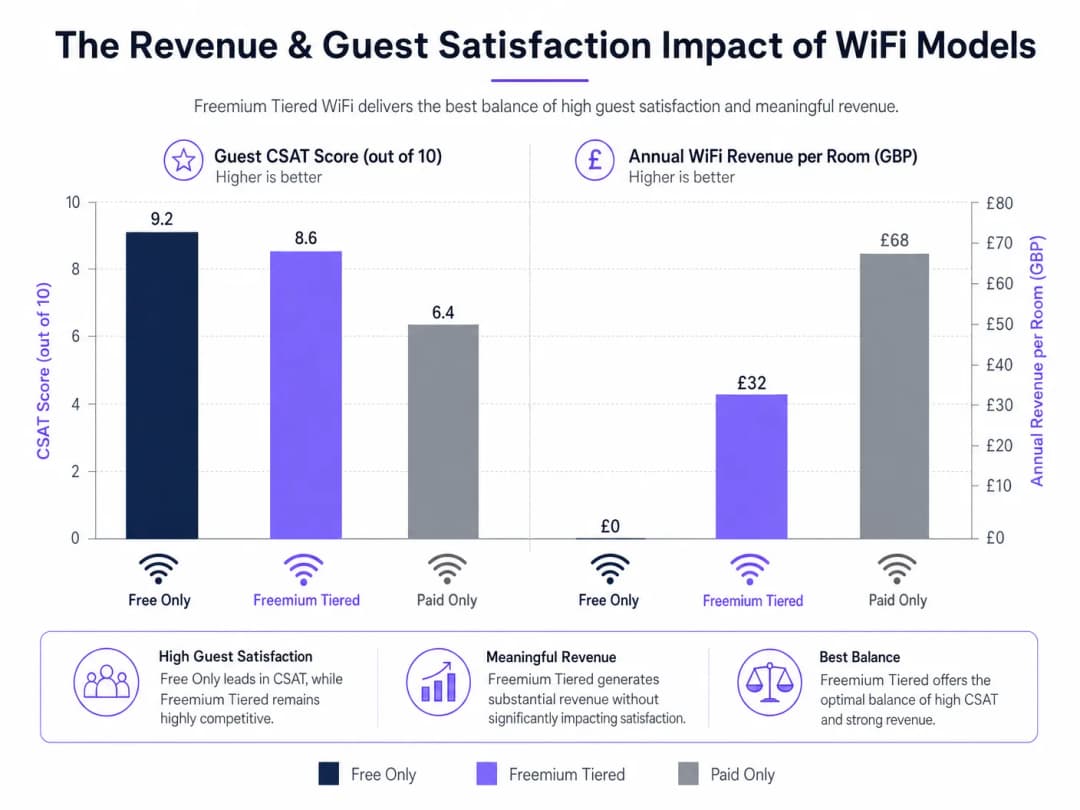
Le débat entre WiFi gratuit et payant dans l'hôtellerie et les grands espaces n'est plus un choix simple. Avec une demande de bande passante en augmentation constante due au streaming 4K, aux conférences basées sur le cloud et à un volume massif d'appareils IoT sans écran, le modèle traditionnel du "gratuit pour tous" s'effondre sous la pression. À l'inverse, les modèles strictement payants nuisent aux scores de satisfaction des clients (CSAT) et génèrent des avis négatifs en ligne.
Pour les responsables informatiques, les architectes réseau et les CTO, le compromis idéal réside dans le modèle Freemium à plusieurs niveaux. Cette approche fournit une connectivité de base gratuite à tous les clients tout en proposant des niveaux premium à haut débit pour les utilisateurs gourmands en bande passante. Ce guide explore l'architecture technique requise pour mettre en œuvre une bande passante échelonnée, les arguments commerciaux pour générer des revenus auxiliaires, et comment des plateformes comme Guest WiFi et WiFi Analytics transforment un centre de coûts en un actif stratégique. L'analyse ci-dessous est pertinente pour tout exploitant de site, qu'il gère un hôtel-boutique de 50 chambres, un immense centre de conférences ou un stade - partout où une décision sur un service WiFi payant doit être prise en toute confiance.
L'argument commercial : Gratuit vs Payant vs Échelonné
Lors de l'évaluation d'un service WiFi payant, les exploitants de sites doivent équilibrer les coûts d'infrastructure avec les attentes modernes des clients. Le secteur a largement convergé vers trois modèles principaux, chacun présentant des compromis financiers et opérationnels distincts.
1. Le modèle "Gratuit uniquement"
Offrir un WiFi entièrement gratuit est souvent considéré comme une attente de base, en particulier dans les environnements de budget et de milieu de gamme de l'hospitality et du retail. Plus de 84 % des clients d'hôtels citent le WiFi gratuit comme un facteur clé dans leurs décisions de réservation, ce qui en fait un service presque essentiel.
Avantages : Satisfaction initiale élevée des clients ; intégration sans friction ; impact positif sur les scores d'évaluation des agences de voyage en ligne.
Inconvénients : Aucun retour sur investissement direct pour compenser l'augmentation des coûts de bande passante ; la congestion du réseau causée par les utilisateurs gourmands dégrade l'expérience de chacun ; opportunité manquée de capturer des données de première main s'il n'est pas mis en œuvre avec un Captive Portal et une authentification appropriée.
2. Le modèle "Payant uniquement"
Facturer l'accès à chaque client est désormais très rare et généralement limité aux transporteurs ultra-économiques, à des hubs de transport spécifiques ou à des systèmes existants qui n'ont pas été modernisés.
Avantages : Génération de revenus directs ; limite naturellement la consommation de bande passante ; facile à mettre en œuvre sur du matériel plus ancien.
Inconvénients : Impact négatif grave sur le CSAT ; friction extrême lors de l'intégration ; décourage activement les réservations dans un marché où la connectivité est considérée comme un droit et non un privilège.
3. Le modèle "Freemium à plusieurs niveaux"
C'est la norme de l'entreprise. Un débit de base (par exemple, 5 Mbps par appareil) est fourni gratuitement en échange des données des visiteurs via un portail d'accueil, tandis que des débits plus élevés (par exemple, 25 Mbps ou 100 Mbps) sont monétisés par le biais de frais journaliers ou par séjour.
Avantages : Équilibre les attentes des clients avec la génération de revenus ; permet un marketing ciblé grâce à la capture de données de première partie ; garantit une allocation équitable de la bande passante via la QoS ; s'intègre aux programmes de fidélité.
Inconvénients : Nécessite une gestion de réseau sophistiquée, une passerelle WiFi performante et une intégration fluide avec le système de gestion hôtelière (PMS).

Analyse technique : Concevoir l'accès multiniveau
La mise en œuvre d'un modèle multiniveau nécessite une architecture réseau robuste. Il ne s'agit pas simplement de brider un routeur ; cela exige des points d'accès de classe entreprise, des contrôleurs intelligents et des cadres d'authentification sécurisés conformes aux normes IEEE 802.1X et WPA3.
Allocation de la bande passante et qualité de service (QoS)
Pour déployer avec succès un service WiFi payant, le réseau doit allouer la bande passante de manière dynamique. Cela est possible grâce à des politiques de qualité de service (QoS) gérées au niveau du contrôleur - soit sur site, soit, de plus en plus, via des plateformes gérées dans le cloud.
| Niveau | Limite de débit | Cas d'usage courant | Priorité QoS |
|---|---|---|---|
| Gratuit de base | 5 Mbps par appareil | E-mail, navigation, réseaux sociaux | Basse |
| Standard | 25 Mbps par appareil | Streaming HD, VPN standard | Moyenne |
| Premium | 100 Mbps par appareil | Vidéo 4K, conférence, transferts volumineux | Haute |
Comme indiqué dans notre guide Vitesse WiFi d'hôtel : Ce que les clients attendent et comment y répondre, définir correctement ces seuils est crucial pour éviter la frustration des clients. Un niveau gratuit mal calibré qui ne peut même pas prendre en charge un flux YouTube de base générera plus d'avis négatifs qu'un modèle exclusivement payant.
Authentification sécurisée et intégration
Une expérience d'intégration fluide est primordiale. La méthode héritée des mots de passe partagés (PSK) représente un risque de sécurité et introduit des frictions. Les déploiements modernes utilisent une approche d'authentification multicouche. Captive Portals : Pour le niveau gratuit, les clients s'authentifient via une page d'accueil personnalisée, acceptant les conditions et fournissant des données (par exemple, e-mail, consentement marketing). C'est le fondement du pipeline de données de WiFi Analytics qui alimente directement les systèmes CRM.
Intégration PMS : Pour les niveaux premium, la passerelle WiFi s'intègre directement au PMS de l'hôtel (par exemple, Oracle Opera, Mews ou Apaleo). Les clients s'authentifient à l'aide de leur numéro de chambre et de leur nom de famille, et les frais premium sont automatiquement reportés sur leur facture - aucune carte de crédit n'est requise sur le portail. Passpoint / OpenRoaming (IEEE 802.11u) : Pour les clients réguliers ou les membres de programmes de fidélité, Passpoint permet des connexions fluides, sans mot de passe et chiffrées individuellement (WPA3-Enterprise), éliminant complètement le besoin d'un Captive Portal et offrant une expérience de roaming similaire à celle du réseau mobile.
Segmentation du réseau et sécurité
La segmentation du réseau via des VLANs est une exigence de sécurité non négociable, en particulier pour la conformité PCI-DSS dans les environnements de vente au détail et d'hôtellerie. Le trafic des invités, le trafic du personnel et le trafic IoT/opérationnel doivent se trouver sur des réseaux logiques complètement distincts, même s'ils partagent les mêmes points d'accès physiques.
Un appareil d'invité compromis sur un réseau non segmenté pourrait accéder aux systèmes de point de vente, aux serrures intelligentes et aux interfaces de gestion internes. Les VLANs empêchent totalement ce mouvement latéral.
Vous avez des questions sur votre configuration spécifique ?
Notre équipe collabore avec des exploitants de sites, des responsables informatiques et des ingénieurs réseau au sein de 80 000 sites. Réservez un appel de 20 minutes et nous vous montrerons comment d'autres professionnels comme vous ont résolu ce problème.
Guide d'implémentation
Le déploiement d'un modèle WiFi à plusieurs niveaux nécessite une planification minutieuse afin de garantir la conformité, la sécurité et une expérience client fluide. Les étapes suivantes s'appliquent aussi bien aux nouveaux déploiements qu'aux mises à niveau d'infrastructures existantes.
Étape 1 : Évaluation de base. Réalisez une étude de site complète. Évaluez l'utilisation actuelle de la bande passante, identifiez les zones de couverture insuffisante et évaluez le matériel existant. Assurez-vous que la liaison terrestre - généralement une ligne louée dédiée par fibre - peut supporter la charge de pointe prévue. Pour en savoir plus sur les exigences de liaison terrestre, consultez Qu'est-ce qu'une ligne louée ? Internet professionnel dédié.
Étape 2 : Définir les niveaux. Établissez des niveaux clairs et faciles à communiquer avec des tarifs qui reflètent la valeur fournie. Une structure courante est : Basique (Gratuit, 5 Mbps), Business (5 £ - 10 £/jour, 25 Mbps) et Pro (15 £+/jour, 100 Mbps non limité).
Étape 3 : Concevoir le Captive Portal. Le portail doit être à l'image de votre marque, adapté aux mobiles et conforme à la législation. Assurez-vous que des cases d'acceptation claires et non cochées par défaut soient présentes pour le marketing afin de respecter le GDPR. Le portail doit clairement formuler la proposition de valeur du niveau premium et minimiser les frictions lors de la mise à niveau.
Étape 4 : Implémenter la segmentation du réseau. Configurez les VLANs sur le contrôleur pour séparer le trafic des invités, du personnel et opérationnel. Appliquez des politiques de qualité de service (QoS) par VLAN pour faire respecter les limites de chaque niveau.
Étape 5 : Intégrer avec le PMS et le CRM. Connectez la passerelle WiFi au PMS pour une facturation automatisée sur le compte de la chambre. Transmettez les données clients capturées au CRM pour des campagnes marketing post-séjour.
Étape 6 : Tests et surveillance. Effectuez des tests de charge avant la mise en service. Configurez des tableaux de bord de surveillance continue pour suivre l'utilisation de la bande passante, les taux d'adoption des différents niveaux et les revenus par chambre disponible (contribution du WiFi au RevPAR).
Bonnes pratiques
Les recommandations suivantes reflètent les normes sectorielles indépendantes des fournisseurs et l'expérience opérationnelle acquise dans les secteurs de l'hôtellerie, de la vente au détail et de l'événementiel.
Implémentez WPA3 sur tous les paliers. Le WPA3 offre un chiffrement individuel des données par appareil, ce qui signifie que même sur un palier gratuit partagé, un client ne peut pas intercepter le trafic d'un autre. Il s'agit d'une amélioration significative par rapport au WPA2, désormais prise en charge par tous les appareils clients modernes.
Utilisez l'isolation des clients sur les VLAN d'invités. Même au sein d'un même VLAN, les appareils des invités doivent être empêchés de communiquer directement entre eux. Cela permet d'atténuer les vecteurs d'attaque de pair à pair.
Appliquez la limitation de débit au niveau de l'AP, et pas seulement de la passerelle. La QoS au niveau du contrôleur est plus granulaire et réactive que la limitation au niveau de la passerelle, et empêche un seul appareil de monopoliser les ressources radio d'un point d'accès partagé.
Auditez la conformité GDPR sur une base trimestrielle. Veillez à ce que les mécanismes de consentement du Captive Portal, les politiques de conservation des données et les accords de partage de données avec des tiers soient régulièrement examinés. L'amende moyenne du UK GDPR pour les violations de données est importante, et l'hôtellerie est un secteur à haut risque.
-
ROI et impact commercial
La transition vers un modèle à paliers transforme le WiFi d'un coût irrécupérable en une source de revenus mesurable, grâce à plusieurs facteurs contributifs.
Revenus directs : Les achats de paliers Premium génèrent des revenus accessoires directs à forte marge. Dans un établissement de 200 chambres avec un taux d'occupation de 70 %, si 10 % des clients achètent une mise à niveau Premium à 10 £, l'établissement génère environ 5 110 £ par mois de revenus WiFi directs - de quoi compenser le coût annuel de l'infrastructure dans de nombreux établissements de taille moyenne.
Revenus indirects (capture de données) : Le palier gratuit sert de moteur de génération de leads. En capturant des adresses e-mail vérifiées et des données CRM, les établissements peuvent stimuler les réservations directes, promouvoir la restauration sur place et augmenter les inscriptions aux programmes de fidélité - contournant ainsi les commissions des agences de voyage en ligne qui consomment généralement 15 à 25 % des revenus des chambres.
Intelligence opérationnelle : Les plateformes de WiFi Analytics comme Purple fournissent des cartes de chaleur de fréquentation, des analyses de temps de séjour et le suivi des visiteurs récurrents. Ces données guident les décisions de dotation en personnel, le calendrier des promotions et l'utilisation de l'espace - ce qui entraîne des économies opérationnelles qui se cumulent au fil du temps.
Atténuation des risques : Un réseau ouvert et mal géré présente des risques juridiques et de réputation importants. Un système à paliers correctement architecturé avec WPA3, isolation des clients et segmentation VLAN minimise les menaces d'attaque de type "man-in-the-middle" et démontre une diligence raisonnable conformément au GDPR et PCI-DSS.
Les mêmes principes s'appliquent aux opérateurs des secteurs connexes. Le guide Wi-Fi in Auto: The Complete 2026 Enterprise Guide montre comment les modèles de connectivité à paliers sont déployés dans les environnements de vente et de service de l'automobile, et le secteur de la santé adopte rapidement des cadres similaires pour le WiFi des patients et des visiteurs.
-
Dépannage et atténuation des risques
Problème : Les clients Premium signalent des débits lents bien qu'ils aient payé pour l'offre supérieure. Cause racine : Les politiques de QoS ne sont pas appliquées au niveau de l'AP, mais uniquement au niveau de la passerelle. Un seul AP desservant plus de 40 appareils peut devenir un goulot d'étranglement radio, quelles que soient les politiques au niveau de la passerelle. Résolution : Imposez l'équité du temps d'antenne (airtime fairness) par AP et assurez-vous que la densité d'AP est suffisante pour le nombre d'appareils connectés simultanément prévu. Une règle générale est d'un AP pour 20 à 25 appareils connectés simultanément dans les environnements à haute densité.
Problème : Les clients ne parviennent pas à connecter des téléviseurs connectés ou des consoles de jeux. Cause racine : Les appareils sans écran ne peuvent pas naviguer sur les Captive Portals. Résolution : Déployez l'iPSK (Individual Pre-Shared Keys) pour permettre l'enregistrement d'appareils sans navigateur, spécifique à chaque chambre. Les clients génèrent des clés via l'application de l'hôtel ou un code QR dans la chambre.
Problème : Préoccupations concernant la conformité GDPR relative à la capture de données. Cause racine : Flux de consentement mal conçus sur le Captive Portal. Résolution : Assurez-vous que le portail utilise des cases d'acceptation explicites et non cochées par défaut pour le marketing. Mettez en œuvre une politique claire de rétention des données et assurez-vous que l'avis de confidentialité est lié et accessible. Les plateformes d'entreprise gèrent cela automatiquement.
Définitions clés
Captive Portal
Une page web que les utilisateurs doivent consulter et avec laquelle ils doivent interagir avant de pouvoir accéder à un réseau WiFi public, généralement utilisée pour l'authentification, la collecte de consentements marketing ou le paiement.
Indispensable pour appliquer le palier gratuit, capturer des données marketing conformes au GDPR et présenter les options de montée en gamme pour les paliers premium. La conception du portail a un impact direct sur les taux de conversion et sur la conformité réglementaire.
Qualité de service (QoS)
Technologies de gestion de réseau qui hiérarchisent certains types de trafic ou limitent la bande passante disponible pour des utilisateurs, appareils ou classes de trafic spécifiques.
Le mécanisme central utilisé pour imposer des limites de bande passante sur le forfait gratuit et garantir le débit pour les clients premium payants. Doit être configuré au niveau du contrôleur et du point d'accès pour une efficacité maximale.
Système de gestion hôtelière (PMS)
Le système logiciel central utilisé par les hôtels pour gérer les réservations, la facturation, l'attribution des chambres et les profils des clients.
La passerelle WiFi doit s'intégrer au PMS pour authentifier les clients par leur numéro de chambre et imputer automatiquement les frais de WiFi premium sur leur facture, permettant ainsi une facturation fluide sans étape de paiement distincte.
Passpoint (Hotspot 2.0 / IEEE 802.11u)
Un protocole de la WiFi Alliance qui permet un roaming fluide, sécurisé et sans mot de passe entre différents réseaux WiFi à l'aide de certificats WPA3-Enterprise.
Permet aux clients fidèles ou de retour de se connecter automatiquement et en toute sécurité sans interagir avec un Captive Portal, offrant une expérience de roaming similaire à celle du réseau cellulaire et éliminant la principale source de friction lors de l'accès.
VLAN (Virtual Local Area Network)
Un sous-réseau logique qui regroupe un ensemble d'appareils de différents segments de réseau physique, imposant l'isolation du trafic au niveau logiciel.
Utilisé pour segmenter en toute sécurité le trafic des clients du trafic opérationnel (systèmes de point de vente, serrures intelligentes, appareils du personnel) sur les mêmes points d'accès physiques. Un contrôle obligatoire pour la conformité PCI-DSS et l'atténuation générale des risques.
Revenu accessoire
Revenus générés par des biens ou services autres que l'offre principale d'une entreprise - dans l'hôtellerie, tout ce qui dépasse le tarif de base de la chambre.
Les forfaits WiFi premium représentent une forme de revenu accessoire à marge élevée. Contrairement à la restauration ou aux services de spa, les mises à niveau WiFi ont un coût marginal quasi nul une fois l'infrastructure déployée, ce qui les rend exceptionnellement rentables.
iPSK (Individual Pre-Shared Key)
Une méthode de sécurité qui fournit un mot de passe WiFi unique pour chaque utilisateur, chambre ou appareil sur le même SSID, sans nécessiter une infrastructure 802.1X complète.
Crucial pour connecter en toute sécurité les appareils IoT sans écran - téléviseurs intelligents, consoles de jeux, clés de streaming - qui ne peuvent pas naviguer sur un Captive Portal. Chaque chambre reçoit une clé unique, maintenant l'isolation entre les clients.
Modèle freemium à plusieurs niveaux
Un modèle de prestation de services dans lequel un niveau de service de base est fourni gratuitement, avec des fonctionnalités ou des performances améliorées disponibles à un tarif premium.
Le modèle commercial WiFi dominant dans l'hôtellerie moderne. Le forfait gratuit stimule la satisfaction client et la collecte de données ; le forfait premium génère des revenus directs. Ce modèle n'est viable qu'avec une application stricte de la QoS pour garantir que le forfait payant offre une expérience nettement supérieure.
RevPAR (Revenu par chambre disponible)
Un indicateur de performance hôtelière calculé en multipliant le tarif journalier moyen d'une chambre par le taux d'occupation.
Les revenus du WiFi et les réservations indirectes générées par la collecte de données WiFi contribuent tous deux au RevPAR. Les prévisions pour les hôtels londoniens en 2026 prévoient une croissance du RevPAR d'environ 1,8 %, l'expérience client basée sur la technologie étant citée comme un moteur clé.
Exemples concrets
Un hôtel de luxe de 300 chambres fait face à des plaintes de clients concernant la lenteur du WiFi pendant les heures de pointe en soirée. L'établissement propose actuellement un réseau unique, gratuit et sans limitation de bande passante avec un mot de passe partagé. Il doit améliorer les performances pour les voyageurs d'affaires sans mécontenter les clients de loisirs. Comment l'équipe informatique doit-elle restructurer le déploiement ?
Étape 1 : Remplacer la clé PSK partagée par un Captive Portal intégré au PMS (Oracle Opera). Étape 2 : Mettre en œuvre un modèle Freemium par paliers avec trois niveaux : Gratuit (10 Mbps, authentification par e-mail pour la collecte de données CRM), Affaires (50 Mbps, 8 £/jour, authentifié par le PMS et facturé sur la note de la chambre), et Premium (100 Mbps, 15 £/jour, même mécanisme de facturation). Étape 3 : Configurer des politiques de QoS au niveau du contrôleur pour appliquer des limites de bande passante par appareil sur le palier gratuit et garantir le débit pour les paliers payants. Étape 4 : Déployer des profils Passpoint via l'application de fidélité de l'hôtel afin que les membres d'élite bénéficient automatiquement et gratuitement du palier Affaires à leur arrivée, sans interaction avec le portail. Étape 5 : Mettre en œuvre une segmentation VLAN pour isoler le trafic des clients des systèmes opérationnels et de point de vente.
Un grand centre de conférences accueille un sommet technologique de 2 000 personnes. L'organisateur de l'événement exige un réseau dédié et sécurisé pour les exposants utilisant des terminaux de point de vente et du matériel de démonstration, ainsi qu'un réseau d'accès général distinct pour les participants. L'équipe informatique du site doit fournir ces deux services sur l'infrastructure physique de points d'accès existante. Comment cette architecture est-elle conçue ?
Étape 1 : Utiliser la segmentation VLAN sur l'infrastructure existante de points d'accès gérés par le cloud pour créer deux réseaux logiques sur le même matériel physique. Étape 2 : Créer un SSID dédié pour les exposants (par exemple, "TechSummit_Exhibitor") en utilisant le WPA3-Enterprise ou l'iPSK pour une connectivité sécurisée et isolée. Chaque exposant reçoit une clé iPSK unique pour son stand, empêchant le trafic entre exposants. Garantir un débit de 20 Mbps par stand d'exposant via la QoS. Étape 3 : Créer un SSID public pour les participants (par exemple, "TechSummit_Guest") avec un Captive Portal personnalisé aux couleurs de l'événement, capturant les données des participants pour l'organisateur. Appliquer une limite de 5 Mbps par appareil pour gérer le nombre élevé de connexions simultanées. Étape 4 : Facturer à l'organisateur de l'événement un tarif premium pour le réseau d'exposants dédié avec un SLA élevé, en tant que service de l'établissement.
Questions d'entraînement
Q1. Le directeur des opérations d'une chaîne d'hôtels de milieu de gamme souhaite facturer 5 £ par jour à tous les clients pour le WiFi afin de récupérer rapidement les coûts de matériel. En tant qu'architecte réseau, quels conseils lui donnez-vous et quelle alternative proposez-vous ?
Conseil : Tenez compte de l'impact sur les classements des agences de voyages en ligne (OTA), les scores de satisfaction client et le potentiel de revenus indirects du forfait gratuit.
Voir la réponse type
Un modèle payant unique (Paid Only) est fortement déconseillé. Plus de 80 % des clients considèrent le WiFi gratuit comme un prérequis, et facturer un accès de base nuit activement aux scores de satisfaction client (CSAT), aux avis sur les agences de voyage en ligne (OTA) et aux taux de conversion des réservations. Recommandez plutôt une approche Freemium par paliers : offrez un palier gratuit de 5 Mbps en échange de la collecte d'adresses e-mail via un Captive Portal, et proposez un palier premium à 50 Mbps pour 8 £/jour destiné aux utilisateurs intensifs. Le palier gratuit génère des données CRM qui stimulent les réservations directes, réduisant ainsi les frais de commission des OTA. Le palier premium génère des revenus annexes directs. Avec un taux d'occupation de 70 % et une adoption du forfait premium de 10 %, un établissement de 200 chambres génère plus de 5 000 £/mois, ce qui est suffisant pour compenser les coûts d'infrastructure sans nuire à la marque.
Q2. Vous déployez un système WiFi par paliers. Comment vous assurez-vous que les clients du palier gratuit ne consomment pas toute la bande passante disponible et ne dégradent pas l'expérience des clients payants du palier premium ?
Conseil : Pensez au contrôle de flux au niveau du contrôleur et aux emplacements d'application des politiques de QoS.
Voir la réponse type
Cette gestion s'effectue via des politiques strictes de Qualité de Service (QoS) au niveau du contrôleur réseau. Lorsqu'un client s'authentifie via le Captive Portal et sélectionne le palier gratuit, le contrôleur associe son adresse MAC à un groupe d'utilisateurs ou à un VLAN spécifique doté d'une limite de bande passante (par exemple, 5 Mbps montant/descendant). Pour les clients premium authentifiés via l'intégration PMS, ils sont affectés à un groupe distinct avec une bande passante non plafonnée et une priorité de trafic supérieure. De plus, les paramètres d'équité de temps d'antenne (airtime fairness) par point d'accès empêchent un seul appareil de monopoliser le support radio partagé. Cela garantit que la liaison de raccordement n'est jamais saturée par les utilisateurs non payants et que le palier premium offre systématiquement l'expérience pour laquelle les clients ont payé.
Q3. Un complexe hôtelier de luxe souhaite offrir un accès WiFi fluide et sans mot de passe à ses membres fidélité de premier rang dès qu'ils pénètrent dans l'établissement, sans qu'ils n'aient jamais à voir de Captive Portal. Comment cela est-il réalisé techniquement et quel protocole de sécurité en est la base ?
Conseil : Pensez à la manière dont les réseaux cellulaires gèrent l'authentification en itinérance, et à l'équivalent pour le WiFi.
Voir la réponse type
Cela est possible grâce à Passpoint (Hotspot 2.0), basé sur la norme IEEE 802.11u. L'application de fidélité de l'hôtel distribue un profil Passpoint contenant un certificat numérique sécurisé sur l'appareil du membre. À son arrivée, l'appareil détecte automatiquement l'SSID compatible Passpoint, échange le certificat en arrière-plan à l'aide de l'authentification WPA3-Enterprise et 802.1X, et se connecte sans aucune interaction de l'utilisateur ni Captive Portal. Le contrôleur réseau valide le certificat, confirme le statut de membre d'élite et attribue l'appareil au VLAN de QoS premium. Chaque connexion est chiffrée individuellement, offrant une sécurité bien supérieure à celle d'une clé PSK partagée. L'expérience est identique à celle d'un téléphone mobile qui se connecte automatiquement à un réseau cellulaire partenaire à l'étranger.
Q4. Un hôtel prévoit de déployer des téléviseurs connectés et des appareils Apple TV dans l'ensemble de ses 150 chambres. Ces appareils ne peuvent pas naviguer sur un Captive Portal. Comment l'équipe informatique doit-elle gérer leur connexion au réseau ?
Conseil : Pensez aux méthodes d'authentification qui ne nécessitent pas de navigateur.
Voir la réponse type
La bonne approche consiste à déployer des clés pré-partagées individuelles (iPSK). Chaque chambre se voit attribuer un mot de passe WiFi unique et sécurisé, différent de celui de toutes les autres chambres. Les clients peuvent récupérer la clé spécifique à leur chambre via un code QR sur la carte de bienvenue en chambre ou via l'application de l'hôtel. Ils saisissent cette clé directement dans les paramètres de la smart TV ou de l'Apple TV. Le contrôleur réseau identifie la clé unique, authentifie l'appareil et l'attribue au VLAN de la chambre correspondante, garantissant ainsi que l'appareil est isolé des appareils des autres clients. Cette approche maintient une sécurité de niveau entreprise sans nécessiter d'interaction avec un Captive Portal sur navigateur.
Continuer la lecture de cette série
Comment configurer un WiFi invité : un guide de configuration d'entreprise sécurisé
Ce guide de référence offre aux responsables informatiques et architectes réseau un modèle définitif pour déployer un WiFi invité d'entreprise sécurisé. Il couvre l'architecture essentielle, la migration WPA3, la segmentation VLAN et l'intégration de captive portal pour protéger les systèmes internes tout en collectant des données de premier niveau conformes.
Comment résoudre les lenteurs de votre WiFi sans augmenter le débit de votre forfait Internet
Un guide de référence technique complet pour les responsables informatiques et les architectes réseau sur l'optimisation des performances WiFi d'entreprise sans augmenter la bande passante du FAI. Couvre le réglage RF, la gestion de la densité des clients, la mise en œuvre de la QoS et l'utilisation de l'analyse WiFi pour diagnostiquer et résoudre les goulots d'étranglement.
Comment concevoir un réseau WiFi de campus : Un guide informatique pour les universités
Ce guide technique fournit un plan complet pour concevoir et déployer des réseaux WiFi de campus à haute densité, couvrant tous les aspects, des études de site actives et de l'emplacement des points d'accès à l'architecture des contrôleurs, au roaming transparent et à l'authentification sécurisée des invités. Il est rédigé pour les responsables informatiques, les architectes réseau et les directeurs de la technologie des universités et des grands sites qui ont besoin de conseils pratiques pour planifier et exécuter un déploiement sans fil ce trimestre. Ce guide intègre également la plateforme de Guest WiFi et d'analyses de Purple aux points d'intégration réels du cycle de vie du déploiement.
Vous avez des questions sur votre configuration spécifique ?
Notre équipe collabore avec des exploitants de sites, des responsables informatiques et des ingénieurs réseau au sein de 80 000 sites. Réservez un appel de 20 minutes et nous vous montrerons comment d'autres professionnels comme vous ont résolu ce problème.