

Wi-Fi 6E बनाम Wi-Fi 7: क्या आपको 6E को छोड़कर सीधे 7 पर जाना चाहिए?
आईटी निदेशकों और नेटवर्क आर्किटेक्ट्स के लिए एक व्यापक निर्णय मार्गदर्शिका जो 2026 में वायरलेस हार्डवेयर को अपग्रेड करने का मूल्यांकन कर रहे हैं। यह Wi-Fi 6E और Wi-Fi 7 की तकनीकी तुलना, एक वर्तमान विक्रेता मूल्य निर्धारण मैट्रिक्स, और आतिथ्य, खुदरा और सार्वजनिक क्षेत्रों में उच्च-घनत्व वाले स्थानों के लिए कार्रवाई योग्य परिनियोजन सिफारिशें प्रदान करती है — टीमों को यह तय करने में मदद करती है कि क्या Wi-Fi 7 का प्रीमियम उनकी विशिष्ट परिचालन आवश्यकताओं के लिए उचित है।
🎧 इस गाइड को सुनें
ट्रांसक्रिप्ट देखें
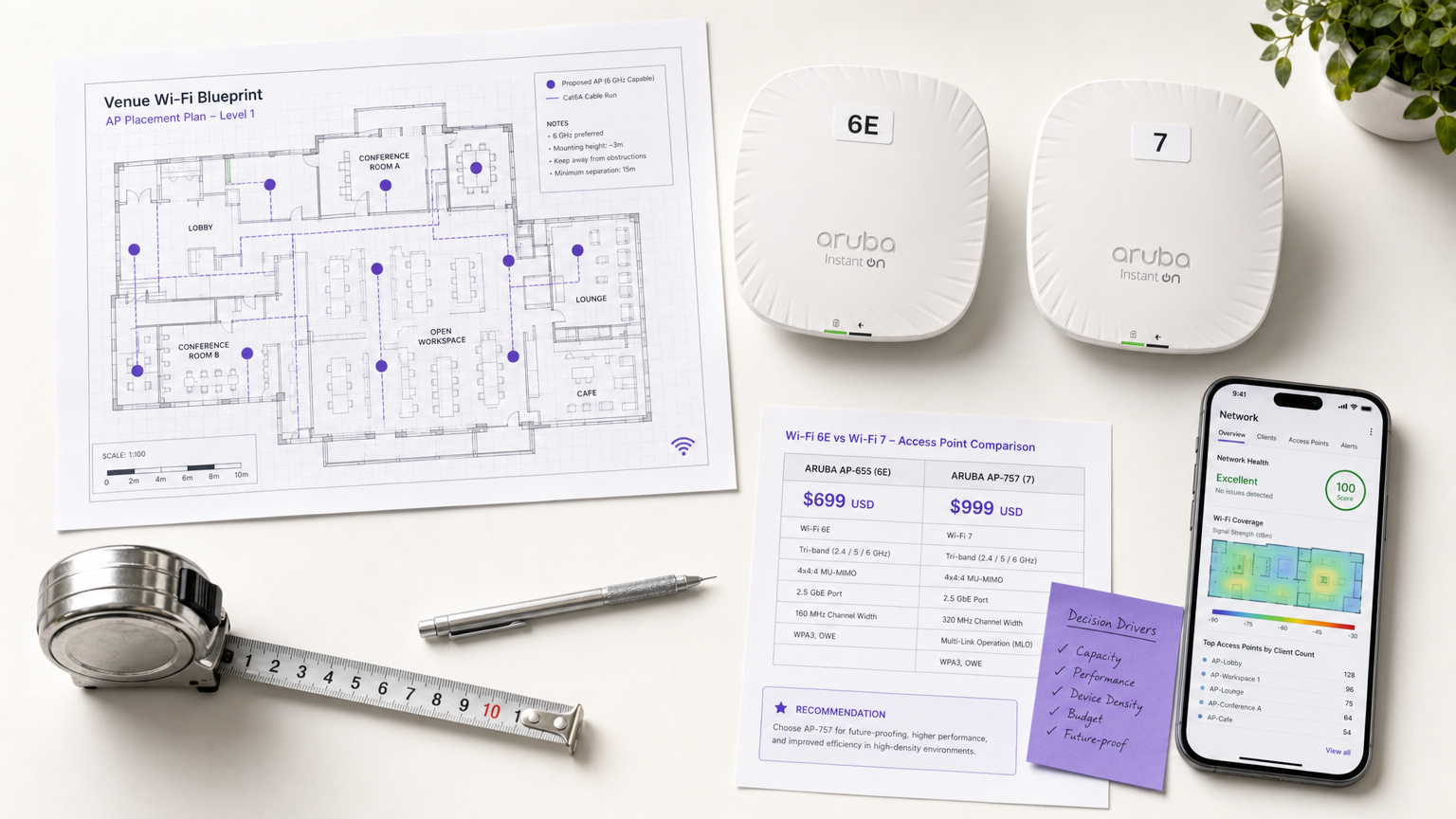
कार्यकारी सारांश
Wi-Fi 6E से Wi-Fi 7 (IEEE 802.11be) में संक्रमण इस बात में एक मौलिक बदलाव का प्रतिनिधित्व करता है कि एंटरप्राइज़ वायरलेस नेटवर्क घनत्व, विलंबता और थ्रूपुट को कैसे संभालते हैं। 2026 में हार्डवेयर अपग्रेड की योजना बना रहे आईटी निदेशकों और नेटवर्क आर्किटेक्ट्स के लिए, यह निर्णय अब केवल एक साधारण बैंडविड्थ गणना नहीं है — यह उच्च-घनत्व वाले स्थानों की परिचालन मांगों के मुकाबले पूंजीगत व्यय का एक रणनीतिक मूल्यांकन है। जबकि Wi-Fi 6E ने 6 GHz बैंड पेश किया, Wi-Fi 7 इसे 320 MHz चैनलों, 4K QAM मॉड्यूलेशन और Multi-Link Operation (MLO) के साथ पूरी तरह से उपयोग करता है।
यह मार्गदर्शिका वर्तमान एंटरप्राइज़ परिदृश्य का एक विक्रेता-तटस्थ विश्लेषण प्रदान करती है, यह मूल्यांकन करती है कि क्या Wi-Fi 7 एक्सेस पॉइंट के लिए 30-50% मूल्य प्रीमियम आतिथ्य , खुदरा , और सार्वजनिक-क्षेत्र के वातावरण में विशिष्ट स्थान के कार्यभार के लिए उचित है। वर्तमान हार्डवेयर उपलब्धता, मूल्य निर्धारण मैट्रिक्स और क्लाइंट पैठ की समय-सीमा की जांच करके, आईटी नेता डेटा-संचालित पूंजीगत व्यय निर्णय ले सकते हैं जो अगले 3-5 वर्षों में व्यावसायिक आवश्यकताओं के साथ बुनियादी ढांचे की क्षमताओं को संरेखित करते हैं।
तकनीकी गहन विश्लेषण: Wi-Fi 6E बनाम Wi-Fi 7
Wi-Fi 6E और Wi-Fi 7 के बीच स्थापत्य संबंधी अंतर सैद्धांतिक अधिकतम थ्रूपुट से कहीं अधिक हैं। जबकि Wi-Fi 6E (IEEE 802.11ax) एक विकासात्मक कदम था जिसने 6 GHz स्पेक्ट्रम को खोला, Wi-Fi 7 (IEEE 802.11be) एक क्रांतिकारी पुनर्रचना है जो नियतात्मक विलंबता और अत्यधिक उच्च थ्रूपुट (EHT) पर केंद्रित है।
| विनिर्देश | Wi-Fi 6E (802.11ax) | Wi-Fi 7 (802.11be) |
|---|---|---|
| अधिकतम सैद्धांतिक थ्रूपुट | 9.6 Gbps | 46 Gbps |
| अधिकतम चैनल चौड़ाई | 160 MHz | 320 MHz |
| मॉड्यूलेशन | 1024-QAM | 4096-QAM (4K QAM) |
| Multi-Link Operation (MLO) | No | Yes |
| प्रस्तावना पंक्चरिंग | मूल | उन्नत |
| फ़्रीक्वेंसी बैंड | 2.4 / 5 / 6 GHz | 2.4 / 5 / 6 GHz |
| अनुशंसित बैकहॉल | 2.5 GbE | 10 GbE |
| बिजली की आवश्यकता | PoE+ (802.3at) | PoE++ (802.3bt) |
स्पेक्ट्रम और चैनल चौड़ाई प्रतिमान
Wi-Fi 6E ने 6 GHz बैंड तक पहुंच प्रदान की, जिससे पारंपरिक 2.4 GHz और 5 GHz स्थानों में भीड़ कम हुई। हालांकि, यह 160 MHz की अधिकतम चैनल चौड़ाई तक सीमित था। Wi-Fi 7 इस क्षमता को दोगुना करता है, विशेष रूप से 6 GHz बैंड में 320 MHz चैनलों का समर्थन करता है। यह विस्तार उच्च-बैंडविड्थ अनुप्रयोगों जैसे संवर्धित वास्तविकता या वास्तविक समय विश्लेषण का समर्थन करने वाले स्थानों के लिए महत्वपूर्ण है। व्यापक चैनल काफी उच्च डेटा दरों की अनुमति देते हैं, जो संगत क्लाइंट उपकरणों के लिए क्षमता सीमा को प्रभावी ढंग से दोगुना करते हैं।
Multi-Link Operation (MLO): गेम चेंजर
Wi-Fi 7 में सबसे महत्वपूर्ण स्थापत्य संबंधी प्रगति Multi-Link Operation (MLO) है। पिछली पीढ़ियों में, Wi-Fi 6E सहित, एक क्लाइंट डिवाइस किसी भी समय केवल एक बैंड पर एक एक्सेस पॉइंट से कनेक्ट हो सकता था। MLO उपकरणों को कई बैंड और चैनलों पर एक साथ डेटा संचारित और प्राप्त करने की अनुमति देकर इस बाधा को मौलिक रूप से बदल देता है।
यह क्षमता एंटरप्राइज़ परिनियोजन के लिए दो महत्वपूर्ण लाभ प्रदान करती है। पहला, यह कई बैंडों की क्षमता को मिलाकर कुल थ्रूपुट में नाटकीय रूप से सुधार करता है। दूसरा, और स्थान संचालन के लिए अधिक महत्वपूर्ण, यह विलंबता को काफी कम करता है और विश्वसनीयता में सुधार करता है। उपलब्ध बैंडों में ट्रैफ़िक को लोड-बैलेंस करके, MLO किसी भी एकल आवृत्ति पर क्षणिक हस्तक्षेप के प्रभाव को कम करता है, जिससे वॉइस ओवर IP (VoIP) और वास्तविक समय पॉइंट-ऑफ-सेल (POS) लेनदेन जैसे विलंबता-संवेदनशील अनुप्रयोगों के लिए नियतात्मक प्रदर्शन सुनिश्चित होता है। उच्च-घनत्व, परिचालन रूप से महत्वपूर्ण वातावरण के लिए Wi-Fi 7 पर विचार करने का यह प्राथमिक कारण है।
मॉड्यूलेशन, पंक्चरिंग और दक्षता
Wi-Fi 7 मॉड्यूलेशन योजना को 1024-QAM से 4096-QAM (4K QAM) में अपग्रेड करता है, जिससे प्रत्येक प्रतीक 10 के बजाय 12 बिट डेटा ले जा सकता है — संचरण दक्षता में 20% की वृद्धि। हालांकि इसके लिए एक उच्च सिग्नल-टू-नॉइज़ अनुपात (SNR) की आवश्यकता होती है जो आमतौर पर एक्सेस पॉइंट के करीब पाया जाता है, यह उच्च-घनत्व वाले वातावरण में प्रदर्शन को काफी बढ़ाता है जहां क्लाइंट बुनियादी ढांचे के करीब क्लस्टर होते हैं, जैसे सम्मेलन कक्ष या स्टेडियम सीटिंग।
इसके अलावा, Wi-Fi 7 उन्नत प्रस्तावना पंक्चरिंग पेश करता है। Wi-Fi 6E में, यदि एक विस्तृत चैनल के एक हिस्से में हस्तक्षेप का अनुभव होता है, तो पूरा चैनल डाउनग्रेड हो सकता है। Wi-Fi 7 की उन्नत पंक्चरिंग एक्सेस पॉइंट को हस्तक्षेप से प्रभावित विशिष्ट उप-चैनल को अलग करने की अनुमति देती है, जबकि शेष स्वच्छ स्पेक्ट्रम का उपयोग जारी रखती है। यह लचीलापन बड़े सार्वजनिक स्थानों के विशिष्ट जटिल RF वातावरण में महत्वपूर्ण है।
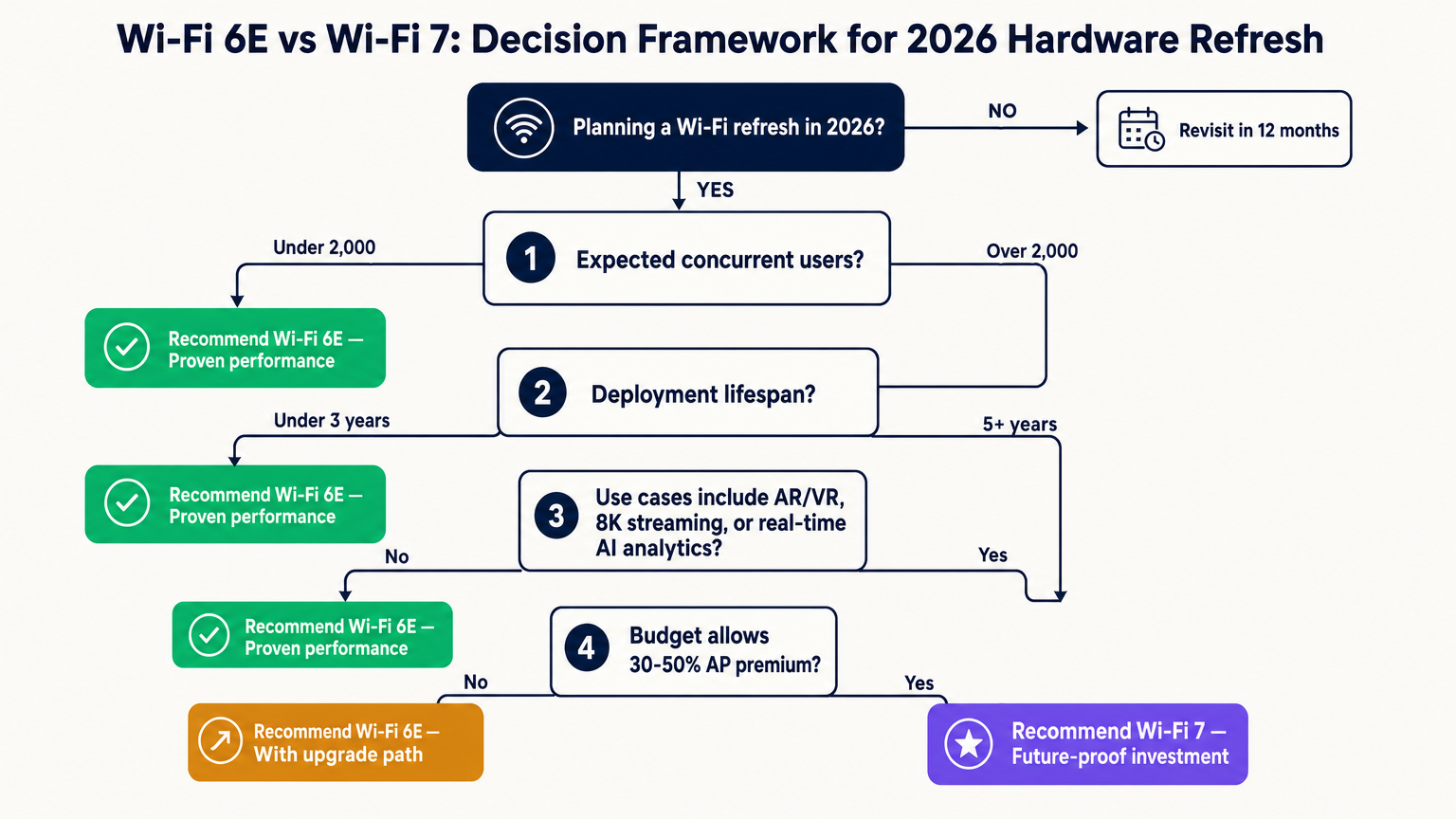
कार्यान्वयन मार्गदर्शिका: 2026 पूंजीगत व्यय निर्णय का आकार निर्धारण
2026 में हार्डवेयर अपग्रेड का मूल्यांकन कर रहे आईटी निदेशकों के लिए, Wi-Fi 6E और Wi-Fi 7 के बीच का निर्णय तत्काल पूंजीगत व्यय को दीर्घकालिक परिचालन आवश्यकताओं के साथ संतुलित करने पर निर्भर करता है। एंटरप्राइज़-ग्रेड Wi-Fi 7 एक्सेस पॉइंट के लिए वर्तमान में सड़क मूल्य प्रीमियम तुलनीय Wi-Fi 6E मॉडल की तुलना में 30% से 50% तक है, हालांकि IDC Wi-Fi 7 AP मूल्य निर्धारण में 38% की साल-दर-साल गिरावट की रिपोर्ट करता है, जो दर्शाता है कि बाजार तेजी से परिपक्व हो रहा है।
विक्रेता परिदृश्य और मूल्य निर्धारण स्नैपशॉट
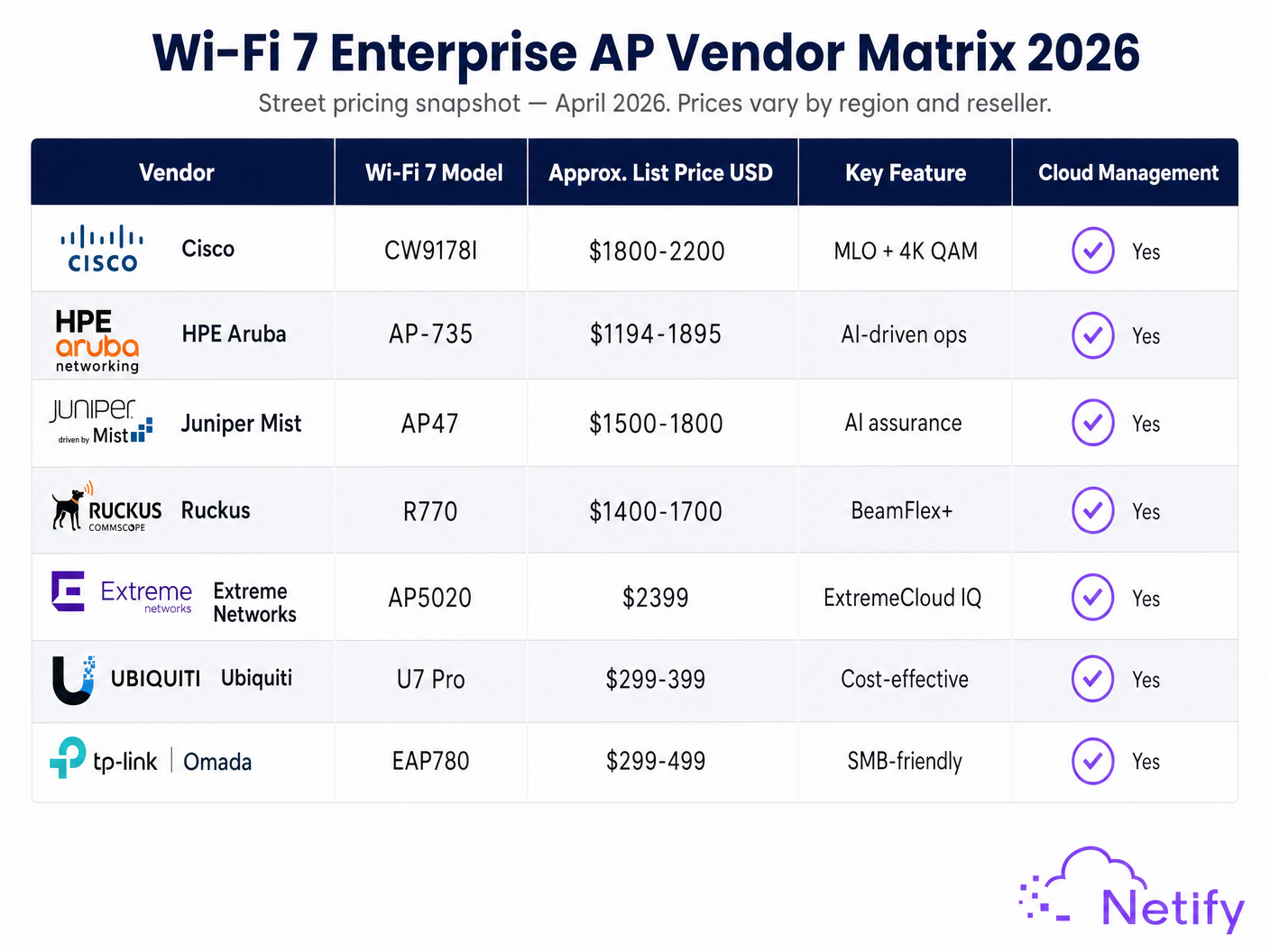
अप्रैल 2026 तक, प्रमुख एंटरप्राइज़ विक्रेताओं ने अपने प्रमुख Wi-Fi 7 एक्सेस पॉइंट जारी किए हैं। नीचे दी गई तालिका विक्रेता मूल्यांकन करने वाली आईटी टीमों के लिए वर्तमान बाजार स्नैपशॉट प्रदान करती है।
| विक्रेता | Wi-Fi 7 Model | लगभग सड़क मूल्य (USD) | मुख्य अंतर |
|---|---|---|---|
| Cisco | CW9178I | $1,800–$2,200 | MLO + 4K QAM, Catalyst integration |
| HPE Aruba | AP-735 | $1,194–$1,895 | AI-driven ops, Central cloud |
| Juniper Mist | AP47 | $1,500–$1,800 | AI assurance, Mist AI |
| Ruckus | R770 | $1,400–$1,700 | BeamFlex+ adaptive antenna |
| Extreme Networks | AP5020 | ~$2,399 | ExtremeCloud IQ |
| Ubiquiti | U7 Pro | $299–$399 | Cost-effective, UniFi ecosystem |
मूल्य स्नैपशॉट — अप्रैल 2026। बाज़ार मूल्य क्षेत्र, पुनर्विक्रेता और मात्रा के अनुसार भिन्न होते हैं। हमेशा वर्तमान वितरक मूल्य निर्धारण के विरुद्ध मान्य करें।
Wi-Fi 7 परिनियोजन के लिए बजट बनाते समय, संगठनों को वायर्ड इन्फ्रास्ट्रक्चर के लिए आवश्यक अपग्रेड का भी ध्यान रखना चाहिए। Wi-Fi 7 की अत्यधिक थ्रूपुट क्षमताएं मल्टी-गीगाबिट बैकहॉल को अनिवार्य बनाती हैं। जबकि Wi-Fi 6E परिनियोजन अक्सर 2.5 GbE स्विच पोर्ट पर आराम से काम करते हैं, 4x4:4 Wi-Fi 7 एक्सेस पॉइंट की पूरी क्षमता का एहसास करने के लिए 10 GbE अपलिंक और PoE++ (802.3bt) पावर बजट की आवश्यकता होती है। इस वायर्ड इन्फ्रास्ट्रक्चर अपग्रेड लागत को स्वामित्व की कुल लागत की तुलना में शामिल किया जाना चाहिए।
क्लाइंट डिवाइस पैठ की समय-सीमा
इन्फ्रास्ट्रक्चर अपग्रेड को क्लाइंट क्षमताओं के साथ संरेखित होना चाहिए। 2026 में, एंटरप्राइज़ वातावरण में Wi-Fi 7 क्लाइंट की पैठ 15% और 20% के बीच है, जो नवीनतम फ्लैगशिप स्मार्टफोन (Samsung Galaxy S24 Ultra, iPhone 16 series) और हाई-एंड लैपटॉप द्वारा संचालित है। इस पैठ के 2028 तक 40-50% तक पहुंचने का अनुमान है। Guest WiFi सेवाओं को प्राथमिकता देने वाले स्थानों के लिए, Wi-Fi 7 की पश्चगामी संगतता यह सुनिश्चित करती है कि पुराने डिवाइस अभी भी काम करेंगे, लेकिन निवेश पर पूरा प्रतिफल धीरे-धीरे तब साकार होगा जब क्लाइंट मिश्रण आधुनिक हो जाएगा।
स्थल परिनियोजन के लिए सर्वोत्तम अभ्यास
अगली पीढ़ी के वायरलेस इन्फ्रास्ट्रक्चर को तैनात करने के लिए स्थल की विशिष्ट परिचालन मांगों के अनुरूप एक सूक्ष्म दृष्टिकोण की आवश्यकता होती है। Purple जैसे प्लेटफॉर्म की हार्डवेयर-अज्ञेयवादी प्रकृति यह सुनिश्चित करती है कि संगठन अंतर्निहित एक्सेस पॉइंट विक्रेता की परवाह किए बिना अपने नेटवर्क निवेश से अधिकतम मूल्य प्राप्त कर सकें।
उच्च-घनत्व वाले वातावरण: स्टेडियम और इवेंट स्पेस
5,000 से अधिक समवर्ती उपयोगकर्ताओं वाले स्थानों के लिए, Wi-Fi 6E को छोड़कर सीधे Wi-Fi 7 पर जाने का तर्क सम्मोहक है। 320 MHz चैनलों और 4K QAM का संयोजन घनी क्लाइंट सांद्रता को संभालने के लिए आवश्यक क्षमता प्रदान करता है। इसके अलावा, MLO यह सुनिश्चित करता है कि महत्वपूर्ण स्थल संचालन — जैसे मोबाइल टिकटिंग और भीड़ प्रबंधन एप्लिकेशन — चरम उपयोग के दौरान भी कम विलंबता बनाए रखें। इन वातावरणों के लिए डिज़ाइन करते समय, IT टीमों को उन्नत RF प्रबंधन और दिशात्मक एंटीना क्षमताओं वाले एक्सेस पॉइंट को प्राथमिकता देनी चाहिए। Internet of Things Architecture: A Complete Guide इस बात पर अतिरिक्त संदर्भ प्रदान करता है कि IoT डिवाइस घनत्व इन आवश्यकताओं को कैसे बढ़ाता है।
आतिथ्य और सम्मेलन केंद्र
Hospitality क्षेत्र में, आवश्यकताएँ संपत्ति के प्रकार के अनुसार काफी भिन्न होती हैं। एक मानक 200-कमरे वाले होटल के लिए, एक अच्छी तरह से डिज़ाइन किया गया Wi-Fi 6E नेटवर्क 2028 तक अतिथि स्ट्रीमिंग और मानक परिचालन कार्यों के लिए पर्याप्त क्षमता प्रदान करेगा। हालांकि, बड़े कन्वेंशन होटलों और समर्पित सम्मेलन केंद्रों को Wi-Fi 7 का मूल्यांकन करना चाहिए। MLO द्वारा प्रदान की गई नियतात्मक विलंबता सैकड़ों एक साथ वीडियो कॉन्फ्रेंस और इंटरैक्टिव प्रस्तुतियों का समर्थन करने के लिए महत्वपूर्ण है। उन संपत्तियों के लिए जहां Guest WiFi एक राजस्व-उत्पादक सेवा है, Wi-Fi 7 की बढ़ी हुई क्षमता अधिक परिष्कृत डेटा कैप्चर और वैयक्तिकरण क्षमताओं का भी समर्थन करती है, जैसा कि AI in Guest WiFi: Personalisation, Engagement, and the GenAI Roadmap पर हमारी मार्गदर्शिका में खोजा गया है।
खुदरा और सार्वजनिक क्षेत्र
Retail वातावरण के लिए, Wi-Fi 6E अक्सर मानक POS सिस्टम, इन्वेंट्री प्रबंधन और बुनियादी WiFi Analytics का समर्थन करने के लिए सबसे लागत प्रभावी समाधान बना रहता है। हालांकि, उन्नत अनुभवात्मक प्रौद्योगिकियों — जैसे AR उत्पाद विज़ुअलाइज़ेशन या वास्तविक समय स्थानिक विश्लेषण — को लागू करने वाले फ्लैगशिप स्टोर Wi-Fi 7 की बढ़ी हुई थ्रूपुट और दक्षता से लाभान्वित होंगे। सार्वजनिक क्षेत्र के परिनियोजन में, जैसे नगरपालिका भवन या Transport हब, निवेश का विस्तारित जीवनचक्र (अक्सर 7-10 साल) Wi-Fi 7 के भविष्य-प्रूफिंग पहलू को अत्यधिक आकर्षक बनाता है, प्रारंभिक कैपेक्स प्रीमियम के बावजूद। Indoor Positioning System: UWB, BLE, & WiFi Guide प्रौद्योगिकियों की सटीक आवश्यकताएं भी Wi-Fi 7 द्वारा प्रदान किए गए कम विलंबता तल से लाभान्वित होती हैं।
समस्या निवारण और जोखिम शमन
एक नए वायरलेस मानक में अपग्रेड करने से विशिष्ट जोखिम उत्पन्न होते हैं जिन्हें परिनियोजन चरण के दौरान प्रबंधित किया जाना चाहिए।
6 GHz कवरेज गैप
Wi-Fi 6E या Wi-Fi 7 में संक्रमण करते समय एक सामान्य गलती 6 GHz बैंड की प्रसार विशेषताओं को कम आंकना है। उच्च आवृत्तियां भौतिक बाधाओं के माध्यम से अधिक तेज़ी से क्षीण होती हैं। विरासत 5 GHz एक्सेस पॉइंट के एक-से-एक प्रतिस्थापन से 6 GHz कवरेज गैप होने की संभावना है। नेटवर्क आर्किटेक्ट को विशेष रूप से 6 GHz स्पेक्ट्रम के लिए मॉडल किए गए व्यापक भविष्य कहनेवाला और सक्रिय साइट सर्वेक्षण करने चाहिए, जिसमें अक्सर सर्वव्यापी कवरेज प्राप्त करने के लिए कुल एक्सेस पॉइंट घनत्व में 15-20% की वृद्धि की आवश्यकता होती है।
पावर और बैकहॉल बॉटलनेक
विरासत स्विचिंग इन्फ्रास्ट्रक्चर पर Wi-Fi 7 एक्सेस पॉइंट तैनात करने से प्रदर्शन गंभीर रूप से बाधित हो सकता है। यदि 10 GbE PoE++ स्विच वर्तमान बजट में नहीं हैं, तो संगठनों को यह सुनिश्चित करना होगा कि उनके चुने हुए एक्सेस पॉइंट मानक PoE+ (802.3at) पर एक डिग्रेडेड मोड में काम कर सकें जब तक कि वायर्ड नेटवर्क को अपग्रेड नहीं किया जाता है। यह चरणबद्ध दृष्टिकोण व्यवहार्य है लेकिन प्रदर्शन अपेक्षाओं को प्रबंधित करने के लिए हितधारकों को स्पष्ट रूप से योजनाबद्ध और सूचित किया जाना चाहिए।
सुरक्षा और अनुपालन एकीकरण
Wi-Fi 6E और Wi-Fi 7 दोनों WPA3 सुरक्षा को अनिवार्य करते हैं, लेकिन एकीकृत करनाइन नए मानकों को मौजूदा एंटरप्राइज़ प्रमाणीकरण प्रणालियों (IEEE 802.1X) के साथ एकीकृत करने के लिए सावधानीपूर्वक योजना की आवश्यकता होती है। प्रोफ़ाइल-आधारित प्रमाणीकरण या OpenRoaming जैसी सेवाओं का उपयोग करने वाले संगठनों को यह सुनिश्चित करना होगा कि उनके पहचान प्रदाता और RADIUS इन्फ्रास्ट्रक्चर नए हार्डवेयर के साथ पूरी तरह से संगत हों। Purple की हार्डवेयर-अज्ञेयवादी पहचान प्रबंधन परत के रूप में भूमिका इस एकीकरण को सरल बनाती है, जो भौतिक एक्सेस पॉइंट विक्रेता से स्वतंत्र एक सुसंगत प्रमाणीकरण और डेटा कैप्चर अनुभव प्रदान करती है। यह PCI DSS 4.0 और GDPR अनुपालन के लिए विशेष रूप से प्रासंगिक है, जहाँ प्रमाणीकरण और डेटा हैंडलिंग परत को अंतर्निहित वायरलेस मानक की परवाह किए बिना स्पष्ट रूप से सुरक्षित होना चाहिए।
ROI और व्यावसायिक प्रभाव
वायरलेस इन्फ्रास्ट्रक्चर अपग्रेड का अंतिम माप व्यावसायिक संचालन और उपयोगकर्ता अनुभव पर इसका प्रभाव है। Wi-Fi 7 बनाम Wi-Fi 6E के ROI का मूल्यांकन करते समय, IT नेताओं को केवल कच्चे थ्रूपुट मेट्रिक्स से परे देखना चाहिए और प्रत्येक मानक द्वारा सक्षम परिचालन क्षमताओं पर विचार करना चाहिए।
सफलता को परिचालन दक्षता में सुधार और नई राजस्व-उत्पादक सेवाओं को सक्षम करने से मापा जाना चाहिए। Wi-Fi 7 की कम विलंबता खुदरा गोदामों में स्वचालित निर्देशित वाहनों (AGVs) की विश्वसनीयता में सीधे सुधार कर सकती है या वास्तविक समय स्थान सेवाओं की सटीकता बढ़ा सकती है। स्थल संचालकों के लिए, एक मजबूत, उच्च क्षमता वाला नेटवर्क उन्नत अतिथि जुड़ाव रणनीतियों की नींव बनाता है। फर्स्ट-पार्टी डेटा कैप्चर करने और बड़े पैमाने पर व्यक्तिगत अनुभव प्रदान करने के लिए एक ऐसे नेटवर्क की आवश्यकता होती है जो मुख्य कनेक्टिविटी अनुभव से समझौता किए बिना जटिल, वास्तविक समय डेटा प्रवाह को संभालने में सक्षम हो।
स्वामित्व की कुल लागत गणना में केवल एक्सेस पॉइंट हार्डवेयर ही नहीं, बल्कि पूरा इन्फ्रास्ट्रक्चर स्टैक शामिल होना चाहिए: स्विच, केबलिंग, साइट सर्वेक्षण लागत और चल रहा प्रबंधन प्लेटफ़ॉर्म। जो संगठन अपने हार्डवेयर रीफ्रेश चक्र को व्यवसाय के रणनीतिक लक्ष्यों के साथ संरेखित करते हैं — बजाय केवल नवीनतम मानक का पीछा करने के — वे अपने वायरलेस इन्फ्रास्ट्रक्चर निवेश से लगातार सबसे मजबूत ROI प्राप्त करेंगे।
मुख्य शब्द और परिभाषाएं
Multi-Link Operation (MLO)
A Wi-Fi 7 feature allowing devices to transmit and receive data simultaneously across multiple frequency bands (2.4, 5, and 6 GHz), aggregating bandwidth and improving reliability through load-balancing.
Critical for IT teams managing latency-sensitive applications like VoIP, real-time analytics, or POS transactions. MLO is the primary architectural differentiator between Wi-Fi 6E and Wi-Fi 7 for enterprise deployments.
4K QAM (4096-QAM)
An advanced modulation scheme in Wi-Fi 7 that encodes 12 bits of data per symbol, compared to 10 bits in Wi-Fi 6E's 1024-QAM, resulting in approximately 20% higher spectral efficiency.
Provides significant throughput gains in high-density areas where clients maintain a strong signal-to-noise ratio close to the access point, such as conference rooms or stadium seating bowls.
320 MHz Channels
Ultra-wide data channels available exclusively in the 6 GHz band under the Wi-Fi 7 standard, doubling the maximum channel width of Wi-Fi 6E (160 MHz) and significantly increasing peak throughput.
Essential for supporting extremely high-bandwidth applications like AR/VR or uncompressed 8K video streaming. In dense deployments, channel planning must balance width against reuse to avoid co-channel interference.
Preamble Puncturing
A technique allowing an access point to use a wide channel even if a portion of it is experiencing interference, by 'puncturing out' the noisy sub-channel while utilising the remaining clean spectrum.
Improves network resilience and spectral efficiency in complex, noisy RF environments typical of large public venues, stadiums, and dense urban deployments. Wi-Fi 7 offers an enhanced version of this capability.
Deterministic Latency
The ability of a network to guarantee data delivery within a specific, predictable timeframe, minimising jitter and packet delays regardless of network load.
A primary operational benefit of Wi-Fi 7's MLO. Critical for venue operations relying on real-time data flows, such as automated warehouse robotics, live event production systems, or contactless payment processing.
PoE++ (802.3bt)
Power over Ethernet standard capable of delivering up to 60W (Type 3) or 90W (Type 4) of power per port, enabling high-performance access points to operate all radios simultaneously.
Required by most enterprise Wi-Fi 7 access points to operate at full capacity. Standard PoE+ (802.3at, 30W) is often insufficient, meaning switch infrastructure upgrades must be budgeted alongside AP replacements.
WPA3-Enterprise
The mandatory security protocol for Wi-Fi 6E and Wi-Fi 7 networks, providing robust 192-bit encryption and mutual authentication via IEEE 802.1X and a RADIUS server.
Ensures compliance with stringent data security standards including PCI DSS 4.0 and GDPR. Both Wi-Fi 6E and Wi-Fi 7 mandate WPA3, but IT teams must verify RADIUS infrastructure compatibility during any hardware refresh.
OpenRoaming
A Wi-Fi federation standard allowing seamless, secure device onboarding across participating networks using profile-based authentication, eliminating manual login portals for enrolled users.
Enhances the user experience in public venues and transport hubs. Platforms like Purple provide the identity management layer to facilitate OpenRoaming across any hardware vendor, independent of the underlying Wi-Fi standard.
केस स्टडीज
A 400-room convention hotel is planning a complete network overhaul in Q3 2026. The property includes a 10,000 sq ft main ballroom and 15 smaller breakout rooms. The current infrastructure is Wi-Fi 5 (802.11ac) and the deployment must last 6 years. The IT Director has a strict capex budget but needs to support dense conference traffic of up to 3,000 simultaneous users in the ballroom.
Deploy a hybrid architecture. Utilise Wi-Fi 7 access points (e.g., HPE Aruba AP-735 or Cisco CW9178I) exclusively in the main ballroom and high-density breakout rooms where MLO and 4K QAM will directly benefit dense delegate populations. For the guest room corridors and standard amenities, deploy cost-effective Wi-Fi 6E access points. Ensure the core and distribution switches serving the conference areas are upgraded to support 10 GbE and PoE++ to prevent backhaul bottlenecks. Conduct a dedicated 6 GHz predictive site survey for the ballroom, expecting approximately 20% more APs than a legacy 5 GHz design would suggest. Implement WPA3-Enterprise with IEEE 802.1X for the corporate SSID and a captive portal solution for guest access.
A national retail chain is refreshing the network infrastructure across 50 mid-sized stores (approximately 15,000 sq ft each). The primary use cases are standard POS operations, employee inventory tablets, and basic guest Wi-Fi. The business plans to pilot AR-based product visualisation in 3 flagship locations next year. The IT team is debating a uniform Wi-Fi 7 rollout across all 50 stores.
Standardise on Wi-Fi 6E for the 47 standard locations. The 160 MHz channels and 6 GHz spectrum access provide more than enough capacity for standard retail operations and guest access, offering significant cost savings over Wi-Fi 7. For the 3 flagship locations, deploy Wi-Fi 7 infrastructure to support the high-bandwidth, low-latency requirements of the upcoming AR pilot. Ensure the flagship stores have 10 GbE switch infrastructure in place before the Wi-Fi 7 deployment. Implement a unified management platform that can handle both 6E and 7 APs to simplify operations. Leverage WiFi Analytics across all locations to capture footfall and dwell time data for marketing purposes.
परिदृश्य विश्लेषण
Q1. A municipal government is upgrading the public Wi-Fi in a busy transport hub. The deployment must last 7 years. The current switch infrastructure supports 2.5 GbE and PoE+ (802.3at). The IT team is debating between high-end Wi-Fi 6E and entry-level Wi-Fi 7 access points. What is the primary constraint they must address before committing to Wi-Fi 7?
💡 संकेत:Consider the power and data throughput requirements of Wi-Fi 7 access points relative to the existing wired infrastructure.
अनुशंसित दृष्टिकोण दिखाएं
The primary constraint is the existing switch infrastructure. Wi-Fi 7 access points typically require PoE++ (802.3bt) to power all radios simultaneously and benefit from 10 GbE uplinks to avoid backhaul bottlenecks. Deploying Wi-Fi 7 on the current 2.5 GbE/PoE+ switches will likely force the APs into a degraded mode, negating the benefits of the investment. The team must either allocate budget to upgrade the edge switches alongside the APs, or accept that Wi-Fi 6E is the optimal choice for their current wired constraints. Given the 7-year lifespan, a phased approach — deploying Wi-Fi 7 APs now but upgrading switches within 12 months — is a viable compromise.
Q2. A stadium IT director is planning a network refresh for a 60,000-seat venue. They are evaluating Wi-Fi 6E versus Wi-Fi 7. Which specific Wi-Fi 7 feature provides the most compelling operational advantage for this high-density environment, and why?
💡 संकेत:Focus on the feature that improves reliability and latency by utilising multiple frequency bands simultaneously, rather than simply increasing peak throughput.
अनुशंसित दृष्टिकोण दिखाएं
Multi-Link Operation (MLO) is the most compelling feature for a stadium environment. In a dense venue with significant RF noise and transient interference from 60,000 devices, MLO allows client devices to transmit and receive across multiple bands simultaneously. This load-balancing significantly reduces latency and ensures deterministic performance for critical venue operations like mobile ticketing, contactless payments, and point-of-sale transactions — even during peak utilisation. The reliability improvement from MLO is operationally more significant than the raw throughput increase, as it prevents the service degradation that can occur when a single band becomes congested.
Q3. When transitioning a retail chain from legacy 5 GHz Wi-Fi 5 access points to a new 6 GHz-capable standard (either 6E or 7), what critical design adjustment must the network architect make regarding access point placement, and what is the typical impact on AP count?
💡 संकेत:Consider the physical propagation characteristics of higher frequency RF signals and how they interact with typical retail store construction materials.
अनुशंसित दृष्टिकोण दिखाएं
The architect must increase the density of access points. The 6 GHz band used by both Wi-Fi 6E and Wi-Fi 7 attenuates more rapidly through physical obstacles — walls, shelving units, and structural elements — compared to 5 GHz. A one-to-one replacement of the legacy APs in the same locations will result in 6 GHz coverage gaps. A new predictive site survey modelled specifically for 6 GHz propagation is mandatory, and IT teams should budget for a 15–20% increase in the total number of access points to achieve seamless coverage equivalent to the legacy 5 GHz design.




