

Wi-Fi 6E vs Wi-Fi 7 : Faut-il ignorer le 6E et passer directement au 7 ?
Un guide décisionnel complet pour les directeurs informatiques et les architectes réseau évaluant une mise à jour matérielle sans fil en 2026. Il propose une comparaison technique du Wi-Fi 6E et du Wi-Fi 7, une matrice de prix des fournisseurs actuelle et des recommandations de déploiement concrètes pour les sites à forte densité dans les secteurs de l'hôtellerie, du commerce de détail et public — aidant les équipes à déterminer si le surcoût du Wi-Fi 7 est justifié pour leurs exigences opérationnelles spécifiques.
🎧 Écouter ce guide
Voir la transcription
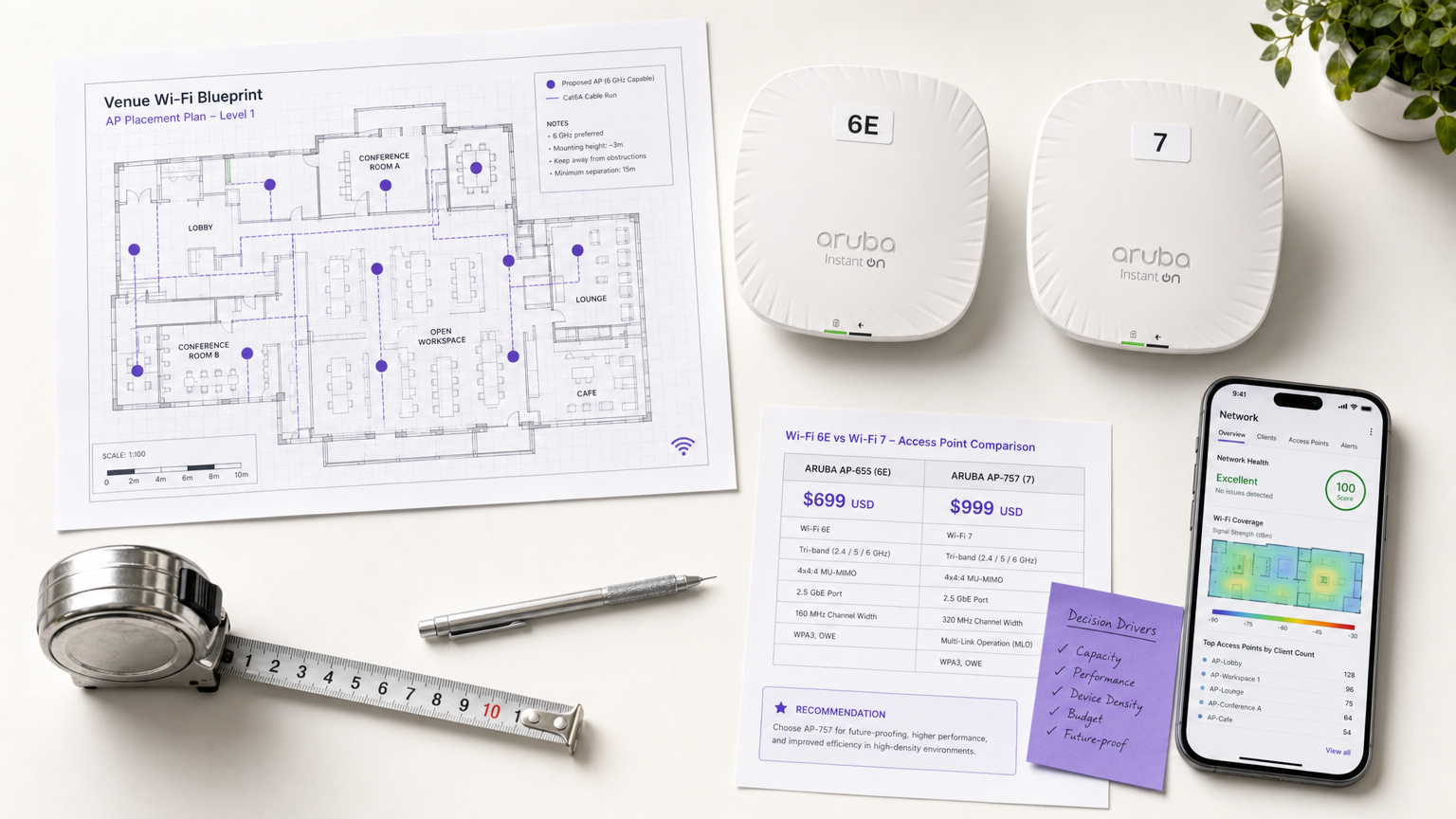
Résumé Exécutif
La transition du Wi-Fi 6E au Wi-Fi 7 (IEEE 802.11be) représente un changement fondamental dans la manière dont les réseaux sans fil d'entreprise gèrent la densité, la latence et le débit. Pour les directeurs informatiques et les architectes réseau planifiant une mise à jour matérielle en 2026, la décision n'est plus un simple calcul de bande passante — c'est une évaluation stratégique des dépenses d'investissement par rapport aux exigences opérationnelles des sites à forte densité. Alors que le Wi-Fi 6E a introduit la bande des 6 GHz, le Wi-Fi 7 l'exploite pleinement avec des canaux de 320 MHz, la modulation 4K QAM et l'opération multi-lien (MLO).
Ce guide fournit une analyse neutre des fournisseurs du paysage d'entreprise actuel, évaluant si le surcoût de 30 à 50 % pour les points d'accès Wi-Fi 7 est justifié pour les charges de travail typiques des sites dans les environnements Hôtellerie , Commerce de détail et du secteur public. En examinant la disponibilité matérielle actuelle, les matrices de prix et les calendriers de pénétration des clients, les leaders informatiques peuvent prendre des décisions d'investissement basées sur les données qui alignent les capacités de l'infrastructure avec les exigences commerciales au cours des 3 à 5 prochaines années.
Analyse Technique Détaillée : Wi-Fi 6E vs Wi-Fi 7
Les différences architecturales entre le Wi-Fi 6E et le Wi-Fi 7 vont bien au-delà du débit théorique maximal. Alors que le Wi-Fi 6E (IEEE 802.11ax) était une étape évolutive qui a ouvert le spectre des 6 GHz, le Wi-Fi 7 (IEEE 802.11be) est une refonte révolutionnaire axée sur la latence déterministe et le débit extrêmement élevé (EHT).
| Spécification | Wi-Fi 6E (802.11ax) | Wi-Fi 7 (802.11be) |
|---|---|---|
| Débit Théorique Max | 9.6 Gbps | 46 Gbps |
| Largeur de Canal Max | 160 MHz | 320 MHz |
| Modulation | 1024-QAM | 4096-QAM (4K QAM) |
| Opération Multi-Lien (MLO) | Non | Oui |
| Poinçonnement de Préambule | Basique | Amélioré |
| Bandes de Fréquence | 2.4 / 5 / 6 GHz | 2.4 / 5 / 6 GHz |
| Réseau de Collecte Recommandé | 2.5 GbE | 10 GbE |
| Exigence d'Alimentation | PoE+ (802.3at) | PoE++ (802.3bt) |
Le Paradigme du Spectre et de la Largeur de Canal
Le Wi-Fi 6E a introduit l'accès à la bande des 6 GHz, soulageant la congestion dans les espaces traditionnels de 2.4 GHz et 5 GHz. Cependant, il était limité à une largeur de canal maximale de 160 MHz. Le Wi-Fi 7 double cette capacité, prenant en charge des canaux de 320 MHz exclusivement dans la bande des 6 GHz. Cette expansion est essentielle pour les sites prenant en charge des applications à large bande passante telles que la réalité augmentée ou l'analyse en temps réel. Les canaux plus larges permettent des débits de données nettement plus élevés, doublant efficacement le plafond de capacité pour les appareils clients compatibles.
Opération Multi-Lien (MLO) : Le Facteur de Changement
L'avancée architecturale la plus significative du Wi-Fi 7 est l'Opération Multi-Lien (MLO). Dans les générations précédentes, y compris le Wi-Fi 6E, un appareil client ne pouvait se connecter à un point d'accès que sur une seule bande à la fois. Le MLO modifie fondamentalement cette contrainte en permettant aux appareils de transmettre et de recevoir des données simultanément sur plusieurs bandes et canaux.
Cette capacité offre deux avantages cruciaux pour les déploiements d'entreprise. Premièrement, elle améliore considérablement le débit agrégé en combinant la capacité de plusieurs bandes. Deuxièmement, et plus important pour les opérations sur site, elle réduit considérablement la latence et améliore la fiabilité. En équilibrant la charge du trafic sur les bandes disponibles, le MLO atténue l'impact des interférences transitoires sur une seule fréquence, garantissant des performances déterministes pour les applications sensibles à la latence comme la voix sur IP (VoIP) et les transactions de point de vente (POS) en temps réel. C'est la raison principale d'envisager le Wi-Fi 7 pour les environnements à forte densité et critiques sur le plan opérationnel.
Modulation, Poinçonnement et Efficacité
Le Wi-Fi 7 améliore le schéma de modulation de 1024-QAM à 4096-QAM (4K QAM), permettant à chaque symbole de transporter 12 bits de données au lieu de 10 — une augmentation de 20 % de l'efficacité de transmission. Bien que cela nécessite un rapport signal/bruit (SNR) élevé, généralement trouvé à proximité du point d'accès, cela améliore considérablement les performances dans les environnements à forte densité où les clients sont regroupés près de l'infrastructure, comme les salles de conférence ou les sièges de stade.
De plus, le Wi-Fi 7 introduit un poinçonnement de préambule amélioré. Dans le Wi-Fi 6E, si une partie d'un canal large subissait des interférences, l'ensemble du canal pouvait être déclassé. Le poinçonnement avancé du Wi-Fi 7 permet au point d'accès d'isoler le sous-canal spécifique affecté par les interférences tout en continuant à utiliser le spectre propre restant. Cette résilience est vitale dans les environnements RF complexes typiques des grands lieux publics.
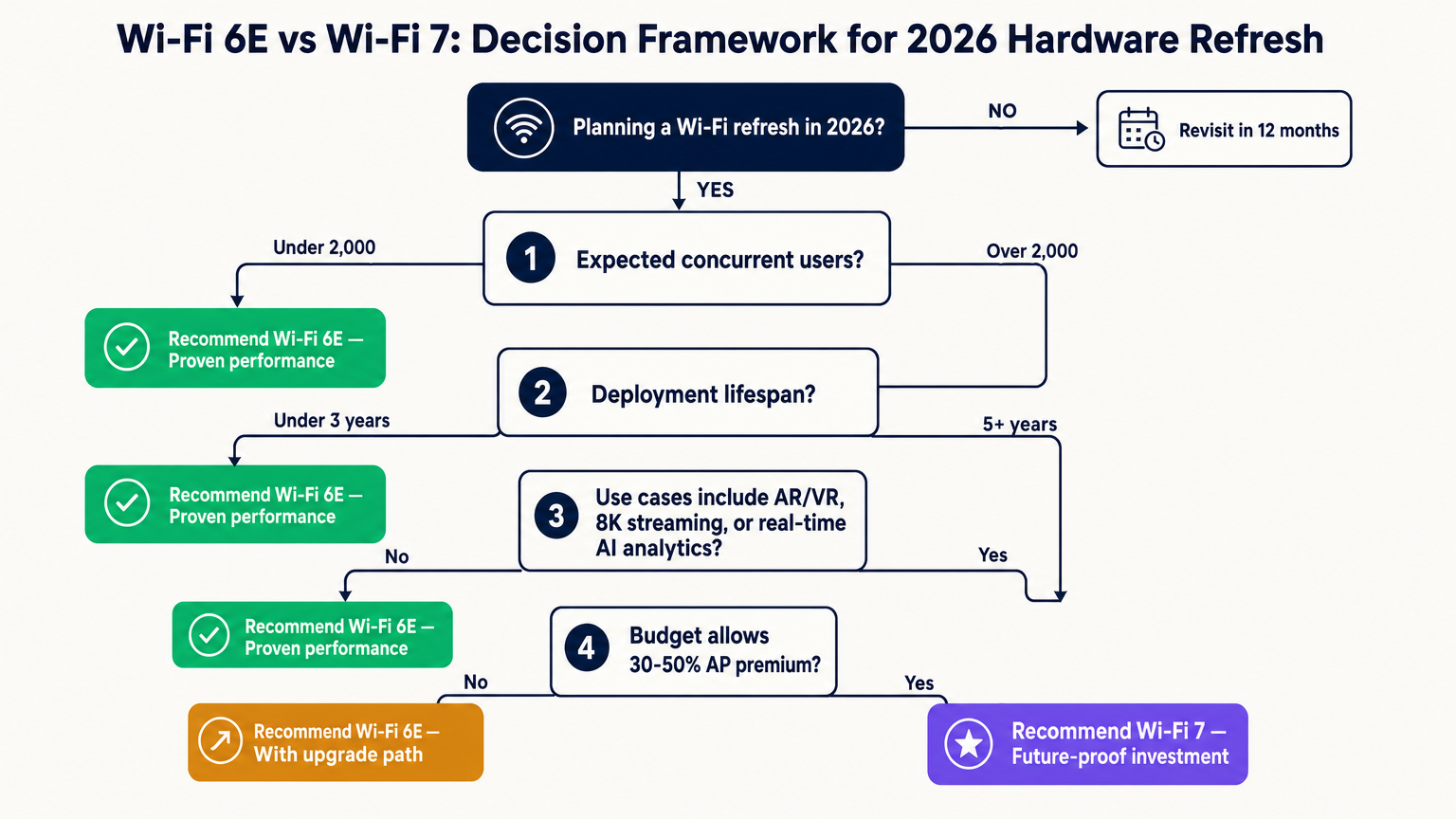
Guide d'Implémentation : Dimensionner la Décision d'Investissement 2026
Pour les directeurs informatiques évaluant une mise à jour matérielle en 2026, la décision entre le Wi-Fi 6E et le Wi-Fi 7 repose sur l'équilibre entre les dépenses d'investissement immédiates et les exigences opérationnelles à long terme. Le surcoût du prix de marché pour les points d'accès Wi-Fi 7 de qualité entreprise varie actuellement de 30 % à 50 % par rapport aux modèles Wi-Fi 6E comparables, bien qu'IDC rapporte une baisse de 38 % d'une année sur l'autre des prix des points d'accès Wi-Fi 7, indiquant que le marché mûrit rapidement.
Paysage des Fournisseurs et Aperçu des Prix
En avril 2026, les principaux fournisseurs d'entreprise ont lancé leurs points d'accès Wi-Fi 7 phares. Le tableau ci-dessous offre un aperçu actuel du marché pour les équipes informatiques effectuant des évaluations de fournisseurs.
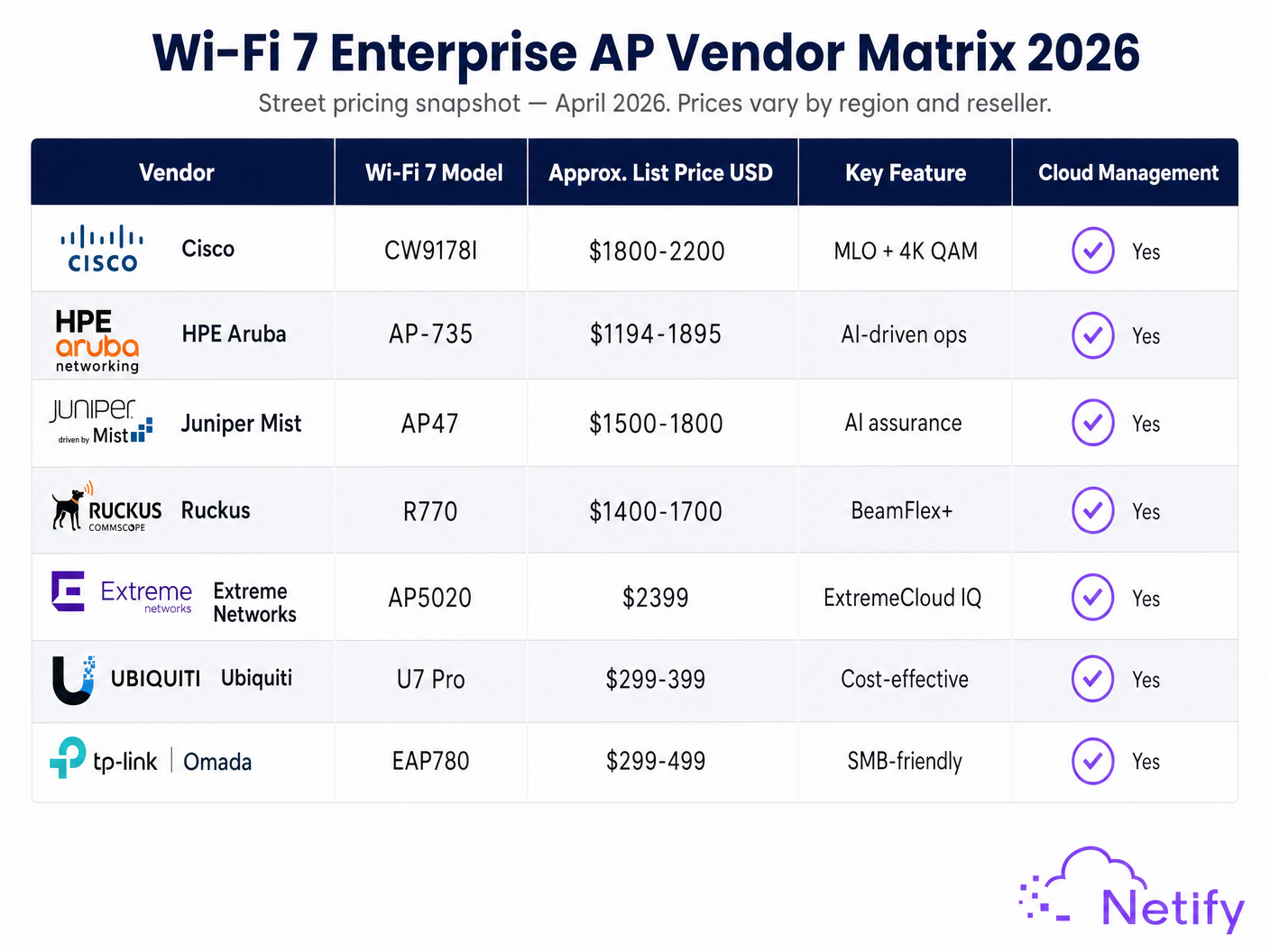
| Fournisseur | Modèle Wi-Fi 7 | Prix Public Approx. (USD) | Différenciateur Clé |
|---|---|---|---|
| Cisco | CW9178I | $1,800–$2,200 | MLO + 4K QAM, intégration Catalyst |
| HPE Aruba | AP-735 | $1,194–$1,895 | Opérations basées sur l'IA, cloud Central |
| Juniper Mist | AP47 | 1 500 $–1 800 $ | AI assurance, Mist AI |
| Ruckus | R770 | 1 400 $–1 700 $ | Antenne adaptative BeamFlex+ |
| Extreme Networks | AP5020 | ~2 399 $ | ExtremeCloud IQ |
| Ubiquiti | U7 Pro | 299 $–399 $ | Rentable, écosystème UniFi |
Aperçu des prix — avril 2026. Les prix de détail varient selon la région, le revendeur et le volume. Toujours valider par rapport aux prix actuels des distributeurs.
Lors de la budgétisation d'un déploiement Wi-Fi 7, les organisations doivent également tenir compte des mises à niveau nécessaires de l'infrastructure filaire. Les capacités de débit extrêmes du Wi-Fi 7 nécessitent une liaison dorsale multi-gigabit. Alors que les déploiements Wi-Fi 6E fonctionnent souvent confortablement sur des ports de commutateur 2.5 GbE, la pleine réalisation du potentiel d'un point d'accès Wi-Fi 7 4x4:4 exige des liaisons montantes 10 GbE et des budgets d'alimentation PoE++ (802.3bt). Ce coût de mise à niveau de l'infrastructure filaire doit être pris en compte dans la comparaison du coût total de possession.
Chronologie de la pénétration des appareils clients
Les mises à niveau de l'infrastructure doivent s'aligner sur les capacités des clients. En 2026, la pénétration des clients Wi-Fi 7 dans les environnements d'entreprise se situe entre 15 % et 20 %, tirée par les derniers smartphones phares (Samsung Galaxy S24 Ultra, série iPhone 16) et les ordinateurs portables haut de gamme. Cette pénétration devrait atteindre 40 à 50 % d'ici 2028. Pour les lieux qui privilégient les services Guest WiFi , la rétrocompatibilité du Wi-Fi 7 garantit que les appareils existants fonctionneront toujours, mais le retour sur investissement complet se matérialisera progressivement à mesure que le parc de clients se modernisera.
Bonnes pratiques pour les déploiements en site
Le déploiement d'une infrastructure sans fil de nouvelle génération exige une approche nuancée, adaptée aux exigences opérationnelles spécifiques du site. La nature agnostique du matériel de plateformes comme Purple garantit que les organisations peuvent tirer le maximum de valeur de leurs investissements réseau, quel que soit le fournisseur de points d'accès sous-jacent.
Environnements à haute densité : Stades et espaces événementiels
Pour les sites dépassant 5 000 utilisateurs simultanés, l'argument en faveur de l'abandon du Wi-Fi 6E pour passer directement au Wi-Fi 7 est convaincant. La combinaison de canaux de 320 MHz et de la 4K QAM offre la capacité nécessaire pour gérer des concentrations denses de clients. De plus, le MLO garantit que les opérations critiques du site — telles que la billetterie mobile et les applications de gestion de foule — maintiennent une faible latence même pendant les périodes de forte utilisation. Lors de la conception de ces environnements, les équipes informatiques devraient privilégier les points d'accès dotés de capacités avancées de gestion RF et d'antennes directionnelles. Le Internet of Things Architecture: A Complete Guide fournit un contexte supplémentaire sur la façon dont la densité des appareils IoT complexifie ces exigences.
Hôtellerie et centres de conférence
Dans le secteur de l' Hospitality , les exigences varient considérablement selon le type de propriété. Pour un hôtel standard de 200 chambres, un réseau Wi-Fi 6E bien conçu fournira une capacité suffisante pour le streaming des clients et les tâches opérationnelles standard jusqu'en 2028. Cependant, les grands hôtels de congrès et les centres de conférence dédiés devraient évaluer le Wi-Fi 7. La latence déterministe fournie par le MLO est cruciale pour prendre en charge des centaines de vidéoconférences simultanées et de présentations interactives. Pour les propriétés où le Guest WiFi est un service générateur de revenus, la capacité améliorée du Wi-Fi 7 prend également en charge des capacités de capture de données et de personnalisation plus sophistiquées, comme exploré dans notre guide sur AI in Guest WiFi: Personalisation, Engagement, and the GenAI Roadmap .
Commerce de détail et secteur public
Pour les environnements de Retail , le Wi-Fi 6E reste souvent la solution la plus rentable pour prendre en charge les systèmes de PDV standard, la gestion des stocks et les WiFi Analytics de base. Cependant, les magasins phares mettant en œuvre des technologies expérientielles avancées — telles que la visualisation de produits en RA ou l'analyse spatiale en temps réel — bénéficieront du débit et de l'efficacité accrus du Wi-Fi 7. Dans les déploiements du secteur public, tels que les bâtiments municipaux ou les pôles de Transport , le cycle de vie prolongé de l'investissement (souvent 7 à 10 ans) rend l'aspect pérenne du Wi-Fi 7 très attractif, malgré la prime de capex initiale. Les exigences de précision des technologies Indoor Positioning System: UWB, BLE, & WiFi Guide bénéficient également du plancher de latence plus bas que le Wi-Fi 7 offre.
Dépannage et atténuation des risques
La mise à niveau vers une nouvelle norme sans fil introduit des risques spécifiques qui doivent être gérés pendant la phase de déploiement.
La lacune de couverture 6 GHz
Un piège courant lors de la transition vers le Wi-Fi 6E ou le Wi-Fi 7 est de sous-estimer les caractéristiques de propagation de la bande 6 GHz. Les fréquences plus élevées s'atténuent plus rapidement à travers les obstacles physiques. Un remplacement un pour un des points d'accès 5 GHz existants entraînera probablement des lacunes de couverture 6 GHz. Les architectes réseau doivent effectuer des études de site prédictives et actives complètes, spécifiquement modélisées pour le spectre 6 GHz, nécessitant souvent une augmentation de 15 à 20 % de la densité totale des points d'accès pour obtenir une couverture omniprésente.
Goulots d'étranglement de l'alimentation et du backhaul
Le déploiement de points d'accès Wi-Fi 7 sur une infrastructure de commutation existante peut gravement limiter les performances. Si les commutateurs 10 GbE PoE++ ne sont pas inclus dans le budget actuel, les organisations doivent s'assurer que les points d'accès choisis peuvent fonctionner en mode dégradé sur le PoE+ (802.3at) standard jusqu'à ce que le réseau filaire soit mis à niveau. Cette approche progressive est viable mais doit être explicitement planifiée et communiquée aux parties prenantes pour gérer les attentes en matière de performances.
Intégration de la sécurité et de la conformité
Le Wi-Fi 6E et le Wi-Fi 7 exigent tous deux la sécurité WPA3, mais l'intégrationl'intégration de ces nouvelles normes avec les systèmes d'authentification d'entreprise existants (IEEE 802.1X) nécessite une planification minutieuse. Les organisations utilisant l'authentification basée sur des profils ou des services comme OpenRoaming doivent s'assurer que leurs fournisseurs d'identité et leur infrastructure RADIUS sont entièrement compatibles avec le nouveau matériel. Le rôle de Purple en tant que couche de gestion d'identité indépendante du matériel simplifie cette intégration, offrant une expérience d'authentification et de capture de données cohérente, quel que soit le fournisseur de point d'accès physique. Ceci est particulièrement pertinent pour la conformité PCI DSS 4.0 et GDPR, où la couche d'authentification et de traitement des données doit être manifestement sécurisée, quelle que soit la norme sans fil sous-jacente.
ROI et impact commercial
La mesure ultime d'une mise à niveau de l'infrastructure sans fil est son impact sur les opérations commerciales et l'expérience utilisateur. Lors de l'évaluation du ROI du Wi-Fi 7 par rapport au Wi-Fi 6E, les responsables informatiques devraient regarder au-delà des métriques de débit brutes et considérer les capacités opérationnelles que chaque norme permet.
Le succès doit être mesuré par des améliorations de l'efficacité opérationnelle et l'activation de nouveaux services générateurs de revenus. La latence réduite du Wi-Fi 7 peut directement améliorer la fiabilité des véhicules à guidage automatique (AGV) dans les entrepôts de vente au détail ou améliorer la précision des services de localisation en temps réel. Pour les opérateurs de sites, un réseau robuste et à haute capacité constitue la base de stratégies avancées d'engagement des invités. La capture de données de première partie et la fourniture d'expériences personnalisées à grande échelle nécessitent un réseau capable de gérer des flux de données complexes en temps réel sans compromettre l'expérience de connectivité de base.
Le calcul du coût total de possession doit englober non seulement le matériel des points d'accès, mais l'ensemble de la pile d'infrastructure : commutateurs, câblage, coûts d'étude de site et la plateforme de gestion continue. Les organisations qui alignent leur cycle de renouvellement matériel sur les objectifs stratégiques de l'entreprise — plutôt que de simplement courir après la dernière norme — obtiendront systématiquement le ROI le plus élevé de leurs investissements en infrastructure sans fil.
Termes clés et définitions
Multi-Link Operation (MLO)
A Wi-Fi 7 feature allowing devices to transmit and receive data simultaneously across multiple frequency bands (2.4, 5, and 6 GHz), aggregating bandwidth and improving reliability through load-balancing.
Critical for IT teams managing latency-sensitive applications like VoIP, real-time analytics, or POS transactions. MLO is the primary architectural differentiator between Wi-Fi 6E and Wi-Fi 7 for enterprise deployments.
4K QAM (4096-QAM)
An advanced modulation scheme in Wi-Fi 7 that encodes 12 bits of data per symbol, compared to 10 bits in Wi-Fi 6E's 1024-QAM, resulting in approximately 20% higher spectral efficiency.
Provides significant throughput gains in high-density areas where clients maintain a strong signal-to-noise ratio close to the access point, such as conference rooms or stadium seating bowls.
320 MHz Channels
Ultra-wide data channels available exclusively in the 6 GHz band under the Wi-Fi 7 standard, doubling the maximum channel width of Wi-Fi 6E (160 MHz) and significantly increasing peak throughput.
Essential for supporting extremely high-bandwidth applications like AR/VR or uncompressed 8K video streaming. In dense deployments, channel planning must balance width against reuse to avoid co-channel interference.
Preamble Puncturing
A technique allowing an access point to use a wide channel even if a portion of it is experiencing interference, by 'puncturing out' the noisy sub-channel while utilising the remaining clean spectrum.
Improves network resilience and spectral efficiency in complex, noisy RF environments typical of large public venues, stadiums, and dense urban deployments. Wi-Fi 7 offers an enhanced version of this capability.
Deterministic Latency
The ability of a network to guarantee data delivery within a specific, predictable timeframe, minimising jitter and packet delays regardless of network load.
A primary operational benefit of Wi-Fi 7's MLO. Critical for venue operations relying on real-time data flows, such as automated warehouse robotics, live event production systems, or contactless payment processing.
PoE++ (802.3bt)
Power over Ethernet standard capable of delivering up to 60W (Type 3) or 90W (Type 4) of power per port, enabling high-performance access points to operate all radios simultaneously.
Required by most enterprise Wi-Fi 7 access points to operate at full capacity. Standard PoE+ (802.3at, 30W) is often insufficient, meaning switch infrastructure upgrades must be budgeted alongside AP replacements.
WPA3-Enterprise
The mandatory security protocol for Wi-Fi 6E and Wi-Fi 7 networks, providing robust 192-bit encryption and mutual authentication via IEEE 802.1X and a RADIUS server.
Ensures compliance with stringent data security standards including PCI DSS 4.0 and GDPR. Both Wi-Fi 6E and Wi-Fi 7 mandate WPA3, but IT teams must verify RADIUS infrastructure compatibility during any hardware refresh.
OpenRoaming
A Wi-Fi federation standard allowing seamless, secure device onboarding across participating networks using profile-based authentication, eliminating manual login portals for enrolled users.
Enhances the user experience in public venues and transport hubs. Platforms like Purple provide the identity management layer to facilitate OpenRoaming across any hardware vendor, independent of the underlying Wi-Fi standard.
Études de cas
A 400-room convention hotel is planning a complete network overhaul in Q3 2026. The property includes a 10,000 sq ft main ballroom and 15 smaller breakout rooms. The current infrastructure is Wi-Fi 5 (802.11ac) and the deployment must last 6 years. The IT Director has a strict capex budget but needs to support dense conference traffic of up to 3,000 simultaneous users in the ballroom.
Deploy a hybrid architecture. Utilise Wi-Fi 7 access points (e.g., HPE Aruba AP-735 or Cisco CW9178I) exclusively in the main ballroom and high-density breakout rooms where MLO and 4K QAM will directly benefit dense delegate populations. For the guest room corridors and standard amenities, deploy cost-effective Wi-Fi 6E access points. Ensure the core and distribution switches serving the conference areas are upgraded to support 10 GbE and PoE++ to prevent backhaul bottlenecks. Conduct a dedicated 6 GHz predictive site survey for the ballroom, expecting approximately 20% more APs than a legacy 5 GHz design would suggest. Implement WPA3-Enterprise with IEEE 802.1X for the corporate SSID and a captive portal solution for guest access.
A national retail chain is refreshing the network infrastructure across 50 mid-sized stores (approximately 15,000 sq ft each). The primary use cases are standard POS operations, employee inventory tablets, and basic guest Wi-Fi. The business plans to pilot AR-based product visualisation in 3 flagship locations next year. The IT team is debating a uniform Wi-Fi 7 rollout across all 50 stores.
Standardise on Wi-Fi 6E for the 47 standard locations. The 160 MHz channels and 6 GHz spectrum access provide more than enough capacity for standard retail operations and guest access, offering significant cost savings over Wi-Fi 7. For the 3 flagship locations, deploy Wi-Fi 7 infrastructure to support the high-bandwidth, low-latency requirements of the upcoming AR pilot. Ensure the flagship stores have 10 GbE switch infrastructure in place before the Wi-Fi 7 deployment. Implement a unified management platform that can handle both 6E and 7 APs to simplify operations. Leverage WiFi Analytics across all locations to capture footfall and dwell time data for marketing purposes.
Analyse de scénario
Q1. A municipal government is upgrading the public Wi-Fi in a busy transport hub. The deployment must last 7 years. The current switch infrastructure supports 2.5 GbE and PoE+ (802.3at). The IT team is debating between high-end Wi-Fi 6E and entry-level Wi-Fi 7 access points. What is the primary constraint they must address before committing to Wi-Fi 7?
💡 Astuce :Consider the power and data throughput requirements of Wi-Fi 7 access points relative to the existing wired infrastructure.
Afficher l'approche recommandée
The primary constraint is the existing switch infrastructure. Wi-Fi 7 access points typically require PoE++ (802.3bt) to power all radios simultaneously and benefit from 10 GbE uplinks to avoid backhaul bottlenecks. Deploying Wi-Fi 7 on the current 2.5 GbE/PoE+ switches will likely force the APs into a degraded mode, negating the benefits of the investment. The team must either allocate budget to upgrade the edge switches alongside the APs, or accept that Wi-Fi 6E is the optimal choice for their current wired constraints. Given the 7-year lifespan, a phased approach — deploying Wi-Fi 7 APs now but upgrading switches within 12 months — is a viable compromise.
Q2. A stadium IT director is planning a network refresh for a 60,000-seat venue. They are evaluating Wi-Fi 6E versus Wi-Fi 7. Which specific Wi-Fi 7 feature provides the most compelling operational advantage for this high-density environment, and why?
💡 Astuce :Focus on the feature that improves reliability and latency by utilising multiple frequency bands simultaneously, rather than simply increasing peak throughput.
Afficher l'approche recommandée
Multi-Link Operation (MLO) is the most compelling feature for a stadium environment. In a dense venue with significant RF noise and transient interference from 60,000 devices, MLO allows client devices to transmit and receive across multiple bands simultaneously. This load-balancing significantly reduces latency and ensures deterministic performance for critical venue operations like mobile ticketing, contactless payments, and point-of-sale transactions — even during peak utilisation. The reliability improvement from MLO is operationally more significant than the raw throughput increase, as it prevents the service degradation that can occur when a single band becomes congested.
Q3. When transitioning a retail chain from legacy 5 GHz Wi-Fi 5 access points to a new 6 GHz-capable standard (either 6E or 7), what critical design adjustment must the network architect make regarding access point placement, and what is the typical impact on AP count?
💡 Astuce :Consider the physical propagation characteristics of higher frequency RF signals and how they interact with typical retail store construction materials.
Afficher l'approche recommandée
The architect must increase the density of access points. The 6 GHz band used by both Wi-Fi 6E and Wi-Fi 7 attenuates more rapidly through physical obstacles — walls, shelving units, and structural elements — compared to 5 GHz. A one-to-one replacement of the legacy APs in the same locations will result in 6 GHz coverage gaps. A new predictive site survey modelled specifically for 6 GHz propagation is mandatory, and IT teams should budget for a 15–20% increase in the total number of access points to achieve seamless coverage equivalent to the legacy 5 GHz design.




