

Wi-Fi 6E vs Wi-Fi 7: ¿Debería omitir el 6E e ir directamente al 7?
Una guía de decisión exhaustiva para directores de TI y arquitectos de red que evalúan una actualización de hardware inalámbrico en 2026. Ofrece una comparación técnica de Wi-Fi 6E y Wi-Fi 7, una matriz de precios de proveedores actual y recomendaciones de implementación prácticas para espacios de alta densidad en los sectores de hostelería, comercio minorista y público — ayudando a los equipos a determinar si el coste adicional de Wi-Fi 7 está justificado para sus requisitos operativos específicos.
🎧 Escuchar esta guía
Ver transcripción
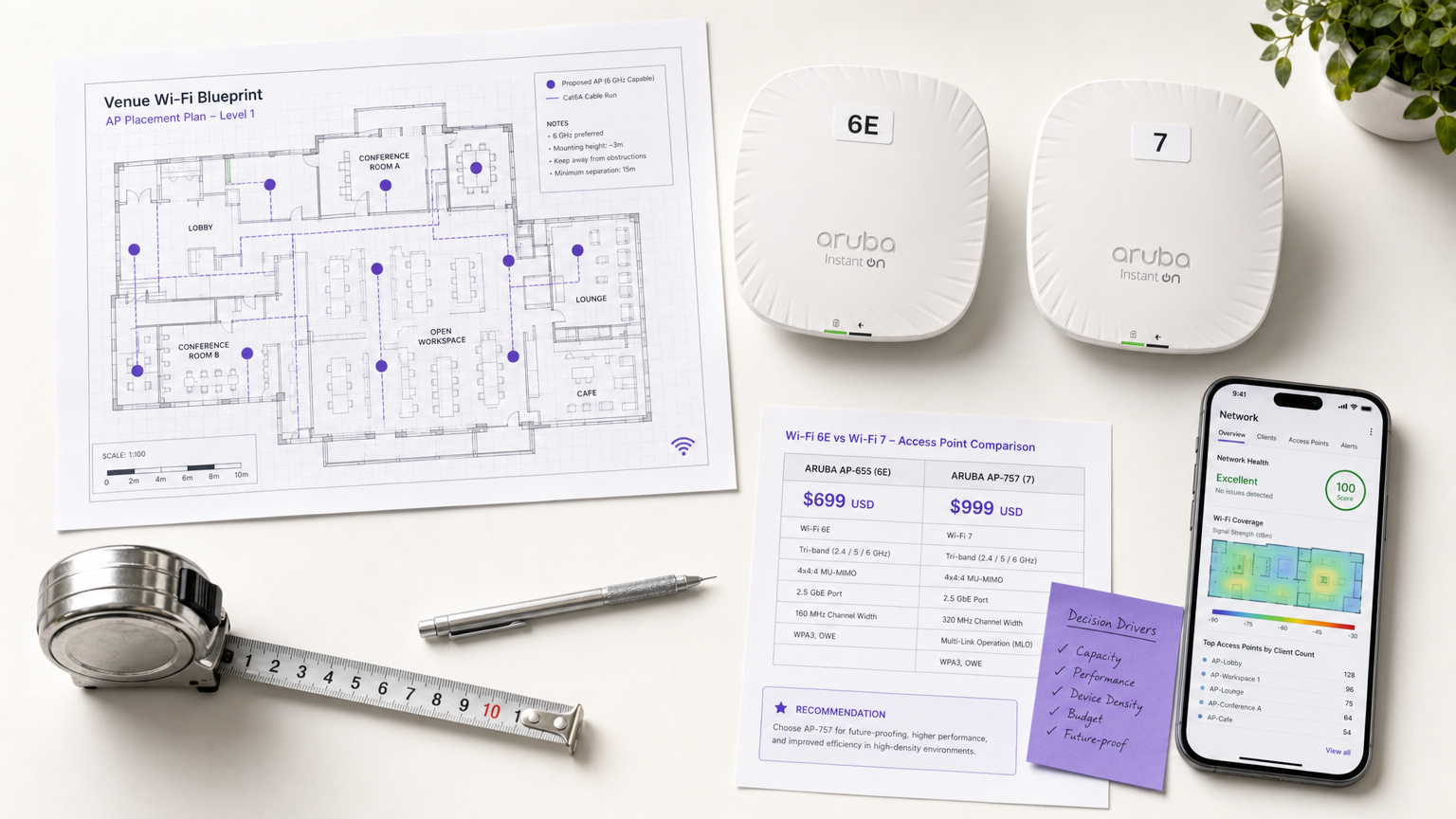
Resumen Ejecutivo
La transición de Wi-Fi 6E a Wi-Fi 7 (IEEE 802.11be) representa un cambio fundamental en cómo las redes inalámbricas empresariales gestionan la densidad, la latencia y el rendimiento. Para los directores de TI y arquitectos de red que planifican una actualización de hardware en 2026, la decisión ya no es un simple cálculo de ancho de banda, sino una evaluación estratégica del gasto de capital frente a las demandas operativas de los espacios de alta densidad. Mientras que Wi-Fi 6E introdujo la banda de 6 GHz, Wi-Fi 7 la explota completamente con canales de 320 MHz, modulación 4K QAM y Multi-Link Operation (MLO).
Esta guía proporciona un análisis neutral de proveedores del panorama empresarial actual, evaluando si el sobreprecio del 30-50% para los puntos de acceso Wi-Fi 7 está justificado para las cargas de trabajo típicas de los espacios en entornos de Hostelería , Comercio minorista y sector público. Al examinar la disponibilidad actual de hardware, las matrices de precios y los plazos de penetración de clientes, los líderes de TI pueden tomar decisiones de gasto de capital basadas en datos que alineen las capacidades de la infraestructura con los requisitos del negocio durante los próximos 3 a 5 años.
Análisis Técnico Detallado: Wi-Fi 6E vs Wi-Fi 7
Las diferencias arquitectónicas entre Wi-Fi 6E y Wi-Fi 7 van mucho más allá del rendimiento teórico máximo. Mientras que Wi-Fi 6E (IEEE 802.11ax) fue un paso evolutivo que abrió el espectro de 6 GHz, Wi-Fi 7 (IEEE 802.11be) es un rediseño revolucionario centrado en la latencia determinista y un rendimiento extremadamente alto (EHT).
| Especificación | Wi-Fi 6E (802.11ax) | Wi-Fi 7 (802.11be) |
|---|---|---|
| Rendimiento Teórico Máximo | 9.6 Gbps | 46 Gbps |
| Ancho de Canal Máximo | 160 MHz | 320 MHz |
| Modulación | 1024-QAM | 4096-QAM (4K QAM) |
| Multi-Link Operation (MLO) | No | Sí |
| Preamble Puncturing | Básico | Mejorado |
| Bandas de Frecuencia | 2.4 / 5 / 6 GHz | 2.4 / 5 / 6 GHz |
| Backhaul Recomendado | 2.5 GbE | 10 GbE |
| Requisito de Alimentación | PoE+ (802.3at) | PoE++ (802.3bt) |
El Paradigma del Espectro y el Ancho de Canal
Wi-Fi 6E introdujo el acceso a la banda de 6 GHz, aliviando la congestión en los espacios tradicionales de 2.4 GHz y 5 GHz. Sin embargo, estaba limitado a un ancho de canal máximo de 160 MHz. Wi-Fi 7 duplica esta capacidad, soportando canales de 320 MHz exclusivamente en la banda de 6 GHz. Esta expansión es fundamental para espacios que soportan aplicaciones de alto ancho de banda, como la realidad aumentada o el análisis en tiempo real. Los canales más anchos permiten velocidades de datos significativamente más altas, duplicando efectivamente el límite de capacidad para dispositivos cliente compatibles.
Multi-Link Operation (MLO): El Elemento Revolucionario
El avance arquitectónico más significativo en Wi-Fi 7 es Multi-Link Operation (MLO). En generaciones anteriores, incluyendo Wi-Fi 6E, un dispositivo cliente solo podía conectarse a un punto de acceso en una única banda en un momento dado. MLO altera fundamentalmente esta restricción al permitir que los dispositivos transmitan y reciban datos simultáneamente a través de múltiples bandas y canales.
Esta capacidad ofrece dos ventajas críticas para las implementaciones empresariales. Primero, mejora drásticamente el rendimiento agregado al combinar la capacidad de múltiples bandas. Segundo, y más importante para las operaciones en espacios, reduce significativamente la latencia y mejora la fiabilidad. Al equilibrar la carga del tráfico entre las bandas disponibles, MLO mitiga el impacto de las interferencias transitorias en cualquier frecuencia única, asegurando un rendimiento determinista para aplicaciones sensibles a la latencia como voz sobre IP (VoIP) y transacciones de punto de venta (POS) en tiempo real. Esta es la razón principal para considerar Wi-Fi 7 en entornos de alta densidad y críticamente operativos.
Modulación, Puncturing y Eficiencia
Wi-Fi 7 actualiza el esquema de modulación de 1024-QAM a 4096-QAM (4K QAM), permitiendo que cada símbolo transporte 12 bits de datos en lugar de 10, un aumento del 20% en la eficiencia de transmisión. Aunque esto requiere una alta relación señal/ruido (SNR) que se encuentra típicamente cerca del punto de acceso, aumenta significativamente el rendimiento en entornos de alta densidad donde los clientes están agrupados cerca de la infraestructura, como salas de conferencias o asientos de estadio.
Además, Wi-Fi 7 introduce el preamble puncturing mejorado. En Wi-Fi 6E, si una parte de un canal ancho experimentaba interferencias, todo el canal podría degradarse. El puncturing avanzado de Wi-Fi 7 permite al punto de acceso aislar el subcanal específico afectado por la interferencia mientras continúa utilizando el espectro limpio restante. Esta resiliencia es vital en entornos de RF complejos, típicos de grandes espacios públicos.
Guía de Implementación: Dimensionando la Decisión de Gasto de Capital para 2026
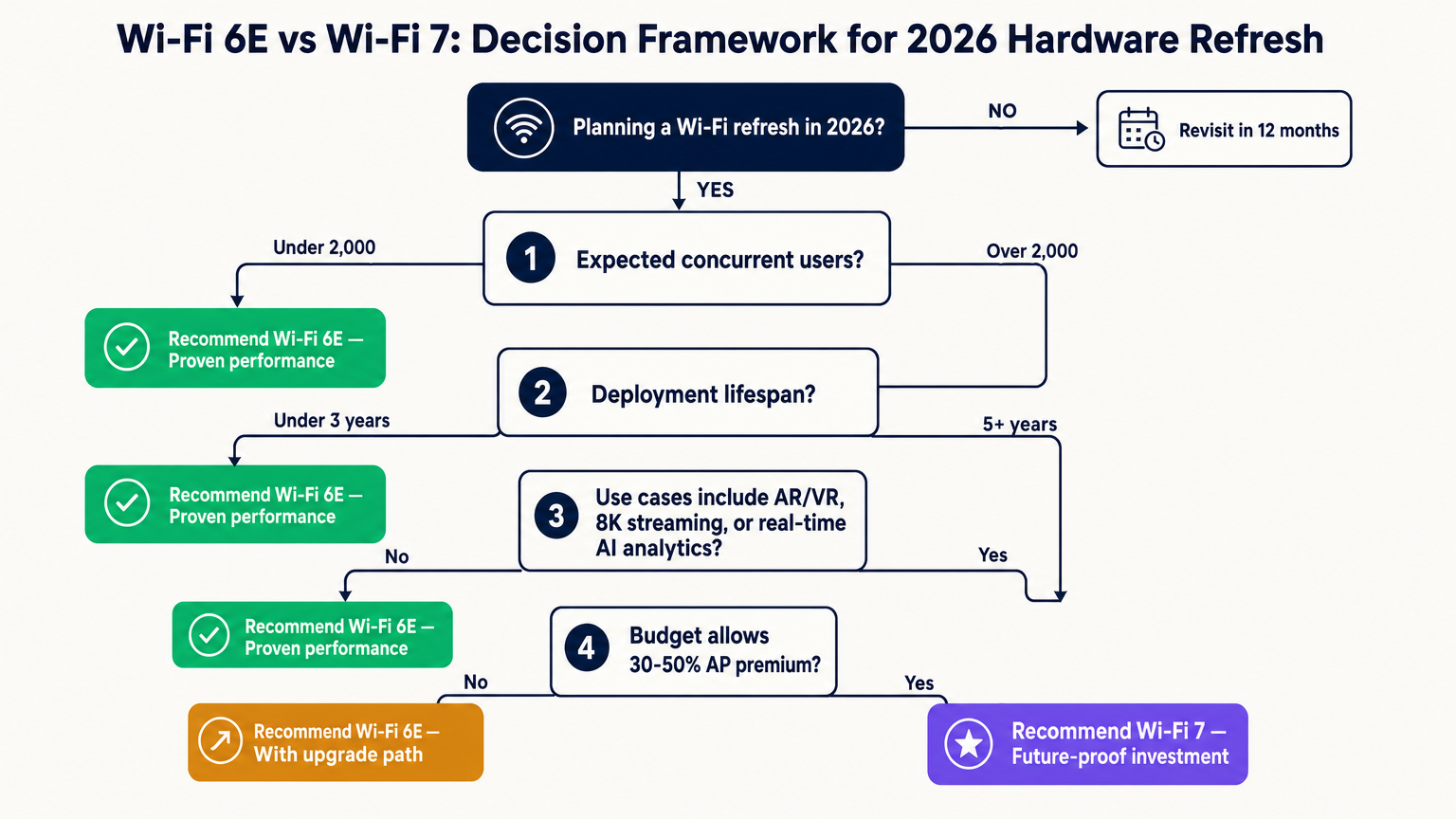
Para los directores de TI que evalúan una actualización de hardware en 2026, la decisión entre Wi-Fi 6E y Wi-Fi 7 depende de equilibrar el gasto de capital inmediato con los requisitos operativos a largo plazo. El sobreprecio en el mercado para los puntos de acceso Wi-Fi 7 de grado empresarial oscila actualmente entre el 30% y el 50% respecto a los modelos Wi-Fi 6E comparables, aunque IDC informa de una caída interanual del 38% en los precios de los AP Wi-Fi 7, lo que indica que el mercado está madurando rápidamente.
Panorama de Proveedores y Resumen de Precios
A partir de abril de 2026, los principales proveedores empresariales han lanzado sus puntos de acceso Wi-Fi 7 insignia. La siguiente tabla proporciona una instantánea actual del mercado para los equipos de TI que realizan evaluaciones de proveedores.
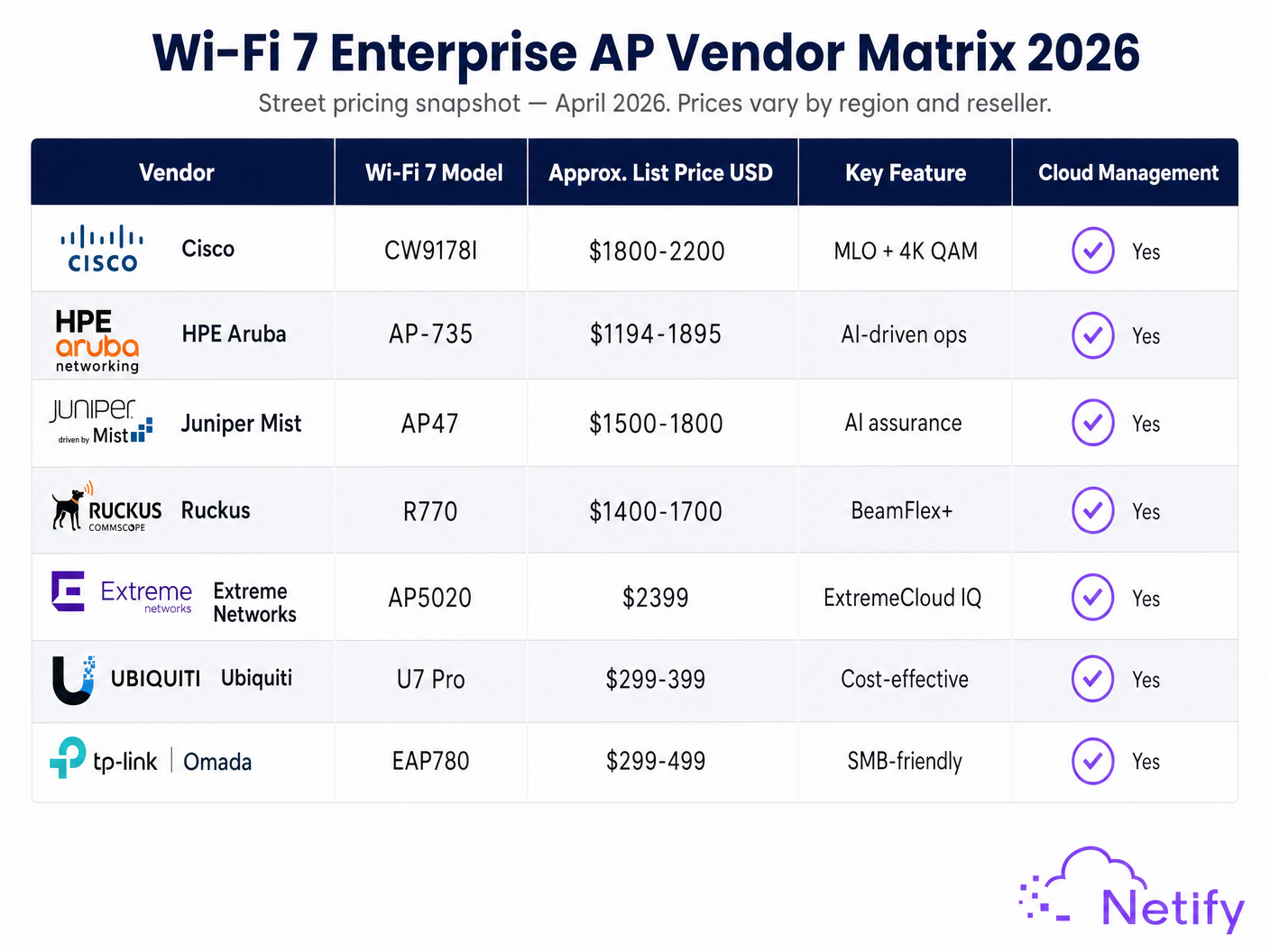
| Proveedor | Modelo Wi-Fi 7 | Precio Aprox. en el Mercado (USD) | Diferenciador Clave |
|---|---|---|---|
| Cisco | CW9178I | $1,800–$2,200 | MLO + 4K QAM, integración con Catalyst |
| HPE Aruba | AP-735 | $1,194–$1,895 | Operaciones impulsadas por IA, nube Central |
| Juniper Mist | AP47 | $1,500–$1,800 | Garantía de IA, Mist AI |
| Ruckus | R770 | $1,400–$1,700 | Antena adaptativa BeamFlex+ |
| Extreme Networks | AP5020 | ~$2,399 | ExtremeCloud IQ |
| Ubiquiti | U7 Pro | $299–$399 | Rentable, ecosistema UniFi |
Precios de referencia — abril de 2026. Los precios de mercado varían según la región, el distribuidor y el volumen. Valide siempre con los precios actuales del distribuidor.
Al presupuestar una implementación de Wi-Fi 7, las organizaciones también deben tener en cuenta las actualizaciones necesarias de la infraestructura cableada. Las capacidades de rendimiento extremo de Wi-Fi 7 requieren un backhaul multigigabit. Mientras que las implementaciones de Wi-Fi 6E a menudo operan cómodamente en puertos de switch de 2,5 GbE, para aprovechar todo el potencial de un punto de acceso Wi-Fi 7 4x4:4 se requieren enlaces ascendentes de 10 GbE y presupuestos de energía PoE++ (802.3bt). Este coste de actualización de la infraestructura cableada debe tenerse en cuenta en la comparación del coste total de propiedad.
Cronograma de penetración de dispositivos cliente
Las actualizaciones de infraestructura deben alinearse con las capacidades del cliente. En 2026, la penetración de clientes Wi-Fi 7 en entornos empresariales se sitúa entre el 15% y el 20%, impulsada por los últimos smartphones insignia (Samsung Galaxy S24 Ultra, serie iPhone 16) y portátiles de gama alta. Se prevé que esta penetración alcance el 40-50% para 2028. Para los recintos que priorizan los servicios de Guest WiFi , la compatibilidad con versiones anteriores de Wi-Fi 7 garantiza que los dispositivos heredados seguirán funcionando, pero el retorno de la inversión completo se materializará progresivamente a medida que la combinación de clientes se modernice.
Mejores prácticas para implementaciones en recintos
La implementación de infraestructura inalámbrica de próxima generación requiere un enfoque matizado y adaptado a las demandas operativas específicas del recinto. La naturaleza agnóstica del hardware de plataformas como Purple garantiza que las organizaciones puedan extraer el máximo valor de sus inversiones en red, independientemente del proveedor de puntos de acceso subyacente.
Entornos de alta densidad: Estadios y espacios para eventos
Para recintos que superan los 5.000 usuarios concurrentes, el argumento para omitir Wi-Fi 6E y pasar directamente a Wi-Fi 7 es convincente. La combinación de canales de 320 MHz y 4K QAM proporciona la capacidad necesaria para manejar concentraciones densas de clientes. Además, MLO garantiza que las operaciones críticas del recinto —como la emisión de entradas móviles y las aplicaciones de gestión de multitudes— mantengan una baja latencia incluso durante la utilización máxima. Al diseñar para estos entornos, los equipos de TI deben priorizar los puntos de acceso con gestión de RF avanzada y capacidades de antena direccional. La Arquitectura del Internet de las Cosas: Una Guía Completa proporciona contexto adicional sobre cómo la densidad de dispositivos IoT agrava estos requisitos.
Hotelería y centros de conferencias
En el sector de la Hotelería , los requisitos varían significativamente según el tipo de propiedad. Para un hotel estándar de 200 habitaciones, una red Wi-Fi 6E bien diseñada proporcionará capacidad suficiente para el streaming de invitados y las tareas operativas estándar hasta bien entrado 2028. Sin embargo, los grandes hoteles de convenciones y los centros de conferencias dedicados deberían evaluar Wi-Fi 7. La latencia determinista proporcionada por MLO es crucial para soportar cientos de videoconferencias y presentaciones interactivas simultáneas. Para propiedades donde Guest WiFi es un servicio generador de ingresos, la capacidad mejorada de Wi-Fi 7 también soporta capacidades más sofisticadas de captura de datos y personalización, como se explora en nuestra guía sobre IA en Guest WiFi: Personalización, Engagement y la Hoja de Ruta GenAI .
Comercio minorista y sector público
Para entornos de Comercio minorista , Wi-Fi 6E a menudo sigue siendo la solución más rentable para soportar sistemas POS estándar, gestión de inventario y WiFi Analytics básicos. Sin embargo, las tiendas insignia que implementan tecnologías experienciales avanzadas —como la visualización de productos con RA o el análisis espacial en tiempo real— se beneficiarán del mayor rendimiento y eficiencia de Wi-Fi 7. En implementaciones del sector público, como edificios municipales o centros de Transporte , el ciclo de vida extendido de la inversión (a menudo de 7 a 10 años) hace que el aspecto de preparación para el futuro de Wi-Fi 7 sea muy atractivo, a pesar de la prima de capex inicial. Los requisitos de precisión de las tecnologías de Sistema de Posicionamiento Interior: UWB, BLE y Guía WiFi también se benefician del menor umbral de latencia que proporciona Wi-Fi 7.
Resolución de problemas y mitigación de riesgos
La actualización a un nuevo estándar inalámbrico introduce riesgos específicos que deben gestionarse durante la fase de implementación.
La brecha de cobertura de 6 GHz
Un error común al hacer la transición a Wi-Fi 6E o Wi-Fi 7 es subestimar las características de propagación de la banda de 6 GHz. Las frecuencias más altas se atenúan más rápidamente a través de obstáculos físicos. Un reemplazo uno a uno de los puntos de acceso de 5 GHz heredados probablemente resultará en brechas de cobertura de 6 GHz. Los arquitectos de red deben realizar encuestas de sitio predictivas y activas exhaustivas, modeladas específicamente para el espectro de 6 GHz, lo que a menudo requiere un aumento del 15-20% en la densidad total de puntos de acceso para lograr una cobertura ubicua.
Cuellos de botella de energía y backhaul
La implementación de puntos de acceso Wi-Fi 7 en infraestructura de switching heredada puede estrangular gravemente el rendimiento. Si los switches 10 GbE PoE++ no están dentro del presupuesto actual, las organizaciones deben asegurarse de que los puntos de acceso elegidos puedan operar en un modo degradado con PoE+ estándar (802.3at) hasta que se actualice la red cableada. Este enfoque por fases es viable, pero debe planificarse y comunicarse explícitamente a las partes interesadas para gestionar las expectativas de rendimiento.
Integración de seguridad y cumplimiento
Tanto Wi-Fi 6E como Wi-Fi 7 exigen seguridad WPA3, pero la integraciónestos nuevos estándares con los sistemas de autenticación empresariales existentes (IEEE 802.1X) requiere una planificación cuidadosa. Las organizaciones que utilizan autenticación basada en perfiles o servicios como OpenRoaming deben asegurarse de que sus proveedores de identidad y su infraestructura RADIUS sean totalmente compatibles con el nuevo hardware. El papel de Purple como capa de gestión de identidad agnóstica al hardware simplifica esta integración, proporcionando una experiencia consistente de autenticación y captura de datos, independientemente del proveedor del punto de acceso físico. Esto es particularmente relevante para el cumplimiento de PCI DSS 4.0 y GDPR, donde la capa de autenticación y manejo de datos debe ser demostrablemente segura, independientemente del estándar inalámbrico subyacente.
ROI e Impacto Empresarial
La medida definitiva de una actualización de infraestructura inalámbrica es su impacto en las operaciones empresariales y la experiencia del usuario. Al evaluar el ROI de Wi-Fi 7 frente a Wi-Fi 6E, los líderes de TI deben ir más allá de las métricas de rendimiento bruto y considerar las capacidades operativas que cada estándar permite.
El éxito debe medirse por las mejoras en la eficiencia operativa y la habilitación de nuevos servicios generadores de ingresos. La latencia reducida de Wi-Fi 7 puede mejorar directamente la fiabilidad de los vehículos guiados automatizados (AGV) en almacenes minoristas o aumentar la precisión de los servicios de localización en tiempo real. Para los operadores de recintos, una red robusta y de alta capacidad constituye la base para estrategias avanzadas de interacción con los invitados. La captura de datos de primera parte y la entrega de experiencias personalizadas a escala requiere una red capaz de manejar flujos de datos complejos y en tiempo real sin comprometer la experiencia de conectividad central.
El cálculo del coste total de propiedad debe abarcar no solo el hardware del punto de acceso, sino la pila completa de infraestructura: conmutadores, cableado, costes de estudio de sitio y la plataforma de gestión continua. Las organizaciones que alinean su ciclo de actualización de hardware con los objetivos estratégicos del negocio —en lugar de simplemente perseguir el último estándar— lograrán consistentemente el ROI más sólido de sus inversiones en infraestructura inalámbrica.
Términos clave y definiciones
Multi-Link Operation (MLO)
A Wi-Fi 7 feature allowing devices to transmit and receive data simultaneously across multiple frequency bands (2.4, 5, and 6 GHz), aggregating bandwidth and improving reliability through load-balancing.
Critical for IT teams managing latency-sensitive applications like VoIP, real-time analytics, or POS transactions. MLO is the primary architectural differentiator between Wi-Fi 6E and Wi-Fi 7 for enterprise deployments.
4K QAM (4096-QAM)
An advanced modulation scheme in Wi-Fi 7 that encodes 12 bits of data per symbol, compared to 10 bits in Wi-Fi 6E's 1024-QAM, resulting in approximately 20% higher spectral efficiency.
Provides significant throughput gains in high-density areas where clients maintain a strong signal-to-noise ratio close to the access point, such as conference rooms or stadium seating bowls.
320 MHz Channels
Ultra-wide data channels available exclusively in the 6 GHz band under the Wi-Fi 7 standard, doubling the maximum channel width of Wi-Fi 6E (160 MHz) and significantly increasing peak throughput.
Essential for supporting extremely high-bandwidth applications like AR/VR or uncompressed 8K video streaming. In dense deployments, channel planning must balance width against reuse to avoid co-channel interference.
Preamble Puncturing
A technique allowing an access point to use a wide channel even if a portion of it is experiencing interference, by 'puncturing out' the noisy sub-channel while utilising the remaining clean spectrum.
Improves network resilience and spectral efficiency in complex, noisy RF environments typical of large public venues, stadiums, and dense urban deployments. Wi-Fi 7 offers an enhanced version of this capability.
Deterministic Latency
The ability of a network to guarantee data delivery within a specific, predictable timeframe, minimising jitter and packet delays regardless of network load.
A primary operational benefit of Wi-Fi 7's MLO. Critical for venue operations relying on real-time data flows, such as automated warehouse robotics, live event production systems, or contactless payment processing.
PoE++ (802.3bt)
Power over Ethernet standard capable of delivering up to 60W (Type 3) or 90W (Type 4) of power per port, enabling high-performance access points to operate all radios simultaneously.
Required by most enterprise Wi-Fi 7 access points to operate at full capacity. Standard PoE+ (802.3at, 30W) is often insufficient, meaning switch infrastructure upgrades must be budgeted alongside AP replacements.
WPA3-Enterprise
The mandatory security protocol for Wi-Fi 6E and Wi-Fi 7 networks, providing robust 192-bit encryption and mutual authentication via IEEE 802.1X and a RADIUS server.
Ensures compliance with stringent data security standards including PCI DSS 4.0 and GDPR. Both Wi-Fi 6E and Wi-Fi 7 mandate WPA3, but IT teams must verify RADIUS infrastructure compatibility during any hardware refresh.
OpenRoaming
A Wi-Fi federation standard allowing seamless, secure device onboarding across participating networks using profile-based authentication, eliminating manual login portals for enrolled users.
Enhances the user experience in public venues and transport hubs. Platforms like Purple provide the identity management layer to facilitate OpenRoaming across any hardware vendor, independent of the underlying Wi-Fi standard.
Casos de éxito
A 400-room convention hotel is planning a complete network overhaul in Q3 2026. The property includes a 10,000 sq ft main ballroom and 15 smaller breakout rooms. The current infrastructure is Wi-Fi 5 (802.11ac) and the deployment must last 6 years. The IT Director has a strict capex budget but needs to support dense conference traffic of up to 3,000 simultaneous users in the ballroom.
Deploy a hybrid architecture. Utilise Wi-Fi 7 access points (e.g., HPE Aruba AP-735 or Cisco CW9178I) exclusively in the main ballroom and high-density breakout rooms where MLO and 4K QAM will directly benefit dense delegate populations. For the guest room corridors and standard amenities, deploy cost-effective Wi-Fi 6E access points. Ensure the core and distribution switches serving the conference areas are upgraded to support 10 GbE and PoE++ to prevent backhaul bottlenecks. Conduct a dedicated 6 GHz predictive site survey for the ballroom, expecting approximately 20% more APs than a legacy 5 GHz design would suggest. Implement WPA3-Enterprise with IEEE 802.1X for the corporate SSID and a captive portal solution for guest access.
A national retail chain is refreshing the network infrastructure across 50 mid-sized stores (approximately 15,000 sq ft each). The primary use cases are standard POS operations, employee inventory tablets, and basic guest Wi-Fi. The business plans to pilot AR-based product visualisation in 3 flagship locations next year. The IT team is debating a uniform Wi-Fi 7 rollout across all 50 stores.
Standardise on Wi-Fi 6E for the 47 standard locations. The 160 MHz channels and 6 GHz spectrum access provide more than enough capacity for standard retail operations and guest access, offering significant cost savings over Wi-Fi 7. For the 3 flagship locations, deploy Wi-Fi 7 infrastructure to support the high-bandwidth, low-latency requirements of the upcoming AR pilot. Ensure the flagship stores have 10 GbE switch infrastructure in place before the Wi-Fi 7 deployment. Implement a unified management platform that can handle both 6E and 7 APs to simplify operations. Leverage WiFi Analytics across all locations to capture footfall and dwell time data for marketing purposes.
Análisis de escenarios
Q1. A municipal government is upgrading the public Wi-Fi in a busy transport hub. The deployment must last 7 years. The current switch infrastructure supports 2.5 GbE and PoE+ (802.3at). The IT team is debating between high-end Wi-Fi 6E and entry-level Wi-Fi 7 access points. What is the primary constraint they must address before committing to Wi-Fi 7?
💡 Sugerencia:Consider the power and data throughput requirements of Wi-Fi 7 access points relative to the existing wired infrastructure.
Mostrar enfoque recomendado
The primary constraint is the existing switch infrastructure. Wi-Fi 7 access points typically require PoE++ (802.3bt) to power all radios simultaneously and benefit from 10 GbE uplinks to avoid backhaul bottlenecks. Deploying Wi-Fi 7 on the current 2.5 GbE/PoE+ switches will likely force the APs into a degraded mode, negating the benefits of the investment. The team must either allocate budget to upgrade the edge switches alongside the APs, or accept that Wi-Fi 6E is the optimal choice for their current wired constraints. Given the 7-year lifespan, a phased approach — deploying Wi-Fi 7 APs now but upgrading switches within 12 months — is a viable compromise.
Q2. A stadium IT director is planning a network refresh for a 60,000-seat venue. They are evaluating Wi-Fi 6E versus Wi-Fi 7. Which specific Wi-Fi 7 feature provides the most compelling operational advantage for this high-density environment, and why?
💡 Sugerencia:Focus on the feature that improves reliability and latency by utilising multiple frequency bands simultaneously, rather than simply increasing peak throughput.
Mostrar enfoque recomendado
Multi-Link Operation (MLO) is the most compelling feature for a stadium environment. In a dense venue with significant RF noise and transient interference from 60,000 devices, MLO allows client devices to transmit and receive across multiple bands simultaneously. This load-balancing significantly reduces latency and ensures deterministic performance for critical venue operations like mobile ticketing, contactless payments, and point-of-sale transactions — even during peak utilisation. The reliability improvement from MLO is operationally more significant than the raw throughput increase, as it prevents the service degradation that can occur when a single band becomes congested.
Q3. When transitioning a retail chain from legacy 5 GHz Wi-Fi 5 access points to a new 6 GHz-capable standard (either 6E or 7), what critical design adjustment must the network architect make regarding access point placement, and what is the typical impact on AP count?
💡 Sugerencia:Consider the physical propagation characteristics of higher frequency RF signals and how they interact with typical retail store construction materials.
Mostrar enfoque recomendado
The architect must increase the density of access points. The 6 GHz band used by both Wi-Fi 6E and Wi-Fi 7 attenuates more rapidly through physical obstacles — walls, shelving units, and structural elements — compared to 5 GHz. A one-to-one replacement of the legacy APs in the same locations will result in 6 GHz coverage gaps. A new predictive site survey modelled specifically for 6 GHz propagation is mandatory, and IT teams should budget for a 15–20% increase in the total number of access points to achieve seamless coverage equivalent to the legacy 5 GHz design.




