How to leverage SMS messages marketing to increase return visits

This technical reference guide details how venue operators can leverage their existing Guest WiFi infrastructure to capture verified phone numbers and automate SMS marketing campaigns. It covers captive portal consent architecture, campaign triggers, CRM integration, and performance benchmarks for driving return visits.

📖 4 min read📝 963 words🔧 2 worked examples3 practice questions📚 8 key definitions

Listen to this guide

View podcast transcript
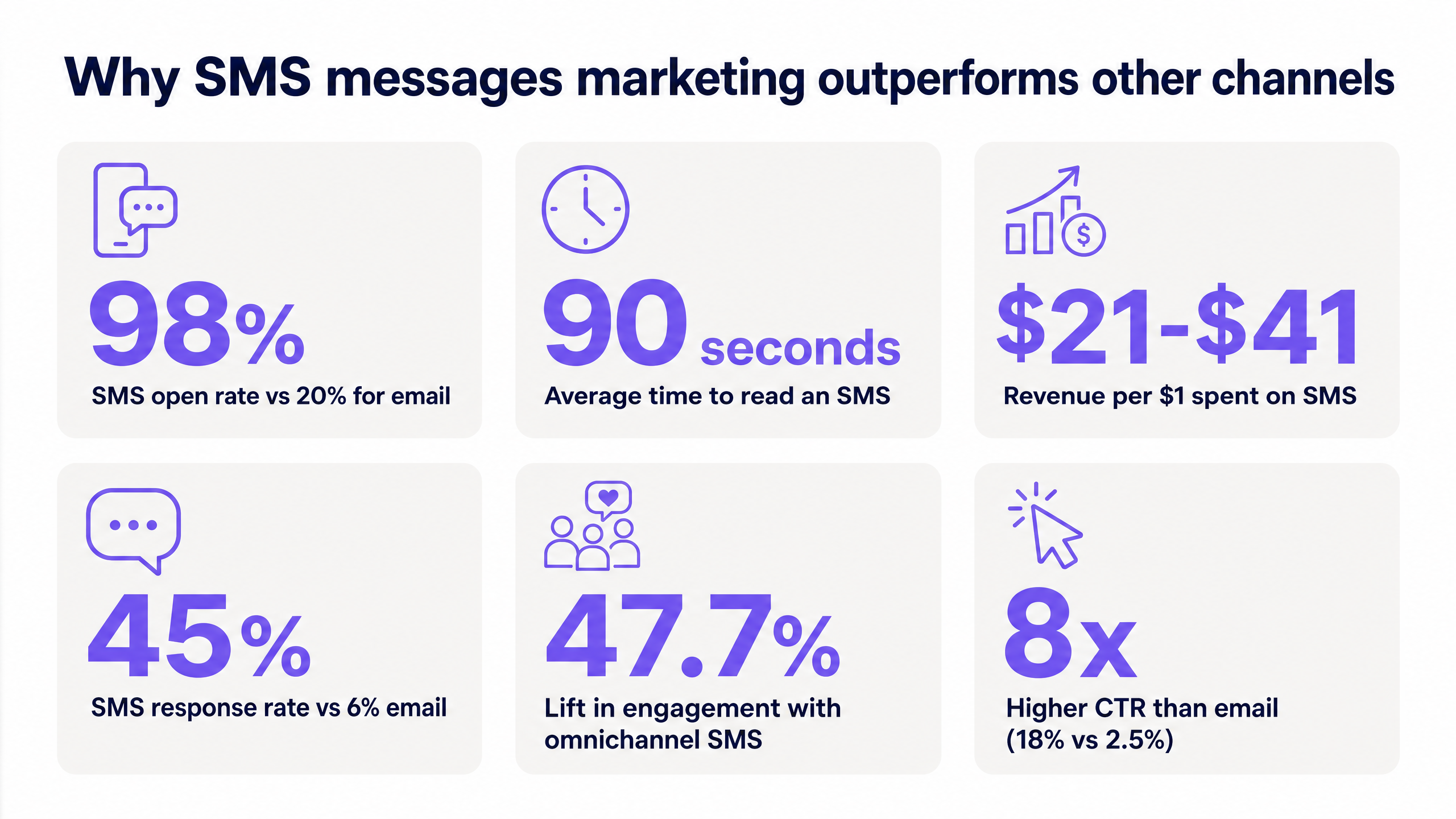
Welcome to the Purple technical briefing series. I'm your host, and today we're getting into something that a lot of venue operators know they should be doing but haven't quite nailed yet: SMS messages marketing, and specifically how to use it to bring guests back through your doors. Let me set the scene. You're running a hotel group, a retail chain, or a stadium. You've got thousands of people walking through your venues every week. Some of them connect to your guest WiFi. Some of them don't. But the ones who do? They're handing you something genuinely valuable: a verified phone number and, if your captive portal is set up correctly, explicit consent to market to them. The question is: what do you do with that? Section one. Why SMS, and why now. Let's start with the numbers, because they're hard to argue with. SMS messages carry a 98% open rate. Email, by comparison, sits at around 20%. Ninety percent of SMS messages are read within three minutes of delivery. And the average click-through rate for SMS is 18%, versus 2.5% for email. That's not a marginal difference. That's a different channel entirely. For every pound spent on SMS marketing, well-run programmes return between 21 and 41 pounds in revenue. Omnisend's data shows that brands integrating SMS into an omnichannel strategy see a 47.7% lift in customer engagement. So why aren't more venue operators doing this properly? Usually it comes down to three things: data quality, consent architecture, and campaign automation. Let's work through each of those. Section two. The data foundation: capturing verified phone numbers at the WiFi login. Here's the thing about phone numbers captured through a guest WiFi captive portal. They're different from phone numbers you'd get through a competition entry or a loyalty sign-up form. When someone connects to your WiFi, they're physically present in your venue. They're engaged. They want to be online. And if your splash page asks for a phone number as part of the login flow, the intent signal is high. Purple Engage captures verified guest phone data at the captive portal login and automates marketing campaigns from that point forward. Across 80,000 live venues and 440 million logins in 2024, we've seen that phone number capture rates at the portal consistently outperform post-visit data collection methods. The architecture here matters. Your captive portal sits between the guest's device and internet access. When a guest authenticates, whether that's via social login, email, or phone number with SMS verification, Purple writes that identity record to a centralised guest profile. That profile persists across visits, across locations if you're a multi-site operator, and across time. The hardware doesn't matter. Purple runs as a cloud overlay on Cisco Meraki, HPE Aruba, Ruckus, Juniper Mist, Ubiquiti UniFi, Cambium, Extreme, and Fortinet. You're not ripping out your network infrastructure. You're adding an intelligence layer on top of it. Section three. Consent architecture and GDPR compliance. This is where a lot of operators get nervous, and understandably so. GDPR and CCPA have real teeth. Getting consent wrong doesn't just create legal exposure; it destroys the trust that makes SMS marketing effective in the first place. The good news is that the captive portal is actually one of the cleanest consent capture mechanisms available. The guest is actively completing a form. They can see exactly what they're signing up for. And because the interaction is synchronous, you can implement a double opt-in flow without adding meaningful friction. Here's what a compliant SMS opt-in flow looks like at the portal level. First, the guest enters their phone number to authenticate. Second, they receive an SMS with a one-time passcode to verify the number is real. Third, the splash page presents a clearly labelled checkbox, separate from the WiFi access consent, stating something like: I agree to receive promotional SMS messages from the venue. Message frequency varies. Reply STOP to unsubscribe. Fourth, that consent record, including the timestamp, the IP address, and the specific consent language shown, is written to the guest profile and stored for audit purposes. That last point is critical. Under GDPR Article 7, you must be able to demonstrate that consent was given. Purple stores consent records with full audit trails, which means if you're ever asked to prove consent, you can. One more thing on this. Do not bundle SMS marketing consent with WiFi access. Accessing the internet is not conditional on agreeing to receive marketing messages. That's a violation of GDPR's requirement for freely given consent. Keep the two consent flows separate, clearly labelled, and independently revocable. Section four. Campaign architecture: segmentation, triggers, and timing. Once you have a verified, consented phone number attached to a guest profile, the next question is: what do you send, and when? The answer depends on your vertical, but the underlying logic is the same across hospitality, retail, and events. You're trying to identify the right moment to send a message that's relevant enough to prompt a return visit. Let me walk through three campaign types that consistently perform well. The first is the welcome series. A guest connects to your WiFi for the first time. Within 24 hours, they receive an SMS: Thanks for visiting. Here's 10% off your next visit. Valid for 30 days. Reply STOP to unsubscribe. Simple, immediate, and tied to a specific action. In hospitality, operators using this approach see welcome conversion rates of 12 to 18%. The second is the re-engagement trigger. A guest who visited regularly hasn't been back in 45 days. Purple Engage detects the lapse based on WiFi connection history and fires an automated SMS: We've missed you. Here's something to bring you back. The trigger is the absence of a WiFi connection event. No manual segmentation required. The third is the visit-frequency campaign. You identify guests who visit more than twice a month. They're your high-value segment. You send them an exclusive offer, early access to an event, or a loyalty reward. The message feels personal because it's based on real behaviour data, not a demographic assumption. In retail, a chain with 50 locations using Purple Engage to run these three campaign types can expect to see a 15 to 25% increase in repeat visit frequency among opted-in guests within the first 90 days. Section five. Integration with your existing marketing stack. Purple Engage doesn't operate in isolation. The guest data captured at the WiFi portal needs to flow into your CRM, your marketing automation platform, and your analytics tools. Purple integrates natively with Salesforce, HubSpot, Mailchimp, Klaviyo, and a range of other platforms via webhook and API. When a guest opts in at the portal, their profile, including phone number, consent record, visit history, and location data, syncs to your CRM in real time. This matters for two reasons. First, it means your SMS campaigns can be orchestrated from the same platform you use for email, so you're not managing a separate tool. Second, it means your guest data is enriched over time. Every WiFi connection event adds a data point: which location, what time, how long. After six months, you have a behavioural profile that's genuinely useful for segmentation. The analytics side of this is handled through Purple's WiFi analytics platform. You can see opt-in rates by location, campaign performance by segment, and return visit attribution. If you send an SMS campaign on a Tuesday and see a 20% uplift in WiFi connections the following weekend, you can attribute that directly. Section six. Implementation pitfalls and how to avoid them. Let me give you the four failure modes I see most often. The first is low opt-in rates at the portal. If fewer than 15% of your WiFi logins are capturing a phone number, your splash page copy is the problem. The value exchange needs to be explicit. Entering your number to get online and receive exclusive offers outperforms simply entering your number to get online by a significant margin. Test the copy. A/B test it if your platform supports it. The second is message fatigue. Sending more than four SMS messages per month to the same contact without strong personalisation will drive up your opt-out rate. Keep frequency low and relevance high. One well-timed, contextually relevant message outperforms four generic ones every time. The third is attribution gaps. If you're not connecting your SMS campaign sends to WiFi connection events, you can't measure return visit lift. Make sure your Purple Engage campaigns are tagged so that subsequent WiFi logins from the same device or phone number are attributed back to the campaign. The fourth is consent record gaps. If you can't produce a timestamped consent record for every phone number on your SMS list, you have a compliance problem. Run a consent audit before you launch any campaign. Remove any contacts where the consent record is incomplete. Section seven. Rapid-fire questions. Can we use SMS for transactional messages as well as marketing? Yes, and you should. Booking confirmations, check-in reminders, and event notifications all have high open rates and reinforce the value of being on your list. Just make sure your consent language covers both transactional and marketing messages, or keep them on separate opt-in flows. What's a realistic opt-in rate to target? For a well-optimised captive portal in a hospitality or retail setting, 20 to 35% of WiFi logins converting to SMS opt-ins is achievable. Stadiums and events venues often see higher rates because the value exchange is more immediate. How do we handle guests who opt out? Immediately. GDPR requires you to process opt-out requests without delay. Purple Engage handles this automatically: a STOP reply removes the contact from all SMS sends and updates the consent record. You do not need to manually manage opt-outs. Can we run SMS campaigns across multiple locations with different offers? Yes. Purple Engage supports location-level segmentation, so you can run a campaign that sends one offer to guests of your Manchester locations and a different offer to guests of your London locations, all from the same campaign interface. Section eight. Summary and next steps. Let me bring this together. SMS messages marketing, when built on a foundation of verified first-party data from your guest WiFi, is one of the highest-return marketing channels available to venue operators. The data is clear: 98% open rates, 18% click-through rates, and returns of 21 to 41 pounds per pound spent. The three things you need to get right are: consent architecture at the captive portal, segmentation logic that uses real visit behaviour rather than demographic assumptions, and integration between your WiFi analytics platform and your marketing automation stack. Purple Engage handles all three. It captures verified phone data at login, automates campaign triggers based on visit behaviour, and integrates with your existing CRM and marketing tools. If you're not already running SMS campaigns from your guest WiFi data, the starting point is a consent audit of your current captive portal flow. Check whether your splash page includes a separate, clearly labelled SMS opt-in checkbox. If it doesn't, that's the first thing to fix. From there, build your three core campaigns: the welcome series, the re-engagement trigger, and the high-value guest programme. Measure return visit lift over 90 days. The numbers will tell you whether to scale. Thank you for listening. If you want to explore how Purple Engage can work for your venues, visit purple.ai or speak to your account manager. We'll see you in the next episode.

header_image.png

Executive Summary

For IT managers and venue operations directors, the physical footprint of your venues represents an untapped data asset. Every week, thousands of visitors connect to your Guest WiFi networks. By reconfiguring the captive portal to capture verified phone numbers alongside explicit marketing consent, you can build a highly engaged SMS subscriber list with zero additional hardware investment.

SMS messages marketing delivers a 98% open rate and an 18% click-through rate [1] [2]. However, scaling this channel requires strict adherence to GDPR and CCPA consent frameworks, clean integration with existing identity providers, and automated campaign triggers based on actual venue behaviour. This guide details the deployment architecture required to use Purple Engage for SMS marketing, focusing on compliance, data flow, and measurable return visit lift.

Technical Deep-Dive: The Data Foundation

The foundation of an effective SMS marketing programme is identity-grade, first-party data. Unlike lists built through passive web forms or third-party data brokers, phone numbers captured at the Guest WiFi login represent high-intent users who are physically present in your venue.

Captive Portal Architecture

The captive portal sits between the user's device and the internet gateway. When a guest attempts to access the network, Purple intercepts the traffic and presents a branded splash page. To build an SMS list, you must configure this page to require a phone number for authentication.

Purple operates as a cloud overlay on your existing hardware (including Cisco Meraki, HPE Aruba, Ruckus, Juniper Mist, Ubiquiti UniFi, Cambium, Extreme, and Fortinet). When a guest submits their phone number, Purple validates the input format and can optionally trigger a One-Time Password (OTP) via SMS to verify ownership. Once authenticated, Purple writes the device MAC address, phone number, and connection timestamp to a centralised guest profile.
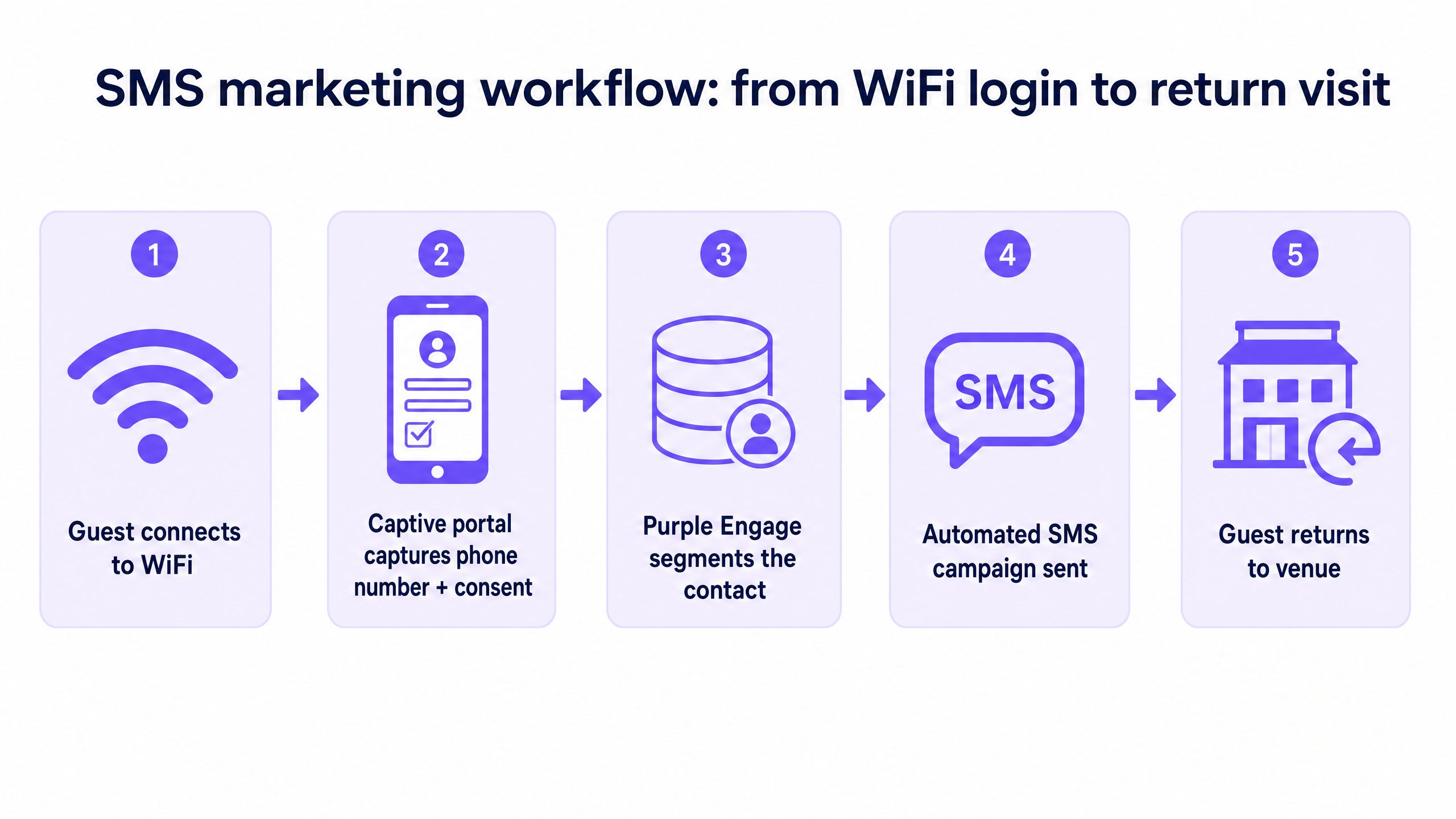
sms_workflow_diagram.png

Capturing the phone number is only the first step; capturing explicit, auditable consent is the critical compliance requirement. Under GDPR Article 7, you must be able to demonstrate that the data subject has consented to processing [3].

Do not bundle SMS marketing consent with the Terms and Conditions for WiFi access. The consent flow must be:

  1. Unbundled: A distinct, unchecked checkbox specifically for SMS marketing.
  2. Clear: State the purpose (e.g., "I agree to receive promotional SMS messages from [Venue Name]").
  3. Recorded: Purple Engage automatically logs the timestamp, IP address, MAC address, and the exact consent language displayed to the user.

Implementation Guide

Deploying an automated SMS campaign architecture requires aligning your WiFi analytics platform with your CRM and marketing automation tools.

Step 1: Configure the Splash Page

Access the Purple portal and navigate to the splash page editor. Add the 'Phone Number' field to the login form. Enable SMS verification if data quality is a higher priority than login speed. Add a custom checkbox for SMS marketing consent, ensuring it is not pre-ticked.

Step 2: Establish CRM Integration

Purple integrates natively with Salesforce, HubSpot, Mailchimp, and Klaviyo via API and webhooks. Configure the integration to sync the guest profile data (phone number, first name, last name, and consent status) to your CRM in real time. Ensure that opt-outs (e.g., a guest replying "STOP") are synced bidirectionally to maintain compliance.

Step 3: Build Automated Triggers in Purple Engage

Instead of relying on manual batch-and-blast sends, use Purple Engage to trigger SMS messages based on physical venue behaviour.

  1. The Welcome Series: Trigger an SMS 24 hours after a guest's first WiFi connection. Offer a tangible incentive to return.
  2. The Re-engagement Trigger: Identify guests who have not connected to the WiFi in 45 days. Trigger a "We miss you" SMS offer.
  3. The High-Value Segment: Identify guests who connect more than three times a month. Trigger an exclusive loyalty reward SMS.

Best Practices

  • Optimise the Value Exchange: If your phone number capture rate is below 15%, your splash page copy is likely failing to articulate the benefit. "Enter your number to get online and receive 10% off your next coffee" will significantly outperform "Enter your number to connect."
  • Limit Message Frequency: Cap promotional SMS messages at two to four per month to prevent list fatigue and high opt-out rates.
  • Use Personalisation: Insert the guest's first name and reference their specific venue location to increase relevance.

Troubleshooting & Risk Mitigation

Failure Mode Root Cause Mitigation Strategy
High Bounce Rate Invalid phone numbers entered at login. Enable OTP SMS verification on the captive portal to ensure only valid numbers are captured.
Compliance Breach Bundled consent or missing audit trails. Separate WiFi T&Cs from marketing consent. Use Purple's built-in consent logging to maintain an audit trail.
Low Return Visit Attribution Inability to link an SMS send to a physical visit. Ensure Purple Engage campaigns are correctly tagged so that subsequent WiFi logins from the targeted MAC address are attributed to the campaign.
sms_stats_infographic.png

ROI & Business Impact

SMS marketing is highly measurable. By tying SMS campaign sends to subsequent Guest WiFi connections, venue operators can directly attribute return visits to specific messages.

Industry benchmarks indicate that well-run SMS campaigns return between $21 and $41 in revenue for every $1 spent [4]. For a multi-site retail or hospitality operator, converting 20% of WiFi logins into SMS opt-ins and driving a 15% increase in repeat visit frequency among that cohort represents a significant, measurable impact on top-line revenue.

References

[1] Sender, "SMS Open Rates," 2026. https://www.sender.net/blog/sms-open-rates/ [2] Infobip, "SMS marketing statistics: Key figures for 2026," 2026. https://www.infobip.com/blog/sms-marketing-statistics [3] MyWiFi Networks, "GDPR & WiFi Data Collection: 2026 Compliance Checklist," 2026. https://www.mywifinetworks.com/blog/gdpr-wifi-data-collection-guide [4] Upcity, "SMS Marketing ROI: Data, Benchmarks & Pilot Template," 2026. https://messageflow.com/blog/how-to-justify-investment-sms-marketing-roi/

Key Definitions

Captive Portal

A web page that the user of a public-access network is obliged to view and interact with before access is granted. Used by Purple to capture guest data and consent.

The primary mechanism for converting anonymous venue footfall into known, marketable contacts.

First-Party Data

Information a company collects directly from its customers. In this context, phone numbers and visit history collected via Guest WiFi.

Highly valuable for marketing because it is accurate, privacy-compliant, and unique to the venue operator.

Double Opt-In

A process where a user signs up for a marketing list and then receives a confirmation message requiring them to verify their intent.

Implemented via SMS OTP at the WiFi login to ensure data accuracy and robust compliance.

Omnichannel Strategy

A seamless, integrated approach to marketing across multiple channels (e.g. email, SMS, in-app) to provide a unified customer experience.

Purple Engage allows operators to integrate SMS triggers with their broader CRM and email campaigns.

MAC Address

A unique identifier assigned to a network interface controller (NIC) for use as a network address in communications within a network segment.

Used by Purple to anonymously track device presence and attribute return visits to SMS marketing campaigns.

Purple Engage

Purple's marketing automation platform that uses Guest WiFi data to trigger targeted, behaviour-based campaigns.

The engine that turns passive WiFi data into active SMS marketing outreach.

GDPR Article 7

The section of the General Data Protection Regulation detailing the conditions for consent, requiring the controller to be able to demonstrate that consent was given.

The legal framework dictating how the captive portal must be designed to capture and log SMS marketing opt-ins.

Attribution

The process of identifying a set of user actions that contribute in some manner to a desired outcome, and then assigning a value to each of these events.

Measuring the success of an SMS campaign by tracking how many recipients subsequently connect to the Guest WiFi.

Worked Examples

A 50-location retail chain wants to implement SMS marketing but is concerned about GDPR compliance and data quality. They currently offer frictionless, one-click Guest WiFi.

The IT team reconfigures the captive portal to require a phone number for access, implementing an SMS OTP flow to verify the number. They add a separate, unticked checkbox for SMS marketing consent. Purple Engage is configured to sync these verified numbers and consent records to their central CRM via API. They launch a 'Welcome' campaign triggered 24 hours after the first login.

Examiner's Commentary: This approach balances the need for high-quality, verified data with strict GDPR compliance. The OTP flow prevents fake numbers, and the separate checkbox ensures consent is freely given. The API integration ensures the marketing team has immediate access to the data.

A stadium operator has a large database of phone numbers but low engagement. They want to use Guest WiFi to drive return visits on non-match days.

The operator uses Purple Engage to segment their WiFi user base, identifying guests who attend matches but haven't visited the stadium's retail store or cafe on non-match days. They trigger an automated SMS campaign offering a 20% discount at the retail store, sent only to guests who haven't connected to the WiFi in the last 30 days.

Examiner's Commentary: This demonstrates the power of behavioural segmentation. By using WiFi connection data as a proxy for physical presence, the operator can target lapsed visitors with highly relevant, timely offers, rather than relying on generic batch-and-blast campaigns.

Practice Questions

Q1. Your marketing director wants to rapidly grow the SMS subscriber list and suggests making the SMS marketing opt-in checkbox pre-ticked on the Guest WiFi captive portal. How do you advise them?

Hint: Consider the specific requirements of GDPR Article 7 regarding how consent must be given.

View model answer

Advise against it. Under GDPR, consent must be a freely given, specific, informed, and unambiguous indication of the user's wishes. Pre-ticked boxes do not constitute valid consent. The checkbox must be unticked by default, requiring an active affirmative action from the guest.

Q2. A hotel group has launched an SMS campaign offering 20% off a future stay. They are tracking click-through rates on the link provided in the SMS, but the operations director wants to know how many people actually walked back into the hotel as a result. How do you measure this?

Hint: Think about how Purple tracks physical presence in a venue.

View model answer

Use Purple's WiFi analytics to track return visit attribution. Because the SMS campaign was sent to contacts whose phone numbers are linked to their device MAC addresses in the Purple guest profile, you can track how many of those specific devices subsequently connected to the Guest WiFi network following the campaign send.

Q3. You are deploying Guest WiFi across a 100-site retail estate using Cisco Meraki hardware. The CRM team needs the phone numbers captured at the portal to sync to Salesforce immediately to trigger a real-time welcome SMS. How is this achieved?

Hint: Consider how Purple integrates with external platforms.

View model answer

Configure a native API or webhook integration between Purple and Salesforce. Purple operates as a hardware-agnostic cloud overlay on the Meraki infrastructure. When a guest authenticates at the portal, Purple captures the data and instantly pushes the profile (including phone number and consent status) to Salesforce via the API, triggering the CRM's automated welcome workflow.