

HIPAA-अनुरूप WiFi: आरोग्य सेवा संस्थांसाठी एक मार्गदर्शक
हे तांत्रिक संदर्भ मार्गदर्शक एंटरप्राइझ आणि गेस्ट WiFi तैनात करणाऱ्या आरोग्य सेवा IT संघांसाठी कार्यवाहीयोग्य अनुपालन धोरणे प्रदान करते. यात नेटवर्क सेगमेंटेशन, 802.1X ऑथेंटिकेशन, ऑडिट लॉगिंग आणि Purple च्या प्लॅटफॉर्मचा वापर करून सुरक्षित, वेगळे वायरलेस ॲक्सेस कसे लागू करावे हे समाविष्ट आहे.
🎧 हे मार्गदर्शक ऐका
ट्रान्सक्रिप्ट पहा
कार्यकारी सारांश
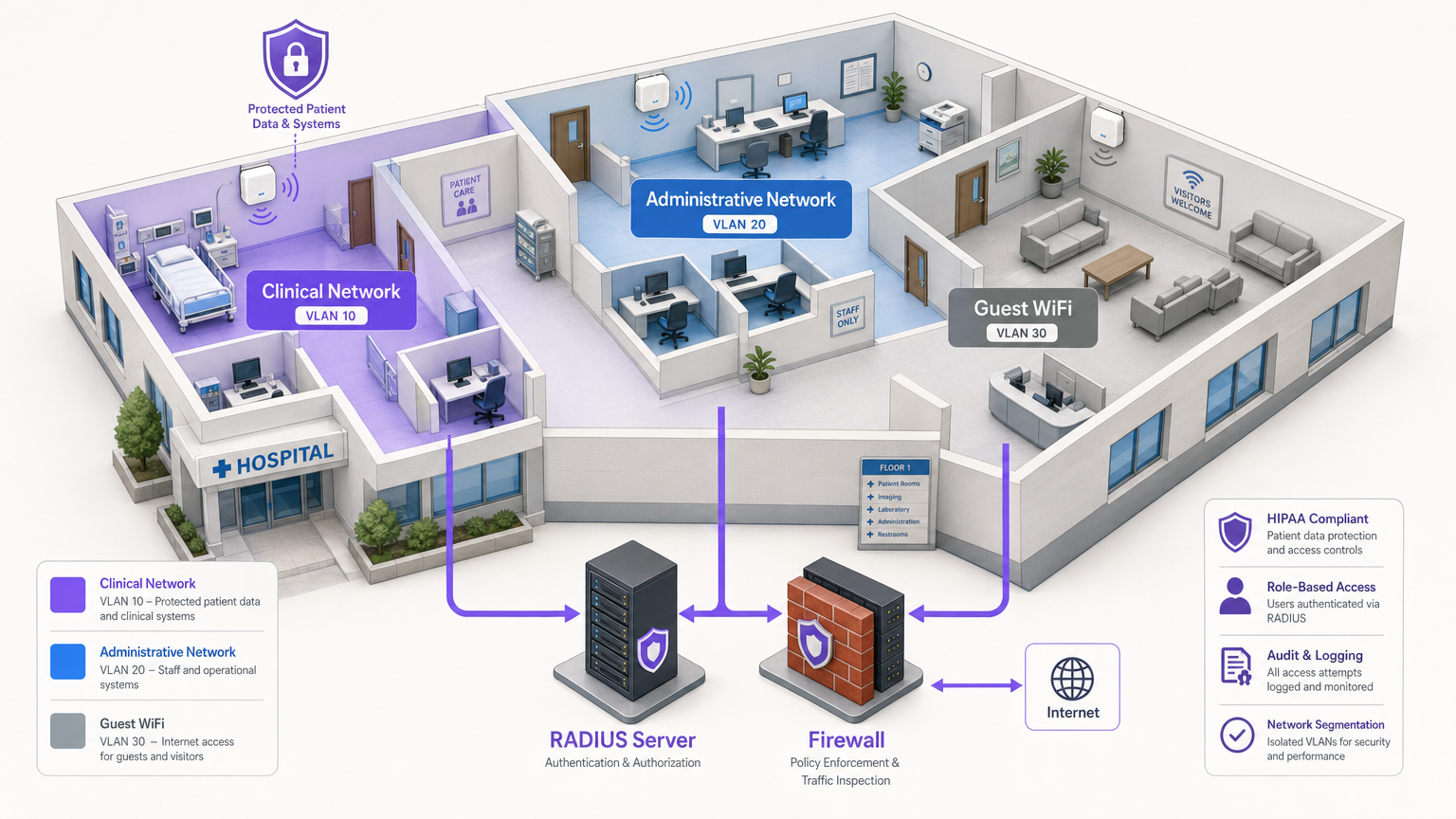
आरोग्य सेवा वातावरणातील IT व्यवस्थापक, नेटवर्क आर्किटेक्ट आणि CTOs साठी, वायरलेस नेटवर्क तैनात करताना दोन महत्त्वाच्या, अनेकदा स्पर्धात्मक प्राधान्यांमध्ये संतुलन साधावे लागते: कठोर HIPAA नियमांचे पालन करण्यासाठी इलेक्ट्रॉनिक संरक्षित आरोग्य माहिती (ePHI) सुरक्षित करणे, आणि रुग्ण, अभ्यागत आणि क्लिनिकल कर्मचाऱ्यांसाठी अखंड, उच्च-गुणवत्तेची कनेक्टिव्हिटी प्रदान करणे. एकच चुकीचे कॉन्फिगर केलेला ॲक्सेस पॉइंट किंवा सामायिक पासवर्डमुळे गंभीर डेटा उल्लंघन, नियामक दंड आणि प्रतिष्ठेचे नुकसान होऊ शकते. हे मार्गदर्शक HIPAA-अनुरूप WiFi तैनात करण्यासाठी एक व्यावहारिक, विक्रेता-तटस्थ फ्रेमवर्क प्रदान करते. यात आवश्यक तीन-झोन सेगमेंटेशन मॉडेल, डेटा एन्क्रिप्शन मानके (WPA3-Enterprise), 802.1X द्वारे मजबूत ओळख व्यवस्थापन आणि सर्वसमावेशक ऑडिट लॉगिंग समाविष्ट आहे. शिवाय, Guest WiFi आणि WiFi Analytics साठी Purple सारखे एंटरप्राइझ प्लॅटफॉर्म कसे समाकलित करावे हे यात सविस्तरपणे सांगितले आहे, जेणेकरून सार्वजनिक ॲक्सेस क्लिनिकल सिस्टमपासून पूर्णपणे वेगळा राहील आणि तरीही मौल्यवान प्रतिबद्धता डेटा कॅप्चर केला जाईल.
तांत्रिक सखोल विश्लेषण
HIPAA-अनुरूप वायरलेस नेटवर्क साध्य करण्यासाठी मूलभूत कनेक्टिव्हिटीच्या पलीकडे जाऊन डिफेन्स-इन-डेप्थ आर्किटेक्चर लागू करणे आवश्यक आहे. HIPAA सुरक्षा नियम ॲक्सेस कंट्रोल, ऑडिट कंट्रोल, अखंडता आणि ट्रान्समिशन सुरक्षिततेसाठी तांत्रिक सुरक्षा उपायांची [1] सक्ती करतो.
1. एन्क्रिप्शन आणि ऑथेंटिकेशन (802.1X आणि WPA3-Enterprise)
वायरलेस सुरक्षिततेचा पाया मजबूत एन्क्रिप्शन आहे. WEP, WPA आणि अगदी WPA2-Personal (प्री-शेअर्ड की वापरून) सारखे जुने प्रोटोकॉल ePHI हाताळणाऱ्या वातावरणासाठी पूर्णपणे अपुरे आहेत. एक तडजोड केलेला PSK हल्लेखोराला संपूर्ण सबनेटमध्ये ॲक्सेस देतो.
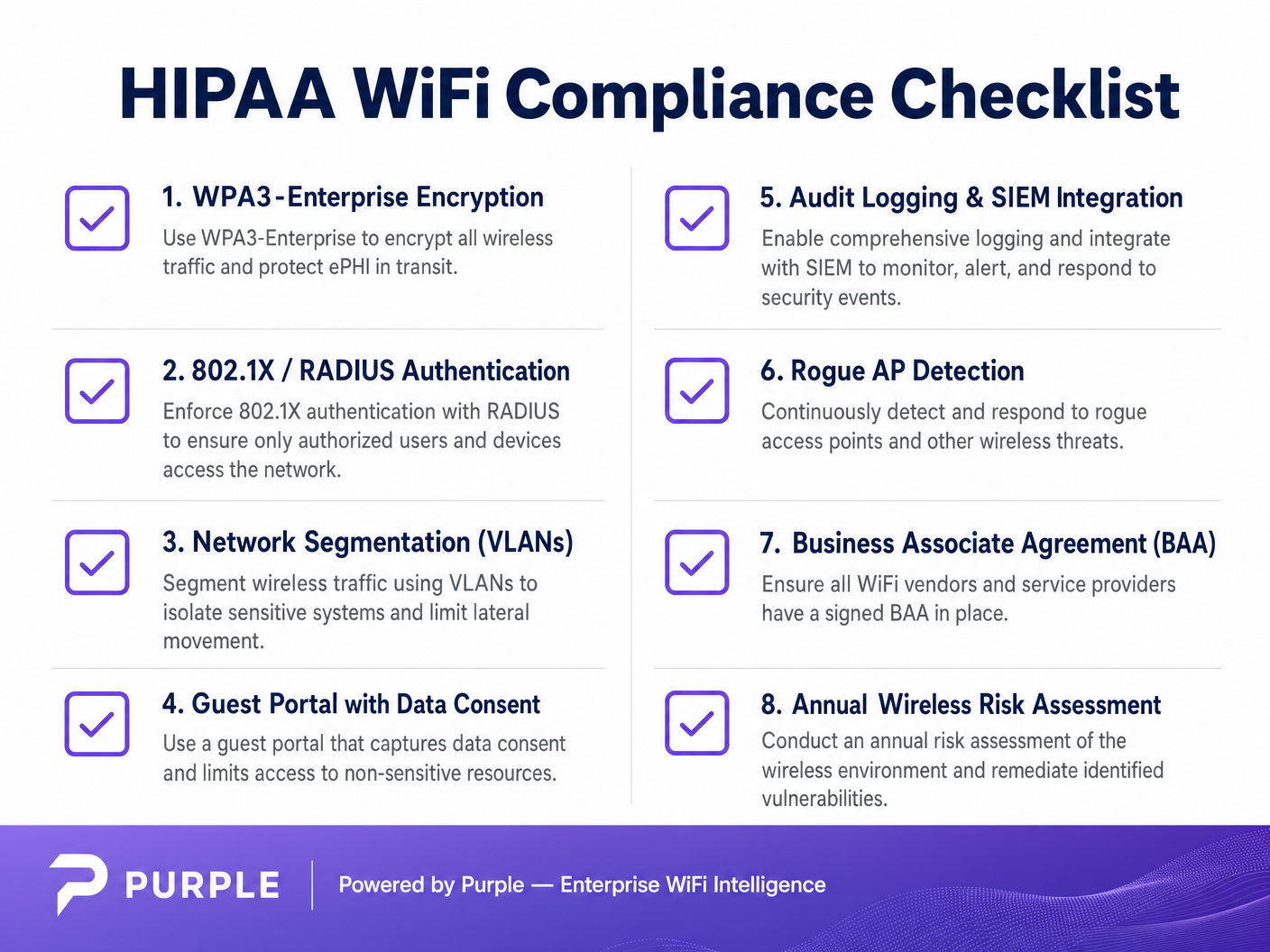
आरोग्य सेवा संस्थांनी WPA3-Enterprise (किंवा किमान WPA2-Enterprise) 802.1X ऑथेंटिकेशन सह लागू करणे आवश्यक आहे. या आर्किटेक्चरमध्ये प्रत्येक वापरकर्ता आणि डिव्हाइसला नेटवर्क ॲक्सेस मिळण्यापूर्वी RADIUS (रिमोट ऑथेंटिकेशन डायल-इन युझर सर्व्हिस) सर्व्हरविरुद्ध स्वतंत्रपणे ऑथेंटिकेट करणे आवश्यक आहे [2].
- क्लिनिकल डिव्हाइसेस (IoT, WOWs): प्रमाणपत्र-आधारित ऑथेंटिकेशन वापरा, विशेषतः EAP-TLS (एक्स्टेंसिबल ऑथेंटिकेशन प्रोटोकॉल-ट्रान्सपोर्ट लेयर सिक्युरिटी). यामुळे पासवर्ड पूर्णपणे काढून टाकले जातात, अधिकृत डिव्हाइसेसवर स्थापित केलेल्या केंद्रीय व्यवस्थापित डिजिटल प्रमाणपत्रांवर अवलंबून राहते. जर एखादे डिव्हाइस हरवले, तर त्याचे प्रमाणपत्र त्वरित रद्द केले जाऊ शकते.
- कर्मचारी डिव्हाइसेस (लॅपटॉप, मोबाईल): रोल-आधारित ॲक्सेस कंट्रोल (RBAC) शी जोडलेल्या डोमेन क्रेडेंशियल्सचा वापर करून ऑथेंटिकेशन लागू करा, अनेकदा ॲक्टिव्ह डिरेक्टरी किंवा आयडेंटिटी प्रोव्हायडर (IdP) सह समाकलित करून.
2. नेटवर्क सेगमेंटेशन (तीन-झोन मॉडेल)
लॅटरल हालचालींविरुद्ध सेगमेंटेशन हा सर्वात महत्त्वाचा आर्किटेक्चरल बचाव आहे. तुमचे गेस्ट स्मार्टफोन तुमच्या इलेक्ट्रॉनिक हेल्थ रेकॉर्ड (EHR) टर्मिनल्सच्या समान VLAN वर असू शकत नाहीत. उद्योग मानक म्हणजे VLANs आणि फायरवॉलद्वारे भौतिक किंवा तार्किकरित्या वेगळे केलेले कठोर तीन-झोन आर्किटेक्चर.
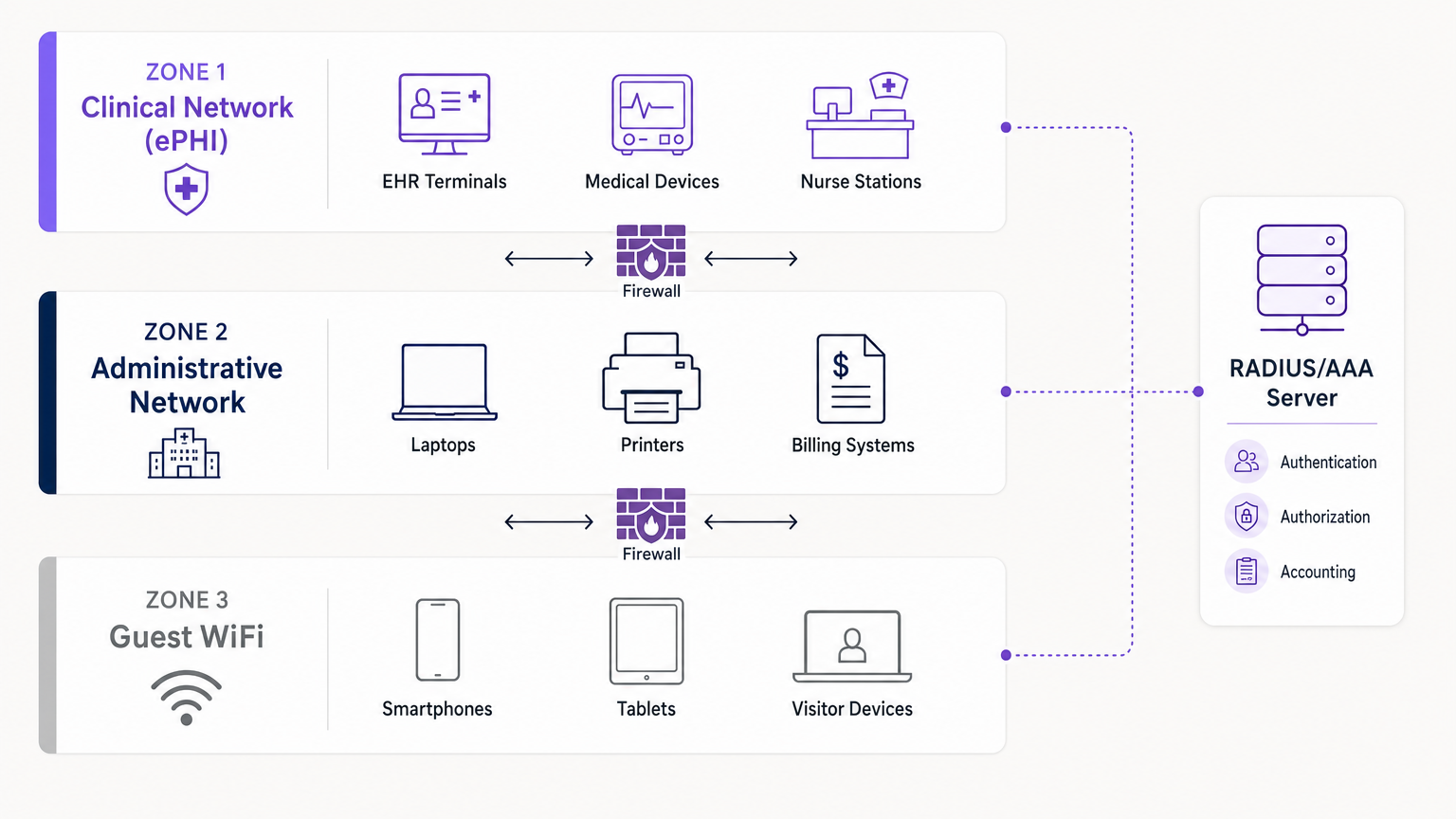
- झोन 1: क्लिनिकल नेटवर्क (ePHI): हा अत्यंत प्रतिबंधित VLAN सर्व संवेदनशील डेटा हाताळतो. तो EHR सिस्टम, वैद्यकीय उपकरणे आणि नर्स स्टेशनला जोडतो. ॲक्सेस केवळ ऑथेंटिकेटेड क्लिनिकल कर्मचारी आणि 802.1X द्वारे व्यवस्थापित डिव्हाइसेसपुरता मर्यादित आहे.
- झोन 2: प्रशासकीय नेटवर्क: हा VLAN हॉस्पिटलच्या कामकाजाला समर्थन देतो—बिलिंग सिस्टम, कर्मचारी लॅपटॉप आणि प्रिंटर—ज्यांना रुग्णाच्या रेकॉर्डमध्ये थेट ॲक्सेसची आवश्यकता नाही.
- झोन 3: गेस्ट WiFi: रुग्ण आणि अभ्यागतांसाठी एक वेगळे, केवळ इंटरनेट कनेक्शन. ते झोन 1 आणि 2 पासून पूर्णपणे वेगळे असले पाहिजे, गेस्ट डिव्हाइसेसना एकमेकांशी संवाद साधण्यापासून रोखण्यासाठी क्लायंट आयसोलेशनचा वापर करून.
3. ऑडिट लॉगिंग आणि SIEM एकत्रीकरण
HIPAA नुसार, संस्थांनी ePHI [1] असलेल्या माहिती प्रणालींमधील क्रियाकलाप रेकॉर्ड आणि तपासण्यासाठी हार्डवेअर, सॉफ्टवेअर आणि प्रक्रियात्मक यंत्रणा लागू करणे आवश्यक आहे. तुमचे वायरलेस कंट्रोलर आणि RADIUS सर्व्हरने सर्व ऑथेंटिकेशन प्रयत्न (यशस्वी आणि अयशस्वी), सेशन कालावधी आणि प्रशासकीय बदल लॉग करणे आवश्यक आहे. हे लॉग सतत मॉनिटरिंग आणि विसंगती शोधण्यासाठी केंद्रीकृत सुरक्षा माहिती आणि इव्हेंट व्यवस्थापन (SIEM) प्रणालीकडे पाठवले पाहिजेत.
अंमलबजावणी मार्गदर्शक
अनुरूप नेटवर्क तैनात करण्यासाठी काळजीपूर्वक नियोजन आणि अंमलबजावणी आवश्यक आहे. सुरक्षित क्लिनिकल ॲक्सेसला वेगळ्या गेस्ट सेवांसह समाकलित करण्यासाठी येथे एक चरण-दर-चरण दृष्टीकोन आहे.
पायरी 1: वायरलेस जोखीम मूल्यांकन करा
नवीन हार्डवेअर तैनात करण्यापूर्वी, एक व्यापक RF साइट सर्वेक्षण आणि जोखीम मूल्यांकन करा. संभाव्य रोग डिव्हाइसेससह सर्व विद्यमान ॲक्सेस पॉइंट ओळखा. क्लिनिकल विरुद्ध गेस्ट ॲक्सेससाठी आवश्यक कव्हरेज क्षेत्रे नकाशावर दर्शवा. हार्डवेअर निवडीवरील माहितीसाठी, Enterprise WiFi Solutions: A Buyer's Guide चा सल्ला घ्या.
पायरी 2: क्लिनिकल आणि प्रशासकीय VLANs कॉन्फिगर करा
तुमची मुख्य पायाभूत सुविधा (उदा. Cisco Meraki, Aruba, किंवा Your Guide to a Wireless Access Point Ruckus ) तैनात करा. आवश्यक असलेल्या क्षेत्रांमध्येच प्रसारित करण्यासाठी क्लिनिकल SSID कॉन्फिगर करा. WPA3-Enterprise लागू करा आणि तुमचे कंट्रोलर RADIUS सर्व्हरशी कनेक्ट करा. सर्व हॉस्पिटलच्या मालकीच्या वैद्यकीय डिव्हाइसेसवर EAP-TLS प्रमाणपत्रे तैनात करा.
पायरी 3: गेस्ट WiFi पोर्टल तैनात करा
येथेच Purple सारखे प्लॅटफॉर्म उत्कृष्ट ठरतात. साध्या ओपन नेटवर्कऐवजी, Purple च्या Captive Portal द्वारे ट्रॅफिक रूट करणारा एक वेगळा Guest SSID तैनात करा.
- आयसोलेशन: गेस्ट VLAN मध्ये कोणत्याही अंतर्गत IP राउटिंगला नकार देणारे कठोर फायरवॉल नियम असल्याची खात्री करा. क्लायंट आयसोलेट सक्षम कराॲक्सेस पॉईंट्सवर आयन.
- संमती आणि अटी: कॅप्टिव्ह पोर्टलने वापरकर्त्यांना अटी व शर्ती स्वीकारण्यास सांगणे आवश्यक आहे, ज्यामुळे कायदेशीर मर्यादा आणि डेटा वापरासाठी संमती स्थापित होते.
- प्रमाणीकरण: Purple अतिथींसाठी ओळख प्रदाता म्हणून कार्य करते, SMS, ईमेल किंवा सोशल लॉगिन हाताळते आणि हा ट्रॅफिक तुमच्या अंतर्गत Active Directory पासून पूर्णपणे वेगळा ठेवते.
पायरी 4: सतत देखरेख लागू करा
तुमच्या वायरलेस इंट्रूजन प्रिव्हेंशन सिस्टम (WIPS) वर रोग AP डिटेक्शन सक्षम करा. हे कर्मचारी किंवा अभ्यागतांनी नेटवर्कमध्ये जोडलेले अनधिकृत ॲक्सेस पॉईंट्स आपोआप ओळखेल आणि दाबून टाकेल. सर्व लॉग तुमच्या SIEM मध्ये प्रवाहित होत असल्याची खात्री करा.
सर्वोत्तम पद्धती
- किमान विशेषाधिकाराचे तत्त्व: वापरकर्ते आणि उपकरणांना त्यांच्या कार्यासाठी आवश्यक असलेल्या विशिष्ट नेटवर्क संसाधनांपर्यंतच प्रवेश असावा. बिलिंग क्लर्कला इमेजिंग VLAN मध्ये प्रवेश करण्याची आवश्यकता नाही.
- व्यवसाय सहयोगी करार (BAA): क्लाउड-व्यवस्थापित नेटवर्किंग किंवा ॲनालिटिक्स सेवा प्रदान करणाऱ्या कोणत्याही विक्रेत्याने BAA वर स्वाक्षरी केली असल्याची खात्री करा, ज्यामुळे डेटा सुरक्षिततेसंबंधी त्यांच्या जबाबदाऱ्या स्पष्टपणे परिभाषित होतात.
- लेगसी प्रोटोकॉल अक्षम करा: सर्व नेटवर्क हार्डवेअरवर WEP, WPA, TKIP आणि Telnet सारखे कालबाह्य व्यवस्थापन प्रोटोकॉल बंद करा. प्रशासकीय प्रवेशासाठी SSH आणि HTTPS लागू करा.
- नियमित ऑडिट: वायरलेस सुरक्षा ही "सेट करा आणि विसरून जा" अशी अंमलबजावणी नाही. वार्षिक भेदक चाचणी आणि कॉन्फिगरेशन पुनरावलोकने करा. सुरक्षित उपयोजनांबद्दल अधिक माहितीसाठी, वाचा WiFi in Hospitals: A Guide to Secure Clinical Networks .
समस्यानिवारण आणि जोखीम कमी करणे
सामान्य अपयश पद्धती
- "शॅडो IT" ॲक्सेस पॉईंट: एका विभागाला चांगल्या कव्हरेजची आवश्यकता असते, म्हणून एक कर्मचारी ग्राहक राउटरला वॉल जॅकमध्ये जोडतो. शमन: कठोर भौतिक पोर्ट सुरक्षा (वायर्ड पोर्ट्सवर 802.1X) आणि WIPS द्वारे सक्रिय रोग AP दमन.
- प्रमाणपत्र कालबाह्यता: क्लिनिकल उपकरणे अचानक नेटवर्कवरून डिस्कनेक्ट होतात कारण त्यांची EAP-TLS प्रमाणपत्रे कालबाह्य झाली आहेत. शमन: स्वयंचलित प्रमाणपत्र जीवनचक्र व्यवस्थापन (CLM) आणि मुदतवाढीच्या 30 दिवस आधी अलर्ट थ्रेशोल्ड लागू करा.
- अतिथी ट्रॅफिक गळती: चुकीच्या कॉन्फिगर केलेल्या VLAN टॅगिंगमुळे अतिथी ट्रॅफिक प्रशासकीय सबनेटमध्ये रूट होते. शमन: VLAN आयसोलेशन सत्यापित करण्यासाठी नियमित भेदक चाचणी आणि स्वयंचलित कॉन्फिगरेशन ऑडिटिंग.
ROI आणि व्यवसाय परिणाम
HIPAA-अनुरूप वायरलेस आर्किटेक्चरमध्ये गुंतवणूक केल्याने केवळ नियामक दंड टाळण्यापलीकडे (जो लाखो डॉलर्सपर्यंत पोहोचू शकतो) महत्त्वपूर्ण परतावा मिळतो.
- जोखीम कमी करणे: मजबूत 802.1X आणि सेगमेंटेशनमुळे हल्ल्याची शक्यता लक्षणीयरीत्या कमी होते, ज्यामुळे संस्थेचे रॅन्समवेअर आणि डेटा उल्लंघनापासून संरक्षण होते.
- कार्यक्षम कार्यप्रणाली: क्लिनिकल उपकरणांसाठी प्रमाणपत्र-आधारित प्रमाणीकरणामुळे पासवर्ड रीसेट आणि कनेक्टिव्हिटी समस्यांशी संबंधित IT हेल्पडेस्क तिकिटे कमी होतात, ज्यामुळे क्लिनिशियन रुग्णांच्या काळजीवर लक्ष केंद्रित करू शकतात.
- सुधारित रुग्ण अनुभव: Purple च्या अतिथी WiFi प्लॅटफॉर्मची सुरक्षितपणे अंमलबजावणी करून, रुग्णालये विश्वसनीय इंटरनेट ॲक्सेस प्रदान करू शकतात—रुग्ण समाधानाचे गुण (HCAHPS) वाढवणारे एक महत्त्वाचे घटक—आणि क्लिनिकल नेटवर्क सुरक्षिततेशी तडजोड न करता मार्गदर्शनासाठी, रुग्ण संप्रेषणासाठी आणि अभिप्राय गोळा करण्यासाठी कॅप्टिव्ह पोर्टलचा लाभ घेऊ शकतात.
संदर्भ
[1] Health Insurance Portability and Accountability Act of 1996 (HIPAA), Pub. L. No. 104-191, 110 Stat. 1936 (1996). [2] Censinet. "HIPAA-Compliant Wireless Network Setup Guide." Censinet Perspectives, 2024.
महत्त्वाच्या संज्ञा आणि व्याख्या
ePHI (Electronic Protected Health Information)
Any protected health information that is created, stored, transmitted, or received electronically.
The primary asset that HIPAA regulations are designed to protect. If a network transmits ePHI, it falls under the strict requirements of the HIPAA Security Rule.
802.1X
An IEEE standard for port-based network access control (PNAC) that provides an authentication mechanism to devices wishing to attach to a LAN or WLAN.
The mandatory authentication framework for enterprise healthcare networks, ensuring that only verified users and devices can access the clinical VLAN.
RADIUS (Remote Authentication Dial-In User Service)
A networking protocol that provides centralized Authentication, Authorization, and Accounting (AAA) management for users who connect and use a network service.
The core server infrastructure that processes 802.1X requests, verifying credentials against a directory (like Active Directory) before granting WiFi access.
EAP-TLS (Extensible Authentication Protocol-Transport Layer Security)
An EAP method that relies on client and server certificates to establish a secure connection, providing strong mutual authentication.
The gold standard for authenticating headless medical devices and mobile workstations, eliminating the need for vulnerable passwords.
Network Segmentation
The practice of splitting a computer network into subnetworks, each being a network segment or VLAN.
Crucial for HIPAA compliance, it ensures that a compromised device on the guest or administrative network cannot access the clinical network housing ePHI.
VLAN (Virtual Local Area Network)
A logical subnetwork that groups a collection of devices from different physical LANs.
The primary mechanism used by network engineers to implement segmentation, isolating clinical, administrative, and guest traffic on the same physical access points.
Captive Portal
A web page accessed with a web browser that is displayed to newly connected users of a Wi-Fi network before they are granted broader access to network resources.
Used for Guest WiFi (often provided by platforms like Purple) to capture user consent, enforce Terms and Conditions, and authenticate visitors without touching internal systems.
Rogue AP (Access Point)
A wireless access point that has been installed on a secure network without explicit authorization from a local network administrator.
A major security risk in hospitals (Shadow IT). Enterprise wireless controllers must actively scan for and suppress these devices to prevent unauthorized network bridging.
केस स्टडीज
A 300-bed regional hospital needs to deploy new mobile workstations (WOWs) for nursing staff. The current network uses a single SSID with a WPA2 Pre-Shared Key (PSK) for all hospital-owned devices. How should the IT architect redesign this for HIPAA compliance?
The architect must eliminate the PSK. They should create a dedicated 'Clinical_ePHI' VLAN and SSID. The new SSID must be configured for WPA3-Enterprise (or WPA2-Enterprise). The architect will deploy a RADIUS server and implement EAP-TLS certificate-based authentication. Each WOW will be provisioned with a unique digital certificate via Mobile Device Management (MDM). The RADIUS server will authenticate the certificate before granting the WOW access to the clinical VLAN.
A large outpatient clinic wants to offer free WiFi to patients in the waiting room, but the CTO is concerned about visitors attempting to access the clinic's billing servers. How should this be implemented?
The network team must implement strict network segmentation. They will create a 'Guest_WiFi' SSID mapped to a dedicated, isolated VLAN (e.g., VLAN 30). Firewall rules must be configured to explicitly deny any routing from VLAN 30 to the internal clinical or administrative subnets (VLANs 10 and 20). Client isolation must be enabled on the access points to prevent guest devices from communicating with each other. Finally, the guest SSID should route through a captive portal, such as Purple, to capture Terms and Conditions consent and handle guest authentication (SMS/Email) separately from the clinic's Active Directory.
परिस्थिती विश्लेषण
Q1. A clinic administrator requests that the new Guest WiFi network use a simple WPA2 password ('ClinicGuest2024') posted on the wall to make it easy for elderly patients to connect, rather than using a captive portal. As the network architect, how do you respond?
💡 संकेत:Consider the requirements for audit logging, user consent, and the risks of shared credentials on public networks.
शिफारस केलेला दृष्टिकोन दाखवा
You must advise against using a shared PSK for the guest network. A shared password provides no individual accountability or audit trail, making it impossible to identify malicious actors on the network. Furthermore, it bypasses the opportunity to present a captive portal where users must accept Terms and Conditions, which is critical for limiting the clinic's liability. The recommended approach is an open Guest SSID that routes immediately to a captive portal (like Purple) for individual authentication (e.g., via SMS or email) and T&C acceptance, ensuring secure, logged, and legally compliant access.
Q2. During a wireless risk assessment, you discover a consumer-grade WiFi router plugged into an Ethernet jack in the radiology department. The staff explains they installed it because the enterprise WiFi signal was weak in that corner. What immediate actions must be taken?
💡 संकेत:Address both the immediate technical threat and the underlying infrastructure issue.
शिफारस केलेला दृष्टिकोन दाखवा
- Immediately disconnect the rogue router from the network, as it creates an unmonitored, unencrypted bridge into the clinical environment, violating HIPAA transmission security rules. 2) Ensure that the enterprise Wireless Intrusion Prevention System (WIPS) is configured to automatically detect and suppress rogue APs. 3) Configure 802.1X on all wired switch ports so unauthorized devices cannot connect to the LAN. 4) Conduct an RF site survey in the radiology department to identify the coverage gap and deploy an authorized, properly configured enterprise access point to resolve the staff's legitimate connectivity issue.
Q3. You are configuring 802.1X authentication for a fleet of new medical infusion pumps. The devices do not have keyboards or screens for users to input credentials. How do you securely authenticate them to the clinical VLAN?
💡 संकेत:Look for an authentication method that relies on machine identity rather than user identity.
शिफारस केलेला दृष्टिकोन दाखवा
The devices should be authenticated using EAP-TLS (certificate-based authentication). You will generate unique digital certificates from the hospital's internal Certificate Authority (CA) and install them on each infusion pump. The RADIUS server will be configured to verify these certificates. When a pump connects to the clinical SSID, it presents its certificate; if valid, the RADIUS server assigns it to the clinical VLAN. This provides strong, passwordless mutual authentication.




