
GDPR e Guest WiFi: Guia de Conformidade para Profissionais de Marketing de Locais e TI
Este guia oferece aos gerentes de TI e operadores de locais uma estrutura prática para garantir que os serviços de Guest WiFi estejam em total conformidade com o GDPR. Ele aborda arquitetura técnica, mecânica de consentimento, retenção de dados e como transformar a conformidade em um ativo seguro de dados primários (first-party).
Ouça este guia
Ver transcrição do podcast
Resumo Executivo
O Guest WiFi é um ponto de coleta de dados regulamentado. Cada hotel, rede de varejo, estádio e centro de conferências que oferece acesso à rede pública torna-se um Controlador de Dados sob o Regulamento Geral de Proteção de Dados (GDPR) no momento em que um convidado se conecta. O ICO pode impor multas de até €20 milhões ou 4% do faturamento anual global por não conformidade. A Marriott International recebeu uma proposta de multa de US$ 124 milhões do ICO após uma violação de dados.
Este guia fornece aos gerentes de TI, arquitetos de rede e operadores de locais uma estrutura prática e acionável para garantir que seus serviços de Guest WiFi estejam em total conformidade. Exploramos os tipos específicos de dados coletados por meio do Guest WiFi, os requisitos legais para consentimento e manuseio de dados, e as melhores práticas independentes de fornecedor para implementar uma solução em conformidade. Para o Diretor de Tecnologia (CTO), este documento descreve como mitigar riscos legais e financeiros. Para o Diretor de Operações, ele demonstra como uma implantação de Guest WiFi em conformidade pode aumentar a confiança do cliente e fornecer inteligência de negócios valiosa e de origem ética.
Análise Técnica Detalhada
Compreender a conformidade com o GDPR para o Guest WiFi começa com uma avaliação clara dos dados que estão sendo processados. Sob o regulamento, dados pessoais são definidos amplamente como qualquer informação relacionada a uma pessoa física identificada ou identificável. No contexto de uma rede Guest WiFi, isso abrange uma gama mais ampla de pontos de dados do que muitas organizações supõem.
Categorias de Dados no Guest WiFi
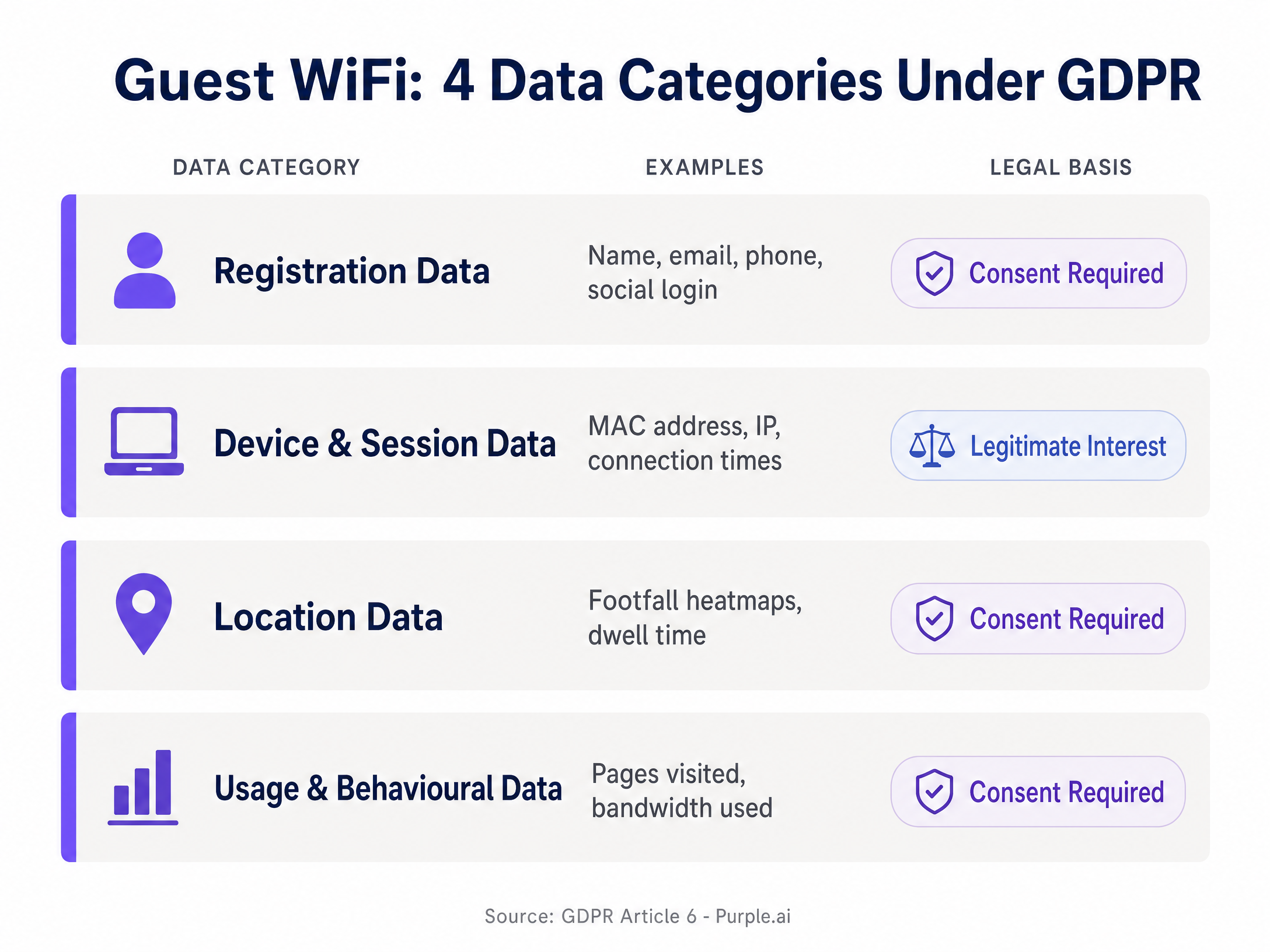
Os dados coletados por meio de uma rede Guest WiFi podem ser segmentados em quatro categorias principais. Cada uma tem implicações distintas para a conformidade com o GDPR, particularmente no que diz respeito à base legal para o processamento e ao período de retenção exigido.
- Dados de Registro: Nome, endereço de e-mail, número de telefone e dados de perfil de redes sociais. A base legal é o Consentimento. Você deve obter consentimento explícito para coletar esses dados e aplicar princípios de minimização de dados para solicitar apenas o que for estritamente necessário.
- Dados de Dispositivo e Sessão: Endereço MAC, endereço IP, horários de conexão e duração da sessão. A base legal é normalmente o Interesse Legítimo para segurança de rede e solução de problemas, desde que você realize e documente uma Avaliação de Interesse Legítimo.
- Dados de Localização: Mapas de calor de fluxo de pessoas e rastreamento de tempo de permanência. A base legal é o Consentimento. Mesmo quando agregada, a coleta inicial de um dispositivo individual constitui dados pessoais.
- Dados de Uso e Comportamento: Páginas visitadas e largura de banda consumida. A base legal é o Consentimento. Você deve ser específico sobre o que está coletando e por quê.
Mecânica de Consentimento do Captive Portal
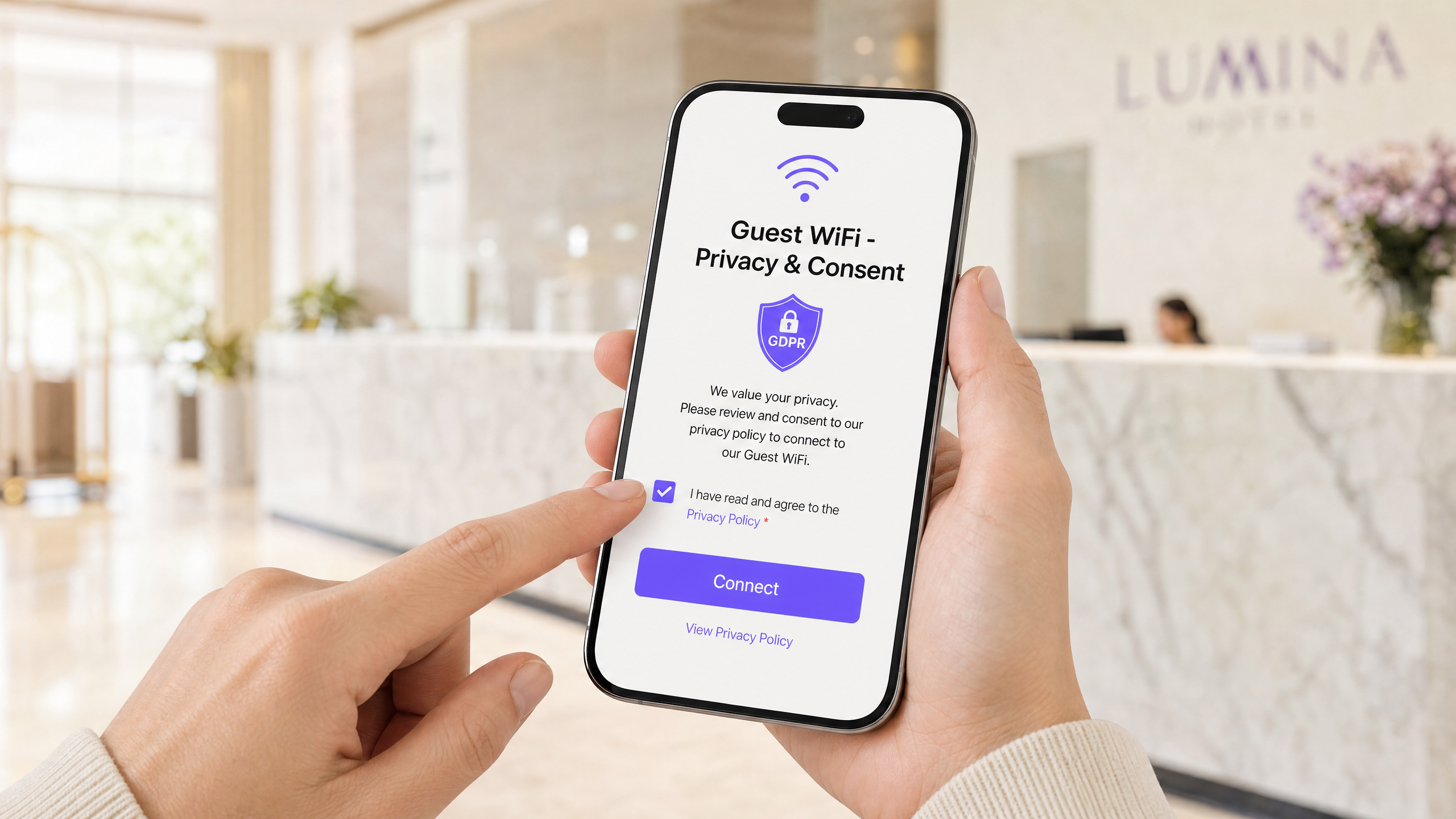
O captive portal é a sua principal interface de conformidade. É a página de entrada (splash page) que os convidados veem antes de acessar a internet. A falha de conformidade mais comum é a venda casada (bundling), onde um local exige que o convidado aceite e-mails de marketing como condição para se conectar. Sob o GDPR, o consentimento deve ser dado livremente. Se você vincular o acesso à rede ao consentimento de marketing, o consentimento será inválido.
Seu captive portal deve apresentar, no mínimo, dois elementos de consentimento separados:
- Uma caixa de seleção obrigatória para aceitação dos seus termos de serviço para acesso à rede.
- Uma caixa de seleção opcional e desmarcada para consentimento para receber comunicações de marketing.
O Considerando 32 do GDPR proíbe explicitamente caixas pré-marcadas. Além da estrutura de consentimento, seu portal deve apresentar um aviso de privacidade claro e conciso antes que o usuário envie qualquer dado. Ele deve explicar quais dados você coleta, por que os coleta, por quanto tempo os mantém e com quem os compartilha. Seu sistema deve registrar cada evento de consentimento: quem consentiu, quando consentiu, com o que consentiu e a versão exata do aviso de privacidade que visualizou. Essa trilha de auditoria de consentimento é a sua prova de conformidade.
Arquitetura de Rede e Segurança
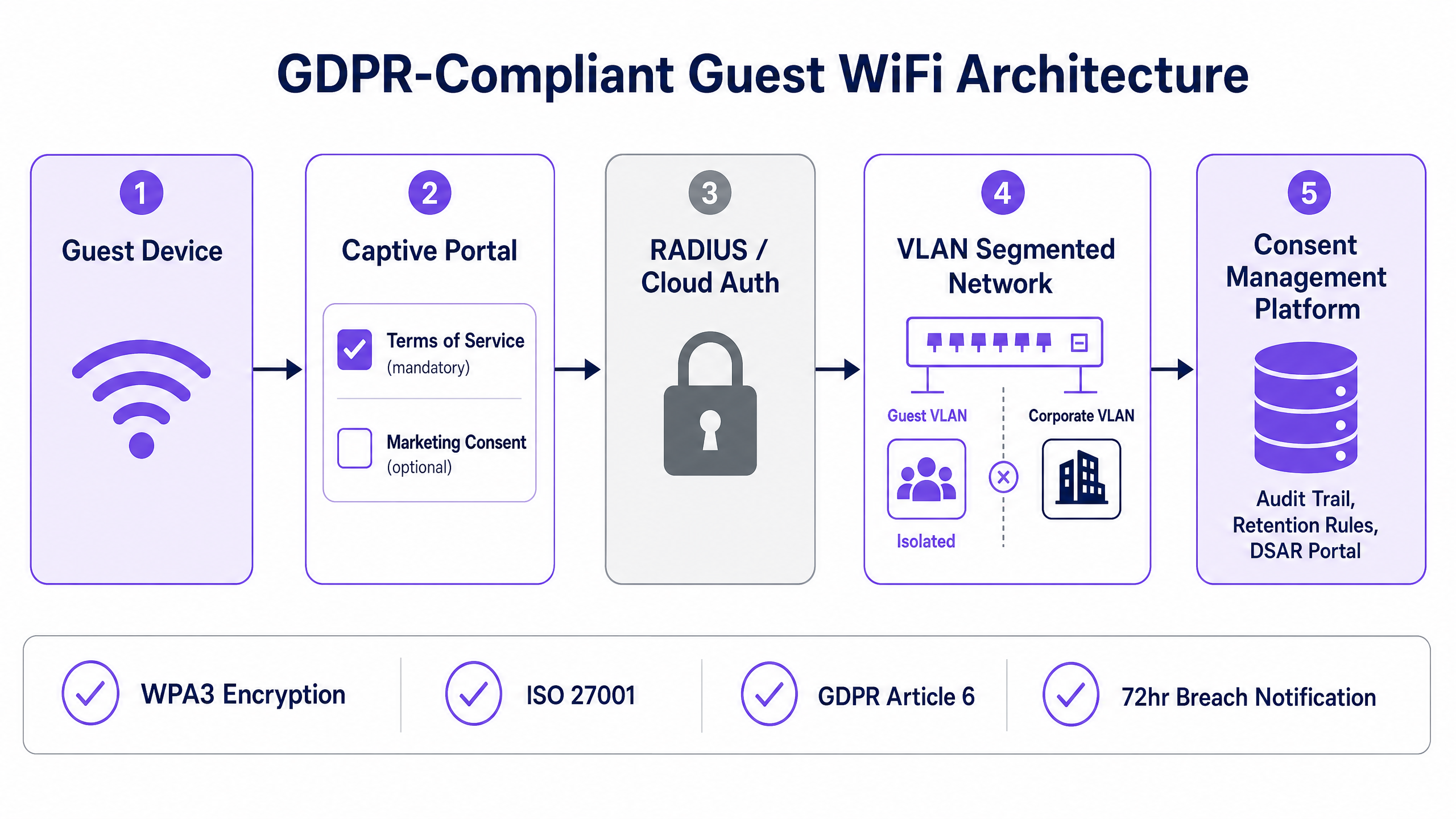
Do ponto de vista da arquitetura de rede, a segmentação de VLAN é inegociável. O tráfego de Guest WiFi deve ser isolado em uma VLAN dedicada, completamente separada da sua rede corporativa. Use listas de controle de acesso para bloquear o acesso de dispositivos de convidados a sub-redes internas e ative o isolamento de clientes para que os dispositivos de convidados não possam se comunicar entre si. Isso se aplica independentemente de você estar implantando Cisco Meraki, HPE Aruba, Ruckus, Juniper Mist ou Ubiquiti UniFi.
Para autenticação, integre seu controlador de LAN sem fio com um servidor RADIUS em nuvem. Quando um usuário conclui o fluxo do captive portal, a plataforma envia uma mensagem RADIUS Access-Accept para o controlador, concedendo acesso à rede. Isso cria uma separação clara entre a camada de autenticação e a camada de coleta de dados.
Sobre criptografia: implante WPA3 onde seu hardware for compatível. O WPA3 usa a Autenticação Simultânea de Iguais, que elimina as vulnerabilidades do handshake de quatro vias do WPA2 e oferece maior proteção contra ataques de dicionário offline. No mínimo, exija WPA2 com criptografia AES. Seu captive portal deve ser servido via HTTPS com um certificado TLS válido. Disponibilizar um formulário que coleta dados pessoais via HTTP é uma falha grave de segurança.
Guia de Implementação
A implantação de uma solução de Guest WiFi em conformidade exige planejamento e execução cuidadosos. As etapas a seguir descrevem uma abordagem independente de fornecedor para a implementação.
Etapa 1: Auditar os Fluxos de Dados Atuais
Mapeie exatamente quais dados sua rede Guest WiFi atual coleta. Identifique cada campo no seu Captive Portal, cada arquivo de log gerado pelo seu controlador sem fio e cada integração de terceiros. Documente a finalidade de cada ponto de dados. Se você não puder justificar a coleta de um ponto de dados específico, elimine-o.
Passo 2: Redesenhar o Captive Portal
Implemente um Captive Portal em conformidade, com caixas de seleção separadas e desmarcadas para os termos de rede e consentimento de marketing. Certifique-se de que a linguagem seja simples e a troca de valor seja clara. Insira um link direto para sua política de privacidade completa.
Passo 3: Automatizar a Retenção de Dados
Configure políticas de exclusão automatizadas na sua plataforma WiFi Analytics . A exclusão manual não é viável em escala.
- Logs de sessão: Elimine após 30 dias.
- Logs de segurança de rede: Retenha por até 12 meses.
- Registros de consentimento: Mantenha pela duração do relacionamento de serviço mais dois anos.
- Perfis de marketing: Exclua imediatamente quando um usuário retirar o consentimento.
Passo 4: Proteger a Borda da Rede
Segmente o tráfego de visitantes em uma VLAN dedicada. Implemente o isolamento de clientes. Force a criptografia WPA3 onde houver suporte. Certifique-se de que seu Captive Portal seja servido via HTTPS.
Passo 5: Implementar uma Central de Preferências
Forneça aos visitantes uma central de preferências de autoatendimento onde eles possam gerenciar suas configurações de consentimento e enviar Solicitações de Acesso do Titular dos Dados (DSARs). Isso reduz a carga operacional da sua equipe de TI e garante que você possa respeitar os direitos dos titulares dos dados de maneira eficiente.
Melhores Práticas
Para manter a conformidade e construir uma estratégia robusta de Guest WiFi , siga estas melhores práticas padrão do setor:
- Realizar uma DPIA: Uma Avaliação de Impacto sobre a Proteção de Dados (DPIA) é legalmente obrigatória sob o Artigo 35 do GDPR antes de implantar qualquer recurso de rastreamento de localização ou perfil comportamental em larga escala.
- Assinar um DPA: Certifique-se de ter um Adendo de Processamento de Dados (DPA) assinado com cada plataforma de terceiros que processa dados de visitantes em seu nome.
- Minimizar a Coleta de Dados: Solicite apenas os dados que você realmente precisa e pretende usar. Se você é um estabelecimento de Varejo , você realmente precisa da data de nascimento de um visitante para fornecer acesso à internet?
- Preparar-se para Violações: O cronômetro de notificação de 72 horas começa no momento em que você toma conhecimento de uma violação. Integre esse cronograma ao seu plano de resposta a incidentes e garanta que sua equipe saiba que deve notificar o ICO em até 72 horas, mesmo que a investigação não esteja concluída.
Solução de Problemas e Mitigação de Riscos
Os modos de falha comuns em implantações de Guest WiFi geralmente decorrem de um mal-entendido sobre os requisitos do GDPR.
Modo de Falha: Fadiga de Consentimento Se o seu portal for muito complexo, os visitantes abandonarão a conexão ou clicarão às cegas. Mantenha a linguagem simples. Explique a troca de valor claramente. For exemplo, "Forneça seu e-mail para um WiFi rápido e gratuito e ofertas ocasionais de nossa parte."
Modo de Falha: Ignorar os Direitos dos Titulares dos Dados Sob o GDPR, os visitantes têm o direito de acessar, retificar e apagar seus dados. Se você não tiver um processo para lidar com essas solicitações, estará exposto a um risco significativo. Uma central de preferências de autoatendimento é a estratégia de mitigação mais eficaz.
Modo de Falha: Retenção Indefinida de Dados A retenção de dados indefinidamente é uma violação direta do princípio de limitação de armazenamento do GDPR. Se você não tiver políticas de exclusão automatizadas em vigor, estará acumulando riscos a cada dia que passa. Configure regras de retenção em sua plataforma para eliminar automaticamente os registros quando eles atingirem o fim do período de retenção.
ROI e Impacto nos Negócios
A conformidade com o GDPR para Guest WiFi não é apenas um custo; é um facilitador estratégico. Uma plataforma em conformidade mitiga o risco de multas regulatórias, constrói a confiança do cliente e fornece inteligência de negócios de origem ética.
Quando um visitante opta ativamente por comunicações de marketing por meio de um Captive Portal em conformidade, a qualidade desse contato é significativamente maior do que um opt-in em lote. Os visitantes que consentem explicitamente têm mais probabilidade de se engajar com as comunicações subsequentes, gerando taxas de conversão mais altas para suas campanhas de marketing.
Além disso, uma plataforma de Guest WiFi bem arquitetada fornece insights valiosos sobre o comportamento dos visitantes. Em ambientes de Hotelaria , esses dados podem informar os níveis de pessoal, otimizar o layout e melhorar a experiência geral do visitante. Ao tratar a conformidade como um elemento fundamental da sua estratégia de Guest WiFi, você transforma um requisito regulatório em um ativo de negócios mensurável.
Ouça nosso podcast para se aprofundar nesses tópicos:
Definições principais
Data Controller
The entity that determines the purposes and means of processing personal data. When you provide Guest WiFi, you are the Data Controller.
This designation makes the venue legally responsible for compliance, regardless of which vendor supplies the WiFi hardware or software.
Data Processor
The entity that processes personal data on behalf of the Data Controller. Your WiFi analytics vendor is a Data Processor.
A signed Data Processing Addendum (DPA) is legally required before sharing data with a Processor.
MAC Address
Media Access Control address. A unique identifier assigned to a network interface controller for use as a network address in communications within a network segment.
Under GDPR, a MAC address is considered personal data when it can be linked to an identifiable individual.
Captive Portal
A web page that the user of a public-access network is obliged to view and interact with before access is granted.
This is the primary interface for collecting consent and serving privacy notices to guests.
VLAN Segmentation
The practice of dividing a physical network into multiple logical networks.
Guest WiFi traffic must be isolated on a dedicated VLAN to prevent access to the corporate network.
Legitimate Interest
A lawful basis for processing personal data when the processing is necessary for your legitimate interests or the legitimate interests of a third party, unless there is a good reason to protect the individual's personal data which overrides those legitimate interests.
Often used as the basis for basic session logging for network security and troubleshooting.
Data Subject Access Request (DSAR)
A request made by an individual to access the personal data an organisation holds about them.
Venues must have a process to handle DSARs efficiently, often facilitated by a self-service preference centre.
WPA3
Wi-Fi Protected Access 3. The latest security certification program developed by the Wi-Fi Alliance.
Provides stronger encryption and protection against offline dictionary attacks compared to WPA2. Should be deployed where hardware supports it.
Exemplos práticos
A 200-room hotel wants to collect guest emails to drive loyalty programme sign-ups. Their current system requires guests to accept marketing to get online.
Deploy a compliant captive portal with separate consent checkboxes. The mandatory checkbox covers terms of service. The optional, unticked checkbox covers marketing consent. The hotel will likely see a lower raw volume of marketing opt-ins compared to the bundled approach, but the quality and legality of the list improves dramatically. Guests who actively opt in are far more likely to engage with subsequent communications. Premier Inn, which uses Purple across its estate, operates exactly this model.
A stadium IT team wants to use WiFi analytics to monitor crowd density and manage safety, but the legal team is concerned that tracking device locations without consent is a GDPR violation.
Update the captive portal privacy notice to explicitly disclose that location data is processed for crowd management and safety purposes. Implement MAC address pseudonymisation at the edge, on the access points themselves, before the data reaches the cloud analytics platform. The analytics system then works with pseudonymous identifiers rather than raw MAC addresses.
Questões práticas
Q1. A retail chain wants to implement WiFi footfall tracking across 50 stores to measure dwell time. The IT Director suggests logging raw MAC addresses centrally for analysis. Is this compliant?
Dica: Consider the definition of personal data and the principle of data minimisation.
Ver resposta modelo
No, this is high risk. Raw MAC addresses are personal data. The recommended approach is to implement MAC address pseudonymisation at the edge (on the access points) before transmitting the data to the central analytics platform. Additionally, a Data Protection Impact Assessment (DPIA) must be conducted before deployment, and clear signage must inform shoppers that analytics are in operation.
Q2. During an audit, you discover that your captive portal requires users to accept both the network terms of service and marketing emails via a single checkbox to connect to the WiFi. What is the immediate required action?
Dica: Review the requirements for valid consent under GDPR Article 6.
Ver resposta modelo
Immediately redesign the captive portal to unbundle the consent. Implement two separate checkboxes: a mandatory one for the network terms of service, and an optional, unticked checkbox for marketing consent. The current bundled approach renders all collected marketing consent invalid under GDPR.
Q3. A guest submits a Data Subject Access Request (DSAR) asking for all data your venue holds on them, including WiFi session logs. Your current retention policy is to keep session logs indefinitely. What are the implications?
Dica: Consider the storage limitation principle.
Ver resposta modelo
Keeping session logs indefinitely violates the GDPR storage limitation principle. You must fulfill the DSAR by providing the requested data, but you must also urgently implement an automated data retention policy. Session logs should typically be purged after 30 days. Holding them indefinitely exposes the venue to significant regulatory risk.
Continue a ler esta série
O Guia Corporativo do SCEP: Implantando o Simple Certificate Enrollment Protocol para Segurança Automatizada de WiFi em Campi
Este guia de referência técnica fornece um modelo de arquitetura definitivo e uma estratégia de implementação passo a passo para a implantação de certificados de WiFi corporativo usando SCEP. Ele aborda as diferenças críticas entre SCEP e PKCS, a sequência exata de implantação necessária para o sucesso e estratégias reais de mitigação de riscos para líderes de TI.
Por que meu WiFi de convidados não conecta? Solucionando problemas de Captive Portal
Este guia de referência técnica definitivo explica a mecânica subjacente da detecção de Captive Portal e detalha os seis principais modos de falha que impedem a conexão do WiFi de convidados. Ele fornece aos gerentes de TI e arquitetos de rede uma estrutura prática de solução de problemas para resolver problemas de redirecionamento HTTP, conflitos de DNS e desafios de randomização de MAC.
Como implementar o SCEP para registro automatizado de certificados WiFi
Este guia explica como implementar o SCEP (Simple Certificate Enrollment Protocol) para registro automatizado de certificados WiFi em locais corporativos. Ele abrange o projeto de arquitetura completo — desde o design de PKI e integração de MDM até a sequência obrigatória de implantação em três etapas — e mostra a gerentes de TI e arquitetos de rede como eliminar credenciais compartilhadas, automatizar o gerenciamento do ciclo de vida de certificados e atender aos requisitos do PCI DSS e GDPR em escala.