

Como um Captive Portal Funciona? Análise Técnica Aprofundada
Uma análise técnica aprofundada e abrangente da arquitetura de captive portals, explicando a interceptação de DNS, redirecionamento HTTP, walled gardens e autenticação RADIUS para profissionais de TI.
🎧 Ouça este Guia
Ver Transcrição

Resumo Executivo
Para gerentes de TI e arquitetos de rede que implementam Guest WiFi público ou corporativo, o captive portal é a fronteira crítica entre um dispositivo não autenticado e sua infraestrutura de rede. Este guia oferece uma análise técnica aprofundada de como um captive portal funciona—removendo a camada de marketing para examinar os mecanismos subjacentes de interceptação de DNS, redirecionamento HTTP, configuração de walled garden e autenticação RADIUS.
Seja você projetando uma implantação de alta densidade para um estádio, uma rede distribuída para Varejo , ou uma solução em conformidade para Saúde , compreender o ciclo de vida da sessão e as dependências arquitetônicas é essencial. Um portal mal configurado leva a experiências de usuário degradadas, avisos de segurança do navegador e potenciais falhas de conformidade. Este guia de referência descreve a arquitetura técnica, melhores práticas de implementação e modos de falha comuns para garantir que sua implantação seja segura, escalável e em conformidade com padrões modernos como WPA3 e Passpoint.
Análise Técnica Aprofundada
Em sua essência, um captive portal é um mecanismo de controle de acesso à rede da Camada 3. Ele intercepta o tráfego de um dispositivo associado, mas não autenticado, redirecionando o usuário para uma interface de autenticação antes de conceder acesso total à rede.
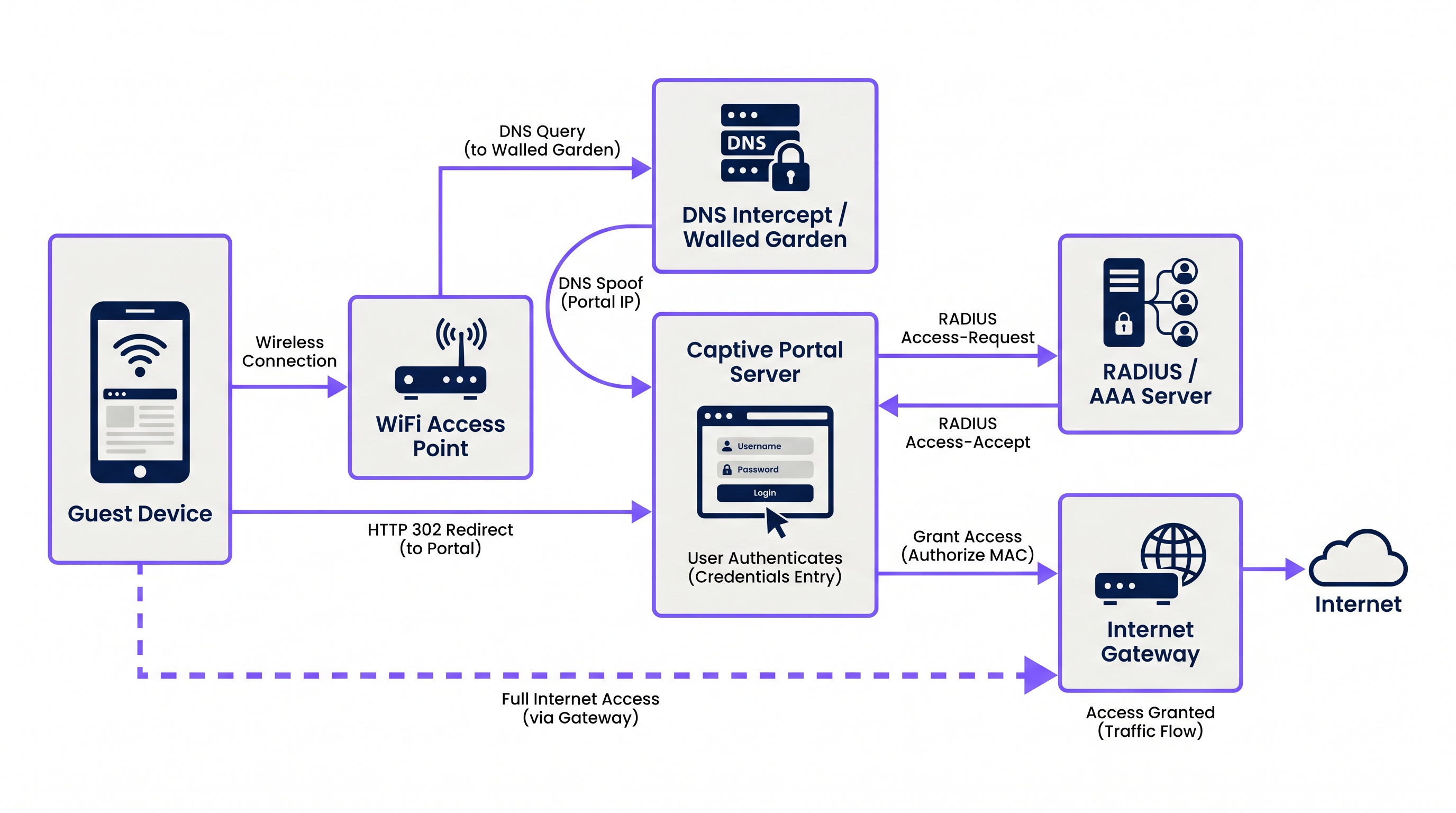
O processo depende de uma sequência coordenada de serviços de rede:
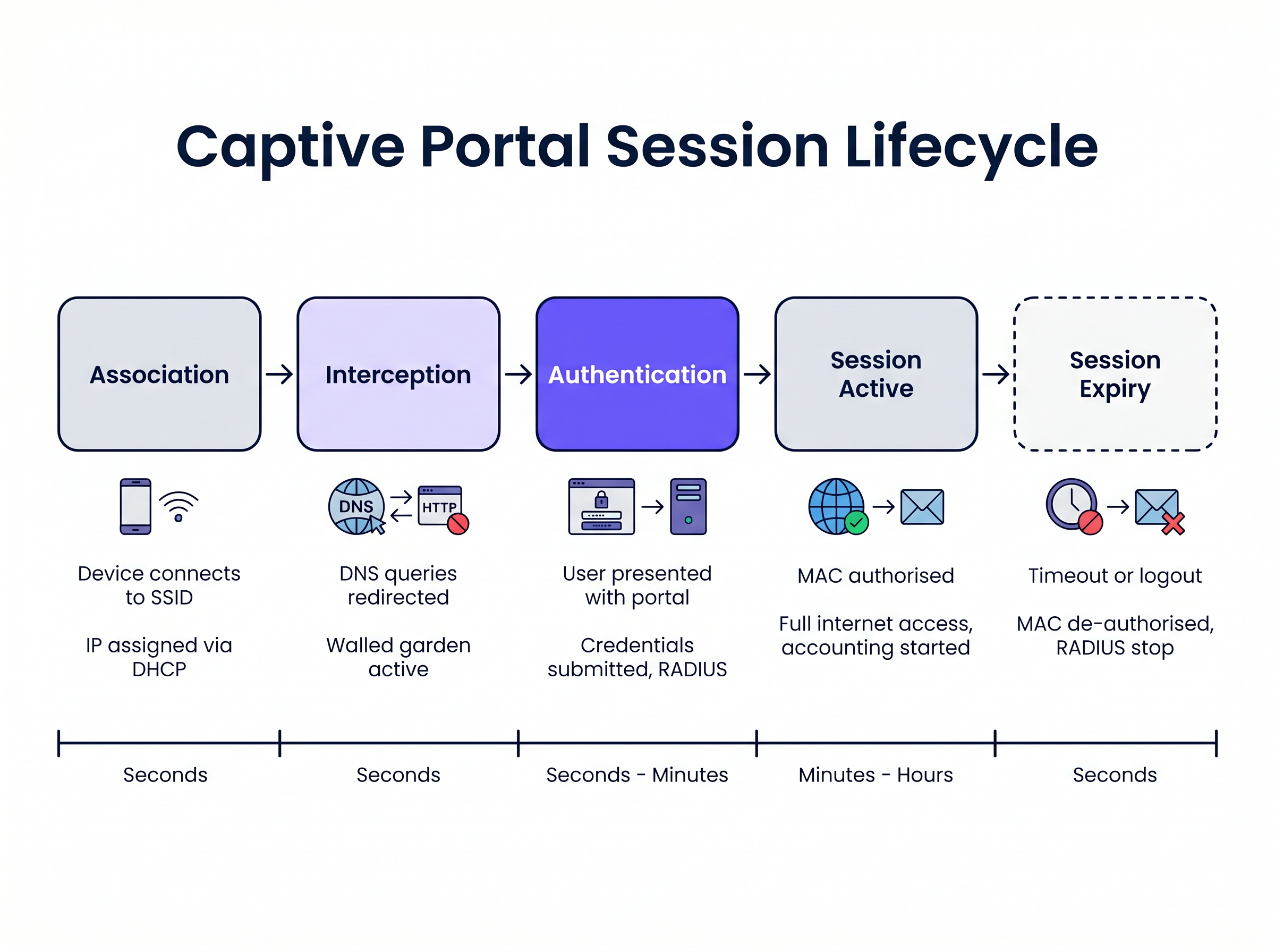
1. Associação e Atribuição de IP Quando um dispositivo convidado se conecta ao SSID, o ponto de acesso sem fio ou controlador faz a ponte da conexão para uma VLAN específica. O servidor DHCP local atribui um endereço IP, máscara de sub-rede e gateway padrão. Nesta fase, o dispositivo está conectado na Camada 2, mas está em um estado "pré-autenticado" na Camada 3. Todo o tráfego de saída está sujeito a listas de controle de acesso (ACLs) rigorosas, aplicadas pelo servidor de acesso à rede (NAS), tipicamente o controlador de LAN sem fio (WLC) ou firewall de borda.
2. Interceptação de DNS (DNS Spoofing)
Para acionar o captive portal, a rede deve interceptar as solicitações web iniciais do usuário. Quando o dispositivo tenta resolver um nome de domínio (por exemplo, www.example.com), a consulta DNS é interceptada pelo NAS ou por um servidor DNS dedicado dentro do walled garden. Em vez de retornar o endereço IP público real para o domínio solicitado, o servidor DNS retorna o endereço IP do servidor captive portal.
3. Redirecionamento HTTP Quando o navegador do cliente tenta uma conexão HTTP com o endereço IP falsificado, o servidor captive portal responde com um redirecionamento HTTP 302 (Encontrado) ou HTTP 303 (Ver Outro). Isso instrui o navegador a navegar para a URL real da página de login do captive portal.
Sistemas operacionais modernos empregam mecanismos de Captive Network Assistant (CNA) para detectar isso automaticamente. Ao conectar-se a uma rede, o SO envia uma solicitação HTTP GET para uma URL de sonda conhecida (por exemplo, captive.apple.com para iOS/macOS, msftconnecttest.com para Windows). Se o SO receber um redirecionamento HTTP em vez do esperado 200 OK ou de uma carga HTML específica, ele assume que um captive portal está presente e lança automaticamente um pseudo-navegador para exibir a página do portal.
4. O Walled Garden Durante o estado pré-autenticado, o usuário deve ser capaz de carregar a página do portal e seus ativos associados. O "walled garden" é uma lista branca de endereços IP, sub-redes e domínios configurados no NAS. O tráfego destinado a esses locais na lista branca é permitido, enquanto todo o outro tráfego é descartado. Um walled garden configurado corretamente deve incluir:
- O endereço IP do servidor captive portal.
- Redes de Entrega de Conteúdo (CDNs) hospedando CSS, JavaScript e ativos de imagem para a página do portal.
- Provedores de identidade (por exemplo, Facebook, Google) se o login social estiver ativado.
- Gateways de pagamento se o portal exigir acesso pago.
5. Autenticação e RADIUS
Assim que o usuário envia suas credenciais ou aceita os termos de serviço, o servidor captive portal atua como um cliente RADIUS. Ele constrói um pacote RADIUS Access-Request contendo os detalhes do usuário e o envia para o servidor RADIUS (Remote Authentication Dial-In User Service).
O servidor RADIUS valida a solicitação em seu banco de dados. Se bem-sucedido, ele retorna um pacote Access-Accept. Crucialmente, este pacote pode incluir Atributos Específicos do Fornecedor (VSAs) que definem os parâmetros da sessão, como Session-Timeout (duração máxima da conexão), Idle-Timeout e limites de taxa de largura de banda.
6. Ativação e Contabilização da Sessão
Ao receber o Access-Accept, o servidor captive portal instrui o NAS a autorizar o endereço MAC do cliente. As restrições do walled garden são removidas, e o dispositivo recebe acesso total à internet. Simultaneamente, o NAS envia um pacote RADIUS Accounting-Request (Start) para o servidor RADIUS para iniciar o rastreamento da sessão para fins de análise e conformidade.
Guia de Implementação
A implantação de um captive portal robusto requer coordenação cuidadosa entre a infraestrutura sem fio e a plataforma do portal. Para gerentes de TI que avaliam Provedores de Guest WiFi: O Que Procurar ao Escolher uma Plataforma WiFi , considere as seguintes abordagens arquitetônicas:
Hospedado na Nuvem vs. Local Implantações corporativas modernas elefavorecem fortemente a infraestrutura de portal e RADIUS hospedada na nuvem. Plataformas como Purple fornecem uma arquitetura RADIUS distribuída globalmente, eliminando a necessidade de servidores AAA locais. O WLC local simplesmente direciona suas solicitações de autenticação e contabilidade RADIUS para os endpoints do provedor de nuvem. Essa abordagem escala de forma contínua e centraliza o gerenciamento em vários locais, o que é particularmente benéfico para ambientes distribuídos de Hotelaria e varejo.
Configuração de Walled Garden A causa mais frequente de problemas de renderização do portal é um walled garden incompleto. Páginas web modernas dependem fortemente de recursos externos. Se uma fonte ou uma biblioteca JavaScript hospedada em um CDN de terceiros for bloqueada, o portal pode travar ou renderizar incorretamente no navegador CNA do sistema operacional.
- Recomendação: Use entradas de walled garden baseadas em domínio onde seu WLC as suporte (por exemplo,
*.purple.ai). Se seu hardware suportar apenas walled gardens baseados em IP, você deve manter uma lista atualizada dos sub-redes IP do provedor do portal.
Tratamento de Interceptação HTTPS Historicamente, os captive portals interceptavam todo o tráfego da porta 80 (HTTP) e da porta 443 (HTTPS). No entanto, com a ampla adoção do HTTP Strict Transport Security (HSTS), a interceptação de tráfego HTTPS faz com que os navegadores exibam avisos de segurança graves, pois o certificado SSL do portal não corresponderá ao domínio solicitado.
- Recomendação: Nunca intercepte tráfego HTTPS. Confie inteiramente nos mecanismos CNA nativos do sistema operacional (que sondam via HTTP) ou instrua explicitamente os usuários a navegar para uma URL HTTP conhecida (por exemplo,
http://neverssl.com) para acionar o redirecionamento.
Melhores Práticas
1. Cache de Endereço MAC para Roaming Contínuo
Para melhorar a experiência do usuário, implemente o cache de endereço MAC. Quando um usuário se autentica com sucesso, o servidor RADIUS registra seu endereço MAC. Se o usuário se desconectar e retornar dentro de um período especificado (por exemplo, 30 dias), o WLC envia uma solicitação de desvio de autenticação MAC (MAB) ao servidor RADIUS. O servidor reconhece o endereço MAC e retorna um Access-Accept imediatamente, concedendo acesso à rede sem exigir que o usuário interaja com o portal novamente.
2. Projetando para o Assistente de Rede Cativa (CNA) Os pseudo-navegadores lançados por iOS e Android para exibir captive portals têm funcionalidade limitada em comparação com navegadores completos. Eles frequentemente não suportam pop-ups, têm restrições rigorosas de tempo limite e lidam com cookies de forma diferente.
- Recomendação: Mantenha a interface do usuário do portal leve. Evite frameworks JavaScript complexos ou ativos de mídia pesados que possam fazer com que o CNA expire. Se você precisar de interações complexas (como downloads de aplicativos), use o portal para autorizar o dispositivo primeiro e, em seguida, redirecione o usuário para seu navegador nativo.
3. Integração com OpenRoaming e Passpoint Embora os captive portals permaneçam essenciais para a captura de dados e aceitação de termos, a indústria está se movendo em direção a padrões de autenticação contínua como Passpoint (Hotspot 2.0). Purple atua como um provedor de identidade gratuito para serviços como OpenRoaming sob a licença Connect. Dispositivos configurados com um perfil OpenRoaming podem se autenticar com segurança na Camada 2 (via 802.1X/EAP) sem interagir com um captive portal, proporcionando uma experiência de roaming semelhante à celular. Sua infraestrutura deve suportar ambos os mecanismos simultaneamente.
Solução de Problemas e Mitigação de Riscos
Sintoma: A página do portal não aparece automaticamente em dispositivos móveis.
- Causa Raiz: O walled garden está mal configurado, permitindo que as solicitações de sonda CNA do sistema operacional alcancem a internet diretamente. Se o sistema operacional receber um
200 OKdecaptive.apple.com, ele assume que tem acesso total à internet e não iniciará o portal. - Mitigação: Certifique-se de que os domínios de sonda CNA não estejam na lista branca do walled garden. Eles devem ser interceptados e redirecionados para o servidor do portal.
Sintoma: Usuários veem um aviso de certificado SSL/TLS.
- Causa Raiz: O WLC está tentando interceptar o tráfego HTTPS e está apresentando o certificado SSL do portal em vez do certificado para o domínio solicitado pelo usuário.
- Mitigação: Desative o redirecionamento HTTPS no WLC.
Sintoma: O login social (por exemplo, Facebook, Google) falha ao carregar ou autenticar.
- Causa Raiz: Os domínios necessários para o fluxo OAuth do provedor de identidade estão faltando no walled garden.
- Mitigação: Audite a configuração do walled garden em relação à documentação atual do provedor de identidade. Observe que esses intervalos de IP e domínios mudam frequentemente.
ROI e Impacto nos Negócios
Um captive portal não é meramente uma necessidade técnica; é um ativo estratégico. Ao substituir chaves pré-compartilhadas genéricas (PSKs) por um portal gerenciado, as organizações alcançam:
- Captura de Dados e Automação de Marketing: A integração do portal com uma plataforma de Análise de WiFi permite que os locais coletem dados primários verificados (e-mails, dados demográficos) em troca de acesso. Esses dados alimentam sistemas de CRM e campanhas de marketing direcionadas.
- Conformidade e Mitigação de Riscos: Operadores de WiFi público estão sujeitos a leis de retenção de dados e responsabilidade por violação de direitos autorais. Um captive portal com contabilidade RADIUS fornece um registro auditável de qual dispositivo (endereço MAC) deteve qual endereço IP em um momento específico, protegendo o local de responsabilidade.
- Gerenciamento de Largura de Banda: Ao aplicar atributos RADIUS como
Filter-IdouWISPr-Bandwidth-Max-Down, a TI pode evitar que usuários individuais monopolizem a conexão WAN, garantindo uma experiência consistente para todos os convidados e protegendo o tráfego crítico de back-office. Isso é particularmente relevante ao avaliar Os Principais Benefícios do SD WAN para Empresas Modernas .
Termos-Chave e Definições
Walled Garden
An access control list (ACL) applied to unauthenticated users, permitting traffic only to specific IP addresses or domains required to load the captive portal.
Crucial for allowing access to CDNs, payment gateways, and social login APIs before the user is fully authorised.
RADIUS (Remote Authentication Dial-In User Service)
The industry-standard networking protocol that provides centralised Authentication, Authorisation, and Accounting (AAA) management.
The captive portal server uses RADIUS to tell the wireless controller whether a user is allowed on the network and what restrictions apply.
Captive Network Assistant (CNA)
A pseudo-browser built into modern operating systems (iOS, Android, Windows) designed specifically to detect and display captive portals.
CNAs have limited functionality compared to full browsers; portals must be designed to accommodate their constraints.
MAC Authentication Bypass (MAB)
A process where the network uses a device's MAC address as its identity to authenticate against a RADIUS server without user interaction.
Used to implement 'MAC Caching', allowing returning guests to connect seamlessly without seeing the portal again.
DNS Interception / Spoofing
The process where the network intercepts a user's DNS query and returns the IP address of the captive portal server instead of the actual destination.
This is the primary mechanism used to force the user's web traffic to the portal page.
HTTP 302 Redirect
An HTTP response status code indicating that the requested resource has been temporarily moved to a different URI.
Used by the portal server to redirect the intercepted HTTP request to the actual login page URL.
Vendor-Specific Attributes (VSAs)
Custom parameters included in a RADIUS message that allow vendors to support features not defined in the base RADIUS standard.
Used to pass specific policies, like bandwidth limits or VLAN assignments, from the portal platform to the specific brand of wireless controller.
Passpoint (Hotspot 2.0)
A standard that enables mobile devices to automatically discover and authenticate to Wi-Fi networks securely without user interaction.
The modern alternative to captive portals for seamless roaming; platforms like Purple act as identity providers for Passpoint networks.
Estudos de Caso
A 500-room hotel is upgrading its guest WiFi. They want returning guests to connect seamlessly without seeing the portal again for 30 days, but they require a daily bandwidth limit of 10Mbps per device.
- Configure the WLC to use external RADIUS authentication pointing to the cloud provider. 2. Enable MAC Address Caching on the RADIUS server with a 30-day retention policy. 3. Configure the portal profile to assign a RADIUS Vendor-Specific Attribute (VSA) for bandwidth limiting (e.g., WISPr-Bandwidth-Max-Down = 10000000) in the Access-Accept packet.
A retail chain deploys a new captive portal featuring a Facebook login option. Users report that when they click the Facebook button, the page hangs indefinitely inside the captive portal pop-up.
The WLC's walled garden configuration is incomplete. The network administrator must add Facebook's required OAuth domains (e.g., graph.facebook.com, connect.facebook.net) and IP subnets to the pre-authentication ACL.
Análise de Cenário
Q1. You are deploying a captive portal at a stadium. The portal requires users to watch a 15-second video hosted on YouTube before gaining access. Users are reporting that the portal loads, but the video frame is blank. What is the most likely architectural cause?
💡 Dica:Consider the state of the device before it is fully authenticated and what resources it needs to access.
Mostrar Abordagem Recomendada
The walled garden configuration is incomplete. The network administrator must add YouTube's video delivery domains and CDNs to the walled garden ACL. Without this, the unauthenticated device cannot reach the YouTube servers to stream the video content, even though the main portal page (hosted elsewhere) loads successfully.
Q2. A client insists on intercepting all HTTPS traffic to force users to the captive portal, arguing that users rarely type 'http://' anymore. Why is this a bad idea, and what is the standard alternative?
💡 Dica:Think about how modern browsers handle SSL/TLS certificates and HSTS.
Mostrar Abordagem Recomendada
Intercepting HTTPS traffic requires the wireless controller to present a certificate for the requested domain (e.g., google.com). Since the controller does not possess Google's private key, the browser will flag the connection as insecure and display a severe certificate warning, breaking the user experience. The standard alternative is to rely on the Operating System's built-in Captive Network Assistant (CNA), which automatically probes known HTTP URLs in the background specifically to trigger the redirect gracefully.
Q3. A venue wants to limit guest WiFi sessions to 2 hours. How is this enforced technically within the captive portal architecture?
💡 Dica:Which component is responsible for Authorisation and passing policy parameters to the network hardware?
Mostrar Abordagem Recomendada
This is enforced via RADIUS. When the captive portal server successfully authenticates the user, it receives an Access-Accept packet from the RADIUS server. This packet includes a 'Session-Timeout' attribute set to 7200 seconds (2 hours). The wireless controller reads this attribute, applies the timer to the user's session, and automatically disconnects the device when the timer expires.




