
O Impacto dos Anúncios em Vídeo no Desempenho da Rede de Convidados
Este guia explora como os anúncios em vídeo de reprodução automática consomem silenciosamente a taxa de transferência da rede de convidados em ambientes de alta densidade. Ele fornece estratégias práticas e independentes de fornecedor para que gerentes de TI e arquitetos de rede recuperem largura de banda usando filtragem de DNS de borda.
Video overview
Ouça este guia
Ver transcrição do podcast
Parte da nossa série principal: Guia de WiFi de Convidados →

Resumo Executivo
Para CTOs e arquitetos de rede que gerenciam locais de alta densidade - como estádios, centros de varejo, ambientes de hospitalidade e hubs de transporte - o desempenho do WiFi de convidados é uma métrica operacional crítica. No entanto, o planejamento padrão de capacidade de rede frequentemente ignora uma pressão silenciosa e estrutural sobre a largura de banda: os anúncios em vídeo de reprodução automática.
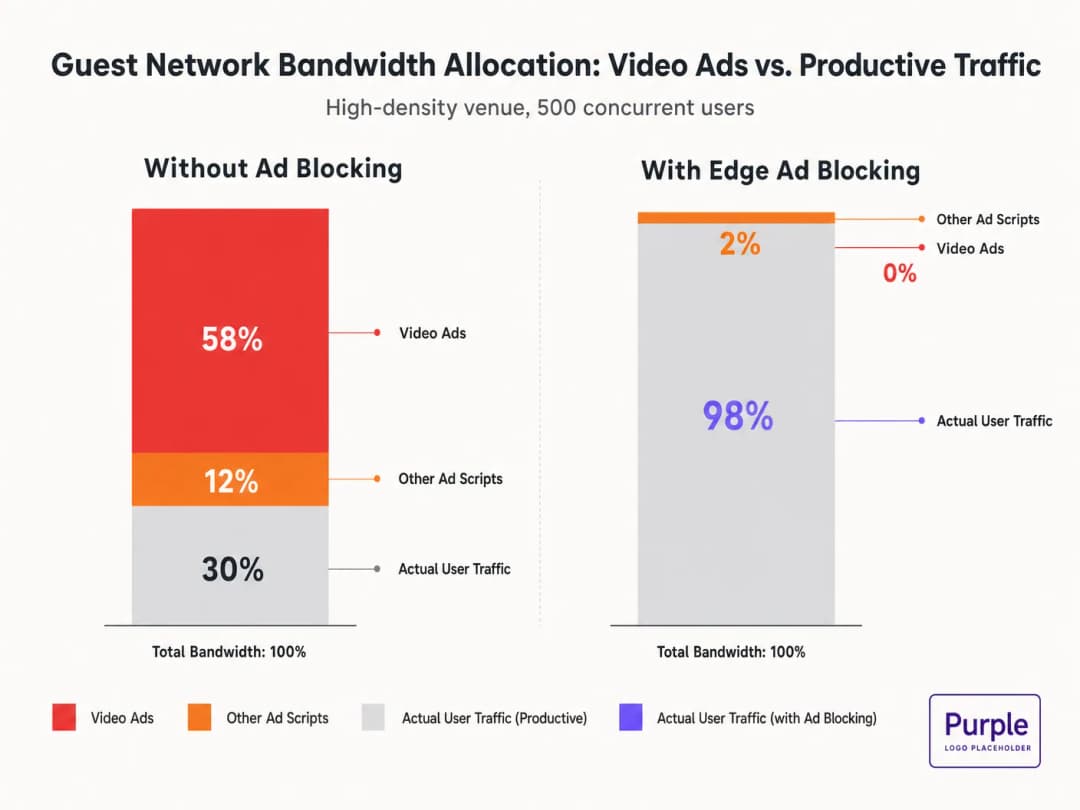
Quando os convidados se conectam à rede e navegam em ativos web padrão, seus dispositivos iniciam dezenas de conexões em segundo plano com redes de distribuição de anúncios. Esses fluxos de vídeo com taxa de bits adaptável podem consumir até 50-70% da largura de banda disponível, degradando a experiência de todos os usuários e saturando os links de backhaul. Este guia detalha a mecânica técnica desse dreno de largura de banda e fornece um modelo neutro de fornecedor para mitigá-lo na borda usando filtragem de DNS. Ao implementar essas estratégias, os locais podem melhorar drasticamente o desempenho do guest WiFi sem esperar por ciclos de atualização de hardware, reduzindo os custos de infraestrutura e aumentando a conformidade.
Ouça nosso briefing sobre este tema:
Deep Dive Técnico: A Física da Saturação de Rede por Anúncios
Anatomia de uma Requisição Web
Quando um usuário em uma rede de convidados acessa um site monetizado por anúncios, o comportamento do navegador é altamente agressivo. O carregamento de uma única página normalmente dispara conexões para 8 a 40 domínios de terceiros distintos, incluindo ad exchanges, plataformas de demanda (DSPs) e redes de entrega de conteúdo (CDNs).
A Penalidade de Banda dos Anúncios em Vídeo
Os anúncios em vídeo, especialmente os formatos pre-roll e mid-roll distribuídos por grandes redes, são entregues como transmissões de taxa de bits adaptável. A CDN testa a largura de banda disponível e fornece a transmissão com a melhor qualidade possível. Em um ambiente de alta densidade com 500 usuários simultâneos, se 20% dos usuários iniciarem uma transmissão de anúncio de 1080p a 4 - 8 Mbps, a demanda agregada aumenta instantaneamente de 400 a 800 Mbps. Esse tráfego indesejado ignora a modelagem padrão de Qualidade de Serviço (QoS) porque se origina de conexões HTTPS legítimas.
Consumo de Tempo de Transmissão e Ineficiência Espectral
Além da saturação do backhaul, os anúncios em vídeo consomem tempo de transmissão de rádio valioso. Em um meio sem fio compartilhado, cada dispositivo que recebe ativamente uma transmissão de alta taxa de bits reduz as oportunidades de transmissão para outros dispositivos. Embora o padrão IEEE 802.11ax (WiFi 6) tenha introduzido OFDMA e BSS Coloring para melhorar a eficiência espectral, esses mecanismos não conseguem compensar o volume massivo de dados exigido pelas redes de anúncios. A camada de rádio fica congestionada, aumentando a latência e a perda de pacotes para o tráfego produtivo.
Cascata de Latência de Resolução DNS
A entrega de anúncios depende de cadeias de redirecionamento complexas. Uma única impressão de anúncio pode exigir de 6 a 12 consultas DNS antes mesmo que a transmissão do vídeo comece. Em uma implantação densa, isso escala rapidamente a carga no resolvedor DNS local. Quando o resolvedor se torna um gargalo, a latência dispara, causando uma degradação perceptível no tempo de carregamento da página para todos os usuários na rede.
Tem dúvidas sobre a sua configuração específica?
A nossa equipa trabalha com operadores de espaços, gestores de TI e engenheiros de rede em 80.000 locais. Agende uma chamada de 20 minutos e mostraremos como outros profissionais na sua situação o resolveram.
Guia de Implementação: Arquitetura de Filtragem DNS na Borda
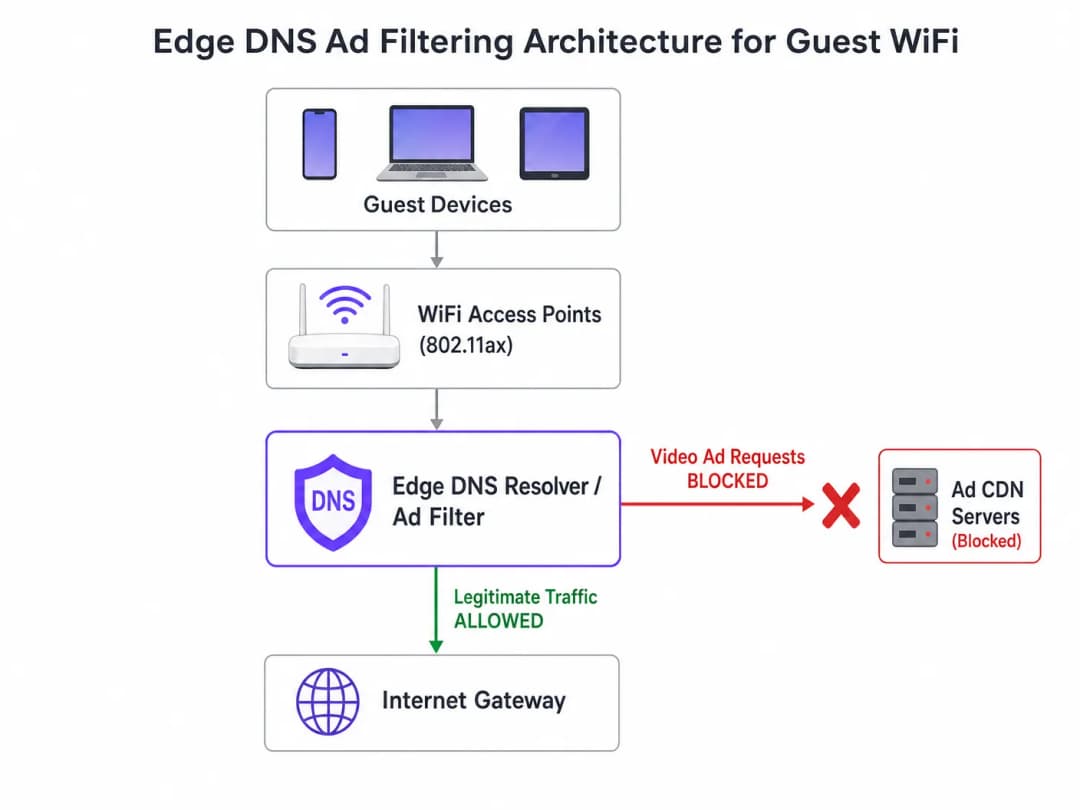
A intervenção arquitetônica mais eficaz é a filtragem DNS na borda. Ao bloquear domínios de redes de anúncios no nível do resolvedor, a rede impede que as conexões TCP cheguem a ser estabelecidas. Essa abordagem é stateless, escala linearmente e adiciona uma latência insignificante.
Estratégia de Implantação Passo a Passo
- Instrumentação Passiva: Implante o registro passivo de DNS na rede de convidados por 48 - 72 horas para estabelecer um perfil de tráfego de linha de base. Identifique os domínios mais consultados e seu volume. Use plataformas como WiFi analytics para visualizar esses dados.
- Aplicação Conservadora de Lista de Bloqueio: Não implemente listas de bloqueio comunitárias massivas (ex.: lista do Steven Black) no primeiro dia. Comece com os 500 principais domínios conhecidos de entrega de anúncios em vídeo. Verifique se a entrega de conteúdo legítimo não é afetada.
- Configuração de DNS Split-Horizon: Garanta uma separação rigorosa entre a infraestrutura de DNS corporativa e de convidados. A política de filtragem deve ser restrita exclusivamente à VLAN de convidados para evitar interrupções operacionais.
- Manutenção Automatizada de Listas de Bloqueio: As redes de anúncios rotacionam domínios dinamicamente e usam Algoritmos de Geração de Domínio (DGAs). Configure o resolver para buscar feeds atualizados de inteligência de ameaças e listas de bloqueio pelo menos a cada 4 horas.
- Tratamento de DNS sobre HTTPS (DoH): Os navegadores modernos podem tentar contornar os resolvers locais usando DoH. Mitigue isso bloqueando a porta de saída TCP/UDP 443 para intervalos de IP de provedores de DoH conhecidos, forçando um fallback para o resolver fornecido pela rede.
Para se aprofundar nos detalhes de configuração, consulte nosso guia sobre Como Melhorar a Velocidade do WiFi Bloqueando Redes de Anúncios na Borda.
Melhores Práticas e Conformidade
Privacidade por Design (GDPR Artigo 25)
A implementação da filtragem de DNS na borda se alinha com os princípios de privacidade por design da GDPR. Ao evitar conexões com domínios de rastreamento de terceiros, a rede protege inerentemente os dados dos convidados contra coleta não autorizada. Essa postura proativa reduz a carga de conformidade do estabelecimento.
Segmentação de Rede (PCI-DSS)
Para estabelecimentos de varejo e hotelaria que processam pagamentos, o PCI-DSS exige uma segmentação de rede rigorosa. A filtragem de DNS reforça esse limite, garantindo que os dispositivos dos convidados não possam, inadvertidamente, servir como vetores para cargas maliciosas entregues por meio de redes de anúncios comprometidas (malvertising).
Experiência de Usuário Transparente
Diferente dos anúncios intercalados do Captive Portal ou da inspeção profunda de pacotes, a filtragem de DNS é transparente. O usuário experimenta carregamentos de página mais rápidos e menor consumo de bateria. Se um espaço de anúncio não carregar, ele normalmente encolhe ou exibe um espaço vazio, o que raramente é percebido pelo usuário como uma falha de rede.
Resolução de Problemas e Mitigação de Riscos
| Modo de Falha | Causa Raiz | Estratégia de Mitigação |
|---|---|---|
| Bloqueio Excessivo de Conteúdo Legítimo | Bloqueio no nível raiz de CDNs compartilhadas (ex.: Akamai, Fastly). | Aplique a filtragem no nível do subdomínio. Mantenha uma lista de permissões robusta para serviços críticos do estabelecimento. |
| Evasão de Filtragem via DoH | Navegadores usando resolvers DoH codificados no sistema. | Aplique rota nula para IPs de provedores DoH conhecidos. Implemente políticas de túnel dividido se estiver usando gerenciamento de dispositivos móveis (MDM). |
| Exaustão de CPU do Resolver | Infraestrutura de DNS subdimensionada lidando com respostas NXDOMAIN excessivas. | Dimensione os resolvers com CPU/RAM adequados. Use cache de forma agressiva. Considere resolvers recursivos hospedados na nuvem para maior elasticidade. |
ROI e Impacto nos Negócios
O impacto comercial da filtragem de DNS na borda é imediato e mensurável:
- Recuperação de Largura de Banda: Os locais normalmente recuperam de 30-50% da largura de banda da rede de convidados, adiando atualizações caras de backhaul.
- Maior Satisfação dos Convidados: Carregamentos de página mais rápidos e conectividade confiável correlacionam-se diretamente com pontuações mais altas de Net Promoter Scores (NPS) e avaliações positivas do local.
- Eficiência Operacional: Menos chamados de suporte técnico relacionados a "WiFi lento" permitem que as equipes de TI se concentrem em iniciativas estratégicas, como a implantação do modo de mapas offline ou a expansão de integrações de cidades inteligentes, conforme defendido por nossa liderança (consulte Purple nomeia Iain Fox como VP de Crescimento).
- Postura de Segurança Aprimorada: Bloquear proativamente domínios de rastreamento e malvertising simplifica as auditorias de segurança e os relatórios de conformidade. Saiba mais em nosso artigo sobre como manter uma postura segura: Explique o que é uma trilha de auditoria para segurança de TI em 2026.
Definições principais
Filtragem de DNS de Borda
A prática de bloquear o acesso a domínios específicos no nível do resolvedor de DNS local, impedindo que os dispositivos resolvam os endereços IP de redes de anúncios conhecidas.
Usado pelas equipes de TI para descartar silenciosamente o tráfego indesejado antes mesmo que uma conexão TCP seja tentada, economizando largura de banda e melhorando o desempenho.
Streaming de Taxa de Bits Adaptável (ABR)
Uma tecnologia que ajusta dinamicamente a qualidade de um fluxo de vídeo com base na largura de banda disponível do usuário.
As redes de anúncios usam ABR para veicular vídeos com a maior qualidade possível, o que consome de forma agressiva a taxa de transferência disponível do WiFi de convidados.
Split-Horizon DNS
Uma configuração onde diferentes respostas de DNS são fornecidas dependendo do endereço IP de origem da consulta (por exemplo, convidados versus corporativo).
Essencial para aplicar políticas de filtragem restritivas a redes de convidados sem impactar as operações administrativas.
DNS sobre HTTPS (DoH)
Um protocolo para realizar resolução de DNS remota por meio do protocolo HTTPS, criptografando as consultas.
O DoH pode ignorar a filtragem de borda local; os arquitetos de rede devem bloquear ativamente provedores de DoH conhecidos para aplicar as políticas de DNS locais.
Coloração BSS
Um recurso do Wi-Fi 6 (802.11ax) que adiciona um identificador de "cor" às transmissões, permitindo que os pontos de acesso ignorem o tráfego de redes sobrepostas.
Melhora a eficiência do rádio em locais densos, mas não resolve a saturação do backhaul causada por anúncios em vídeo.
NXDOMAIN
Um código de resposta DNS que indica que o nome de domínio solicitado não existe.
A resposta padrão retornada por um resolvedor de filtragem quando um dispositivo tenta consultar um domínio de rede de anúncios bloqueado.
Algoritmo de Geração de Domínio (DGA)
Técnicas usadas por malwares e algumas redes de anúncios agressivas para gerar periodicamente novos nomes de domínio para evitar listas de bloqueio estáticas.
Exige que as equipes de TI usem feeds de inteligência de ameaças dinâmicos e atualizados com frequência, em vez de arquivos hosts estáticos.
Malvertising
O uso de publicidade online para distribuir malware ou redirecionar usuários para sites maliciosos.
Bloquear redes de anúncios na borda protege inerentemente os dispositivos dos visitantes contra essas ameaças, melhorando a postura de segurança do local.
Exemplos práticos
Um hotel de 400 quartos está enfrentando uma degradação severa no WiFi de convidados todas as noites entre 19:00 e 22:00. O backhaul de 1 Gbps está saturado, mas o sistema de gerenciamento de propriedades (PMS) mostra apenas 600 dispositivos conectados. Como o arquiteto de rede deve resolver isso sem fazer o upgrade do circuito?
- Implemente o log de DNS passivo na VLAN de convidados para analisar o perfil de tráfego durante a janela de pico. 2. Identifique os domínios que mais consomem largura de banda, que provavelmente são CDNs de anúncios em vídeo. 3. Implante um resolvedor de DNS recursivo com uma lista de bloqueio selecionada direcionada a essas redes de anúncios específicas. 4. Configure o escopo do DHCP de convidados para atribuir o novo resolvedor. 5. Monitore a utilização da largura de banda; espere uma redução de 30 - 40% na carga de pico.
O diretor de TI de um estádio quer implementar o bloqueio de anúncios por DNS, mas está preocupado em quebrar o próprio aplicativo móvel do local, que usa um SDK de análise de terceiros.
- Audite as dependências de rede do aplicativo móvel usando uma ferramenta de proxy. 2. Identifique os endpoints de API específicos necessários para a funcionalidade do aplicativo. 3. Adicione esses FQDNs (Nomes de Domínio Totalmente Qualificados) específicos à lista de permissões do resolvedor de DNS, substituindo quaisquer políticas de lista de bloqueio. 4. Distribua a política de filtragem para um subconjunto de pontos de acesso (por exemplo, um saguão) para testes beta antes de uma implantação em todo o local.
Questões práticas
Q1. Uma rede de varejo deseja implantar filtragem DNS em 500 lojas. Atualmente, eles usam uma solução de firewall gerenciada na nuvem. Eles devem implantar resolvedores DNS locais em cada loja ou rotear todas as consultas DNS para um resolvedor na nuvem centralizado?
Dica: Considere o impacto de latência das consultas DNS nos tempos de carregamento de página.
Ver resposta modelo
Eles devem rotear as consultas para um resolvedor na nuvem centralizado com pontos de presença (PoPs) geograficamente distribuídos, desde que a latência para o PoP mais próximo seja inferior a 20ms. Implantar e manter 500 resolvedores locais introduz uma sobrecarga operacional significativa. Os resolvedores na nuvem oferecem gerenciamento centralizado de políticas e atualizações automatizadas de listas de bloqueio, o que é ideal para um ambiente de varejo distribuído.
Q2. Após implementar uma lista de bloqueio de DNS, a equipe de marketing relata que a página de splash do Captive Portal do local não está carregando para alguns usuários. Qual é a causa mais provável?
Dica: Os portais cativos geralmente dependem de recursos externos para rastreamento ou autenticação.
Ver resposta modelo
A lista de bloqueio provavelmente bloqueou inadvertidamente um CDN ou domínio de pixel de rastreamento (por exemplo, Google Analytics ou uma API de login social) do qual o Captive Portal depende. O arquiteto deve revisar os logs de DNS para a faixa de IPs do walled garden do Captive Portal, identificar a dependência bloqueada e adicioná-la à lista de permissões.
Q3. Um centro de conferências está sediando um evento de marketing digital. O diretor de TI está preocupado que o bloqueio de redes de anúncios atrapalhe a capacidade dos participantes de trabalhar e demonstrar seus produtos. Como isso deve ser tratado?
Dica: As políticas de rede podem ser segmentadas por SSID ou VLAN.
Ver resposta modelo
O diretor de TI deve provisionar um SSID ou VLAN dedicado para os participantes do evento com uma política de desvio que use resolvedores DNS não filtrados (por exemplo, 8.8.8.8). A rede WiFi de visitantes padrão pode continuar filtrada. Isso fornece o acesso necessário para o evento específico sem comprometer o desempenho da rede pública geral.
Continue a ler esta série
Como verificar a interferência de WiFi e encontrar o melhor canal
Este guia técnico abrangente fornece aos líderes de TI corporativos metodologias práticas para identificar interferências de RF e selecionar os canais de 5GHz ideais. Ele abrange análise de espectro, considerações sobre DFS e estratégias práticas de implantação para maximizar o rendimento e reduzir a latência sem a necessidade de novos investimentos em hardware.
Como Melhorar a Velocidade do WiFi Sem Comprar Novos Pontos de Acesso
Este guia detalha como locais corporativos podem recuperar mais de 30% de sua largura de banda de WiFi sem a necessidade de adquirir novos pontos de acesso. Ao implementar filtragem de DNS, band steering e políticas de QoS, as equipes de TI podem estender a vida útil do hardware, reduzir o CapEx e melhorar o desempenho e a segurança da rede.
Reduzindo a Latência em Redes WiFi de Alta Densidade
Este guia detalha como a eliminação de consultas DNS desnecessárias para domínios de rastreamento reduz drasticamente a latência em redes WiFi de alta densidade. Ele fornece orientações práticas de arquitetura, implementação e ROI para líderes de TI que gerenciam ambientes de locais congestionados.
Tem dúvidas sobre a sua configuração específica?
A nossa equipa trabalha com operadores de espaços, gestores de TI e engenheiros de rede em 80.000 locais. Agende uma chamada de 20 minutos e mostraremos como outros profissionais na sua situação o resolveram.