
Requisitos Legais e de Conformidade para Infraestrutura de WiFi Compartilhado
Este guia de referência técnica definitivo descreve os requisitos legais, regulatórios e de arquitetura cruciais para implantar e gerenciar infraestruturas de WiFi compartilhado. Ele fornece a gerentes de TI, arquitetos de rede e operadores de locais de grande público estruturas práticas para garantir proteção de dados robusta, conformidade estrita com segurança de pagamentos e isolamento de inquilinos de alto desempenho usando padrões corporativos.
Video overview
Ouça este guia
Ver transcrição do podcast
Parte da nossa série principal: Guia de WiFi Multi-Tenant →
Resumo Executivo
Os locais corporativos modernos operam em um cenário altamente regulamentado e hiperconectado. A oferta de infraestrutura sem fio compartilhada - seja em um hotel, empreendimento comercial, hub de transporte ou campus do setor público - não é mais um simples utilitário; é uma atividade regulamentada. No momento em que uma organização roteia tráfego ou coleta dados de vários inquilinos independentes, funcionários e visitantes públicos em uma única rede física, ela assume responsabilidades jurídicas substanciais. Essas obrigações abrangem regulamentos de privacidade de dados, como o GDPR [1], padrões de segurança de cartões de pagamento (PCI-DSS 4.0) [2] e legislação de segurança nacional, como o UK Investigatory Powers Act [3].
Para o Chief Technology Officer (CTO) e o Chief Information Security Officer (CISO), a falha em arquitetar essas redes corretamente expõe a empresa a multas regulatórias severas - de até 4% do faturamento anual global sob o GDPR - e a violações de segurança catastróficas. Para o Diretor de Operações do Local, a não conformidade representa uma ameaça direta à continuidade dos negócios, à retenção de inquilinos e à confiança do cliente.
Este guia fornece um modelo arquitetônico abrangente e independente de fornecedor para superar esses desafios. Ao implementar a segmentação de rede virtual (VLANs), controle de acesso robusto baseado em identidade (IEEE 802.1X) e gerenciamento de consentimento automatizado, as organizações podem transformar sua rede WiFi compartilhada de uma responsabilidade de alto risco em um ativo de negócios seguro, em conformidade e altamente valioso. A integração de plataformas de inteligência corporativa como o Guest WiFi e o WiFi Analytics da Purple garante que a conformidade não seja alcançada às custas da experiência do usuário, mas sim como um facilitador para a captura segura de dados primários e eficiência operacional.
Detalhamento Técnico
A transição de uma implantação sem fio de local único para uma infraestrutura compartilhada e multilocatária exige uma mudança fundamental na filosofia de design de rede: de um ambiente plano e confiável para uma estrutura segmentada de zero-trust. O objetivo principal é garantir que múltiplos inquilinos independentes coexistam em uma única infraestrutura física sem comprometer a segurança, o desempenho ou a privacidade.
O Imperativo Fundamental da Segmentação de VLAN
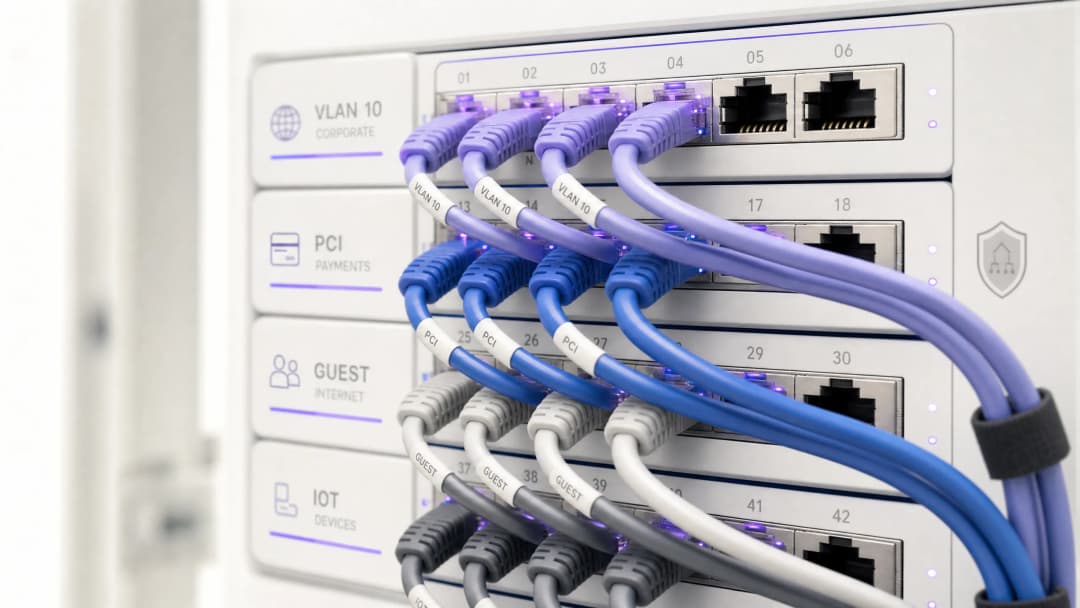
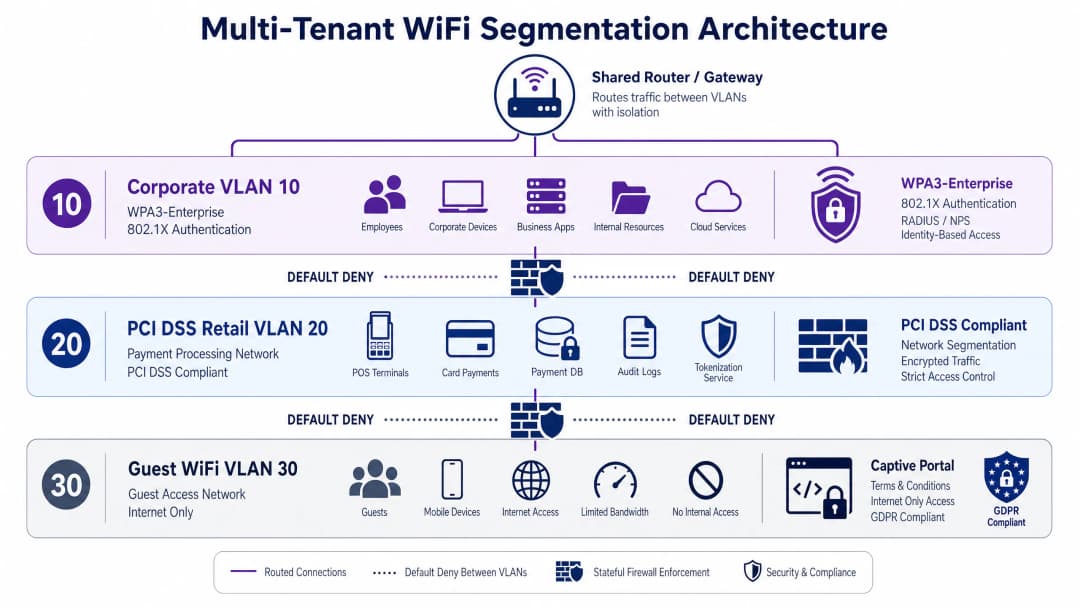
A base de qualquer rede multi-tenant é a Virtual Local Area Network (VLAN). Conforme definido pelo padrão IEEE 802.1Q, as VLANs permitem que um único switch de rede físico seja particionado em múltiplos domínios de broadcast logicamente separados [4]. Em um local compartilhado, isso significa que o tráfego de um tenant - por exemplo, uma loja de varejo na VLAN 10 - é completamente invisível e inacessível ao tráfego de outro tenant, como um escritório corporativo na VLAN 20, mesmo quando seus dispositivos se conectam aos mesmos pontos de acesso físicos.
Regra Arquitetônica: Sem a implementação adequada de VLAN, a separação de tenants é meramente cosmética. Múltiplos SSIDs em uma única LAN plana não oferecem isolamento de segurança; qualquer dispositivo na rede pode farejar o tráfego de broadcast e realizar reconhecimento lateral.
Para impor um isolamento estrito de tenants, o núcleo da rede deve implementar regras de firewall inter-VLAN com estado. Por padrão, todo roteamento inter-VLAN deve ser bloqueado (Default Deny). O tráfego só deve ter permissão para cruzar as fronteiras da VLAN se corresponder a regras de firewall explícitas e altamente restritas (por exemplo, roteamento de portas específicas para uma impressora local compartilhada ou gateway de pagamento).
Padrões de Autenticação: WPA3 e IEEE 802.1X
Garantir o acesso seguro à infraestrutura compartilhada exige alinhar o protocolo de autenticação ao perfil de risco específico do tenant. Uma abordagem de chave pré-compartilhada (PSK) única é uma vulnerabilidade de segurança crítica e uma falha direta de conformidade em ambientes corporativos.
- Tenants Corporativos e Regulamentados: Esses ambientes exigem WPA3-Enterprise combinado com controle de acesso à rede baseado em porta IEEE 802.1X [5]. Essa arquitetura substitui senhas estáticas por credenciais individuais e dinâmicas autenticadas via um método Extensible Authentication Protocol (EAP), como EAP-TLS (baseado em certificado) ou PEAP-MSCHAPv2 (baseado em credencial), comunicando-se com um servidor RADIUS (Remote Authentication Dial-In User Service) central. Isso garante que, quando um funcionário sai ou um dispositivo é comprometido, seu acesso possa ser revogado instantaneamente sem afetar nenhum outro usuário ou tenant. Para etapas detalhadas de implantação, consulte nosso guia sobre Como Implementar Autenticação 802.1X com Cloud RADIUS.
- Dispositivos IoT e Sem Interface (Headless): Sensores de edifícios inteligentes, sinalização digital e controles ambientais frequentemente carecem da capacidade de realizar autenticação 802.1X. Para esses dispositivos, tecnologias Multi-Pre-Shared Key (MPSK) ou Dynamic PSK (DPSK) devem ser implantadas. Isso permite que a rede atribua uma PSK única e individual para cada dispositivo, mapeando-o automaticamente para uma VLAN de IoT restrita sem exigir software cliente de nível corporativo.* Public Guest Access: Para proteger o tráfego de convidados públicos contra interceptação sem fio passiva sem introduzir a fricção de senhas, os locais devem implantar o WPA3-Enhanced Open, baseado em Opportunistic Wireless Encryption (OWE) [6]. O OWE estabelece sessões sem fio individuais e criptografadas para cada dispositivo de convidado automaticamente, garantindo a privacidade em redes abertas enquanto mantém um fluxo de integração contínuo por meio de um Captive Portal.
A Camada de Proteção de Dados: Conformidade com o GDPR e UK GDPR
Quando um local opera uma rede WiFi para convidados, ele é legalmente classificado como Controlador de Dados sob o GDPR e o UK GDPR. O provedor do Captive Portal atua como o Processador de Dados. Essa distinção é crítica: o local retém a responsabilidade legal final sobre como os dados dos convidados são capturados, processados e armazenados.
Nos termos do Artigo 4 do GDPR, os dados pessoais incluem qualquer informação relativa a uma pessoa física identificada ou identificável [1]. Em um ambiente de WiFi para convidados, isso abrange tanto dados explícitos (nomes, endereços de e-mail, números de telefone ou perfis de redes sociais capturados por meio do Captive Portal) quanto dados implícitos (endereços MAC, endereços IP, carimbos de data/hora de sessão e dados de localização do dispositivo capturados automaticamente pelo controlador sem fio).
Para processar esses dados pessoais legalmente, os locais devem estabelecer uma base legal válida de acordo com o Artigo 6 do GDPR. Para conectividade de rede básica e registro de segurança, os locais podem alegar Interesse Legítimo (Artigo 6(1)(f)). No entanto, se o local desejar usar esses dados para marketing, perfil comportamental ou análise de dados, ele deverá obter Consentimento Explícito (Artigo 6(1)(a)).
Padrão de Consentimento: O consentimento deve ser fornecido livremente, de forma específica, informada e inequívoca. Ele deve ser indicado por uma ação afirmativa clara. Condicionar o consentimento de marketing aos termos de serviço para acesso à rede é uma violação direta do regulamento.
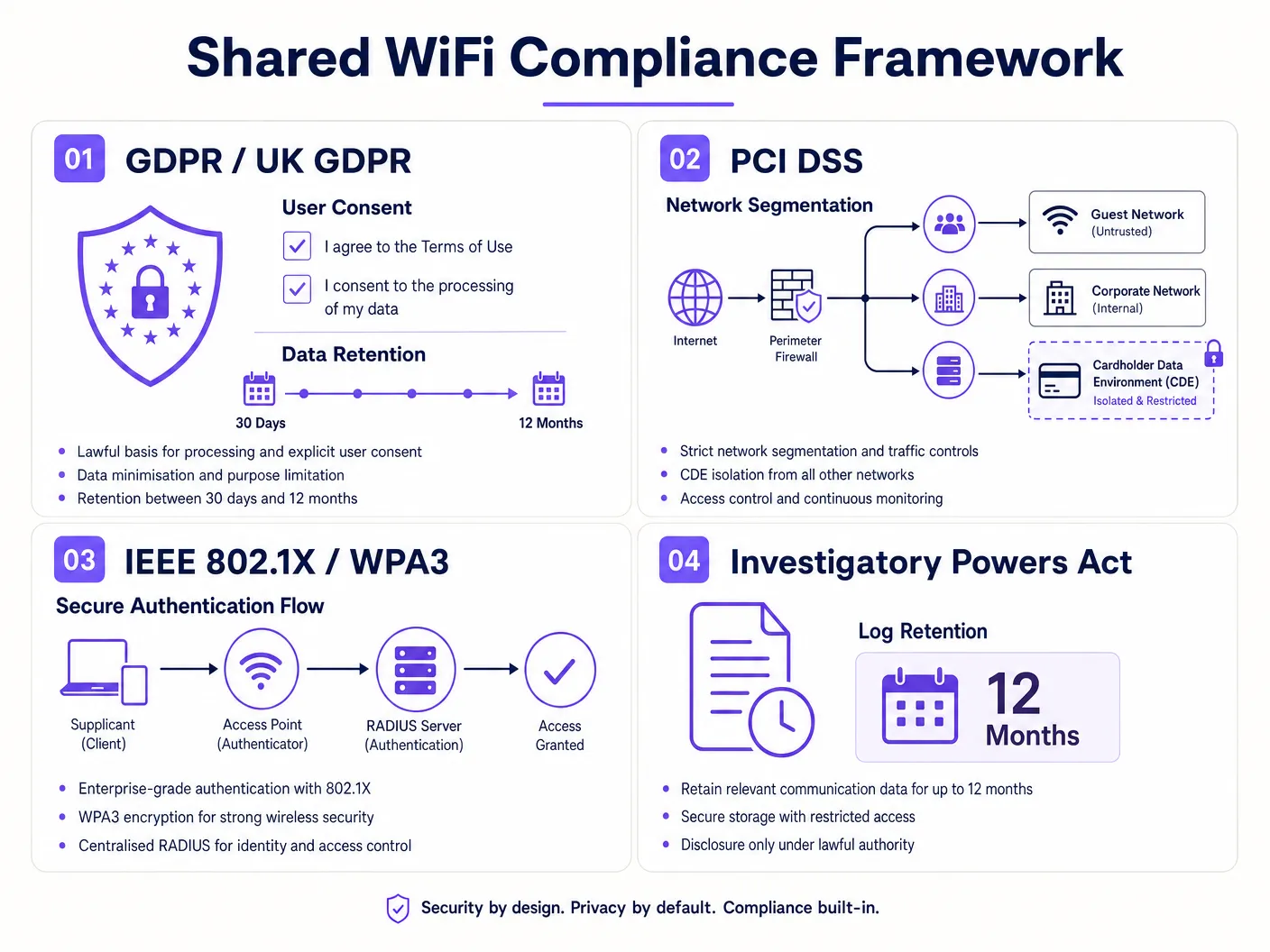
Para atender a esse padrão, a página inicial do Captive Portal deve ser arquitetada com caixas de seleção separadas e desmarcadas para cada finalidade de processamento distinta. Por exemplo, um usuário deve ser capaz de aceitar os Termos de Uso da rede para se conectar sem ser forçado a optar por comunicações de marketing. Além disso, o sistema deve manter uma trilha detalhada e à prova de violações de Auditoria de Consentimento, registrando exatamente quem consentiu, quando, quais divulgações foram mostradas e a versão exata da política de privacidade ativa naquele momento.
Retenção de Dados e o Conflito Regulatório
As equipes de TI enfrentam um desafio complexo de duas frentes ao gerenciar a retenção de registros de rede. Elas devem equilibrar o princípio do GDPR de Minimização de Dados (reter dados pessoais por não mais tempo do que o estritamente necessário) com as leis de segurança nacional que exigem a retenção de registros de acesso.
Por exemplo, o UK Investigatory Powers Act 2016 (IPA) exige que os provedores de serviços de comunicação retenham Internet Connection Records (ICRs) por até 12 meses para auxiliar as autoridades na investigação de crimes graves [3]. Da mesma forma, vários regulamentos nacionais de telecomunicações europeus exigem a retenção de logs de conexão variando de 30 dias a 12 meses.
Para navegar por este conflito, os locais devem implementar uma Arquitetura de Retenção em Camadas que segrega e automatiza os cronogramas de retenção com base na classificação dos dados:
- Logs de Sessão de Rede (alocações de IP, endereços MAC, carimbos de data/hora): Retidos por 12 meses em um repositório syslog seguro e criptografado com acesso restrito para cumprir obrigações legais de aplicação da lei, sendo então eliminados automaticamente.
- Dados de Registro de Captive Portal (sem consentimento): Eliminados ou totalmente anonimizados dentro de 30 dias após o término da sessão.
- Perfis de Marketing (com consentimento): Retidos até que o usuário retire o consentimento (opte por sair). Perfis inativos (por exemplo, usuários que não se conectaram por 180 dias) devem ser sinalizados automaticamente para exclusão ou campanhas de novo consentimento.
Guia de Implementação
A implantação de uma rede sem fio multi-tenant segura e em conformidade exige uma abordagem estruturada de etapas e portões. Esta seção descreve as etapas críticas de configuração, concentrando-se nas melhores práticas independentes de fornecedor para arquitetos de rede e gerentes de TI.
Etapa 1: Configuração Física e Lógica de VLAN
Comece definindo o esquema de VLAN no switch principal e propagando-o por todos os switches de distribuição e pontos de acesso (APs) usando entroncamento 802.1Q. Aloque sub-redes e IDs de VLAN distintos para isolar completamente os domínios de tráfego:
Configure Core Switch:
  vlan 10 -> Name: Corporate_Tenant (Subnet: 10.10.10.0/24)
  vlan 20 -> Name: Retail_POS_PCI (Subnet: 10.20.20.0/24)
  vlan 30 -> Name: Guest_WiFi (Subnet: 172.16.0.0/16)
Nos switches de borda, configure as portas que se conectam aos pontos de acesso sem fio como Trunk Ports, permitindo as VLANs 10, 20 e 30. Garanta que a VLAN nativa (sem tag) seja definida para uma VLAN de gerenciamento sem roteamento (por exemplo, VLAN 99) para proteger o tráfego de gerenciamento contra interceptação de inquilinos.
Etapa 2: Lista de Controle de Acesso (ACL) e Aplicação de Firewall
No limite da Camada 3 (normalmente o switch principal ou gateway de segurança), aplique o bloqueio estrito entre VLANs. O estado padrão para todo o tráfego inter-VLAN deve ser bloqueado. Implemente Listas de Controle de Acesso (ACLs) com estado ou regras de firewall para impedir o movimento lateral:
Create Access-List (Cisco IOS Example):
ip access-list extended BLOCK_LATERAL
deny ip 172.16.0.0 0.0.255.255 10.10.10.0 0.0.0.255 (Block Guest to Corp)
deny ip 172.16.0.0 0.0.255.255 10.20.20.0 0.0.0.255 (Block Guest to PCI)
permit ip 172.16.0.0 0.0.255.255 any (Permit Guest to WAN)
```Aplique esta ACL de entrada na SVI (Switch Virtual Interface) para a VLAN 30. Para a VLAN 20 sob escopo do PCI-DSS, configure uma regra de inspeção stateful que bloqueia todo o tráfego de entrada de todas as outras VLANs, permitindo apenas sessões TLS criptografadas de saída para os endereços IP específicos do processador de pagamento.
### Passo 3: Integração com RADIUS Corporativo e 802.1X
Para locatários corporativos, integre o controlador sem fio com um servidor RADIUS seguro (como FreeRADIUS, Microsoft NPS ou uma solução RADIUS baseada em nuvem). Configure o SSID corporativo para usar WPA3-Enterprise (criptografia AES-CCMP ou GCMP-256) com autenticação 802.1X.
Configure o servidor RADIUS para realizar autenticação baseada em certificado (EAP-TLS). Gere e distribua certificados de cliente exclusivos para todos os dispositivos corporativos por meio de uma plataforma de MDM (Mobile Device Management). Isso evita que dispositivos pessoais não autorizados se conectem à rede corporativa, mesmo que as credenciais do usuário sejam vazadas.
### Passo 4: Configuração do Captive Portal e Captura de Consentimento
Para o WiFi de Convidados público (VLAN 30), configure o controlador sem fio para redirecionar todo o tráfego HTTP/HTTPS não autenticado para um Captive Portal externo. Certifique-se de que o portal esteja hospedado em um servidor seguro e habilitado para HTTPS com um certificado SSL/TLS válido.
Usando uma plataforma focada em conformidade como o Purple, projete a página inicial do Captive Portal para aplicar os seguintes elementos de interface do usuário:
1. **Aviso de Privacidade Claro**: Exiba um resumo proeminente e de fácil leitura explicando quais dados são coletados (por exemplo, nome, e-mail, endereço MAC) e as finalidades do processamento.
2. **Caixas de Seleção de Consentimento Separadas**: Implemente caixas de seleção separadas, desmarcadas e não obrigatórias para adesão de marketing. A caixa de seleção "Aceitar Termos de Uso" deve ser separada da adesão de marketing.
3. **Link de Direitos do Titular dos Dados**: Forneça links diretos e funcionais para a Política de Privacidade completa do local e um portal de autoatendimento onde os convidados possam solicitar acesso ou exclusão de dados (DSARs).
## Melhores Práticas e Mapeamento Regulatório
Para garantir a conformidade a longo prazo, as equipes de TI devem alinhar seus controles técnicos com as regulamentações e padrões internacionais estabelecidos. A tabela abaixo mapeia requisitos regulatórios específicos para os controles técnicos correspondentes e as melhores práticas de arquitetura.
| Regulamentação / Padrão | Requisito Específico | Controle Técnico / Melhor Prática | Capacidade da Plataforma Purple |
| :--- | :--- | :--- | :--- |
| **GDPR / UK GDPR** [1] | Artigo 6: Base legal para o processamento; Artigo 7: Condições para o consentimento. | Caixas de seleção de consentimento desmarcadas e granulares no Captive Portal; registro de consentimento seguro e imutável. | Captive Portals automatizados e multilíngues com registro de consentimento em conformidade e exportações prontas para auditoria. || **GDPR / UK GDPR** [1] | Artigo 35: Avaliação de Impacto sobre a Proteção de Dados (AIPD). | Realizar uma AIPD formal antes de implantar análise de localização ou rastreamento público sistemático. | Análise de fluxo de pessoas anonimizada e relatórios de dados agregados para minimizar o impacto na privacidade. |
| **PCI DSS 4.0** [2] | Requisito 1.2: Restringir o tráfego entre o Ambiente de Dados do Portador de Cartão (CDE) e outras redes. | Segmentação de VLAN de Camada 3; regras de firewall stateful com negação padrão; isolamento físico/lógico de redes de POS. | Compatibilidade total de isolamento de rede; implantação agnóstica de fornecedor em VLANs segmentadas. |
| **PCI DSS 4.0** [2] | Requisito 11.4: Detectar e prevenir pontos de acesso sem fio não autorizados (Rogue APs). | Implementar Sistemas de Prevenção de Intrusão Sem Fio (WIPS); realizar varreduras sem fio trimestrais. | Integração com APIs de controladores empresariais para sinalizar pontos de acesso não autorizados ou rogue. |
| **UK Investigatory Powers Act** [3] | Seção 87: Retenção de Registros de Conexão à Internet (ICRs) para aplicação da lei. | Armazenamento de syslog segregado; retenção por 12 meses de mapeamento de IP para MAC e carimbos de data/hora de sessão. | Encaminhamento automatizado de syslog para repositórios de retenção externos seguros com arquivamento em conformidade. |
| **IEEE 802.1X / WPA3** [5] | Criptografia segura pelo ar e controle robusto de acesso baseado em porta. | WPA3-Enterprise para redes corporativas; WPA3-Enhanced Open (OWE) para redes de visitantes públicas. | Integração perfeita com RADIUS empresarial e suporte para padrões avançados de segurança WPA3. |
### Melhores Práticas de Implementação Específicas do Setor
* **Hospitalidade (Hotéis & Resorts)**: As redes de visitantes devem ser segmentadas por quarto ou por hóspede usando **VLANs Privadas (PVLANs)** ou **Isolamento de Cliente** no nível do AP. Isso impede que os hóspedes do Quarto 101 façam varreduras ou acessem dispositivos (como smart TVs ou notebooks) no Quarto 102. Para os lojistas de varejo e alimentação que operam no local, aplique uma segmentação rigorosa de VLAN para manter seus sistemas de Ponto de Venda (POS) completamente fora do escopo da rede de visitantes de hospitalidade [7]. Consulte o nosso [Guia do Setor de Hospitalidade](/industries/hotels) para insights verticais detalhados.
* **Redes de Varejo & Shopping Centers**: Os varejistas devem isolar suas redes de POS principais tanto da rede WiFi pública para visitantes quanto das redes corporativas administrativas. Se implantar análises baseadas em localização (como rastrear o tempo de permanência do cliente por meio de solicitações de varredura WiFi), o sistema deve imediatamente aplicar hash ou anonimizar os endereços MAC na borda para evitar o rastreamento de indivíduos identificáveis sem consentimento. Explore o nosso [Guia do Setor de Varejo](/industries/retail) para saber como equilibrar a captura de dados em conformidade com a inteligência de marketing.
* **Setor Público e Educação**: Municípios e distritos escolares devem aplicar filtragem rigorosa de conteúdo (conformidade com CIPA nos EUA, ou diretrizes locais de filtragem do setor público no Reino Unido) para bloquear o acesso a material nocivo ou ilegal em redes públicas [8]. Além disso, as redes devem ser segmentadas para garantir que os sistemas administrativos, registros de estudantes e redes públicas de convidados fiquem totalmente isolados. Para obter conformidade específica para a área de educação, consulte nosso guia abrangente sobre [WiFi in Schools: The 2026 Administrator & IT Guide](/blogs/wifi-in-schools).
## Solução de Problemas e Mitigação de Riscos
Mesmo as redes projetadas com o maior cuidado podem sofrer desvios de configuração ou falhas operacionais que comprometem a conformidade. Esta seção descreve modos de falha comuns e fornece estratégias técnicas de mitigação.
### Modos de Falha Comuns e Mitigações Técnicas
#### 1. O "Vizinho Barulhento" e a Exaustão de Largura de Banda
* **Risco**: Um único inquilino ou convidado público consome largura de banda excessiva (por exemplo, streaming de vídeo em alta definição), degradando o desempenho da rede para aplicações de negócios críticas ou outros inquilinos.
* **Mitigação**: Aplique políticas de **Qualidade de Serviço (QoS)** e limitação estrita de taxa. Aplique limites de largura de banda de upstream e downstream por sessão de usuário na VLAN de convidados (por exemplo, 5 Mbps de download, 1 Mbps de upload). No limite da WAN, configure o enfileiramento baseado em classe para garantir um pool mínimo de largura de banda dedicada para VLANs corporativas e de processamento de pagamentos críticas, independentemente da utilização da rede de convidados.
#### 2. Vazamentos de VLAN e Portas de Switch Desconfiguradas
* **Risco**: Uma porta de switch é desconfigurada (por exemplo, uma porta de acesso não marcada atribuída à VLAN errada, ou uma porta de tronco vazando tráfego de gerenciamento), permitindo que pacotes atravessem os limites do inquilino sem passar pelo firewall.
* **Mitigação**: Implemente **Dynamic ARP Inspection (DAI)**, **DHCP Snooping** e **IP Source Guard** em todos os switches para evitar spoofing de MAC e atribuição não autorizada de endereços IP. Realize auditorias de rede semestrais usando ferramentas automatizadas de conformidade de configuração para detectar alterações não autorizadas de VLAN ou desconfigurações de portas.
#### 3. Access Points Não Autorizados e Ataques de "Evil Twin"
* **Risco**: Um invasor implanta um access point não autorizado transmitindo o mesmo SSID que o WiFi de convidados do local, capturando credenciais de login e dados pessoais dos convidados por meio de um Captive Portal malicioso.
* **Mitigação**: Ative o **Wireless Intrusion Prevention System (WIPS)** em todos os APs corporativos. Configure o WIPS para monitorar ativamente as frequências de rádio, detectar APs não autorizados transmitindo SSIDs corporativos ou de convidados e conter automaticamente os dispositivos invasores usando quadros de desautenticação. Force o uso de WPA3-Enterprise e WPA3-Enhanced Open, que mitigam o risco de espionagem passiva e ataques de dicionário offline.
#### 4. Falhas na Trilha de Auditoria de Consentimento
* **Risco**: A plataforma de Captive Portal falha ao registrar o carimbo de data/hora do opt-in de marketing de um visitante ou o registra incorretamente, deixando o estabelecimento incapaz de comprovar a conformidade durante uma auditoria regulatória.
* **Mitigação**: Implante uma plataforma robusta baseada em nuvem como o Purple, que replica os registros de consentimento em vários data centers geograficamente isolados. Certifique-se de que os registros de consentimento sejam armazenados em um banco de dados somente leitura e somente gravação (append-only) com hash criptográfico para garantir a integridade do registro. Implemente verificações diárias automatizadas de integridade para verificar se as gravações no banco de dados estão ocorrendo com sucesso.
## Retorno sobre o Investimento (ROI) e Impacto nos Negócios
Os líderes de TI frequentemente visualizam os requisitos legais e de conformidade apenas sob a ótica de custos e mitigação de riscos. No entanto, uma infraestrutura de WiFi compartilhado bem projetada e em conformidade é um poderoso motor de eficiência operacional, confiança do cliente e valor de negócios mensurável.
### O Custo-Benefício da Conformidade
O impacto financeiro da não conformidade é severo. Sob a GDPR, a multa máxima para uma infração grave é de **€20 milhões ou 4% do faturamento anual global**, o que for maior [1]. Para um grande grupo hoteleiro ou multinacional do varejo, uma única falha de conformidade pode resultar em uma penalidade multimilionária, sem incluir os custos legais associados, despesas de investigação forense e danos catastróficos à reputação da marca.
Por outro lado, o custo de implementação de uma solução de nível empresarial e em conformidade como o Purple é uma fração dessa exposição ao risco. Ao consolidar vários utilitários de rede fragmentados em uma única infraestrutura física multi-tenant gerenciada centralmente, as organizações alcançam economias significativas de **Despesas de Capital (CapEx)** e **Despesas Operacionais (OpEx)**:
* **Consolidação de Infraestrutura**: Em vez de implantar cabeamento físico, switches e pontos de acesso separados para cada inquilino ou serviço, uma única rede física de alto desempenho é logicamente segmentada. Isso reduz os custos de aquisição de hardware em até 40% e reduz drasticamente o consumo de energia e os custos contínuos de manutenção.
* **Gerenciamento Centralizado**: Gerenciar múltiplos inquilinos a partir de um único painel baseado em nuvem reduz a carga administrativa sobre as equipes internas de TI. O provisionamento de um novo inquilino, o ajuste dos limites de largura de banda ou a atualização das políticas de privacidade do Captive Portal podem ser executados em minutos, em vez de dias, representando um ganho enorme de eficiência operacional.
### Transformando a Conformidade em um Ativo Estratégico
Ao implantar um Captive Portal em conformidade, os estabelecimentos podem capturar legalmente dados primários (first-party data) de alta qualidade de seus visitantes. Esses dados são extremamente valiosos para marketing e business intelligence, desde que tenham sido capturados de forma ética e transparente:
* **Bases de Dados de Marketing Ético**: Como os visitantes optaram de forma ativa e transparente por receber comunicações de marketing por meio de caixas de seleção não marcadas em conformidade, a base de dados de marketing resultante apresenta um engajamento significativamente maior, taxas de cancelamento de inscrição mais baixas e métricas de conversão superiores em comparação com listas não segmentadas ou não complacentes.
* **Análise Granular de Visitantes**: Ao aproveitar o rastreamento de localização anonimizado e em conformidade, os operadores do local obtêm insights profundos sobre o comportamento do visitante - como padrões de fluxo de pessoas, tempos médios de permanência e frequências de visitas repetidas. Esses dados podem ser compartilhados com os lojistas do varejo para ajudá-los a otimizar as equipes, avaliar vitrines e medir o ROI de marketing, criando um poderoso diferencial em mercados imobiliários competitivos.
Para ouvir um briefing em áudio detalhado sobre esses conceitos, ouça o episódio do podcast profissional abaixo:
<audio controls src="https://tfstmpunsngbqczbybwb.supabase.co/storage/v1/object/public/guide-assets/guides/legal-compliance-shared-wifi/legal_and_compliance_requirements_for_shared_wifi_infrastructure_podcast.mp3" preload="none"></audio>
***
## Referências
1. **European Parliament and Council**. (2016). *Regulation (EU) 2016/679 (General Data Protection Regulation)*. Official Journal of the European Union. [https://gdpr-info.eu/](https://gdpr-info.eu/)
2. **PCI Security Standards Council**. (2022). *Payment Card Industry (PCI) Data Security Standard, Version 4.0*. [https://www.pcisecuritystandards.org/](https://www.pcisecuritystandards.org/)
3. **UK Parliament**. (2016). *Investigatory Powers Act 2016*. UK Statute Law Database. [https://www.legislation.gov.uk/ukpga/2016/25/contents](https://www.legislation.gov.uk/ukpga/2016/25/contents)
4. **IEEE Computer Society**. (2018). *IEEE Standard for Local and Metropolitan Area Networks - Bridges and Bridged Networks (IEEE Std 802.1Q-2018)*. IEEE Xplore. [https://ieeexplore.ieee.org/document/8403927](https://ieeexplore.ieee.org/document/8403927)
5. **Wi-Fi Alliance**. (2018). *WPA3™ Security White Paper*. [https://www.wi-fi.org/](https://www.wi-fi.org/)
6. **IETF RFC 8110**. (2017). *Opportunistic Wireless Encryption (OWE)*. Internet Engineering Task Force. [https://tools.ietf.org/html/rfc8110](https://tools.ietf.org/html/rfc8110)
7. **PCI Security Standards Council**. (2009). *PCI DSS Wireless Guidelines*. [https://www.pcisecuritystandards.org/pdfs/PCI_DSS_v2_Wireless_Guidelines.pdf](https://www.pcisecuritystandards.org/pdfs/PCI_DSS_v2_Wireless_Guidelines.pdf)
8. **Federal Communications Commission**. (2001). *Children's Internet Protection Act (CIPA)*. FCC Consumer Guide. [https://www.fcc.gov/consumers/guides/childrens-internet-protection-act](https://www.fcc.gov/consumers/guides/childrens-internet-protection-act)
Definições principais
Virtual LAN (VLAN)
Uma sub-rede lógica que agrupa uma coleção de dispositivos de diferentes LANs físicas, isolando seus domínios de difusão usando marcação IEEE 802.1Q.
Crucial para ambientes multilocatários para segregar redes corporativas, de visitantes e de pagamento em hardware físico compartilhado.
IEEE 802.1X
Um padrão IEEE para Controle de Acesso à Rede baseado em porta (PNAC) que fornece um mecanismo de autenticação para dispositivos que desejam se conectar a uma LAN ou WLAN.
O padrão para proteger redes corporativas e de locatários, autenticando dispositivos individualmente em um servidor RADIUS.
WPA3-Enterprise
A última geração de segurança WiFi Protected Access para redes corporativas, exigindo força criptográfica de 192 bits e Quadros de Gerenciamento Protegidos (PMF) obrigatórios.
Obrigatório para locatários corporativos, regulamentados e de alta segurança em um ambiente sem fio compartilhado.
WPA3-Enhanced Open (OWE)
Um padrão WiFi Alliance baseado em Criptografia Sem Fio Oportunista que fornece criptografia de dados individual para redes sem fio abertas e públicas sem exigir senhas de usuário.
O padrão de melhor prática para WiFi de visitantes público, protegendo os usuários contra monitoramento passivo local enquanto mantém a facilidade de acesso.
Controlador de Dados
A pessoa física ou jurídica, autoridade pública, agência ou outro órgão que, individualmente ou em conjunto com outros, determina os fins e os meios do processamento de dados pessoais.
No WiFi de visitantes, o operador do local é o Controlador de Dados e assume a responsabilidade jurídica final sob o GDPR.
Operador de Dados
Uma pessoa física ou jurídica, autoridade pública, agência ou outro órgão que processa dados pessoais em nome do controlador.
O provedor da plataforma de WiFi de visitantes (por exemplo, a Purple) atua como o Operador de Dados, tratando os dados de acordo com as instruções do controlador.
Ambiente de Dados de Portador de Cartão (CDE)
As pessoas, processos e tecnologias que armazenam, processam ou transmitem dados do portador do cartão ou dados de autenticação confidenciais.
O objetivo principal da conformidade com o PCI-DSS; deve ser totalmente isolado das redes sem fio corporativas e de visitantes.
Registro de Conexão de Internet (RCI)
Um registro dos serviços de internet acessados por um dispositivo específico, incluindo endereços IP, números de porta e carimbos de data/hora de conexão, mas excluindo o conteúdo específico das comunicações.
De acordo com o Investigatory Powers Act do Reino Unido, os provedores de comunicações podem ser obrigados a reter ICRs por 12 meses para acesso das autoridades policiais.
Exemplos práticos
Um hotel histórico de 250 quartos em Londres apresenta uma galeria comercial no térreo com cinco lojas independentes e um grande centro de conferências que sedia eventos corporativos semanais. O hotel opera uma única conexão física de internet de fibra óptica. O hotel precisa fornecer acesso WiFi seguro para os hóspedes, oferecer redes isoladas de processamento de pagamentos para os lojistas e disponibilizar capacidade sem fio dedicada e de alto desempenho para clientes de conferências corporativas, tudo isso em conformidade com o UK GDPR, PCI-DSS e a UK Investigatory Powers Act.
O arquiteto de rede implementa uma rede sem fio multi-tenant segmentada via VLANs em hardware de nível corporativo. Três VLANs distintas são configuradas: VLAN 100 para Hóspedes do Hotel, VLAN 200 para PDV do Varejo (escopo do PCI-DSS) e VLAN 300 para Clientes de Conferência.
Rede de Hóspedes do Hotel (VLAN 100): Configurada com WPA3-Enhanced Open (OWE) para fornecer criptografia no ar sem a necessidade de senha. Os usuários são redirecionados para um Captive Portal seguro, habilitado para HTTPS e hospedado pela Purple. O portal apresenta caixas de seleção separadas e desmarcadas para aceitação de marketing. Os logs de sessão são encaminhados para um servidor syslog local e retidos por 12 meses para atender às obrigações da UK Investigatory Powers Act, enquanto os perfis de marketing do Captive Portal são sincronizados com o CRM apenas para os hóspedes que aceitaram explicitamente.
Rede de PDV do Varejo (VLAN 200): Completamente isolada de todas as outras VLANs usando uma política de firewall stateful de "Negação Padrão" no gateway principal. Apenas o tráfego de saída TLS 1.3 para os endereços IP específicos do gateway de pagamento é permitido. Nenhum dispositivo de hóspede ou corporativo pode rotear tráfego para esta VLAN. Varreduras externas de vulnerabilidade trimestrais são agendadas para manter a conformidade com o PCI-DSS.
Rede de Conferência (VLAN 300): Configurada com WPA3 e autenticação 802.1X. A atribuição dinâmica de VLAN é configurada no servidor RADIUS para que, quando um cliente corporativo se autentique com suas credenciais exclusivas, ele seja mapeado dinamicamente para uma sub-VLAN dedicada com um pool de largura de banda de Qualidade de Serviço (QoS) garantido de 100 Mbps simétricos, evitando o problema de "vizinho barulhento" decorrente de streamings de hóspedes.
Uma rede de varejo nacional com 150 lojas no Reino Unido e na Europa deseja implantar WiFi público para hóspedes para capturar endereços de e-mail de clientes para campanhas de marketing localizadas. Eles também utilizam análises de localização WiFi (rastreamento de probe requests) para medir o fluxo de pessoas, o tempo de permanência nas lojas e as taxas de clientes recorrentes. Eles devem garantir que sua captura de dados e rastreamento de localização estejam em total conformidade com o GDPR e o UK GDPR.
A rede de varejo implanta a plataforma de análise e WiFi de visitantes corporativa da Purple em todas as 150 unidades.
Configuração do Captive Portal: O captive portal é configurado com um seletor de idioma com detecção geográfica. Ele apresenta um aviso de privacidade claro e conciso no idioma local antes que qualquer campo de cadastro seja exibido. O formulário solicita apenas o nome e o endereço de e-mail do cliente (minimização de dados). Uma caixa de seleção separada e desmarcada é implementada para a adesão de marketing, com uma explicação clara de que a adesão é opcional e não afeta o acesso ao WiFi gratuito.
Conformidade de Analytics de Localização: Para rastrear a circulação de visitantes em conformidade, sem consentimento explícito (já que as solicitações de busca são capturadas automaticamente quando um dispositivo tem o WiFi ativado, antes de conectar), os controladores sem fio são configurados para criptografar imediatamente na borda todos os endereços MAC capturados usando um algoritmo SHA-256 com sal. O sal é rotacionado automaticamente a cada 24 horas. Esse processo anonimiza permanentemente os identificadores do dispositivo, convertendo-os de dados pessoais em dados estatísticos agregados e não identificáveis, que estão fora do escopo do GDPR.
Direitos dos Titulares de Dados: Um portal de privacidade de autoatendimento exclusivo é vinculado a partir do captive portal. Os clientes podem inserir seu endereço de e-mail para visualizar todos os dados pessoais mantidos pela varejista, atualizar suas preferências ou solicitar a exclusão imediata (exercendo seu Direito ao Esquecimento sob o Artigo 17 do GDPR).
Questões práticas
Q1. Um gerente de TI está configurando uma rede sem fio compartilhada para um shopping center. A equipe de gestão do shopping deseja coletar os endereços de e-mail dos visitantes para marketing e também rastrear o movimento dos dispositivos pelo shopping para otimizar os preços de locação dos lojistas. O diretor de marketing sugere oferecer "WiFi gratuito de alta velocidade" apenas para os visitantes que optarem por receber a newsletter de marketing. Essa abordagem está em conformidade com o GDPR e como a rede deve ser configurada?
Dica: Considere os princípios do GDPR de consentimento "livremente fornecido" e minimização de dados, e como o rastreamento de localização deve ser tratado.
Ver resposta modelo
Essa abordagem não está em conformidade com o GDPR. Condicionar a adesão ao marketing ao acesso à rede viola o requisito de consentimento "livremente fornecido" do Artigo 7(4). A rede deve ser configurada para permitir que os usuários acessem o WiFi gratuito aceitando os Termos de Uso da rede, sem serem forçados a consentir com o marketing. Para o rastreamento de localização, como os dispositivos dos visitantes transmitem solicitações de busca automaticamente, os endereços MAC devem ser imediatamente criptografados e anonimizados na borda da rede usando um algoritmo SHA-256 com salt rotativo diário. Isso converte os dados de rastreamento pessoal em dados estatísticos anônimos de fluxo de pessoas, garantindo a conformidade e, ao mesmo tempo, fornecendo à administração do shopping as informações operacionais necessárias para definir os preços das locações.
Q2. O sistema de Ponto de Venda (POS) de um restaurante e bar de um hotel funciona na mesma infraestrutura de switch físico que a rede WiFi de convidados. Durante uma auditoria de conformidade, o QSA (Qualified Security Assessor) sinaliza a rede como não conforme com o PCI DSS 4.0. O diretor de TI do hotel argumenta que, como o WiFi de convidados e o POS usam SSIDs diferentes, eles estão isolados com segurança. Como o arquiteto de rede deve resolver essa disputa?
Dica: Os SSIDs por si só não fornecem segmentação de rede. Pense na separação de Camada 2 e Camada 3.
Ver resposta modelo
O QSA está correto e o argumento do diretor de TI é inválido. Os SSIDs são apenas pontos de entrada sem fio; se eles mapearem de volta para a mesma rede local plana (LAN), os dispositivos na rede de convidados poderão facilmente monitorar o tráfego do POS, realizar envenenamento de ARP ou executar ataques laterais. Para resolver isso e colocar a rede em conformidade com o PCI DSS 4.0, o arquiteto de rede deve configurar VLANs separadas no switch e nos pontos de acesso (por exemplo, VLAN 20 para POS, VLAN 30 para Convidados). O gateway principal deve aplicar uma política de firewall stateful "Default Deny" entre essas VLANs, bloqueando todo o roteamento inter-VLAN. A VLAN de convidados deve ter acesso apenas à WAN (internet), e a VLAN do POS deve ser restrita a sessões TLS criptografadas de saída para o processador de pagamento, removendo completamente a rede de convidados do escopo de conformidade do PCI DSS.
Q3. Uma organização do setor público que opera um centro cívico no Reino Unido recebe uma solicitação formal das autoridades para entregar os registros de conexão de um endereço IP específico que foi associado a um incidente de cibercrime há três meses. O DPO (Data Protection Officer) da organização argumenta que, sob os princípios de minimização de dados do GDPR, eles excluem todos os registros de conexão após 30 dias, portanto não possuem mais os dados. Isso expõe a organização a responsabilidade legal e como a retenção de registros deve ser estruturada?
Dica: Equilibre o princípio de minimização de dados do GDPR com as obrigações estatutárias do Investigatory Powers Act do Reino Unido.
Ver resposta modelo
Sim, isso expõe a organização a uma responsabilidade jurídica significativa. Embora o GDPR promova a minimização de dados, o Artigo 6(1)(c) fornece uma base legal para o processamento quando este for necessário para o cumprimento de uma obrigação jurídica. No Reino Unido, a Investigatory Powers Act 2016 exige que os provedores de serviços de comunicação (o que pode incluir operadores do setor público de WiFi público de grande escala) retenham Registros de Conexão de Internet (ICRs) por até 12 meses. Ao excluir todos os logs após 30 dias, a organização falhou em suas obrigações estatutárias sob a IPA. O arquiteto de rede deve implementar uma arquitetura de retenção em camadas: os logs de conexão de sessão (mapeamentos de IP para MAC e carimbos de data/hora) devem ser encaminhados para um servidor syslog seguro e criptografado e retidos por exatamente 12 meses com acesso restrito, enquanto os dados pessoais de marketing capturados no Captive Portal são gerenciados separadamente e excluídos ou anonimizados dentro de 30 dias se nenhum consentimento de marketing tiver sido concedido.
Fontes
- https://gdpr-info.eu/
- https://www.pcisecuritystandards.org/
- https://www.legislation.gov.uk/ukpga/2016/25/contents
- https://ieeexplore.ieee.org/document/8403927
- https://www.wi-fi.org/
- https://tools.ietf.org/html/rfc8110
- https://www.pcisecuritystandards.org/pdfs/PCIDSSv2WirelessGuidelines.pdf
- https://www.fcc.gov/consumers/guides/childrens-internet-protection-act
Continue a ler esta série
Por que o WiFi de hóspedes estilo hotel falha em edifícios residenciais
Você será capaz de diagnosticar por que os moradores em blocos BTR, residências estudantis e MDUs continuam relatando falhas de WiFi e escolher o modelo de autenticação que as corrige. A resposta é uma chave iPSK por residência nos seus access points existentes, mantendo uma rede de Captive Portal separada para visitantes.
Projetando Redes WiFi para Edifícios de Escritórios Multi-inquilinos
Este guia fornece a gerentes de TI, arquitetos de rede e CTOs um modelo neutro de fornecedor para projetar redes WiFi escaláveis, seguras e isoladas em edifícios de escritórios multi-inquilinos. Ele abrange segmentação de VLAN sob IEEE 802.1Q, Atribuição Dinâmica de VLAN via 802.1X e RADIUS, planejamento de RF para ambientes de alta densidade e considerações de conformidade sob GDPR e PCI DSS. Operadores de locais e administradores de edifícios encontrarão orientações de arquitetura acionáveis, estudos de caso reais e armadilhas de configuração a serem evitadas antes da implantação.
Mean time to innocence: como provar que o problema não é o WiFi
Mean time to innocence (MTTI) é a métrica crítica que define quanto tempo as equipes de TI gastam para provar que um problema de rede não é culpa delas. Este guia detalha uma metodologia de observabilidade em cinco etapas para eliminar o jogo de culpas em ambientes multi-tenant, substituindo acusações por evidências compartilhadas para reduzir o mean time to resolution (MTTR).
Tem dúvidas sobre a sua configuração específica?
A nossa equipa trabalha com operadores de espaços, gestores de TI e engenheiros de rede em 80.000 locais. Agende uma chamada de 20 minutos e mostraremos como outros profissionais na sua situação o resolveram.