
Mean time to innocence: como provar que o problema não é o WiFi
Mean time to innocence (MTTI) é a métrica crítica que define quanto tempo as equipes de TI gastam para provar que um problema de rede não é culpa delas. Este guia detalha uma metodologia de observabilidade em cinco etapas para eliminar o jogo de culpas em ambientes multi-tenant, substituindo acusações por evidências compartilhadas para reduzir o mean time to resolution (MTTR).
Video overview
Ouça este guia
Ver transcrição do podcast
Parte da nossa série principal: Guia de WiFi Multi-Tenant →
Resumo Executivo
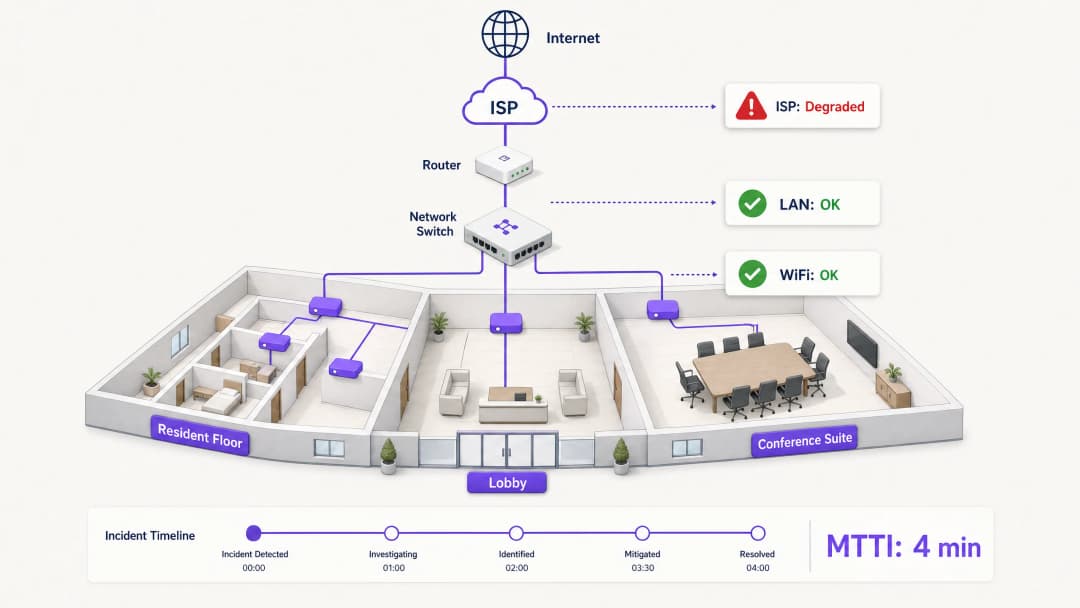
Quando a conectividade cai em um ambiente multi-inquilino, o WiFi é o primeiro a ser culpado. Ele é a borda visível da rede, o último salto antes do dispositivo e o alvo mais fácil para usuários frustrados. Para gerentes de TI, arquitetos de rede e diretores de operações de locais, isso cria uma taxa operacional persistente: o tempo gasto provando a inocência.
O tempo médio para a inocência (MTTI) mede o tempo médio decorrido entre o relato de um incidente e a capacidade de uma equipe de demonstrar que seu domínio não é a causa raiz. Em ambientes complexos, como blocos residenciais para aluguel (BTR), hotéis ou centros de conferências, a rede é fragmentada entre gerentes de propriedade, provedores de WiFi gerenciado e provedores de serviços de internet (ISPs). Sem uma telemetria definitiva, o MTTI infla o tempo médio de resolução (MTTR) à medida que as equipes discutem sobre a responsabilidade em vez de corrigir a falha.
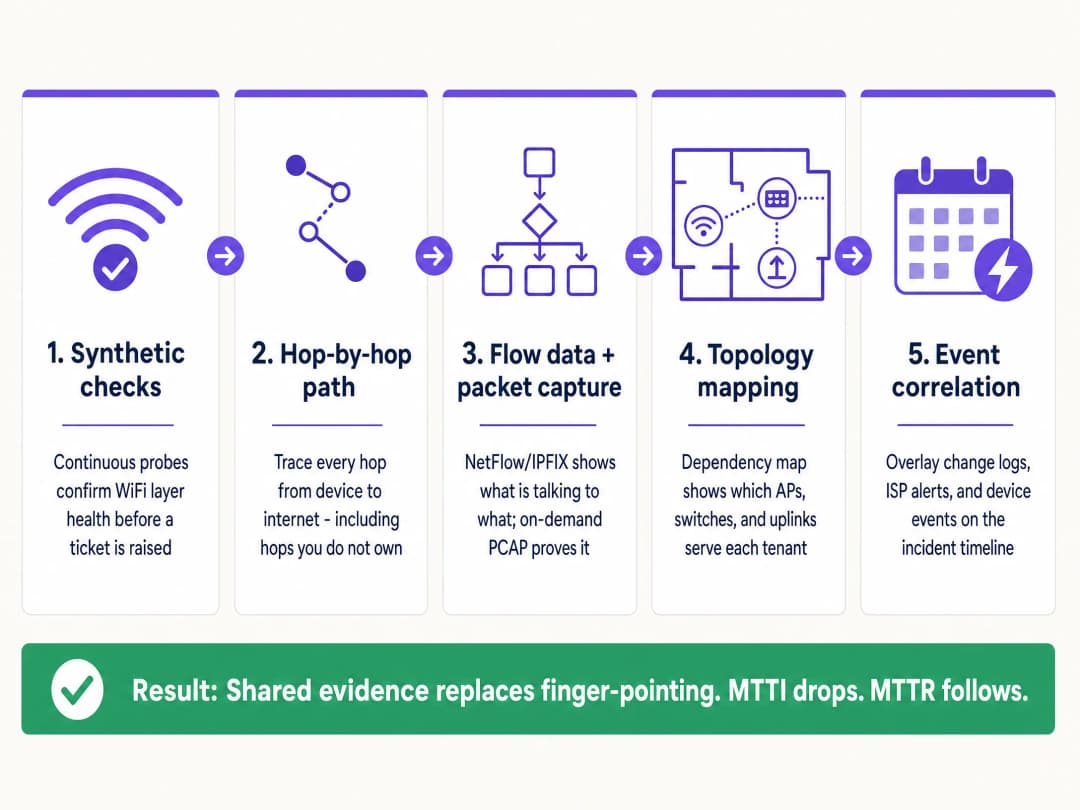
Este guia detalha uma metodologia de observabilidade de cinco etapas para reduzir sistematicamente o MTTI. Ao implantar verificações sintéticas contínuas, visibilidade de caminho salto a salto, análise de dados de fluxo, mapeamento de topologia e correlação de eventos, você pode substituir o apontamento de dedos por evidências compartilhadas. O objetivo não é vencer o jogo da culpa mais rápido, mas acabar com ele de vez.
Análise Técnica Profunda: A Mecânica do MTTI
A Distinção Entre MTTI e Tempo Médio de Identificação
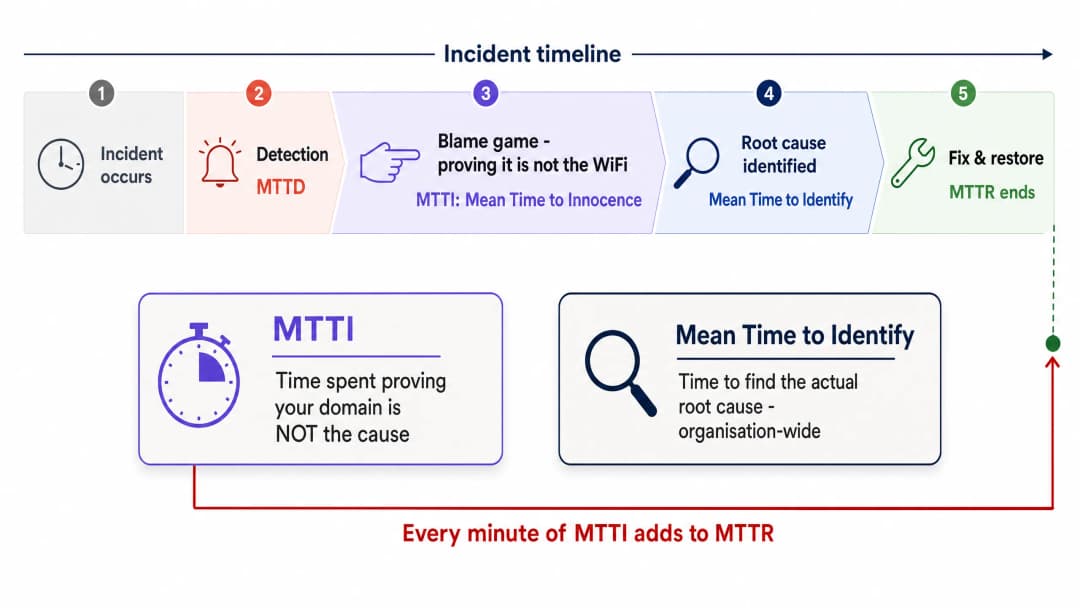
É fundamental separar o MTTI do tempo médio de identificação. O tempo médio de identificação é uma métrica que abrange toda a organização, monitorando quanto tempo leva para encontrar a causa raiz real de uma interrupção. O MTTI é uma métrica isolada e específica de um domínio, que monitora quanto tempo uma equipe leva para provar que não é a culpada.
Cada minuto de MTTI é somado diretamente ao MTTR. Se um provedor de WiFi gerenciado passa 40 minutos verificando manualmente pontos de acesso (APs) e logs de switch antes de concluir que o problema está no ISP, o MTTR já tem uma penalidade de 40 minutos embutida antes mesmo de a remediação real começar.
Por que o WiFi Leva a Culpa
Em ambientes que atendem 350 milhões de usuários únicos em mais de 80.000 locais ativos, a Purple observa o mesmo padrão repetidamente. A camada de WiFi é culpada por padrão devido a três realidades estruturais:
- Viés de visibilidade: O indicador de sinal do WiFi é a única ferramenta de diagnóstico de rede disponível para o usuário comum do local.
- Proximidade da ponta: Como o último salto até o dispositivo cliente, o WiFi herda os sintomas de todas as falhas que ocorrem acima dele. Um tempo limite de DNS no ISP parece idêntico a uma falha de AP sob a perspectiva do usuário.
- Lacunas de telemetria: Historicamente, provar a integridade da rede sem fio exigia intervenção manual. Se você não puder mostrar que a camada sem fio está funcionando perfeitamente em menos de dois minutos, você perde o controle da narrativa.
A Complicação do Multi-Tenant
Em uma empresa de locatário único (single-tenant), as equipes de rede são proprietárias de toda a infraestrutura, do AP ao firewall. Em ambientes WiFi multi-tenant, a propriedade é fragmentada.
Um residente de BTR paga ao administrador da propriedade. O administrador contrata um provedor de WiFi gerenciado. O provedor de WiFi gerenciado depende de um circuito de ISP terceirizado e, frequentemente, da rede de distribuição interna do proprietário do edifício. Quando um residente não consegue reproduzir um vídeo, o provedor precisa isentar rapidamente o hardware de WiFi (Cisco Meraki, HPE Aruba, Ruckus ou Juniper Mist) e isolar a falha no dispositivo cliente, no switch do edifício ou no ISP. Não fazer isso prejudica o relacionamento comercial entre o provedor e o administrador da propriedade.
Tem dúvidas sobre a sua configuração específica?
A nossa equipa trabalha com operadores de espaços, gestores de TI e engenheiros de rede em 80.000 locais. Agende uma chamada de 20 minutos e mostraremos como outros profissionais na sua situação o resolveram.
Guia de Implementação: A Metodologia de 5 Passos
Para reduzir sistematicamente o MTTI, implemente esta arquitetura de observabilidade de cinco camadas.
1. Testes Sintéticos Contínuos
Não espere que um usuário reclame. Implante testes sintéticos automatizados que simulam continuamente o comportamento do usuário a partir da borda da rede.
- Implementação: Configure APs ou sensores dedicados para executar testes programados de resposta DHCP, resolução DNS, acessibilidade HTTP e fluxos de autenticação (como logins de 802.1X ou Captive Portal).
- Resultado: Quando um chamado é aberto, você verifica primeiro o painel sintético. Se as sondagens mostrarem uma acessibilidade HTTP limpa no momento exato da reclamação, você inocenta imediatamente a camada WiFi e o circuito WAN, mudando o foco para o dispositivo cliente específico ou para a aplicação de destino.
2. Visibilidade de Caminho Salto a Salto
Provar que seu hardware está funcionando perfeitamente é insuficiente se você não puder provar que o caminho para a internet está livre.
- Implementação: Use ferramentas de visualização de caminho para rastrear o tráfego da camada de acesso pela LAN, passando pelo ponto de demarcação e entrando na rede do provedor de internet.
- Resultado: Quando a latência aumenta, um rastreamento de caminho revela exatamente qual nó introduziu o atraso. Se os saltos de um a quatro (seu domínio) mostrarem latência de 2ms, e o salto cinco (o roteador de borda do provedor de internet) mostrar latência de 150ms e perda de pacotes de 12%, você tem uma prova definitiva para apresentar ao provedor de internet.
3. Dados de Fluxo e Captura de Pacotes sob Demanda
Quando os usuários relatam falhas específicas de aplicações, você precisa de visibilidade no nível da conversa.
- Implementação: Exporte dados NetFlow ou IPFIX de seus switches principais ou firewalls. Garanta que o hardware da sua camada de acesso suporte captura de pacotes (PCAP) remota e sob demanda, sem a necessidade de um engenheiro no local.
- Resultado: Os dados de fluxo provam se o tráfego para um serviço específico está saindo da sua rede de forma limpa. Se estiver, a rede é inocente. Se for necessária uma prova forense mais profunda, um PCAP direcionado na VLAN específica fornece evidências incontestáveis de retransmissões TCP ou resets do lado do servidor.
4. Mapeamento de Topologia e Dependência
Em um ambiente multi-inquilino, isolar o raio de impacto é a maneira mais rápida de categorizar uma falha.
- Implementação: Mantenha um mapa de dependências ativo e atualizado dinamicamente que conecte cada AP ao seu switch, uplink e circuito WAN, mapeado em relação às VLANs dos inquilinos.
- Resultado: Se uma falha afeta APs em vários andares, mas apenas em um único switch, o problema é o switch. Se afeta todos os APs, mas apenas a VLAN de um único inquilino, trata-se de um problema de configuração lógica. O dimensionamento rápido do escopo evita o desperdício de esforço investigando uma infraestrutura saudável.
5. Correlação de Eventos
Dados sem contexto prolongam as investigações.
- Implementação: Insira registros de alterações, alertas de manutenção do provedor de internet, atualizações de firmware de hardware e chamados de usuários em uma única visualização de linha do tempo.
- Resultado: Sobrepor um aumento nas falhas de autenticação com um evento de expiração de certificado do Microsoft Entra ID ocorrido 10 minutos antes identifica imediatamente a causa raiz, ignorando completamente o hardware de rede.
Melhores Práticas
- Padronize a infraestrutura de hardware: Limite as implantações a fornecedores corporativos canônicos (Cisco Meraki, HPE Aruba, Ruckus, Juniper Mist, Ubiquiti UniFi, Cambium, Extreme, Fortinet) que expõem APIs para testes sintéticos e PCAP remoto.
- Automatize as evidências: Configure sua plataforma de monitoramento para anexar automaticamente resultados de testes sintéticos e rastreamentos de caminho aos tickets de ITSM no momento em que forem criados.
- Compartilhe o painel: Forneça aos gerentes de propriedade acesso apenas de leitura a um painel de integridade de alto nível. A transparência evita o jogo de empurra.
- Monitore o MTTI formalmente: Meça o tempo entre a criação do ticket e o momento em que sua equipe fornece a prova de inocência. Trate isso como um KPI principal ao lado do MTTR.
Solução de problemas e mitigação de riscos
- Risco: O ciclo de "Nenhuma falha encontrada": Os usuários relatam problemas, mas as verificações sintéticas aparecem verdes.
- Mitigação: O problema provavelmente é específico do dispositivo ou relacionado a interferências de RF (interferência de canal adjacente ou obstrução física). Use análises do lado do cliente para verificar o RSSI e o histórico de roaming do dispositivo específico.
- Risco: Negação do provedor de internet: O provedor de internet se recusa a aceitar a falha, apesar de suas evidências.
- Mitigação: Forneça rastreamentos de caminho salto a salto mostrando o endereço IP exato onde a perda de pacotes começa. Compartilhe PCAPs demonstrando saída limpa do seu ponto de demarcação. Dados concretos forçam a escalabilidade além do suporte de Nível 1.
- Risco: Falhas no Captive Portal: Os usuários culpam o WiFi quando o portal não carrega.
- Mitigação: Isole o provedor de identidade. Verifique o status da integração (Microsoft Entra ID, Okta, Google Workspace). Se a rede permite o tráfego de pré-autenticação, mas o provedor de identidade expira, a rede é inocente.
ROI e impacto comercial
A redução do MTTI entrega valor comercial mensurável muito além de simplesmente economizar horas de engenharia.
- Redução do MTTR: Eliminar 40 minutos de discussões sobre culpados em um incidente reduz diretamente o tempo de inatividade, protegendo a receita em ambientes de varejo e hotelaria.
- Conformidade com SLA: A exoneração mais rápida evita que penalidades injustas sejam cobradas do provedor de WiFi gerenciado quando a falha é do provedor de internet ou da infraestrutura do edifício.
- Retenção de clientes: No setor de WiFi multi-tenant, os gerentes de propriedades renovam contratos com provedores que oferecem transparência e respostas rápidas. Evidências compartilhadas geram confiança; argumentos defensivos a destroem.
- Otimização de recursos: Engenheiros de rede de Nível 3 altamente remunerados gastam seu tempo projetando soluções, em vez de provar manualmente que a rede está funcionando corretamente.
Definições principais
Mean Time to Innocence (MTTI)
O tempo médio necessário para que uma equipe de TI específica prove, usando dados objetivos, que seu domínio ou infraestrutura não é a causa raiz de um incidente relatado.
Crítico para provedores de WiFi gerenciado que precisam defender seu serviço contra gerentes de propriedades e ISPs.
Mean Time to Identify
A métrica de toda a organização que rastreia o tempo total decorrido desde a detecção do incidente até a descoberta da causa raiz real.
O MTTI é um subconjunto desta métrica. Reduzir o MTTI reduz diretamente o tempo geral de identificação.
Verificações Sintéticas
Testes automatizados e contínuos que emulam o tráfego do usuário (ex: consultas DNS, requisições HTTP) para monitorar proativamente a saúde da rede.
Usado para provar que a camada de WiFi estava funcionando corretamente no momento exato em que um usuário reclamou.
Visibilidade de Caminho Salto a Salto
Telemetria que rastreia o tráfego de rede nó por nó, do cliente ao destino, medindo a latência e a perda em cada roteador ou switch específico.
Essencial para provar que uma falha está na rede de um ISP ou no switch de distribuição de um proprietário, e não no hardware de WiFi gerenciado.
Dados de Fluxo (NetFlow/IPFIX)
Dados de protocolo de rede que fornecem um resumo das conversas de tráfego, mostrando origem, destino, protocolo e volume.
Usado para provar que o tráfego de uma aplicação específica está saindo com sucesso da rede local.
Captura de Pacotes sob Demanda (PCAP)
A capacidade de gravar remotamente o tráfego de rede bruto a partir de um ponto de acesso ou switch para análise forense.
A prova definitiva usada para demonstrar erros do lado do servidor ou mau comportamento do dispositivo cliente.
Raio de Impacto
O escopo do impacto de um incidente específico (por exemplo, um usuário, um AP, um switch, um locatário ou o edifício inteiro).
Determinar o raio de impacto por meio do mapeamento de topologia é a maneira mais rápida de excluir a infraestrutura saudável de uma investigação.
Correlação de Eventos
A prática de sobrepor diferentes fluxos de dados (logs, alertas, atualizações) em uma única linha do tempo para identificar causa e efeito.
Utilizado para provar que uma queda de rede foi causada por uma alteração de terceiros, como uma janela de manutenção não anunciada do provedor de internet.
Exemplos práticos
Um hotel de 350 quartos relata que o WiFi nos quartos está lento em toda a propriedade. A recepção culpa o provedor de WiFi gerenciado. Como você exonera a rede e encontra a causa raiz?
- Verifique as sondas sintéticas: testes de alcançabilidade DNS e HTTP mostram que os APs têm uma conexão limpa com a internet. 2. Revise o mapa de topologia: o problema afeta todos os APs em todos os switches, descartando hardware de borda. 3. Execute um traçado de rota: o traçado mostra latência de 2ms dentro da LAN do hotel, mas latência de 180ms no terceiro salto (o roteador de agregação do ISP). 4. Exporte as evidências: envie a captura de tela do traçado de rota para o gerente do hotel e para o ISP.
Um varejista nacional relata que os terminais de ponto de venda (POS) em uma região estão perdendo conexões com o processador de pagamentos. A equipe de rede é culpada por uma configuração incorreta de firewall ou roteamento.
- Isole o raio de impacto: confirme que apenas os terminais POS (VLAN específica) foram afetados; o WiFi de visitantes e os sistemas administrativos estão normais. 2. Analise os dados de fluxo: o NetFlow confirma que o tráfego destinado à faixa de IP do processador de pagamentos está saindo com sucesso dos roteadores das lojas. 3. Capture pacotes: um PCAP sob demanda na VLAN de POS revela que o servidor do processador de pagamentos está enviando resets TCP (RST). 4. Compartilhe o PCAP com a equipe de suporte do processador de pagamentos.
Questões práticas
Q1. Um locatário em um espaço de coworking reclama que não consegue acessar a VPN corporativa. Outros locatários estão navegando na internet sem problemas. Qual é a maneira mais eficiente de provar que a rede WiFi não é a culpada?
Dica: Considere o raio de impacto e o tipo específico de tráfego que está falhando.
Ver resposta modelo
Primeiro, use o mapa de topologia para confirmar que o raio de impacto está limitado a um único usuário ou a um serviço específico, descartando uma falha geral de AP ou switch. Segundo, analise os dados de fluxo (NetFlow/IPFIX) para o endereço IP desse cliente. Se os dados de fluxo mostrarem que o tráfego da VPN (por exemplo, UDP 500 ou TCP 443) está saindo da rede normalmente, o WiFi e a LAN estão inocentados. O problema está na configuração da VPN do cliente ou no firewall corporativo bloqueando a conexão.
Q2. Seu painel de monitoramento mostra que um AP ficou offline, mas o gerente da propriedade insiste que o WiFi está quebrado porque o provedor de internet caiu. Como você prova que o problema é de energia interna, e não do provedor?
Dica: Procure por correlação entre o estado da infraestrutura e eventos externos.
Ver resposta modelo
Utilize a correlação de eventos e o mapeamento de topologia. Se o mapa de topologia mostrar que apenas um AP está offline enquanto outros no mesmo switch estão funcionando, o circuito do provedor está claramente ativo. A correlação de eventos pode mostrar um log de falha de PoE (Power over Ethernet) na porta do switch conectada àquele AP específico. Isso prova que o problema é no hardware local ou no cabeamento, não no circuito WAN.
Q3. Um diretor de operações de um estádio alega que o WiFi falhou durante o intervalo porque os leitores de ingressos pararam de funcionar. Você precisa inocentar a rede em menos de dois minutos. Qual telemetria você utiliza?
Dica: Você precisa de uma prova histórica do estado de integridade no momento exato da falha relatada.
Ver resposta modelo
Extraia os dados históricos dos testes sintéticos contínuos. Mostre ao diretor de operações o painel confirmando que, durante a janela exata de 15 minutos do intervalo, os APs estavam resolvendo DNS com sucesso e alcançando o endereço IP do servidor de bilhetagem com baixa latência. Isso prova imediatamente que a rede sem fio estava saudável e direciona a investigação para os servidores do aplicativo de bilhetagem, que provavelmente sobrecarregaram com o pico repentino de demanda.
Continue a ler esta série
Por que o WiFi de hóspedes estilo hotel falha em edifícios residenciais
Você será capaz de diagnosticar por que os moradores em blocos BTR, residências estudantis e MDUs continuam relatando falhas de WiFi e escolher o modelo de autenticação que as corrige. A resposta é uma chave iPSK por residência nos seus access points existentes, mantendo uma rede de Captive Portal separada para visitantes.
Projetando Redes WiFi para Edifícios de Escritórios Multi-inquilinos
Este guia fornece a gerentes de TI, arquitetos de rede e CTOs um modelo neutro de fornecedor para projetar redes WiFi escaláveis, seguras e isoladas em edifícios de escritórios multi-inquilinos. Ele abrange segmentação de VLAN sob IEEE 802.1Q, Atribuição Dinâmica de VLAN via 802.1X e RADIUS, planejamento de RF para ambientes de alta densidade e considerações de conformidade sob GDPR e PCI DSS. Operadores de locais e administradores de edifícios encontrarão orientações de arquitetura acionáveis, estudos de caso reais e armadilhas de configuração a serem evitadas antes da implantação.
Requisitos Legais e de Conformidade para Infraestrutura de WiFi Compartilhado
Este guia de referência técnica definitivo descreve os requisitos legais, regulatórios e de arquitetura cruciais para implantar e gerenciar infraestruturas de WiFi compartilhado. Ele fornece a gerentes de TI, arquitetos de rede e operadores de locais de grande público estruturas práticas para garantir proteção de dados robusta, conformidade estrita com segurança de pagamentos e isolamento de inquilinos de alto desempenho usando padrões corporativos.
Tem dúvidas sobre a sua configuração específica?
A nossa equipa trabalha com operadores de espaços, gestores de TI e engenheiros de rede em 80.000 locais. Agende uma chamada de 20 minutos e mostraremos como outros profissionais na sua situação o resolveram.