
Rede WiFi Ferroviária: Como as Operadoras Estão Oferecendo Conectividade em Velocidade
Este guia de referência técnica oferece insights acionáveis para líderes de TI, arquitetos de rede e diretores de operações de transporte sobre como arquitetar e implantar redes WiFi ferroviárias confiáveis. Ele abrange toda a pilha, desde a infraestrutura de linha e agregação multi-portadora até o gerenciamento de largura de banda, captive portals e análise de passageiros. O guia demonstra como as operadoras podem ir além de tratar o WiFi a bordo como um centro de custo e, em vez disso, alavancá-lo como um ativo estratégico que gera dados primários, inteligência operacional e ROI mensurável.
Ouça este guia
Ver transcrição do podcast
Resumo Executivo
Oferecer WiFi confiável em trens em movimento é um dos desafios mais complexos em redes corporativas. Para gerentes de TI, arquitetos de rede e diretores de operações de locais, a conectividade de passageiros não é mais um luxo — é uma expectativa básica que impacta diretamente a satisfação do cliente e a percepção da marca.
Este guia descreve a arquitetura técnica necessária para manter conectividade de alta velocidade a 125 mph, navegando por transferências constantes de torres de celular, efeitos de gaiola de Faraday de vagões de metal e densidades de usuários flutuantes. Exploramos a transição de roteadores celulares simples para gateways de agregação multi-portadora e infraestrutura de linha dedicada. Crucialmente, examinamos como as operadoras podem utilizar captive portals e plataformas de análise — como Guest WiFi e WiFi Analytics — para gerenciar a largura de banda, garantir a conformidade com a GDPR e extrair dados primários acionáveis. Ao tratar a rede a bordo não apenas como um centro de custo, mas como um ativo estratégico, as operadoras de transporte podem gerar um ROI significativo enquanto atendem às demandas digitais do passageiro moderno.
Análise Técnica Detalhada
Arquitetar uma rede WiFi ferroviária exige uma mudança fundamental em relação ao design estático de LAN corporativa. A rede deve preencher a lacuna entre um ambiente local em rápido movimento e o backhaul central da internet, tudo isso enquanto mantém a continuidade da sessão para centenas de usuários simultâneos.
A Arquitetura de Backhaul Multi-Portadora
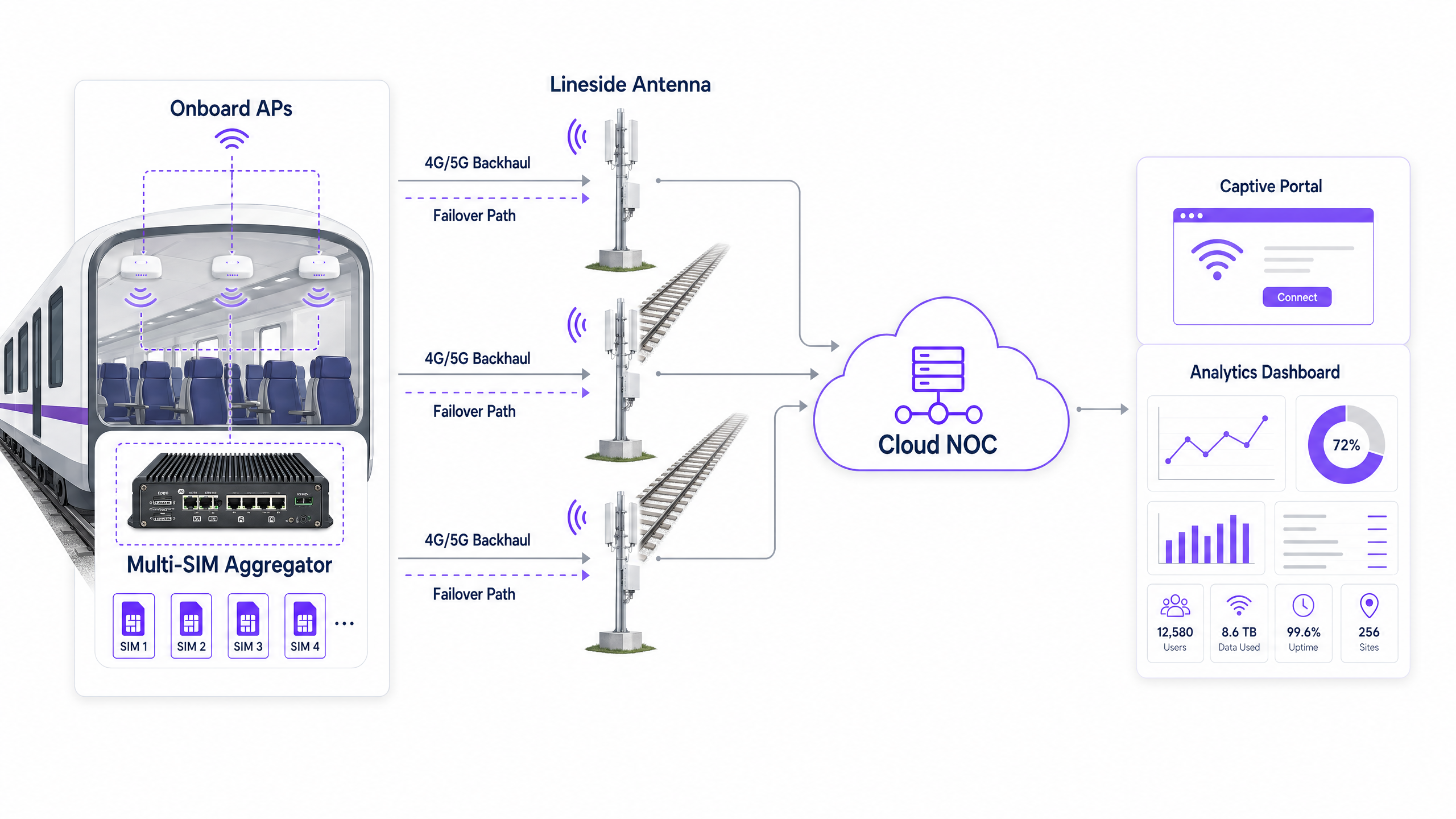
Confiar em um único provedor celular é insuficiente para um trem em movimento. Implantações modernas utilizam um gateway de agregação multi-SIM (ou roteador multi-portadora) instalado no trem. Este dispositivo une conexões de múltiplas Operadoras de Rede Móvel (MNOs) através de redes 4G e 5G simultaneamente.
À medida que o trem atravessa diferentes zonas de cobertura, o agregador roteia dinamicamente o tráfego pelos links disponíveis com base em métricas de latência em tempo real, perda de pacotes e intensidade do sinal. Se uma operadora perder o sinal em um túnel ou corte rural, as outras mantêm a sessão, proporcionando um failover contínuo sem interrupção perceptível para o passageiro. Esta é a decisão arquitetônica mais importante em qualquer implantação de WiFi ferroviário.
Infraestrutura de Linha (Via-para-Trem)
Para rotas de passageiros de alta densidade onde as redes celulares públicas ficam congestionadas durante os horários de pico, as operadoras estão investindo em infraestrutura de linha dedicada. Isso envolve a implantação de antenas ao longo da via — tipicamente em intervalos de 500 metros a 2 quilômetros, dependendo da tecnologia — que transmitem um sinal dedicado usando mmWave ou espectro 5G proprietário diretamente para receptores montados no exterior dos vagões do trem.
Esta abordagem contorna completamente o congestionamento celular público, oferecendo throughput garantido. A desvantagem é um investimento de capital significativo na construção da infraestrutura de linha, mas para rotas intermunicipais de alta receita, o caso de negócios é convincente. Uma consideração chave é o efeito Doppler: em velocidades acima de 100 mph, a frequência de rádio percebida pelo receptor difere da frequência transmitida, exigindo equipamento de rádio especializado projetado especificamente para cenários de mobilidade de alta velocidade.
Distribuição a Bordo e Padrões de Hardware
Uma vez que o backhaul é assegurado, o sinal é distribuído via um backbone Ethernet a bordo para Pontos de Acesso Sem Fio (APs) em cada vagão. O hardware implantado em trens deve aderir a padrões ambientais rigorosos, especificamente EN 50155. Este padrão dita os requisitos para equipamentos eletrônicos usados em material rodante, garantindo resiliência contra variações extremas de temperatura (tipicamente -25°C a +70°C), umidade, choque e vibração.
APs tipicamente exigem conectores industriais M12 em vez de portas RJ45 padrão para evitar desconexões devido à vibração. Wi-Fi 6 (802.11ax) é agora o padrão recomendado para novas implantações, oferecendo desempenho aprimorado em ambientes de alta densidade através de tecnologias como OFDMA e BSS Colouring.
A topologia da LAN a bordo é igualmente importante. Uma abordagem em cadeia (daisy-chain) cria pontos únicos de falha em cada conexão entre vagões. A arquitetura recomendada é uma topologia de anel redundante, onde uma interrupção em qualquer segmento de cabo único é automaticamente contornada roteando o tráfego na direção oposta ao redor do anel.
Guia de Implementação
Implantar um serviço WiFi ferroviário requer planejamento cuidadoso e execução faseada. Os seguintes passos fornecem uma estrutura prática para equipes de TI.
Passo 1: Levantamento de RF e Avaliação de Backhaul
Antes da seleção do hardware, conduza um levantamento de RF abrangente de toda a rota do trem. Mapeie a intensidade do sinal e o throughput de dados de todas as principais MNOs ao longo da via em horários representativos do dia. Identifique pontos cegos — túneis, cortes profundos, trechos rurais — onde a cobertura celular cai completamente. Esses dados informam diretamente a configuração da operadora SIM para os gateways de agregação e destacam onde o investimento em infraestrutura de linha pode ser justificado.
Passo 2: Aquisição e Instalação de Hardware
Selecione hardware compatível com EN 50155 de fornecedores com implantações ferroviárias comprovadas. Instale o agregador multi-SIM em um gabinete de comunicações seguro e ventilado, tipicamente no vagão dianteiro ou traseiro. Passe cabeamento resiliente — anéis Ethernet duplos redundantes usando cabo de nível industrial — através dos vagões até os APs. Enas antenas exteriores são aerodinamicamente perfiladas e seladas com classificação IP67 ou superior contra a entrada de intempéries.
Passo 3: Configuração do Captive Portal e Gerenciamento de Largura de Banda
Este é o ponto de integração crítico onde a infraestrutura encontra a experiência do passageiro. Não é possível oferecer largura de banda irrestrita em um trem; o backhaul é um recurso finito e compartilhado. Implemente uma solução de Captive Portal para aplicar Políticas de Uso Justo (FUP).
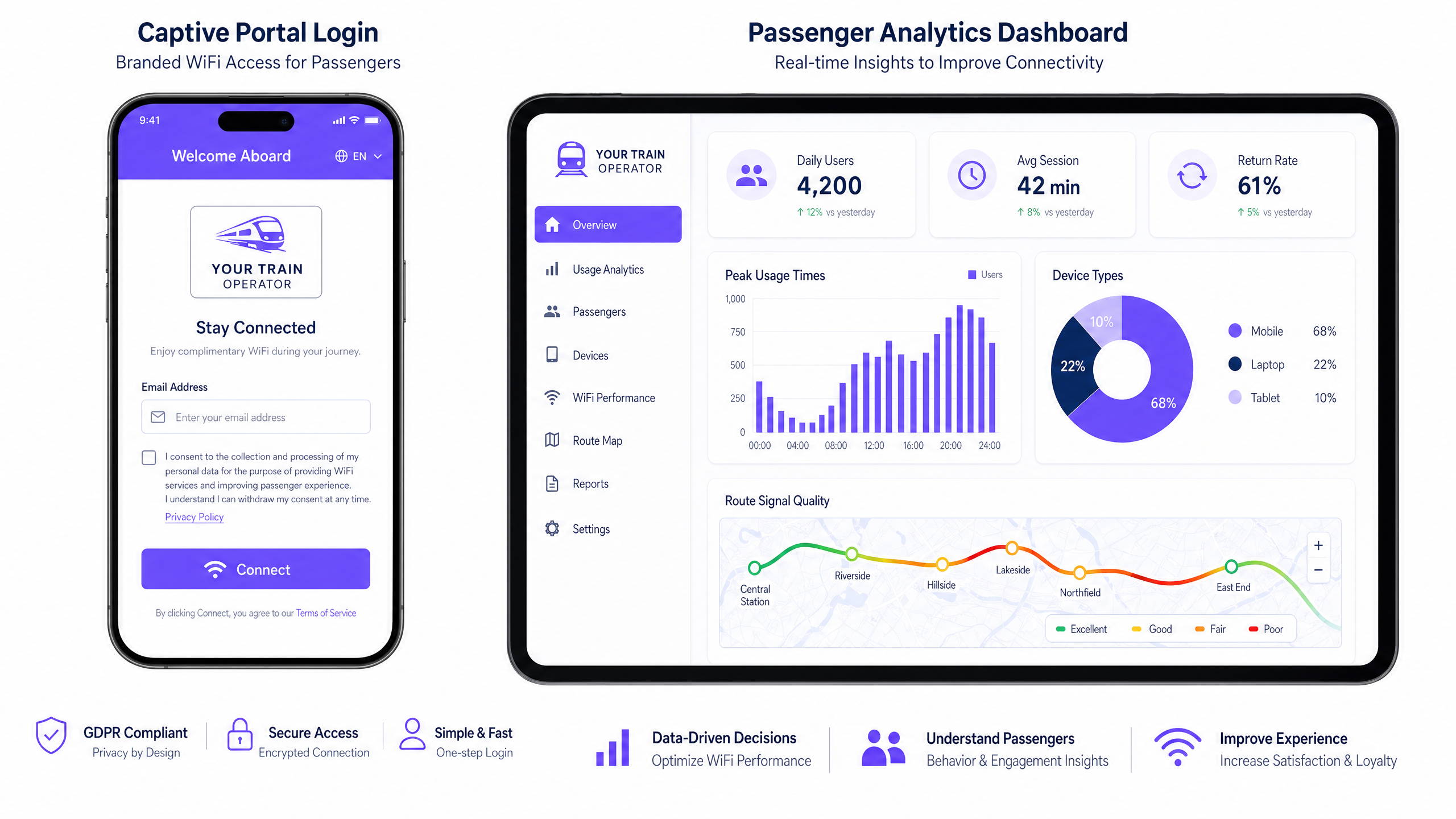
Limitação de Taxa (Rate Limiting) limita as velocidades individuais dos usuários — tipicamente 5 Mbps de download — para garantir acesso equitativo em todos os dispositivos conectados. O Traffic Shaping bloqueia ou restringe aplicativos de alta largura de banda, como streaming 4K ou grandes atualizações de software, priorizando navegação na web, e-mail e VoIP. A Autenticação via portal captura dados do passageiro (endereço de e-mail, login social) em total conformidade com a GDPR, alimentando-os em sua plataforma de análise.
Passo 4: Integração e Monitoramento do NOC
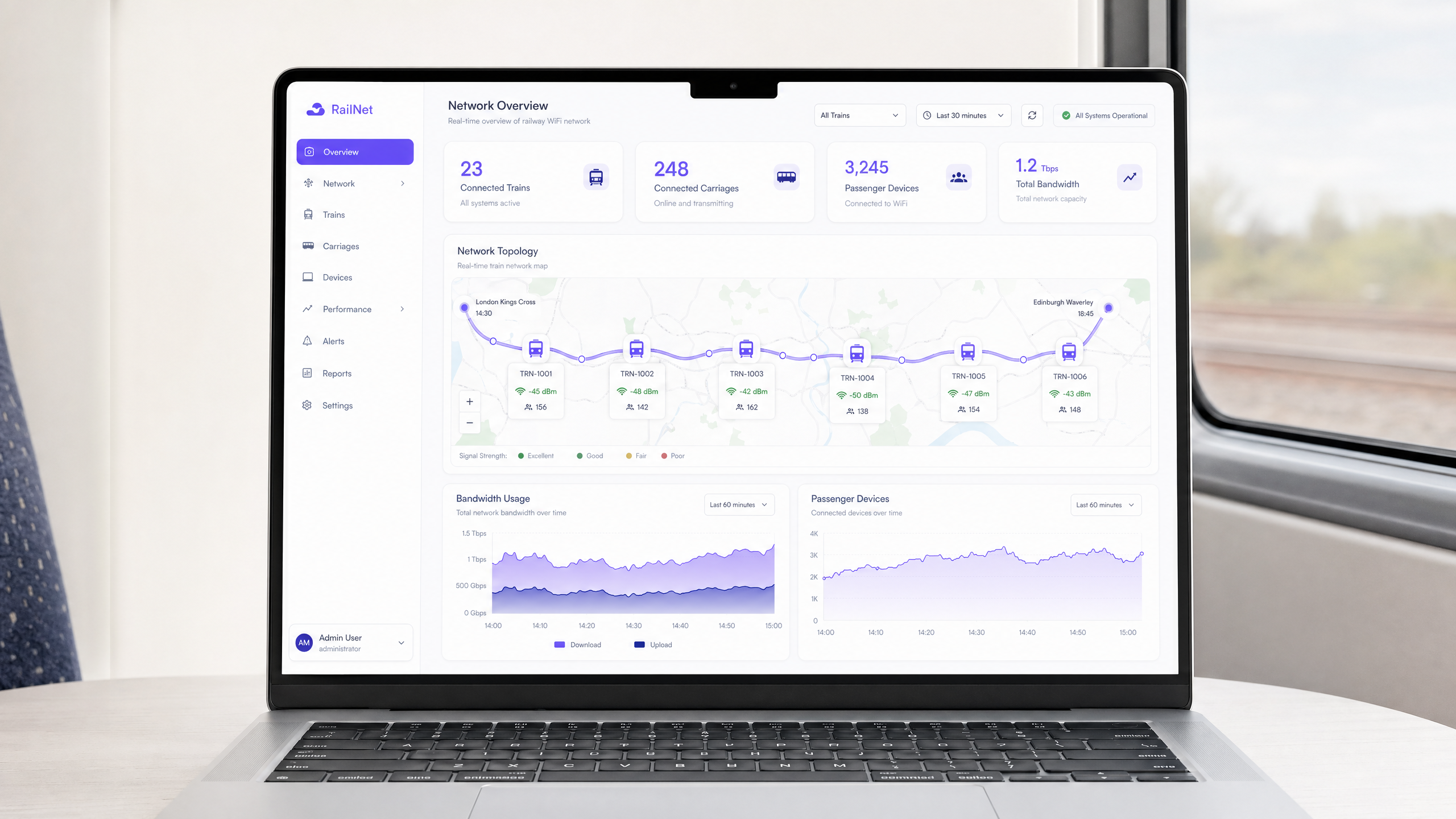
Integre a rede a bordo com um Centro de Operações de Rede (NOC) baseado em nuvem. Configure alertas em tempo real para a saúde dos APs, limites de latência do backhaul e eventos de failover de SIM. Sobreponha dados de posição GPS do trem com métricas de desempenho de rede para criar um mapa de qualidade de sinal em nível de rota. Esta é a base para uma gestão proativa, em vez de um tratamento reativo de reclamações.
Melhores Práticas
Implemente o Isolamento de Cliente em todos os APs. Garanta que os dispositivos dos passageiros não possam se comunicar diretamente entre si na rede local. Isso mitiga o risco de ataques peer-to-peer, exploits man-in-the-middle e propagação de malware na LAN a bordo. Esta é uma linha de base de segurança não negociável para qualquer rede pública.
Adote o OpenRoaming para reduzir o atrito do portal. Para melhorar a experiência do passageiro para viajantes frequentes, suporte Passpoint e OpenRoaming (IEEE 802.11u). Isso permite que dispositivos compatíveis se autentiquem de forma segura e automática sem interagir com um Captive Portal em cada viagem. Purple atua como um provedor de identidade gratuito para serviços OpenRoaming, tornando este um caminho de atualização viável para operadores que já utilizam a plataforma. Para mais contexto sobre os fundamentos de segurança de rede, consulte Proteja Sua Rede com DNS e Segurança Fortes .
O monitoramento proativo é inegociável. Não dependa de reclamações de passageiros para identificar interrupções. Integre a rede a bordo com um NOC em nuvem para monitorar o tempo de atividade, a latência do backhaul e a saúde dos APs em tempo real. O objetivo é identificar e resolver problemas antes que o primeiro passageiro perceba.
Trate o Captive Portal como um produto, não como um utilitário. O portal é seu principal ponto de contato com o passageiro. Invista em uma experiência de marca, com carregamento rápido, que comunique claramente os termos de serviço e o uso de dados. Um portal mal projetado cria atrito e reduz as taxas de autenticação, impactando diretamente a qualidade de seus dados primários.
Solução de Problemas e Mitigação de Riscos
O Efeito de Pico na Estação
O Risco: Quando um trem chega a uma estação movimentada, centenas de dispositivos a bordo podem tentar simultaneamente se conectar à rede macrocelular da estação ou ao WiFi público da própria estação, causando interferência severa, saturação do backhaul e uma experiência degradada para todos os passageiros.
Mitigação: Configure os APs a bordo para alternar dinamicamente seu backhaul da rede celular para um link dedicado de alta capacidade WiFi ou fibra na plataforma da estação. Use gatilhos de geolocalização ou GPS para ajustar automaticamente as políticas de largura de banda quando o trem estiver parado em um grande centro, removendo temporariamente os limites por usuário quando a capacidade do backhaul for efetivamente ilimitada.
Falhas de Cabeamento Entre Vagões
O Risco: As conexões físicas entre os vagões estão sujeitas a estresse mecânico constante, vibração e movimento durante as operações de acoplamento e desacoplamento, levando à degradação do cabo e à segmentação da rede.
Mitigação: Implemente uma topologia de anel redundante para a LAN a bordo usando switches compatíveis com EN 50155 com Rapid Spanning Tree Protocol (RSTP) ou um protocolo de anel proprietário. Se um cabo se romper entre quaisquer dois vagões, o tráfego é automaticamente roteado na direção oposta ao redor do anel, mantendo a conectividade para todos os APs em segundos.
Saturação do Backhaul Durante a Saída de Túneis
O Risco: Quando um trem sai de um túnel longo, todos os dispositivos tentam simultaneamente ressincronizar dados (e-mails, atualizações de aplicativos, backups na nuvem), criando um pico de tráfego que satura o backhaul por 30 a 60 segundos.
Mitigação: Implemente políticas agressivas de Traffic Shaping que especificamente limitem o tráfego de aplicativos em segundo plano. Configure o Captive Portal para despriorizar o tráfego de atualização do sistema operacional e os serviços de sincronização em nuvem na camada de aplicativo, garantindo que o tráfego interativo (navegação na web, mensagens) seja sempre priorizado.
ROI e Impacto nos Negócios
Embora a implantação de uma rede WiFi ferroviária exija um investimento de capital significativo — tipicamente de £50.000 a £200.000 por trem, dependendo da complexidade da solução de backhaul — ela oferece retornos substanciais e mensuráveis quando integrada a uma plataforma de análise robusta.
| Driver de Valor | Mecanismo | Resultado Mensurável |
|---|---|---|
| Aquisição de Dados Primários | Autenticação via Captive Portal | Banco de dados de e-mails de passageiros para CRM e marketing |
| Inteligência Operacional | Análise do NOC + sobreposição de GPS | Responsabilidade do SLA da operadora, identificação de lacunas de cobertura |
| Receita de Mídia de Varejo | Publicidade no Captive Portal | Receita direta de conteúdo patrocinado no login |
| Satisfação do Passageiro | Conectividade confiável | Pontuações NPS aprimoradas, aumento da participação no modal ferroviário |
| Conformidade Regulatória | Captura de dados em conformidade com a GDPR | Risco legal reduzido, registros de consentimento auditáveis |
Ao exigir autenticação via Captive Portal, os operadores constroem um valioso banco de dados de pademografia dos passageiros e hábitos de viagem. Esses dados podem ser usados para campanhas de marketing direcionadas, programas de fidelidade e personalização de serviços. Painéis de análise que sobrepõem o desempenho da rede com dados de localização de trens permitem que os operadores identifiquem lacunas de cobertura ao longo da via e responsabilizem os provedores de celular pelos SLAs contratados.
O Captive Portal em si é um espaço digital privilegiado. Os operadores podem inserir anúncios direcionados ou mensagens patrocinadas no fluxo de login, gerando receita direta para compensar os custos de infraestrutura. Este modelo é altamente bem-sucedido em outros setores, incluindo Retail e centros de Transport , e os mesmos princípios se aplicam diretamente ao ambiente ferroviário. Para operadores no setor de hospitalidade que gerenciam hotéis ou lounges em estações, os mesmos princípios da plataforma se aplicam — consulte nosso guia sobre implantações de Hospitality WiFi para padrões de implementação paralelos.
Definições principais
Multi-Bearer Aggregation
The process of combining multiple network connections — typically several 4G or 5G SIM cards from different carriers — into a single, robust data connection using a bonding gateway to improve aggregate bandwidth and provide automatic failover.
Essential for trains, as it prevents network dropouts when passing through areas where a single cellular provider lacks coverage. The gateway dynamically routes packets across all available bearers in real-time.
EN 50155
An international standard (IEC 60571) covering electronic equipment used on rolling stock for railway applications, specifying requirements for temperature, humidity, vibration, shock, and power supply fluctuations.
IT teams must ensure all onboard routers, switches, and APs are EN 50155 certified. Standard enterprise hardware will fail in the railway environment due to vibration and temperature extremes.
Captive Portal
A web page that the user of a public-access network is obliged to view and interact with before full internet access is granted. It typically requires authentication and acceptance of terms of service.
Used by operators to authenticate users, enforce fair usage policies, and capture valuable first-party marketing data. It is the primary commercial interface between the operator and the passenger on the WiFi network.
Client Isolation
A security feature on wireless access points that prevents connected devices from communicating directly with each other on the local network, forcing all traffic through the gateway.
Critical for public networks like train WiFi to protect passengers from peer-to-peer hacking attempts, man-in-the-middle attacks, and malware propagation across the onboard LAN.
Lineside Infrastructure
Dedicated telecommunications equipment — including antennas, radio units, and fibre backhaul — installed along the railway track to provide a private, high-capacity backhaul network for the trains.
Deployed when public cellular networks cannot handle the high data demands of dense commuter routes. Requires significant capital investment but offers guaranteed throughput independent of public network congestion.
Passpoint / OpenRoaming
A protocol suite (based on IEEE 802.11u and Hotspot 2.0) that allows devices to automatically and securely connect to participating WiFi networks without requiring a captive portal login, using certificate-based authentication.
Improves the passenger experience for repeat travellers by providing seamless, automatic connectivity. Purple acts as an identity provider for this service, enabling operators to offer it without building their own authentication infrastructure.
Traffic Shaping (QoS)
The practice of regulating network data transfer to control bandwidth allocation, prioritise certain types of traffic, and block or throttle others, ensuring a defined quality of service for all users.
Used on trains to block high-bandwidth applications (like 4K video streaming) and prioritise interactive traffic (web browsing, email, VoIP) to ensure all passengers have a usable connection despite finite backhaul capacity.
Doppler Shift
The change in frequency of a radio wave as perceived by a receiver that is moving relative to the transmitter. At high speeds, this frequency shift can degrade the quality of the radio link.
A fundamental physical challenge in high-speed rail networking. Specialised track-to-train radio equipment is required to compensate for Doppler shift at speeds above 100 mph, making standard enterprise outdoor APs unsuitable for lineside deployment.
Fair Usage Policy (FUP)
A set of rules enforced by the network operator that limits the bandwidth or data consumption of individual users to ensure equitable access for all connected devices.
Implemented via the captive portal and traffic shaping engine on the multi-SIM aggregator. Without an FUP, a small number of heavy users can saturate the entire backhaul, degrading the experience for all passengers.
Exemplos práticos
A regional rail operator with 50 trains is experiencing severe WiFi complaints. Passengers report the network drops out completely during a 15-minute stretch of the journey through a rural valley. The current setup uses a single-SIM 4G router in each carriage. What is the recommended remediation approach?
The operator must upgrade to a multi-bearer architecture. Step 1: Replace the single-SIM routers with a centralised EN 50155-compliant multi-SIM aggregation gateway per train. Step 2: Conduct an RF survey of the valley to determine which MNOs have partial coverage in the affected segment. Step 3: Provision the gateway with SIMs from at least three different MNOs (e.g., EE, O2, Vodafone), configuring the gateway for packet-level bonding and seamless failover. Step 4: Implement a captive portal to enforce a strict 2 Mbps per-user rate limit during the low-coverage valley segment to prevent connection timeouts for basic web browsing. Step 5: Integrate with a cloud NOC to monitor the failover events in real-time and build a coverage map for carrier negotiations.
A major intercity operator is launching a new premium service and wants to offer a differentiated WiFi experience: first-class passengers get 20 Mbps uncapped, while standard-class passengers receive 5 Mbps with streaming blocked. How should this be architected?
This requires a multi-SSID architecture with per-SSID QoS policies. Step 1: Configure two separate SSIDs on the onboard APs — one for first class, one for standard class. Step 2: Assign each SSID to a separate VLAN. Step 3: On the multi-SIM aggregator, configure per-VLAN traffic shaping policies: VLAN 10 (first class) receives priority queuing with no application-layer blocking; VLAN 20 (standard class) receives a 5 Mbps per-user cap with Deep Packet Inspection (DPI) rules blocking known streaming service domains and IP ranges. Step 4: Deploy separate captive portal instances for each SSID, with the first-class portal pre-populated for frequent travellers via OpenRoaming or a loyalty programme token.
Questões práticas
Q1. You are designing the onboard LAN for a new fleet of 8-carriage trains. The project manager suggests daisy-chaining the APs via standard Cat6 cable between carriages to reduce cost. What is the primary risk of this approach, and what architecture should you recommend instead?
Dica: Consider the physical environment of a moving train and what happens to network segments downstream of a broken inter-carriage cable.
Ver resposta modelo
The primary risk is a cascading single point of failure. If the cable between Carriage 3 and Carriage 4 breaks due to vibration or mechanical stress during coupling, Carriages 4 through 8 lose all network connectivity. I would recommend a redundant ring topology using EN 50155-compliant managed switches with M12 connectors and RSTP or a proprietary ring protocol. In a ring topology, a break in any single cable segment is automatically bypassed within milliseconds by routing traffic in the opposite direction around the ring, maintaining connectivity for all APs.
Q2. Your analytics dashboard shows that total bandwidth on the 08:00 commuter service is maxing out the multi-SIM backhaul, causing widespread complaints about slow speeds. However, only 30% of passengers have authenticated on the captive portal. What is the likely cause and what is the solution?
Dica: Think about what devices do in the background when they detect a known or open WiFi network, even before a user actively browses.
Ver resposta modelo
The most likely cause is background device activity: OS updates, cloud backups (iCloud, Google Drive), app refresh cycles, and email sync all initiate automatically as soon as a device associates with the SSID, regardless of whether the user has authenticated through the captive portal. The solution is to implement strict pre-authentication walled gardens on the captive portal — only allowing access to the portal itself before login — combined with post-authentication traffic shaping that blocks known update server IP ranges and CDN domains during peak hours. Per-user rate limiting should also be applied immediately post-authentication.
Q3. A train operator wants to deploy dedicated lineside track-to-train infrastructure to bypass public cellular networks entirely. Their procurement team has identified a low-cost option using standard enterprise outdoor WiFi access points mounted on poles at 200-metre intervals along the track. The trains travel at 125 mph. Why will this approach fail, and what should they specify instead?
Dica: Consider both the physics of high-speed radio communication and the operational requirements of handoff between access points.
Ver resposta modelo
This approach will fail for two fundamental reasons. First, standard enterprise outdoor APs are not designed to handle the rapid handoffs required when a train is moving at 125 mph — at that speed, the train passes a 200-metre cell in under 4 seconds, far faster than standard 802.11 roaming protocols can execute a clean handoff. Second, the Doppler shift effect at those speeds will degrade the radio link quality, as standard APs cannot compensate for the frequency shift caused by the relative velocity between the train and the fixed antenna. The operator must specify dedicated track-to-train radio equipment from vendors with proven high-speed railway deployments, using technologies specifically designed for mobility scenarios, with directional antennas and proprietary handoff protocols optimised for train speeds.
Q4. A passenger rail operator is preparing for a GDPR audit. Their captive portal collects email addresses and uses them for marketing. What are the three most critical compliance requirements they must demonstrate?
Dica: Focus on the lawful basis for processing, the right to withdraw consent, and data retention.
Ver resposta modelo
The three most critical requirements are: 1) Lawful basis and explicit consent — the portal must present a clear, unbundled consent checkbox for marketing communications that is not pre-ticked and is separate from the terms of service acceptance required for WiFi access. Passengers must be able to access WiFi without consenting to marketing. 2) Right to withdraw — there must be a clear, accessible mechanism for passengers to withdraw their marketing consent at any time, typically an unsubscribe link in every email and a self-service preference centre. 3) Data retention and minimisation — the operator must have a documented data retention policy specifying how long passenger data is held, and must be able to demonstrate that data is deleted or anonymised after the retention period. All three must be evidenced with audit logs.
Continue a ler esta série
Como reduzir o número de SSIDs de WiFi usando PSK por dispositivo (iPSK, DPSK, MPSK)
Este guia de referência técnica definitivo explica como as equipes de TI podem eliminar a degradação de desempenho do WiFi causada pelo overhead de beacons de SSID, colapsando múltiplas redes dedicadas em um único SSID usando PSK por dispositivo (xPSK). Ele abrange o ecossistema de fornecedores, incluindo Cisco iPSK, HPE Aruba MPSK, Ruckus DPSK, Juniper Mist PPSK e Ubiquiti UniFi PPSK, com orientações práticas de implementação sobre atribuição dinâmica de VLAN, integração de IoT e conformidade com o PCI DSS. Operadores de locais em hotelaria, varejo, estádios e organizações do setor público encontrarão orientações de arquitetura acionáveis e exemplos práticos do mundo real.
O que é uma Solicitação de Sondagem (Probe Request)? Entendendo Como os Dispositivos Descobrem Redes
Este guia de referência técnica oferece uma análise aprofundada das solicitações de sondagem IEEE 802.11, varredura ativa versus passiva e o impacto da randomização de MAC na análise de locais. Ele fornece estratégias de implementação acionáveis para arquitetos de rede otimizarem implantações de alta densidade, mitigarem tempestades de sondagem e garantirem a coleta de dados precisa e em conformidade com o GDPR usando camadas de identidade autenticadas.
Como Corrigir WiFi Lento Sem Fazer Upgrade do Seu Plano de Internet
Um guia de referência técnica abrangente para gerentes de TI e arquitetos de rede sobre como otimizar o desempenho de WiFi empresarial sem aumentar a largura de banda do ISP. Abrange ajuste de RF, gerenciamento de densidade de clientes, implementação de QoS e como aproveitar a análise de WiFi para diagnosticar e resolver gargalos.