
WiFi de Aeroporto: Como as Operadoras Oferecem Conectividade em Todos os Terminais
Este guia oferece aos líderes de TI estratégias acionáveis para projetar, implantar e gerenciar redes WiFi de aeroporto de alta densidade. Ele aborda arquitetura técnica, planejamento de RF e como aproveitar plataformas como a Purple para transformar a conectividade dos passageiros em análises valiosas e receita.
Ouça este guia
Ver transcrição do podcast
Resumo Executivo
Para gerentes de TI e arquitetos de rede, implantar uma rede sem fio de aeroporto é um dos desafios mais exigentes na TI empresarial. Você não está apenas fornecendo acesso à internet; você está gerenciando um ambiente de RF de alta densidade e alta interferência que abrange milhões de metros quadrados e atende dezenas de milhares de usuários simultâneos. Os passageiros esperam conectividade contínua e de alta velocidade desde o momento em que entram no terminal até o segundo em que embarcam. A falha em entregar isso resulta em baixas pontuações de experiência do passageiro e oportunidades comerciais perdidas.
Este guia de referência técnica detalha a arquitetura, as estratégias de implantação e o impacto nos negócios do WiFi de aeroporto de nível empresarial. Exploraremos como fazer a transição de implantações legadas para redes WiFi 6/6E de alta capacidade, mitigar desafios comuns de RF e utilizar plataformas como o Guest WiFi da Purple para capturar dados primários, impulsionar a lealdade e desbloquear novas fontes de receita através da monetização de mídia de varejo.
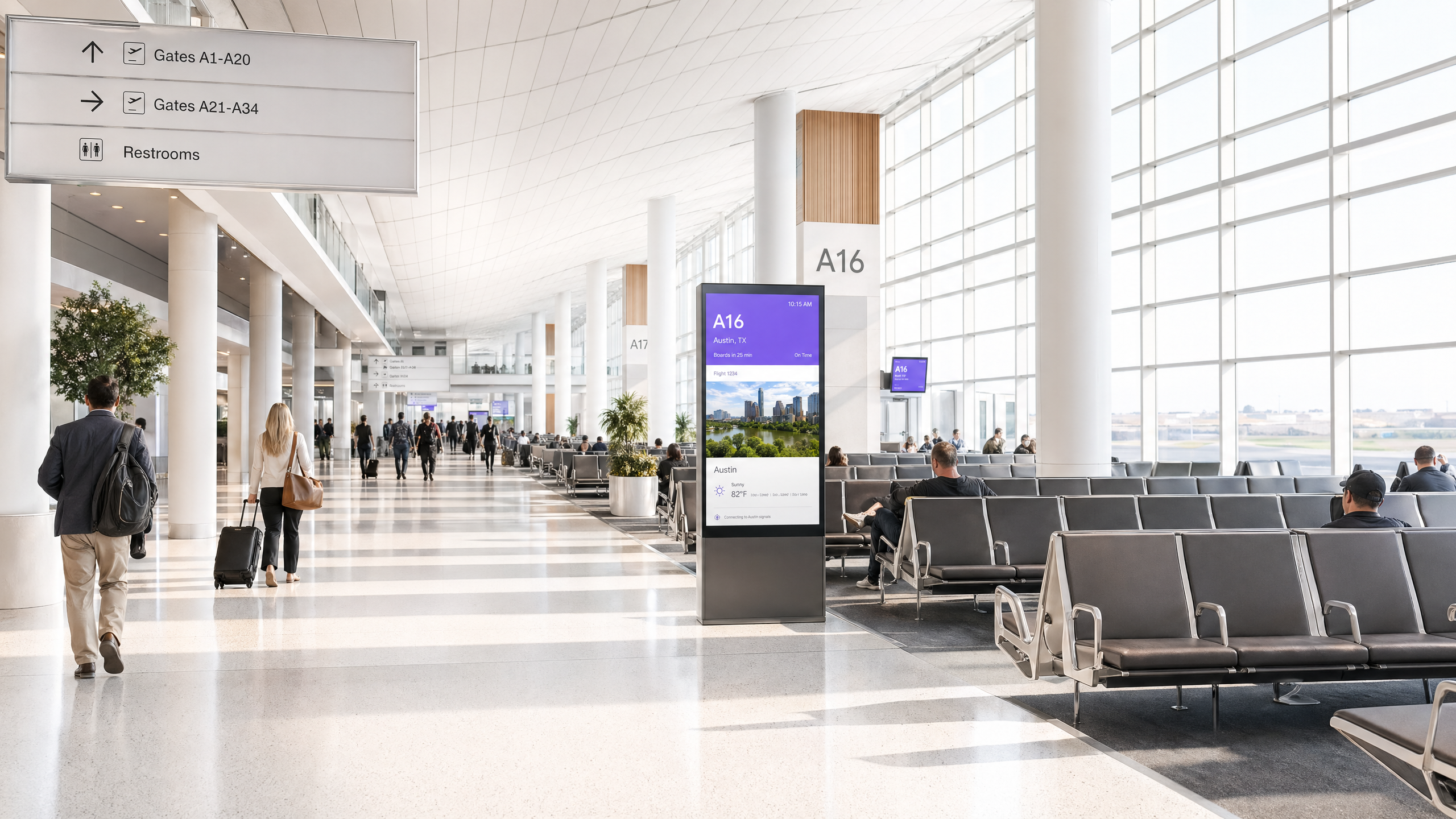
Análise Técnica Aprofundada: Arquitetura e Padrões
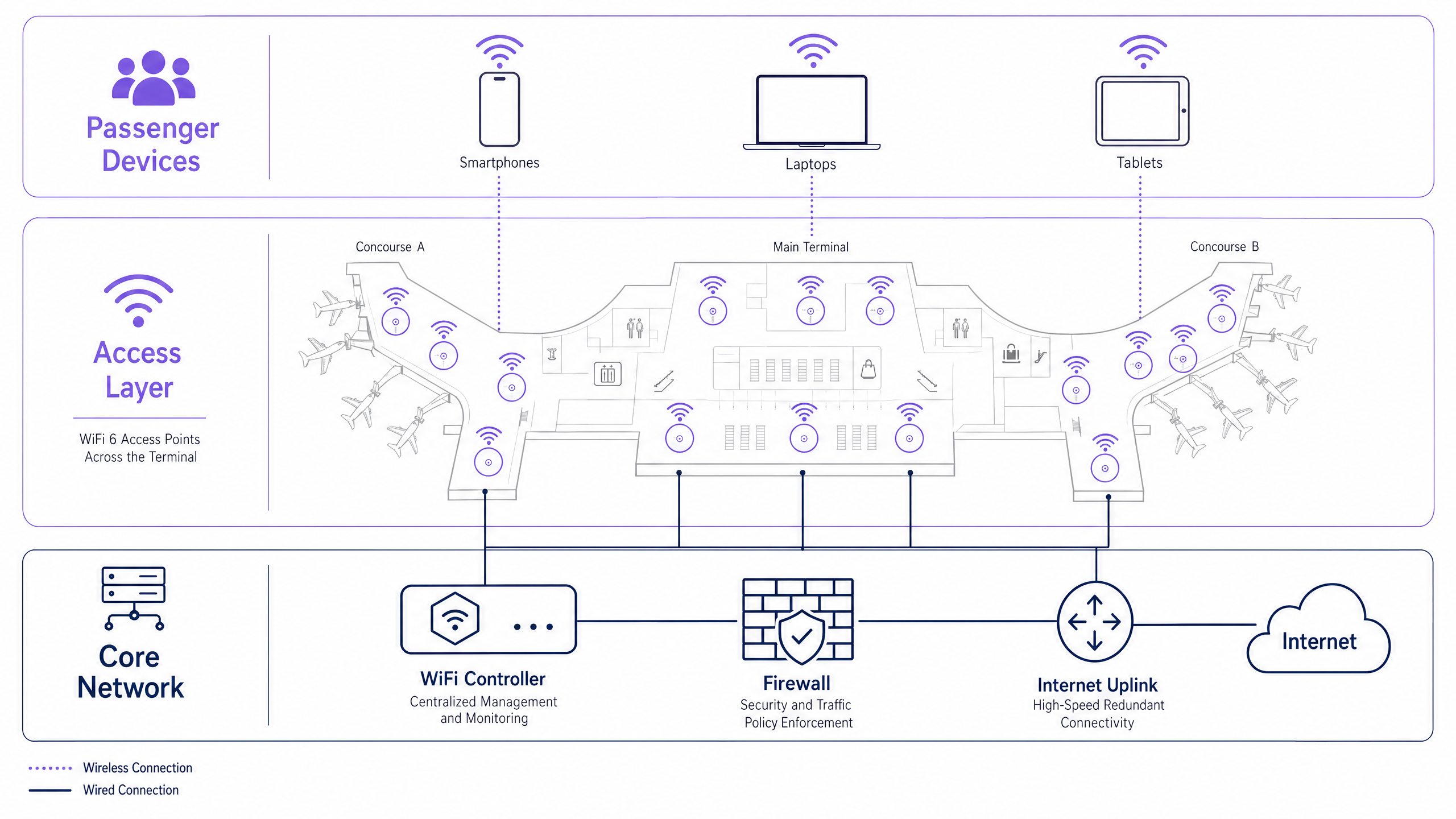
Oferecer WiFi para passageiros confiável exige uma arquitetura robusta e multicamadas, projetada para capacidade, não apenas cobertura.
A Camada de Acesso: Conquistando a Densidade
A camada de acesso é onde a batalha pelo desempenho é ganha ou perdida. Em um ambiente de aeroporto, o principal desafio é a densidade — milhares de dispositivos convergindo em salas de embarque, praças de alimentação e áreas de retirada de bagagem.
- WiFi 6 (802.11ax) e 6E: A atualização para WiFi 6 é crítica. Recursos como Orthogonal Frequency-Division Multiple Access (OFDMA) e Multi-User MIMO (MU-MIMO) permitem que os Access Points (APs) lidem com múltiplos dispositivos clientes simultaneamente, reduzindo drasticamente a latência em áreas congestionadas. O WiFi 6E introduz a banda de 6GHz, fornecendo um espectro limpo muito necessário, longe das bandas congestionadas de 2.4GHz e 5GHz.
- Gerenciamento Dinâmico de RF: O ambiente físico de um aeroporto está em constante mudança. Um controlador centralizado deve empregar gerenciamento dinâmico de RF para ajustar automaticamente as atribuições de canal e a potência de transmissão para mitigar a interferência de co-canal à medida que os volumes de passageiros flutuam.
- Direcionamento de Clientes: As redes devem direcionar agressivamente clientes capazes para as bandas de 5GHz ou 6GHz, preservando a banda de 2.4GHz para dispositivos legados e infraestrutura de IoT.
A Rede Central e a Segurança
A rede central deve agregar grandes volumes de tráfego sem gargalos.
- Uplinks de Alta Velocidade: Conexões de internet redundantes e de alta capacidade são obrigatórias. Compreender O Que É uma Linha Dedicada? Internet Empresarial Dedicada é crucial para garantir largura de banda e SLAs garantidos.
- Segurança e Segmentação: O tráfego de convidados deve ser estritamente isolado das redes operacionais (por exemplo, manuseio de bagagem, sistemas de segurança) usando VLANs e firewalls. A implementação de WPA3 (onde suportado) e filtragem DNS robusta é essencial para Proteger Sua Rede com DNS e Segurança Fortes .
Guia de Implementação: Estratégias de Implantação
Implantar um ambiente de rede sem fio de aeroporto exige planejamento meticuloso.
- Pesquisas Abrangentes de Local: Nunca confie apenas em modelagem preditiva. Conduza pesquisas de local de RF ativas e passivas para contabilizar a atenuação causada por elementos arquitetônicos como concreto armado, aço estrutural e vidro especializado.
- Design para Capacidade: Implantações tradicionais focavam na cobertura (ter um sinal em todos os lugares). Implantações modernas devem focar na capacidade (garantir throughput suficiente para todos os dispositivos conectados em uma determinada zona). Isso geralmente significa maior densidade de APs com menor potência de transmissão para minimizar a sobreposição de células.
- Roaming Contínuo: Implemente protocolos de roaming rápido (como 802.11r/k/v) para garantir que os dispositivos clientes possam fazer a transição suavemente entre os APs enquanto os passageiros se movem pelo terminal, evitando quedas de conexão durante chamadas VoIP ou transmissões de vídeo.
- Autenticação Baseada em Perfil: Para reduzir o atrito, implemente métodos de autenticação baseados em perfil como o OpenRoaming. Isso permite que dispositivos compatíveis se conectem automaticamente e com segurança, melhorando significativamente a experiência do usuário, ao mesmo tempo em que permite que o local mantenha o controle.
Melhores Práticas para Operadores de Locais
Além da infraestrutura física, a forma como você gerencia a conexão dita seu valor comercial.
- Aproveite o Captive Portal: O Captive Portal é um ponto de contato estratégico. Use-o para capturar dados primários (com conformidade GDPR/CCPA) e apresentar ofertas direcionadas. Isso transforma a rede de um centro de custo em um ativo de marketing.
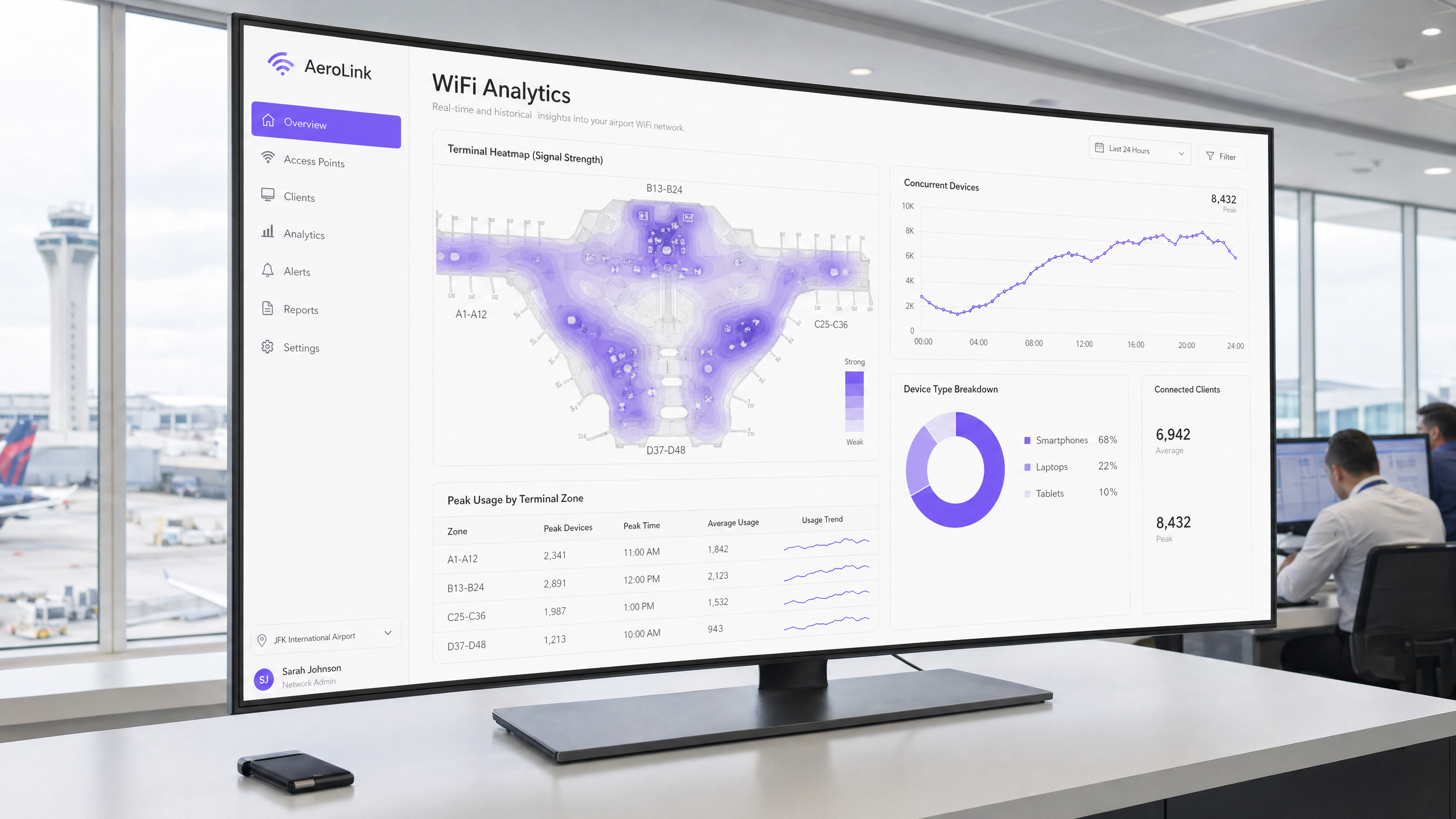
- Utilize o WiFi Analytics: Implante plataformas como o WiFi Analytics da Purple para obter insights acionáveis. Ao analisar solicitações de sondagem de dispositivos e dados de conexão, os operadores podem visualizar o fluxo de passageiros, medir os tempos de permanência em zonas de varejo e otimizar os layouts dos terminais.
- Aprendizados Intersetoriais: Busque estratégias comprovadas em outros ambientes de alta densidade. Os desafios enfrentados em aeroportos são semelhantes aos de grandes centros de varejo ou grandes centros de transporte. Por exemplo, revisar como os operadores lidam com a conectividade no setor de Varejo ou explorar a Rede WiFi Ferroviária: Como as Operadoras Estão Oferecendo Conectividade em Velocidade pode fornecer insights arquitetônicos valiosos.
Solução de Problemas e Mitigação de Riscos
Mesmo bem-projetadas encontram problemas. Modos de falha comuns incluem:
- Sticky Clients: Dispositivos que se recusam a se conectar a um AP mais próximo, degradando o desempenho para si e para outros. Mitigação: Implementar limites mínimos rigorosos de RSSI (Received Signal Strength Indicator) para forçar os clientes a se desconectarem e encontrarem um AP melhor.
- Rogue APs: Pontos de acesso não autorizados (como hotspots móveis de passageiros) causando interferência. Mitigação: Utilizar Sistemas de Prevenção de Intrusão Sem Fio (WIPS) para detectar e conter APs não autorizados automaticamente.
- Captive Portal Failures: Usuários incapazes de autenticar devido à exaustão de DNS ou DHCP. Mitigação: Garantir que os escopos DHCP sejam dimensionados adequadamente para a capacidade máxima e que os servidores DNS estejam altamente disponíveis.
ROI e Impacto nos Negócios
Implantar uma rede sem fio de aeroporto de nível empresarial exige um CapEx significativo, mas o ROI é mensurável.
- Eficiência Operacional: Análises derivadas da rede permitem otimizar a equipe (por exemplo, abrindo mais faixas de segurança com base na densidade de passageiros em tempo real).
- Monetização de Mídia de Varejo: Ao utilizar o espaço da tela WiFi e o Captive Portal, os aeroportos podem veicular publicidade direcionada, gerando novas fontes de receita que podem compensar o custo da infraestrutura de rede.
- Experiência Aprimorada do Passageiro: A conectividade confiável correlaciona-se diretamente com pontuações mais altas de satisfação do passageiro, influenciando o planejamento de rotas aéreas e a competitividade geral do aeroporto.
Definições principais
High-Density Deployment
A network design strategy focused on serving a massive number of concurrent client devices in a confined physical space, prioritizing capacity and throughput over simple geographic coverage.
Crucial for areas like departure gates and baggage claim where thousands of passengers congregate simultaneously.
Captive Portal
A web page that a user of a public access network is obliged to view and interact with before access is granted, typically used for authentication, accepting terms of service, or marketing.
The primary mechanism for venue operators to capture first-party data and present retail media to passengers.
Band Steering
A feature on wireless controllers that encourages dual-band client devices to connect to the less congested 5GHz or 6GHz bands rather than the crowded 2.4GHz band.
Essential for maximizing overall network performance and ensuring a smooth experience in crowded terminals.
OFDMA (Orthogonal Frequency-Division Multiple Access)
A key feature of WiFi 6 that allows a single Access Point to communicate with multiple client devices simultaneously by dividing the wireless channel into smaller sub-channels.
Dramatically reduces latency and improves efficiency in high-density environments compared to older WiFi standards.
RSSI (Received Signal Strength Indicator)
A measurement of the power present in a received radio signal. Higher values indicate a stronger connection.
IT teams use RSSI thresholds to force 'sticky clients' to disconnect from distant APs and roam to closer ones, optimizing network health.
First-Party Data
Information a company collects directly from its customers or users, such as email addresses, demographics, and behavioral data (like dwell time).
Captured via the WiFi captive portal, this data is highly valuable for personalized marketing and operational analytics, especially as third-party cookies are phased out.
Retail Media Monetization
The practice of using owned digital real estate (like a WiFi captive portal or venue app) to display targeted advertising or promotions.
A key strategy for airport operators to generate revenue from their IT infrastructure by partnering with terminal retailers.
Profile-Based Authentication (e.g., OpenRoaming)
A system that allows users to securely and automatically connect to participating WiFi networks without needing to manually enter passwords or interact with a captive portal every time.
Provides a frictionless passenger experience while maintaining security, representing the future of seamless secure WiFi.
Exemplos práticos
A major international airport is experiencing severe network degradation in its newly renovated Concourse B during peak departure times. Passengers report being connected to the WiFi but having no internet access. The IT team notices that the DHCP pool for the guest VLAN is exhausted.
The immediate solution is to decrease the DHCP lease time for the guest network. In a high-churn environment like an airport concourse, a standard 24-hour lease time will quickly exhaust available IP addresses as passengers connect, board their flights, and leave, while their IP remains reserved. The lease time should be reduced to 1 or 2 hours. Furthermore, the subnet size for the guest VLAN should be evaluated and likely expanded (e.g., moving from a /24 to a /22 or /21) to accommodate the peak volume of concurrent devices.
An airport operator wants to increase retail revenue in Terminal 1. They have a robust WiFi network but are currently only offering a basic 'click-to-accept' terms and conditions page for access.
The operator should deploy a sophisticated captive portal solution, such as Purple's Guest WiFi platform. Instead of a simple splash page, the portal should require a social login or email address to authenticate. Once authenticated, the user is redirected to a landing page featuring targeted promotions for restaurants and duty-free shops within Terminal 1. Simultaneously, the platform begins collecting location data to analyze dwell times and foot traffic patterns around the retail units.
Questões práticas
Q1. Your airport is expanding Terminal 3 with a new high-end retail and dining concourse. The commercial director wants to ensure maximum engagement with the new stores. How should you architect the WiFi access layer and authentication process to support this business goal?
Dica: Consider both RF capacity for a crowded space and the mechanism for delivering targeted content.
Ver resposta modelo
Architecturally, deploy high-density WiFi 6/6E APs focused on capacity (smaller cell sizes) to handle the expected device volume in the dining areas. For authentication, deploy a captive portal requiring user registration (email or social login) to capture first-party data. Integrate this with a platform like Purple to display targeted retail media (e.g., duty-free discount codes) on the landing page post-authentication. Furthermore, utilize the WiFi analytics to track dwell times in front of specific retail units to provide ROI data back to the commercial director.
Q2. During a busy holiday travel weekend, the IT helpdesk receives numerous complaints of dropped WiFi connections as passengers walk from the security checkpoint to their departure gates in Concourse A. What is the most likely technical cause, and how do you resolve it?
Dica: Think about how a client device behaves when moving between the coverage areas of different Access Points.
Ver resposta modelo
The most likely cause is a failure of seamless roaming, often due to 'sticky clients' holding onto a weak AP signal instead of transitioning to a closer, stronger one. To resolve this, ensure fast roaming protocols (802.11r/k/v) are enabled on the wireless controller. Additionally, implement or adjust minimum RSSI thresholds to actively disassociate clients with weak signals, forcing them to roam to a better AP as they move through the concourse.
Q3. You are tasked with securing the airport's new public WiFi network. The operations team is concerned that passenger devices might interfere with or access the baggage handling systems, which operate on the same physical switching infrastructure. What is the standard approach to mitigate this risk?
Dica: Consider network segmentation and traffic isolation techniques at the core network layer.
Ver resposta modelo
The standard approach is strict network segmentation using Virtual Local Area Networks (VLANs). The public WiFi traffic must be placed on a dedicated, isolated guest VLAN. This VLAN should have strict firewall rules applied, explicitly denying any routing or access to the operational VLANs (like the baggage handling system). Furthermore, client isolation should be enabled on the guest SSID to prevent passenger devices from communicating directly with each other, mitigating the risk of peer-to-peer attacks.
Continue a ler esta série
Como reduzir o número de SSIDs de WiFi usando PSK por dispositivo (iPSK, DPSK, MPSK)
Este guia de referência técnica definitivo explica como as equipes de TI podem eliminar a degradação de desempenho do WiFi causada pelo overhead de beacons de SSID, colapsando múltiplas redes dedicadas em um único SSID usando PSK por dispositivo (xPSK). Ele abrange o ecossistema de fornecedores, incluindo Cisco iPSK, HPE Aruba MPSK, Ruckus DPSK, Juniper Mist PPSK e Ubiquiti UniFi PPSK, com orientações práticas de implementação sobre atribuição dinâmica de VLAN, integração de IoT e conformidade com o PCI DSS. Operadores de locais em hotelaria, varejo, estádios e organizações do setor público encontrarão orientações de arquitetura acionáveis e exemplos práticos do mundo real.
O que é uma Solicitação de Sondagem (Probe Request)? Entendendo Como os Dispositivos Descobrem Redes
Este guia de referência técnica oferece uma análise aprofundada das solicitações de sondagem IEEE 802.11, varredura ativa versus passiva e o impacto da randomização de MAC na análise de locais. Ele fornece estratégias de implementação acionáveis para arquitetos de rede otimizarem implantações de alta densidade, mitigarem tempestades de sondagem e garantirem a coleta de dados precisa e em conformidade com o GDPR usando camadas de identidade autenticadas.
Como Corrigir WiFi Lento Sem Fazer Upgrade do Seu Plano de Internet
Um guia de referência técnica abrangente para gerentes de TI e arquitetos de rede sobre como otimizar o desempenho de WiFi empresarial sem aumentar a largura de banda do ISP. Abrange ajuste de RF, gerenciamento de densidade de clientes, implementação de QoS e como aproveitar a análise de WiFi para diagnosticar e resolver gargalos.