
WiFi Gratuito vs. Pago em Hotéis: Qual é o Modelo Certo para Sua Propriedade?
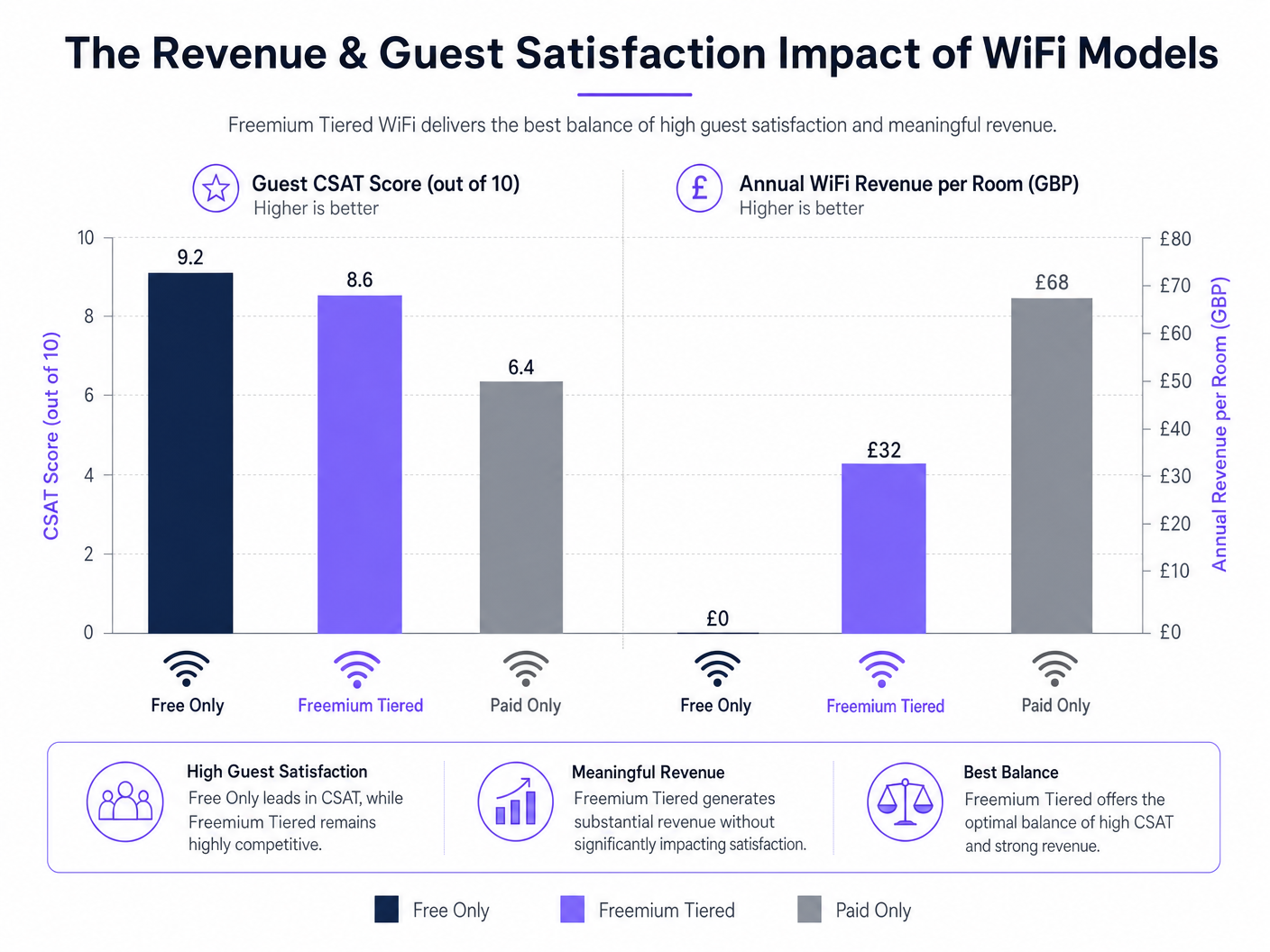
Este guia oferece a líderes de TI e operadores de estabelecimentos uma estrutura definitiva para escolher entre modelos de WiFi gratuito, pago e em camadas em ambientes de hospitalidade. Ele analisa a arquitetura técnica, o impacto nos negócios e as métricas de satisfação do hóspede necessárias para monetizar a conectividade com sucesso, mantendo a segurança de nível empresarial e a conformidade com a GDPR. Operadores que implementam o modelo Freemium em Camadas podem gerar receita auxiliar significativa, preservando as altas pontuações de CSAT que impulsionam reservas repetidas.
Ouça este guia
Ver transcrição do podcast
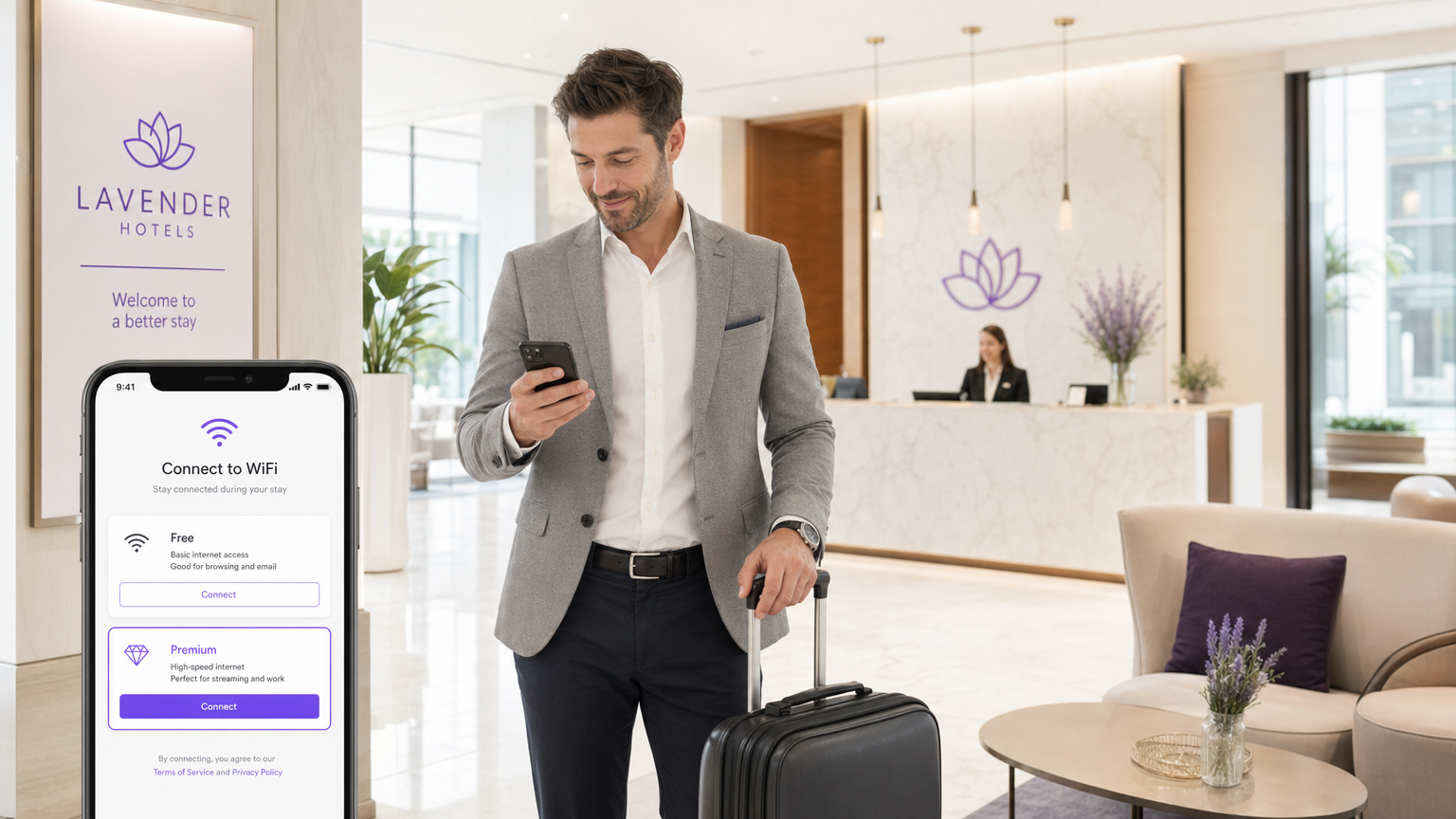
Resumo Executivo
O debate entre WiFi gratuito e pago em hospitalidade e grandes estabelecimentos não é mais uma escolha binária. À medida que as demandas por largura de banda aumentam devido ao streaming em 4K, conferências baseadas em nuvem e uma explosão de dispositivos IoT sem interface, o modelo tradicional de "gratuito para todos" está cedendo sob pressão. Por outro lado, modelos estritos de "pague para usar" estão ativamente prejudicando as pontuações de Satisfação do Hóspede (CSAT) e gerando avaliações online negativas.
Para gerentes de IT, arquitetos de rede e CTOs, a solução ideal reside no Modelo Freemium em Camadas. Essa abordagem oferece uma base de conectividade gratuita e funcional para todos os hóspedes, enquanto disponibiliza camadas premium de alta velocidade para usuários avançados. Este guia explora a arquitetura técnica necessária para implementar largura de banda em camadas, o caso de negócios para geração de receita auxiliar e como plataformas como Guest WiFi e WiFi Analytics transformam um centro de custo em um ativo estratégico. A análise abaixo é relevante para qualquer operador de estabelecimento, desde um hotel boutique de 50 quartos até um grande centro de conferências ou estádio — em qualquer lugar onde uma decisão sobre um serviço de WiFi pago precise ser tomada com confiança.
O Caso de Negócios: Gratuito vs. Pago vs. Em Camadas
Ao avaliar um serviço de WiFi pago, os operadores de estabelecimentos devem equilibrar o custo da infraestrutura com as expectativas do hóspede moderno. A indústria tem se consolidado em torno de três modelos principais, cada um com distintas compensações financeiras e operacionais.
1. O Modelo "Apenas Gratuito"
Oferecer WiFi totalmente gratuito é frequentemente visto como um requisito básico, especialmente em ambientes de Hospitalidade e Varejo de baixo e médio custo. Mais de 84% dos hóspedes de hotéis citam o WiFi gratuito como um fator chave em suas decisões de reserva, tornando-o uma comodidade quase obrigatória.
Prós: Alta satisfação inicial do hóspede; remove atrito durante o onboarding; impacto positivo nas pontuações de avaliação de OTAs.
Contras: Nenhum ROI direto para compensar o aumento dos custos de largura de banda; congestionamento da rede por usuários pesados degrada a experiência para todos os hóspedes; oportunidade perdida para captura de dados primários se não implementado com um Captive Portal e autenticação adequada.
2. O Modelo "Apenas Pago"
Cobrar de cada hóspede pelo acesso é cada vez mais raro e geralmente restrito a transportadoras de ultra-baixo custo, centros de Transporte específicos ou implantações legadas que não foram modernizadas.
Prós: Geração direta de receita; limita naturalmente o consumo de largura de banda; simples de implementar em hardware legado.
Contras: Impacto negativo severo no CSAT; alto atrito no onboarding; ativamente desencoraja reservas em um mercado onde a conectividade é considerada um direito, não um privilégio.
3. O Modelo "Freemium em Camadas"
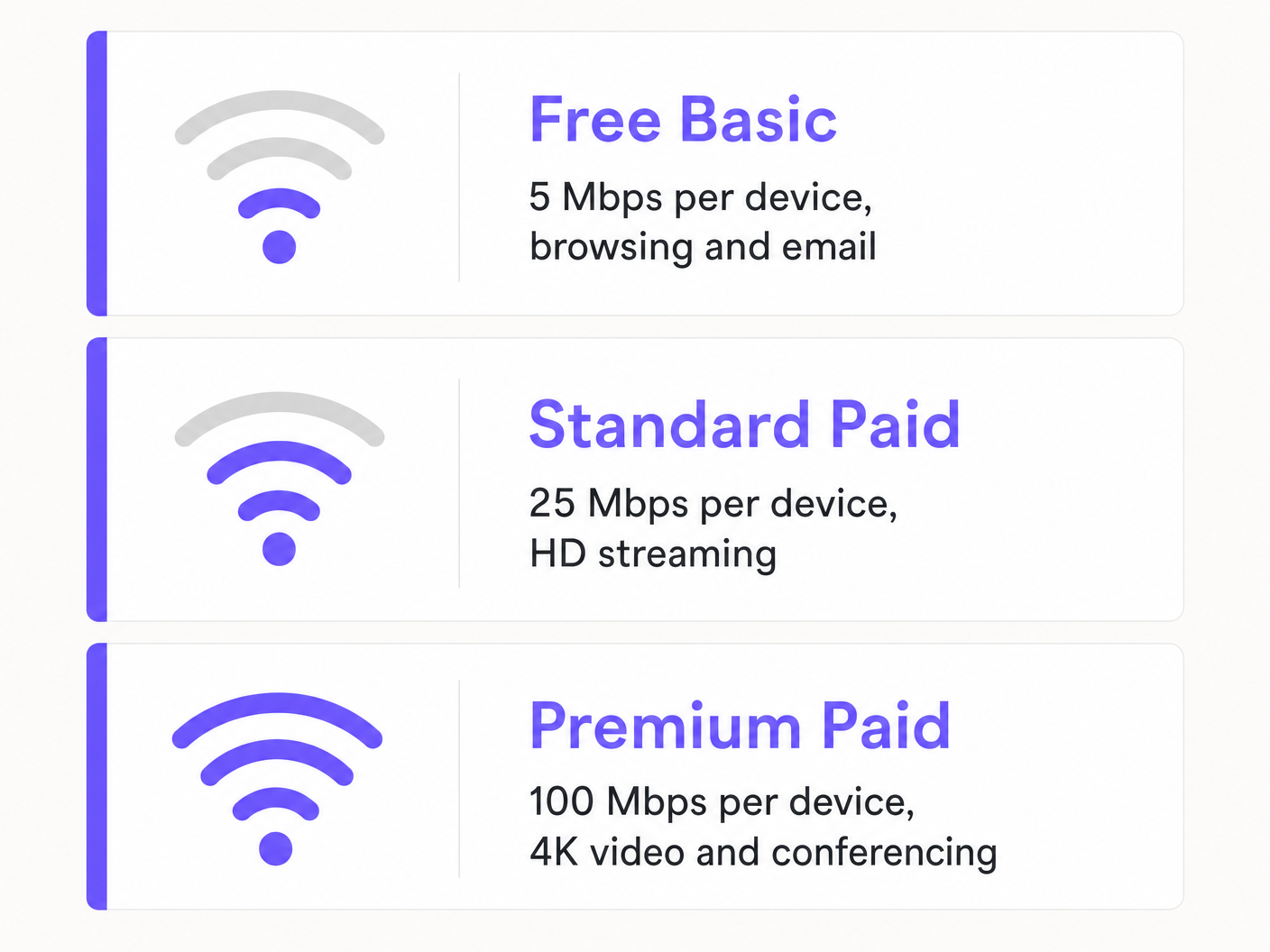
O padrão empresarial. Uma velocidade básica (por exemplo, 5 Mbps por dispositivo) é fornecida gratuitamente em troca de dados do hóspede via uma página de splash, enquanto velocidades mais altas (por exemplo, 25 Mbps ou 100 Mbps) são monetizadas através de uma cobrança diária ou por estadia.
Prós: Equilibra as expectativas dos hóspedes com a geração de receita; permite marketing direcionado através da captura de dados primários; garante alocação justa de largura de banda via QoS; integra-se com programas de fidelidade.
Contras: Requer gerenciamento de rede sofisticado, um gateway WiFi capaz e integração perfeita com Sistemas de Gerenciamento de Propriedade (PMS).
Análise Técnica Aprofundada: Arquitetando Acesso em Camadas
A implementação de um modelo em camadas requer uma arquitetura de rede robusta. Não é simplesmente uma questão de limitar um roteador; requer pontos de acesso de nível empresarial, controladores inteligentes e estruturas de autenticação seguras que estejam em conformidade com os padrões IEEE 802.1X e WPA3.
Alocação de Largura de Banda e Qualidade de Serviço (QoS)
Para implantar com sucesso um serviço de WiFi pago, a rede deve alocar largura de banda dinamicamente. Isso é alcançado através de políticas de Qualidade de Serviço (QoS) gerenciadas no nível do controlador — seja no local ou, cada vez mais, via uma plataforma gerenciada na nuvem.
| Camada | Limite de Vazão | Caso de Uso Típico | Prioridade QoS |
|---|---|---|---|
| Básico Gratuito | 5 Mbps por dispositivo | E-mail, navegação, redes sociais | Baixa |
| Padrão | 25 Mbps por dispositivo | Streaming HD, VPN padrão | Média |
| Premium | 100 Mbps por dispositivo | Vídeo 4K, conferências, grandes uploads | Alta |
Conforme discutido em nosso guia sobre Velocidade do WiFi em Hotéis: O Que os Hóspedes Esperam e Como Entregar , definir esses limites corretamente é crucial para evitar a frustração dos hóspedes. Uma camada gratuita mal calibrada que não consegue sustentar um stream básico do YouTube gerará mais avaliações negativas do que um modelo apenas pago.
Autenticação Segura e Integração
Uma experiência de onboarding perfeita é primordial. A abordagem legada de senhas compartilhadas (PSK) é uma vulnerabilidade de segurança e cria atrito. Implantações modernas utilizam uma abordagem de autenticação em camadas.
Captive Portals: Para a camada gratuita, os hóspedes se autenticam via uma página de splash de marca, aceitando termos e fornecendo dados (por exemplo, e-mail, consentimento de marketing opt-in). Esta é a base do pipeline de dados do WiFi Analytics e alimenta diretamente os sistemas CRM.
Integração PMS: Para camadas premium, o gateway WiFi integra-se diretamente com o PMS do hotel (por exemplo, Oracle Opera, Mews ou Apaleo). Os hóspedes se autenticam usando o número do quarto e o sobrenome, e a cobrança premium é automaticamente lançada em sua conta — nenhum cartão de crédito é exigido no portal.
Passpoint / OpenRoaming (IEEE 802.11u): Para hóspedes recorrentes ou membros de programas de fidelidade, o Passpoint permite uma autenticação perfeita, sem senha e individualmente criptografada (WPA3-Enter"conexões), eliminando completamente o Captive Portal e oferecendo uma experiência de roaming semelhante à celular.
Segmentação e Segurança de Rede
A segmentação de rede via VLANs é um requisito de segurança inegociável, particularmente para conformidade com PCI DSS em ambientes de Varejo e hospitalidade. O tráfego de hóspedes, o tráfego de funcionários e o tráfego de IoT/operacional devem residir em redes lógicas totalmente separadas, mesmo quando compartilham os mesmos pontos de acesso físicos.
Um dispositivo de hóspede comprometido em uma rede não segmentada pode acessar sistemas POS, fechaduras inteligentes e interfaces de gerenciamento internas. As VLANs impedem completamente esse movimento lateral.
Guia de Implementação
A implantação de um modelo de WiFi em camadas requer planejamento cuidadoso para garantir conformidade, segurança e uma experiência de hóspede sem atritos. As etapas a seguir se aplicam tanto a novas implantações (greenfield) quanto a atualizações de infraestrutura existente.
Etapa 1: Avaliação da Linha de Base. Conduza uma pesquisa de site abrangente. Avalie a utilização atual da largura de banda, identifique lacunas de cobertura e avalie o hardware existente. Garanta que o backhaul — tipicamente uma linha dedicada de fibra alugada — possa suportar a carga de pico projetada. Para mais informações sobre os requisitos de backhaul, consulte O Que É uma Linha Alugada? Internet Empresarial Dedicada .
Etapa 2: Defina as Camadas. Estabeleça camadas claras e comunicáveis com preços que reflitam o valor entregue. Uma estrutura comum é: Básico (gratuito, 5 Mbps), Empresarial (£5–£10/dia, 25 Mbps) e Pro (£15+/dia, 100 Mbps ilimitados).
Etapa 3: Projete o Captive Portal. O portal deve ser de marca, responsivo para dispositivos móveis e legalmente compatível. Garanta caixas de seleção de opt-in explícitas e desmarcadas para marketing, a fim de aderir ao GDPR. O portal deve apresentar a proposta de valor das camadas premium claramente e reduzir o atrito na atualização.
Etapa 4: Implemente a Segmentação de Rede. Configure VLANs no controlador para separar o tráfego de hóspedes, funcionários e operacional. Aplique políticas de QoS por VLAN para impor os limites das camadas.
Etapa 5: Integre com PMS e CRM. Conecte o gateway WiFi ao PMS para faturamento automático de contas. Alimente os dados de hóspedes capturados no CRM para campanhas de marketing pós-estadia.
Etapa 6: Teste e Monitore. Conduza testes de carga antes do lançamento. Estabeleça painéis de monitoramento contínuo para rastrear a utilização da largura de banda, as taxas de adoção das camadas e a receita por quarto disponível (contribuição do WiFi para o RevPAR).
Melhores Práticas
As seguintes recomendações refletem padrões da indústria neutros em relação a fornecedores e experiência operacional em ambientes de hospitalidade, varejo e eventos.
Imponha WPA3 em todas as camadas. O WPA3 fornece criptografia de dados individualizada por dispositivo, o que significa que, mesmo na camada gratuita compartilhada, um hóspede não pode interceptar o tráfego de outro. Esta é uma melhoria significativa em relação ao WPA2 e agora é suportada por todos os dispositivos cliente modernos.
Use isolamento de cliente na VLAN de hóspedes. Mesmo dentro da mesma VLAN, os dispositivos dos hóspedes devem ser impedidos de se comunicar diretamente uns com os outros. Isso mitiga vetores de ataque peer-to-peer.
Implemente limitação de taxa no nível do AP, não apenas no gateway. O QoS no nível do controlador é mais granular e responsivo do que a limitação no nível do gateway, e impede que um único dispositivo monopolize os recursos de rádio de um ponto de acesso compartilhado.
Audite a conformidade com o GDPR trimestralmente. Garanta que o mecanismo de consentimento do Captive Portal, as políticas de retenção de dados e os acordos de compartilhamento de dados com terceiros sejam revisados regularmente. A multa média do GDPR no Reino Unido por uma violação de dados é significativa, e a hospitalidade é um setor de alto risco.
ROI e Impacto nos Negócios
A transição para um modelo em camadas transforma o WiFi de um custo irrecuperável em uma fonte de receita mensurável com múltiplos vetores de contribuição.
Receita Direta: As compras de camadas premium fornecem receita auxiliar direta e de alta margem. Em uma propriedade de 200 quartos com 70% de ocupação, se 10% dos hóspedes comprarem um upgrade premium de £10, a propriedade gera aproximadamente £5.110 por mês em receita direta de WiFi — o suficiente para compensar o custo anual da infraestrutura em muitas propriedades de médio porte.
Receita Indireta (Captura de Dados): A camada gratuita atua como um motor de geração de leads. Ao capturar e-mails verificados e dados de CRM, os estabelecimentos podem impulsionar reservas diretas, promover alimentos e bebidas no local e aumentar a adesão a programas de fidelidade — cada um contornando as taxas de comissão de OTAs que tipicamente variam de 15 a 25% da receita do quarto.
Inteligência Operacional: Plataformas de Análise de WiFi como a Purple fornecem mapas de calor de fluxo de pessoas, análise de tempo de permanência e rastreamento de visitas repetidas. Esses dados informam decisões de pessoal, cronometragem promocional e utilização do espaço — gerando economias operacionais que se acumulam ao longo do tempo.
Mitigação de Riscos: Uma rede aberta e mal gerenciada apresenta riscos legais e de reputação significativos. Um sistema em camadas, devidamente arquitetado, com WPA3, isolamento de cliente e segmentação de VLAN, mitiga vetores de ataque man-in-the-middle e demonstra a devida diligência sob GDPR e PCI DSS.
Para operadores em setores adjacentes, os mesmos princípios se aplicam. O Wi-Fi em Automóveis: O Guia Completo para Empresas 2026 demonstra como modelos de conectividade em camadas estão sendo implantados em ambientes de varejo e serviços automotivos, e o setor de Saúde está cada vez mais adotando estruturas semelhantes para WiFi de pacientes e visitantes.
Solução de Problemas e Mitigação de Riscos
Problema: Hóspedes premium relatando velocidades lentas apesar de pagar pela camada superior. Causa raiz: Políticas de QoS não aplicadas no nível do AP, apenas no gateway. Um únicoum AP atendendo mais de 40 dispositivos pode se tornar um gargalo de rádio, independentemente das políticas de nível de gateway. Resolução: Implemente a equidade de tempo de antena por AP e garanta que a densidade de APs seja suficiente para o número esperado de dispositivos simultâneos. Uma regra geral é um AP para cada 20–25 dispositivos simultâneos em ambientes de alta densidade.
Problema: Hóspedes incapazes de conectar smart TVs ou consoles de jogos. Causa raiz: Dispositivos sem interface não conseguem navegar em Captive Portals. Resolução: Implemente iPSK (Individual Pre-Shared Keys) para permitir o onboarding de dispositivos específicos do quarto sem um navegador. Os hóspedes geram a chave através do aplicativo do hotel ou de um código QR no quarto.
Problema: Preocupações com a conformidade com a GDPR em relação à captura de dados. Causa raiz: Fluxos de consentimento mal projetados no Captive Portal. Resolução: Garanta que o portal utilize caixas de seleção de opt-in explícitas e desmarcadas para marketing. Implemente uma política clara de retenção de dados e garanta que o aviso de privacidade esteja vinculado e acessível. Plataformas empresariais lidam com isso automaticamente.
Definições principais
Captive Portal
A web page that users must view and interact with before access is granted to a public WiFi network, typically used for authentication, marketing consent capture, or payment.
Essential for enforcing the free tier, capturing GDPR-compliant marketing data, and presenting the upsell options for premium tiers. The design of the portal directly impacts both conversion rates and compliance posture.
Quality of Service (QoS)
Network management technologies that prioritise certain types of traffic or limit the bandwidth available to specific users, devices, or traffic classes.
The core mechanism used to enforce bandwidth caps on the free tier and guarantee throughput for paying premium guests. Must be configured at both the controller and AP level for maximum effectiveness.
Property Management System (PMS)
The central software system used by hotels to manage reservations, billing, room assignments, and guest profiles.
The WiFi gateway must integrate with the PMS to authenticate guests by room number and automatically post premium WiFi charges to their folio, enabling frictionless billing without a separate payment step.
Passpoint (Hotspot 2.0 / IEEE 802.11u)
A Wi-Fi Alliance protocol that enables seamless, secure, passwordless roaming between different WiFi networks using WPA3-Enterprise certificates.
Allows returning guests or loyalty members to connect automatically and securely without interacting with a captive portal, delivering a cellular-like roaming experience and eliminating the primary source of onboarding friction.
VLAN (Virtual Local Area Network)
A logical subnetwork that groups a collection of devices from different physical network segments, enforcing traffic isolation at the software level.
Used to securely segment guest traffic from operational traffic (POS systems, smart locks, staff devices) on the same physical access points. A mandatory control for PCI DSS compliance and general risk mitigation.
Ancillary Revenue
Income generated from goods or services other than a company's primary product offering — in hospitality, anything beyond the base room rate.
Premium WiFi tiers represent a high-margin form of ancillary revenue. Unlike F&B or spa services, WiFi upgrades have near-zero marginal cost once the infrastructure is deployed, making them exceptionally profitable.
iPSK (Individual Pre-Shared Key)
A security method that provides a unique WiFi password for each user, room, or device on the same SSID, without requiring a full 802.1X infrastructure.
Crucial for securely connecting headless IoT devices — smart TVs, gaming consoles, streaming sticks — that cannot navigate a captive portal. Each room receives a unique key, maintaining isolation between guests.
Freemium Tiered Model
A service delivery model in which a baseline level of service is provided for free, with enhanced features or performance available at a premium price.
The dominant WiFi business model in modern hospitality. The free tier drives CSAT and data capture; the premium tier drives direct revenue. The model is only viable with robust QoS enforcement to ensure the paid tier delivers a meaningfully better experience.
RevPAR (Revenue Per Available Room)
A hotel performance metric calculated by multiplying the average daily room rate by the occupancy rate.
WiFi revenue and the indirect bookings driven by WiFi data capture both contribute to RevPAR. London hotel forecasts for 2026 project approximately 1.8% RevPAR growth, with tech-enabled guest experiences cited as a key driver.
Exemplos práticos
A 300-room luxury hotel is experiencing guest complaints about slow WiFi during peak evening hours. They currently offer a single, free, unthrottled network with a shared password. They need to improve performance for business travellers without alienating leisure guests. How should the IT team restructure the deployment?
Step 1: Replace the shared PSK with a Captive Portal integrated with the PMS (Oracle Opera). Step 2: Implement a Freemium Tiered model with three tiers: Free (10 Mbps, email authentication for CRM data capture), Business (50 Mbps, £8/day, PMS-authenticated and billed to folio), and Premium (100 Mbps, £15/day, same billing mechanism). Step 3: Configure QoS policies at the controller level to enforce per-device bandwidth caps on the free tier and guarantee throughput for paid tiers. Step 4: Deploy Passpoint profiles via the hotel loyalty app so that elite loyalty members automatically receive the Business tier for free upon arrival, with no portal interaction. Step 5: Implement VLAN segmentation to isolate guest traffic from POS and operational systems.
A large conference centre is hosting a 2,000-person technology summit. The event organiser requires a dedicated, secure network for exhibitors running POS and demo hardware, and a separate general-access network for attendees. The venue's IT team must deliver both on the existing physical AP infrastructure. How is this architected?
Step 1: Utilise VLAN segmentation on the existing cloud-managed AP infrastructure to create two logical networks on the same physical hardware. Step 2: Create a dedicated SSID for Exhibitors (e.g., 'TechSummit_Exhibitor') using WPA3-Enterprise or iPSK for secure, isolated connectivity. Each exhibitor receives a unique iPSK for their stand, preventing cross-exhibitor traffic. Guarantee 20 Mbps per exhibitor stand via QoS. Step 3: Create a public SSID for attendees (e.g., 'TechSummit_Guest') with a branded captive portal capturing attendee data for the event organiser. Apply a 5 Mbps per-device cap to manage the high concurrent device count. Step 4: Charge the event organiser a premium for the dedicated, high-SLA exhibitor network as a venue service.
Questões práticas
Q1. A mid-scale hotel chain's Operations Director wants to charge all guests £5 per day for WiFi to recoup hardware costs quickly. As the Network Architect, how do you advise them, and what alternative do you propose?
Dica: Consider the impact on OTA rankings, CSAT scores, and the indirect revenue potential of the free tier.
Ver resposta modelo
A Paid Only model should be strongly discouraged. Over 80% of guests consider free WiFi a prerequisite, and charging a baseline fee actively damages CSAT scores, OTA review ratings, and booking conversion. Instead, recommend a Freemium Tiered approach: provide a free 5 Mbps tier in exchange for email capture via a captive portal, and offer a premium £8/day tier at 50 Mbps for power users. The free tier generates CRM data that drives direct bookings, reducing OTA commission costs. The premium tier generates direct ancillary revenue. At 70% occupancy with 10% premium adoption, a 200-room property generates over £5,000/month — sufficient to offset infrastructure costs without damaging the brand.
Q2. You are deploying a tiered WiFi system. How do you ensure that free-tier guests do not consume all available bandwidth and degrade the experience for paying premium guests?
Dica: Think about controller-level traffic shaping and where QoS policies are applied.
Ver resposta modelo
This is managed through strict Quality of Service (QoS) policies at the network controller level. When a guest authenticates via the captive portal and selects the Free tier, the controller assigns their MAC address to a specific user group or VLAN with a bandwidth cap (e.g., 5 Mbps up/down). For Premium guests authenticated via PMS integration, they are assigned to a separate group with uncapped bandwidth and higher traffic priority. Additionally, per-AP airtime fairness settings prevent any single device from monopolising the shared radio medium. This ensures the backhaul is never saturated by non-paying users, and the premium tier consistently delivers the experience guests paid for.
Q3. A luxury resort wants to offer seamless, passwordless WiFi to its top-tier loyalty members the moment they walk onto the property, without them ever seeing a captive portal. How is this technically achieved, and what security protocol underpins it?
Dica: Consider how cellular networks handle roaming authentication, and the WiFi equivalent.
Ver resposta modelo
This is achieved using Passpoint (Hotspot 2.0), based on IEEE 802.11u. The hotel's loyalty app distributes a Passpoint profile containing a secure digital certificate to the member's device. When the member arrives, their device automatically discovers the Passpoint-enabled SSID, exchanges the certificate in the background using WPA3-Enterprise and 802.1X authentication, and connects without any user interaction or captive portal. The network controller validates the certificate, confirms elite status, and assigns the device to the Premium QoS VLAN. Each connection is individually encrypted, providing far stronger security than a shared PSK. The experience is identical to how a mobile phone automatically connects to a roaming cellular network in a foreign country.
Q4. A hotel is planning to deploy smart TVs and Apple TV devices in all 150 guest rooms. These devices cannot navigate a captive portal. How should the IT team handle their network onboarding?
Dica: Consider authentication methods that do not require a browser.
Ver resposta modelo
The correct approach is to deploy Individual Pre-Shared Keys (iPSK). Each guest room is assigned a unique, secure WiFi password that is different from every other room. Guests can retrieve their room-specific key via a QR code on the in-room welcome card or through the hotel app. They enter this key directly into the smart TV or Apple TV settings. The network controller recognises the unique key, authenticates the device, and assigns it to the correct room's VLAN — ensuring the device is isolated from other guests' devices. This approach maintains enterprise-grade security without requiring a browser-based captive portal interaction.
Continue a ler esta série
Como reduzir o número de SSIDs de WiFi usando PSK por dispositivo (iPSK, DPSK, MPSK)
Este guia de referência técnica definitivo explica como as equipes de TI podem eliminar a degradação de desempenho do WiFi causada pelo overhead de beacons de SSID, colapsando múltiplas redes dedicadas em um único SSID usando PSK por dispositivo (xPSK). Ele abrange o ecossistema de fornecedores, incluindo Cisco iPSK, HPE Aruba MPSK, Ruckus DPSK, Juniper Mist PPSK e Ubiquiti UniFi PPSK, com orientações práticas de implementação sobre atribuição dinâmica de VLAN, integração de IoT e conformidade com o PCI DSS. Operadores de locais em hotelaria, varejo, estádios e organizações do setor público encontrarão orientações de arquitetura acionáveis e exemplos práticos do mundo real.
O que é uma Solicitação de Sondagem (Probe Request)? Entendendo Como os Dispositivos Descobrem Redes
Este guia de referência técnica oferece uma análise aprofundada das solicitações de sondagem IEEE 802.11, varredura ativa versus passiva e o impacto da randomização de MAC na análise de locais. Ele fornece estratégias de implementação acionáveis para arquitetos de rede otimizarem implantações de alta densidade, mitigarem tempestades de sondagem e garantirem a coleta de dados precisa e em conformidade com o GDPR usando camadas de identidade autenticadas.
Como Corrigir WiFi Lento Sem Fazer Upgrade do Seu Plano de Internet
Um guia de referência técnica abrangente para gerentes de TI e arquitetos de rede sobre como otimizar o desempenho de WiFi empresarial sem aumentar a largura de banda do ISP. Abrange ajuste de RF, gerenciamento de densidade de clientes, implementação de QoS e como aproveitar a análise de WiFi para diagnosticar e resolver gargalos.