
Cisco Meraki vs. Aruba: Uma Comparação Técnica para Guest WiFi
Uma comparação técnica de referência entre a Cisco Meraki e a HPE Aruba para implementações de Guest WiFi empresariais. Este guia oferece perspetivas práticas para gestores e arquitetos de TI sobre arquitetura, autenticação, segmentação de rede e integração de analítica independente de hardware.
Video overview
Ouça este guia
Ver transcrição do podcast
Parte da nossa série principal: Guia de Guest WiFi →
Cisco Meraki vs HPE Aruba: Guest WiFi Architecture & TCO Comparison Tool
Model access point sizing, 5-year licensing costs, dynamic captive portal scaling, and multi-vendor network management across Cisco Meraki and HPE Aruba wireless estates.
Neither vendor publishes list pricing in this form and street price moves with reseller, region and volume. The defaults are planning placeholders, not quoted prices, and every TCO figure below is only as good as what you put here.
Hardware Architecture & Licensing Cost Comparison
| Comparison Criterion | Cisco Meraki | HPE Aruba | Purple Agnostic Overlay |
|---|---|---|---|
| Management Architecture | 100% Cloud-native dashboard (out-of-band management) | Hybrid: Aruba Central (cloud) or Mobility Conductor (on-prem) | Centralises guest management across both vendors |
| Zero-Touch Provisioning (ZTP) | Native cloud discovery via serial number in Dashboard | Aruba Central Activate auto-provisioning service | Compatible with ZTP splash redirect templates |
| License Expiry Impact | Traffic stops passing 30 days after cloud license lapse | Central reverts to local AP mode; on-prem controllers continue | Zero disruption to user database or marketing data |
| Client Roaming Standards | 802.11r, 802.11k, 802.11v client steering | ClientMatch real-time RF steering with 802.11k/v/r | Maintains captive portal session state across APs |
| 5-Year Total Sizing Cost | $400,000 | $397,500 | Saves migration costs during hardware refresh |
Resumo Executivo
Para os CTOs e arquitetos de rede nos setores da hotelaria, retalho e setor público, a seleção da infraestrutura wireless empresarial correta é uma decisão crítica que determina os custos operacionais e a experiência dos convidados para o próximo ciclo de atualização. Este guia técnico compara dois líderes de mercado: Cisco Meraki e HPE Aruba.
Embora ambas as plataformas ofereçam um desempenho WiFi 6/6E robusto, diferem fundamentalmente na sua arquitetura de gestão e na abordagem ao controlo de acessos à rede. A Cisco Meraki assenta num modelo de provisionamento zero-touch centrado na cloud, que se destaca em implementações distribuídas multissítio. A HPE Aruba oferece flexibilidade de implementação híbrida e aplicação de políticas sofisticadas baseadas em funções através do ClearPass, tornando-se o padrão para ambientes de RF complexos e de alta densidade.
Independentemente do hardware subjacente escolhido, os operadores empresariais devem autonomizar a sua camada de inteligência de convidados. Ao integrar uma plataforma independente de hardware como a Purple, as organizações garantem a conformidade, mantêm a continuidade do seu WiFi Analytics e permitem o fornecimento avançado de identidades em qualquer ciclo de atualização de hardware.
Análise Técnica Detalhada: Arquitetura e Autenticação
Arquitetura do Plano de Gestão
A diferença arquitetónica mais significativa entre os dois fabricantes reside no seu plano de gestão.
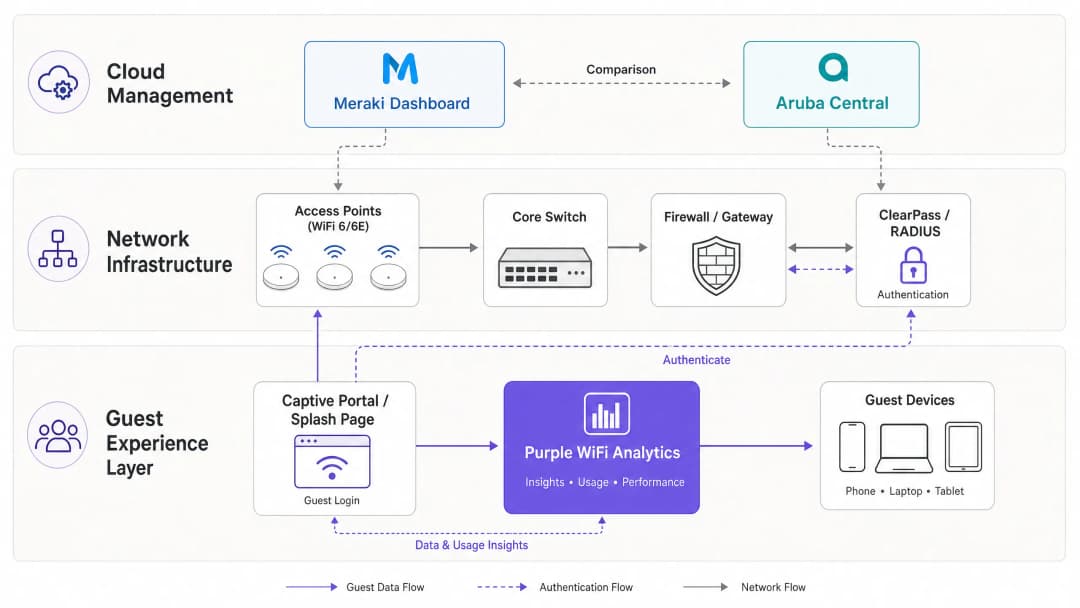
Cisco Meraki utiliza uma arquitetura totalmente gerida na cloud. O painel da Meraki serve como um ecrã único para toda a configuração, monitorização e gestão de firmware. Os pontos de acesso (APs) são "headless" e requerem conectividade à cloud Meraki para receber atualizações de políticas. Este modelo permite um provisionamento zero-touch real: os APs podem ser enviados para filiais remotas de Retail, ligados a switches PoE, e obterão automaticamente os seus modelos de configuração.
HPE Aruba oferece uma abordagem híbrida. Enquanto o Aruba Central oferece uma gestão na cloud comparável à Meraki, a Aruba também suporta controladores locais (Mobility Controllers). Este é um requisito essencial para muitas implementações de Healthcare e do setor público, onde a soberania dos dados ou regras rigorosas de governação do NHS impedem o encaminhamento do tráfego de gestão através da cloud pública.
Autenticação de Convidados e Controlo de Acesso à Rede
O onboarding de convidados é o ponto onde a política de rede se cruza com a experiência do utilizador.
Meraki gere o acesso de convidados através de páginas de splash integradas ou integração RADIUS externa. O Captive Portal nativo é funcional, mas carece de captura de dados sofisticada e gestão de consentimento necessária para a conformidade moderna com o GDPR. Para implementações empresariais, a arquitetura padrão envolve a configuração do SSID Meraki com um requisito de "Sign-on com", apontando para um URL de Captive Portal externo (como o Purple) e autenticando via RADIUS.
A Aruba aborda isto através do ClearPass Policy Manager, um dispositivo dedicado de controlo de acesso à rede (NAC). O ClearPass Guest oferece capacidades abrangentes para autorregisto, aprovação de patrocinadores e controlo de acesso baseado em funções (RBAC) granular. No entanto, o ClearPass é um produto complexo e separado que requer licenciamento específico e competências para ser gerido de forma eficaz.
Tem dúvidas sobre a sua configuração específica?
A nossa equipa trabalha com operadores de espaços, gestores de TI e engenheiros de rede em 80.000 espaços. Agende uma chamada de 20 minutos e mostraremos como outros profissionais na sua área o resolveram.
Guia de Implementação: Melhores Práticas para Implementações Empresariais
1. Segmentação de Rede e Design de VLAN
A segmentação de rede adequada é obrigatória para a segurança e conformidade PCI-DSS. O tráfego de convidados deve ser isolado das redes corporativas, IoT e de pontos de venda (PoS).
- Implementação Meraki: Crie um SSID de convidados dedicado e atribua-o a uma VLAN específica (por exemplo, VLAN 100). Utilize as regras de firewall de Camada 3/7 da Meraki para negar explicitamente o tráfego para subredes LAN locais, garantindo que os convidados apenas tenham saída para a internet.
- Implementação Aruba: Utilize a firewall baseada em funções da Aruba. Atribua a função "Guest" ao SSID e defina políticas que descartem qualquer tráfego destinado a espaços de IP privados RFC 1918 antes de permitir o tráfego HTTP/HTTPS para a WAN.
Para aprofundar as estratégias de segmentação, consulte o nosso guia sobre Comparação de Access Points Baseados em Controlador vs. Geridos na Nuvem.
2. Design de RF de Alta Densidade
Em ambientes de Hospitalidade (centros de conferências) ou hubs de Transporte, a colocação de APs e o planeamento de canais são críticos.
- Implemente APs WiFi 6E (6 GHz), como o Meraki MR57 ou Aruba AP-635, para mitigar a congestão na banda de 5 GHz.
- Limite o rádio de 2,4 GHz para fornecer cobertura básica para dispositivos IoT herdados, enquanto direciona os dispositivos dos convidados para as bandas de 5 GHz e 6 GHz.
- A tecnologia ClientMatch da Aruba oferece historicamente um excelente direcionamento de clientes em ambientes de alta densidade, enquanto o Auto RF da Meraki lida de forma eficaz com a atribuição dinâmica de canais e potência para locais distribuídos.

Resolução de Problemas e Mitigação de Riscos
Modos de Falha Comuns
- Falhas de Redirecionamento do Captive Portal: Frequentemente causadas por interceção HTTPS agressiva (HSTS) ou problemas de resolução de DNS antes da autenticação. Certifique-se de que o seu Walled Garden inclui os domínios necessários para a plataforma de Captive Portal, fornecedores de identidade (Apple, Google, Facebook) e Listas de Revogação de Certificados (CRLs).2. Fuga de VLAN: Portas de trunking de switches mal configuradas podem permitir que o tráfego de convidados passe para a rede corporativa. Utilize sempre VLANs explicitamente etiquetadas para uplinks de AP e evite utilizar a VLAN nativa para o tráfego de convidados.
- Encaminhamento Assimétrico em Ambientes Híbridos: Ao migrar ou misturar fabricantes, certifique-se de que o gateway predefinido para a sub-rede de convidados é consistente e gere o NAT corretamente para evitar ligações stateful perdidas.
ROI e Impacto no Negócio
A implementação de WiFi empresarial é um investimento significativo em CapEx e OpEx. Para gerar ROI, a rede tem de fazer mais do que apenas fornecer conectividade básica.
Ao sobrepor a plataforma agnóstica de hardware da Purple no topo do Meraki ou Aruba, os espaços transformam um centro de custos num ativo gerador de receitas. A autenticação baseada em perfis da Purple (com mais de 440M de utilizadores globais) reduz a fricção ao mesmo tempo que recolhe dados primários. Isto possibilita a monetização de meios de retalho, marketing direcionado e análises profundas de tráfego de visitantes.
Como referido no nosso manual recente sobre Como Melhorar a Satisfação dos Convidados: O Manual Definitivo, a conectividade contínua é a base; o envolvimento inteligente é o diferencial.
-
Ouça o Briefing Técnico
Para uma análise aprofundada de 10 minutos sobre esta comparação, ouça o nosso podcast Senior Architect Briefing:
Definições Principais
Provisionamento Zero-Touch (ZTP)
A capacidade de configurar o hardware de rede através da nuvem antes de este chegar ao local, permitindo-lhe descarregar a sua configuração automaticamente ao ligar-se à internet.
Crítico para equipas de TI que implementam WiFi em centenas de filiais de retalho sem necessidade de enviar engenheiros a cada local.
Controlo de Acesso à Rede (NAC)
Uma solução de segurança que aplica políticas em dispositivos e utilizadores que tentam aceder à rede, garantindo que apenas entidades autorizadas obtenham entrada.
O Aruba ClearPass é um NAC dedicado; determina o que um utilizador pode aceder com base na sua função, tipo de dispositivo e localização.
Walled Garden
Uma lista limitada de endereços IP ou domínios que um utilizador pode aceder antes de se ter autenticado totalmente no Captive Portal.
Essencial para permitir que os dispositivos alcancem a página de splash do Purple, fornecedores de identidade (como Google ou Facebook para login social) e servidores de validação de certificados antes de conceder acesso total à internet.
RADIUS (Remote Authentication Dial-In User Service)
Um protocolo de rede que fornece gestão centralizada de Autenticação, Autorização e Contabilidade (AAA) para utilizadores que se ligam a um serviço de rede.
O protocolo padrão utilizado pela Meraki e pela Aruba para comunicar com o Purple ou o ClearPass para verificar se um convidado deve ser permitido no WiFi.
VLAN (Virtual Local Area Network)
Uma sub-rede lógica que agrupa uma coleção de dispositivos de diferentes redes locais físicas, isolando o seu tráfego de transmissão.
O método principal para manter o tráfego de Guest WiFi completamente separado dos sistemas sensíveis de back-office ou de Ponto de Venda (PoS).
WiFi 6E (802.11ax em 6 GHz)
Uma extensão da norma WiFi 6 que utiliza o espetro de 6 GHz recentemente disponível, proporcionando canais mais amplos e menos interferência.
Crucial para preparar o futuro de locais de alta densidade, como estádios, garantindo que a rede consegue gerir milhares de ligações simultâneas sem congestionamento de dispositivos legados.
Captive Portal
Uma página web que o utilizador de uma rede de acesso público é obrigado a visualizar e a interagir antes de lhe ser concedido acesso.
O principal ponto de contacto do convidado onde os termos são aceites, o consentimento de marketing é recolhido e ocorre o envolvimento com a marca.
Profile-Based Authentication
Um método através do qual os utilizadores se autenticam uma vez e são subsequentemente reconhecidos de forma contínua numa rede de locais, sem terem de introduzir credenciais repetidamente.
A abordagem da Purple para criar uma experiência de convidado sem fricção, tirando partido de uma rede global de mais de 440 milhões de utilizadores.
Exemplos Práticos
Um hotel resort de 400 quartos precisa de implementar Guest WiFi nos blocos de alojamento, num centro de conferências de alta densidade e nas áreas exteriores da piscina. Dispõem de uma equipa de TI reduzida de apenas dois engenheiros e necessitam de uma recolha de dados de marketing em conformidade com o GDPR.
Implementar APs Cisco Meraki MR46 nos blocos de alojamento e APs MR57 (WiFi 6E) no centro de conferências para suporte de alta densidade. Utilizar o Meraki Dashboard para provisionamento zero-touch e gestão unificada, reduzindo a carga sobre a reduzida equipa de TI. Para o requisito de marketing, configurar o SSID de Guest da Meraki para utilizar um URL de splash personalizado que aponte para o Purple WiFi. O Purple irá gerir o captive portal, o consentimento GDPR e a recolha de dados, integrando-se com a Meraki via RADIUS para autenticação.
Um grande grupo hospitalar do setor público necessita de Guest WiFi para doentes e visitantes. Regras estritas de governação de dados exigem que nenhum tráfego de gestão de rede possa atravessar uma nuvem pública. Também necessitam de integração com o Active Directory existente para acesso BYOD de funcionários num SSID separado.
Implementar pontos de acesso HPE Aruba AP-515 geridos por Aruba Mobility Controllers locais (on-premises). Isto garante que todo o tráfego de gestão e do plano de controlo permanece no centro de dados do hospital. Implementar o ClearPass Policy Manager para gerir os complexos requisitos de NAC: integração com AD para BYOD de funcionários e fornecimento de um portal de convidados seguro e segmentado para doentes. O Purple ainda pode ser integrado via ClearPass para fornecer analítica avançada e roaming contínuo (como OpenRoaming) sem violar a restrição de gestão local.
Perguntas de Prática
Q1. Uma cadeia de retalho com 150 pequenas filiais necessita de implementar WiFi para convidados. Não dispõem de pessoal de TI dedicado ao nível das filiais e dependem de uma pequena equipa central. Qual é a arquitetura de plataforma mais adequada?
Dica: Considere a sobrecarga operacional de implementar hardware em 150 localizações sem conhecimentos técnicos no local.
Ver resposta modelo
A abordagem recomendada é o Cisco Meraki. A sua arquitetura baseada exclusivamente na nuvem e o aprovisionamento zero-touch permitem que a equipa de TI central configure modelos no Dashboard. O hardware pode ser enviado diretamente para as filiais, ligado pelo pessoal da loja, e transferirá automaticamente a sua configuração, reduzindo significativamente a complexidade e os custos de implementação.
Q2. Está a configurar uma rede WiFi para convidados num hotel. Precisa de garantir que os convidados não conseguem aceder aos servidores do sistema de reservas do hotel localizados na mesma infraestrutura de rede física. Qual é a abordagem padrão?
Dica: Pense no isolamento de Camada 2 e no controlo de fronteiras de Camada 3.
Ver resposta modelo
A abordagem padrão é a segmentação rigorosa da rede. O SSID de Convidados deve ser mapeado para uma VLAN dedicada (por exemplo, VLAN 200), completamente separada da VLAN corporativa (por exemplo, VLAN 10). Adicionalmente, devem ser aplicadas regras de firewall de Camada 3/7 ao nível do AP ou do gateway para recusar explicitamente qualquer tráfego da VLAN de Convidados com destino a endereços IP privados RFC 1918 (a rede interna), permitindo apenas tráfego com destino à internet pública.
Q3. Um local pretende recolher dados de convidados para fins de marketing e garantir a conformidade com o GDPR. Por que motivo a dependência exclusiva das páginas de boas-vindas nativas fornecidas pelos fabricantes de hardware é frequentemente insuficiente para os requisitos empresariais?
Dica: Considere a diferença entre o controlo de acesso à rede e a gestão de consentimento/privacidade de dados.
Ver resposta modelo
As páginas de boas-vindas nativas dos fabricantes são concebidas principalmente para o controlo básico de acesso à rede (aceitação de termos e condições). Geralmente carecem das funcionalidades sofisticadas exigidas pelo marketing moderno e pela conformidade, tais como a gestão granular de consentimentos, políticas de retenção de dados, fluxos de trabalho de direito ao apagamento, integrações de login social e sincronização contínua com CRM. É necessária uma plataforma de sobreposição como a Purple para gerir a complexa carga de conformidade e abstrair a camada de inteligência de convidados do hardware subjacente.
Perguntas frequentes
What are the primary architectural differences between Cisco Meraki and HPE Aruba for guest WiFi?
Cisco Meraki uses a 100% cloud-native dashboard with zero-touch provisioning and out-of-band management, ideal for distributed multi-site venues with lean IT teams. HPE Aruba provides a hybrid architecture supporting either Aruba Central cloud management or on-premises Mobility Conductor controllers with deep RF optimization (ClientMatch) and granular Policy Enforcement Firewall (PEF) rules.
How do Cisco Meraki and HPE Aruba handle guest captive portals and external splash page redirection?
Both platforms support external captive portal redirection over HTTPS. Cisco Meraki redirects clients to an external splash URL and uses RADIUS authentication with walled garden domain whitelists. HPE Aruba uses external captive portal profiles paired with RFC 3576 Change of Authorization (CoA) to dynamically switch client roles upon successful authentication. Purple integrates seamlessly across both platforms as a unified captive portal overlay.
What happens to network operations if Cisco Meraki or HPE Aruba cloud licenses expire?
Cisco Meraki requires an active cloud management license; if a license expires, the hardware enters a 30-day grace period, after which the access points cease passing network traffic. HPE Aruba access points managed via Aruba Central revert to local autonomous mode if licenses lapse, while on-premises controller-managed estates continue operating indefinitely with perpetual licenses.
How do Cisco Meraki and HPE Aruba enforce guest network segmentation and PCI DSS isolation?
Cisco Meraki enforces guest isolation at Layer 2/Layer 3 via bridge mode on dedicated VLANs, client isolation preventing peer-to-peer traffic, and Group Policies applying Layer 7 firewall rules. HPE Aruba utilizes its Policy Enforcement Firewall (PEF) to apply stateful role-based access control directly at the AP ingress, tunneling guest traffic to DMZ gateways for strict PCI DSS boundary compliance.
Can an enterprise deploy a unified guest WiFi captive portal across both Cisco Meraki and HPE Aruba access points?
Yes. By deploying Purple as a hardware-agnostic guest WiFi overlay, enterprises can run a single consistent branded captive portal, centralized CRM integration, and unified footfall analytics across mixed estates of Cisco Meraki and HPE Aruba hardware, eliminating vendor lock-in.
How do Cisco Meraki and HPE Aruba compare in 5-year total cost of ownership (TCO) for multi-site deployments?
Cisco Meraki features lower initial deployment costs and reduced on-site engineering labor due to zero-touch cloud provisioning, but requires mandatory ongoing per-device annual licenses. HPE Aruba offers competitive hardware pricing and flexible licensing options (cloud subscription or perpetual on-prem controllers), though complex multi-tier controller deployments may incur higher initial design overhead.
Continue a ler esta série
O que é um WLC (Wireless LAN Controller) e ainda precisa de um?
Este guia abrangente explora a evolução dos Wireless LAN Controllers (WLCs) e fornece um modelo técnico para determinar a arquitetura certa em 2026. Abrange modelos de hardware tradicionais, geridos na nuvem e sem controlador, detalhando o seu impacto na conformidade, escalabilidade e experiência de guest WiFi.
Redes Mesh vs Access Points: Qual é Melhor para Grandes Espaços?
Este guia técnico fornece uma comparação definitiva entre redes mesh e access points com fios tradicionais para espaços de grande escala, abrangendo a arquitetura, as compensações de desempenho e a estratégia de implementação. Capacita gestores de TI, arquitetos de rede e CTOs com estruturas de ação para conceber infraestruturas de WiFi de alto desempenho e em conformidade para os setores da hotelaria, retalho, eventos e ambientes do setor público. O guia também mapeia estas decisões de arquitetura com a plataforma de análise e de guest WiFi agnóstica de hardware da Purple, demonstrando como a escolha de infraestrutura correta impulsiona resultados de negócio mensuráveis.
Comparação entre Access Points Baseados em Controladora e Geridos na Nuvem
Este guia de referência técnica compara arquiteturas de Access Points baseados em controladora e geridos na nuvem para ambientes empresariais. Fornece aos líderes de TI uma estrutura neutra em termos de fornecedor para avaliar modelos de implementação, custo total de propriedade e capacidades de integração com plataformas de inteligência de visitantes como a Purple.
Tem dúvidas sobre a sua configuração específica?
A nossa equipa trabalha com operadores de espaços, gestores de TI e engenheiros de rede em 80.000 espaços. Agende uma chamada de 20 minutos e mostraremos como outros profissionais na sua área o resolveram.