
How to Set Up a Captive Portal on Starlink: A Guide for Remote & Maritime Venues
Este guia detalha como contornar o hardware nativo da Starlink e integrar um captive portal gerido na cloud utilizando equipamento de encaminhamento empresarial. Irá aprender a superar a limitação de CGNAT, impor a segmentação de VLAN, gerir as restrições de largura de banda de satélite e garantir a conformidade regulamentar.
Ouça este guia
Ver transcrição do podcast
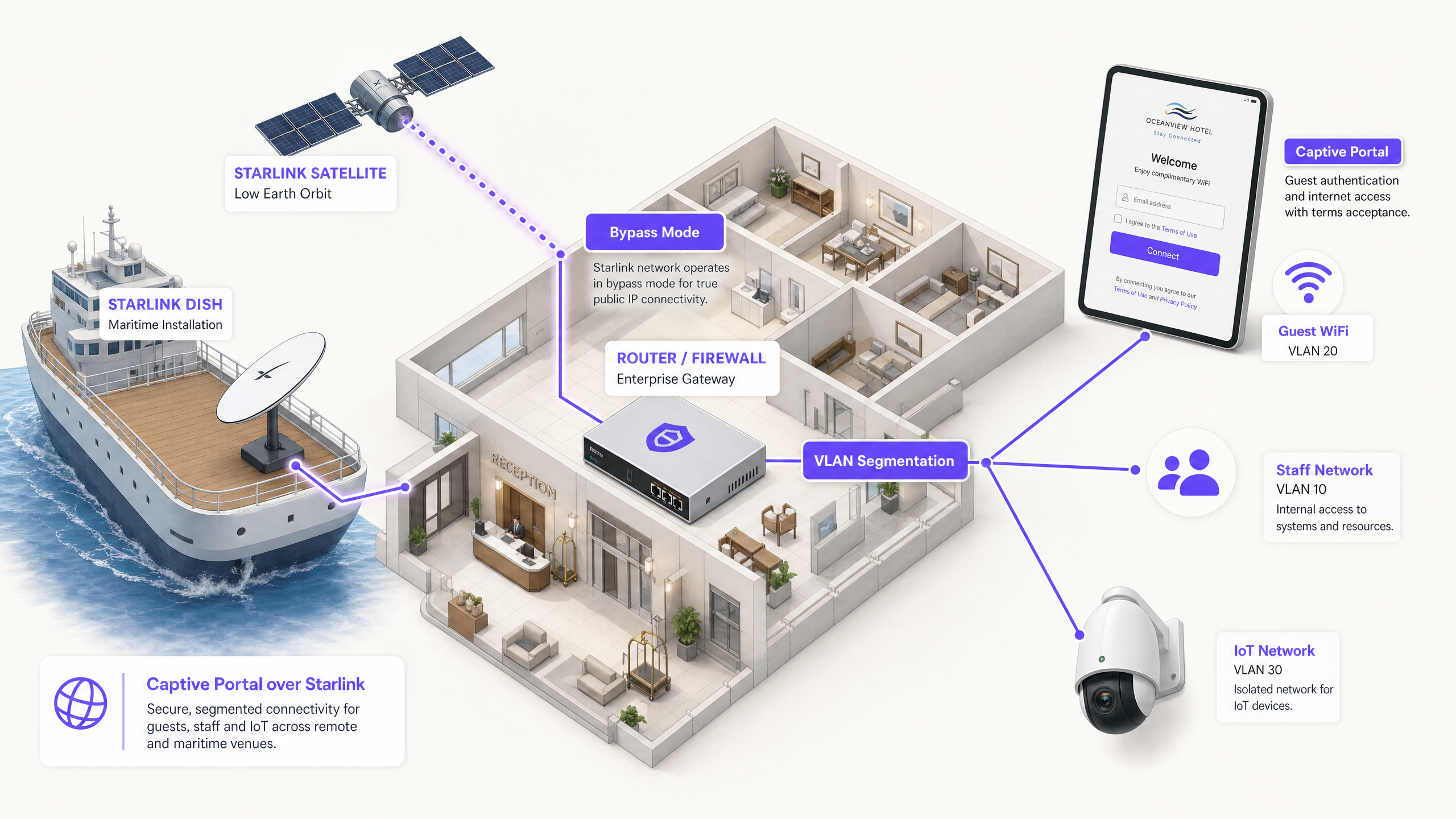
Resumo Executivo
A Starlink fornece conectividade de 220 Mbps a locais onde a fibra não chega, alterando fundamentalmente o panorama das redes para locais remotos e marítimos. No entanto, a conectividade em bruto é insuficiente para ambientes abertos ao público. Ao implementar a Starlink para convidados, passageiros ou tripulação, deve implementar autenticação, controlo de acessos, consentimento em conformidade com o GDPR e gestão de largura de banda. O router nativo da Starlink não oferece nenhuma destas capacidades.
Este guia detalha como contornar o hardware nativo da Starlink e integrar um captive portal gerido na cloud utilizando equipamento de encaminhamento empresarial. Irá aprender a superar a limitação de Carrier Grade NAT (CGNAT), impor a segmentação de VLAN, gerir as restrições de largura de banda de satélite e garantir a conformidade regulamentar.
Ao implementar esta arquitetura, os operadores de locais convertem uma ligação de internet não gerida numa rede segura e segmentada que recolhe dados primários (first-party data) e protege a infraestrutura de negócio principal.
Análise Técnica Detalhada
O Campo de Recrutamento do CGNAT
O principal obstáculo técnico ao implementar um captive portal na Starlink é o Carrier Grade NAT (CGNAT). A antena padrão da Starlink liga-se a um router proprietário que gere DHCP e NAT. Por predefinição, o endereço IP WAN atribuído ao seu equipamento encontra-se na gama 100.64.0.0/10. Como este não é um endereço IP público, o seu router não consegue receber ligações de entrada a partir da internet.
As arquiteturas padrão de captive portal assumem frequentemente que o portal na cloud consegue aceder de volta à sua rede para autenticar utilizadores ou atualizar listas de controlo de acessos. Com o CGNAT, as ligações de entrada falham.
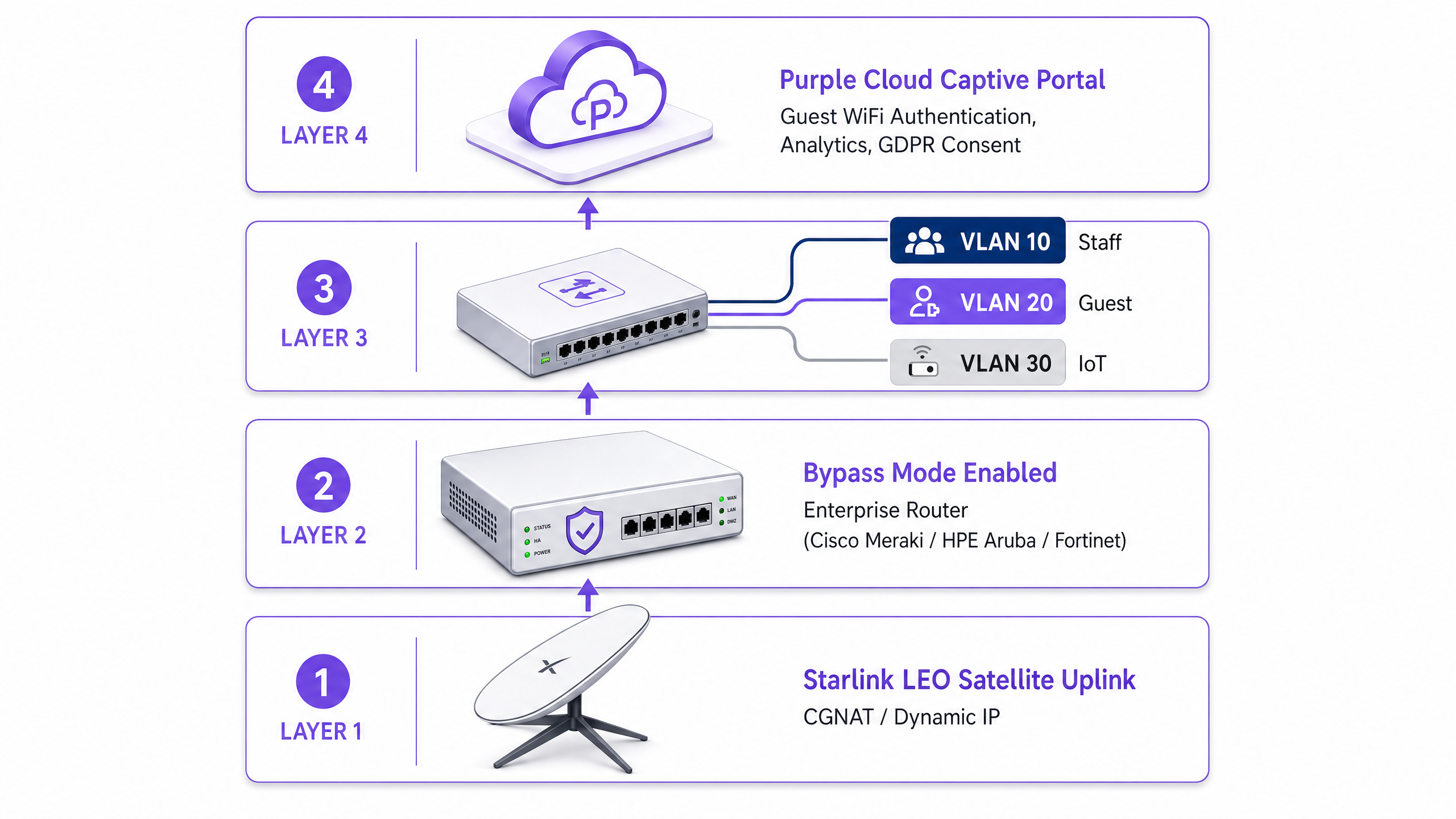
Para resolver isto, deve configurar a antena da Starlink em Modo Bypass (frequentemente designado por modo bridge). No Modo Bypass, as funções do router da Starlink são desativadas e a antena passa o endereço CGNAT diretamente para a porta WAN do seu router empresarial. O seu router empresarial assume então o controlo total da camada de encaminhamento.
Arquitetura de Túnel Inverso
Com o router empresarial a processar o tráfego, a restrição de entrada do CGNAT permanece. A solução é uma arquitetura de túnel inverso. O seu router estabelece uma ligação de saída para o portal na cloud e mantém-na de forma persistente. Todo o tráfego de autenticação flui através deste túnel estabelecido. A infraestrutura na cloud nunca precisa de iniciar uma ligação de entrada.
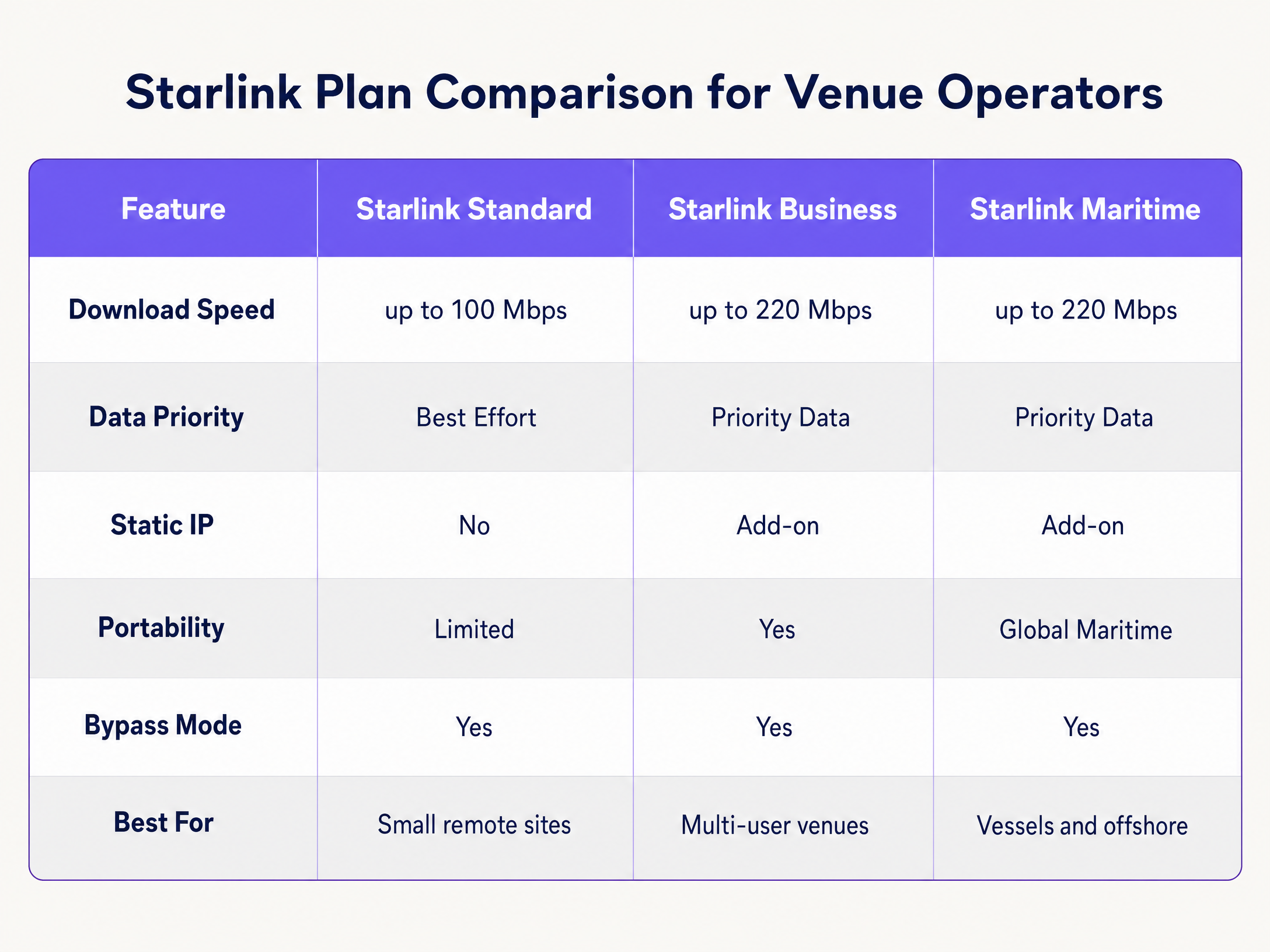
A arquitetura de sobreposição na cloud da Purple lida com isto de forma nativa. Não precisa de configurar túneis VPN manuais. Se a sua implementação exigir um IP estático para servidores RADIUS legados locais ou listas de permissões de IP estritas, os planos Starlink Business e Maritime oferecem um IP estático como um extra pago.
Restrições de Largura de Banda e Modulação de Tráfego
A largura de banda de satélite é um recurso partilhado e limitado. Um único utilizador a transmitir vídeo em 4K pode consumir 25 Mbps continuamente. Numa embarcação com 50 passageiros a partilhar uma ligação Starlink de 220 Mbps, um utilizador pode consumir 11% da capacidade total.
Deve abordar esta questão ao nível do captive portal e do router através de uma modulação de tráfego (traffic shaping) agressiva:
- Limites por Dispositivo: Restrinja os dispositivos individuais de convidados a 5 Mbps de download e 2 Mbps de upload.
- Políticas de Utilização Responsável: Implemente limites diários de dados (ex.: 2 GB por cada 24 horas).
- Controlo de Aplicações: Priorize a navegação na web e os protocolos de mensagens em detrimento da transmissão de vídeo e da partilha de ficheiros peer-to-peer.
- Acesso por Níveis: Ofereça um nível gratuito para conectividade básica e um nível premium pago para streaming, convertendo a infraestrutura de WiFi de um centro de custos num fluxo de receitas.
Guia de Implementação
Siga estes passos para implementar um captive portal seguro sobre a Starlink utilizando hardware empresarial.
Passo 1: Ativar o Modo Bypass
- Instale o hardware da Starlink e verifique a conectividade utilizando o router nativo.
- Abra a aplicação móvel da Starlink e navegue até Definições.
- Selecione Bypass Starlink WiFi router e confirme.
- Ligue o adaptador Ethernet da Starlink à porta WAN do seu router empresarial (Cisco Meraki, HPE Aruba, Ruckus, Juniper Mist, Ubiquiti UniFi, Cambium, Extreme ou Fortinet).
Nota: Se a antena da Starlink for reposta para as definições de fábrica, o Modo Bypass é desativado automaticamente. Documente isto no manual de procedimentos (runbook) do seu local e configure um alerta de monitorização na interface WAN do seu router.
Passo 2: Configurar a Segmentação de VLAN
Deve isolar o tráfego de convidados dos seus sistemas de negócio principais. Configure pelo menos três VLANs no seu switch principal e pontos de acesso:
- VLAN 10 (Staff): Transporta sistemas POS, aplicações de back-office e tráfego de gestão.
- VLAN 20 (Guest): O segmento apenas de internet que redireciona para o captive portal.
- VLAN 30 (IoT): Rede isolada para câmaras, termóstatos inteligentes e sistemas de gestão de edifícios.
Configure regras de firewall para bloquear todo o encaminhamento inter-VLAN. Um dispositivo de convidado na VLAN 20 nunca deve conseguir efetuar um ping a um terminal POS na VLAN 10. Esta segmentação é um requisito rigoroso para a conformidade com o PCI DSS.
Passo 3: Implementar o Captive Portal na Cloud
- Configure os seus pontos de acesso para transmitir o SSID de Convidados na VLAN 20.
- Defina o método de autenticação para RADIUS externo ou utilize a integração de API do fornecedor.
- Aponte os servidores de autenticação para a infraestrutura na cloud da Purple.
- Configure o walled garden (lista de permissões) para permitir o tráfego para os domínios da Purple antes de a autenticação ser concluída.
- Desenhe a splash page no portal da Purple, garantindo a imagem de marca está alinhada com o seu espaço e os termos de serviço estão claramente visíveis.
Passo 4: Testar o Fluxo do Utilizador
Teste o fluxo de autenticação em dispositivos iOS e Android. O Captive Network Assistant (CNA) da Apple e a sonda de rede do Android comportam-se de forma diferente. Verifique se a splash page carrega em menos de 10 segundos e se o dispositivo obtém acesso à internet imediatamente após a autenticação.
Boas Práticas
- Interceção HTTPS: Certifique-se de que o seu router lida corretamente com a interceção HTTPS. Os dispositivos modernos utilizam HTTPS por predefinição. Se o router não conseguir redirecionar os pedidos HTTPS de forma limpa, os convidados irão deparar-se com erros de certificado antes de acederem ao portal.
- Session Keepalive: A constelação de Órbita Terrestre Baixa (LEO) da Starlink oferece uma latência de 20 a 40 milissegundos, mas ocorrem pequenos picos durante as transições de satélite. Defina os intervalos de session keepalive do seu Captive Portal para 60 segundos ou menos para evitar desconexões prematuras.
- Cache Offline: Configure o seu router para armazenar em cache as sessões ativas localmente. Se a ligação Starlink cair temporariamente, os convidados que já estejam autenticados permanecerão online quando a conectividade for restaurada, em vez de serem forçados a iniciar sessão novamente.
Resolução de Problemas e Mitigação de Riscos
| Modo de Falha | Causa Raiz | Mitigação |
|---|---|---|
| O Captive Portal falha ao carregar | Configuração incorreta do walled garden | Verifique se todos os domínios Purple e endpoints de CDN necessários estão adicionados à lista de permissões de pré-autenticação no router. |
| Erros de Double NAT | Modo Bypass desativado | Verifique a aplicação Starlink para confirmar se o Modo Bypass está ativo. Um pico de corrente ou uma reposição manual podem ter revertido a antena para as definições predefinidas. |
| Velocidades lentas para convidados | Largura de banda ilimitada | Aplique limites de largura de banda por dispositivo (ex.: 5 Mbps) e bloqueie aplicações de elevada largura de banda, como o BitTorrent, na firewall. |
| Falha na auditoria de segurança | Encaminhamento inter-VLAN ativado | Audite as regras de firewall para garantir que o tráfego da VLAN de Convidados não consegue ser encaminhado para as VLANs de Funcionários ou de Gestão. |
ROI e Impacto no Negócio
A implementação de um Captive Portal gerido na Starlink transforma uma ligação de internet básica num ativo de negócio mensurável.
Para um navio de cruzeiro de 120 cabines que utilize o Starlink Maritime a 220 Mbps, o acesso básico não oferece qualquer retorno comercial. Ao implementar pontos de acesso Cisco Meraki e o Captive Portal da Purple, o operador pode impor um limite diário de 2 GB para passageiros padrão, enquanto faz o upsell de um nível premium de 10 GB. A receita de WiFi resultante cobre o custo mensal de subscrição da Starlink de mais de 250 $. Além disso, o portal recolhe dados de e-mail de primeira parte totalmente em conformidade, expandindo a lista de marketing direto do operador para futuras viagens.
Num ambiente de hotel remoto, a implementação de um portal com políticas rigorosas de largura de banda reduz as reclamações dos hóspedes relativas a WiFi lento em até 60%, uma vez que os utilizadores intensivos são impedidos de monopolizar a ligação por satélite.
Definições Principais
Bypass Mode
A configuration setting that disables the native Starlink router's DHCP and NAT functions, passing the WAN IP directly to a third-party enterprise router.
Required when integrating enterprise networking equipment with a Starlink dish to avoid double NAT and routing conflicts.
CGNAT (Carrier Grade NAT)
A method used by ISPs to share a single public IP address among multiple customers. The customer's router receives a private IP address (typically 100.64.0.0/10).
Starlink uses CGNAT by default, which prevents inbound connections from the internet and requires reverse tunnel architectures for cloud management.
VLAN (Virtual Local Area Network)
A logical subnetwork that groups a collection of devices from different physical LANs.
Used to isolate guest WiFi traffic from staff and IoT networks, ensuring security and compliance.
Captive Portal
A web page that a user of a public access network is obliged to view and interact with before access is granted.
Used to enforce terms of service, collect marketing data, and authenticate users on guest WiFi networks.
Walled Garden
A limited environment that controls the user's access to web content and services before they have fully authenticated.
Required to allow guest devices to reach the cloud captive portal and authentication servers before they are granted full internet access.
RADIUS
A networking protocol that provides centralized Authentication, Authorization, and Accounting management for users who connect and use a network service.
The underlying protocol used by enterprise access points to communicate with the cloud captive portal to verify user credentials.
Traffic Shaping
The manipulation and prioritization of network traffic to reduce the impact of heavy users or latency-sensitive applications.
Essential on Starlink networks to prioritize web browsing over high-bandwidth activities like video streaming.
First-Party Data
Information a company collects directly from its customers and owns.
Captured via the captive portal login process (e.g., email addresses) and used for direct marketing and loyalty campaigns.
Exemplos Práticos
A 120-cabin cruise vessel running Starlink Maritime at 220 Mbps needs to provide passenger WiFi without degrading ship operations. They require a mechanism to monetise the connection and collect marketing data.
The operator deploys Cisco Meraki access points throughout the vessel with three strict VLANs: crew, passenger, and ship systems. Purple's captive portal handles passenger authentication via email or a cabin number lookup integrated with the PMS. Each passenger receives a 2GB daily allowance. Premium tier passengers can purchase a 10GB allocation. The portal collects first-party email data for post-voyage marketing.
A remote Highland hotel with no fibre infrastructure runs Starlink Business at 150 Mbps. Guests frequently complain about slow speeds during the evening, and the hotel has no visibility into who is using the network.
The hotel deploys HPE Aruba access points across the main building and outbuildings. They configure the Starlink dish in Bypass Mode and connect it to an Aruba gateway. Guests authenticate via email on Purple's portal. The hotel enforces a strict 5 Mbps per-device bandwidth cap and uses Purple's analytics to monitor peak usage times.
Perguntas de Prática
Q1. A remote mining camp has deployed Starlink Business. They have connected a Cisco Meraki MX firewall to the Starlink router. Guests can connect to the WiFi, but the captive portal page times out and fails to load. What is the most likely cause?
Dica: Consider how the Starlink hardware handles routing by default and what the Meraki firewall requires to manage traffic effectively.
Ver resposta modelo
The Starlink dish has not been placed in Bypass Mode. As a result, the network is suffering from double NAT (the Starlink router and the Meraki firewall are both attempting to perform Network Address Translation). The administrator must use the Starlink app to enable Bypass Mode, allowing the Meraki firewall to receive the CGNAT IP directly and manage the routing and captive portal interception.
Q2. You are deploying a captive portal for a hotel using Starlink. You have configured Bypass Mode and VLAN segmentation. During testing, you notice that Apple devices prompt the user to log in immediately, but some Android devices show a certificate error when the user tries to browse to a secure website before authenticating. How do you resolve this?
Dica: Think about how modern browsers handle initial connection requests and what the router must do to intercept them cleanly.
Ver resposta modelo
The enterprise router is not configured to handle HTTPS interception correctly for the captive portal redirect. Modern browsers default to HTTPS. When the user attempts to visit an HTTPS site before authenticating, the router intercepts the traffic and presents its own certificate, which the browser rejects as invalid. You must ensure the router's captive portal settings are configured to use a valid SSL certificate for the redirect, or rely on the OS-level network probes (like Apple's CNA) which use HTTP endpoints to trigger the portal automatically.
Q3. A maritime operator complains that their Starlink Maritime connection (220 Mbps) becomes unusable every evening. They currently provide an open, password-free guest network. What three specific configurations should you implement on the enterprise router and captive portal to resolve this?
Dica: Focus on controlling how much data individual users can consume and prioritising critical traffic types.
Ver resposta modelo
- Implement a captive portal requiring authentication to track and manage individual users. 2. Enforce per-device bandwidth caps (e.g., 5 Mbps down / 2 Mbps up) to prevent a single user from monopolising the connection. 3. Apply traffic shaping rules at the firewall to prioritise web browsing and messaging protocols while throttling or blocking high-bandwidth applications like video streaming and P2P file sharing.
Continue a ler esta série
Hotel Guest WiFi Management: Integrating PMS, Portals, and Brand Standards
Este guia técnico detalha como arquitetar redes WiFi de hotéis de nível empresarial, focando-se na segmentação de VLAN, integração de PMS para gestão automatizada de sessões e otimização de captive portal para captura de dados em conformidade com o GDPR.
Captive Portal Best Practices: Designing for High Conversion and Compliance
Este guia técnico oferece aos gestores de TI, arquitetos de rede e diretores de operações de espaços um plano completo para implementar captive portals que equilibram a segurança da rede com uma elevada conversão de utilizadores. Abrange toda a arquitetura, desde a segmentação de VLAN e autenticação RADIUS até ao design de consentimento em conformidade com o GDPR e à seleção do método de autenticação. Baseado na experiência operacional da Purple em mais de 80.000 espaços e 440 milhões de inícios de sessão em 2024, cada recomendação é fundamentada em dados reais de implementação.
Como Otimizar Captive Portals para a Máxima Segurança de Rede e Conversão de Utilizadores
Este guia fornece um plano técnico completo para otimizar captive portals em locais empresariais, abrangendo a arquitetura de segmentação de rede, a seleção do método de autenticação, o design de consentimento em conformidade com o GDPR e a otimização da conversão. Foi escrito para gestores de TI, arquitetos de rede e CTOs em hotéis, cadeias de retalho, estádios e organizações do setor público que precisam de equilibrar a segurança de rede com a captura de dados primários (first-party). A Purple opera infraestruturas de captive portal em mais de 80.000 locais com 440 milhões de inícios de sessão em 2024, e as estruturas aqui apresentadas refletem essa experiência operacional.