
Gestão de Largura de Banda e Qualidade de Serviço (QoS) em Espaços de Co-Working
Um guia de referência técnica autoritativo para gestores de TI, arquitetos de rede e diretores de operações de espaços sobre a implementação de estruturas robustas de Gestão de Largura de Banda e Qualidade de Serviço (QoS) em ambientes de co-working. Este guia detalha a segmentação de rede, a priorização de tráfego, as configurações neutras de fornecedor e as métricas reais de ROI para fornecer conectividade de classe empresarial. Abrange as normas IEEE 802.11e/WMM, o design de VLAN, a limitação de taxa por utilizador e estratégias de resolução de problemas com resultados de negócio mensuráveis.
Ouça este guia
Ver transcrição do podcast
Parte da nossa série principal: Multi-Tenant WiFi Guide →

Resumo Executivo
Os espaços de co-working apresentam um ambiente de RF (radiofrequência) e de rede único e volátil. Ao contrário dos escritórios corporativos tradicionais com comportamento de utilizador previsível, ou hotspots públicos com baixas expectativas de largura de banda, os espaços de co-working devem suportar implementações multi-tenant de alta densidade onde os utilizadores exigem throughput de classe empresarial, baixa latência e fiabilidade excecional. Um único tenant que realize uma grande transferência de dados ou execute uma sincronização de cópia de segurança sem restrições pode degradar a experiência sem fios para todo o espaço, levando à perda de clientes e à perda direta de receita.
Este guia fornece aos arquitetos de rede e diretores de TI uma estrutura prática e neutra em termos de fornecedor para implementar políticas de Gestão de Largura de Banda e Qualidade de Serviço (QoS). Ao tirar partido de segmentação de rede avançada com Guest WiFi e VLANs seguras, integrando WiFi Analytics para monitorizar a utilização em tempo real, e aplicando normas rigorosas IEEE 802.11e/WMM, os operadores podem garantir Acordos de Nível de Serviço (SLAs) para tenants de alto valor, mantendo uma experiência de base fluida para visitantes casuais.
Análise Técnica Detalhada
O Dilema da Rede Multi-Tenant
Num ambiente de co-working multi-tenant, o principal desafio é a imprevisibilidade do tráfego. Num determinado dia, a rede deve suportar simultaneamente comunicações unificadas sensíveis à latência como um Serviço (UCaaS) (tais como Zoom ou Microsoft Teams), sincronizações de bases de dados na nuvem altamente intermitentes, transferências de ficheiros de alto throughput e streaming de vídeo recreativo. Sem uma gestão ativa, o escalonamento "first-in, first-out" (FIFO) de switches de rede e pontos de acesso padrão levará inevitavelmente ao bufferbloat - um fenómeno no qual pacotes de alta largura de banda e não em tempo real saturam as filas de buffer, introduzindo jitter e latência que destroem a usabilidade das aplicações em tempo real.
Para mitigar isto, os administradores de rede devem ir além da simples limitação de taxa para uma arquitetura de Qualidade de Serviço (QoS) e modelação de tráfego em várias camadas. Isto começa com um design físico e lógico de rede adequado, tirando partido de hardware de classe empresarial para segmentar e priorizar o tráfego.
Segmentação de Rede e Design de VLAN
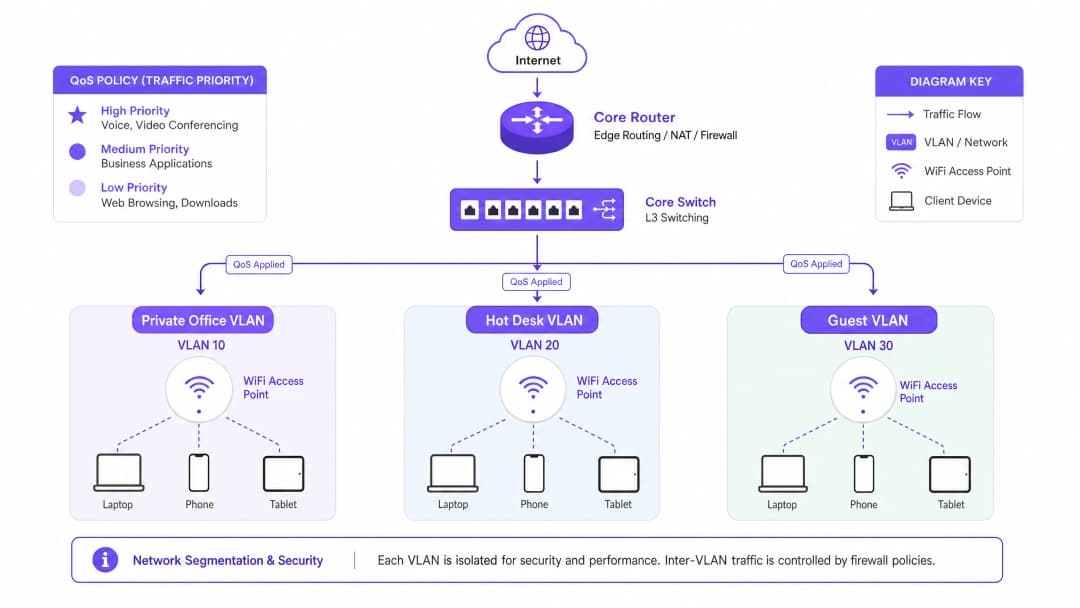
Uma gestão eficaz de largura de banda é impossível sem um isolamento lógico rigoroso dos grupos de tenants. Recomendamos a implementação de um mínimo de três Redes Locais Virtuais (VLANs) distintas, mapeadas para SSIDs separados utilizando Cisco Wireless APs de classe empresarial ou hardware semelhante:
| ID da VLAN | Nome do SSID | Público-Alvo | Mecanismo de Autenticação | Perfil de QoS |
|---|---|---|---|---|
| VLAN 10 | CoWork_Private |
Tenants de escritórios privados | WPA3-Enterprise (802.1X / Cloud RADIUS) | Platina (Prioridade de Voz/Vídeo) |
| VLAN 20 | CoWork_HotDesk |
Membros hot-desk / flexíveis | WPA3-Enterprise ou WPA3-SAE com Portal | Gold (Aplicações de negócios) |
| VLAN 30 | CoWork_Guest |
Visitantes diários / convidados | Captive Portal via Guest WiFi | Bronze (Melhor esforço / taxa limitada) |
Ao segmentar a rede, os administradores podem aplicar perfis de QoS personalizados no limite da VLAN, garantindo que o tráfego de convidados na VLAN 30 nunca congestione o tráfego crítico para o negócio nas VLANs 10 e 20. A implementação destas políticas de segurança requer a integração com uma solução robusta de Network Access Control (NAC) para atribuir dinamicamente as VLANs com base nas credenciais do utilizador. Para orientações detalhadas, consulte o nosso guia completo: How to Implement 802.1X Authentication with Cloud RADIUS.
IEEE 802.11e e Wi-Fi Multimedia (WMM)
Na camada sem fios, o QoS é governado pela norma IEEE 802.11e, conhecida comercialmente como Wi-Fi Multimedia (WMM). O WMM substitui a antiga Distributed Coordination Function (DCF) pelo Enhanced Distributed Channel Access (EDCA). O EDCA introduz quatro Categorias de Acesso (ACs), correspondentes a diferentes níveis de prioridade no meio:
A Voz (WMM-AC_VO) tem a prioridade mais elevada e foi concebida para VoIP e áudio interativo em tempo real. Utiliza os tempos de recuo (backoff) mais curtos para minimizar a latência. O Vídeo (WMM-AC_VI) tem prioridade elevada e está otimizado para videoconferência e streaming de multimédia, equilibrando a baixa latência com um elevado débito. O Melhor Esforço (WMM-AC_BE) é a categoria predefinida para o tráfego web normal, correio eletrónico e aplicações gerais. O Fundo (WMM-AC_BK) tem a prioridade mais baixa e está reservado para transferências de dados não sensíveis ao fator tempo, atualizações de sistema e cópias de segurança em segundo plano.
Para manter a clareza de voz e vídeo em ambientes de alta densidade, o WMM deve ser ativado globalmente em todos os pontos de acesso. Adicionalmente, os mapeamentos DSCP (Differentiated Services Code Point) devem ser configurados para que as categorias WMM sem fios sejam traduzidas para pacotes IP com fios à medida que atravessam switches e routers.
Guia de Implementação
Implementação Passo a Passo de Limitação de Tráfego e QoS
A implementação da gestão de largura de banda num espaço de co-working requer uma abordagem sistemática. Siga estes passos de implementação independentes de fornecedor para estabelecer uma estratégia de limitação de tráfego de nível empresarial.
Passo 1: Estabelecer o orçamento de largura de banda WAN. Antes de configurar os limites internos, determine o seu débito WAN total. Para um espaço de co-working típico de 200 pessoas, recomenda-se uma ligação de fibra simétrica de 1 Gbps / 1 Gbps. Reserve uma margem fixa de 10% de overhead no gateway WAN para evitar a saturação da interface e o bufferbloat. Isto deixa 900 Mbps de largura de banda atribuível.
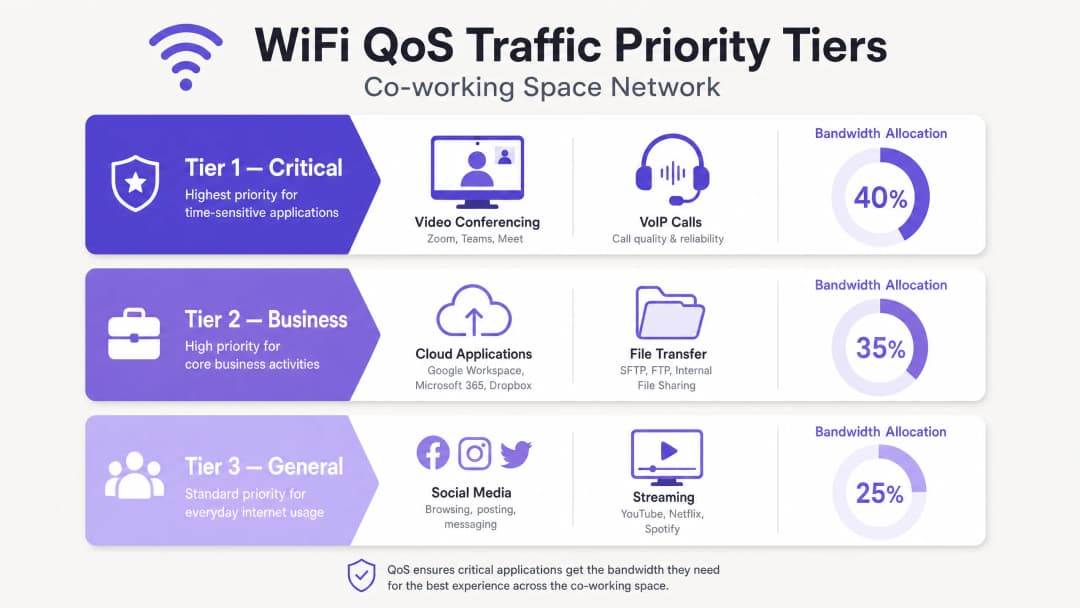
Passo 2: Definir classes de tráfego e filas de prioridade. Configure o Class-Based Weighted Fair Queueing (CBWFQ) ou Low Latency Queueing (LLQ) no seu gateway/firewall principal. Defina três classes principais com base na VLAN de origem e nas assinaturas de aplicações. O Nível 1 (Crítico) aloca 40% de largura de banda garantida para tráfego VoIP e UCaaS, mapeado para DSCP EF. O Nível 2 (Negócios) aloca 35% para aplicações na nuvem e tráfego web, mapeado para DSCP AF41. O Nível 3 (Geral/Convidados) aloca 25% com um limite agregado estrito, mapeado para DSCP CS1.
Passo 3: Configurar limitação de largura de banda por utilizador (alocação dinâmica). Para evitar que utilizadores com consumo excessivo degradem a qualidade da rede, implemente uma limitação dinâmica por utilizador em vez de limites estáticos, sempre que possível. A limitação dinâmica permite que os utilizadores atinjam velocidades mais elevadas quando a rede está inativa, mas reduz a velocidade para um valor de referência garantido durante os períodos de pico. Para o SSID flexível/hot-desk, configure um limite dinâmico de 50 Mbps de download / 20 Mbps de upload por cliente, com um mínimo garantido de 10 Mbps simétricos durante os picos de utilização. Para o SSID de convidados, aplique um limite estático estrito de 10 Mbps de download / 5 Mbps de upload por cliente.
Passo 4: Implementar filtragem ao nível da aplicação (Camada 7). Os firewalls e APs modernos utilizam a Inspeção Profunda de Pacotes (DPI) para identificar aplicações independentemente das portas que utilizam. Configure regras de Camada 7 para restringir a partilha de ficheiros peer-to-peer (P2P), downloads de BitTorrent e cópias de segurança em nuvem pessoais a um máximo de 2 Mbps por utilizador. Certifique-se de que os domínios UCaaS conhecidos (ex: *.zoom.us, *.microsoft.com) são automaticamente identificados como DSCP EF ou AF41.
Tem dúvidas sobre a sua configuração específica?
A nossa equipa trabalha com operadores de espaços, gestores de TI e engenheiros de rede em 80.000 espaços. Agende uma chamada de 20 minutos e mostraremos como outros profissionais na sua área o resolveram.
Melhores Práticas
Planeamento de RF Rigoroso e Reutilização de Canais
Os espaços de co-working de alta densidade sofrem de Interferência de Canal Comum (CCI) quando múltiplos pontos de acesso funcionam no mesmo canal. Num espaço de trabalho moderno, migre os dispositivos legados para as bandas de 5 GHz e 6 GHz. Se o 2.4 GHz tiver de permanecer ativo para IoT, restrinja-o a um número reduzido de APs específicos utilizando canais que não se sobreponham (1, 6, 11) com a potência de transmissão mínima. Implemente Wi-Fi 6E ou Wi-Fi 7 para tirar partido do recém-disponibilizado espetro de 6 GHz, que oferece até 14 canais adicionais de 80 MHz e pode eliminar a CCI por completo. Mantenha uma largura de canal de 40 MHz na banda de 5 GHz para equilibrar o rendimento com a disponibilidade de canais.
Airtime Fairness
Ative o Airtime Fairness (ATF) em todos os APs de classe empresarial. O ATF aloca a todos os clientes o mesmo tempo de acesso ao canal, em vez de um número igual de pacotes. Isto evita que clientes legados lentos (a funcionar em 802.11n ou normas anteriores) monopolizem o meio sem fios e prejudiquem o desempenho dos clientes modernos de alta velocidade Wi-Fi 6/7.
Análise e Monitorização Contínuas
Aproveite a análise de WiFi Analytics de nível empresarial para obter informações detalhadas sobre o comportamento dos inquilinos, a densidade de dispositivos e a utilização de aplicações. Ao analisar as tendências históricas de tráfego, os gestores de TI podem ajustar proativamente as alocações de largura de banda antes que ocorram estrangulamentos físicos. O mesmo se aplica a ambientes de Hospitality, implementações de Retail e interfaces de Transport, onde a densidade sem fios multi-inquilino é um desafio operacional constante.
Resolução de Problemas e Mitigação de Riscos
Mesmo com uma configuração robusta de QoS, as redes de co-working encontrarão anomalias de desempenho. A tabela abaixo fornece uma matriz de diagnóstico para as falhas mais comuns relacionadas com a largura de banda.
| Sintoma | Causa Raiz | Passos de Diagnóstico | Ação de Mitigação |
|---|---|---|---|
| Chamadas de Zoom/Teams com falhas durante as horas de pico | Bufferbloat no gateway WAN ou erros de mapeamento DSCP | Execute um teste de bufferbloat a partir de um dispositivo cliente; verifique as estatísticas das portas do switch para pacotes de saída descartados | Ative LLQ para tráfego UCaaS no router; ajuste a reserva de largura de banda da WAN de 10% para 15% |
| Latência elevada e perda de pacotes na banda de 5 GHz | Interferência de Co-Canal (CCI) causada por potência de transmissão excessiva dos APs ou canais demasiado largos | Realize um levantamento de RF no local ou analise o mapa de canais e as métricas de interferência do controlador | Reduza a largura do canal de 80 MHz para 40 MHz; ative a Atribuição Dinâmica de Canais (DCA) |
| Um inquilino específico relata velocidades lentas dentro de um escritório privado | Obstrução física ou o dispositivo cliente fixado a um AP distante (sticky client) | Verifique o RSSI do cliente e a banda ligada no painel do controlador sem fios | Ative o roaming rápido 802.11k/r/v; ajuste a taxa básica mínima para 12 Mbps ou 24 Mbps |
| Picos de utilização na rede de convidados, congestionando os inquilinos corporativos | Limites de largura de banda de convidados a serem contornados ou tempos de limite de sessão do Captive Portal demasiado longos | Verifique o consumo agregado de largura de banda da VLAN de convidados no painel da firewall | Aplique limites estritos de largura de banda por utilizador (10/5 Mbps) no SSID de convidados; encurte o tempo limite de sessão para 4 horas |
Retorno do Investimento (ROI) e Impacto Comercial
Retenção de Inquilinos e Redução de Cancelamentos
A queixa número um nos espaços de co-working é a má conectividade de rede. Num setor com baixos custos de mudança e abundantes alternativas de espaços flexíveis, apenas uma semana de conectividade instável pode levar um inquilino corporativo de alto valor a rescindir o seu contrato. Com uma arquitetura de QoS devidamente implementada, os operadores reportam consistentemente que a taxa anual de cancelamento de inquilinos cai da média do setor de 18 a 22% para menos de 8%, representando uma receita de aluguer retida significativa.
Novas Receitas Através de Planos Premium
Ao tirar partido de um núcleo de rede robusto, os operadores de co-working podem transformar a sua infraestrutura de WiFi de um centro de custos num fluxo de receitas de elevada margem. Os operadores podem fazer o upsell de inquilinos de planos standard para pacotes de rede premium, oferecendo VLANs dedicadas, SSIDs privados, largura de banda simétrica garantida e endereços IP estáticos por uma mensalidade adicional.
| Nível do Plano | Funcionalidades | Preços Indicativos |
|---|---|---|
| Standard | SSID partilhado para hot-desk, 50/20 Mbps, QoS de melhor esforço, login via Captive Portal | Incluído na adesão base |
| Premium | VLAN/SSID dedicado, 100/100 Mbps, QoS Platinum (prioridade VoIP), WPA3 | +150 £ por mês |
| Enterprise | SSID privado personalizado, 200 Mbps simétricos, integração Cloud RADIUS, IP estático | +450 £ por mês |
Eficiência Operacional
Ao automatizar a alocação de largura de banda e a modelação de tráfego, o volume diário de pedidos de suporte de TI de "rede lenta" pode ser reduzido em até 75%. Isto permite que os gestores de comunidade no local se foquem na hospitalidade e nas vendas em vez de resolverem problemas de rede. Os mesmos princípios aplicam-se a instalações de cuidados de saúde e locais do setor público, onde a fiabilidade da rede é operacionalmente crítica. Para mais informações sobre estratégias de implementação sem fios de alta densidade, consulte o nosso guia: WiFi nas Escolas: O Guia de 2026 para Administradores e TI.
-
Ouça: O Podcast de Briefing Técnico
-
Referências
[1] Cisco Systems, "High Density Wi-Fi Deployment Guide," 2025. [2] Internet Engineering Task Force (IETF), "Controlled Delay Active Queue Management (CoDel)," RFC 8289, 2018. [3] IEEE Standards Association, "IEEE 802.11e-2005 - Amendment 8: Medium Access Control (MAC) Quality of Service Enhancements," 2005. [4] Aruba Networks, "Airtime Fairness Technology Whitepaper," 2024.
Definições Principais
Bufferbloat
Latência elevada e jitter causados pelo buffer excessivo de pacotes nos equipamentos de rede, particularmente no limite da WAN. Quando o tráfego de alta largura de banda e que não é em tempo real satura estes buffers, os pacotes em tempo real (como VoIP e vídeo) sofrem atrasos, causando uma degradação grave do desempenho.
As equipas de TI deparam-se com bufferbloat quando os utilizadores se queixam de videochamadas tremidas, apesar de terem internet de fibra de alta velocidade. É mitigado reservando uma margem de 10% na largura de banda WAN e implementando uma gestão ativa de filas (AQM), como o FQ-CoDel.
Quality of Service (QoS)
Um conjunto de tecnologias e técnicas utilizadas para gerir os recursos de rede, priorizando tipos de tráfego específicos. Os mecanismos de QoS permitem que os administradores garantam largura de banda, minimizem a latência e controlem o jitter para aplicações críticas.
Essencial em espaços de co-working multi-inquilino para garantir que as ferramentas de colaboração em tempo real (Zoom, Teams) tenham prioridade sobre as transferências de ficheiros em segundo plano e streaming recreativo.
WiFi Multimedia (WMM)
Uma certificação de interoperabilidade da WiFi Alliance baseada na norma IEEE 802.11e. Fornece funcionalidades de Quality of Service (QoS) a redes WiFi ao priorizar o tráfego em quatro Categorias de Acesso: Voz, Vídeo, Best Effort (Melhor Esforço) e Segundo Plano.
Deve ser ativado globalmente nos access points de co-working para garantir que os dispositivos sem fios possam priorizar os pacotes de voz e vídeo antes de serem transmitidos pelo ar.
Differentiated Services Code Point (DSCP)
Um campo de 6 bits no cabeçalho de um pacote IP utilizado para classificar e priorizar o tráfego de rede na Camada 3. As marcações padrão incluem EF (Expedited Forwarding para voz) e AF (Assured Forwarding para vídeo e aplicações de negócios).
Utilizado para manter a prioridade de QoS à medida que o tráfego se move do AP sem fios, passa pelos switches cablados e sai através do router de gateway WAN. As marcações DSCP devem ser preservadas de ponta a ponta para que o QoS funcione corretamente.
Airtime Fairness (ATF)
Uma funcionalidade sem fios empresarial que aloca o tempo de transmissão do canal (airtime) igualmente entre os clientes ligados, independentemente da sua velocidade de ligação ou padrão sem fios.
Impede que os dispositivos antigos ou distantes com fraco sinal consumam tempo excessivo do meio sem fios, protegendo o throughput dos dispositivos modernos WiFi 6/7 em ambientes de co-working de alta densidade.
Dynamic Bandwidth Allocation
Uma técnica de modelação de tráfego que ajusta dinamicamente os limites de largura de banda de um utilizador com base na utilização da rede em tempo real, permitindo altas velocidades de rajada (burst speeds) quando a rede está inativa, enquanto aplica limites rigorosos durante as horas de ponta.
Permite aos operadores de co-working oferecer uma experiência de utilizador rápida e de elevada resposta, sem correr o risco de saturação total da rede durante as horas de ponta.
Co-Channel Interference (CCI)
Interferência que ocorre quando dois ou mais pontos de acesso sem fios em proximidade próxima operam no mesmo canal de frequência, forçando-os a partilhar o tempo de antena e reduzindo drasticamente a capacidade global sem fios.
Um problema grave em espaços de co-working de alta densidade. Mitigado através de um planeamento de canais adequado, reduzindo as larguras de canal para 40 MHz e utilizando a banda de 6 GHz em implementações WiFi 6E/7.
Client Isolation
Uma funcionalidade de segurança e desempenho em pontos de acesso sem fios que impede os clientes sem fios ligados de comunicarem diretamente entre si ou de analisarem outros dispositivos na mesma sub-rede.
Obrigatório para redes de convidados e SSIDs de hot-desking para proteger a segurança dos inquilinos e eliminar o tráfego desnecessário de transmissão sem fios (como ARP e mDNS) de consumir tempo de antena.
Exemplos Práticos
Um espaço de co-working de alta densidade com 15 000 pés quadrados em dois pisos acomoda 250 membros diários ativos, incluindo 15 inquilinos de escritórios privados. Durante as horas de ponta (das 10:00 às 15:00), os utilizadores sofrem de forte jitter e perda de pacotes em chamadas do Microsoft Teams e Zoom. O espaço tem uma ligação simétrica de fibra de 500 Mbps. Desenhe uma estratégia de alocação de largura de banda e QoS neutra de fornecedor para resolver este problema.
Para resolver a latência e o jitter das horas de ponta, implemente uma estratégia de QoS de três frentes: colocação em fila ao nível da WAN, modelação do tráfego sem fios e segmentação lógica.
Limitação de Taxa e Colocação em Fila ao Nível da WAN: Defina um limite de largura de banda WAN no router gateway para 450 Mbps (90% do circuito de 500 Mbps) para evitar o bufferbloat. Configure a Fila de Baixa Latência (LLQ) na interface WAN com uma fila de prioridade estrita de 50 Mbps para tráfego de voz e videoconferência (identificado através de assinaturas DPI de Camada 7 para Zoom, Teams e Webex), mapeado para DSCP EF. Configure CBWFQ para os restantes 400 Mbps: Classe-1 (VLAN de Escritório Privado 10) recebe uma garantia de 50% de largura de banda (200 Mbps), expansível até 450 Mbps, mapeada para DSCP AF41; Classe-2 (VLAN de Hot-Desk 20) recebe uma garantia de 35% (140 Mbps), expansível até 300 Mbps, mapeada para DSCP AF21; Classe-3 (VLAN de Visitantes 30) recebe uma garantia de 15% (60 Mbps), estritamente limitada a 100 Mbps agregados, mapeada para DSCP CS1.
Configuração da Camada Sem Fios (WMM e Roaming): Ative o WiFi Multimedia (WMM) globalmente em todos os APs, mapeando as filas de voz e vídeo sem fios diretamente para as marcações DSCP EF e AF41 com fios. Force o Airtime Fairness (ATF) em todos os APs. Defina a Taxa Básica Mínima para 24 Mbps na banda de 5 GHz e desative os 2,4 GHz em 80% os APs.
Limitação de Taxa por Utilizador: Aplique uma limitação dinâmica de taxa por utilizador na VLAN 20 (Hot-Desks): download de 30 Mbps / upload de 10 Mbps por cliente, expansível até 50 Mbps quando a utilização total da rede for inferior a 60%. Aplique limites estáticos estritos por utilizador na VLAN 30 (Visitantes): download de 10 Mbps / upload de 3 Mbps.
Um operador de co-working empresarial quer fazer um upsell a um inquilino de serviços financeiros de alto valor que necessita de uma rede dedicada e altamente segura para 30 funcionários dentro de um conjunto de escritórios privados. Eles exigem um débito simétrico garantido de 100 Mbps, um SSID dedicado e um isolamento estrito de todos os outros inquilinos para cumprir com as regulamentações financeiras. Detalhe o modelo de configuração e implementação passo a passo para fornecer este serviço utilizando uma infraestrutura física partilhada.
Para fornecer este serviço empresarial premium de forma segura e fiável numa infraestrutura partilhada, utilize o encaminhamento dinâmico de VLAN, o aprovisionamento de SSID dedicado e a reserva rigorosa de largura de banda de QoS.
Segregação Lógica de Rede e Segurança: Crie uma VLAN dedicada (VLAN 105) no comutador central e no gateway firewall. Configure um SSID dedicado denominado CoWork_FinSecure transmitido apenas pelos pontos de acesso nas proximidades do escritório privado do cliente. Proteja o SSID utilizando autenticação WPA3-Enterprise integrada com um servidor Cloud RADIUS. É atribuída a cada colaborador do cliente uma credencial 802.1X exclusiva; após uma autenticação bem-sucedida, o servidor RADIUS devolve o atributo Tunnel-Private-Group-ID de 105, encaminhando dinamicamente o dispositivo do utilizador para a VLAN 105. Configure ACLs rigorosas no gateway firewall para bloquear todo o tráfego inter-VLAN entre a VLAN 105 e quaisquer outras VLANs de clientes.
Reserva de Largura de Banda e Definição de Perfis de QoS: No gateway WAN, crie uma classe de tráfego dedicada para a VLAN 105. Configure uma política CBWFQ que garanta um débito WAN simétrico de 100 Mbps exclusivamente para a VLAN 105. Defina um limite rígido de modelação de tráfego (traffic-shaping) de 100 Mbps na VLAN 105 para evitar que o cliente exceda o seu SLA. Dentro da VLAN 105, ative a tradução de etiquetas de QoS: mapeie as etiquetas DSCP recebidas dos clientes (EF para VoIP, AF41 para vídeo) diretamente para as filas WAN correspondentes.
Otimização ao Nível do Cliente: Ative o isolamento de clientes no SSID CoWork_FinSecure para evitar que os dispositivos dentro da VLAN façam varrimentos ou comuniquem entre si, adicionando uma camada extra de conformidade regulamentar.
Durante uma conferência tecnológica de grande escala realizada no salão de eventos de um espaço de co-working, 150 participantes ligam-se ao Guest WiFi em simultâneo. Em 30 minutos, toda a rede fica paralisada. Os membros em hot-desking noutras partes do edifício não conseguem carregar páginas Web básicas e a receção do espaço não consegue processar pagamentos com cartões de crédito. Diagnostique a falha de rede e descreva as medidas de mitigação de emergência imediatas e a solução arquitetural a longo prazo.
Esta é uma falha clássica de tempestade de broadcast (broadcast storm) e de saturação do meio sem fios, agravada pela falta de isolamento de largura de banda ao nível da WAN.
Análise de Diagnóstico: 150 clientes ativos num único AP de convidados no salão de eventos saturam o meio sem fios. Se os clientes estiverem ligados na banda de 2.4 GHz ou a utilizar canais largos de 80 MHz, a interferência de canal comum (CCI) aumenta drasticamente, causando retransmissões maciças de pacotes. Uma inundação de pedidos DHCP e de tráfego de broadcast (ARP, mDNS) a partir da rede de convidados satura a CPU do router principal. A rede de convidados não tem um limite de largura de banda agregada, permitindo que os dispositivos dos participantes da conferência consumam todo o circuito WAN.
Mitigação de Emergência Imediata (Resolução em 15 Minutos): Inicie sessão na firewall principal e aplique imediatamente um limite de largura de banda agregada na VLAN de Convidados (VLAN 30), limitando-a a um total de 50 Mbps. Defina um limite estrito por utilizador de 3 Mbps de download / 1 Mbps de upload no SSID de Convidados. Ative o Isolamento de Clientes (Client Isolation) no SSID de Convidados para bloquear o tráfego sem fios peer-to-peer e impedir que os pacotes de broadcast atravessem as ondas de rádio.
Solução Arquitetónica de Longo Prazo: Implante Access Points dedicados de alta densidade (APs WiFi 6E/7 com antenas direcionais) especificamente para o salão de eventos numa VLAN dedicada e separada (VLAN 40 - Espaço de Eventos). Configure a firewall principal para priorizar a VLAN 90 (POS/Operações) com 10 Mbps garantidos (DSCP CS5) e a VLAN 20 (Hot-Desks) com 200 Mbps garantidos. Aplique um limite agregado rígido e não ultrapassável de 150 Mbps na VLAN de Eventos (VLAN 40).
Perguntas de Prática
Q1. Um operador de co-working nota que a utilização da CPU do seu router de gateway principal atinge um pico de 95% todas as terças e quintas-feiras à tarde, coincidindo com uma quebra nas velocidades de rede para todos os inquilinos. Não existem transferências de ficheiros grandes ativas na altura. Qual é a causa mais provável e como deve o arquiteto de rede resolver a situação?
Dica: Analise as definições de segurança e de protocolo nas redes de convidados e de hot-desk. Picos na CPU sem um elevado throughput apontam frequentemente para taxas elevadas de pacotes por segundo (PPS) provenientes de tráfego de transmissão ou de protocolos de deteção de dispositivos.
Ver resposta modelo
A causa mais provável é uma tempestade de transmissão (broadcast storm) ou tráfego multicast excessivo (como os protocolos de deteção mDNS, ARP ou Bonjour) com origem nos SSIDs de Convidados e Hot-Desk. Em ambientes de alta densidade com centenas de dispositivos, os protocolos de deteção em segundo plano podem gerar milhares de pacotes por segundo. Como os pacotes de transmissão têm de ser processados por todos os dispositivos e pelo gateway principal, isto satura a CPU do router sem gerar uma utilização significativa de largura de banda.
Para resolver isto: (1) Ative o Client Isolation globalmente nos SSIDs de Convidados e Hot-Desk. Isto bloqueia imediatamente a comunicação sem fios ponto a ponto e impede que os pacotes de transmissão/multicast sejam repetidos no meio sem fios. (2) Ative o IGMP Snooping em todos os switches para restringir o tráfego multicast apenas às portas que o solicitem ativamente, reduzindo a carga de CPU do switch e do router. (3) Configure o controlador sem fios para rejeitar tramas ARP e outras tramas de transmissão ao nível do AP, convertendo os pedidos ARP em unicast sempre que possível.
Q2. Um gestor de TI pretende implementar QoS para um espaço de co-working, mas descobre que os seus switches antigos não suportam mapeamento DSCP, apenas a marcação básica de Camada 2 CoS (Class of Service) 802.1p. Como deve adaptar o design de QoS para manter a priorização do tráfego?
Dica: O 802.1p CoS opera na Camada 2 (trama Ethernet), enquanto o DSCP opera na Camada 3 (cabeçalho IP). Quando o mapeamento da Camada 3 não está disponível, a priorização deve ser mantida dentro do domínio de transmissão local utilizando valores CoS.
Ver resposta modelo
Quando o mapeamento Layer 3 DSCP não é suportado pelos switches de acesso, o gestor de IT deve recorrer à marcação Layer 2 802.1p Class of Service (CoS). Configure os Access Points sem fios para mapear as WMM Access Categories diretamente para etiquetas Layer 2 802.1p CoS à medida que o tráfego entra na rede com fios. Por exemplo: WMM-AC_VO (Voz) mapeia para CoS 6; WMM-AC_VI (Vídeo) mapeia para CoS 5; WMM-AC_BE (Best Effort) mapeia para CoS 0. Nos switches antigos, configure o enfileiramento de saída (egress queuing) com base nos valores de CoS utilizando Weighted Round Robin (WRR) ou enfileiramento Strict Priority nas portas de uplink do switch, atribuindo CoS 6 e 5 às filas de maior prioridade. No router de gateway central (que suporta Layer 3), configure a porta de switch de entrada para ler as etiquetas Layer 2 CoS recebidas e remarcá-las para os valores Layer 3 DSCP correspondentes (por exemplo, CoS 6 para DSCP EF, CoS 5 para DSCP AF41) antes de encaminhar o tráfego pela interface WAN.
Q3. Um espaço de co-working tem uma ligação de fibra simétrica de 1 Gbps. O operador pretende garantir que uma empresa de desenvolvimento de realidade virtual (VR) que ocupa uma suite privada obtém pelo menos 200 Mbps de largura de banda simétrica com menos de 5ms de latência. No entanto, também pretende assegurar que, se a empresa de VR não estiver a utilizar a sua largura de banda, outros inquilinos a possam utilizar. Que configuração específica de enfileiramento e modelação de tráfego (traffic shaping) deve ser aplicada no gateway WAN?
Dica: Considere mecanismos de enfileiramento baseados em classes que suportem tanto um mínimo garantido (committed information rate) como um limite máximo, permitindo o empréstimo de largura de banda não utilizada de um pool principal.
Ver resposta modelo
Implemente Class-Based Weighted Fair Queueing (CBWFQ) com Hierarchical Token Bucket (HTB) no gateway WAN. Defina o modelador principal (parent shaper) para 900 Mbps (aplicando a regra de despesa adicional de 10%). Para a Classe de Inquilino VR (VLAN 150), configure uma Committed Information Rate (CIR) de 200 Mbps (largura de banda garantida) e uma Peak Information Rate (PIR) de 500 Mbps (limite máximo de burst), atribuída a uma fila de alta prioridade com características de baixa latência. Para a Classe de Inquilinos Partilhados (VLANs 10, 20, 30), configure uma CIR de 700 Mbps com um limite de burst de 900 Mbps. Ative a partilha de largura de banda (empréstimo) sob o agendador HTB para que, quando a utilização da empresa de VR for inferior a 200 Mbps, a capacidade não utilizada seja automaticamente distribuída pelas outras classes de inquilinos com base nos pesos configurados. Assim que a empresa de VR iniciar uma transferência de alta velocidade, o agendador recupera imediatamente a largura de banda até aos 200 Mbps garantidos, antecipando-se a outras classes de tráfego sem derrubar ligações ativas.
Continue a ler esta série
Conceção de Redes WiFi para Edifícios de Escritórios Multi-Inquilino
Este guia fornece aos gestores de TI, arquitetos de rede e CTOs um plano neutro em termos de fornecedor para conceber redes WiFi escaláveis, seguras e isoladas em edifícios de escritórios multi-inquilino. Aborda a segmentação de VLAN sob IEEE 802.1Q, a Atribuição Dinâmica de VLAN através de 802.1X e RADIUS, o planeamento de RF para ambientes de alta densidade e considerações de conformidade sob GDPR e PCI-DSS. Os operadores de espaços e gestores de edifícios encontrarão orientações de arquitetura práticas, estudos de caso do mundo real e erros de configuração a evitar antes da implementação.
Tempo médio para a inocência: como provar que a culpa não é do WiFi
O tempo médio para a inocência (MTTI) é a métrica crítica que define quanto tempo as equipas de TI passam a provar que um problema de rede não é culpa delas. Este guia detalha uma metodologia de observabilidade em cinco etapas para eliminar o jogo da culpa em ambientes multi-tenant, substituindo a troca de acusações por provas partilhadas para reduzir o tempo médio de resolução (MTTR).
Requisitos Legais e de Conformidade para Infraestruturas Partilhadas de WiFi
Este guia de referência técnica e de autoridade descreve os requisitos legais, regulamentares e de arquitetura críticos para a implementação e gestão de infraestruturas partilhadas de WiFi. Fornece aos gestores de TI, arquitetos de rede e operadores de recintos estruturas de ação práticas para garantir uma proteção de dados robusta, conformidade rigorosa com a segurança de pagamentos e isolamento de inquilinos de alto desempenho utilizando padrões empresariais.
Tem dúvidas sobre a sua configuração específica?
A nossa equipa trabalha com operadores de espaços, gestores de TI e engenheiros de rede em 80.000 espaços. Agende uma chamada de 20 minutos e mostraremos como outros profissionais na sua área o resolveram.