
O Impacto dos Anúncios de Vídeo no Desempenho da Rede de Convidados
Este guia explora como os anúncios de vídeo de reprodução automática consomem silenciosamente o desempenho da rede de convidados em ambientes de alta densidade. Oferece estratégias acionáveis e neutras em termos de fornecedor para que gestores de TI e arquitetos de rede possam recuperar largura de banda utilizando filtragem DNS de ponta.
Video overview
Ouça este guia
Ver transcrição do podcast
Parte da nossa série principal: Guia de WiFi de Convidados →

Resumo Executivo
Para os CTOs e arquitetos de rede que gerem locais de alta densidade - tais como estádios, centros de retalho, ambientes de hotelaria e interfaces de transporte - o desempenho do WiFi para convidados é uma métrica operacional crítica. No entanto, o planeamento padrão da capacidade de rede ignora frequentemente uma pressão silenciosa e estrutural sobre a largura de banda: os anúncios de vídeo com reprodução automática.
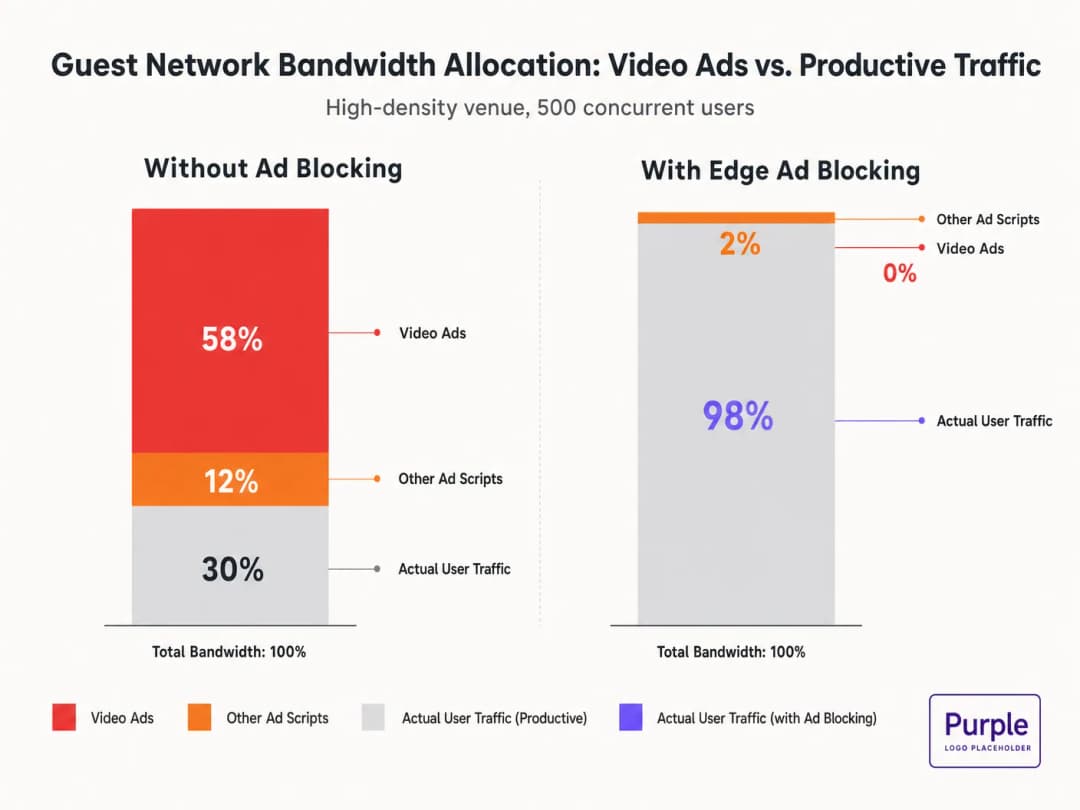
Quando os convidados se ligam à rede e navegam em ativos web padrão, os seus dispositivos iniciam dezenas de ligações em segundo plano para redes de distribuição de anúncios. Estes fluxos de vídeo com taxa de bits adaptável podem consumir até 50 - 70% do débito disponível, degradando a experiência de todos os utilizadores e saturando as ligações de backhaul. Este guia detalha o funcionamento técnico deste consumo de largura de banda e fornece um modelo neutro em termos de fornecedor para o mitigar na periferia (edge) utilizando filtragem de DNS. Ao implementar estas estratégias, os locais podem melhorar drasticamente o desempenho do guest WiFi sem esperar por ciclos de renovação de hardware, reduzindo os custos de infraestrutura e melhorando a conformidade.
Ouça o nosso briefing sobre este tema:
Análise Técnica Detalhada: A Física da Saturação de Rede Impulsionada por Anúncios
Anatomia de um Pedido Web
Quando um utilizador numa rede de convidados acede a um website suportado por publicidade, o comportamento do browser é altamente agressivo. O carregamento de uma única página desencadeia tipicamente ligações a 8-40 domínios distintos de terceiros, incluindo ad exchanges, demand-side platforms (DSPs) e content delivery networks (CDNs).
A Penalização de Banda Larga dos Anúncios de Vídeo
Os anúncios em vídeo, particularmente os formatos pre-roll e mid-roll servidos pelas principais exchanges, são entregues como streams de taxa de bits adaptável. A CDN testa a largura de banda disponível e serve o stream com a melhor qualidade possível. Num ambiente de alta densidade com 500 utilizadores concorrentes, se 20% dos utilizadores desencadearem um stream de anúncio a 1080p de 4-8 Mbps, a procura agregada dispara instantaneamente de 400-800 Mbps. Este tráfego indesejado contorna a modelação standard de Qualidade de Serviço (QoS) porque tem origem em ligações HTTPS legítimas.
Consumo de Tempo de Antena e Ineficiência Espetral
Para além da saturação do backhaul, os anúncios em vídeo consomem valioso tempo de antena de rádio. Num meio sem fios partilhado, cada dispositivo que recebe ativamente um stream de alta taxa de bits reduz as oportunidades de transmissão para outros dispositivos. Embora a norma IEEE 802.11ax (WiFi 6) tenha introduzido OFDMA e BSS Colouring para melhorar a eficiência espetral, estes mecanismos não conseguem compensar o volume bruto de dados exigido pelas redes de anúncios. A camada de rádio fica congestionada, aumentando a latência e a perda de pacotes para o tráfego produtivo.
Cascata de Latência de Resolução DNS
A entrega de anúncios depende de cadeias de redirecionamento complexas. Uma única impressão de anúncio pode exigir 6-12 consultas DNS antes mesmo de o stream de vídeo começar. Numa implementação densa, isto escala rapidamente a carga no resolvedor DNS local. Quando o resolvedor se torna um estrangulamento, a latência dispara, causando uma degradação percetível nos tempos de carregamento das páginas para cada utilizador na rede.
Tem dúvidas sobre a sua configuração específica?
A nossa equipa trabalha com operadores de espaços, gestores de TI e engenheiros de rede em 80.000 espaços. Agende uma chamada de 20 minutos e mostraremos como outros profissionais na sua área o resolveram.
Guia de Implementação: Arquitetura de Filtragem DNS na Periferia
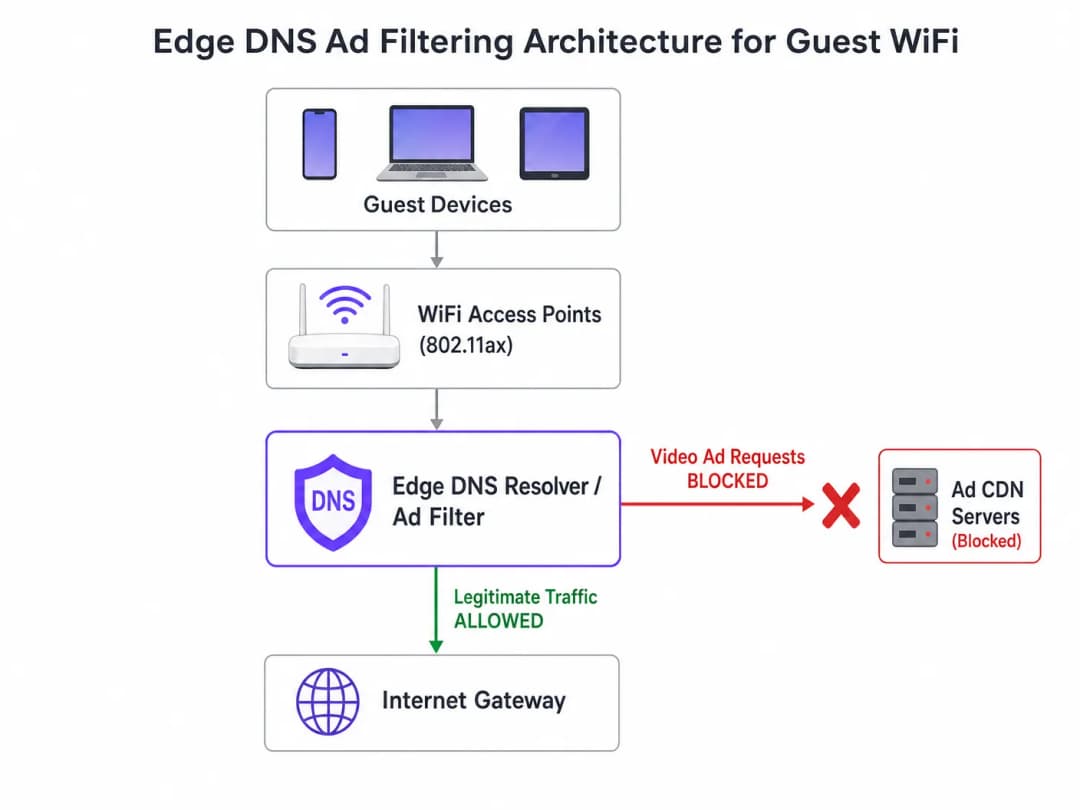
A intervenção arquitetural mais eficaz é a filtragem DNS na periferia. Ao bloquear os domínios das redes de anúncios ao nível do resolvedor, a rede impede que as ligações TCP cheguem a ser estabelecidas. Esta abordagem é stateless, escala linearmente e adiciona uma latência insignificante.
Estratégia de Implementação Passo a Passo
- Instrumentação Passiva: Implemente o registo passivo de DNS na rede de convidados durante 48-72 horas para estabelecer um perfil de tráfego de referência. Identifique os domínios mais consultados e o respetivo volume. Utilize plataformas como a de WiFi analytics para visualizar estes dados.
- Aplicação Conservadora de Lista de Bloqueio: Não implemente listas de bloqueio comunitárias massivas (ex. a lista de Steven Black) no primeiro dia. Comece com os 500 principais domínios conhecidos de fornecimento de anúncios em vídeo. Verifique se o fornecimento de conteúdos legítimos não é afetado.
- Configuração DNS Split-Horizon: Garanta uma separação rigorosa entre a infraestrutura de DNS corporativa e de convidados. A política de filtragem deve ser confinada exclusivamente à VLAN de convidados para evitar interrupções operacionais.
- Manutenção Automatizada de Listas de Bloqueio: As redes de anúncios rodam domínios dinamicamente e utilizam Algoritmos de Geração de Domínio (DGAs). Configure o resolvedor para obter feeds atualizados de inteligência de ameaças e listas de bloqueio, pelo menos, a cada 4 horas.
- Gestão de DNS over HTTPS (DoH): Os browsers modernos podem tentar contornar os resolvedores locais utilizando DoH. Mitigue esta situação bloqueando a saída da porta TCP/UDP 443 para gamas de IP de fornecedores de DoH conhecidos, forçando um fallback para o resolvedor fornecido pela rede.
Para aprofundar os detalhes de configuração, consulte o nosso guia sobre Como Melhorar a Velocidade do WiFi Bloqueando Redes de Anúncios no Edge.
Melhores Práticas e Conformidade
Privacidade desde a Conceção (Artigo 25.º do GDPR)
A implementação de filtragem de DNS no edge alinha-se com os princípios de privacidade desde a conceção do GDPR. Ao impedir ligações a domínios de monitorização de terceiros, a rede protege inerentemente os dados dos convidados contra a recolha não autorizada. Esta postura proativa reduz a carga de conformidade do espaço.
Segmentação de Rede (PCI-DSS)
Para espaços de retalho e hotelaria que processam pagamentos, o PCI-DSS exige uma segmentação de rede rigorosa. A filtragem de DNS reforça este limite, garantindo que os dispositivos dos convidados não possam servir inadvertidamente como vetores para payloads maliciosos distribuídos através de redes de anúncios comprometidas (malvertising).
Experiência de Utilizador Transparente
Ao contrário dos anúncios em Captive Portal ou da inspeção profunda de pacotes, a filtragem de DNS é transparente. O utilizador experimenta carregamentos de página mais rápidos e um menor consumo de bateria. Se um espaço publicitário não carregar, normalmente colapsa ou exibe um espaço vazio, o que raramente é percebido pelo utilizador como uma falha de rede.
Resolução de Problemas e Mitigação de Riscos
| Modo de Falha | Causa Raiz | Estratégia de Mitigação |
|---|---|---|
| Bloqueio Excessivo de Conteúdo Legítimo | Bloqueio ao nível da raiz de CDNs partilhadas (ex. Akamai, Fastly). | Aplique a filtragem ao nível do subdomínio. Mantenha uma lista de permissões robusta para serviços críticos do espaço. |
| Contorno de Filtragem via DoH | Browsers que utilizam resolvedores DoH codificados no sistema. | Aplique null-route a IPs de fornecedores de DoH conhecidos. Implemente políticas de split-tunnelling se utilizar Gestão de Dispositivos Móveis (MDM). |
| Exaustão de CPU do Resolvedor | Infraestrutura de DNS subdimensionada a processar respostas NXDOMAIN excessivas. | Aloque resolvedores com CPU/RAM adequados. Utilize o caching de forma agressiva. Considere resolvedores recursivos alojados na cloud para maior elasticidade. |
ROI e Impacto no Negócio
O impacto no negócio da filtragem de DNS no edge é imediato e mensurável:
- Recuperação de Largura de Banda: Os locais recuperam normalmente 30 - 50% da largura de banda da sua rede de convidados, adiando atualizações dispendiosas de backhaul.
- Melhoria da Satisfação dos Convidados: Carregamentos de página mais rápidos e uma conetividade fiável correlacionam-se diretamente com pontuações mais elevadas de Net Promoter Scores (NPS) e avaliações positivas do local.
- Eficiência Operacional: Menos pedidos de suporte relacionados com "WiFi lento" permitem que as equipas de TI se foquem em iniciativas estratégicas, tais como implementar o modo de mapas offline ou expandir integrações de smart cities, conforme defendido pela nossa liderança (consulte Purple nomeia Iain Fox como VP de Crescimento).
- Melhoria da Postura de Segurança: O bloqueio proativo de publicidade maliciosa (malvertising) e domínios de monitorização simplifica as auditorias de segurança e os relatórios de conformidade. Saiba mais no nosso artigo sobre como manter uma postura segura: Explique o que é uma pista de auditoria para segurança informática em 2026.
Definições Principais
Filtragem DNS de Ponta
A prática de bloquear o acesso a domínios específicos ao nível do resolvedor DNS local, impedindo que os dispositivos resolvam os endereços IP de redes de anúncios conhecidas.
Utilizado por equipas de TI para descartar silenciosamente o tráfego indesejado antes mesmo de se tentar uma ligação TCP, poupando largura de banda e melhorando o desempenho.
Adaptive Bitrate Streaming (ABR)
Uma tecnologia que ajusta dinamicamente a qualidade de uma transmissão de vídeo com base na largura de banda disponível do utilizador.
As redes de anúncios utilizam ABR para disponibilizar a maior qualidade de vídeo possível, o que consome agressivamente o desempenho disponível do WiFi de convidados.
Split-Horizon DNS
Uma configuração na qual são fornecidas respostas DNS diferentes dependendo do endereço IP de origem da consulta (por exemplo, convidados versus corporativo).
Essencial para aplicar políticas de filtragem restritivas a redes de convidados sem afetar as operações internas do escritório.
DNS over HTTPS (DoH)
Um protocolo para realizar a resolução remota de DNS através do protocolo HTTPS, encriptando as consultas.
O DoH pode contornar a filtragem de ponta local; os arquitetos de rede devem bloquear ativamente fornecedores conhecidos de DoH para impor as políticas locais de DNS.
BSS Colouring
Uma funcionalidade do Wi-Fi 6 (802.11ax) que adiciona um identificador de "cor" às transmissões, permitindo que os pontos de acesso ignorem o tráfego de redes sobrepostas.
Melhora a eficiência de rádio em recintos densos, mas não resolve a saturação do backhaul causada por anúncios de vídeo.
NXDOMAIN
Um código de resposta DNS que indica que o nome de domínio solicitado não existe.
A resposta padrão devolvida por um resolvedor de filtragem quando um dispositivo tenta consultar um domínio de rede de anúncios bloqueado.
Algoritmo de Geração de Domínio (DGA)
Técnicas utilizadas por malware e por algumas redes de anúncios agressivas para gerar periodicamente novos nomes de domínio de modo a contornar listas de bloqueio estáticas.
Exige que as equipas de TI utilizem fontes de dados de inteligência de ameaças dinâmicas e frequentemente atualizadas, em vez de ficheiros de anfitriões estáticos.
Malvertising
O uso de publicidade online para distribuir malware ou redirecionar utilizadores para websites maliciosos.
Bloquear redes de anúncios na periferia protege inerentemente os dispositivos dos visitantes contra estas ameaças, melhorando a postura de segurança do local.
Exemplos Práticos
Um hotel de 400 quartos está a registar uma degradação severa no WiFi de convidados todas as noites entre as 19:00 e as 22:00. O backhaul de 1 Gbps está saturado, mas o sistema de gestão de propriedade (PMS) mostra apenas 600 dispositivos ligados. Como deve o arquiteto de rede resolver isto sem atualizar o circuito?
- Implementar o registo passivo de DNS na VLAN de convidados para analisar o perfil de tráfego durante o período de pico. 2. Identificar os domínios que mais consomem largura de banda, que provavelmente serão CDNs de anúncios de vídeo. 3. Implementar um resolvedor DNS recursivo com uma lista de bloqueio selecionada direcionada a estas redes de anúncios específicas. 4. Configurar o âmbito DHCP de convidados para atribuir o novo resolvedor. 5. Monitorizar a utilização da largura de banda; prever uma redução de 30 a 40% na carga de pico.
O diretor de TI de um estádio quer implementar o bloqueio de anúncios por DNS, mas está preocupado em não comprometer a aplicação móvel própria do recinto, que utiliza um SDK de análise de terceiros.
- Auditar as dependências de rede da aplicação móvel utilizando uma ferramenta de proxy. 2. Identificar os endpoints de API específicos necessários para o funcionamento da aplicação. 3. Adicionar estes FQDNs (Fully Qualified Domain Names) específicos à lista de permissões do resolvedor DNS, sobrepondo-se a quaisquer políticas de lista de bloqueio. 4. Implementar a política de filtragem num subconjunto de pontos de acesso (por exemplo, um corredor de circulação) para testes beta antes de uma implementação em todo o recinto.
Perguntas de Prática
Q1. Uma cadeia de retalho pretende implementar filtragem DNS em 500 lojas. Atualmente, utilizam uma solução de firewall gerida na nuvem. Devem implementar resolvedores DNS locais em cada loja ou encaminhar todas as consultas DNS para um resolvedor na nuvem centralizado?
Dica: Considere o impacto da latência das consultas DNS nos tempos de carregamento das páginas.
Ver resposta modelo
Devem encaminhar as consultas para um resolvedor na nuvem centralizado com pontos de presença (PoPs) geograficamente distribuídos, desde que a latência para o PoP mais próximo seja inferior a 20ms. A implementação e manutenção de 500 resolvedores locais introduz uma sobrecarga operacional significativa. Os resolvedores na nuvem oferecem uma gestão de políticas centralizada e atualizações automatizadas de listas de bloqueio, o que é ideal para um ambiente de retalho distribuído.
Q2. Após a implementação de uma lista de bloqueio de DNS, a equipa de marketing reporta que a página splash do Captive Portal do local não está a carregar para alguns utilizadores. Qual é a causa mais provável?
Dica: Os portais cativos dependem frequentemente de recursos externos para rastreio ou autenticação.
Ver resposta modelo
A lista de bloqueio provavelmente bloqueou inadvertidamente um domínio de CDN ou de pixel de rastreio (por exemplo, Google Analytics ou uma API de login social) do qual o Captive Portal depende. O arquiteto deve analisar os registos de DNS para a gama de IPs do walled garden do Captive Portal, identificar a dependência bloqueada e adicioná-la à lista de permissões.
Q3. Um centro de conferências está a acolher uma cimeira de marketing digital. O diretor de TI está preocupado que o bloqueio de redes de anúncios possa perturbar a capacidade de trabalho dos participantes e a demonstração dos seus produtos. Como deve isto ser gerido?
Dica: As políticas de rede podem ser segmentadas por SSID ou VLAN.
Ver resposta modelo
O diretor de TI deve disponibilizar um SSID/VLAN dedicado para os participantes da cimeira com uma política de desvio que utilize resolvedores DNS não filtrados (por exemplo, 8.8.8.8). A rede WiFi de convidados padrão pode permanecer filtrada. Isto fornece o acesso necessário para o evento específico sem comprometer o desempenho da rede pública geral.
Continue a ler esta série
Como Procurar Interferências de WiFi e Encontrar o Melhor Canal
Este guia técnico detalhado fornece aos líderes de TI empresariais metodologias práticas para identificar interferências de RF e selecionar os canais de 5GHz ideais. Abrange análise de espetro, considerações sobre DFS e estratégias de implementação práticas para maximizar o rendimento e reduzir a latência sem necessidade de investir em novo hardware.
Como Melhorar a Velocidade do WiFi Sem Comprar Novos Pontos de Acesso
Este guia detalha como os espaços empresariais podem recuperar mais de 30% da sua largura de banda de WiFi sem adquirir novos pontos de acesso. Ao implementar filtragem de DNS, band steering e políticas de QoS, as equipas de TI podem prolongar a vida útil do hardware, reduzir o CapEx e melhorar o desempenho e a segurança da rede.
Reduzir a Latência em Redes WiFi de Alta Densidade
Este guia detalha como a eliminação de pesquisas de DNS desnecessárias para domínios de rastreamento reduz drasticamente a latência em redes WiFi de alta densidade. Oferece orientações práticas de arquitetura, implementação e ROI para líderes de TI que gerem ambientes de recintos congestionados.
Tem dúvidas sobre a sua configuração específica?
A nossa equipa trabalha com operadores de espaços, gestores de TI e engenheiros de rede em 80.000 espaços. Agende uma chamada de 20 minutos e mostraremos como outros profissionais na sua área o resolveram.